Putting CMC in practice in the EFL classroom: Students’ experiences and attitudes at employing a wiki for an advanced English Language courseConstantinos TsourisLanguage CentreUniversity of Cyprus
Study synopsisThis small-scale study explores the practices and experiences of university Ss on the application and effectiveness of CMC in the EFL classroom.  Ongoing study; to be triangulated/replicated in the next 6 months.
Study synopsis (cont.)Advanced, elective English language course (B2 level)Course Aim:  to promote critical thinking skillsAwiki was employed as a means of S-S and S-T interaction and as a means of continuous course assessment Ss’ views and experiences were gathered in a 2-week period in order to assess the use of technology for LL purposesWiki was only means of communication between Ss-T for those 2 weeks
The introduction of a wiki had a trifold purpose: to motivate learners to practice written, authentic expression; to promote their critical thinking skills based on a constructivist approach;to gather data for this study.
Only 20% of sample had previous contact with wikis so there was a need for the T to train them (account creation / wiki management)Following training, Ss seemed to be at ease with using this toolDuring use of tool, questions did arise regarding:tool functionality (e.g. whether they could upload a file from their pc)how to do things (e.g. how to link a website/upload a video)troubleshooting (e.g. wiki stopped responding / failure to save comments / overwriting of comments)
MethodFor this qualitative study, two methods of data collection are/will be used:(i) Wiki material;(ii) Semi-structured individual and group interviews with all Ss, to be conducted after the course is finished;
FeedbackFeedback revolved around Ss’ experiences in dealing with CMC for this language course and their views on its advantages and drawbacks.
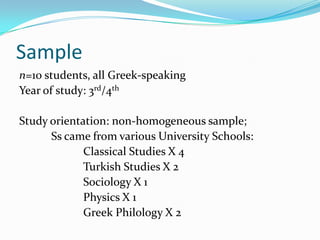
Samplen=10 students, all Greek-speakingYear of study: 3rd/4thStudy orientation: non-homogeneous sample; Sscame from various University Schools:	Classical Studies X 4	Turkish Studies X 2	Sociology X 1	Physics X 1	Greek Philology X 2
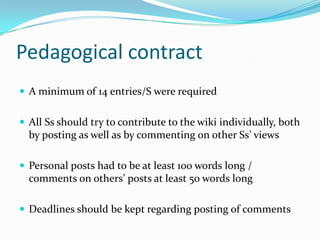
Pedagogical contractA minimum of 14 entries/S were requiredAll Ss should try to contribute to the wiki individually, both by posting as well as by commenting on other Ss’ views Personal posts had to be at least 100 words long / comments on others’ posts at least 50 words longDeadlines should be kept regarding posting of comments
Pre-taskAccount creation
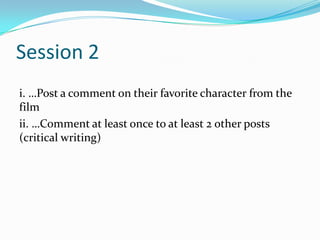
Experimentation with ghost wiki page (a how-t0 tutorial)Session 1i. Sshad to pick their favorite film ii. …Post a comment regarding their chosen filmiii. …Comment at least once on every other post (critical writing)
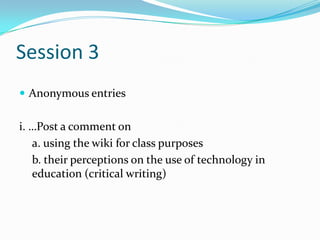
Session 2i. …Post a comment on their favorite character from the filmii.…Comment at least once to at least 2 other posts (critical writing)
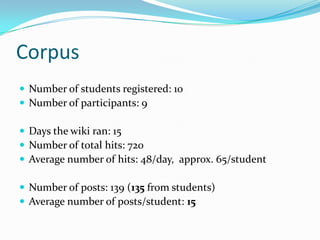
Session 3Anonymous entriesi. …Post a comment on a. using the wiki for class purposes b. their perceptions on the use of technology in education (critical writing)
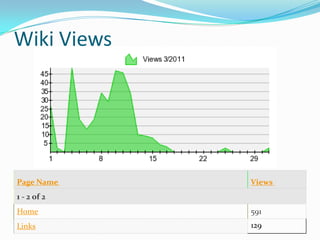
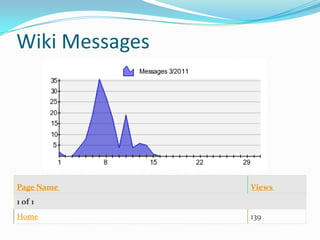
CorpusNumber of students registered: 10Number of participants: 9Days the wiki ran: 15Number of total hits: 720Average number of hits: 48/day,  approx. 65/studentNumber of posts: 139 (135 from students)Average number of posts/student: 15
Wiki Views
Wiki Messages
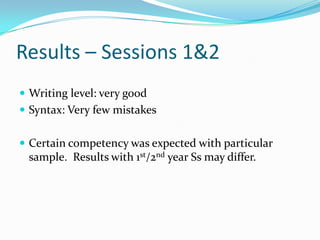
Results – Sessions 1&2Writing level: very goodSyntax: Very few mistakesCertain competency was expected with particular sample.  Results with 1st/2nd year Ss may differ.
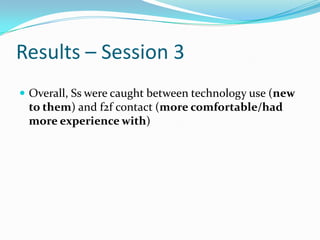
Results – Session 3Overall, Ss were caught between technology use (new to them) and f2f contact (more comfortable/had more experience with)
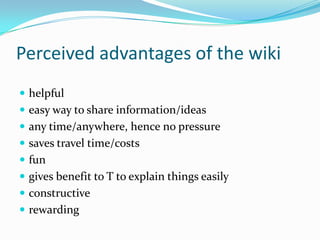
Perceived advantages of the wikihelpful easy way to share information/ideasany time/anywhere, hence no pressuresaves travel time/costsfun gives benefit to T to explain things easily constructiverewarding
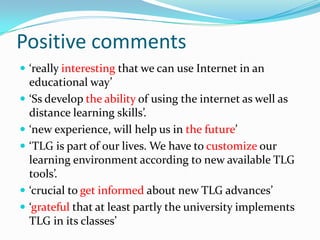
Positive comments‘really interesting that we can use Internet in an educational way’ ‘Ss develop the ability of using the internet as well as distance learning skills’. ‘new experience, will help us in the future’ ‘TLG is part of our lives. We have to customize our learning environment according to new available TLG tools’. ‘crucial to get informed about new TLG advances’‘grateful that at least partly the university implements TLG in its classes’
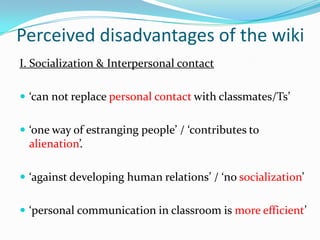
Perceived disadvantages of the wikiI. Socialization & Interpersonal contact‘can not replace personal contact with classmates/Ts’‘one way of estranging people’ / ‘contributes to alienation’. ‘against developing human relations’ / ‘no socialization’‘personal communication in classroom is more efficient’
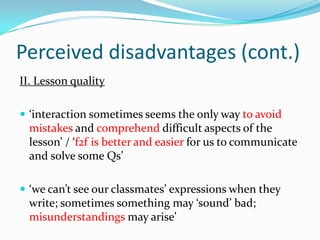
Perceived disadvantages (cont.)II. Lesson quality‘interaction sometimes seems the only way to avoid mistakes and comprehend difficult aspects of the lesson’ / ‘f2f is better and easier for us to communicate and solve some Qs’‘we can’t see our classmates’ expressions when they write; sometimes something may ‘sound’ bad; misunderstandings may arise’
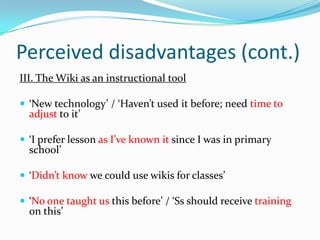
Perceived disadvantages (cont.)III. The Wiki as an instructional tool‘New technology’ / ‘Haven’t used it before; need time to adjust to it’‘I prefer lesson as I’ve known it since I was in primary school’‘Didn’t know we could use wikis for classes’ ‘No one taught us this before’ / ‘Ss should receive training on this’
Quality of studyQualitatively, the project was positively perceivedBeing a pedagogical activity, the wiki is not a ‘‘real-life’’ one.  However, interactions were meaningful because, based on level/quality of participation, they made sense for the learners who were fully engaged in the writing process/interactions (cf. Mompean, 2010)
ConclusionsSmall scale project, and learning context (FL course / writing tasks) was critical to outcomesHence, no great claims about generality of findings can be made.Study needs to be replicated using larger numbers of SsResults show internal consistencyKey points are not discipline-specific, thus I consider them valuable for the wider LL&T community.
ConclusionsConsensus that CMC can be put in great use in the FL classroom.  However, not everyone feels comfortable using it because: it is a relatively innovative developmentof a lack of traininga number of Ssare accustomed to more traditional learning methods
SuggestionsFurther training of both instructors and students in CMCGradual implementation of CMC in the EFL curriculum (blended approach) More user-friendly virtual environments to help novices
Follow-upOpen-ended interviews are scheduled after the course ends in May to triangulate findingsStudy to be replicated during Fall semester 2011 with larger samples of 1st/2nd year Ss in order to (a) try and replicate findings and, (b) see whether year of study has any bearing on perceptions
ReferencesCole, M. (2009) Using Wiki technology to support student engagement: 	Lessons from the trenches. Computers & Education, 52, 141–146.Kessler, G. (2008) Student-Initiated attention to form in wiki-based 	collaborative learning. ReCALL, 20(1), 35-54. Lund, A. (2008) Wikis: a collective approach to language production. 	ReCALL20(1), 35-54.Su, F. and Beaumont, C. (2010) Evaluating the use of a wiki for 	collaborative learning. Innovations in Education and Teaching 	International, 47(4), 417-431.Wheeler, S., Yeomans, P., and Wheeler, D. (2008) The good, the bad and 	the wiki: Evaluating student-generated content for collaborative 	learning. British J of Educational Technology, 39(6), 987-995.

CMC Teacher Education SIG Presentation; Tsouris

  • 1.
    Putting CMC inpractice in the EFL classroom: Students’ experiences and attitudes at employing a wiki for an advanced English Language courseConstantinos TsourisLanguage CentreUniversity of Cyprus
  • 2.
    Study synopsisThis small-scalestudy explores the practices and experiences of university Ss on the application and effectiveness of CMC in the EFL classroom. Ongoing study; to be triangulated/replicated in the next 6 months.
  • 3.
    Study synopsis (cont.)Advanced,elective English language course (B2 level)Course Aim: to promote critical thinking skillsAwiki was employed as a means of S-S and S-T interaction and as a means of continuous course assessment Ss’ views and experiences were gathered in a 2-week period in order to assess the use of technology for LL purposesWiki was only means of communication between Ss-T for those 2 weeks
  • 4.
    The introduction ofa wiki had a trifold purpose: to motivate learners to practice written, authentic expression; to promote their critical thinking skills based on a constructivist approach;to gather data for this study.
  • 5.
    Only 20% ofsample had previous contact with wikis so there was a need for the T to train them (account creation / wiki management)Following training, Ss seemed to be at ease with using this toolDuring use of tool, questions did arise regarding:tool functionality (e.g. whether they could upload a file from their pc)how to do things (e.g. how to link a website/upload a video)troubleshooting (e.g. wiki stopped responding / failure to save comments / overwriting of comments)
  • 6.
    MethodFor this qualitativestudy, two methods of data collection are/will be used:(i) Wiki material;(ii) Semi-structured individual and group interviews with all Ss, to be conducted after the course is finished;
  • 7.
    FeedbackFeedback revolved aroundSs’ experiences in dealing with CMC for this language course and their views on its advantages and drawbacks.
  • 8.
    Samplen=10 students, allGreek-speakingYear of study: 3rd/4thStudy orientation: non-homogeneous sample; Sscame from various University Schools: Classical Studies X 4 Turkish Studies X 2 Sociology X 1 Physics X 1 Greek Philology X 2
  • 9.
    Pedagogical contractA minimumof 14 entries/S were requiredAll Ss should try to contribute to the wiki individually, both by posting as well as by commenting on other Ss’ views Personal posts had to be at least 100 words long / comments on others’ posts at least 50 words longDeadlines should be kept regarding posting of comments
  • 10.
  • 11.
    Experimentation with ghostwiki page (a how-t0 tutorial)Session 1i. Sshad to pick their favorite film ii. …Post a comment regarding their chosen filmiii. …Comment at least once on every other post (critical writing)
  • 12.
    Session 2i. …Posta comment on their favorite character from the filmii.…Comment at least once to at least 2 other posts (critical writing)
  • 13.
    Session 3Anonymous entriesi.…Post a comment on a. using the wiki for class purposes b. their perceptions on the use of technology in education (critical writing)
  • 14.
    CorpusNumber of studentsregistered: 10Number of participants: 9Days the wiki ran: 15Number of total hits: 720Average number of hits: 48/day, approx. 65/studentNumber of posts: 139 (135 from students)Average number of posts/student: 15
  • 15.
  • 16.
  • 17.
    Results – Sessions1&2Writing level: very goodSyntax: Very few mistakesCertain competency was expected with particular sample. Results with 1st/2nd year Ss may differ.
  • 18.
    Results – Session3Overall, Ss were caught between technology use (new to them) and f2f contact (more comfortable/had more experience with)
  • 19.
    Perceived advantages ofthe wikihelpful easy way to share information/ideasany time/anywhere, hence no pressuresaves travel time/costsfun gives benefit to T to explain things easily constructiverewarding
  • 20.
    Positive comments‘really interestingthat we can use Internet in an educational way’ ‘Ss develop the ability of using the internet as well as distance learning skills’. ‘new experience, will help us in the future’ ‘TLG is part of our lives. We have to customize our learning environment according to new available TLG tools’. ‘crucial to get informed about new TLG advances’‘grateful that at least partly the university implements TLG in its classes’
  • 21.
    Perceived disadvantages ofthe wikiI. Socialization & Interpersonal contact‘can not replace personal contact with classmates/Ts’‘one way of estranging people’ / ‘contributes to alienation’. ‘against developing human relations’ / ‘no socialization’‘personal communication in classroom is more efficient’
  • 22.
    Perceived disadvantages (cont.)II.Lesson quality‘interaction sometimes seems the only way to avoid mistakes and comprehend difficult aspects of the lesson’ / ‘f2f is better and easier for us to communicate and solve some Qs’‘we can’t see our classmates’ expressions when they write; sometimes something may ‘sound’ bad; misunderstandings may arise’
  • 24.
    Perceived disadvantages (cont.)III.The Wiki as an instructional tool‘New technology’ / ‘Haven’t used it before; need time to adjust to it’‘I prefer lesson as I’ve known it since I was in primary school’‘Didn’t know we could use wikis for classes’ ‘No one taught us this before’ / ‘Ss should receive training on this’
  • 25.
    Quality of studyQualitatively,the project was positively perceivedBeing a pedagogical activity, the wiki is not a ‘‘real-life’’ one. However, interactions were meaningful because, based on level/quality of participation, they made sense for the learners who were fully engaged in the writing process/interactions (cf. Mompean, 2010)
  • 26.
    ConclusionsSmall scale project,and learning context (FL course / writing tasks) was critical to outcomesHence, no great claims about generality of findings can be made.Study needs to be replicated using larger numbers of SsResults show internal consistencyKey points are not discipline-specific, thus I consider them valuable for the wider LL&T community.
  • 27.
    ConclusionsConsensus that CMCcan be put in great use in the FL classroom. However, not everyone feels comfortable using it because: it is a relatively innovative developmentof a lack of traininga number of Ssare accustomed to more traditional learning methods
  • 28.
    SuggestionsFurther training ofboth instructors and students in CMCGradual implementation of CMC in the EFL curriculum (blended approach) More user-friendly virtual environments to help novices
  • 29.
    Follow-upOpen-ended interviews arescheduled after the course ends in May to triangulate findingsStudy to be replicated during Fall semester 2011 with larger samples of 1st/2nd year Ss in order to (a) try and replicate findings and, (b) see whether year of study has any bearing on perceptions
  • 30.
    ReferencesCole, M. (2009)Using Wiki technology to support student engagement: Lessons from the trenches. Computers & Education, 52, 141–146.Kessler, G. (2008) Student-Initiated attention to form in wiki-based collaborative learning. ReCALL, 20(1), 35-54. Lund, A. (2008) Wikis: a collective approach to language production. ReCALL20(1), 35-54.Su, F. and Beaumont, C. (2010) Evaluating the use of a wiki for collaborative learning. Innovations in Education and Teaching International, 47(4), 417-431.Wheeler, S., Yeomans, P., and Wheeler, D. (2008) The good, the bad and the wiki: Evaluating student-generated content for collaborative learning. British J of Educational Technology, 39(6), 987-995.