User Observation Design insights through watching Chris Bernard, User Experience Evangelist, Microsoft How can user observation help you be more insightful. What techniques can be used for this. This presentation covers methods used at the Institute of Design and with a class project that was done for Bose. February 2008
Topics for discussion Our session goals Design methods defined A design methods toolkit A sampling of methods A sample application: user research Discussion on level of effort, skills required Listing of resources and where to learn more User Observation | Design Methods 06/01/09
Our goals for today’s session Know what design methods are and why they are valuable Know where they can bring extra value and differentiation to what you do Know where to apply them Know where to go to learn more about methods and the active design, development and business community that supports them User Observation | Design Methods 06/01/09
Design methods defined The goal of design methods is to gain key insights or unique essential truths that can create more holistic solutions to improve products and services as well as create better experiences for users. Insight is derived from a process that is structured and linear but also flexible and iterative. User Observation | Design Methods 06/01/09 Source: Nate Burgos and Adam Kallish, WikiPedia
Design methods encompass a broad area that focuses on: Redefining the  specifications  of design  solutions  which can lead to  better  guidelines for traditional design activities (graphic, industrial, architectural, web, etc.);  User Observation | Design Methods 06/01/09 Source: Nate Burgos and Adam Kallish, WikiPedia
Design methods encompass a broad area that focuses on: Redefining the  specifications  of design  solutions  which can lead to  better  guidelines for traditional design activities (graphic, industrial, architectural, web, etc.);  (Incremental Innovations, Best Practices, Asset or Component-based Solutions) User Observation | Design Methods 06/01/09 Source: Nate Burgos and Adam Kallish, WikiPedia
Design methods encompass a broad area that focuses on: Redefining the  specifications  of design  solutions  which can lead to  better  guidelines for traditional design activities (graphic, industrial, architectural, web, etc.);  (Incremental Innovations, Best Practices, Asset or Component-based Solutions) Exploring  possibilities  and  constraints  by focusing  critical thinking skills  to  research  and  define  problem  spaces  for  existing  products or services—or the creation of  new  categories; User Observation | Design Methods 06/01/09 Source: Nate Burgos and Adam Kallish, WikiPedia
Design methods encompass a broad area that focuses on: Redefining the  specifications  of design  solutions  which can lead to  better  guidelines for traditional design activities (graphic, industrial, architectural, web, etc.);  (Incremental Innovations, Best Practices, Asset or Component-based Solutions) Exploring  possibilities  and  constraints  by focusing  critical thinking skills  to  research  and  define  problem  spaces  for  existing  products or services—or the creation of  new  categories; (Breakthrough Innovations) User Observation | Design Methods 06/01/09 Source: Nate Burgos and Adam Kallish, WikiPedia
Design methods encompass a broad area that focuses on: Redefining the  specifications  of design  solutions  which can lead to  better  guidelines for traditional design activities (graphic, industrial, architectural, web, etc.);  (Incremental Innovations, Best Practices, Asset or Component-based Solutions) Exploring  possibilities  and  constraints  by focusing  critical thinking skills  to  research  and  define  problem  spaces  for  existing  products or services—or the creation of  new  categories; (Breakthrough Innovations) Managing  the process of  exploring ,  defining ,  creating  artifacts continually over time User Observation | Design Methods 06/01/09 Source: Nate Burgos and Adam Kallish, WikiPedia
Design methods encompass a broad area that focuses on: Redefining the  specifications  of design  solutions  which can lead to  better  guidelines for traditional design activities (graphic, industrial, architectural, web, etc.);  (Incremental Innovations, Best Practices, Asset or Component-based Solutions) Exploring  possibilities  and  constraints  by focusing  critical thinking skills  to  research  and  define  problem  spaces  for  existing  products or services—or the creation of  new  categories; (Breakthrough Innovations) Managing  the process of  exploring ,  defining ,  creating  artifacts continually over time   Prototyping  scenarios and solutions that incrementally or significantly address the problem User Observation | Design Methods 06/01/09 Source: Nate Burgos and Adam Kallish, WikiPedia
Incremental innovation Builds on an existing product or model Creates incremental improvements that can differentiate User Observation | Design Methods 06/01/09
Breakthrough innovation Combine multiple factors (such as product design, branding and service) Can create new value propositions (time savings) User Observation | Design Methods 06/01/09
Disruptive innovations Are usually ‘platform’ based and are a ‘collection’ of innovations that may fall out of the typical ‘offering’ category User Observation | Design Methods 06/01/09 Source: Doblin Group
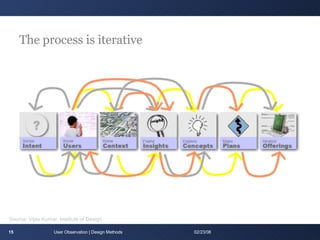
What is a ‘typical’ design method process? User Observation | Design Methods 06/01/09 Source: Vijay Kumar, Institute of Design
The process is iterative User Observation | Design Methods 06/01/09 Source: Vijay Kumar, Institute of Design
… And typically uses a toolkit-based approach User Observation | Design Methods 06/01/09 Source: Vijay Kumar, Institute of Design
A focus on knowing users User Observation | Design Methods 06/01/09 Source: Vijay Kumar, Institute of Design
How a toolkit is applied: Knowing users User Observation | Design Methods 06/01/09 Source: Vijay Kumar & Patrick Whitney, Institute of Design
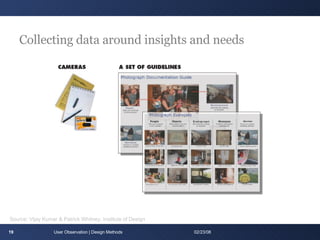
Collecting data around insights and needs User Observation | Design Methods 06/01/09 Source: Vijay Kumar & Patrick Whitney, Institute of Design
Collecting data around insights and needs User Observation | Design Methods 06/01/09 Source: Vijay Kumar & Patrick Whitney, Institute of Design Frameworks can be used to sort, massage and prioritize data
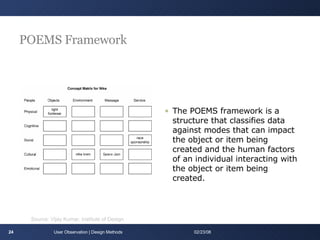
POEMS Framework The POEMS framework is a structure that classifies data against modes that can impact the object or item being created and the human factors of an individual interacting with the object or item being created. User Observation | Design Methods 06/01/09 Source: Vijay Kumar, Institute of Design
Insights and needs to  patterns User Observation | Design Methods 06/01/09 Source: Vijay Kumar & Patrick Whitney, Institute of Design
Patterns to  criteria User Observation | Design Methods 06/01/09 Source: Vijay Kumar & Patrick Whitney, Institute of Design
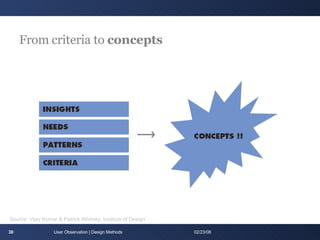
From criteria to  concepts User Observation | Design Methods 06/01/09 Source: Vijay Kumar & Patrick Whitney, Institute of Design
From criteria to  concepts  (Let’s not move too fast) User Observation | Design Methods 06/01/09 Source: Vijay Kumar & Patrick Whitney, Institute of Design
How can we make it relevant to what we do? User Observation | Design Methods 06/01/09 Project Vision User Profiles & Scenarios Feature Map Information Architecture Visual Design Graphic Production Design Style Guide Content Assessment Content Matrix Content Plan / Strategy Accessibility Review Usability Test Plan Usability Test Report User Support Materials Usability / Accessibility Content Visual Design Information Architecture
Design methods can be used to augment our traditional requirements definition in a more meaningful way and provide traceability and validation for design decisions that is more accurate than JRDs and stakeholder interviews User Observation | Design Methods 06/01/09 Project Vision User Profiles & Scenarios Feature Map Information Architecture Visual Design Graphic Production Design Style Guide Content Assessment Content Matrix Content Plan / Strategy Accessibility Review Usability Test Plan Usability Test Report User Support Materials Usability / Accessibility Content Visual Design Information Architecture
Design methods can also be used to figure out the  what  and not just the  how  of solving a problem User Observation | Design Methods 06/01/09 Case Study for Bose: Enhancing the buying experience for  the Personal Amplification System Source: Chris Bernard, Institute of Design
Project topics Understanding of the product Traditional amplification  Bose Personal Amplification (PAS) Understanding the customer Plans, methods, and analysis Findings Synthesis Recommendations User Observation | Design Methods 06/01/09 Source: Chris Bernard, Institute of Design
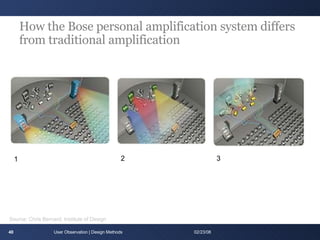
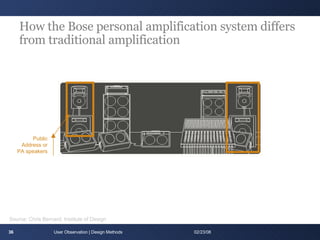
How the Bose personal amplification system differs from traditional amplification User Observation | Design Methods 06/01/09 Public Address or PA speakers Source: Chris Bernard, Institute of Design
How the Bose personal amplification system differs from traditional amplification User Observation | Design Methods 06/01/09 Instrument Amplifiers Source: Chris Bernard, Institute of Design
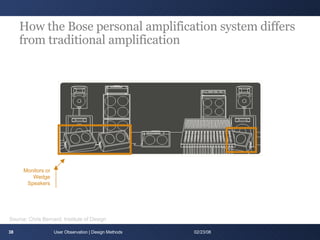
How the Bose personal amplification system differs from traditional amplification User Observation | Design Methods 06/01/09 Monitors or Wedge Speakers Source: Chris Bernard, Institute of Design
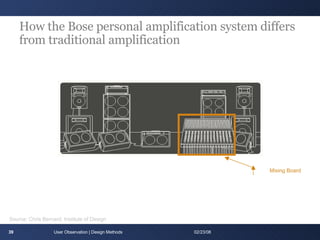
How the Bose personal amplification system differs from traditional amplification User Observation | Design Methods 06/01/09 Mixing Board Source: Chris Bernard, Institute of Design
How the Bose personal amplification system differs from traditional amplification User Observation | Design Methods 06/01/09 Source: Chris Bernard, Institute of Design 1 2 3
Protocol: Plan User Observation | Design Methods 06/01/09 Information about the consumer electronics industry and “music-based” products. BOSE Bose background information PAS Musicians’ experience with BOSE and PAS; strengths and weaknesses of PAS; purchasing What do we know about musicians? Apple store; B&O store; ABT store; Bose experience; purchasing experience; set-up experience; performing experience; experience with other musical products What is important to musicians? How can we better sell the Personal Amplification System to musicians? Phase 1  - Secondary Research Phase 2  - Primary Research Secondary Research Phase 3  - Analysis Phase 4  - Synthesis Recommendations Source: Chris Bernard, Institute of Design
Protocol: Methods & analytics Ethnographic methods Survey: 14 respondents Interview:  3 musicians Videotape Digital Camera: 4 stores  Apple, B&O, ABT, Guitar Center) 1 household 1 concert Field Notes Participatory methods Shadowing methods User Observation | Design Methods 06/01/09 Source: Chris Bernard, Institute of Design
Protocol: The Journey User Observation | Design Methods 06/01/09 Areas of focus Source: Chris Bernard, Institute of Design
Themes ‘ The collector’ ‘ Worship your hero’ ‘ This isn’t art, it’s my job’ ‘ Extreme hobbyist’ AEIOU Defined Activities Environments Interactions Objects  Users   User Observation | Design Methods 06/01/09 Source: Chris Bernard, Institute of Design ELITO Defined Metaphor Observation Judgment Value Concept
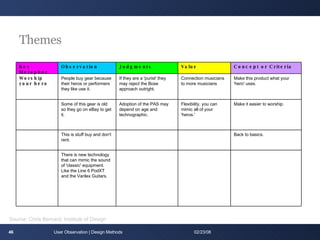
Themes User Observation | Design Methods 06/01/09 Source: Chris Bernard, Institute of Design Key Metaphor Observation Judgments Value Concept or Criteria Worship your hero People buy gear because their heros or performers they like use it. If they are a 'purist' they may reject the Bose approach outright. Connection musicians to more musicians Make this product what your 'hero' uses.   Some of this gear is old so they go on eBay to get it. Adoption of the PAS may depend on age and technographic. Flexibility, you can mimic all of your 'heros.' Make it easier to worship.   This is stuff buy and don't rent.     Back to basics.   There is new technology that can mimic the sound of 'classic' equipment. Like the Line 6 PodXT and the Varilex Guitars.      
Themes User Observation | Design Methods 06/01/09 Source: Chris Bernard, Institute of Design Key Metaphor Observation Judgments Value Concept or Criteria This isn't art, it's my job (Cynical professional or Institutional User) People play in churches Some people want it cheap. Money matters. Simplicity on the equipment site/easy setup Develop your audience   People play in schools Comes apart without tools Portable     The PAS would be considerably easier for a new beginner.   Connect audience to musicians     Difference practice and performance environment.   Flexibility     People play Gospel      
Themes User Observation | Design Methods 06/01/09 Source: Chris Bernard, Institute of Design Key Metaphor Observation Judgments Value Concept or Criteria This isn't art, it's my job  Some people play multiple venues Comes apart without any tools Sound quality, clarity Music sponsorship   Some people play multiple music genres The artists are not in control of the traditional set up Simplicity on the equipment side/easy set-up Jam session in retail environment   The PAS would be considerable easier to set up for a show for a beginner And big starts won't use it. Portable Focus general business musicians   Musicians and audience hear two different sounds. One system for electric and acoustic guitars. Connecting musicians     Doesn't take up a lot of space.   Connecting audience to musicians     You can play it quiet.   Connecting musicians and audience     New tech that mimic classic sound.   Audiovisual consistency/Eys and ears and harmony         Existing equipment can be too loud, vicious cycle.  
Themes User Observation | Design Methods 06/01/09 Source: Chris Bernard, Institute of Design Key Metaphor Observation Judgments Value Concept or Criteria Extreme hobbyist People play multiple music genres Some people are more about the technology than the music Connecting musicians Endorsement by the "Heros."   New technology Some people want it cheap -money matter. Flexibility Underlying tactic/Work of mouth   Sometimes you want to mess with your gear, sometimes you want to Play! One system for electronic and acoustic guitars Simplicity on the equipment side/easy set-up Jam session in specific retail environment.   Most people own as opposed to renting Comes apart without any tools       People purchase equipment on ebay and guitar center.         You can play it quiet         New technology that can mimic classic sound         Musicians like to play around with equipment in the purchase environment      
Who decides how the sound is? Musicians or… Venues (i.e ‘techs’ or sound engineers) User Observation | Design Methods 06/01/09 Source: Chris Bernard, Institute of Design
Who decides how the sound is? Is is likely that venues that targeted musicians play in will adopt this system? User Observation | Design Methods 06/01/09 Source: Chris Bernard, Institute of Design
What is important to musicians? Endorsement by heroes Culture of having stuff User Observation | Design Methods 06/01/09 Source: Chris Bernard, Institute of Design
What is important to musicians? Trust word-of-mouth Proprietary sound User Observation | Design Methods 06/01/09 Source: Chris Bernard, Institute of Design
Current retail channel Problems: Current retail store is not helping consumers learn about the system People don't know the difference between Bose’s personal amplification system and other amplifiers User Observation | Design Methods 06/01/09 Source: Chris Bernard, Institute of Design
Where is the Bose amplifier? User Observation | Design Methods 06/01/09 Source: Chris Bernard, Institute of Design
Recommendations Sell to the existing market by: Setting up demo areas Setting up and subsidizing practice environments Selling products on ebay User Observation | Design Methods 06/01/09 Source: Chris Bernard, Institute of Design
Set up demo areas Use already established distribution channel   (Guitar Center) Educate consumers Improved display area to showcase and explain the Bose personal amp system Knowledgeable sales staff Try Bose system Demo areas to compare both systems Allow musicians to practice with equipment User Observation | Design Methods 06/01/09 Source: Chris Bernard, Institute of Design
Subsidize a practice environment “ It’s expensive to rent practice rooms, so we rent a practice room with a few other bands to split the cost and create a schedule for our practice times.”   User Observation | Design Methods 06/01/09 “ If one of the bands has equipment they are willing to share with the rest of the bands, they leave it in the practice room. In exchange for letting us use their equipment, they pay a smaller portion of the rent.” Jenny Choi & Phillip Stone of Sanawan Source: Chris Bernard, Institute of Design
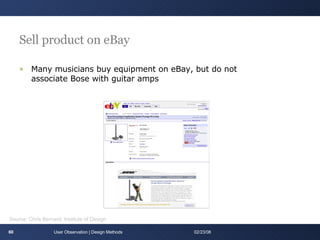
Sell product on eBay Many musicians buy equipment on eBay, but do not associate Bose with guitar amps User Observation | Design Methods 06/01/09 Source: Chris Bernard, Institute of Design
Redefine your market The current Bose marketing strategy for the PAS is too Rock-focused.  The culture of the Rock musician doesn’t directly relate to the nature of the Bose PAS.  The guy in this picture is NOT the guy that would buy a PAS Source: Chris Bernard, Institute of Design
Redefine your market The image of rock music is exhibited in the large speakers, large spools of wire, large sound boards—the large image of rock in general seems to have become fundamental to the artist.  The PAS is solving the fundamental problems of unnecessarily large amounts of equipment. In doing so, it immediately pushes itself out of the marketing range of a mainstream Rock market. Source: Chris Bernard, Institute of Design
Suggestions for how to redefine the target market: Major venue placement  Major entertainment programming with musical acts Musical festivals  (with a focus on different genres) Source: Chris Bernard, Institute of Design
Summary
Design methods summary Design methods aren’t a replacement for your existing processes, they are a set of techniques and methods for improving the quality of the data and insights that go into existing artifacts we create everyday and drive the creation of business strategy, requirements, vision, user profiles, user scenarios and information design. User Observation | Design Methods 06/01/09
Design methods summary Design methods aren’t a replacement for our existing processes, they are a set of techniques and methods for improving the quality of the data and insights that go into existing artifacts we create everyday and drive the creation of business strategy, requirements, vision, user profiles, user scenarios and information design. Design methods aren’t just for web sites or application development, they can be used to shape and define business problems and the space in which solutions can reside User Observation | Design Methods 06/01/09
Design methods summary Design methods aren’t a replacement for our existing processes, they are a set of techniques and methods for improving the quality of the data and insights that go into existing artifacts we create everyday and drive the creation of business strategy, requirements, vision, user profiles, user scenarios and information design. Design methods aren’t just for web sites or application development, they can be used to shape and define business problems and the space in which solutions can reside Design methods (when more fully developed into our practice) can enable our user experience team to work on a larger variety of projects and provide a new dimension of customer value through their ability to generate tangible and insightful solutions User Observation | Design Methods 06/01/09
So, how much does it cost? Design methods are a collection of techniques that can be added to any project Small, modest efforts for focused problems (i.e. how to improve a registration process) can be completed with 1 to 2 FTEs in 2 to 3 week in 4 to 6 days Moderate efforts (i.e. how to improve an online shopping cart) require 2 to 3 FTEs and can be completed in 4 to 6 weeks Transformational efforts that look at an entire enterprise (i.e. what business should we be in) can take 6 to 8 FTEs and require up to six months to complete User Observation | Design Methods 06/01/09
What’s the skill set? Individuals that have the following skills can usually pick up design methods quickly Interaction designers Information designers User researchers (ethnographers and anthropologists) Analysts User experience leaders User interaction designers and developers User Observation | Design Methods 06/01/09
Resources Web Design methods in detail , Wikipedia Design Consulting Services , IBM Design at SAP , Hasso Plattner (Keynote) Institute of Design Institute of Design Strategy Conference The D-School at Stanford BusinessWeek Innovation Design Channel Elito Framework POEMS Framework AEIOU Framework  (Framework discussion around ethnography) Related Books Designing for Interaction , Dan Saffer Designing Interaction , Bill Moggridge Tools IDEO , Method Cards … or my blog,  www.designthinkingdigest.com/   User Observation | Design Methods 06/01/09

User Observation

  • 1.
    User Observation Designinsights through watching Chris Bernard, User Experience Evangelist, Microsoft How can user observation help you be more insightful. What techniques can be used for this. This presentation covers methods used at the Institute of Design and with a class project that was done for Bose. February 2008
  • 2.
    Topics for discussionOur session goals Design methods defined A design methods toolkit A sampling of methods A sample application: user research Discussion on level of effort, skills required Listing of resources and where to learn more User Observation | Design Methods 06/01/09
  • 3.
    Our goals fortoday’s session Know what design methods are and why they are valuable Know where they can bring extra value and differentiation to what you do Know where to apply them Know where to go to learn more about methods and the active design, development and business community that supports them User Observation | Design Methods 06/01/09
  • 4.
    Design methods definedThe goal of design methods is to gain key insights or unique essential truths that can create more holistic solutions to improve products and services as well as create better experiences for users. Insight is derived from a process that is structured and linear but also flexible and iterative. User Observation | Design Methods 06/01/09 Source: Nate Burgos and Adam Kallish, WikiPedia
  • 5.
    Design methods encompassa broad area that focuses on: Redefining the specifications of design solutions which can lead to better guidelines for traditional design activities (graphic, industrial, architectural, web, etc.); User Observation | Design Methods 06/01/09 Source: Nate Burgos and Adam Kallish, WikiPedia
  • 6.
    Design methods encompassa broad area that focuses on: Redefining the specifications of design solutions which can lead to better guidelines for traditional design activities (graphic, industrial, architectural, web, etc.); (Incremental Innovations, Best Practices, Asset or Component-based Solutions) User Observation | Design Methods 06/01/09 Source: Nate Burgos and Adam Kallish, WikiPedia
  • 7.
    Design methods encompassa broad area that focuses on: Redefining the specifications of design solutions which can lead to better guidelines for traditional design activities (graphic, industrial, architectural, web, etc.); (Incremental Innovations, Best Practices, Asset or Component-based Solutions) Exploring possibilities and constraints by focusing critical thinking skills to research and define problem spaces for existing products or services—or the creation of new categories; User Observation | Design Methods 06/01/09 Source: Nate Burgos and Adam Kallish, WikiPedia
  • 8.
    Design methods encompassa broad area that focuses on: Redefining the specifications of design solutions which can lead to better guidelines for traditional design activities (graphic, industrial, architectural, web, etc.); (Incremental Innovations, Best Practices, Asset or Component-based Solutions) Exploring possibilities and constraints by focusing critical thinking skills to research and define problem spaces for existing products or services—or the creation of new categories; (Breakthrough Innovations) User Observation | Design Methods 06/01/09 Source: Nate Burgos and Adam Kallish, WikiPedia
  • 9.
    Design methods encompassa broad area that focuses on: Redefining the specifications of design solutions which can lead to better guidelines for traditional design activities (graphic, industrial, architectural, web, etc.); (Incremental Innovations, Best Practices, Asset or Component-based Solutions) Exploring possibilities and constraints by focusing critical thinking skills to research and define problem spaces for existing products or services—or the creation of new categories; (Breakthrough Innovations) Managing the process of exploring , defining , creating artifacts continually over time User Observation | Design Methods 06/01/09 Source: Nate Burgos and Adam Kallish, WikiPedia
  • 10.
    Design methods encompassa broad area that focuses on: Redefining the specifications of design solutions which can lead to better guidelines for traditional design activities (graphic, industrial, architectural, web, etc.); (Incremental Innovations, Best Practices, Asset or Component-based Solutions) Exploring possibilities and constraints by focusing critical thinking skills to research and define problem spaces for existing products or services—or the creation of new categories; (Breakthrough Innovations) Managing the process of exploring , defining , creating artifacts continually over time Prototyping scenarios and solutions that incrementally or significantly address the problem User Observation | Design Methods 06/01/09 Source: Nate Burgos and Adam Kallish, WikiPedia
  • 11.
    Incremental innovation Buildson an existing product or model Creates incremental improvements that can differentiate User Observation | Design Methods 06/01/09
  • 12.
    Breakthrough innovation Combinemultiple factors (such as product design, branding and service) Can create new value propositions (time savings) User Observation | Design Methods 06/01/09
  • 13.
    Disruptive innovations Areusually ‘platform’ based and are a ‘collection’ of innovations that may fall out of the typical ‘offering’ category User Observation | Design Methods 06/01/09 Source: Doblin Group
  • 14.
    What is a‘typical’ design method process? User Observation | Design Methods 06/01/09 Source: Vijay Kumar, Institute of Design
  • 15.
    The process isiterative User Observation | Design Methods 06/01/09 Source: Vijay Kumar, Institute of Design
  • 16.
    … And typicallyuses a toolkit-based approach User Observation | Design Methods 06/01/09 Source: Vijay Kumar, Institute of Design
  • 17.
    A focus onknowing users User Observation | Design Methods 06/01/09 Source: Vijay Kumar, Institute of Design
  • 18.
    How a toolkitis applied: Knowing users User Observation | Design Methods 06/01/09 Source: Vijay Kumar & Patrick Whitney, Institute of Design
  • 19.
    Collecting data aroundinsights and needs User Observation | Design Methods 06/01/09 Source: Vijay Kumar & Patrick Whitney, Institute of Design
  • 20.
    Collecting data aroundinsights and needs User Observation | Design Methods 06/01/09 Source: Vijay Kumar & Patrick Whitney, Institute of Design
  • 21.
    Collecting data aroundinsights and needs User Observation | Design Methods 06/01/09 Source: Vijay Kumar & Patrick Whitney, Institute of Design
  • 22.
    Collecting data aroundinsights and needs User Observation | Design Methods 06/01/09 Source: Vijay Kumar & Patrick Whitney, Institute of Design Frameworks can be used to sort, massage and prioritize data
  • 23.
    POEMS Framework ThePOEMS framework is a structure that classifies data against modes that can impact the object or item being created and the human factors of an individual interacting with the object or item being created. User Observation | Design Methods 06/01/09 Source: Vijay Kumar, Institute of Design
  • 24.
    POEMS Framework ThePOEMS framework is a structure that classifies data against modes that can impact the object or item being created and the human factors of an individual interacting with the object or item being created. User Observation | Design Methods 06/01/09 Source: Vijay Kumar, Institute of Design
  • 25.
    Insights and needsto patterns User Observation | Design Methods 06/01/09 Source: Vijay Kumar & Patrick Whitney, Institute of Design
  • 26.
    Insights and needsto patterns User Observation | Design Methods 06/01/09 Source: Vijay Kumar & Patrick Whitney, Institute of Design
  • 27.
    Insights and needsto patterns User Observation | Design Methods 06/01/09 Source: Vijay Kumar & Patrick Whitney, Institute of Design
  • 28.
    Insights and needsto patterns User Observation | Design Methods 06/01/09 Source: Vijay Kumar & Patrick Whitney, Institute of Design
  • 29.
    Patterns to criteria User Observation | Design Methods 06/01/09 Source: Vijay Kumar & Patrick Whitney, Institute of Design
  • 30.
    From criteria to concepts User Observation | Design Methods 06/01/09 Source: Vijay Kumar & Patrick Whitney, Institute of Design
  • 31.
    From criteria to concepts (Let’s not move too fast) User Observation | Design Methods 06/01/09 Source: Vijay Kumar & Patrick Whitney, Institute of Design
  • 32.
    How can wemake it relevant to what we do? User Observation | Design Methods 06/01/09 Project Vision User Profiles & Scenarios Feature Map Information Architecture Visual Design Graphic Production Design Style Guide Content Assessment Content Matrix Content Plan / Strategy Accessibility Review Usability Test Plan Usability Test Report User Support Materials Usability / Accessibility Content Visual Design Information Architecture
  • 33.
    Design methods canbe used to augment our traditional requirements definition in a more meaningful way and provide traceability and validation for design decisions that is more accurate than JRDs and stakeholder interviews User Observation | Design Methods 06/01/09 Project Vision User Profiles & Scenarios Feature Map Information Architecture Visual Design Graphic Production Design Style Guide Content Assessment Content Matrix Content Plan / Strategy Accessibility Review Usability Test Plan Usability Test Report User Support Materials Usability / Accessibility Content Visual Design Information Architecture
  • 34.
    Design methods canalso be used to figure out the what and not just the how of solving a problem User Observation | Design Methods 06/01/09 Case Study for Bose: Enhancing the buying experience for the Personal Amplification System Source: Chris Bernard, Institute of Design
  • 35.
    Project topics Understandingof the product Traditional amplification Bose Personal Amplification (PAS) Understanding the customer Plans, methods, and analysis Findings Synthesis Recommendations User Observation | Design Methods 06/01/09 Source: Chris Bernard, Institute of Design
  • 36.
    How the Bosepersonal amplification system differs from traditional amplification User Observation | Design Methods 06/01/09 Public Address or PA speakers Source: Chris Bernard, Institute of Design
  • 37.
    How the Bosepersonal amplification system differs from traditional amplification User Observation | Design Methods 06/01/09 Instrument Amplifiers Source: Chris Bernard, Institute of Design
  • 38.
    How the Bosepersonal amplification system differs from traditional amplification User Observation | Design Methods 06/01/09 Monitors or Wedge Speakers Source: Chris Bernard, Institute of Design
  • 39.
    How the Bosepersonal amplification system differs from traditional amplification User Observation | Design Methods 06/01/09 Mixing Board Source: Chris Bernard, Institute of Design
  • 40.
    How the Bosepersonal amplification system differs from traditional amplification User Observation | Design Methods 06/01/09 Source: Chris Bernard, Institute of Design 1 2 3
  • 41.
    How the Bosepersonal amplification system differs from traditional amplification User Observation | Design Methods 06/01/09 Source: Chris Bernard, Institute of Design 1 2 3
  • 42.
    Protocol: Plan UserObservation | Design Methods 06/01/09 Information about the consumer electronics industry and “music-based” products. BOSE Bose background information PAS Musicians’ experience with BOSE and PAS; strengths and weaknesses of PAS; purchasing What do we know about musicians? Apple store; B&O store; ABT store; Bose experience; purchasing experience; set-up experience; performing experience; experience with other musical products What is important to musicians? How can we better sell the Personal Amplification System to musicians? Phase 1 - Secondary Research Phase 2 - Primary Research Secondary Research Phase 3 - Analysis Phase 4 - Synthesis Recommendations Source: Chris Bernard, Institute of Design
  • 43.
    Protocol: Methods &analytics Ethnographic methods Survey: 14 respondents Interview: 3 musicians Videotape Digital Camera: 4 stores Apple, B&O, ABT, Guitar Center) 1 household 1 concert Field Notes Participatory methods Shadowing methods User Observation | Design Methods 06/01/09 Source: Chris Bernard, Institute of Design
  • 44.
    Protocol: The JourneyUser Observation | Design Methods 06/01/09 Areas of focus Source: Chris Bernard, Institute of Design
  • 45.
    Themes ‘ Thecollector’ ‘ Worship your hero’ ‘ This isn’t art, it’s my job’ ‘ Extreme hobbyist’ AEIOU Defined Activities Environments Interactions Objects Users User Observation | Design Methods 06/01/09 Source: Chris Bernard, Institute of Design ELITO Defined Metaphor Observation Judgment Value Concept
  • 46.
    Themes User Observation| Design Methods 06/01/09 Source: Chris Bernard, Institute of Design Key Metaphor Observation Judgments Value Concept or Criteria Worship your hero People buy gear because their heros or performers they like use it. If they are a 'purist' they may reject the Bose approach outright. Connection musicians to more musicians Make this product what your 'hero' uses.   Some of this gear is old so they go on eBay to get it. Adoption of the PAS may depend on age and technographic. Flexibility, you can mimic all of your 'heros.' Make it easier to worship.   This is stuff buy and don't rent.     Back to basics.   There is new technology that can mimic the sound of 'classic' equipment. Like the Line 6 PodXT and the Varilex Guitars.      
  • 47.
    Themes User Observation| Design Methods 06/01/09 Source: Chris Bernard, Institute of Design Key Metaphor Observation Judgments Value Concept or Criteria This isn't art, it's my job (Cynical professional or Institutional User) People play in churches Some people want it cheap. Money matters. Simplicity on the equipment site/easy setup Develop your audience   People play in schools Comes apart without tools Portable     The PAS would be considerably easier for a new beginner.   Connect audience to musicians     Difference practice and performance environment.   Flexibility     People play Gospel      
  • 48.
    Themes User Observation| Design Methods 06/01/09 Source: Chris Bernard, Institute of Design Key Metaphor Observation Judgments Value Concept or Criteria This isn't art, it's my job Some people play multiple venues Comes apart without any tools Sound quality, clarity Music sponsorship   Some people play multiple music genres The artists are not in control of the traditional set up Simplicity on the equipment side/easy set-up Jam session in retail environment   The PAS would be considerable easier to set up for a show for a beginner And big starts won't use it. Portable Focus general business musicians   Musicians and audience hear two different sounds. One system for electric and acoustic guitars. Connecting musicians     Doesn't take up a lot of space.   Connecting audience to musicians     You can play it quiet.   Connecting musicians and audience     New tech that mimic classic sound.   Audiovisual consistency/Eys and ears and harmony         Existing equipment can be too loud, vicious cycle.  
  • 49.
    Themes User Observation| Design Methods 06/01/09 Source: Chris Bernard, Institute of Design Key Metaphor Observation Judgments Value Concept or Criteria Extreme hobbyist People play multiple music genres Some people are more about the technology than the music Connecting musicians Endorsement by the "Heros."   New technology Some people want it cheap -money matter. Flexibility Underlying tactic/Work of mouth   Sometimes you want to mess with your gear, sometimes you want to Play! One system for electronic and acoustic guitars Simplicity on the equipment side/easy set-up Jam session in specific retail environment.   Most people own as opposed to renting Comes apart without any tools       People purchase equipment on ebay and guitar center.         You can play it quiet         New technology that can mimic classic sound         Musicians like to play around with equipment in the purchase environment      
  • 50.
    Who decides howthe sound is? Musicians or… Venues (i.e ‘techs’ or sound engineers) User Observation | Design Methods 06/01/09 Source: Chris Bernard, Institute of Design
  • 51.
    Who decides howthe sound is? Is is likely that venues that targeted musicians play in will adopt this system? User Observation | Design Methods 06/01/09 Source: Chris Bernard, Institute of Design
  • 52.
    What is importantto musicians? Endorsement by heroes Culture of having stuff User Observation | Design Methods 06/01/09 Source: Chris Bernard, Institute of Design
  • 53.
    What is importantto musicians? Trust word-of-mouth Proprietary sound User Observation | Design Methods 06/01/09 Source: Chris Bernard, Institute of Design
  • 54.
    Current retail channelProblems: Current retail store is not helping consumers learn about the system People don't know the difference between Bose’s personal amplification system and other amplifiers User Observation | Design Methods 06/01/09 Source: Chris Bernard, Institute of Design
  • 55.
    Where is theBose amplifier? User Observation | Design Methods 06/01/09 Source: Chris Bernard, Institute of Design
  • 56.
    Where is theBose amplifier? User Observation | Design Methods 06/01/09 Source: Chris Bernard, Institute of Design
  • 57.
    Recommendations Sell tothe existing market by: Setting up demo areas Setting up and subsidizing practice environments Selling products on ebay User Observation | Design Methods 06/01/09 Source: Chris Bernard, Institute of Design
  • 58.
    Set up demoareas Use already established distribution channel (Guitar Center) Educate consumers Improved display area to showcase and explain the Bose personal amp system Knowledgeable sales staff Try Bose system Demo areas to compare both systems Allow musicians to practice with equipment User Observation | Design Methods 06/01/09 Source: Chris Bernard, Institute of Design
  • 59.
    Subsidize a practiceenvironment “ It’s expensive to rent practice rooms, so we rent a practice room with a few other bands to split the cost and create a schedule for our practice times.” User Observation | Design Methods 06/01/09 “ If one of the bands has equipment they are willing to share with the rest of the bands, they leave it in the practice room. In exchange for letting us use their equipment, they pay a smaller portion of the rent.” Jenny Choi & Phillip Stone of Sanawan Source: Chris Bernard, Institute of Design
  • 60.
    Sell product oneBay Many musicians buy equipment on eBay, but do not associate Bose with guitar amps User Observation | Design Methods 06/01/09 Source: Chris Bernard, Institute of Design
  • 61.
    Redefine your marketThe current Bose marketing strategy for the PAS is too Rock-focused. The culture of the Rock musician doesn’t directly relate to the nature of the Bose PAS. The guy in this picture is NOT the guy that would buy a PAS Source: Chris Bernard, Institute of Design
  • 62.
    Redefine your marketThe image of rock music is exhibited in the large speakers, large spools of wire, large sound boards—the large image of rock in general seems to have become fundamental to the artist. The PAS is solving the fundamental problems of unnecessarily large amounts of equipment. In doing so, it immediately pushes itself out of the marketing range of a mainstream Rock market. Source: Chris Bernard, Institute of Design
  • 63.
    Suggestions for howto redefine the target market: Major venue placement Major entertainment programming with musical acts Musical festivals (with a focus on different genres) Source: Chris Bernard, Institute of Design
  • 64.
  • 65.
    Design methods summaryDesign methods aren’t a replacement for your existing processes, they are a set of techniques and methods for improving the quality of the data and insights that go into existing artifacts we create everyday and drive the creation of business strategy, requirements, vision, user profiles, user scenarios and information design. User Observation | Design Methods 06/01/09
  • 66.
    Design methods summaryDesign methods aren’t a replacement for our existing processes, they are a set of techniques and methods for improving the quality of the data and insights that go into existing artifacts we create everyday and drive the creation of business strategy, requirements, vision, user profiles, user scenarios and information design. Design methods aren’t just for web sites or application development, they can be used to shape and define business problems and the space in which solutions can reside User Observation | Design Methods 06/01/09
  • 67.
    Design methods summaryDesign methods aren’t a replacement for our existing processes, they are a set of techniques and methods for improving the quality of the data and insights that go into existing artifacts we create everyday and drive the creation of business strategy, requirements, vision, user profiles, user scenarios and information design. Design methods aren’t just for web sites or application development, they can be used to shape and define business problems and the space in which solutions can reside Design methods (when more fully developed into our practice) can enable our user experience team to work on a larger variety of projects and provide a new dimension of customer value through their ability to generate tangible and insightful solutions User Observation | Design Methods 06/01/09
  • 68.
    So, how muchdoes it cost? Design methods are a collection of techniques that can be added to any project Small, modest efforts for focused problems (i.e. how to improve a registration process) can be completed with 1 to 2 FTEs in 2 to 3 week in 4 to 6 days Moderate efforts (i.e. how to improve an online shopping cart) require 2 to 3 FTEs and can be completed in 4 to 6 weeks Transformational efforts that look at an entire enterprise (i.e. what business should we be in) can take 6 to 8 FTEs and require up to six months to complete User Observation | Design Methods 06/01/09
  • 69.
    What’s the skillset? Individuals that have the following skills can usually pick up design methods quickly Interaction designers Information designers User researchers (ethnographers and anthropologists) Analysts User experience leaders User interaction designers and developers User Observation | Design Methods 06/01/09
  • 70.
    Resources Web Designmethods in detail , Wikipedia Design Consulting Services , IBM Design at SAP , Hasso Plattner (Keynote) Institute of Design Institute of Design Strategy Conference The D-School at Stanford BusinessWeek Innovation Design Channel Elito Framework POEMS Framework AEIOU Framework (Framework discussion around ethnography) Related Books Designing for Interaction , Dan Saffer Designing Interaction , Bill Moggridge Tools IDEO , Method Cards … or my blog, www.designthinkingdigest.com/ User Observation | Design Methods 06/01/09