Ritvij Gautam
CEO & Co-founder
TryMyUI
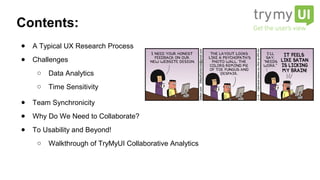
Contents:
● A Typical UX Research Process
● Challenges
○ Data Analytics
○ Time Sensitivity
● Team Synchronicity
● Why Do We Need to Collaborate?
● To Usability and Beyond!
○ Walkthrough of TryMyUI Collaborative Analytics
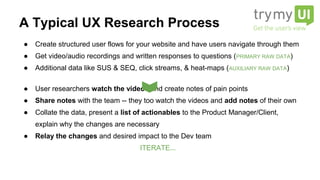
● Create structured user flows for your website and have users navigate through them
● Get video/audio recordings and written responses to questions (PRIMARY RAW DATA)
● Additional data like SUS & SEQ, click streams, & heat-maps (AUXILIARY RAW DATA)
● User researchers watch the videos and create notes of pain points
● Share notes with the team -- they too watch the videos and add notes of their own
● Collate the data, present a list of actionables to the Product Manager/Client,
explain why the changes are necessary
● Relay the changes and desired impact to the Dev team
ITERATE...
A Typical UX Research Process
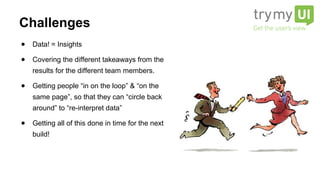
● Data! = Insights
● Covering the different takeaways from the
results for the different team members.
● Getting people “in on the loop” & “on the
same page”, so that they can “circle back
around” to “re-interpret data”
● Getting all of this done in time for the next
build!
Challenges
● In doing UX research, we often get carried away with
the data collection process. In fact there is a terrible
pre-conceived notion that usability testing is purely a
data collection activity.
● We can collect primary & auxiliary raw usability data,
but if we do not establish an analytical methodology
that drives the way we extract insights from them, we
are simply wasting time.
● The auxiliary data should help you identify patterns
and trends in the primary data, but what you need is a
tool that will help you analyze and interpret it all.
Data Analytics
“Big data is not about the data”
-Gary King, Harvard University
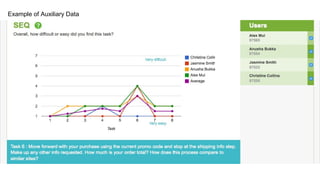
Example of Auxiliary Data
● The more tools/vendors/platforms used to manage
the data, the more unwieldy the analytical process.
● The more isolated the team members’ respective
analysis, the more disjointed the analytical
process.
● Analysis that could take a week often takes twice
or thrice the amount of time because of gaps in
communication and the time wasted in between
meetings and follow ups.
“the ultimate inspiration is the deadline”
- Nolan Bushnell, Founder of Atari
Time Sensitivity
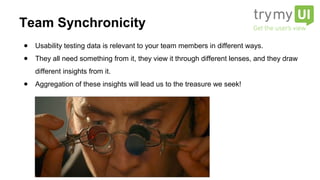
● Usability testing data is relevant to your team members in different ways.
● They all need something from it, they view it through different lenses, and they draw
different insights from it.
● Aggregation of these insights will lead us to the treasure we seek!
Team Synchronicity
It falls to the UX Researcher to watch all of the results and identify
key findings, judge what is important and what isn’t, and then
persuasively communicate these to decision makers.
To achieve his or her goals, therefore, what the UX Researcher
really needs is a way to easily pinpoint and reference critical,
demonstra- tive moments in the results to back up their arguments
and justify making changes to the design.
UX Researcher
Decision Maker
UI/UX Designer
Developer
Team Synchronicity: UX Researcher
The decision-maker’s objective, on the other hand, is to make an
informed decision about the direction of the product roadmap and
which issues will be prioritized over others, based on the topline
analysis of what the pain points are.
What the Decision-maker needs to achieve their goals is an
efficient means of knowing and understanding the issues, and
seeing the evidence needed to green-light changes.
UX Researcher
Decision Maker
UI/UX Designer
Developer
Team Synchronicity: Decision Maker
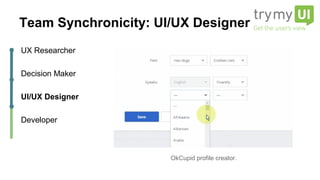
The goal of the designer, for their part, is to see why particular
design elements work or do not work, and then use that
information to create new solutions based on real user behavior.
For the Designer to achieve his or her goals, they need to be able
to directly access the results and witness users interacting with
the product at key junctures and hear their thoughts and
reactions when they run into walls.
UX Researcher
Decision Maker
UI/UX Designer
Developer
Team Synchronicity: UI/UX Designer
UX Researcher
Decision Maker
UI/UX Designer
Developer
Team Synchronicity: UI/UX Designer
OkCupid profile creator.
The Developer’s role is to determine how & where in the usability
test(and the production code) a functionality issue arises. They
need to see the actions leading up to it so that they can replicate it,
identify it and solve it.
For the Developer to achieve his or her goals, they need to be able
to see the user’s actions leading up to an error and also see which
aspects of recurring user behaviour will dictate the way interactive
elements are coded.
UX Researcher
Decision Maker
UI/UX Designer
Developer
Team Synchronicity: Developer
UX Researcher
Decision Maker
UI/UX Designer
Developer
Team Synchronicity: Developer
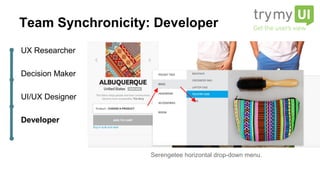
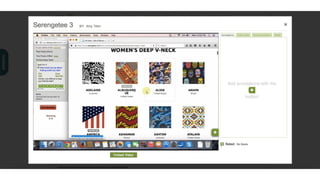
Serengetee horizontal drop-down menu.
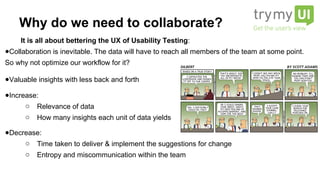
It is all about bettering the UX of Usability Testing:
● Collaboration is inevitable. The data will have to reach all members of the team at some
point. So why not optimize our workflow for it?
● Valuable insights with less back and forth
● Increase:
o Relevance of data
o How many insights each unit of data yields
● Decrease:
o Time taken to deliver & implement the suggestions for change
o Entropy and miscommunication within the team
Why do we need to collaborate?
More resources:
blog.trymyui.com
trymyui.com/webinar
Webinar replay:
Follow us on Twitter at @trymyui Ritvij Gautam
CEO & Co-founder
TryMyUI
ritvij@trymyui.com
(415) 323-0377
https://www.youtube.com/watch?v=9g05rGMnmYs

TryMyUI Collaborative UX Research Webinar

  • 2.
    Ritvij Gautam CEO &Co-founder TryMyUI
  • 3.
    Contents: ● A TypicalUX Research Process ● Challenges ○ Data Analytics ○ Time Sensitivity ● Team Synchronicity ● Why Do We Need to Collaborate? ● To Usability and Beyond! ○ Walkthrough of TryMyUI Collaborative Analytics
  • 4.
    ● Create structureduser flows for your website and have users navigate through them ● Get video/audio recordings and written responses to questions (PRIMARY RAW DATA) ● Additional data like SUS & SEQ, click streams, & heat-maps (AUXILIARY RAW DATA) ● User researchers watch the videos and create notes of pain points ● Share notes with the team -- they too watch the videos and add notes of their own ● Collate the data, present a list of actionables to the Product Manager/Client, explain why the changes are necessary ● Relay the changes and desired impact to the Dev team ITERATE... A Typical UX Research Process
  • 5.
    ● Data! =Insights ● Covering the different takeaways from the results for the different team members. ● Getting people “in on the loop” & “on the same page”, so that they can “circle back around” to “re-interpret data” ● Getting all of this done in time for the next build! Challenges
  • 6.
    ● In doingUX research, we often get carried away with the data collection process. In fact there is a terrible pre-conceived notion that usability testing is purely a data collection activity. ● We can collect primary & auxiliary raw usability data, but if we do not establish an analytical methodology that drives the way we extract insights from them, we are simply wasting time. ● The auxiliary data should help you identify patterns and trends in the primary data, but what you need is a tool that will help you analyze and interpret it all. Data Analytics “Big data is not about the data” -Gary King, Harvard University
  • 7.
  • 8.
    ● The moretools/vendors/platforms used to manage the data, the more unwieldy the analytical process. ● The more isolated the team members’ respective analysis, the more disjointed the analytical process. ● Analysis that could take a week often takes twice or thrice the amount of time because of gaps in communication and the time wasted in between meetings and follow ups. “the ultimate inspiration is the deadline” - Nolan Bushnell, Founder of Atari Time Sensitivity
  • 9.
    ● Usability testingdata is relevant to your team members in different ways. ● They all need something from it, they view it through different lenses, and they draw different insights from it. ● Aggregation of these insights will lead us to the treasure we seek! Team Synchronicity
  • 10.
    It falls tothe UX Researcher to watch all of the results and identify key findings, judge what is important and what isn’t, and then persuasively communicate these to decision makers. To achieve his or her goals, therefore, what the UX Researcher really needs is a way to easily pinpoint and reference critical, demonstra- tive moments in the results to back up their arguments and justify making changes to the design. UX Researcher Decision Maker UI/UX Designer Developer Team Synchronicity: UX Researcher
  • 11.
    The decision-maker’s objective,on the other hand, is to make an informed decision about the direction of the product roadmap and which issues will be prioritized over others, based on the topline analysis of what the pain points are. What the Decision-maker needs to achieve their goals is an efficient means of knowing and understanding the issues, and seeing the evidence needed to green-light changes. UX Researcher Decision Maker UI/UX Designer Developer Team Synchronicity: Decision Maker
  • 12.
    The goal ofthe designer, for their part, is to see why particular design elements work or do not work, and then use that information to create new solutions based on real user behavior. For the Designer to achieve his or her goals, they need to be able to directly access the results and witness users interacting with the product at key junctures and hear their thoughts and reactions when they run into walls. UX Researcher Decision Maker UI/UX Designer Developer Team Synchronicity: UI/UX Designer
  • 13.
    UX Researcher Decision Maker UI/UXDesigner Developer Team Synchronicity: UI/UX Designer OkCupid profile creator.
  • 14.
    The Developer’s roleis to determine how & where in the usability test(and the production code) a functionality issue arises. They need to see the actions leading up to it so that they can replicate it, identify it and solve it. For the Developer to achieve his or her goals, they need to be able to see the user’s actions leading up to an error and also see which aspects of recurring user behaviour will dictate the way interactive elements are coded. UX Researcher Decision Maker UI/UX Designer Developer Team Synchronicity: Developer
  • 15.
    UX Researcher Decision Maker UI/UXDesigner Developer Team Synchronicity: Developer Serengetee horizontal drop-down menu.
  • 16.
    It is allabout bettering the UX of Usability Testing: ● Collaboration is inevitable. The data will have to reach all members of the team at some point. So why not optimize our workflow for it? ● Valuable insights with less back and forth ● Increase: o Relevance of data o How many insights each unit of data yields ● Decrease: o Time taken to deliver & implement the suggestions for change o Entropy and miscommunication within the team Why do we need to collaborate?
  • 27.
    More resources: blog.trymyui.com trymyui.com/webinar Webinar replay: Followus on Twitter at @trymyui Ritvij Gautam CEO & Co-founder TryMyUI ritvij@trymyui.com (415) 323-0377 https://www.youtube.com/watch?v=9g05rGMnmYs