User authentication
To guard against the baneful influence exerted by strangers
is therefore an elementary dictate of savage prudence.
Hence before strangers are allowed to enter a district, or
at least before they are permitted to mingle freely with
the inhabitants, certain ceremonies are often performed
by the natives of the country for the purpose of disarming
the strangers of their magical powers, or of disinfecting,
so to speak, the tainted atmosphere by which they are
supposed to be surrounded.
—The Golden Bough, Sir James George Frazer
Remote User Authentication Principles:
 In most computer security contexts, user authentication is
the fundamental building block and the primary line of
defense.
 User authentication is the basis for most types of access
control and for user accountability.
 User information needs to be stored on any server or
computer system that he/she wishes to use and could be
known to system administrators.
 Typical item of authentication information associated with
the user ID is password.
 User ID and password enables administrators to set up
user’s access permissions and audit their activity.
An authentication process consists of two steps:
• Identification step: Presenting an identifier to
the security system.
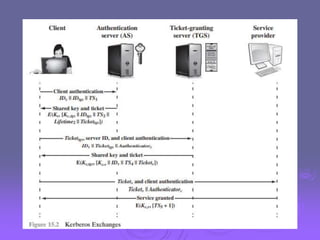
• Verification step: Presenting or generating
authentication information that confirms the
binding between the entity and the identifier.
There are four general means of authenticating a user’s
identity, which can be used alone or in combination:
1) Something the individual knows: Examples include a
password, a personal identification number (PIN), or
answers to a prearranged set of questions.
2) Something the individual possesses: Examples include
cryptographic keys, electronic keycards, smart cards, and
physical keys.
3) Something the individual is (static biometrics): Examples
include recognition by fingerprint, retina, and face.
4) Something the individual does (dynamic biometrics):
Examples include recognition by voice pattern, handwriting
characteristics, and typing rhythm.
All of these methods, properly implemented and used,
can provide secure user authentication. But, these
methods have drawbacks.
For network-based user authentication, the most important
methods involve cryptographic keys and something the
individual knows, such as a password.
Mutual Authentication :
Mutual authentication protocols enable communicating parties
to satisfy themselves mutually about each other’s identity and
to exchange session keys.
Central to the problem of authenticated key exchange are two
issues: confidentiality and timeliness
To prevent compromise of session keys, essential identification
and session-key information must be communicated in
encrypted form.
Timeliness, is important because of the threat of message
replays.
Replay Attacks
where a valid signed message is copied and later
resent
 simple replay
 repetition that can be logged
 repetition that cannot be detected
 backward replay without modification
 countermeasures include
a) use of sequence numbers (generally impractical)
b) timestamps (needs synchronized clocks,. protocol must
be both fault tolerant, to cope with network errors, and secure,
to cope with hostile attacks)
c) challenge/response (using unique nonce)
Because of the variable and unpredictable nature of
network delays, distributed clocks cannot be expected to
maintain precise synchronization. So, timestamp-based
procedure must allow for a window of time sufficiently large
to accommodate network delays yet sufficiently small to
minimize the opportunity for attack
The challenge-response approach is unsuitable for a
connectionless type of application, because it requires the
overhead of a handshake before any connectionless
transmission, effectively negating the chief characteristic of
a connectionless transaction.
One way authentication :
One application for which encryption is growing in popularity is
electronic mail.
The chief benefit of Email is that it is not necessary for the
sender and receiver to be online at the same time.
The e-mail message is forwarded to the receiver’s electronic
mailbox, where it is buffered until the receiver is available to
read it.
The message can be handled by the store-and-forward e-mail
protocol, such as the Simple Mail Transfer Protocol (SMTP) or
X.400
E-mail message should be encrypted such that the mail-
handling system is not in possession of the decryption key.
second requirement is that of authentication. The recipient
wants some assurance that the message is from the genuine
sender.
Remote user authentication using symmetric encryption :
Mutual Authentication:
Two-level hierarchy of symmetric encryption keys can be used
to provide confidentiality for communication in a distributed
environment ( the third party KDC distributes the session key
encrypting session key using master key )
Needham and Schroeder [NEED78] for secret key distribution
using a KDC . Below is the protocol.
Despite the handshake of steps 4 and 5, the protocol is still vulnerable to a
form of replay attack.
Adversary X can impersonate A and trick B into using the old key by simply
replaying step 3.
Authentication
steps
Denning [DENN81, DENN82] proposes to overcome this
weakness by a modification to the Needham/Schroeder
protocol that includes the addition of a timestamp to steps 2
and 3. Her proposal assumes that the master keys, Ka and
Kb, are secure, and it consists of the following steps.
T is a timestamp that assures A and B that the session key
has only just been generated. Thus, both A and B know that
the key distribution is a fresh exchange
A and B can verify timeliness by checking that
Δt1 is the estimated normal discrepancy
between the KDC’s clock and the local clock (at
A or B)
The Denning protocol seems to provide an increased
degree of security compared to the Needham/Schroeder
protocol.
A new concern in the Denning’s approach is that the
clocks must be synchronized throughout the network.
when a sender’s clock is ahead of the intended recipient’s
clock., an opponent can intercept a message from the
sender and replay it later when the timestamp in the
message becomes current at the recipient’s site. This
replay could cause unexpected results. such attacks are
referred as suppress-replay attacks.
One way to counter suppress-replay attacks is to enforce the
requirement that parties regularly check their clocks against the
KDC’s clock.
The other alternative, which avoids the need for clock
synchronization, is to rely on handshaking protocols using
nonces
In [KEHN92], an attempt is made to respond to the concerns
about suppress replay attacks and at the same time fix the
problems in the Needham/Schroeder protocol.
Subsequently, an inconsistency in this latter protocol was
noted and an improved strategy was presented in
[NEUM93a]. The protocol is,
Ks - session key
Tb – time limit to use Ks
ticket
1. A initiates the authentication exchange by generating a nonce, Na, and sending
that plus its identifier to B in plaintext. This nonce will be returned to A in an
encrypted message that includes the session key, assuring A of its timeliness.
2. B alerts the KDC that a session key is needed. Its message to the KDC includes
its identifier and a nonce, Nb. This nonce will be returned to B in an encrypted
message that includes the session key, assuring B of its timeliness. B’s message
to the KDC also includes a block encrypted with the secret key shared by B and
the KDC. This block is used to instruct the KDC to issue credentials to A; the block
specifies the intended recipient of the credentials, a suggested expiration time for
the credentials, and the nonce received from A.
3. The KDC passes on to A B’s nonce and a block encrypted with the secret key
that B shares with the KDC. The block serves as a “ticket” that can be used
by A for subsequent authentications, as will be seen. The KDC also sends to
A a block encrypted with the secret key shared by A and the KDC. This block
verifies that B has received A’s initial message (IDB) and that this is a timely
message and not a replay (Na), and it provides A with a session key (Ks) and
the time limit on its use (Tb).
4. A transmits the ticket to B, together with the B’s nonce, the latter encrypted
with the session key. The ticket provides B with the secret key that is used to
decrypt E(Ks, Nb) to recover the nonce. The fact that B’s nonce is encrypted with
the session key authenticates that the message came from A and is not a replay.
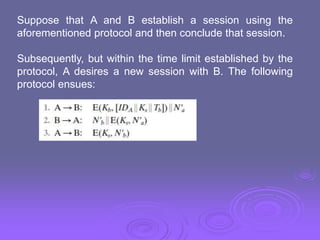
Suppose that A and B establish a session using the
aforementioned protocol and then conclude that session.
Subsequently, but within the time limit established by the
protocol, A desires a new session with B. The following
protocol ensues:
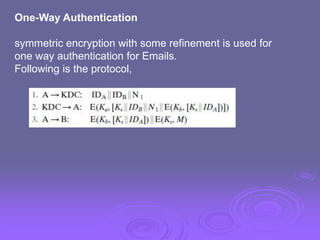
One-Way Authentication
symmetric encryption with some refinement is used for
one way authentication for Emails.
Following is the protocol,
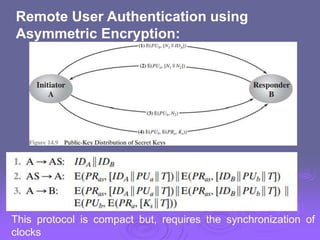
Remote User Authentication using
Asymmetric Encryption:
This protocol is compact but, requires the synchronization of
clocks
Another approach, proposed by Woo and Lam
[WOO92a], makes use of nonces. The protocol
consists of the following steps
This protocol seems to be a secure protocol that takes
into account the various attacks.
The authors themselves spotted a flaw and submitted
a revised version of the algorithm in [WOO92b].
Revised version of the algorithm in [WOO92b]
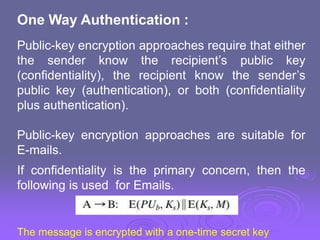
One Way Authentication :
Public-key encryption approaches require that either
the sender know the recipient’s public key
(confidentiality), the recipient know the sender’s
public key (authentication), or both (confidentiality
plus authentication).
Public-key encryption approaches are suitable for
E-mails.
If confidentiality is the primary concern, then the
following is used for Emails.
The message is encrypted with a one-time secret key
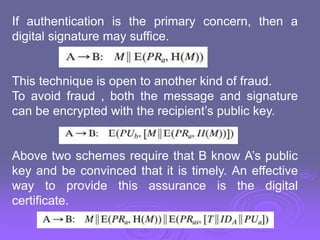
If authentication is the primary concern, then a
digital signature may suffice.
This technique is open to another kind of fraud.
To avoid fraud , both the message and signature
can be encrypted with the recipient’s public key.
Above two schemes require that B know A’s public
key and be convinced that it is timely. An effective
way to provide this assurance is the digital
certificate.
Kerberos
 Trusted authentication server system from
MIT
 provides centralised authentication server
in a distributed network whose function is to
authenticate users to servers and servers to
users.
 Kerberos relies exclusively on symmetric
encryption
 Two versions in use: 4 & 5
Motivation:
A distributed architecture consisting of dedicated user
workstations (clients) and distributed or centralized servers.
Following are the three approaches to security in
distributed Environment.
1. Rely on each individual client workstation to assure the
identity of its user or users and rely on each server to
enforce a security policy based on user identification (ID).
2. Require that client systems authenticate themselves to
servers, but trust the client system concerning the identity of
its user.
3. Require the user to prove his or her identity for each
service invoked. Also require that servers prove their
identity to clients.
For small and closed env – option 1 or 2
For open env – option 3
Kerberos Requirements
 Kerberos first report identified following requirements :
 Secure :A N/w eavesdropper should not be able to obtain
the necessary info to impersonate a user.
 Reliable : Kerberos should be highly reliable and should
employ a distributed server architecture with one system
able to back up other.
• Transparent: user should not be aware that
authentication is taking place beyond the requirement to enter
a password.
 Scalable : support more number of clients and servers.
Kerberos assumes a distributed client/server architecture
and employs one or more Kerberos servers to provide an
authentication service.
Kerberos v4:
Version 4 of Kerberos makes use of DES, to provide
the authentication service.
A simple Authentication Dialogue :
 In an unprotected network environment, any client
can apply to any server for service.
 The obvious security risk is that of impersonation.
An opponent can pretend to be another client and
obtain unauthorized privileges on server machine.
 To counter this threat, servers must be able to
confirm the identities of clients who request
service.
 in an open environment, above way of
authentication places a substantial burden on each
server.
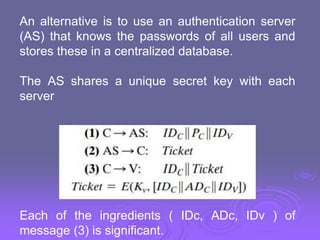
An alternative is to use an authentication server
(AS) that knows the passwords of all users and
stores these in a centralized database.
The AS shares a unique secret key with each
server
Each of the ingredients ( IDc, ADc, IDv ) of
message (3) is significant.
A more secure Authentication Dialogue:
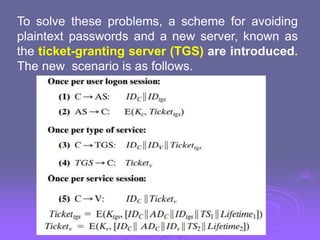
Two problems of authentication in an open
network environment in previous authentication
scheme are,
1) A user has to enter a password each time
he/she request for service from server.
2) A plaintext transmission of the password
[message (1)]. An eavesdropper could capture the
password and use any service accessible to the
victim.
To solve these problems, a scheme for avoiding
plaintext passwords and a new server, known as
the ticket-granting server (TGS) are introduced.
The new scenario is as follows.
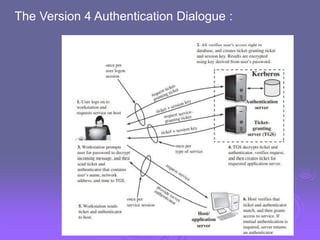
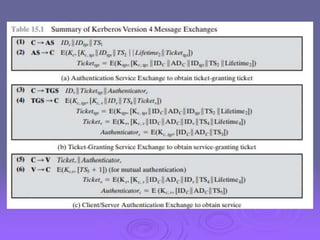
The Version 4 Authentication Dialogue :
Kerberos Realms
 a Kerberos environment consists of:
 a Kerberos server
 a number of clients, all registered with server
 application servers, sharing keys with server
 this is termed a realm
 typically a single administrative domain
 if have multiple realms, their Kerberos
servers must share keys and trust
Kerberos Realms and Multiple Kerberi :
A full-service Kerberos environment consisting of a Kerberos
server, a number of clients, and a number of application
servers requires the following:
1. The Kerberos server must have the user ID and hashed
passwords of all participating users in its database. All users
are registered with the Kerberos server.
2. The Kerberos server must share a secret key with each
server. All servers are registered with the Kerberos server
Above environment is referred to as a Kerberos realm.
 A Kerberos realm is a set of managed nodes that share
the same Kerberos database. The Kerberos database
resides on the Kerberos master computer system.
 Changing or accessing the contents of a Kerberos
database requires the Kerberos master password
User authentication crytography in cse engineering

User authentication crytography in cse engineering

  • 1.
    User authentication To guardagainst the baneful influence exerted by strangers is therefore an elementary dictate of savage prudence. Hence before strangers are allowed to enter a district, or at least before they are permitted to mingle freely with the inhabitants, certain ceremonies are often performed by the natives of the country for the purpose of disarming the strangers of their magical powers, or of disinfecting, so to speak, the tainted atmosphere by which they are supposed to be surrounded. —The Golden Bough, Sir James George Frazer
  • 2.
    Remote User AuthenticationPrinciples:  In most computer security contexts, user authentication is the fundamental building block and the primary line of defense.  User authentication is the basis for most types of access control and for user accountability.  User information needs to be stored on any server or computer system that he/she wishes to use and could be known to system administrators.  Typical item of authentication information associated with the user ID is password.  User ID and password enables administrators to set up user’s access permissions and audit their activity.
  • 3.
    An authentication processconsists of two steps: • Identification step: Presenting an identifier to the security system. • Verification step: Presenting or generating authentication information that confirms the binding between the entity and the identifier.
  • 4.
    There are fourgeneral means of authenticating a user’s identity, which can be used alone or in combination: 1) Something the individual knows: Examples include a password, a personal identification number (PIN), or answers to a prearranged set of questions. 2) Something the individual possesses: Examples include cryptographic keys, electronic keycards, smart cards, and physical keys. 3) Something the individual is (static biometrics): Examples include recognition by fingerprint, retina, and face. 4) Something the individual does (dynamic biometrics): Examples include recognition by voice pattern, handwriting characteristics, and typing rhythm. All of these methods, properly implemented and used, can provide secure user authentication. But, these methods have drawbacks.
  • 5.
    For network-based userauthentication, the most important methods involve cryptographic keys and something the individual knows, such as a password. Mutual Authentication : Mutual authentication protocols enable communicating parties to satisfy themselves mutually about each other’s identity and to exchange session keys. Central to the problem of authenticated key exchange are two issues: confidentiality and timeliness To prevent compromise of session keys, essential identification and session-key information must be communicated in encrypted form. Timeliness, is important because of the threat of message replays.
  • 6.
    Replay Attacks where avalid signed message is copied and later resent  simple replay  repetition that can be logged  repetition that cannot be detected  backward replay without modification  countermeasures include a) use of sequence numbers (generally impractical) b) timestamps (needs synchronized clocks,. protocol must be both fault tolerant, to cope with network errors, and secure, to cope with hostile attacks) c) challenge/response (using unique nonce)
  • 7.
    Because of thevariable and unpredictable nature of network delays, distributed clocks cannot be expected to maintain precise synchronization. So, timestamp-based procedure must allow for a window of time sufficiently large to accommodate network delays yet sufficiently small to minimize the opportunity for attack The challenge-response approach is unsuitable for a connectionless type of application, because it requires the overhead of a handshake before any connectionless transmission, effectively negating the chief characteristic of a connectionless transaction.
  • 8.
    One way authentication: One application for which encryption is growing in popularity is electronic mail. The chief benefit of Email is that it is not necessary for the sender and receiver to be online at the same time. The e-mail message is forwarded to the receiver’s electronic mailbox, where it is buffered until the receiver is available to read it. The message can be handled by the store-and-forward e-mail protocol, such as the Simple Mail Transfer Protocol (SMTP) or X.400 E-mail message should be encrypted such that the mail- handling system is not in possession of the decryption key. second requirement is that of authentication. The recipient wants some assurance that the message is from the genuine sender.
  • 9.
    Remote user authenticationusing symmetric encryption : Mutual Authentication: Two-level hierarchy of symmetric encryption keys can be used to provide confidentiality for communication in a distributed environment ( the third party KDC distributes the session key encrypting session key using master key ) Needham and Schroeder [NEED78] for secret key distribution using a KDC . Below is the protocol. Despite the handshake of steps 4 and 5, the protocol is still vulnerable to a form of replay attack. Adversary X can impersonate A and trick B into using the old key by simply replaying step 3. Authentication steps
  • 10.
    Denning [DENN81, DENN82]proposes to overcome this weakness by a modification to the Needham/Schroeder protocol that includes the addition of a timestamp to steps 2 and 3. Her proposal assumes that the master keys, Ka and Kb, are secure, and it consists of the following steps. T is a timestamp that assures A and B that the session key has only just been generated. Thus, both A and B know that the key distribution is a fresh exchange A and B can verify timeliness by checking that Δt1 is the estimated normal discrepancy between the KDC’s clock and the local clock (at A or B)
  • 11.
    The Denning protocolseems to provide an increased degree of security compared to the Needham/Schroeder protocol. A new concern in the Denning’s approach is that the clocks must be synchronized throughout the network. when a sender’s clock is ahead of the intended recipient’s clock., an opponent can intercept a message from the sender and replay it later when the timestamp in the message becomes current at the recipient’s site. This replay could cause unexpected results. such attacks are referred as suppress-replay attacks. One way to counter suppress-replay attacks is to enforce the requirement that parties regularly check their clocks against the KDC’s clock. The other alternative, which avoids the need for clock synchronization, is to rely on handshaking protocols using nonces
  • 12.
    In [KEHN92], anattempt is made to respond to the concerns about suppress replay attacks and at the same time fix the problems in the Needham/Schroeder protocol. Subsequently, an inconsistency in this latter protocol was noted and an improved strategy was presented in [NEUM93a]. The protocol is, Ks - session key Tb – time limit to use Ks ticket
  • 13.
    1. A initiatesthe authentication exchange by generating a nonce, Na, and sending that plus its identifier to B in plaintext. This nonce will be returned to A in an encrypted message that includes the session key, assuring A of its timeliness. 2. B alerts the KDC that a session key is needed. Its message to the KDC includes its identifier and a nonce, Nb. This nonce will be returned to B in an encrypted message that includes the session key, assuring B of its timeliness. B’s message to the KDC also includes a block encrypted with the secret key shared by B and the KDC. This block is used to instruct the KDC to issue credentials to A; the block specifies the intended recipient of the credentials, a suggested expiration time for the credentials, and the nonce received from A. 3. The KDC passes on to A B’s nonce and a block encrypted with the secret key that B shares with the KDC. The block serves as a “ticket” that can be used by A for subsequent authentications, as will be seen. The KDC also sends to A a block encrypted with the secret key shared by A and the KDC. This block verifies that B has received A’s initial message (IDB) and that this is a timely message and not a replay (Na), and it provides A with a session key (Ks) and the time limit on its use (Tb). 4. A transmits the ticket to B, together with the B’s nonce, the latter encrypted with the session key. The ticket provides B with the secret key that is used to decrypt E(Ks, Nb) to recover the nonce. The fact that B’s nonce is encrypted with the session key authenticates that the message came from A and is not a replay.
  • 14.
    Suppose that Aand B establish a session using the aforementioned protocol and then conclude that session. Subsequently, but within the time limit established by the protocol, A desires a new session with B. The following protocol ensues:
  • 15.
    One-Way Authentication symmetric encryptionwith some refinement is used for one way authentication for Emails. Following is the protocol,
  • 16.
    Remote User Authenticationusing Asymmetric Encryption: This protocol is compact but, requires the synchronization of clocks
  • 17.
    Another approach, proposedby Woo and Lam [WOO92a], makes use of nonces. The protocol consists of the following steps This protocol seems to be a secure protocol that takes into account the various attacks. The authors themselves spotted a flaw and submitted a revised version of the algorithm in [WOO92b].
  • 18.
    Revised version ofthe algorithm in [WOO92b]
  • 19.
    One Way Authentication: Public-key encryption approaches require that either the sender know the recipient’s public key (confidentiality), the recipient know the sender’s public key (authentication), or both (confidentiality plus authentication). Public-key encryption approaches are suitable for E-mails. If confidentiality is the primary concern, then the following is used for Emails. The message is encrypted with a one-time secret key
  • 20.
    If authentication isthe primary concern, then a digital signature may suffice. This technique is open to another kind of fraud. To avoid fraud , both the message and signature can be encrypted with the recipient’s public key. Above two schemes require that B know A’s public key and be convinced that it is timely. An effective way to provide this assurance is the digital certificate.
  • 21.
    Kerberos  Trusted authenticationserver system from MIT  provides centralised authentication server in a distributed network whose function is to authenticate users to servers and servers to users.  Kerberos relies exclusively on symmetric encryption  Two versions in use: 4 & 5
  • 22.
    Motivation: A distributed architectureconsisting of dedicated user workstations (clients) and distributed or centralized servers. Following are the three approaches to security in distributed Environment. 1. Rely on each individual client workstation to assure the identity of its user or users and rely on each server to enforce a security policy based on user identification (ID). 2. Require that client systems authenticate themselves to servers, but trust the client system concerning the identity of its user. 3. Require the user to prove his or her identity for each service invoked. Also require that servers prove their identity to clients. For small and closed env – option 1 or 2 For open env – option 3
  • 23.
    Kerberos Requirements  Kerberosfirst report identified following requirements :  Secure :A N/w eavesdropper should not be able to obtain the necessary info to impersonate a user.  Reliable : Kerberos should be highly reliable and should employ a distributed server architecture with one system able to back up other. • Transparent: user should not be aware that authentication is taking place beyond the requirement to enter a password.  Scalable : support more number of clients and servers. Kerberos assumes a distributed client/server architecture and employs one or more Kerberos servers to provide an authentication service.
  • 24.
    Kerberos v4: Version 4of Kerberos makes use of DES, to provide the authentication service. A simple Authentication Dialogue :  In an unprotected network environment, any client can apply to any server for service.  The obvious security risk is that of impersonation. An opponent can pretend to be another client and obtain unauthorized privileges on server machine.  To counter this threat, servers must be able to confirm the identities of clients who request service.  in an open environment, above way of authentication places a substantial burden on each server.
  • 25.
    An alternative isto use an authentication server (AS) that knows the passwords of all users and stores these in a centralized database. The AS shares a unique secret key with each server Each of the ingredients ( IDc, ADc, IDv ) of message (3) is significant.
  • 26.
    A more secureAuthentication Dialogue: Two problems of authentication in an open network environment in previous authentication scheme are, 1) A user has to enter a password each time he/she request for service from server. 2) A plaintext transmission of the password [message (1)]. An eavesdropper could capture the password and use any service accessible to the victim.
  • 27.
    To solve theseproblems, a scheme for avoiding plaintext passwords and a new server, known as the ticket-granting server (TGS) are introduced. The new scenario is as follows.
  • 28.
    The Version 4Authentication Dialogue :
  • 31.
    Kerberos Realms  aKerberos environment consists of:  a Kerberos server  a number of clients, all registered with server  application servers, sharing keys with server  this is termed a realm  typically a single administrative domain  if have multiple realms, their Kerberos servers must share keys and trust
  • 32.
    Kerberos Realms andMultiple Kerberi : A full-service Kerberos environment consisting of a Kerberos server, a number of clients, and a number of application servers requires the following: 1. The Kerberos server must have the user ID and hashed passwords of all participating users in its database. All users are registered with the Kerberos server. 2. The Kerberos server must share a secret key with each server. All servers are registered with the Kerberos server Above environment is referred to as a Kerberos realm.  A Kerberos realm is a set of managed nodes that share the same Kerberos database. The Kerberos database resides on the Kerberos master computer system.  Changing or accessing the contents of a Kerberos database requires the Kerberos master password