Jeopardy Causes of  The American Revolution
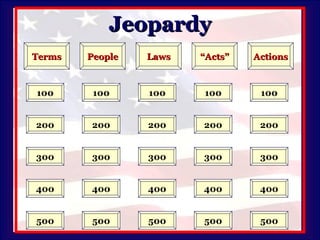
Jeopardy People 100 200 500 400 300 Actions 100 200 500 400 300 “ Acts” 100 200 500 400 300 Laws 100 200 500 400 300 Terms 100 200 500 400 300
Add 100 Nice Work! Return to Game
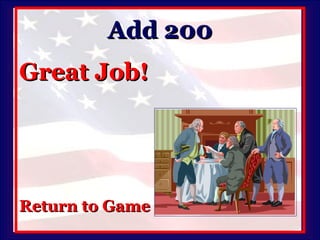
Add 200 Great Job! Return to Game
Add 300 Excellent! Return to Game
Add 400 Awesome! Return to Game
Add 500 Fantastic! Return to Game
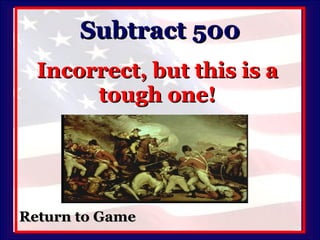
Subtract 500 Incorrect, but this is a tough one! Return to Game
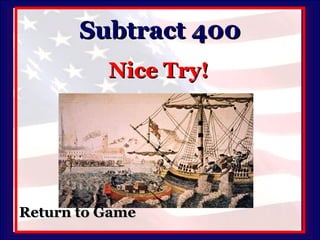
Subtract 400 Nice Try! Return to Game
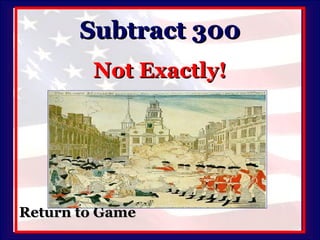
Subtract 300 Not Exactly! Return to Game
Subtract 200 Sorry! Return to Game
Subtract 100 Better Luck Next Time! Return to Game
Terms for 100 What is a boycott? A   –  When you support a cause. B  –  When you refuse to buy certain  goods. C  –  When you dishonestly influence  others. D  –  When you attack from a hidden place.
People for 100 ___ helped establish the Sons of Liberty, a secret resistance group. A   –  John Adams B   –  Benjamin Franklin C   –  Samuel Adams D   –  George Washington
Laws for 100 Rule by the military. A   –  salutary neglect B   –  martial law C   –  mercantilism D   –  federalism
“Acts” for 100 Parliament passed the ___, requiring colonists to pay a direct tax on a variety of printed items. A   –  Stamp Act B   –  Declaratory Act C   –  Intolerable Act D   –  Townshend Act
Actions for 100 Colonists held the Boston Tea Party to protest the: A   –  Declaratory Act B   –  Quartering Act C   –  Boston Massacre D   –  Tea Act
People for 200 ___ were members of the Massachusetts militia. A   –  committees of correspondence B   –  Native Americans C   –  loyalists D   –  minutemen
Laws for 200 The ___ Act required colonists to house British soldiers. A   – Townshend Act B   – Housing Act C   – Intolerable Act D   – Quartering Act
“Acts” for 200 The Sugar Act was enacted by Britain in an effort to: A   –  reduce colonial smuggling. B   –  prevent colonial importing of sugar. C   –  increase colonial exporting of sugar D   –  raise money to carry on war with  France.
Actions for 200 Colonists called the confrontation between British soldiers and civilians in March of 1770 “the Boston Massacre” in order to: A   –  encourage Parliament to repeal the  Intolerable Acts. B   –  inspire foreign countries to support the  colonies. C   –  describe the event as truthfully as possible. D   –  sway public opinion against the British.
Terms for 200 According to the theory of ___, a nation could increase its wealth and power by obtaining as much gold and silver as possible, and by establishing a favorable balance of trade. A   –  nullification B   –  salutary neglect C   –  capitalism D   –  mercantilism
Terms for 300 Then Enlightenment was a movement that emphasized the value of: A   –  reason B   –  religion C   –  miracles D   –  emotionalism
People for 300 The committees of correspondence were: A   –  a network set up to inform other  colonies of ways that Britain  threatened colonial rights. B   –  groups of soldiers chosen to defend  the colonies. C   –  responsible for the Boston Massacre D   –  the British governing body in the  colonies
Laws for 300 The purpose of the Navigation Acts was to: A   –  restrict colonial trade. B   –  expand colonial trade. C   –  strengthen England’s navy. D   –  make the colonies self-sufficient.
“Acts” for 300 The British passed the Coercive Acts, and the colonists felt they were: A   –  illegal B   – irresponsible C   – intolerable D   –  idiotic
Actions for 300 As a result of ___ Britain gained control of North America. A   –  The French and Indian War B   –  The Proclamation of 1763 C   –  The Stono Rebellion D   –  Pontiac’s Rebellion
Terms for 400 The movement known as the Great Awakening encouraged people to: A   –  renew their dedication to God. B   –  reject religion. C   –  submit to traditional church  authority. D   –  use the scientific method to find  religious meaning.
People for 400 The author of  Common Sense: A   –  Thomas Jefferson B   –  Benjamin Franklin C   –  Thomas Paine D   –  James Madison
Laws for 400 The Treaty of Paris, 1763 ended: A   –  The French and Indian War B   –  The Proclamation of 1763 C   –  The Boston Tea Party D   –  The Revolutionary War
“Acts” for 400 Which of the following  was not  part of the Intolerable Acts? A   –  Boston Harbor was shut down. B   –  Parliament had the right to tax the  colonies. C   –  Massachusetts was put under martial  law. D   –  The Quartering Act.
Actions for 400 The first fighting between redcoats and minutemen occurred during the: A   –  Boston Massacre B   –  Battle of Lexington C   –  Battle of Concord D   –  Battle of Bunker Hill
Terms for 500 England’s policy of “salutary neglect” allowed the colonies to increase their: A   –  trade with foreign nations. B   –  representation in Parliament. C   –  legal rights under English law. D   –  control of day-to-day activities.
People for 500 This financial expert was chosen by King George III to serve as Prime Minister in the hope that he could solve the financial problems caused by the French and Indian War. A   –  William Pitt B   –  George Grenville C   –  George Washington D   –  Thomas Paine
“Acts” for 500 The ___ taxed imports such as glass, lead, paint, paper, and tea. A   –  Importation Acts B   –  Intolerable Acts C   –  Townshend Acts D   –  Coercive Acts
Actions for 500 The First Continental Congress met in Philadelphia in 1774 and: A   –  wrote the Declaration of  Independence B   –  issued the Olive Branch Petition C   –  wrote the Declaration of Colonial  Rights D   –  wrote the Constitution
Laws for 500 The Proclamation of 1763 was an attempt by Britain to: A   –  stop settlement west of the the Appalachians. B   –  encourage settlement west of the  Appalachians. C   –  force France off the North American  continent. D   –  claim Canada and North America east  of the Mississippi.

American Revolution Jeopardy

  • 1.
    Jeopardy Causes of The American Revolution
  • 2.
    Jeopardy People 100200 500 400 300 Actions 100 200 500 400 300 “ Acts” 100 200 500 400 300 Laws 100 200 500 400 300 Terms 100 200 500 400 300
  • 3.
    Add 100 NiceWork! Return to Game
  • 4.
    Add 200 GreatJob! Return to Game
  • 5.
    Add 300 Excellent!Return to Game
  • 6.
    Add 400 Awesome!Return to Game
  • 7.
    Add 500 Fantastic!Return to Game
  • 8.
    Subtract 500 Incorrect,but this is a tough one! Return to Game
  • 9.
    Subtract 400 NiceTry! Return to Game
  • 10.
    Subtract 300 NotExactly! Return to Game
  • 11.
    Subtract 200 Sorry!Return to Game
  • 12.
    Subtract 100 BetterLuck Next Time! Return to Game
  • 13.
    Terms for 100What is a boycott? A – When you support a cause. B – When you refuse to buy certain goods. C – When you dishonestly influence others. D – When you attack from a hidden place.
  • 14.
    People for 100___ helped establish the Sons of Liberty, a secret resistance group. A – John Adams B – Benjamin Franklin C – Samuel Adams D – George Washington
  • 15.
    Laws for 100Rule by the military. A – salutary neglect B – martial law C – mercantilism D – federalism
  • 16.
    “Acts” for 100Parliament passed the ___, requiring colonists to pay a direct tax on a variety of printed items. A – Stamp Act B – Declaratory Act C – Intolerable Act D – Townshend Act
  • 17.
    Actions for 100Colonists held the Boston Tea Party to protest the: A – Declaratory Act B – Quartering Act C – Boston Massacre D – Tea Act
  • 18.
    People for 200___ were members of the Massachusetts militia. A – committees of correspondence B – Native Americans C – loyalists D – minutemen
  • 19.
    Laws for 200The ___ Act required colonists to house British soldiers. A – Townshend Act B – Housing Act C – Intolerable Act D – Quartering Act
  • 20.
    “Acts” for 200The Sugar Act was enacted by Britain in an effort to: A – reduce colonial smuggling. B – prevent colonial importing of sugar. C – increase colonial exporting of sugar D – raise money to carry on war with France.
  • 21.
    Actions for 200Colonists called the confrontation between British soldiers and civilians in March of 1770 “the Boston Massacre” in order to: A – encourage Parliament to repeal the Intolerable Acts. B – inspire foreign countries to support the colonies. C – describe the event as truthfully as possible. D – sway public opinion against the British.
  • 22.
    Terms for 200According to the theory of ___, a nation could increase its wealth and power by obtaining as much gold and silver as possible, and by establishing a favorable balance of trade. A – nullification B – salutary neglect C – capitalism D – mercantilism
  • 23.
    Terms for 300Then Enlightenment was a movement that emphasized the value of: A – reason B – religion C – miracles D – emotionalism
  • 24.
    People for 300The committees of correspondence were: A – a network set up to inform other colonies of ways that Britain threatened colonial rights. B – groups of soldiers chosen to defend the colonies. C – responsible for the Boston Massacre D – the British governing body in the colonies
  • 25.
    Laws for 300The purpose of the Navigation Acts was to: A – restrict colonial trade. B – expand colonial trade. C – strengthen England’s navy. D – make the colonies self-sufficient.
  • 26.
    “Acts” for 300The British passed the Coercive Acts, and the colonists felt they were: A – illegal B – irresponsible C – intolerable D – idiotic
  • 27.
    Actions for 300As a result of ___ Britain gained control of North America. A – The French and Indian War B – The Proclamation of 1763 C – The Stono Rebellion D – Pontiac’s Rebellion
  • 28.
    Terms for 400The movement known as the Great Awakening encouraged people to: A – renew their dedication to God. B – reject religion. C – submit to traditional church authority. D – use the scientific method to find religious meaning.
  • 29.
    People for 400The author of Common Sense: A – Thomas Jefferson B – Benjamin Franklin C – Thomas Paine D – James Madison
  • 30.
    Laws for 400The Treaty of Paris, 1763 ended: A – The French and Indian War B – The Proclamation of 1763 C – The Boston Tea Party D – The Revolutionary War
  • 31.
    “Acts” for 400Which of the following was not part of the Intolerable Acts? A – Boston Harbor was shut down. B – Parliament had the right to tax the colonies. C – Massachusetts was put under martial law. D – The Quartering Act.
  • 32.
    Actions for 400The first fighting between redcoats and minutemen occurred during the: A – Boston Massacre B – Battle of Lexington C – Battle of Concord D – Battle of Bunker Hill
  • 33.
    Terms for 500England’s policy of “salutary neglect” allowed the colonies to increase their: A – trade with foreign nations. B – representation in Parliament. C – legal rights under English law. D – control of day-to-day activities.
  • 34.
    People for 500This financial expert was chosen by King George III to serve as Prime Minister in the hope that he could solve the financial problems caused by the French and Indian War. A – William Pitt B – George Grenville C – George Washington D – Thomas Paine
  • 35.
    “Acts” for 500The ___ taxed imports such as glass, lead, paint, paper, and tea. A – Importation Acts B – Intolerable Acts C – Townshend Acts D – Coercive Acts
  • 36.
    Actions for 500The First Continental Congress met in Philadelphia in 1774 and: A – wrote the Declaration of Independence B – issued the Olive Branch Petition C – wrote the Declaration of Colonial Rights D – wrote the Constitution
  • 37.
    Laws for 500The Proclamation of 1763 was an attempt by Britain to: A – stop settlement west of the the Appalachians. B – encourage settlement west of the Appalachians. C – force France off the North American continent. D – claim Canada and North America east of the Mississippi.