Slavery
System
Md. Farhad Ahmed
Roll: 17121019
The Origins of Slavery
Black slavery between antagonistic tribes existed in Africa long before the advent of
the Portuguese in the 1400s.
Portuguese slave trading and kidnapping, beginning in
1442.
West coast in an area that became known as the‘Slave
Coast’ (present day nations of Togo, Dahomey, and
Nigeria).
Spanish in 1517 to enter the lucrative market, followed
by the English (1553), the French (1624), and soon after
by Holland, Denmark and the American colonies.
The first Negroes (20) arrived at Jamestown, Virginia, in
1619 aboard a Dutch ship, not as slaves, but as servants,
much like other unfortunate Indians and whites
The transition from limited
servitude to a lifetime of
slavery for Negroes was
legalized in the colonies by
Massachusetts in 1641
Connecticut in 1650 and
Virginia in 1661.
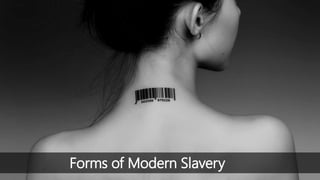
Forms of Modern Slavery
Involves transporting, recruiting or harboring people for the purpose of exploitation, using
violence, threats or coercion.
Descent-based slavery
where people are born into
slavery because their
ancestors were captured
and enslaved; they remain
in slavery by descent.
Child slavery
Forced and Early marriage
The Law of Slavery
তবে তাবের স্ত্রী ও ডান হাবতর মালিকানাভু ক্তবের (োসীবের)
ক্ষেবে [ক্ষ ৌনাঙ্গবক] সং ত না রাখবি তারা লতরস্কৃ ত হবে না।
[২৩:৬]
Manu Smriti (Chapter 8, verse 415)
classifies Slaves into seven categories:
1. War captive
2. A self-volunteered slave
3. Born of a female slave
4. A slave purchased
5. Slave given by parents
6. Inherited through will and
7. Penalized by the king
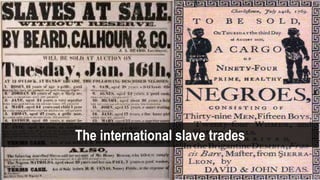
The international slave trades
Organized commerce began in the Neolithic Period (New Stone Age)
End
of
Slavery
Jean Bodin (1530–96), the French founder of antislavery
thought, for example, condemned the institution as
immoral and counterproductive and advocated that no
group of men should be excluded from the body politic.
Serfdom replaced slavery in medieval Germany.
By the end of the Middle Ages slavery no longer existed in
England, and the famous Cartwright decision of the reign
of Elizabeth I (1569) held that “England was too pure an air
for slaves to breathe in.”
In Poland it was replaced by the second enserfment; the
sale and purchase of slaves were forbidden in the 15th
century
In Lithuania, slavery was formally abolished in 1588.
In Russia it came to an end with the first enserfment:
agricultural slaves were formally converted into serfs in 1679,
and household slaves were converted into house serfs in
1723.
The Vermont constitution of 1777 was the first document in
the United States to abolish slavery.
In 1807 the British abolished the slave trade with their
colonies.
In the Caribbean, slavery was abolished by British
Parliamentary fiat, effective July 31, 1834, when 776,000
slaves in the British plantation colonies were freed.
The European colonization movement of the second half
of the 19th century put an end to slavery in many parts
of Africa, East Asia, and Southeast Asia.
The abolition of slavery in both Hindu and Muslim India
by Act V of 1843 meant only that the British courts would
not enforce claims to a slave, but the Penal Code of 1861
made holding a slave a crime.
The imperial government formally abolished slavery in
China in 1906, and the law became effective on January
31, 1910, when all adult slaves were converted into hired
laborer’s and the young were freed upon reaching age
25.
There were no limits in most societies on how much a slave
could be abused. The slave was removed from lines of natal
descent. Legally, and often socially, he had no kin. No
relatives could stand up for his rights or get vengeance for
him. As an “outsider,” “marginal individual,” or “socially dead
person” in the society where he was enslaved, his rights to
participate in political decision making and other social
activities were fewer than those enjoyed by his owner. The
product of a slave’s labor could be claimed by someone else,
who also frequently had the right to control his physical
reproduction.
Any
Question??
Slavery system

Slavery system

  • 1.
  • 3.
  • 4.
    Black slavery betweenantagonistic tribes existed in Africa long before the advent of the Portuguese in the 1400s.
  • 5.
    Portuguese slave tradingand kidnapping, beginning in 1442. West coast in an area that became known as the‘Slave Coast’ (present day nations of Togo, Dahomey, and Nigeria). Spanish in 1517 to enter the lucrative market, followed by the English (1553), the French (1624), and soon after by Holland, Denmark and the American colonies. The first Negroes (20) arrived at Jamestown, Virginia, in 1619 aboard a Dutch ship, not as slaves, but as servants, much like other unfortunate Indians and whites
  • 6.
    The transition fromlimited servitude to a lifetime of slavery for Negroes was legalized in the colonies by Massachusetts in 1641 Connecticut in 1650 and Virginia in 1661.
  • 9.
  • 12.
    Involves transporting, recruitingor harboring people for the purpose of exploitation, using violence, threats or coercion.
  • 13.
    Descent-based slavery where peopleare born into slavery because their ancestors were captured and enslaved; they remain in slavery by descent.
  • 14.
  • 15.
  • 16.
    The Law ofSlavery
  • 20.
    তবে তাবের স্ত্রীও ডান হাবতর মালিকানাভু ক্তবের (োসীবের) ক্ষেবে [ক্ষ ৌনাঙ্গবক] সং ত না রাখবি তারা লতরস্কৃ ত হবে না। [২৩:৬]
  • 21.
    Manu Smriti (Chapter8, verse 415) classifies Slaves into seven categories: 1. War captive 2. A self-volunteered slave 3. Born of a female slave 4. A slave purchased 5. Slave given by parents 6. Inherited through will and 7. Penalized by the king
  • 22.
  • 23.
    Organized commerce beganin the Neolithic Period (New Stone Age)
  • 24.
  • 25.
    Jean Bodin (1530–96),the French founder of antislavery thought, for example, condemned the institution as immoral and counterproductive and advocated that no group of men should be excluded from the body politic. Serfdom replaced slavery in medieval Germany. By the end of the Middle Ages slavery no longer existed in England, and the famous Cartwright decision of the reign of Elizabeth I (1569) held that “England was too pure an air for slaves to breathe in.” In Poland it was replaced by the second enserfment; the sale and purchase of slaves were forbidden in the 15th century
  • 26.
    In Lithuania, slaverywas formally abolished in 1588. In Russia it came to an end with the first enserfment: agricultural slaves were formally converted into serfs in 1679, and household slaves were converted into house serfs in 1723. The Vermont constitution of 1777 was the first document in the United States to abolish slavery. In 1807 the British abolished the slave trade with their colonies. In the Caribbean, slavery was abolished by British Parliamentary fiat, effective July 31, 1834, when 776,000 slaves in the British plantation colonies were freed.
  • 27.
    The European colonizationmovement of the second half of the 19th century put an end to slavery in many parts of Africa, East Asia, and Southeast Asia. The abolition of slavery in both Hindu and Muslim India by Act V of 1843 meant only that the British courts would not enforce claims to a slave, but the Penal Code of 1861 made holding a slave a crime. The imperial government formally abolished slavery in China in 1906, and the law became effective on January 31, 1910, when all adult slaves were converted into hired laborer’s and the young were freed upon reaching age 25.
  • 28.
    There were nolimits in most societies on how much a slave could be abused. The slave was removed from lines of natal descent. Legally, and often socially, he had no kin. No relatives could stand up for his rights or get vengeance for him. As an “outsider,” “marginal individual,” or “socially dead person” in the society where he was enslaved, his rights to participate in political decision making and other social activities were fewer than those enjoyed by his owner. The product of a slave’s labor could be claimed by someone else, who also frequently had the right to control his physical reproduction.
  • 29.