URINARY
ELIMINATION
EDGAR A. ULEP, RM, LPT, MSPH
MIDWIFERY DEPARTMENT
LEARNING OBJECTIVES
 Review of anatomy and physiology
 Composition and characteristics of urine
 Factors influencing urination
 Alteration in urinary elimination
 Types and collection of urine specimen, observation, urine testing
 Facilitating urine elimination: (Assessment, Types, Equipment, Procedures,
and special considerations)
 Providing urinal/bed pan, condom drainage
 Catheterization, Care of urinary drainage, and perineal care
INTRODUCTION
 Urinary elimination is defined as expulsion of waste products from the
body through the urinary system.
 It is essential to maintain homeostasis of the body
 It helps in removal of metabolic waste products from the body
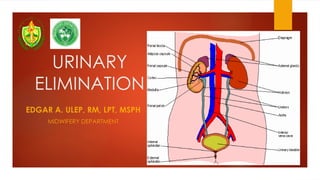
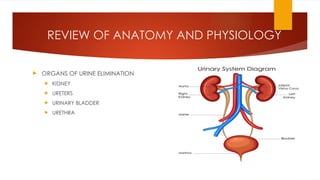
REVIEW OF ANATOMY AND PHYSIOLOGY
 ORGANS OF URINE ELIMINATION
 KIDNEY
 URETERS
 URINARY BLADDER
 URETHRA
KIDNEY
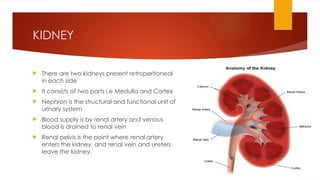
 There are two kidneys present retroperitoneal
in each side
 It consists of two parts i.e Medulla and Cortex
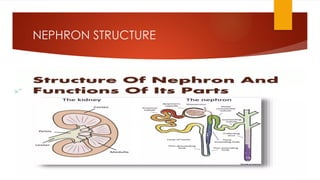
 Nephron is the structural and functional unit of
urinary system
 Blood supply is by renal artery and venous
blood is drained to renal vein
 Renal pelvis is the point where renal artery
enters the kidney, and renal vein and ureters
leave the kidney.
FUNCTIONS OF KIDNEY
1. EXCRATORY FUNCTION
 Excretion of metabolites
 Drugs and toxins from the body
2. HOMEOSTATIC FUNCTION
 Maintenance of water balance
 Maintenance of electrolyte balance
 Maintenance of acid-base balance
3. ENDOCRINE (HORMONAL) FUNCTION
 Renin secretion by JG cells
 Secretion of Erythropoietin Hormone
 Secretion of Prostaglandins
4. THE KIDNEY converts VITAMIN D3 – active 1,25-dihydroxycholecalciferol
URETERS
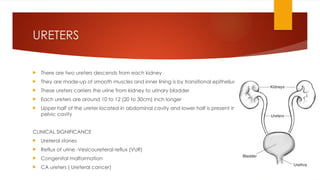
 There are two ureters descends from each kidney
 They are made-up of smooth muscles and inner lining is by transitional epithelium
 These ureters carriers the urine from kidney to urinary bladder
 Each ureters are around 10 to 12 (20 to 30cm) inch longer
 Upper half of the ureter located in abdominal cavity and lower half is present in
pelvic cavity
CLINICAL SIGNIFICANCE
 Ureteral stones
 Reflux of urine -Vesicoureteral reflux (VUR)
 Congenital malformation
 CA ureters ( Ureteral cancer)
URINARY BLADDER
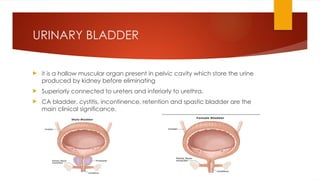
 it is a hallow muscular organ present in pelvic cavity which store the urine
produced by kidney before eliminating
 Superiorly connected to ureters and inferiorly to urethra.
 CA bladder, cystitis, incontinence, retention and spastic bladder are the
main clinical significance.
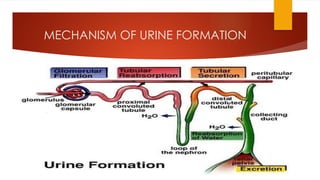
MECHANISM OF URINE FORMATION
NEPHRON STRUCTURE
COMPOSITION OF URINE
 95% of volume of normal urine is due to water
 Organic components
 Urea –end product of protein metabolism
 Uric acid – end product of purines
 Creatinine
 Amino acids
 Metabolites of hormones - insulin
 In organics
 Cations: Na2+, K+, Ca2+, etc
 Anions: CI-
, SO4
2-
, HCO3
-
etc
CHARACTERISTICS OF URINE
PHYSICAL CHARACTERS
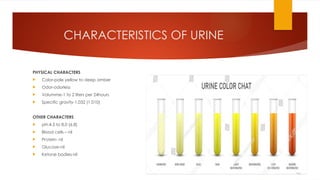
 Color-pale yellow to deep amber
 Odor-odorless
 Volumme-1 to 2 liters per 24hours
 Specific gravity-1.032 (1.010)
OTHER CHARACTERS
 pH-4.5 to 8.0 (6.8)
 Blood cells – nil
 Protein- nil
 Glucose-nil
 Ketone bodies-nil
FACTORS INFLUENCING URINATION
 Lifestyle
 Fluid and food intake
 Environment
 Psychological factor – emotional stress may cause urgency in urination
 Medications – cholinergics & diuretis cause urinary elimination
 Muscle tone and activity – regular exercise
 Pathological condition – some diseases can affect formation of urine
 Surgical and diagnostic procedures
ALTERATION IN URINE ELIMINATION
 Polyuria-urine volume in excess of 3L/day
 Oliguria-urine volume less than 500ml/day
 Anuria-urine volume less than 100ml/day
 Nocturia-frequent night time urination
 Dysuria-difficulty in urination/burning maturation
 Enuresis-bed wetting
 Urinary incontinence and involuntary dribbling of urine
 Urinary retention- inability to void the urine / empty the bladder completely
 Hematuria-blood in the urine
 Proteinuria(Albuminuria)-presence of protein in the urine
 Glycosuria-presence of glucose in urine
URINE SPECIMEN COLLECTION
 Proper collection of specimen is important to maximize the outcome of
laboratory test for the diagnosis of infectious diseases.
 A variety of laboratory test can be performed to make a presumptive or
definitive diagnosis so that therapy can begin.
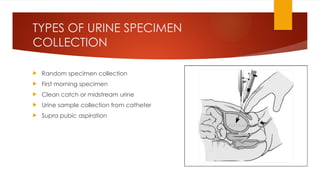
TYPES OF URINE SPECIMEN
COLLECTION
 Random specimen collection
 First morning specimen
 Clean catch or midstream urine
 Urine sample collection from catheter
 Supra pubic aspiration
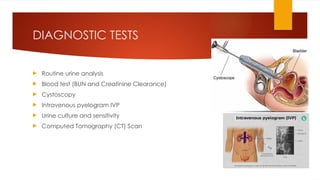
DIAGNOSTIC TESTS
 Routine urine analysis
 Blood test (BUN and Creatinine Clearance)
 Cystoscopy
 Intravenous pyelogram IVP
 Urine culture and sensitivity
 Computed Tomography (CT) Scan
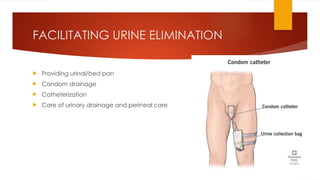
FACILITATING URINE ELIMINATION
 Providing urinal/bed pan
 Condom drainage
 Catheterization
 Care of urinary drainage and perineal care
CATHETERIZATION
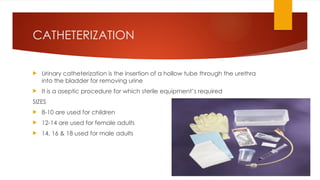
 Urinary catheterization is the insertion of a hollow tube through the urethra
into the bladder for removing urine
 It is a aseptic procedure for which sterile equipment’s required
SIZES
 8-10 are used for children
 12-14 are used for female adults
 14, 16 & 18 used for male adults
PURPOSE OF URINARY CATHETER
 To relieve from urinary retention
 To obtain a sterile urine specimen
 To measure residual urine
 To empty the bladder before, during and the surgery
 To measure the urine output accurately
TYPES OF CATHETERIZATION
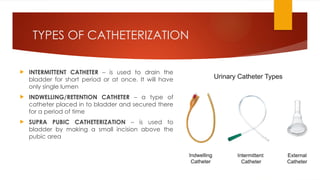
 INTERMITTENT CATHETER – is used to drain the
bladder for short period or at once. It will have
only single lumen
 INDWELLING/RETENTION CATHETER – a type of
catheter placed in to bladder and secured there
for a period of time
 SUPRA PUBIC CATHETERIZATION – is used to
bladder by making a small incision above the
pubic area
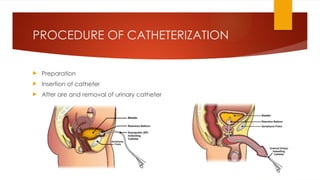
PROCEDURE OF CATHETERIZATION
 Preparation
 Insertion of catheter
 After are and removal of urinary catheter
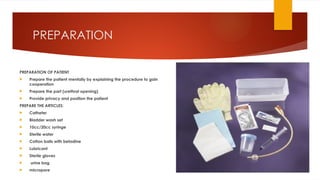
PREPARATION
PREPARATION OF PATIENT
 Prepare the patient mentally by explaining the procedure to gain
cooperation
 Prepare the part (urethral opening)
 Provide privacy and position the patient
PREPARE THE ARTICLES:
 Catheter
 Bladder wash set
 10cc/20cc syringe
 Sterile water
 Cotton balls with betadine
 Lubricant
 Sterile gloves
 urine bag
 micropore
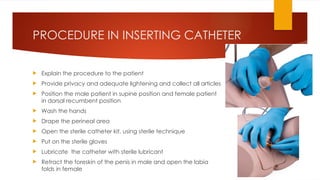
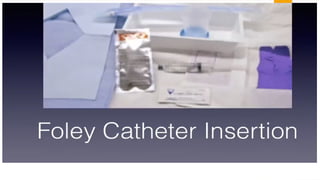
PROCEDURE IN INSERTING CATHETER
 Explain the procedure to the patient
 Provide privacy and adequate lightening and collect all articles
 Position the male patient in supine position and female patient
in dorsal recumbent position
 Wash the hands
 Drape the perineal area
 Open the sterile catheter kit, using sterile technique
 Put on the sterile gloves
 Lubricate the catheter with sterile lubricant
 Retract the foreskin of the penis in male and open the labia
folds in female
 Cleaned the urethra in a circular motion from inside to outer
 Hold the penis in 90 degrees angle, insert the catheter and allow urinary
sphincter to relax
 Lower the catheter and continue to advance the catheter
NOTE: Never force the catheter to advance and discontinue the procedure if
there is resistance
 When the catheter reaches bladder urine starts to flow, gently insert until
1-2 inches beyond where urine is noted
 Inflate the balloon, using correct amount of sterile liquid
 Gently pull the catheter until inflation balloon is sung against bladder
neck, and connect the catheter to drainage system
 Fix the tube with micropore and keep bag below the bladder level
 AFTER CARE OF PROCEDURE AND ARTICLES
 Discard the waste, remove gloves and replace the articles
 Wash hands and document the procedure
CATHETER CARE
 Fix the catheter to high or abdominal wall of the patient
 Always keep urine bag below the bladder level
 Everyday morning catheter care should be given with aseptic techniques
 Maintain close drainage system
 Irrigate bladder with antimicrobials
 Routinely examine for any signs of infection
 Don’t collect urine sample from urine bag or catheter directly
 Provide perineal care
 Don’t allow the fecal to contaminate the catheter
REMOVAL OF URINARY CATHETER
 Once patient got relieved from the condition physician can plan to
remove the catheter
 Take a sterile 10/20cc syringe
 Deflate the catheter
 Pull the catheter gently until catheter come out
 Discard the catheter, wash hands and document the procedure
END
BOWEL ELIMINATION
BOWEL ELIMINATION OR DEFECATION
 Defecation, also called bowel movement, the act of eliminating solid or
semisolid waste materials/feces from digestive tract
 In human beings, wastes are usually removed once or twice daily, but the
frequency can vary from several times daily to three times weekly and
remain within normal limits
 Muscular contractions – move fecal material to the rectum
 The rectum – temporary reservoir for the waste
 As the rectal walls expand with filling, stretch receptors from the nervous
system, located in the rectal walls, stimulate the desire to defecate
 The urges passes within one to two minutes if not relieved, and the
material in the rectum is then often returned to the colon where more
water is absorbed
 If defecation is continuously delayed, constipation and hardened fees
result
 When the rectum is filled, pressure within it is increased
 This increased rectal initially forces the walls of the anal canal part and
allows the fecal material to enter the canal
 In the anus there are two mascular constrictors, the internal and external
sphincters, that allows the feces to be passed or retained
 While defecation is occurring, the excretion of urine is usually stimulated
 The chest muscles, diaphragm, abdominal-wall muscles, and pelvic
diaphragm all exert pressure on the digestive tract
 Respiration temporarily ceases as the filled lungs push the diaphragm
down to exert pressure
 Blood pressure rises in the body, and the amount of blood pumped by the
heart decreases
COMPOSITION OF FECES
1. WATER
 65-85% of stools are water
 All the water drank by an individual is completely absorbed in the small and large intestine
 In case of diarrhea, the water content of stool is more than 85%
2. PROTEIN
 Protein from food is digested completely in the small intestine and is converted into amino
acids before being absorbed in blood
3. FAT
 95% of all fat consumed is absorbed in the small intestine
 Traces of fat can definitely be found in stools
 Fats in excess of 6% in stools are abnormal (Steatorrhea)
 4. CARBOHYDRATE
 Simple and complex carbohydrates – sugar and starches in diet
 They are completely absorbed in the small intestine and assimilated in blood as glucose,
fructose or galactose
 Undigested carbohydrates in normal stools should be below 0.5%
 5. FIBER
 Fiber is completely indigestible and gives volume and bulk to stools
 The more fiber one eats the more of undigested food wastes can be discharged from the
body
 Fiber diet – undigested food would account for 5-7% of the total stool volume
 High fiber diet, 10-15% of the undigested wastes could be discharged from the body
5 MAJOR COMPONENTS
 Mineral salts which are insoluble
 They too cannot be digested by the body
 This indigestible component of feces is known as Ash. 0.2 to 1.2% of normal
stool is ash
 The stools also contain mucous shed from the inner lining of digestive tract
 The mucus helps to bind together undigested food, intestinal bacteria and
metabolic debris like dead cells or bile secreted by the liver etc.
CHARACTERISTICS OF FECES
 NORMAL COLOR
 Adult – Brown
 Infant - Yellow
ABNORMAL COLOR
 CLAY OR WHITE –absence of bile pigment( bile obstruction) or diagnostic
study using barium
 BLACK OR TARRY – drug (e.i. Iron), bleeding from upper gastrointestinal
tract (e.i. Stomach, small intestine), diet high in red meat and dark green
vegetables (e.i. Spinach)
 RED –bleeding from lower gastrointestinal tract (e.i. rectum), some foods
(e.i. Sugar beets)
 PALE – malabsorption of fats, diet high in milk and milk products and low in
meat
CONSISTENCY
 NORMAL CONSISTENCY : Formed, soft, semisolid, moist
 ABNORMAL CONSISTENCY:
 hard, dry, constipated stool
 Dehydration, decreased intestinal motility resulting from lack of fiber in diet, lack
of exercise, emotional upset, laxative abuse
 Diarrhea – increased intestinal motility
SHAPE
 NORMAL SHAPE: Cylindrical, about 2.5 cm (1inch) in diameter in adults
 ABNORMAL SHAPE: Narrow, pencil-shaped, or string likestool
 Obstructive conditional of rectum
FACTORS AFFECTING BOWEL
ELIMINATION
 Age
 Diet
 Fluid intake
 Medications
 Physical activity
 Psychological activity
 Personal habits
 Position
 Pain
 Pregnancy
 Surgery & Anesthesia
 Diagnostic tests
DIET
 There are different ways that
diet can affect bowel
elimination
ex,. High fiber diets & fruits
promote regularity, while
cheeses causes constipation
AGE
 Must be of a certain age or
physical maturity to be able
to control your bowels
 Humans also can lose
control of their bowels after
a certain age
PHYSICAL ACTIVITY
 Higher activity rate lessens
the chances of constipation
FLUID INTAKE
 The more fluid you take in
the less likely you are to
become constipated
 The less fluid you take in the
more likely you are to
become constipated
PSYCHOLOGICAL FACTOR
 Usually the source of ulcerative colitis or Crohn’s disease
 Depression causes peristalsis to decrease
PERSONAL HABITS
 A person not wanting to go for an extended period of time can cause
harm to their body and can make it harder to go later
 They may not want to use those facilities
PAIN
 Person may be hesitant
about going if they think it
will cause them pain
 Usually due to hemorrhoids,
rectal surgery or abdominal
surgery
POSITIONS
 Normal positioning for bowel
elimination is sitting or
squatting
PREGNANCY
 The way the baby is lying on the mothers GI tract affects peristalsis by
slowing it
 Force the mother to go in between
SURGERY & ANESTHESIA
 Affects defecation by the slowing of peristalsis or complete stop
MEDICATION
 Different medicines affect bowel elimination differently
 Some medications increase the process others may inhibit it or stop it
completely
DIAGNOSTIC TESTS
 These affect patient because they usually require them to be NPO prior to
it which in turn will limit their food intake which limits bowel elimination or
stops them completely
ALTERATION IN BOWEL
ELIMINATION
CONSTIPATION

URINARY ELIMINATION in Midwifery Practice.pptx

  • 1.
    URINARY ELIMINATION EDGAR A. ULEP,RM, LPT, MSPH MIDWIFERY DEPARTMENT
  • 2.
    LEARNING OBJECTIVES  Reviewof anatomy and physiology  Composition and characteristics of urine  Factors influencing urination  Alteration in urinary elimination  Types and collection of urine specimen, observation, urine testing  Facilitating urine elimination: (Assessment, Types, Equipment, Procedures, and special considerations)  Providing urinal/bed pan, condom drainage  Catheterization, Care of urinary drainage, and perineal care
  • 3.
    INTRODUCTION  Urinary eliminationis defined as expulsion of waste products from the body through the urinary system.  It is essential to maintain homeostasis of the body  It helps in removal of metabolic waste products from the body
  • 4.
    REVIEW OF ANATOMYAND PHYSIOLOGY  ORGANS OF URINE ELIMINATION  KIDNEY  URETERS  URINARY BLADDER  URETHRA
  • 5.
    KIDNEY  There aretwo kidneys present retroperitoneal in each side  It consists of two parts i.e Medulla and Cortex  Nephron is the structural and functional unit of urinary system  Blood supply is by renal artery and venous blood is drained to renal vein  Renal pelvis is the point where renal artery enters the kidney, and renal vein and ureters leave the kidney.
  • 6.
    FUNCTIONS OF KIDNEY 1.EXCRATORY FUNCTION  Excretion of metabolites  Drugs and toxins from the body 2. HOMEOSTATIC FUNCTION  Maintenance of water balance  Maintenance of electrolyte balance  Maintenance of acid-base balance 3. ENDOCRINE (HORMONAL) FUNCTION  Renin secretion by JG cells  Secretion of Erythropoietin Hormone  Secretion of Prostaglandins 4. THE KIDNEY converts VITAMIN D3 – active 1,25-dihydroxycholecalciferol
  • 7.
    URETERS  There aretwo ureters descends from each kidney  They are made-up of smooth muscles and inner lining is by transitional epithelium  These ureters carriers the urine from kidney to urinary bladder  Each ureters are around 10 to 12 (20 to 30cm) inch longer  Upper half of the ureter located in abdominal cavity and lower half is present in pelvic cavity CLINICAL SIGNIFICANCE  Ureteral stones  Reflux of urine -Vesicoureteral reflux (VUR)  Congenital malformation  CA ureters ( Ureteral cancer)
  • 8.
    URINARY BLADDER  itis a hallow muscular organ present in pelvic cavity which store the urine produced by kidney before eliminating  Superiorly connected to ureters and inferiorly to urethra.  CA bladder, cystitis, incontinence, retention and spastic bladder are the main clinical significance.
  • 9.
  • 10.
  • 11.
    COMPOSITION OF URINE 95% of volume of normal urine is due to water  Organic components  Urea –end product of protein metabolism  Uric acid – end product of purines  Creatinine  Amino acids  Metabolites of hormones - insulin  In organics  Cations: Na2+, K+, Ca2+, etc  Anions: CI- , SO4 2- , HCO3 - etc
  • 12.
    CHARACTERISTICS OF URINE PHYSICALCHARACTERS  Color-pale yellow to deep amber  Odor-odorless  Volumme-1 to 2 liters per 24hours  Specific gravity-1.032 (1.010) OTHER CHARACTERS  pH-4.5 to 8.0 (6.8)  Blood cells – nil  Protein- nil  Glucose-nil  Ketone bodies-nil
  • 13.
    FACTORS INFLUENCING URINATION Lifestyle  Fluid and food intake  Environment  Psychological factor – emotional stress may cause urgency in urination  Medications – cholinergics & diuretis cause urinary elimination  Muscle tone and activity – regular exercise  Pathological condition – some diseases can affect formation of urine  Surgical and diagnostic procedures
  • 14.
    ALTERATION IN URINEELIMINATION  Polyuria-urine volume in excess of 3L/day  Oliguria-urine volume less than 500ml/day  Anuria-urine volume less than 100ml/day  Nocturia-frequent night time urination  Dysuria-difficulty in urination/burning maturation  Enuresis-bed wetting  Urinary incontinence and involuntary dribbling of urine  Urinary retention- inability to void the urine / empty the bladder completely  Hematuria-blood in the urine  Proteinuria(Albuminuria)-presence of protein in the urine  Glycosuria-presence of glucose in urine
  • 15.
    URINE SPECIMEN COLLECTION Proper collection of specimen is important to maximize the outcome of laboratory test for the diagnosis of infectious diseases.  A variety of laboratory test can be performed to make a presumptive or definitive diagnosis so that therapy can begin.
  • 16.
    TYPES OF URINESPECIMEN COLLECTION  Random specimen collection  First morning specimen  Clean catch or midstream urine  Urine sample collection from catheter  Supra pubic aspiration
  • 17.
    DIAGNOSTIC TESTS  Routineurine analysis  Blood test (BUN and Creatinine Clearance)  Cystoscopy  Intravenous pyelogram IVP  Urine culture and sensitivity  Computed Tomography (CT) Scan
  • 18.
    FACILITATING URINE ELIMINATION Providing urinal/bed pan  Condom drainage  Catheterization  Care of urinary drainage and perineal care
  • 19.
    CATHETERIZATION  Urinary catheterizationis the insertion of a hollow tube through the urethra into the bladder for removing urine  It is a aseptic procedure for which sterile equipment’s required SIZES  8-10 are used for children  12-14 are used for female adults  14, 16 & 18 used for male adults
  • 20.
    PURPOSE OF URINARYCATHETER  To relieve from urinary retention  To obtain a sterile urine specimen  To measure residual urine  To empty the bladder before, during and the surgery  To measure the urine output accurately
  • 21.
    TYPES OF CATHETERIZATION INTERMITTENT CATHETER – is used to drain the bladder for short period or at once. It will have only single lumen  INDWELLING/RETENTION CATHETER – a type of catheter placed in to bladder and secured there for a period of time  SUPRA PUBIC CATHETERIZATION – is used to bladder by making a small incision above the pubic area
  • 22.
    PROCEDURE OF CATHETERIZATION Preparation  Insertion of catheter  After are and removal of urinary catheter
  • 23.
    PREPARATION PREPARATION OF PATIENT Prepare the patient mentally by explaining the procedure to gain cooperation  Prepare the part (urethral opening)  Provide privacy and position the patient PREPARE THE ARTICLES:  Catheter  Bladder wash set  10cc/20cc syringe  Sterile water  Cotton balls with betadine  Lubricant  Sterile gloves  urine bag  micropore
  • 24.
    PROCEDURE IN INSERTINGCATHETER  Explain the procedure to the patient  Provide privacy and adequate lightening and collect all articles  Position the male patient in supine position and female patient in dorsal recumbent position  Wash the hands  Drape the perineal area  Open the sterile catheter kit, using sterile technique  Put on the sterile gloves  Lubricate the catheter with sterile lubricant  Retract the foreskin of the penis in male and open the labia folds in female
  • 25.
     Cleaned theurethra in a circular motion from inside to outer  Hold the penis in 90 degrees angle, insert the catheter and allow urinary sphincter to relax  Lower the catheter and continue to advance the catheter NOTE: Never force the catheter to advance and discontinue the procedure if there is resistance  When the catheter reaches bladder urine starts to flow, gently insert until 1-2 inches beyond where urine is noted  Inflate the balloon, using correct amount of sterile liquid
  • 26.
     Gently pullthe catheter until inflation balloon is sung against bladder neck, and connect the catheter to drainage system  Fix the tube with micropore and keep bag below the bladder level  AFTER CARE OF PROCEDURE AND ARTICLES  Discard the waste, remove gloves and replace the articles  Wash hands and document the procedure
  • 27.
    CATHETER CARE  Fixthe catheter to high or abdominal wall of the patient  Always keep urine bag below the bladder level  Everyday morning catheter care should be given with aseptic techniques  Maintain close drainage system  Irrigate bladder with antimicrobials  Routinely examine for any signs of infection  Don’t collect urine sample from urine bag or catheter directly  Provide perineal care  Don’t allow the fecal to contaminate the catheter
  • 28.
    REMOVAL OF URINARYCATHETER  Once patient got relieved from the condition physician can plan to remove the catheter  Take a sterile 10/20cc syringe  Deflate the catheter  Pull the catheter gently until catheter come out  Discard the catheter, wash hands and document the procedure
  • 31.
  • 32.
  • 33.
    BOWEL ELIMINATION ORDEFECATION  Defecation, also called bowel movement, the act of eliminating solid or semisolid waste materials/feces from digestive tract  In human beings, wastes are usually removed once or twice daily, but the frequency can vary from several times daily to three times weekly and remain within normal limits  Muscular contractions – move fecal material to the rectum  The rectum – temporary reservoir for the waste  As the rectal walls expand with filling, stretch receptors from the nervous system, located in the rectal walls, stimulate the desire to defecate
  • 34.
     The urgespasses within one to two minutes if not relieved, and the material in the rectum is then often returned to the colon where more water is absorbed  If defecation is continuously delayed, constipation and hardened fees result  When the rectum is filled, pressure within it is increased  This increased rectal initially forces the walls of the anal canal part and allows the fecal material to enter the canal  In the anus there are two mascular constrictors, the internal and external sphincters, that allows the feces to be passed or retained
  • 35.
     While defecationis occurring, the excretion of urine is usually stimulated  The chest muscles, diaphragm, abdominal-wall muscles, and pelvic diaphragm all exert pressure on the digestive tract  Respiration temporarily ceases as the filled lungs push the diaphragm down to exert pressure  Blood pressure rises in the body, and the amount of blood pumped by the heart decreases
  • 37.
    COMPOSITION OF FECES 1.WATER  65-85% of stools are water  All the water drank by an individual is completely absorbed in the small and large intestine  In case of diarrhea, the water content of stool is more than 85% 2. PROTEIN  Protein from food is digested completely in the small intestine and is converted into amino acids before being absorbed in blood 3. FAT  95% of all fat consumed is absorbed in the small intestine  Traces of fat can definitely be found in stools  Fats in excess of 6% in stools are abnormal (Steatorrhea)
  • 38.
     4. CARBOHYDRATE Simple and complex carbohydrates – sugar and starches in diet  They are completely absorbed in the small intestine and assimilated in blood as glucose, fructose or galactose  Undigested carbohydrates in normal stools should be below 0.5%  5. FIBER  Fiber is completely indigestible and gives volume and bulk to stools  The more fiber one eats the more of undigested food wastes can be discharged from the body  Fiber diet – undigested food would account for 5-7% of the total stool volume  High fiber diet, 10-15% of the undigested wastes could be discharged from the body
  • 39.
    5 MAJOR COMPONENTS Mineral salts which are insoluble  They too cannot be digested by the body  This indigestible component of feces is known as Ash. 0.2 to 1.2% of normal stool is ash  The stools also contain mucous shed from the inner lining of digestive tract  The mucus helps to bind together undigested food, intestinal bacteria and metabolic debris like dead cells or bile secreted by the liver etc.
  • 40.
    CHARACTERISTICS OF FECES NORMAL COLOR  Adult – Brown  Infant - Yellow
  • 41.
    ABNORMAL COLOR  CLAYOR WHITE –absence of bile pigment( bile obstruction) or diagnostic study using barium  BLACK OR TARRY – drug (e.i. Iron), bleeding from upper gastrointestinal tract (e.i. Stomach, small intestine), diet high in red meat and dark green vegetables (e.i. Spinach)  RED –bleeding from lower gastrointestinal tract (e.i. rectum), some foods (e.i. Sugar beets)  PALE – malabsorption of fats, diet high in milk and milk products and low in meat
  • 42.
    CONSISTENCY  NORMAL CONSISTENCY: Formed, soft, semisolid, moist  ABNORMAL CONSISTENCY:  hard, dry, constipated stool  Dehydration, decreased intestinal motility resulting from lack of fiber in diet, lack of exercise, emotional upset, laxative abuse  Diarrhea – increased intestinal motility
  • 43.
    SHAPE  NORMAL SHAPE:Cylindrical, about 2.5 cm (1inch) in diameter in adults  ABNORMAL SHAPE: Narrow, pencil-shaped, or string likestool  Obstructive conditional of rectum
  • 46.
    FACTORS AFFECTING BOWEL ELIMINATION Age  Diet  Fluid intake  Medications  Physical activity  Psychological activity  Personal habits  Position  Pain  Pregnancy  Surgery & Anesthesia  Diagnostic tests
  • 47.
    DIET  There aredifferent ways that diet can affect bowel elimination ex,. High fiber diets & fruits promote regularity, while cheeses causes constipation AGE  Must be of a certain age or physical maturity to be able to control your bowels  Humans also can lose control of their bowels after a certain age
  • 48.
    PHYSICAL ACTIVITY  Higheractivity rate lessens the chances of constipation FLUID INTAKE  The more fluid you take in the less likely you are to become constipated  The less fluid you take in the more likely you are to become constipated
  • 49.
    PSYCHOLOGICAL FACTOR  Usuallythe source of ulcerative colitis or Crohn’s disease  Depression causes peristalsis to decrease
  • 50.
    PERSONAL HABITS  Aperson not wanting to go for an extended period of time can cause harm to their body and can make it harder to go later  They may not want to use those facilities
  • 51.
    PAIN  Person maybe hesitant about going if they think it will cause them pain  Usually due to hemorrhoids, rectal surgery or abdominal surgery POSITIONS  Normal positioning for bowel elimination is sitting or squatting
  • 52.
    PREGNANCY  The waythe baby is lying on the mothers GI tract affects peristalsis by slowing it  Force the mother to go in between
  • 53.
    SURGERY & ANESTHESIA Affects defecation by the slowing of peristalsis or complete stop
  • 54.
    MEDICATION  Different medicinesaffect bowel elimination differently  Some medications increase the process others may inhibit it or stop it completely
  • 55.
    DIAGNOSTIC TESTS  Theseaffect patient because they usually require them to be NPO prior to it which in turn will limit their food intake which limits bowel elimination or stops them completely
  • 56.
  • 57.

Editor's Notes

  • #3 -HOMEOSTASIS – helps the body to maintain stable internal environment
  • #5 Retroperitoneal - they sit behind a lining in the abdominal cavity
  • #6 HOMEOSTATIC – self regulating process tend to maintain stability Renin - Specialized granule cells called juxtaglomerular cells enzyme that converts an inactive plasma protein -Erythropoietin is the main regulator of the production of red blood cells. -Prostaglandins are released during menstruation, Release of prostaglandins cause the uterus to contract. These substances are thought to be a major factor in primary dysmenorrhea.
  • #7 -Vesicoureteral reflux (VUR) is a condition in which urine flows backward from the bladder to one or both ureters and sometimes to the kidneys.
  • #8 -Cystitis – infection of the bladder -incontinence – lack of voluntary control during urination -Urinary retention is a condition in which you are unable to empty all the urine from your bladder. -bladder spasm - occurs when the bladder muscle squeezes suddenly without warning, causing an urgent need to release urine.
  • #11 -Urea is the chief nitrogenous end product of the metabolic breakdown of proteins -Uric acid is a normal body waste product. It forms when chemicals called purines break down. Purines are a natural substance found in the body. They are also found in many foods, such as liver, shellfish, and alcohol. -Creatinine is a chemical waste product of creatine. Creatine is a chemical made by the body and is used to supply energy mainly to muscles. -Amino acid – organic chemicals are combines to form proteins
  • #17 -IVP is an imaging test used to look at the kidneys and ureters. -A urine culture looks for bacteria that cause UTIs. -A computed tomography scan is a medical imaging technique used to obtain detailed internal images of the body.
  • #21 INTERMITTENT CATHETER – Not steady