Urinary Elimination
By
Rubina Yasmin
Nursing Instructor
College Of Nursing & Midwifery
FJMU. Lahore
Learning outcomes
After completing this chapter, student will be able to:
1. Describe the process of urination, from urine formation through micturition.
2. Identify factors that influence urinary elimination.
3. Identify common causes of selected urinary problems.
4. Develop nursing diagnoses and desired outcomes related to urinary elimination.
5. Describe nursing interventions to maintain normal urinary elimination, prevent
urinary tract infection, and manage urinary incontinence.
Introduction:
• Elimination from the urinary tract is usually taken for granted. Only when a
problem arises do most people become aware of their urinary habits and any
associated symptoms
• Urinary elimination is essential to health, and voiding can be postponed for only
so long before the urge normally becomes too great to control.
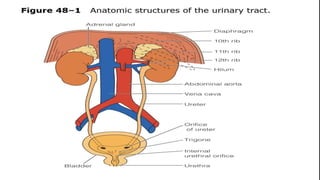
Physiology of urinary elimination
• Depends on effective functioning of:
- upper urinary tract
kidneys, ureters
- lower urinary tract
bladder, urethra, pelvic floor
• Nephron
- Functional unit of the kidney
- Urine is formed here
Points To Remember
• Glomerulus
- Fluids and solutes move across
Endothelium of capillaries into the capsule
• Proximal convoluted tubule
- Most of water and electrolytes reabsorbed
Cont.
• Ureters
- 25-30cm long and 1.25 cm in diameter
- Upper end funnel shaped, enters kidney
- Lower end enters bladder at posterior corners
• Bladder
- Hollow organ serving as reservoir for urine
• Urethra
- Extend from bladder to meatus
• Pelvic floor
- Vagina, urethra, and rectum
Urination
• Also known as micuturation and voiding
refer to the process of emptying the bladder.
Urge to void happen when an adult bladder
contains 250ml and 450ml of urine, and in children 50-200ml.
• Older adults whose cognition is impaired
may not be aware of the need to urinate or
able to respond to this urge by seeking toilet
facilities.
Factors effecting voiding
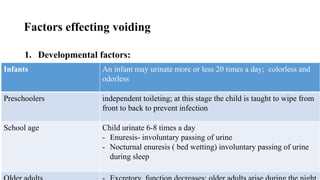
1. Developmental factors:
Infants An infant may urinate more or less 20 times a day; colorless and
odorless
Preschoolers independent toileting; at this stage the child is taught to wipe from
front to back to prevent infection
School age Child urinate 6-8 times a day
- Enuresis- involuntary passing of urine
- Nocturnal enuresis ( bed wetting) involuntary passing of urine
during sleep
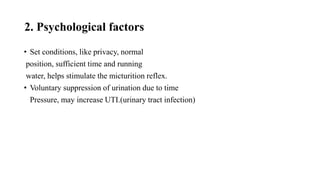
2. Psychological factors
• Set conditions, like privacy, normal
position, sufficient time and running
water, helps stimulate the micturition reflex.
• Voluntary suppression of urination due to time
Pressure, may increase UTI.(urinary tract infection)
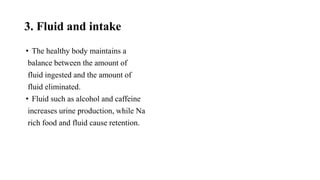
3. Fluid and intake
• The healthy body maintains a
balance between the amount of
fluid ingested and the amount of
fluid eliminated.
• Fluid such as alcohol and caffeine
increases urine production, while Na
rich food and fluid cause retention.
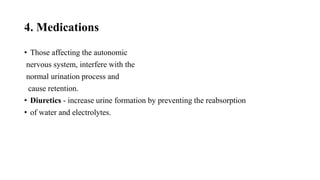
4. Medications
• Those affecting the autonomic
nervous system, interfere with the
normal urination process and
cause retention.
• Diuretics - increase urine formation by preventing the reabsorption
• of water and electrolytes.
5. Muscle tone
• Good muscle tone is important
to maintain the stretch and contractility
of the detrusor muscle so the bladder
can fill adequately and empty completely.
Pathologic Conditions
a. Diseases of the kidneys may
affect the ability of the nephrons
to produce urine.
b. Heart and circulatory disorders such
as heart failure, shock, or hypertension
can affect blood flow to the kidneys, interfering with
urine production.
c. Urinary stones- obstruct urethra
d. Hypertrophy of the prostate gland
obstruct urethra.
Surgical/diagnosis procedures
a. Cystoscopy- swelling of urethra
b. Surgery- postoperative bleeding
turning the urine pink or red.
c. Spinal anesthesia- decreases
awareness of need to void.
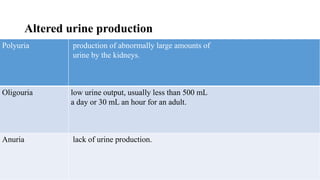
Altered urine production
Polyuria production of abnormally large amounts of
urine by the kidneys.
Oligouria low urine output, usually less than 500 mL
a day or 30 mL an hour for an adult.
Anuria lack of urine production.
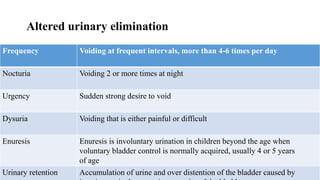
Altered urinary elimination
Frequency Voiding at frequent intervals, more than 4-6 times per day
Nocturia Voiding 2 or more times at night
Urgency Sudden strong desire to void
Dysuria Voiding that is either painful or difficult
Enuresis Enuresis is involuntary urination in children beyond the age when
voluntary bladder control is normally acquired, usually 4 or 5 years
of age
Urinary retention Accumulation of urine and over distention of the bladder caused by
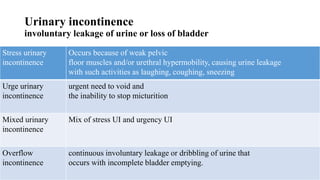
Urinary incontinence
involuntary leakage of urine or loss of bladder
Stress urinary
incontinence
Occurs because of weak pelvic
floor muscles and/or urethral hypermobility, causing urine leakage
with such activities as laughing, coughing, sneezing
Urge urinary
incontinence
urgent need to void and
the inability to stop micturition
Mixed urinary
incontinence
Mix of stress UI and urgency UI
Overflow
incontinence
continuous involuntary leakage or dribbling of urine that
occurs with incomplete bladder emptying.
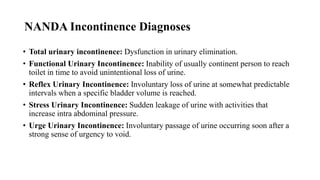
NANDA Incontinence Diagnoses
• Total urinary incontinence: Dysfunction in urinary elimination.
• Functional Urinary Incontinence: Inability of usually continent person to reach
toilet in time to avoid unintentional loss of urine.
• Reflex Urinary Incontinence: Involuntary loss of urine at somewhat predictable
intervals when a specific bladder volume is reached.
• Stress Urinary Incontinence: Sudden leakage of urine with activities that
increase intra abdominal pressure.
• Urge Urinary Incontinence: Involuntary passage of urine occurring soon after a
strong sense of urgency to void.
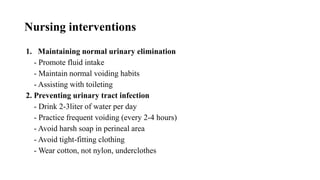
Nursing interventions
1. Maintaining normal urinary elimination
- Promote fluid intake
- Maintain normal voiding habits
- Assisting with toileting
2. Preventing urinary tract infection
- Drink 2-3liter of water per day
- Practice frequent voiding (every 2-4 hours)
- Avoid harsh soap in perineal area
- Avoid tight-fitting clothing
- Wear cotton, not nylon, underclothes
Nursing interventions cont.
3. Managing urinary incontinence by
Bladder training
Habit training
Prompt voiding
Pelvic muscle exercise e.g. Kegel exercise
Nursing interventions cont.
• Maintain skin integrity
• Applying external urinary drainage devices.
• Managing urinary retention by
medications
• Crede’s maneuver
• Urinary catheterization
Desired outcomes
• Maintain or restore normal voiding pattern.
• Regain normal urine output.
• Prevent associated risk.
• Perform toilet activities.
• Contain urine with appropriate device e.g. catheter care etc.
Kegel exercise
• Make sure your bladder is empty, then sit or lie down.
• Tighten your pelvic floor muscles. Hold tight and count 3 to 5 seconds.
• Relax the muscles and count 3 to 5 seconds.
• Repeat 10 times, 3 times a day (morning, afternoon, and night).
References
• Kozier& Erb‘s. Fundamentals of Nursing: concepts, process and practice,
11th Edition.
• Potter & Perry's, Fundamentals of Nursing,2nd Edition
Urinary elimination.pptxmmmmmmkmkkkkkkkii

Urinary elimination.pptxmmmmmmkmkkkkkkkii

  • 1.
    Urinary Elimination By Rubina Yasmin NursingInstructor College Of Nursing & Midwifery FJMU. Lahore
  • 2.
    Learning outcomes After completingthis chapter, student will be able to: 1. Describe the process of urination, from urine formation through micturition. 2. Identify factors that influence urinary elimination. 3. Identify common causes of selected urinary problems. 4. Develop nursing diagnoses and desired outcomes related to urinary elimination. 5. Describe nursing interventions to maintain normal urinary elimination, prevent urinary tract infection, and manage urinary incontinence.
  • 3.
    Introduction: • Elimination fromthe urinary tract is usually taken for granted. Only when a problem arises do most people become aware of their urinary habits and any associated symptoms • Urinary elimination is essential to health, and voiding can be postponed for only so long before the urge normally becomes too great to control.
  • 4.
    Physiology of urinaryelimination • Depends on effective functioning of: - upper urinary tract kidneys, ureters - lower urinary tract bladder, urethra, pelvic floor • Nephron - Functional unit of the kidney - Urine is formed here
  • 5.
    Points To Remember •Glomerulus - Fluids and solutes move across Endothelium of capillaries into the capsule • Proximal convoluted tubule - Most of water and electrolytes reabsorbed
  • 7.
    Cont. • Ureters - 25-30cmlong and 1.25 cm in diameter - Upper end funnel shaped, enters kidney - Lower end enters bladder at posterior corners • Bladder - Hollow organ serving as reservoir for urine • Urethra - Extend from bladder to meatus • Pelvic floor - Vagina, urethra, and rectum
  • 8.
    Urination • Also knownas micuturation and voiding refer to the process of emptying the bladder. Urge to void happen when an adult bladder contains 250ml and 450ml of urine, and in children 50-200ml. • Older adults whose cognition is impaired may not be aware of the need to urinate or able to respond to this urge by seeking toilet facilities.
  • 9.
    Factors effecting voiding 1.Developmental factors: Infants An infant may urinate more or less 20 times a day; colorless and odorless Preschoolers independent toileting; at this stage the child is taught to wipe from front to back to prevent infection School age Child urinate 6-8 times a day - Enuresis- involuntary passing of urine - Nocturnal enuresis ( bed wetting) involuntary passing of urine during sleep
  • 10.
    2. Psychological factors •Set conditions, like privacy, normal position, sufficient time and running water, helps stimulate the micturition reflex. • Voluntary suppression of urination due to time Pressure, may increase UTI.(urinary tract infection)
  • 11.
    3. Fluid andintake • The healthy body maintains a balance between the amount of fluid ingested and the amount of fluid eliminated. • Fluid such as alcohol and caffeine increases urine production, while Na rich food and fluid cause retention.
  • 12.
    4. Medications • Thoseaffecting the autonomic nervous system, interfere with the normal urination process and cause retention. • Diuretics - increase urine formation by preventing the reabsorption • of water and electrolytes.
  • 13.
    5. Muscle tone •Good muscle tone is important to maintain the stretch and contractility of the detrusor muscle so the bladder can fill adequately and empty completely.
  • 14.
    Pathologic Conditions a. Diseasesof the kidneys may affect the ability of the nephrons to produce urine. b. Heart and circulatory disorders such as heart failure, shock, or hypertension can affect blood flow to the kidneys, interfering with urine production. c. Urinary stones- obstruct urethra d. Hypertrophy of the prostate gland obstruct urethra.
  • 15.
    Surgical/diagnosis procedures a. Cystoscopy-swelling of urethra b. Surgery- postoperative bleeding turning the urine pink or red. c. Spinal anesthesia- decreases awareness of need to void.
  • 16.
    Altered urine production Polyuriaproduction of abnormally large amounts of urine by the kidneys. Oligouria low urine output, usually less than 500 mL a day or 30 mL an hour for an adult. Anuria lack of urine production.
  • 17.
    Altered urinary elimination FrequencyVoiding at frequent intervals, more than 4-6 times per day Nocturia Voiding 2 or more times at night Urgency Sudden strong desire to void Dysuria Voiding that is either painful or difficult Enuresis Enuresis is involuntary urination in children beyond the age when voluntary bladder control is normally acquired, usually 4 or 5 years of age Urinary retention Accumulation of urine and over distention of the bladder caused by
  • 18.
    Urinary incontinence involuntary leakageof urine or loss of bladder Stress urinary incontinence Occurs because of weak pelvic floor muscles and/or urethral hypermobility, causing urine leakage with such activities as laughing, coughing, sneezing Urge urinary incontinence urgent need to void and the inability to stop micturition Mixed urinary incontinence Mix of stress UI and urgency UI Overflow incontinence continuous involuntary leakage or dribbling of urine that occurs with incomplete bladder emptying.
  • 19.
    NANDA Incontinence Diagnoses •Total urinary incontinence: Dysfunction in urinary elimination. • Functional Urinary Incontinence: Inability of usually continent person to reach toilet in time to avoid unintentional loss of urine. • Reflex Urinary Incontinence: Involuntary loss of urine at somewhat predictable intervals when a specific bladder volume is reached. • Stress Urinary Incontinence: Sudden leakage of urine with activities that increase intra abdominal pressure. • Urge Urinary Incontinence: Involuntary passage of urine occurring soon after a strong sense of urgency to void.
  • 20.
    Nursing interventions 1. Maintainingnormal urinary elimination - Promote fluid intake - Maintain normal voiding habits - Assisting with toileting 2. Preventing urinary tract infection - Drink 2-3liter of water per day - Practice frequent voiding (every 2-4 hours) - Avoid harsh soap in perineal area - Avoid tight-fitting clothing - Wear cotton, not nylon, underclothes
  • 21.
    Nursing interventions cont. 3.Managing urinary incontinence by Bladder training Habit training Prompt voiding Pelvic muscle exercise e.g. Kegel exercise
  • 22.
    Nursing interventions cont. •Maintain skin integrity • Applying external urinary drainage devices. • Managing urinary retention by medications • Crede’s maneuver • Urinary catheterization
  • 23.
    Desired outcomes • Maintainor restore normal voiding pattern. • Regain normal urine output. • Prevent associated risk. • Perform toilet activities. • Contain urine with appropriate device e.g. catheter care etc.
  • 24.
    Kegel exercise • Makesure your bladder is empty, then sit or lie down. • Tighten your pelvic floor muscles. Hold tight and count 3 to 5 seconds. • Relax the muscles and count 3 to 5 seconds. • Repeat 10 times, 3 times a day (morning, afternoon, and night).
  • 25.
    References • Kozier& Erb‘s.Fundamentals of Nursing: concepts, process and practice, 11th Edition. • Potter & Perry's, Fundamentals of Nursing,2nd Edition