
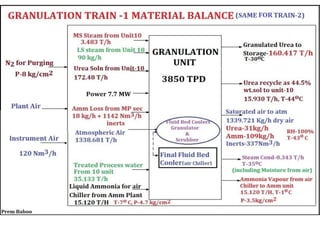




UREA GRANULATION
Presented By
**********
Prem Baboo
************** *******************************
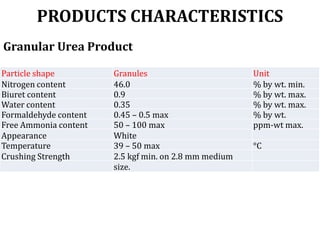
PRODUCTS CHARACTERISTICS
Particle shape Granules Unit
Nitrogen content 46.0 % by wt. min.
Biuret content 0.9 % by wt. max.
Water content 0.35 % by wt. max.
Formaldehyde content 0.45 – 0.5 max % by wt.
Free Ammonia content 50 – 100 max ppm-wt max.
Appearance White
Temperature 39 – 50 max °C
Crushing Strength 2.5 kgf min. on 2.8 mm medium
size.
Granular Urea Product
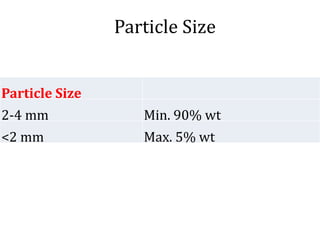
Particle Size
Particle Size
2-4 mm Min. 90% wt
<2 mm Max. 5% wt
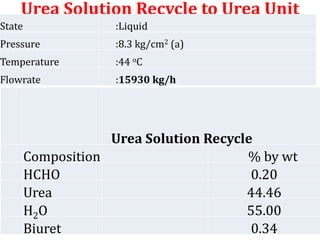
Urea Solution Recycle to Urea Unit
State :Liquid
Pressure :8.3 kg/cm2 (a)
Temperature :44 oC
Flowrate :15930 kg/h
Urea Solution Recycle
Composition % by wt
HCHO 0.20
Urea 44.46
H2O 55.00
Biuret 0.34
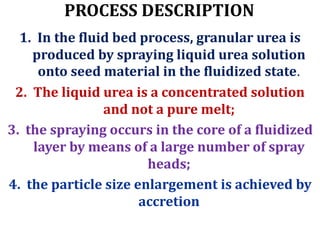
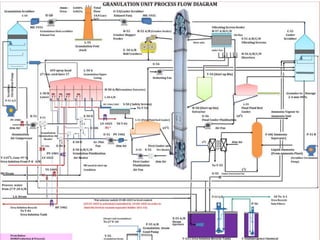
PROCESS DESCRIPTION
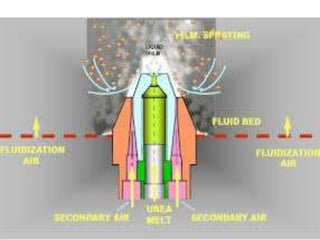
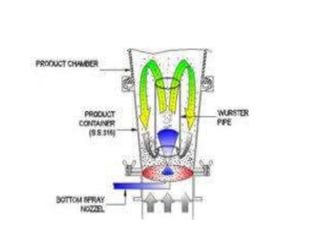
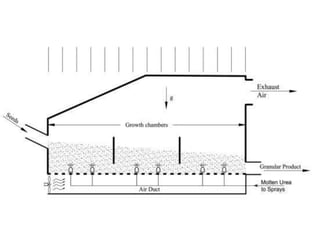
1. In the fluid bed process, granular urea is
produced by spraying liquid urea solution
onto seed material in the fluidized state.
2. The liquid urea is a concentrated solution
and not a pure melt;
3. the spraying occurs in the core of a fluidized
layer by means of a large number of spray
heads;
4. the particle size enlargement is achieved by
accretion
MODES OF GRANULATION
1. Agglomeration; i.e. adhering of several particles
to one another by solution acting as a binder.
Agglomeration often leads to a non-homogeneous
product, with rather poor mechanical properties.
2. Layering; i.e. growth by addition of successive
layers around the seed particles. Layering gives the
so-called "onion skin" structure. In the layering
process, a rather thick layer of solution is applied at
regular intervals which then is allowed to solidify
between each "dip".
3. Accretion; i.e. growth by continuous evaporation
and solidification of a large number of minute
drops of the solution onto the initial particle (seed
or nucleus).
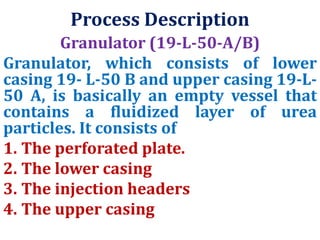
Process Description
Granulator (19-L-50-A/B)
Granulator, which consists of lower
casing 19- L-50 B and upper casing 19-L-
50 A, is basically an empty vessel that
contains a fluidized layer of urea
particles. It consists of
1. The perforated plate.
2. The lower casing
3. The injection headers
4. The upper casing
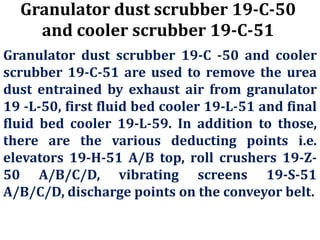
Granulator dust scrubber 19-C-50
and cooler scrubber 19-C-51
Granulator dust scrubber 19-C -50 and cooler
scrubber 19-C-51 are used to remove the urea
dust entrained by exhaust air from granulator
19 -L-50, first fluid bed cooler 19-L-51 and final
fluid bed cooler 19-L-59. In addition to those,
there are the various deducting points i.e.
elevators 19-H-51 A/B top, roll crushers 19-Z-
50 A/B/C/D, vibrating screens 19-S-51
A/B/C/D, discharge points on the conveyor belt.
First fluid bed cooler 19-L-51 and
final fluid bed cooler 19-L-59
First fluid bed cooler 19-L-51 and final fluid bed cooler
19-L-59 are standard fluid bed coolers. Fluidization air
supplied by first fluid bed cooler fluidization air fan 19
-U-52 and by final fluid bed cooler fluidization air fan
U-56 respectively is used as cooling medium
Vibrating Screen (19-S-51A/B/C/D)
and Safety Screen (19-S-50-A/B)
The safety screens 19-S -50 A/B are
provided in order to remove any lumps or
agglomerates present in the urea granules.
Vibrating screens 19-S-51 A/B/C/D are
provided to classify the urea granule
product into three fractions: oversize,
undersize and on-size.
Atomization air compressor 19-K-51 supplies
atomization air to the granulator, at the
required pressure. The preparation to start-up
of the atomization air compressor 19-K-51
consists in a sequence of operations where the
internal and external circuits and the relevant
instrumentation have to be put in service in
order to obtain the condition of machine ready
to start. The pressure normally maintained 0.5
kg/cm2g
Atomization Air Compressor 19-K-51
Bucket Elevators (19-H-51 A/B),
Conveyors and Roll Crushers (19-Z-50
A/B/C/D)
Bucket elevators are used to move the
urea granules from first fluid bed
cooler to the vibrating screen feeders
(19-H-57 A/B/C/D). Belt Conveyors
are provided to move the urea product
to the storage.
Pumps
Granulation unit consists of the following pump
1. Scrubbers Circulation Pumps (19-P-51 A/B/C/D)
2. Urea Solution Recycle Pumps (19-P-53 A/B).
3. Granulation Steam Condensate Pumps (19-P-55
A/B).
4. Emergency Chemical Basin Granulation Pump (19-
P-56)
AVERAGE PRODUCT DIAMETER
The average diameter of the final granular product is
mainly determined by:
the mesh size used for the screens of the vibrating
screens 19-S-51 A/B/C/D . roller-gap-adjustment of
the roll crushers 19-Z-50 A/B/C/D.
By reducing or widening the gaps of the upper and lower roll pair, the rate of
seeds, which are recycled to the granulator, is determined; i.e. the gap
adjustment influences the total number of nuclei per time unit, onto which
the urea feed solution is sprayed in the granulation chambers 1, 2, 3 and 4 of
granulator 19-L-50 B. Internal partition plates (weirs and baffles) are
installed inside the granulator upper casing in order to reduce back mixing.
These are fitted with an adjustable baffle which can be raised or lowered.
Adjusting the open gap between perforated plate and each of the partition
plates influences the granulator selectivity and the width of the granular size
distribution curve at granulator discharge.
STORAGE CONDITIONS / PRODUCT TEMPERATURE
Urea granules are prone to caking when stored in bulk at high
temperatures and/or at increased moisture content of the
granules. Under normal operating conditions of the urea
granulation plant, the moisture content of granular product is
below the critical limit, above which bridge formation between
the granules will occur. Besides that, the end product is treated
with formaldehyde, added as urea/formaldehyde UF85 to the
urea feed solution, which further reduces the sensitivity to
moisture pick-up. However, improper storage and loading
conditions can lead to an unacceptable increase of the product
moisture content. High relative humidity in the bulk storage will
cause moisture pick-up from ambient air inside the bulk hall,
which will result in higher caking tendency of the product. Urea
granules stored at too high temperatures will also tend to cake,
because of their high plasticity and the presence of residual
liquid phase. In addition, the slow cooling at the pile surface
• To avoid moisture pick-up and migration, the
product temperature should be kept stable (day and
night) when dumping on one heap. Only while
moving the dump car to an entirely new heap, the
product temperature can be varied depending on
ambient conditions.
• During winter operation the final product
temperature can be lowered.
START-UP SEQUENCE
The start-up sequence is characterized by the
following main phases:
1. Granulator internal check.
Granulation main fans and Atomization air
compressor 19-K-51 start-up (according to
Manufacturer procedure, refer to doc. N° xxx-xx-xx).
2.Granulator Heating up.
3.Ammonia Chilling Section Start up.
4. Start-up of the other equipments.
5. Effective start-up synchronous with solids filling
PREPARATION FOR START-UP AND PRE-
START CHECK LIST
PRE START-UP CHECK LIST
After carrying out the preliminary checks
as well as instrument and equipment
commissioning, proceed as follows:
1. Make sure that the following feedstock and
utilities are available at the battery limits in the
required quantity and quality: Urea solution with
97%wt. concentration .UF85 Start up bin filled with
urea granules Medium and Low pressure
steam.Process condensate, Steam condensate
(flushing),Polished water, Plant air ,Instrument
air,Cooling water, Nitrogen, Ammonia
1. Make sure that all the electrical equipment and the safety
systems are able to operate. Check also the alarms and trips.
2. Make sure that all the control valves are ready to operate from
control room, checking that the relevant block valves are opened and
the by-pass closed.
3. Verify that all isolation valves, located upstream and downstream
of PSV’s and thermal expansion, are fully open.
4.Check that block valves of all steam tracing and jackets are fully
open.
4. Verify that all spectacle blinds are in correct position as per P&ID.
5. Make sure that all the process lines have been carefully flushed.
6.Make sure that all the piping, pressure devices, steam jackets and
tracing have been carefully vented.
7. Check that from the highest points of Cooling Water line, no air is
coming out.
8. Make sure that all the valves of manometers, flow transmitters,
switches, transmitters, controllers and pressure regulators are open.
9. Close all the drains, vents and sample outlets.
10. Make sure that valves of all the level gauges are open. Instrument air or
condensate purge for Level and pressure instruments are ON.
11. Make sure that all the lubricating systems operate correctly and that they have
been filled with the proper type of oil and in the right quantity.
12. When steam is introduced both into the lines and in the equipment, it is
recommended to proceed slowly so as to get gradual heating. Open all the drains
upstream of the steam traps until all the condensate is drained. Open the valves of
each steam trap and close the relevant drains
13. All the pumps shall be in standby condition.
14.Close all the flushing valves.
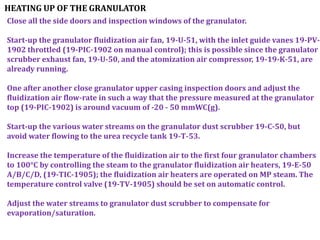
HEATING UP OF THE GRANULATOR
Close all the side doors and inspection windows of the granulator.
Start-up the granulator fluidization air fan, 19-U-51, with the inlet guide vanes 19-PV-
1902 throttled (19-PIC-1902 on manual control); this is possible since the granulator
scrubber exhaust fan, 19-U-50, and the atomization air compressor, 19-19-K-51, are
already running.
One after another close granulator upper casing inspection doors and adjust the
fluidization air flow-rate in such a way that the pressure measured at the granulator
top (19-PIC-1902) is around vacuum of -20 - 50 mmWC(g).
Start-up the various water streams on the granulator dust scrubber 19-C-50, but
avoid water flowing to the urea recycle tank 19-T-53.
Increase the temperature of the fluidization air to the first four granulator chambers
to 100°C by controlling the steam to the granulator fluidization air heaters, 19-E-50
A/B/C/D, (19-TIC-1905); the fluidization air heaters are operated on MP steam. The
temperature control valve (19-TV-1905) should be set on automatic control.
Adjust the water streams to granulator dust scrubber to compensate for
evaporation/saturation.
Start-up the dedusting fan, 19-U-54 and correct the
position of the butterfly-valves at air intake of the
various dedusting points. Set the flushing water flow to
this fan.
Heating–up of First Fluid Bed Cooler 19-L-51 and Final
Fluid Bed Cooler, 19-L-59, shall be done in parallel
with Granulator heating-up, applying the same
procedure.
START-UP OF REMAINING EQUIPMENTS
Start-up of equipment according to the following
sequence:
the roll crushers, 19-Z-50 A/B/C/D, and their feeders, 19-H-52 A/B/C/D;
the first handling belt;
the bucket elevators, 19-H-51 A/B;
the coolers scrubber exhaust fan, 19-U-53;
the final fluid bed cooler fluidization air fan, 19-U-56;
the first fluid bed cooler fluidization air fan, 19-U-52;
the safety screens, 19-S-50 A/B;
the granulator extractors, 19-H-50 A/B.
Start-up the various water streams on the fluid bed
coolers scrubber, 19-C-51.
GRANULATOR SOLID FILLS
Make sure that the start-up bin 19-T-54 is full; if not, or at first
start-up, complete or prime the installation by loading granules
into the elevator boot and direct them via the vibrating screens,
19-S-51 A/B/C/D (to be taken in operation for this occasion)
and diverters 19-H-56 A/B/C/D to the start-up bin 19-T-54.
Check, whether the granulator is already fully "dried".
Check atomization air pressure; required pressure: 0.15
kg/cm2(g) (19-PI-1903).
Set the atomization air temperature at 100°C (19-TIC-1906),
which controls the MS steam to atomization air heater E-51 by
means of 19-TV-1906; set temperature controller on automatic
control.
Start up the vibrating screens 19-S-51 A/B/C/D (if not already
done for filling the start-up bin).
Adjust diverters, 19-H-56 A/B/C/D, to redirect the on-size and fine product
to the granulator; lock diverters in their correct position.
Open slide valve of start-up bin, 19-T-54, and start the start-up bin extractor,
19-H-58 to discharge urea granules into the bucket elevators: the product
flows via the vibrating screens to the granulator;
CAUTION: avoid overloading of bucket elevators, 19-H-51 A/B.
Adjust the fluidization air flow rate to the granulator (19-PIC-1902 to be set
at 40 %, typically) to initiate fluidization of the particles; ensure a limited
under pressure in the upper disengagement zone, and switch 19-PV-1902 to
automatic control. Check visually that no particles are blown out of the
granulator to the granulator dust scrubber 19-C-50, due to a too high air flow
rate.
When minimum level in the granulator has been reached, set
the granulator extractors, 19-H-50 A/B, to minimum and open
granulator extractor flapper valves 19-L-58 A/B (by 19-HV-
1904 / 19-HV-1905).
The product is now circulating slowly through the plant,
regularly building up its temperature.
CAUTION: the fluidization air temperature should not exceed
115°C.
Fill-up the granulator to a bed height equal to 400 mmWC (19-
LIC-1901), the preset amount of fluidization air remains
constant since the automatic control of 19-PV-1902
compensates for increasing pressure/level build-up; visually
check the fluidization pattern during this operation and open
the inlet guide vanes 19-HV-1931 of granulator scrubber
exhaust fan slowly to around 55% during level build-up.
Heat up the product in the granulator fluidized bed to around
70°-80°C: control the temperature via 19-TI-1907 / 19-TI-1904
/ 19-TI-1901 / 19-TI-1908.
Check the product movement in the First Fluid Bed Cooler, 19-L-
51, and adjust the fluidization air flow rate if necessary; set a
bed layer thickness of about 50 mm with the overflow weir.
Adjust the position of the inlet guide vanes 19-HV-
1932 of the coolers scrubber exhaust fan,19-U-53, to
maintain a slight under pressure at the upper casing of
first fluid bed cooler.
When the granulator is filled, stop the feed by shutting
off the start-up bin extraction. Check the bottom
section of the start-up bin for remaining lumps.
PROCEDURE TO PUT A HEADER IN OPERATION
Open drain valve completely;
Slowly drain condensate after opening the steam valve a little;
When steam is dry, open steam valve completely;
Close drain valve;
Steam flush the injection header for about 5 seconds;
Close steam valve;
Switch the main block valve over to injection position;
Open drain valve;
Flush drain valve with steam;
Close steam valve, but keep drain valve open
PROCEDURE TO PUT A HEADER OUT OF OPERATION
Open drain valve completely;
Open steam valve to drain condensate and heat up the drain
line;
Close steam valve;
Switch the main block valve over to off position;
Before the opening of the steam valve, verify if residual solution
is drained completely through drain valve;
Open steam valve completely;
Close drain valve; Steam flush for about 5 seconds; Open drain
valve; Close steam valve
ATTENTION:
In case of shut down the headers are self
draining to the recycle tank.
NEVER steam flush headers when the bed
is not in fluidization.
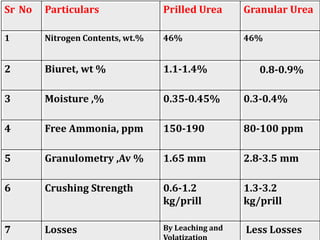
Sr. No Particulars Prilled Urea Granular Urea
1 Nitrogen Contents, wt.% 46% 46%
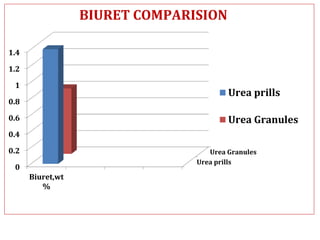
2 Biuret, wt % 1.1-1.4% 0.8-0.9%
3 Moisture ,% 0.35-0.45% 0.3-0.4%
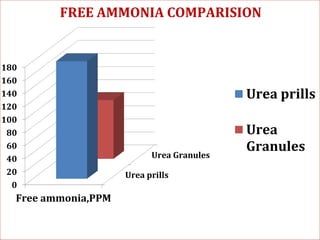
4 Free Ammonia, ppm 150-190 80-100 ppm
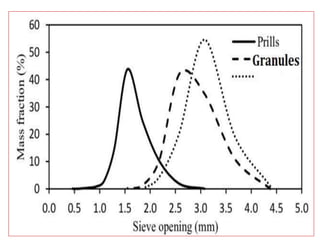
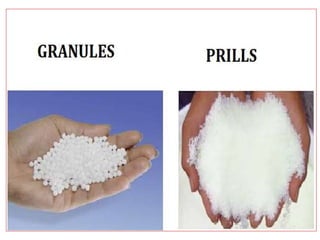
5 Granulometry ,Av % 1.65 mm 2.8-3.5 mm
6 Crushing Strength 0.6-1.2
kg/prill
1.3-3.2
kg/prill
7 Losses By Leaching and Less Losses
Urea prills
Urea Granules
0
0.2
0.4
0.6
0.8
1
1.2
1.4
Biuret,wt
%
Urea prills
Urea Granules
BIURET COMPARISION
Urea prills,Kg/Prill
Urea
Granules,Kg/granule
0
0.5
1
1.5
2
2.5
3
3.5
Crushing Strength
Urea prills,Kg/Prill
Urea
Granules,Kg/granule
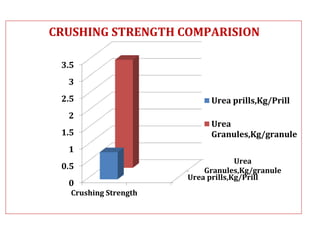
CRUSHING STRENGTH COMPARISION
Urea prills
Urea Granules
0
20
40
60
80
100
120
140
160
180
Free ammonia,PPM
Urea prills
Urea
Granules
FREE AMMONIA COMPARISION
Sr. No Particulars Prilled Urea Granular Urea
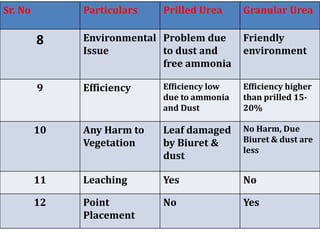
8 Environmental
Issue
Problem due
to dust and
free ammonia
Friendly
environment
9 Efficiency Efficiency low
due to ammonia
and Dust
Efficiency higher
than prilled 15-
20%
10 Any Harm to
Vegetation
Leaf damaged
by Biuret &
dust
No Harm, Due
Biuret & dust are
less
11 Leaching Yes No
12 Point
Placement
No Yes
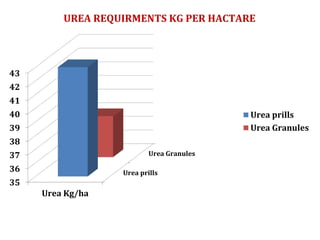
Urea prills
Urea Granules
35
36
37
38
39
40
41
42
43
Urea Kg/ha
Urea prills
Urea Granules
UREA REQUIRMENTS KG PER HACTARE
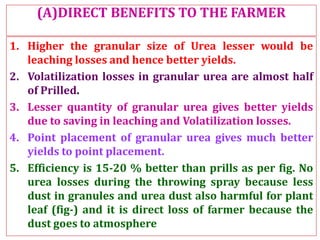
(A)DIRECT BENEFITS TO THE FARMER
1. Higher the granular size of Urea lesser would be
leaching losses and hence better yields.
2. Volatilization losses in granular urea are almost half
of Prilled.
3. Lesser quantity of granular urea gives better yields
due to saving in leaching and Volatilization losses.
4. Point placement of granular urea gives much better
yields to point placement.
5. Efficiency is 15-20 % better than prills as per fig. No
urea losses during the throwing spray because less
dust in granules and urea dust also harmful for plant
leaf (fig-) and it is direct loss of farmer because the
dust goes to atmosphere
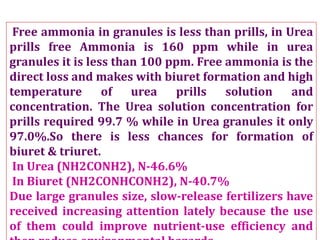
Free ammonia in granules is less than prills, in Urea
prills free Ammonia is 160 ppm while in urea
granules it is less than 100 ppm. Free ammonia is the
direct loss and makes with biuret formation and high
temperature of urea prills solution and
concentration. The Urea solution concentration for
prills required 99.7 % while in Urea granules it only
97.0%.So there is less chances for formation of
biuret & triuret.
In Urea (NH2CONH2), N-46.6%
In Biuret (NH2CONHCONH2), N-40.7%
Due large granules size, slow-release fertilizers have
received increasing attention lately because the use
of them could improve nutrient-use efficiency and
(B)MORE BENIFICIAL DUE TO
CRUSHING STRENGTH
The urea granule crushing strength is
approximately is about three times higher than
the prills so the losses during handling is also
minimum. Generally, the crushing strength about
600 gm to 1.2 Kg per prill. The crushing strength
of Granule Urea is about 1.3 to 3.2 kg per granule.
The crushing strength of fertilizer particles
differs greatly depending on the chemical
composition. Crushing strength is the minimum
pressure needed to crush individual particles.
(B)MORE BENIFICIAL DUE TO
CRUSHING STRENGTH
The urea granule crushing strength is
approximately is about three times higher than
the prills so the losses during handling is also
minimum. Generally, the crushing strength about
600 gm to 1.2 Kg per prill. The crushing strength
of Granule Urea is about 1.3 to 3.2 kg per granule.
The crushing strength of fertilizer particles
differs greatly depending on the chemical
composition. Crushing strength is the minimum
pressure needed to crush individual particles.
(C) UREA GRANULES ARE ENVIRONMENT
FRIENDLY
Less leaching loss hence, environment friendly and
less dust losses. In also prilling process. The prilling
tower is the major source of emission in urea plants.
The large volume of discharge untreated cooling air
contain particulate urea dust 1-2 kg/ton of urea as
well as ammonia 0.7 -1.0 kg/ton of urea. In force draft
prilling tower this figures are 2-5 kg/ton of urea and
ammonia 0.8-1.5 kg/ton of urea. Increasing the load
on a prilling tower can have negative consequence of
prills quality. higher moisture contents and higher
temperature cause more dust formation and
increased likelihood of caking problems. Urea prills
Recommendation
Granulated Urea is as efficient as any other
nitrogen fertilizer when incorporated into soil
immediately after application. Urea often has a
lower density than other fertilizers with which
it is blended. This lack of “weight” produces
shorter “distance of throw” when fertilizer is
applied with spinner – type equipment. In
extreme cases this will result in uneven crop
growth and “wavy” or “streaky” fields
In crops like paddy when it has to be used in
standing water, as being larger size it takes a
IN BRIEF
 Better industrial quality.
 Even granulometry.
 Harder granules.
 Absorbs lesser moisture from atmosphere.
 Can be mixed with other fertilizers.
 Does not become compact.
 Best adaptation to humid climates.
 Less leaching loss hence, environment friendly.
 It has less fines and dust when handled and transported.
 It is three times harder than prilled urea.
 Granules are larger, harder and more resistant to moisture.
As a result, granulated urea has become a more suitable
material for fertilizer blends Best Condition for efficient
absorption of ammonium ions.
Urea granulation

Urea granulation

  • 1.
    UREA GRANULATION Presented By ********** PremBaboo ************** *******************************
  • 2.
    PRODUCTS CHARACTERISTICS Particle shapeGranules Unit Nitrogen content 46.0 % by wt. min. Biuret content 0.9 % by wt. max. Water content 0.35 % by wt. max. Formaldehyde content 0.45 – 0.5 max % by wt. Free Ammonia content 50 – 100 max ppm-wt max. Appearance White Temperature 39 – 50 max °C Crushing Strength 2.5 kgf min. on 2.8 mm medium size. Granular Urea Product
  • 3.
    Particle Size Particle Size 2-4mm Min. 90% wt <2 mm Max. 5% wt
  • 4.
    Urea Solution Recycleto Urea Unit State :Liquid Pressure :8.3 kg/cm2 (a) Temperature :44 oC Flowrate :15930 kg/h Urea Solution Recycle Composition % by wt HCHO 0.20 Urea 44.46 H2O 55.00 Biuret 0.34
  • 5.
    PROCESS DESCRIPTION 1. Inthe fluid bed process, granular urea is produced by spraying liquid urea solution onto seed material in the fluidized state. 2. The liquid urea is a concentrated solution and not a pure melt; 3. the spraying occurs in the core of a fluidized layer by means of a large number of spray heads; 4. the particle size enlargement is achieved by accretion
  • 6.
    MODES OF GRANULATION 1.Agglomeration; i.e. adhering of several particles to one another by solution acting as a binder. Agglomeration often leads to a non-homogeneous product, with rather poor mechanical properties. 2. Layering; i.e. growth by addition of successive layers around the seed particles. Layering gives the so-called "onion skin" structure. In the layering process, a rather thick layer of solution is applied at regular intervals which then is allowed to solidify between each "dip". 3. Accretion; i.e. growth by continuous evaporation and solidification of a large number of minute drops of the solution onto the initial particle (seed or nucleus).
  • 12.
    Process Description Granulator (19-L-50-A/B) Granulator,which consists of lower casing 19- L-50 B and upper casing 19-L- 50 A, is basically an empty vessel that contains a fluidized layer of urea particles. It consists of 1. The perforated plate. 2. The lower casing 3. The injection headers 4. The upper casing
  • 13.
    Granulator dust scrubber19-C-50 and cooler scrubber 19-C-51 Granulator dust scrubber 19-C -50 and cooler scrubber 19-C-51 are used to remove the urea dust entrained by exhaust air from granulator 19 -L-50, first fluid bed cooler 19-L-51 and final fluid bed cooler 19-L-59. In addition to those, there are the various deducting points i.e. elevators 19-H-51 A/B top, roll crushers 19-Z- 50 A/B/C/D, vibrating screens 19-S-51 A/B/C/D, discharge points on the conveyor belt.
  • 14.
    First fluid bedcooler 19-L-51 and final fluid bed cooler 19-L-59 First fluid bed cooler 19-L-51 and final fluid bed cooler 19-L-59 are standard fluid bed coolers. Fluidization air supplied by first fluid bed cooler fluidization air fan 19 -U-52 and by final fluid bed cooler fluidization air fan U-56 respectively is used as cooling medium
  • 15.
    Vibrating Screen (19-S-51A/B/C/D) andSafety Screen (19-S-50-A/B) The safety screens 19-S -50 A/B are provided in order to remove any lumps or agglomerates present in the urea granules. Vibrating screens 19-S-51 A/B/C/D are provided to classify the urea granule product into three fractions: oversize, undersize and on-size.
  • 16.
    Atomization air compressor19-K-51 supplies atomization air to the granulator, at the required pressure. The preparation to start-up of the atomization air compressor 19-K-51 consists in a sequence of operations where the internal and external circuits and the relevant instrumentation have to be put in service in order to obtain the condition of machine ready to start. The pressure normally maintained 0.5 kg/cm2g Atomization Air Compressor 19-K-51
  • 17.
    Bucket Elevators (19-H-51A/B), Conveyors and Roll Crushers (19-Z-50 A/B/C/D) Bucket elevators are used to move the urea granules from first fluid bed cooler to the vibrating screen feeders (19-H-57 A/B/C/D). Belt Conveyors are provided to move the urea product to the storage.
  • 18.
    Pumps Granulation unit consistsof the following pump 1. Scrubbers Circulation Pumps (19-P-51 A/B/C/D) 2. Urea Solution Recycle Pumps (19-P-53 A/B). 3. Granulation Steam Condensate Pumps (19-P-55 A/B). 4. Emergency Chemical Basin Granulation Pump (19- P-56)
  • 19.
    AVERAGE PRODUCT DIAMETER Theaverage diameter of the final granular product is mainly determined by: the mesh size used for the screens of the vibrating screens 19-S-51 A/B/C/D . roller-gap-adjustment of the roll crushers 19-Z-50 A/B/C/D. By reducing or widening the gaps of the upper and lower roll pair, the rate of seeds, which are recycled to the granulator, is determined; i.e. the gap adjustment influences the total number of nuclei per time unit, onto which the urea feed solution is sprayed in the granulation chambers 1, 2, 3 and 4 of granulator 19-L-50 B. Internal partition plates (weirs and baffles) are installed inside the granulator upper casing in order to reduce back mixing. These are fitted with an adjustable baffle which can be raised or lowered. Adjusting the open gap between perforated plate and each of the partition plates influences the granulator selectivity and the width of the granular size distribution curve at granulator discharge.
  • 20.
    STORAGE CONDITIONS /PRODUCT TEMPERATURE Urea granules are prone to caking when stored in bulk at high temperatures and/or at increased moisture content of the granules. Under normal operating conditions of the urea granulation plant, the moisture content of granular product is below the critical limit, above which bridge formation between the granules will occur. Besides that, the end product is treated with formaldehyde, added as urea/formaldehyde UF85 to the urea feed solution, which further reduces the sensitivity to moisture pick-up. However, improper storage and loading conditions can lead to an unacceptable increase of the product moisture content. High relative humidity in the bulk storage will cause moisture pick-up from ambient air inside the bulk hall, which will result in higher caking tendency of the product. Urea granules stored at too high temperatures will also tend to cake, because of their high plasticity and the presence of residual liquid phase. In addition, the slow cooling at the pile surface
  • 21.
    • To avoidmoisture pick-up and migration, the product temperature should be kept stable (day and night) when dumping on one heap. Only while moving the dump car to an entirely new heap, the product temperature can be varied depending on ambient conditions. • During winter operation the final product temperature can be lowered.
  • 22.
    START-UP SEQUENCE The start-upsequence is characterized by the following main phases: 1. Granulator internal check. Granulation main fans and Atomization air compressor 19-K-51 start-up (according to Manufacturer procedure, refer to doc. N° xxx-xx-xx). 2.Granulator Heating up. 3.Ammonia Chilling Section Start up. 4. Start-up of the other equipments. 5. Effective start-up synchronous with solids filling
  • 23.
    PREPARATION FOR START-UPAND PRE- START CHECK LIST PRE START-UP CHECK LIST After carrying out the preliminary checks as well as instrument and equipment commissioning, proceed as follows: 1. Make sure that the following feedstock and utilities are available at the battery limits in the required quantity and quality: Urea solution with 97%wt. concentration .UF85 Start up bin filled with urea granules Medium and Low pressure steam.Process condensate, Steam condensate (flushing),Polished water, Plant air ,Instrument air,Cooling water, Nitrogen, Ammonia
  • 24.
    1. Make surethat all the electrical equipment and the safety systems are able to operate. Check also the alarms and trips. 2. Make sure that all the control valves are ready to operate from control room, checking that the relevant block valves are opened and the by-pass closed. 3. Verify that all isolation valves, located upstream and downstream of PSV’s and thermal expansion, are fully open. 4.Check that block valves of all steam tracing and jackets are fully open. 4. Verify that all spectacle blinds are in correct position as per P&ID. 5. Make sure that all the process lines have been carefully flushed. 6.Make sure that all the piping, pressure devices, steam jackets and tracing have been carefully vented. 7. Check that from the highest points of Cooling Water line, no air is coming out. 8. Make sure that all the valves of manometers, flow transmitters, switches, transmitters, controllers and pressure regulators are open.
  • 25.
    9. Close allthe drains, vents and sample outlets. 10. Make sure that valves of all the level gauges are open. Instrument air or condensate purge for Level and pressure instruments are ON. 11. Make sure that all the lubricating systems operate correctly and that they have been filled with the proper type of oil and in the right quantity. 12. When steam is introduced both into the lines and in the equipment, it is recommended to proceed slowly so as to get gradual heating. Open all the drains upstream of the steam traps until all the condensate is drained. Open the valves of each steam trap and close the relevant drains 13. All the pumps shall be in standby condition. 14.Close all the flushing valves.
  • 26.
    HEATING UP OFTHE GRANULATOR Close all the side doors and inspection windows of the granulator. Start-up the granulator fluidization air fan, 19-U-51, with the inlet guide vanes 19-PV- 1902 throttled (19-PIC-1902 on manual control); this is possible since the granulator scrubber exhaust fan, 19-U-50, and the atomization air compressor, 19-19-K-51, are already running. One after another close granulator upper casing inspection doors and adjust the fluidization air flow-rate in such a way that the pressure measured at the granulator top (19-PIC-1902) is around vacuum of -20 - 50 mmWC(g). Start-up the various water streams on the granulator dust scrubber 19-C-50, but avoid water flowing to the urea recycle tank 19-T-53. Increase the temperature of the fluidization air to the first four granulator chambers to 100°C by controlling the steam to the granulator fluidization air heaters, 19-E-50 A/B/C/D, (19-TIC-1905); the fluidization air heaters are operated on MP steam. The temperature control valve (19-TV-1905) should be set on automatic control. Adjust the water streams to granulator dust scrubber to compensate for evaporation/saturation.
  • 27.
    Start-up the dedustingfan, 19-U-54 and correct the position of the butterfly-valves at air intake of the various dedusting points. Set the flushing water flow to this fan. Heating–up of First Fluid Bed Cooler 19-L-51 and Final Fluid Bed Cooler, 19-L-59, shall be done in parallel with Granulator heating-up, applying the same procedure.
  • 28.
    START-UP OF REMAININGEQUIPMENTS Start-up of equipment according to the following sequence: the roll crushers, 19-Z-50 A/B/C/D, and their feeders, 19-H-52 A/B/C/D; the first handling belt; the bucket elevators, 19-H-51 A/B; the coolers scrubber exhaust fan, 19-U-53; the final fluid bed cooler fluidization air fan, 19-U-56; the first fluid bed cooler fluidization air fan, 19-U-52; the safety screens, 19-S-50 A/B; the granulator extractors, 19-H-50 A/B. Start-up the various water streams on the fluid bed coolers scrubber, 19-C-51.
  • 29.
    GRANULATOR SOLID FILLS Makesure that the start-up bin 19-T-54 is full; if not, or at first start-up, complete or prime the installation by loading granules into the elevator boot and direct them via the vibrating screens, 19-S-51 A/B/C/D (to be taken in operation for this occasion) and diverters 19-H-56 A/B/C/D to the start-up bin 19-T-54. Check, whether the granulator is already fully "dried".
  • 30.
    Check atomization airpressure; required pressure: 0.15 kg/cm2(g) (19-PI-1903). Set the atomization air temperature at 100°C (19-TIC-1906), which controls the MS steam to atomization air heater E-51 by means of 19-TV-1906; set temperature controller on automatic control. Start up the vibrating screens 19-S-51 A/B/C/D (if not already done for filling the start-up bin).
  • 31.
    Adjust diverters, 19-H-56A/B/C/D, to redirect the on-size and fine product to the granulator; lock diverters in their correct position. Open slide valve of start-up bin, 19-T-54, and start the start-up bin extractor, 19-H-58 to discharge urea granules into the bucket elevators: the product flows via the vibrating screens to the granulator; CAUTION: avoid overloading of bucket elevators, 19-H-51 A/B. Adjust the fluidization air flow rate to the granulator (19-PIC-1902 to be set at 40 %, typically) to initiate fluidization of the particles; ensure a limited under pressure in the upper disengagement zone, and switch 19-PV-1902 to automatic control. Check visually that no particles are blown out of the granulator to the granulator dust scrubber 19-C-50, due to a too high air flow rate.
  • 32.
    When minimum levelin the granulator has been reached, set the granulator extractors, 19-H-50 A/B, to minimum and open granulator extractor flapper valves 19-L-58 A/B (by 19-HV- 1904 / 19-HV-1905). The product is now circulating slowly through the plant, regularly building up its temperature. CAUTION: the fluidization air temperature should not exceed 115°C.
  • 33.
    Fill-up the granulatorto a bed height equal to 400 mmWC (19- LIC-1901), the preset amount of fluidization air remains constant since the automatic control of 19-PV-1902 compensates for increasing pressure/level build-up; visually check the fluidization pattern during this operation and open the inlet guide vanes 19-HV-1931 of granulator scrubber exhaust fan slowly to around 55% during level build-up. Heat up the product in the granulator fluidized bed to around 70°-80°C: control the temperature via 19-TI-1907 / 19-TI-1904 / 19-TI-1901 / 19-TI-1908. Check the product movement in the First Fluid Bed Cooler, 19-L- 51, and adjust the fluidization air flow rate if necessary; set a bed layer thickness of about 50 mm with the overflow weir.
  • 34.
    Adjust the positionof the inlet guide vanes 19-HV- 1932 of the coolers scrubber exhaust fan,19-U-53, to maintain a slight under pressure at the upper casing of first fluid bed cooler. When the granulator is filled, stop the feed by shutting off the start-up bin extraction. Check the bottom section of the start-up bin for remaining lumps.
  • 35.
    PROCEDURE TO PUTA HEADER IN OPERATION Open drain valve completely; Slowly drain condensate after opening the steam valve a little; When steam is dry, open steam valve completely; Close drain valve; Steam flush the injection header for about 5 seconds; Close steam valve; Switch the main block valve over to injection position; Open drain valve; Flush drain valve with steam; Close steam valve, but keep drain valve open
  • 36.
    PROCEDURE TO PUTA HEADER OUT OF OPERATION Open drain valve completely; Open steam valve to drain condensate and heat up the drain line; Close steam valve; Switch the main block valve over to off position; Before the opening of the steam valve, verify if residual solution is drained completely through drain valve; Open steam valve completely; Close drain valve; Steam flush for about 5 seconds; Open drain valve; Close steam valve
  • 37.
    ATTENTION: In case ofshut down the headers are self draining to the recycle tank. NEVER steam flush headers when the bed is not in fluidization.
  • 38.
    Sr. No ParticularsPrilled Urea Granular Urea 1 Nitrogen Contents, wt.% 46% 46% 2 Biuret, wt % 1.1-1.4% 0.8-0.9% 3 Moisture ,% 0.35-0.45% 0.3-0.4% 4 Free Ammonia, ppm 150-190 80-100 ppm 5 Granulometry ,Av % 1.65 mm 2.8-3.5 mm 6 Crushing Strength 0.6-1.2 kg/prill 1.3-3.2 kg/prill 7 Losses By Leaching and Less Losses
  • 39.
  • 40.
    Urea prills,Kg/Prill Urea Granules,Kg/granule 0 0.5 1 1.5 2 2.5 3 3.5 Crushing Strength Ureaprills,Kg/Prill Urea Granules,Kg/granule CRUSHING STRENGTH COMPARISION
  • 41.
    Urea prills Urea Granules 0 20 40 60 80 100 120 140 160 180 Freeammonia,PPM Urea prills Urea Granules FREE AMMONIA COMPARISION
  • 42.
    Sr. No ParticularsPrilled Urea Granular Urea 8 Environmental Issue Problem due to dust and free ammonia Friendly environment 9 Efficiency Efficiency low due to ammonia and Dust Efficiency higher than prilled 15- 20% 10 Any Harm to Vegetation Leaf damaged by Biuret & dust No Harm, Due Biuret & dust are less 11 Leaching Yes No 12 Point Placement No Yes
  • 43.
    Urea prills Urea Granules 35 36 37 38 39 40 41 42 43 UreaKg/ha Urea prills Urea Granules UREA REQUIRMENTS KG PER HACTARE
  • 44.
    (A)DIRECT BENEFITS TOTHE FARMER 1. Higher the granular size of Urea lesser would be leaching losses and hence better yields. 2. Volatilization losses in granular urea are almost half of Prilled. 3. Lesser quantity of granular urea gives better yields due to saving in leaching and Volatilization losses. 4. Point placement of granular urea gives much better yields to point placement. 5. Efficiency is 15-20 % better than prills as per fig. No urea losses during the throwing spray because less dust in granules and urea dust also harmful for plant leaf (fig-) and it is direct loss of farmer because the dust goes to atmosphere
  • 45.
    Free ammonia ingranules is less than prills, in Urea prills free Ammonia is 160 ppm while in urea granules it is less than 100 ppm. Free ammonia is the direct loss and makes with biuret formation and high temperature of urea prills solution and concentration. The Urea solution concentration for prills required 99.7 % while in Urea granules it only 97.0%.So there is less chances for formation of biuret & triuret. In Urea (NH2CONH2), N-46.6% In Biuret (NH2CONHCONH2), N-40.7% Due large granules size, slow-release fertilizers have received increasing attention lately because the use of them could improve nutrient-use efficiency and
  • 48.
    (B)MORE BENIFICIAL DUETO CRUSHING STRENGTH The urea granule crushing strength is approximately is about three times higher than the prills so the losses during handling is also minimum. Generally, the crushing strength about 600 gm to 1.2 Kg per prill. The crushing strength of Granule Urea is about 1.3 to 3.2 kg per granule. The crushing strength of fertilizer particles differs greatly depending on the chemical composition. Crushing strength is the minimum pressure needed to crush individual particles.
  • 49.
    (B)MORE BENIFICIAL DUETO CRUSHING STRENGTH The urea granule crushing strength is approximately is about three times higher than the prills so the losses during handling is also minimum. Generally, the crushing strength about 600 gm to 1.2 Kg per prill. The crushing strength of Granule Urea is about 1.3 to 3.2 kg per granule. The crushing strength of fertilizer particles differs greatly depending on the chemical composition. Crushing strength is the minimum pressure needed to crush individual particles.
  • 50.
    (C) UREA GRANULESARE ENVIRONMENT FRIENDLY Less leaching loss hence, environment friendly and less dust losses. In also prilling process. The prilling tower is the major source of emission in urea plants. The large volume of discharge untreated cooling air contain particulate urea dust 1-2 kg/ton of urea as well as ammonia 0.7 -1.0 kg/ton of urea. In force draft prilling tower this figures are 2-5 kg/ton of urea and ammonia 0.8-1.5 kg/ton of urea. Increasing the load on a prilling tower can have negative consequence of prills quality. higher moisture contents and higher temperature cause more dust formation and increased likelihood of caking problems. Urea prills
  • 54.
    Recommendation Granulated Urea isas efficient as any other nitrogen fertilizer when incorporated into soil immediately after application. Urea often has a lower density than other fertilizers with which it is blended. This lack of “weight” produces shorter “distance of throw” when fertilizer is applied with spinner – type equipment. In extreme cases this will result in uneven crop growth and “wavy” or “streaky” fields In crops like paddy when it has to be used in standing water, as being larger size it takes a
  • 55.
    IN BRIEF  Betterindustrial quality.  Even granulometry.  Harder granules.  Absorbs lesser moisture from atmosphere.  Can be mixed with other fertilizers.  Does not become compact.  Best adaptation to humid climates.  Less leaching loss hence, environment friendly.  It has less fines and dust when handled and transported.  It is three times harder than prilled urea.  Granules are larger, harder and more resistant to moisture. As a result, granulated urea has become a more suitable material for fertilizer blends Best Condition for efficient absorption of ammonium ions.