INDUSTRIAL TRAINING
KANPUR FERTILIZERS AND CEMENT LIMITED
CONTENT
 COMPANY PROFILE
 INTRODUCTION
 PROPERTIES OF UREA
 METHOD OF PRODUCTION OF UREA
 PROCESS DISCRIPTION
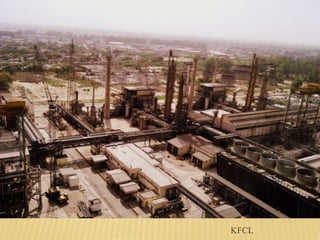
KFCL
COMPANY PROFILE
• KFCL was commissioned in December 1969 as
the name of Duncans fertilizers limited.
• Now it is handed over to the Jaypee group.
• Company has a turnover of Rs. 1000 crores in the
year 2010.
• There are 3 Ammonia plant units and 2 Urea plant
units.
• Capacity of Urea plant is 730 TPD.
INTRODUCTION
Urea (identified 1773), the first organic compound prepared
by inorganic synthesis (1828 Wohler)
NH₃ + HCNO → CO(NH₂)₂
• Commercial production started in :
1922 – Germany, 1932 – USA and 1935 – UK.
• Urea has been considered as slow – release fertilizer since it
must undergo two transportations:
1. Hydrolysis.
2. Nitrification: NH₃ → Nitrite or Nitrate (Microbes, moist and
warm soil )
• Biuret is the impurity in urea.
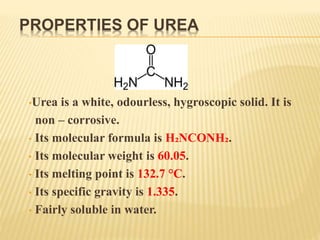
PROPERTIES OF UREA
•Urea is a white, odourless, hygroscopic solid. It is
non – corrosive.
• Its molecular formula is H₂NCONH₂.
• Its molecular weight is 60.05.
• Its melting point is 132.7 °C.
• Its specific gravity is 1.335.
• Fairly soluble in water.
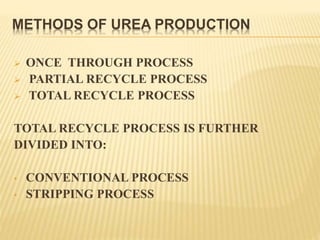
METHODS OF UREA PRODUCTION
 ONCE THROUGH PROCESS
 PARTIAL RECYCLE PROCESS
 TOTAL RECYCLE PROCESS
TOTAL RECYCLE PROCESS IS FURTHER
DIVIDED INTO:
• CONVENTIONAL PROCESS
• STRIPPING PROCESS
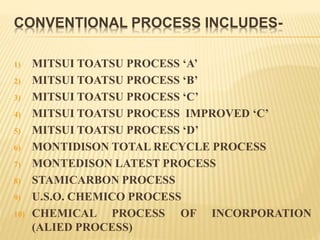
CONVENTIONAL PROCESS INCLUDES-
1) MITSUI TOATSU PROCESS ‘A’
2) MITSUI TOATSU PROCESS ‘B’
3) MITSUI TOATSU PROCESS ‘C’
4) MITSUI TOATSU PROCESS IMPROVED ‘C’
5) MITSUI TOATSU PROCESS ‘D’
6) MONTIDISON TOTAL RECYCLE PROCESS
7) MONTEDISON LATEST PROCESS
8) STAMICARBON PROCESS
9) U.S.O. CHEMICO PROCESS
10) CHEMICAL PROCESS OF INCORPORATION
(ALIED PROCESS)
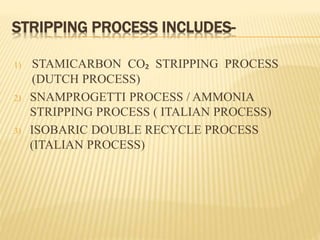
STRIPPING PROCESS INCLUDES-
1) STAMICARBON CO₂ STRIPPING PROCESS
(DUTCH PROCESS)
2) SNAMPROGETTI PROCESS / AMMONIA
STRIPPING PROCESS ( ITALIAN PROCESS)
3) ISOBARIC DOUBLE RECYCLE PROCESS
(ITALIAN PROCESS)
MITSUI TOATSU TOTAL RECYCLE- C
PROCESS
• The total recycle urea process is a conventional carbamate
solution recycle process with three pressure-staged carbamate
decomposition & recovery systems. The reactor is operated at
about 190 o C, 220 kg/cm2. About 67 % of the total ammonium
carbamate present in the reactor is converted to urea.
• The unconverted carbamate is decomposed and stripped from
the urea solution together with excess NH3 in a series of three
pressure-stage decomposers, operating respectively at about
18 atm & 150oC, 3.06 atm & 130 oC, & atmospheric pressure
& 120 o C.
CONTINUED...
 The main feature of the Mitsui Toatsu process is the
fact that the gaseous phase in each decomposition
stage is contacted in counter-current flow with the
urea product solution issuing from the preceeding
decomposition stage. Either a packed section or a
sieve tray section is used for this purpose. The effect
is that the NH3 & CO2 gaseous mixture obtained
from the decomposition of carbamate is considerably
reduced in vapor content. Thus the amount of water
recycled to the reactor is maintained at a relatively
low level and a relatively high conversion in the
reactor is attained. The off-gas from each
CONTINUED...
 Excess NH3 is separated from the aqueous solution of
carbamate & scrubbed from the last traces of CO2 in counter
current flow with reflux liquid, NH3, fed to the top of the high
pressure absorber. The pure excess NH3 thus obtained is
condensed to liquid with cooling water & recycled to the
reactor. The carbamate solution is recycled back to the reactor
for total recovery.
RAW MATERIALS
 AMMONIA (LIQUID): AVAILABLE AT 220 kg/cm2
& 1900 C.
SPECIFICATIONS: NH₃(MIN.) - 99.5% WT
WATER - 0.5% WT
OIL - 10 PPM (MAX)
 CARBON DIOXIDE (GAS): AVAILABLE AT 220
kg/cm2 & 130° C
REACTION INVOLVES
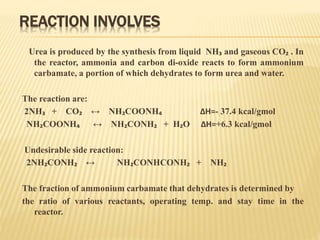
Urea is produced by the synthesis from liquid NH₃ and gaseous CO₂ . In
the reactor, ammonia and carbon di-oxide reacts to form ammonium
carbamate, a portion of which dehydrates to form urea and water.
The reaction are:
2NH₃ + CO₂ ↔ NH₂COONH₄ ∆H=- 37.4 kcal/gmol
NH₂COONH₄ ↔ NH₂CONH₂ + H₂O ∆H=+6.3 kcal/gmol
Undesirable side reaction:
2NH₂CONH₂ ↔ NH₂CONHCONH₂ + NH₂
The fraction of ammonium carbamate that dehydrates is determined by
the ratio of various reactants, operating temp. and stay time in the
reactor.
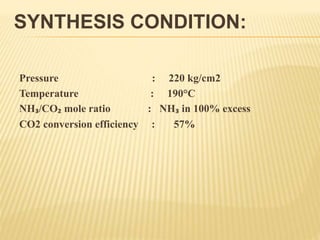
SYNTHESIS CONDITION:
Pressure : 220 kg/cm2
Temperature : 190°C
NH₃/CO₂ mole ratio : NH₃ in 100% excess
CO2 conversion efficiency : 57%
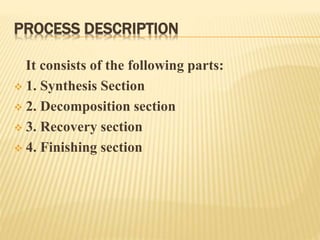
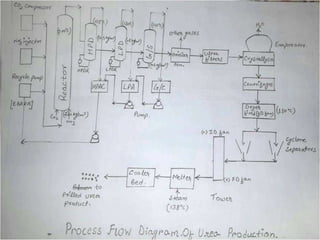
PROCESS DESCRIPTION
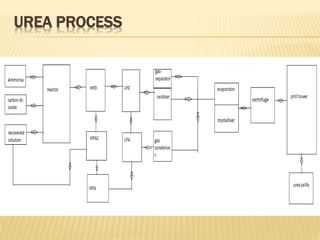
It consists of the following parts:
 1. Synthesis Section
 2. Decomposition section
 3. Recovery section
 4. Finishing section
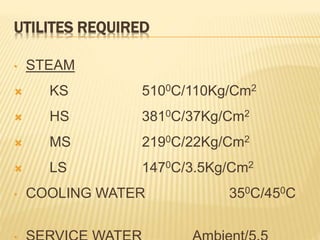
UTILITES REQUIRED
• STEAM
 KS 5100C/110Kg/Cm2
 HS 3810C/37Kg/Cm2
 MS 2190C/22Kg/Cm2
 LS 1470C/3.5Kg/Cm2
• COOLING WATER 350C/450C
UREA PROCESS
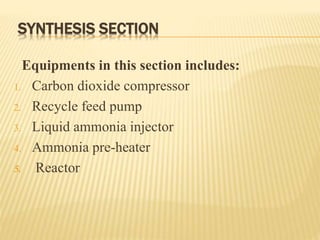
SYNTHESIS SECTION
Equipments in this section includes:
1. Carbon dioxide compressor
2. Recycle feed pump
3. Liquid ammonia injector
4. Ammonia pre-heater
5. Reactor
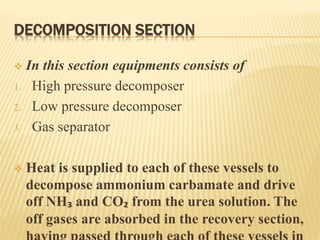
DECOMPOSITION SECTION
 In this section equipments consists of
1. High pressure decomposer
2. Low pressure decomposer
3. Gas separator
 Heat is supplied to each of these vessels to
decompose ammonium carbamate and drive
off NH₃ and CO₂ from the urea solution. The
off gases are absorbed in the recovery section,
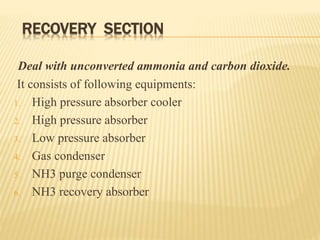
RECOVERY SECTION
Deal with unconverted ammonia and carbon dioxide.
It consists of following equipments:
1. High pressure absorber cooler
2. High pressure absorber
3. Low pressure absorber
4. Gas condenser
5. NH3 purge condenser
6. NH3 recovery absorber
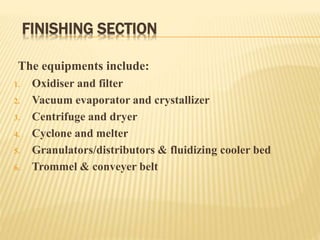
FINISHING SECTION
The equipments include:
1. Oxidiser and filter
2. Vacuum evaporator and crystallizer
3. Centrifuge and dryer
4. Cyclone and melter
5. Granulators/distributors & fluidizing cooler bed
6. Trommel & conveyer belt
ENGINEERING PROBLEMS:
*Carbamate decomposition and recycle.
*Production of granular urea.
*Heat dissipation in the autoclave.
*Allide chemicals high pressure process.
*Corrosion.
USES OF UREA
 About 56 % of Urea manufactured is used in
solid fertilizers.
 About 31 % of Urea manufactured is used in
liquid fertilizers.
 Urea-formaldehyde resins have large use as
a plywood adhesive.
 Main N₂ fertilizer, specially for the flooded
region.
 Melamine-formaldehyde resins are used as

kfcl.pptx for training and study and understanding

  • 1.
  • 2.
    CONTENT  COMPANY PROFILE INTRODUCTION  PROPERTIES OF UREA  METHOD OF PRODUCTION OF UREA  PROCESS DISCRIPTION
  • 3.
  • 4.
    COMPANY PROFILE • KFCLwas commissioned in December 1969 as the name of Duncans fertilizers limited. • Now it is handed over to the Jaypee group. • Company has a turnover of Rs. 1000 crores in the year 2010. • There are 3 Ammonia plant units and 2 Urea plant units. • Capacity of Urea plant is 730 TPD.
  • 5.
    INTRODUCTION Urea (identified 1773),the first organic compound prepared by inorganic synthesis (1828 Wohler) NH₃ + HCNO → CO(NH₂)₂ • Commercial production started in : 1922 – Germany, 1932 – USA and 1935 – UK. • Urea has been considered as slow – release fertilizer since it must undergo two transportations: 1. Hydrolysis. 2. Nitrification: NH₃ → Nitrite or Nitrate (Microbes, moist and warm soil ) • Biuret is the impurity in urea.
  • 6.
    PROPERTIES OF UREA •Ureais a white, odourless, hygroscopic solid. It is non – corrosive. • Its molecular formula is H₂NCONH₂. • Its molecular weight is 60.05. • Its melting point is 132.7 °C. • Its specific gravity is 1.335. • Fairly soluble in water.
  • 7.
    METHODS OF UREAPRODUCTION  ONCE THROUGH PROCESS  PARTIAL RECYCLE PROCESS  TOTAL RECYCLE PROCESS TOTAL RECYCLE PROCESS IS FURTHER DIVIDED INTO: • CONVENTIONAL PROCESS • STRIPPING PROCESS
  • 8.
    CONVENTIONAL PROCESS INCLUDES- 1)MITSUI TOATSU PROCESS ‘A’ 2) MITSUI TOATSU PROCESS ‘B’ 3) MITSUI TOATSU PROCESS ‘C’ 4) MITSUI TOATSU PROCESS IMPROVED ‘C’ 5) MITSUI TOATSU PROCESS ‘D’ 6) MONTIDISON TOTAL RECYCLE PROCESS 7) MONTEDISON LATEST PROCESS 8) STAMICARBON PROCESS 9) U.S.O. CHEMICO PROCESS 10) CHEMICAL PROCESS OF INCORPORATION (ALIED PROCESS)
  • 9.
    STRIPPING PROCESS INCLUDES- 1)STAMICARBON CO₂ STRIPPING PROCESS (DUTCH PROCESS) 2) SNAMPROGETTI PROCESS / AMMONIA STRIPPING PROCESS ( ITALIAN PROCESS) 3) ISOBARIC DOUBLE RECYCLE PROCESS (ITALIAN PROCESS)
  • 10.
    MITSUI TOATSU TOTALRECYCLE- C PROCESS • The total recycle urea process is a conventional carbamate solution recycle process with three pressure-staged carbamate decomposition & recovery systems. The reactor is operated at about 190 o C, 220 kg/cm2. About 67 % of the total ammonium carbamate present in the reactor is converted to urea. • The unconverted carbamate is decomposed and stripped from the urea solution together with excess NH3 in a series of three pressure-stage decomposers, operating respectively at about 18 atm & 150oC, 3.06 atm & 130 oC, & atmospheric pressure & 120 o C.
  • 11.
    CONTINUED...  The mainfeature of the Mitsui Toatsu process is the fact that the gaseous phase in each decomposition stage is contacted in counter-current flow with the urea product solution issuing from the preceeding decomposition stage. Either a packed section or a sieve tray section is used for this purpose. The effect is that the NH3 & CO2 gaseous mixture obtained from the decomposition of carbamate is considerably reduced in vapor content. Thus the amount of water recycled to the reactor is maintained at a relatively low level and a relatively high conversion in the reactor is attained. The off-gas from each
  • 12.
    CONTINUED...  Excess NH3is separated from the aqueous solution of carbamate & scrubbed from the last traces of CO2 in counter current flow with reflux liquid, NH3, fed to the top of the high pressure absorber. The pure excess NH3 thus obtained is condensed to liquid with cooling water & recycled to the reactor. The carbamate solution is recycled back to the reactor for total recovery.
  • 13.
    RAW MATERIALS  AMMONIA(LIQUID): AVAILABLE AT 220 kg/cm2 & 1900 C. SPECIFICATIONS: NH₃(MIN.) - 99.5% WT WATER - 0.5% WT OIL - 10 PPM (MAX)  CARBON DIOXIDE (GAS): AVAILABLE AT 220 kg/cm2 & 130° C
  • 14.
    REACTION INVOLVES Urea isproduced by the synthesis from liquid NH₃ and gaseous CO₂ . In the reactor, ammonia and carbon di-oxide reacts to form ammonium carbamate, a portion of which dehydrates to form urea and water. The reaction are: 2NH₃ + CO₂ ↔ NH₂COONH₄ ∆H=- 37.4 kcal/gmol NH₂COONH₄ ↔ NH₂CONH₂ + H₂O ∆H=+6.3 kcal/gmol Undesirable side reaction: 2NH₂CONH₂ ↔ NH₂CONHCONH₂ + NH₂ The fraction of ammonium carbamate that dehydrates is determined by the ratio of various reactants, operating temp. and stay time in the reactor.
  • 15.
    SYNTHESIS CONDITION: Pressure :220 kg/cm2 Temperature : 190°C NH₃/CO₂ mole ratio : NH₃ in 100% excess CO2 conversion efficiency : 57%
  • 16.
    PROCESS DESCRIPTION It consistsof the following parts:  1. Synthesis Section  2. Decomposition section  3. Recovery section  4. Finishing section
  • 17.
    UTILITES REQUIRED • STEAM KS 5100C/110Kg/Cm2  HS 3810C/37Kg/Cm2  MS 2190C/22Kg/Cm2  LS 1470C/3.5Kg/Cm2 • COOLING WATER 350C/450C
  • 18.
  • 19.
    SYNTHESIS SECTION Equipments inthis section includes: 1. Carbon dioxide compressor 2. Recycle feed pump 3. Liquid ammonia injector 4. Ammonia pre-heater 5. Reactor
  • 20.
    DECOMPOSITION SECTION  Inthis section equipments consists of 1. High pressure decomposer 2. Low pressure decomposer 3. Gas separator  Heat is supplied to each of these vessels to decompose ammonium carbamate and drive off NH₃ and CO₂ from the urea solution. The off gases are absorbed in the recovery section,
  • 21.
    RECOVERY SECTION Deal withunconverted ammonia and carbon dioxide. It consists of following equipments: 1. High pressure absorber cooler 2. High pressure absorber 3. Low pressure absorber 4. Gas condenser 5. NH3 purge condenser 6. NH3 recovery absorber
  • 22.
    FINISHING SECTION The equipmentsinclude: 1. Oxidiser and filter 2. Vacuum evaporator and crystallizer 3. Centrifuge and dryer 4. Cyclone and melter 5. Granulators/distributors & fluidizing cooler bed 6. Trommel & conveyer belt
  • 24.
    ENGINEERING PROBLEMS: *Carbamate decompositionand recycle. *Production of granular urea. *Heat dissipation in the autoclave. *Allide chemicals high pressure process. *Corrosion.
  • 25.
    USES OF UREA About 56 % of Urea manufactured is used in solid fertilizers.  About 31 % of Urea manufactured is used in liquid fertilizers.  Urea-formaldehyde resins have large use as a plywood adhesive.  Main N₂ fertilizer, specially for the flooded region.  Melamine-formaldehyde resins are used as