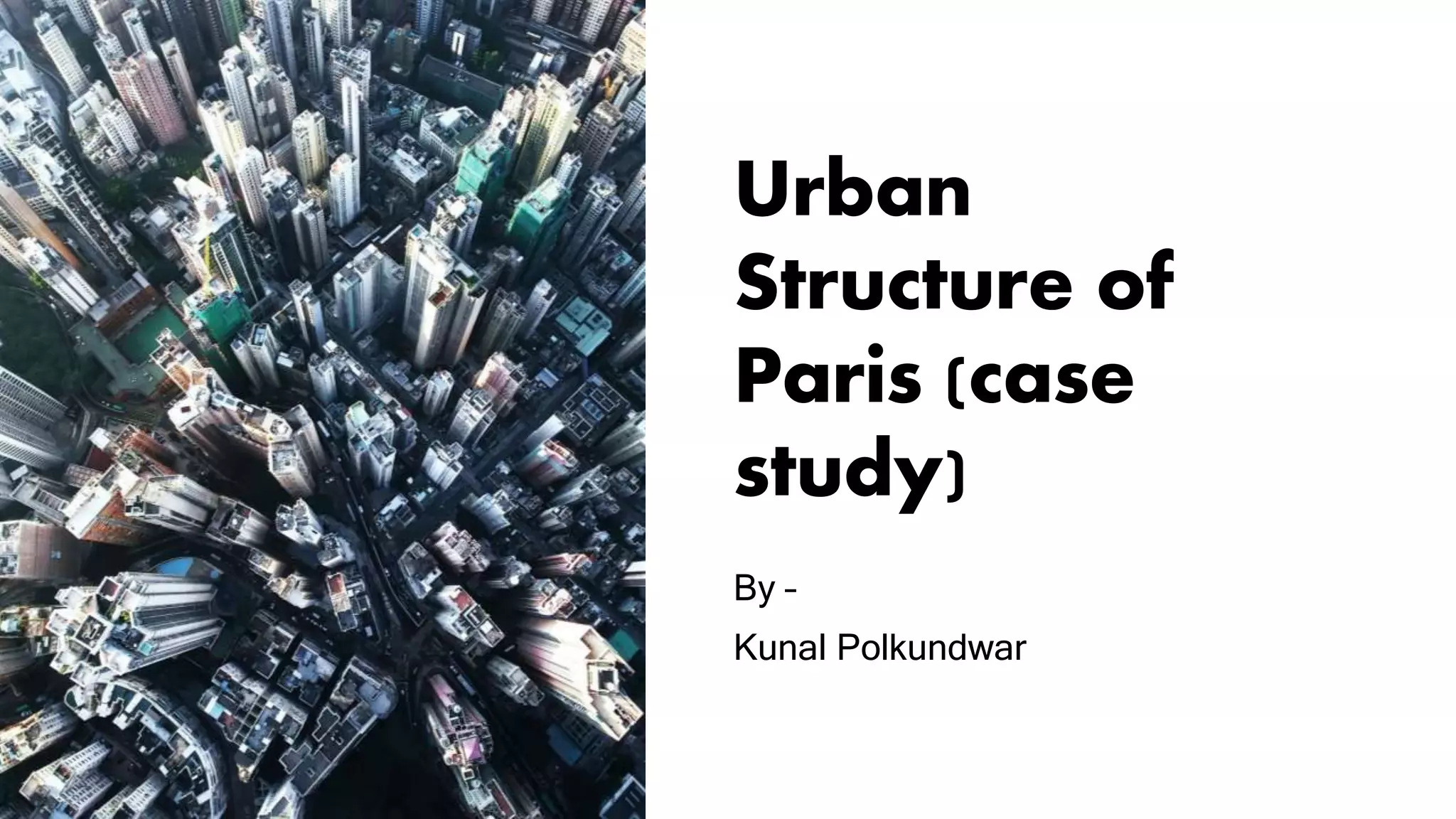
Urban
Structure of
Paris (case
study)
By –
Kunal Polkundwar
Key Factors in Urban planning
+ Transport
Promoting Cycling and Walking
Planning for Local Hubs
Congestion charging
Extensive provision of electric vehicle charging points
Seamless Travel
Key Factors in Urban planning
(continued)
+ Smart cities and crowd-sourcing
Tapping the wisdom
Collaborative partnerships
+ Buildings
Remote monitoring and management
Densification
Climatic resilience
Key Factors in Urban planning
(continued)
+ Energy
Local Energy
Solar Energy
Anaerobic digestion
+ Food
Urban Growing
Making space for nature
Features of a Smart City
+ Smart cities will promote the use of technology, information and
data to enhance and improve its infrastructure and services.
+ Formation of E-groups will allow people to voice their opinions and
receive feedback, monitor programs and activities.
+ Access to public transportation and creative solutions such as
smart parking, intelligent management, and integrated modal
transport. Smart cities will be more pedestrian and cyclist friendly.
Features of a Smart City (continued)
+ Smart cities will redevelop or develop unplanned and
poorly planned areas such as slums.
+ Living spaces will be made to accommodate the growing
population and also enhance its standard of living.
+ Infrastructure will be more sustainable and eco-friendly, by
reducing the amount of waste generated and also through
mindful consumption of natural resources.
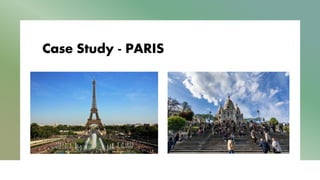
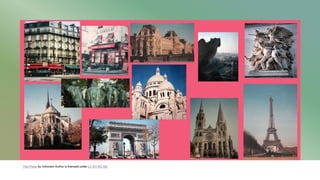
Case Study - PARIS
This Photo by Unknown Author is licensed under CC BY-NC-ND
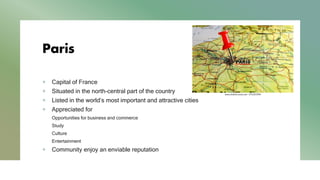
Paris
+ Capital of France
+ Situated in the north-central part of the country
+ Listed in the world’s most important and attractive cities
+ Appreciated for
Opportunities for business and commerce
Study
Culture
Entertainment
+ Community enjoy an enviable reputation
Development of Paris
+ From the mid-14th to the mid-16th century, the city’s
growth took place at grand scale.
+ It comprises 20 municipal districts, each of which has its
own particular features.
+ The numbering begins in the heart of Paris and continues
in the spiraling shape of a snail shell (Concentric Zone
Model).
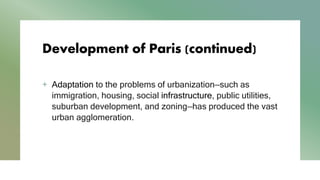
Development of Paris (continued)
+ Adaptation to the problems of urbanization—such as
immigration, housing, social infrastructure, public utilities,
suburban development, and zoning—has produced the vast
urban agglomeration.
The Post-Annexation of Paris
(continued)
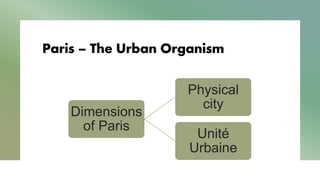
Paris – The Urban Organism
Dimensions
of Paris
Physical
city
Unité
Urbaine
Paris – The Urban Organism
(continued)
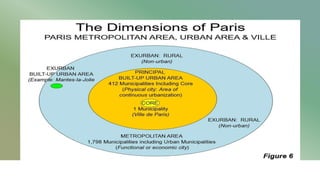
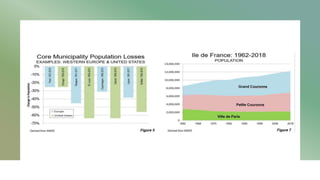
+ There are two dimensions to Paris, organism. There is the physical city, the
continuous urban development that INSEE calls the “Unité Urbaine”.
+ The labour and housing market, or metropolitan area, is the functional or
economic city.
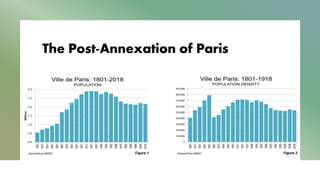
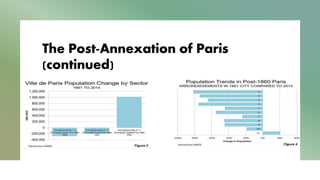
+ In 1861, 250,000 people lived in the suburbs of the built-up urban area, but
outside the “Ville de Paris.”
+ Today, the number of sub-urbanites has grown to more than 8.5 million.
+ In 1861, about 80% of the physical city was in the “Ville de Paris.”
Paris – The Urban Organism
(continued)
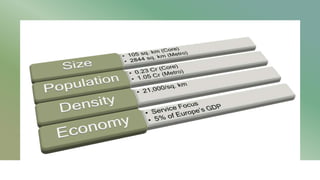
+ In 2014, the Paris “Unité Urbaine” has 10.7 million
residents in 1,050 square miles (2,845 square kilometers)
+ Paris has a population density of 10,100 per square mile
(3,900 per square kilometer) This is below London, but
less dense than Madrid and Milan.
Paris – The Urban Organism
(continued)
+ The Paris metropolitan area covers 6,620 square miles, or 17,145
square miles.
+ In recent years, the metropolitan area has expanded to the outside,
and now includes parts of six additional departments.
+ The “Métropole du Grand Paris” is composed of the “Ville de Paris”
and 130 additional municipalities.
+ It has a population of 7.1 million, but excludes more than 3.5 million
residents in 281 urban communes.
Paris – The Organic City
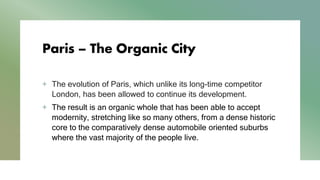
+ The evolution of Paris, which unlike its long-time competitor
London, has been allowed to continue its development.
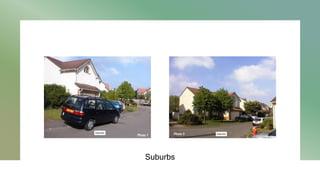
+ The result is an organic whole that has been able to accept
modernity, stretching like so many others, from a dense historic
core to the comparatively dense automobile oriented suburbs
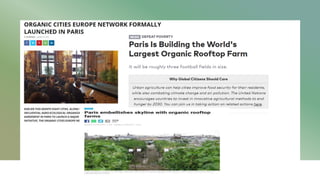
where the vast majority of the people live.
Suburbs
Paris – The Organic City (continued)
+ Many innovative projects have been implemented towards
the environmental care with an aesthetic approach.
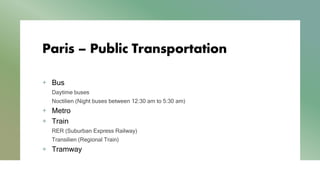
Paris – Public Transportation
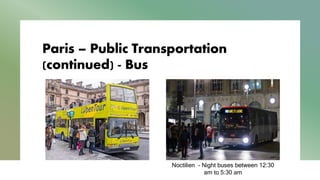
+ Bus
Daytime buses
Noctilien (Night buses between 12:30 am to 5:30 am)
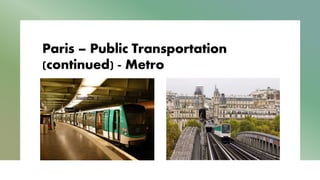
+ Metro
+ Train
RER (Suburban Express Railway)
Transilien (Regional Train)
+ Tramway
Paris – Public Transportation
(continued) - Bus
Noctilien - Night buses between 12:30
am to 5:30 am
Paris – Public Transportation
(continued) - Metro
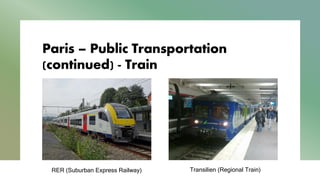
Paris – Public Transportation
(continued) - Train
Transilien (Regional Train)
RER (Suburban Express Railway)
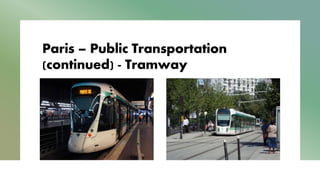
Paris – Public Transportation
(continued) - Tramway
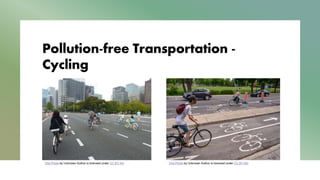
Pollution-free Transportation -
Cycling
This Photo by Unknown Author is licensed under CC BY-SA This Photo by Unknown Author is licensed under CC BY-ND
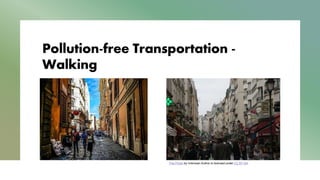
Pollution-free Transportation -
Walking
This Photo by Unknown Author is licensed under CC BY-SA
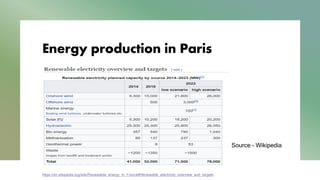
Energy production in Paris
Source - Wikipedia
https://en.wikipedia.org/wiki/Renewable_energy_in_France#Renewable_electricity_overview_and_targets
Energy production in Paris (continued)
Source - Wikipedia
https://en.wikipedia.org/wiki/Solar_power_in_France#List_of_owners_of_photovoltaic_portfolios_i
n_France_(2014)[31]
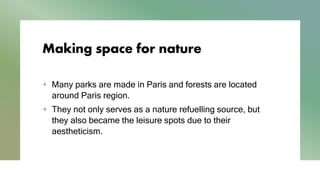
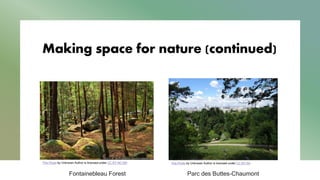
Making space for nature
+ Many parks are made in Paris and forests are located
around Paris region.
+ They not only serves as a nature refuelling source, but
they also became the leisure spots due to their
aestheticism.
Making space for nature (continued)
This Photo by Unknown Author is licensed under CC BY-NC-ND
Fontainebleau Forest
This Photo by Unknown Author is licensed under CC BY-SA
Parc des Buttes-Chaumont
This Photo by Unknown Author is licensed under CC BY-SA
Merci pour votre temps!
THANK YOU

Urban structure of Paris (Case Study)

  • 1.
  • 2.
    Key Factors inUrban planning + Transport Promoting Cycling and Walking Planning for Local Hubs Congestion charging Extensive provision of electric vehicle charging points Seamless Travel
  • 3.
    Key Factors inUrban planning (continued) + Smart cities and crowd-sourcing Tapping the wisdom Collaborative partnerships + Buildings Remote monitoring and management Densification Climatic resilience
  • 4.
    Key Factors inUrban planning (continued) + Energy Local Energy Solar Energy Anaerobic digestion + Food Urban Growing Making space for nature
  • 5.
    Features of aSmart City + Smart cities will promote the use of technology, information and data to enhance and improve its infrastructure and services. + Formation of E-groups will allow people to voice their opinions and receive feedback, monitor programs and activities. + Access to public transportation and creative solutions such as smart parking, intelligent management, and integrated modal transport. Smart cities will be more pedestrian and cyclist friendly.
  • 6.
    Features of aSmart City (continued) + Smart cities will redevelop or develop unplanned and poorly planned areas such as slums. + Living spaces will be made to accommodate the growing population and also enhance its standard of living. + Infrastructure will be more sustainable and eco-friendly, by reducing the amount of waste generated and also through mindful consumption of natural resources.
  • 7.
  • 8.
    This Photo byUnknown Author is licensed under CC BY-NC-ND
  • 9.
    Paris + Capital ofFrance + Situated in the north-central part of the country + Listed in the world’s most important and attractive cities + Appreciated for Opportunities for business and commerce Study Culture Entertainment + Community enjoy an enviable reputation
  • 10.
    Development of Paris +From the mid-14th to the mid-16th century, the city’s growth took place at grand scale. + It comprises 20 municipal districts, each of which has its own particular features. + The numbering begins in the heart of Paris and continues in the spiraling shape of a snail shell (Concentric Zone Model).
  • 12.
    Development of Paris(continued) + Adaptation to the problems of urbanization—such as immigration, housing, social infrastructure, public utilities, suburban development, and zoning—has produced the vast urban agglomeration.
  • 14.
  • 15.
    The Post-Annexation ofParis (continued)
  • 16.
    Paris – TheUrban Organism Dimensions of Paris Physical city Unité Urbaine Paris – The Urban Organism
  • 17.
    Paris – TheUrban Organism (continued) + There are two dimensions to Paris, organism. There is the physical city, the continuous urban development that INSEE calls the “Unité Urbaine”. + The labour and housing market, or metropolitan area, is the functional or economic city. + In 1861, 250,000 people lived in the suburbs of the built-up urban area, but outside the “Ville de Paris.” + Today, the number of sub-urbanites has grown to more than 8.5 million. + In 1861, about 80% of the physical city was in the “Ville de Paris.”
  • 18.
    Paris – TheUrban Organism (continued) + In 2014, the Paris “Unité Urbaine” has 10.7 million residents in 1,050 square miles (2,845 square kilometers) + Paris has a population density of 10,100 per square mile (3,900 per square kilometer) This is below London, but less dense than Madrid and Milan.
  • 19.
    Paris – TheUrban Organism (continued) + The Paris metropolitan area covers 6,620 square miles, or 17,145 square miles. + In recent years, the metropolitan area has expanded to the outside, and now includes parts of six additional departments. + The “Métropole du Grand Paris” is composed of the “Ville de Paris” and 130 additional municipalities. + It has a population of 7.1 million, but excludes more than 3.5 million residents in 281 urban communes.
  • 21.
    Paris – TheOrganic City + The evolution of Paris, which unlike its long-time competitor London, has been allowed to continue its development. + The result is an organic whole that has been able to accept modernity, stretching like so many others, from a dense historic core to the comparatively dense automobile oriented suburbs where the vast majority of the people live.
  • 22.
  • 23.
    Paris – TheOrganic City (continued) + Many innovative projects have been implemented towards the environmental care with an aesthetic approach.
  • 25.
    Paris – PublicTransportation + Bus Daytime buses Noctilien (Night buses between 12:30 am to 5:30 am) + Metro + Train RER (Suburban Express Railway) Transilien (Regional Train) + Tramway
  • 26.
    Paris – PublicTransportation (continued) - Bus Noctilien - Night buses between 12:30 am to 5:30 am
  • 27.
    Paris – PublicTransportation (continued) - Metro
  • 28.
    Paris – PublicTransportation (continued) - Train Transilien (Regional Train) RER (Suburban Express Railway)
  • 29.
    Paris – PublicTransportation (continued) - Tramway
  • 30.
    Pollution-free Transportation - Cycling ThisPhoto by Unknown Author is licensed under CC BY-SA This Photo by Unknown Author is licensed under CC BY-ND
  • 31.
    Pollution-free Transportation - Walking ThisPhoto by Unknown Author is licensed under CC BY-SA
  • 32.
    Energy production inParis Source - Wikipedia https://en.wikipedia.org/wiki/Renewable_energy_in_France#Renewable_electricity_overview_and_targets
  • 33.
    Energy production inParis (continued) Source - Wikipedia https://en.wikipedia.org/wiki/Solar_power_in_France#List_of_owners_of_photovoltaic_portfolios_i n_France_(2014)[31]
  • 34.
    Making space fornature + Many parks are made in Paris and forests are located around Paris region. + They not only serves as a nature refuelling source, but they also became the leisure spots due to their aestheticism.
  • 35.
    Making space fornature (continued) This Photo by Unknown Author is licensed under CC BY-NC-ND Fontainebleau Forest This Photo by Unknown Author is licensed under CC BY-SA Parc des Buttes-Chaumont
  • 36.
    This Photo byUnknown Author is licensed under CC BY-SA
  • 37.
    Merci pour votretemps! THANK YOU

Editor's Notes

  • #3 https://www.smartcitiesdive.com/ex/sustainablecitiescollective/21-features-future-sustainable-city/285946/
  • #6 http://bwsmartcities.businessworld.in/article/6-Features-Of-A-Smart-City/06-02-2019-166882/
  • #10 https://www.britannica.com/place/Paris
  • #11 https://www.britannica.com/place/Paris
  • #12 https://www.newgeography.com/content/005912-the-evolving-urban-form-paris
  • #13 https://www.britannica.com/place/Paris
  • #15 https://www.newgeography.com/content/005912-the-evolving-urban-form-paris
  • #16 https://www.newgeography.com/content/005912-the-evolving-urban-form-paris
  • #17 https://www.newgeography.com/content/005912-the-evolving-urban-form-paris
  • #18 https://www.newgeography.com/content/005912-the-evolving-urban-form-paris
  • #19 https://www.newgeography.com/content/005912-the-evolving-urban-form-paris
  • #20 https://www.newgeography.com/content/005912-the-evolving-urban-form-paris
  • #21 https://www.newgeography.com/content/005912-the-evolving-urban-form-paris
  • #23 https://www.newgeography.com/content/005912-the-evolving-urban-form-paris
  • #25 https://www.france24.com/en/20170902-paris-urban-farming-commercial-rooftops-skyline-ratp-metro-city-environment-agriculture https://www.naturalproductsglobal.com/europe/organic-cities-europe-network-formally-launched-paris/ https://www.globalcitizen.org/en/content/paris-biggest-rooftop-farm/