CONSERVATION OF
HISTORICAL MONUMENTS
Prepared by :- Sameer D. Shaikh
Astt. Prof. at Sanjivani college of Engineering
Kopargaon.
WHAT IS CONSERVATION
• Conservation is all the processes of looking after a place so as to retain
its cultural significance. It includes maintenance and according to
circumstances may include preservation, restoration, reconstruction
and adaption and will be commonly a combination of more than one of
these.
• The conservation of built heritage is generally perceived to be in the
long term interest of society. This can be better understood if
categorized under economic, cultural, and environmental, although
they are not mutually exclusive and, indeed, they are often interlocked.
HISTORICAL BACKGROUND
• In India, the first instance of conservation was when Emperor Ashoka ordered to
conserve wildlife in the 3rd century BC.
• Then in the 14th century AD, Firuz Shah Tughlaq ordered to protect ancient buildings.
• During the British Rule, the “Bengal Regulation (XIX)” was passed in 1810.
• Madras Regulation (VII)” was passed in 1817.
• These regulations vested the government with the power to intervene whenever the
public buildings were underthreat of misuse.
• Then in 1863, Act XX was passed which authorised the government to “prevent injury to
and preserve buildings remarkable for their antiquity or for their historical or
architectural value”
NEED OF REHABILITATION OF MONUMENTS
• A way to preserve our history and maintain the beauty and value of a
place.
• Preserve our traditions and culture & conserve our cultura heritage.
• Very important in order to maintain the beauty and grace of the older
monuments.
• Monuments are designed to endure, but time and exposure to the
elements takes a toll.
• The Indian Treasure Trove Act, 1878
• The Ancient Monuments Preservation Act, 1904
• The Antiquities (Export Control) Act, 1947
• The Ancient Monuments and Archaeological Sites and Remains Act
1958 ( No 24 of 1958)
• The Antiquities and Art Treasures Act 1972
Listing work comprises of two
phases.
1. Background research
2. Field work.
• Before commencing the actual fieldwork, the basic information is gathered
from various sources including gazetteers, travel books, and several other
specialized books.
• This work could be done in the libraries and archives of various universities
and other institutions of the central government, the state government and
private individuals or trusts.
• Many of the museums established by the central government or state
governments or even private museums can provide interesting information.
• In a given area, local experts, professionals and scholars could also provide the
required guidance and help.
• Before launching into field work, a reliable map of the area should be
collected and its various constituents.
• Survey of India maps and those available with the state department
of town and country planning should prove useful. However, at the
field level, ward maps available with the municipal/ cantonment/
panchayat authorities may be of greater help.
• Field work requires lot of work to scan the heritage properties and
recording information for each property in the prescribed format.
• This comprises of physically inspecting the property as well as
meeting local people such as owners of the property, talking to other
residents and local ward or panchayat members, and knowledgeable
residents and representatives of institutions.
• Photography is an important component of the listing. A photograph
freezes the building and its setting to the time when it is taken.
• A comparison would show the changes that have occurred over time
to the building and, in particular, to its embellishments.
• The primary objective of listing is to record extant architectural
heritage and sites. But the outcome of this process should invariably
be to grade the listed heritage into a hierarchical series.
• This process must be undertaken in a rigorous and transparent
manner by a multidisciplinary team of experts whose
recommendations should be available for public scrutiny.
• The importance of this process cannot be underestimated because its
results determine subsequent conservation decisions.
• Heritage Grade-I
• Richly deserves careful
preservation.
• Heritage Grade-II
• Deserves intelligent
conservation (though on a lesser
scale than Grade-II and special
protection to unique features
and attributes).
1. Heritage Conservation Committee (HCC) under
Ministry of Urban Development
2. Archaeological Survey of India (ASI)
3. State Archaeological Department, Govt. of NCT of Delhi
4. Delhi Development Authority (DDA)
5. MCD (EDMC, SDMC, NDMC)
6. Cantonment Board, Delhi
7. INTACH
Natural Factors
• Flood
• Air Pollutant
• Moisture
• Rainstorm
• Ground salts and water
• Air Pollutant
• Solar Radiation
• Temperature
• Vibration
• Windstorm
• Biological Factor
• Solar Radiation
• Temperature
• Vibration
• Windstorm
Social Factors :
• Fire
• Urban Development
• Vandalism
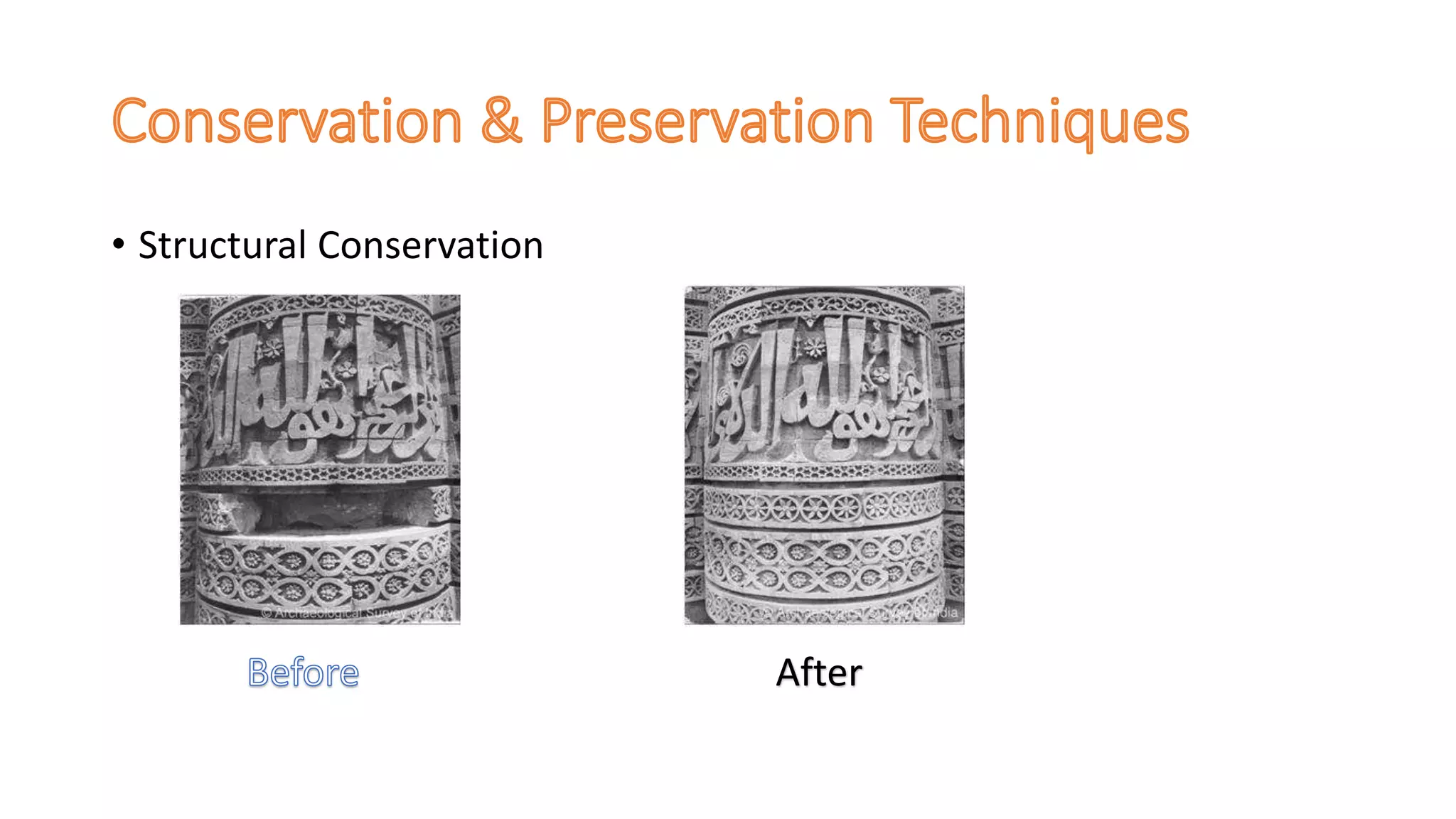
• Structural Conservation
After
• The Archaeological Survey of India’s Science Branch isresponsible mainly for the
chemical conservation treatmentand preservation of some three thousand five
hundred ninetythree Protected monuments besides chemical preservation of
museum and excavated objects countrywide.
After
• Bricks and Stones
• Stucco
• Wood Siding
Painting - Painting is the most important maintenance item with wood siding.
Ensure the paint work is in sound condition.
Split Boards - Pry split boards apart and coat the interior faces with an epoxy
resin glue. When tacky, push the split together, sand and spot paint.
Replacing Boards - Cut out deteriorated sections only between the nearest
studs, with circular saw and chisel. Using the removed section as a template,
insert a new piece, nail and caulk end joints.
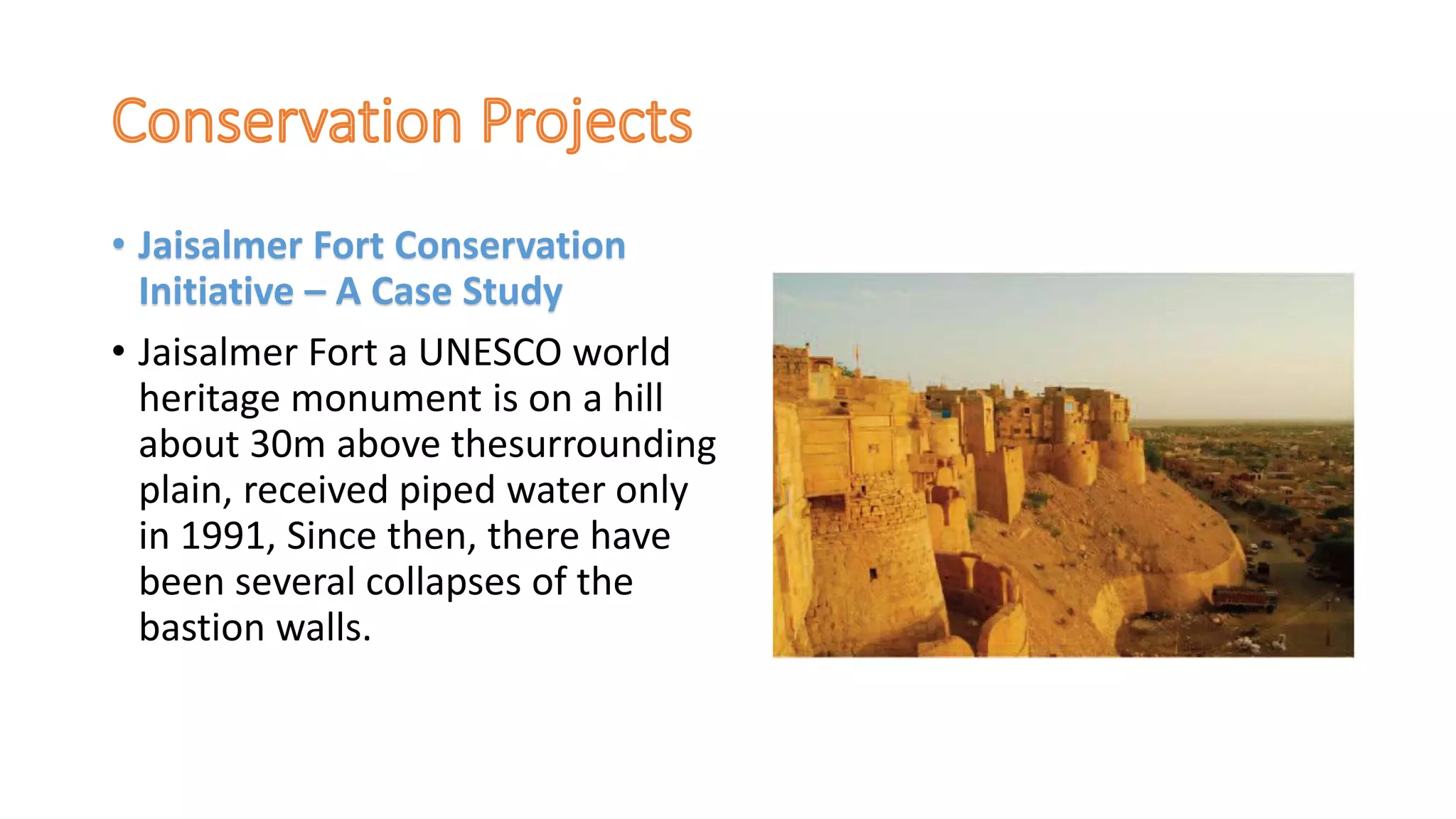
• Jaisalmer Fort Conservation
Initiative – A Case Study
• Jaisalmer Fort a UNESCO world
heritage monument is on a hill
about 30m above thesurrounding
plain, received piped water only
in 1991, Since then, there have
been several collapses of the
bastion walls.
The restoration of Rani Ka Mahal
After
Hawa Prol - Gateway of winds
After
• Isa Khan’s tomb not only pre-
dates Humayun’s Tomb by two
decades, it is also the
culmination of an architectural
style used for royal tombs in
Delhi during the Sayyid and Lodi
dynasties from the early
fifteenth to the early sixteenth
centuries.
1. INTACH; http://www.intach.org/chapters-structure.asp?links=chapt1
2. Mapping and Evaluating Heritage, Shikha Jain, DRONAH
3. Conservation of Heritage Buildings in Delhi submitted to Centre for Civil Societyby Ujjwal
Gaur
4. City Development Plan Delhi, Dept. of Urban Development, Govt. of Delhi
5. Archaeological Survey of India; http://asi.nic.in/asi_cons_prev.asp
6. Environmental Factors Threatening the Survival of Heritage Buildings By Mahamoud
Sodangi, Arazi Idrus, Faris Khamidi and Adam Dahiru Adam
7. Effect of Vibrations on Historic Buildings: An Overview By J H Rainer
.
THANK YOU

Conservation of historical monuments

  • 1.
    CONSERVATION OF HISTORICAL MONUMENTS Preparedby :- Sameer D. Shaikh Astt. Prof. at Sanjivani college of Engineering Kopargaon.
  • 2.
    WHAT IS CONSERVATION •Conservation is all the processes of looking after a place so as to retain its cultural significance. It includes maintenance and according to circumstances may include preservation, restoration, reconstruction and adaption and will be commonly a combination of more than one of these. • The conservation of built heritage is generally perceived to be in the long term interest of society. This can be better understood if categorized under economic, cultural, and environmental, although they are not mutually exclusive and, indeed, they are often interlocked.
  • 3.
    HISTORICAL BACKGROUND • InIndia, the first instance of conservation was when Emperor Ashoka ordered to conserve wildlife in the 3rd century BC. • Then in the 14th century AD, Firuz Shah Tughlaq ordered to protect ancient buildings. • During the British Rule, the “Bengal Regulation (XIX)” was passed in 1810. • Madras Regulation (VII)” was passed in 1817. • These regulations vested the government with the power to intervene whenever the public buildings were underthreat of misuse. • Then in 1863, Act XX was passed which authorised the government to “prevent injury to and preserve buildings remarkable for their antiquity or for their historical or architectural value”
  • 4.
    NEED OF REHABILITATIONOF MONUMENTS • A way to preserve our history and maintain the beauty and value of a place. • Preserve our traditions and culture & conserve our cultura heritage. • Very important in order to maintain the beauty and grace of the older monuments. • Monuments are designed to endure, but time and exposure to the elements takes a toll.
  • 5.
    • The IndianTreasure Trove Act, 1878 • The Ancient Monuments Preservation Act, 1904 • The Antiquities (Export Control) Act, 1947 • The Ancient Monuments and Archaeological Sites and Remains Act 1958 ( No 24 of 1958) • The Antiquities and Art Treasures Act 1972
  • 6.
    Listing work comprisesof two phases. 1. Background research 2. Field work.
  • 7.
    • Before commencingthe actual fieldwork, the basic information is gathered from various sources including gazetteers, travel books, and several other specialized books. • This work could be done in the libraries and archives of various universities and other institutions of the central government, the state government and private individuals or trusts. • Many of the museums established by the central government or state governments or even private museums can provide interesting information. • In a given area, local experts, professionals and scholars could also provide the required guidance and help.
  • 8.
    • Before launchinginto field work, a reliable map of the area should be collected and its various constituents. • Survey of India maps and those available with the state department of town and country planning should prove useful. However, at the field level, ward maps available with the municipal/ cantonment/ panchayat authorities may be of greater help. • Field work requires lot of work to scan the heritage properties and recording information for each property in the prescribed format.
  • 9.
    • This comprisesof physically inspecting the property as well as meeting local people such as owners of the property, talking to other residents and local ward or panchayat members, and knowledgeable residents and representatives of institutions. • Photography is an important component of the listing. A photograph freezes the building and its setting to the time when it is taken. • A comparison would show the changes that have occurred over time to the building and, in particular, to its embellishments.
  • 10.
    • The primaryobjective of listing is to record extant architectural heritage and sites. But the outcome of this process should invariably be to grade the listed heritage into a hierarchical series. • This process must be undertaken in a rigorous and transparent manner by a multidisciplinary team of experts whose recommendations should be available for public scrutiny. • The importance of this process cannot be underestimated because its results determine subsequent conservation decisions.
  • 11.
    • Heritage Grade-I •Richly deserves careful preservation. • Heritage Grade-II • Deserves intelligent conservation (though on a lesser scale than Grade-II and special protection to unique features and attributes).
  • 12.
    1. Heritage ConservationCommittee (HCC) under Ministry of Urban Development 2. Archaeological Survey of India (ASI) 3. State Archaeological Department, Govt. of NCT of Delhi 4. Delhi Development Authority (DDA) 5. MCD (EDMC, SDMC, NDMC) 6. Cantonment Board, Delhi 7. INTACH
  • 13.
    Natural Factors • Flood •Air Pollutant • Moisture • Rainstorm • Ground salts and water • Air Pollutant • Solar Radiation • Temperature • Vibration • Windstorm
  • 14.
    • Biological Factor •Solar Radiation • Temperature • Vibration • Windstorm
  • 15.
    Social Factors : •Fire • Urban Development • Vandalism
  • 16.
  • 17.
    • The ArchaeologicalSurvey of India’s Science Branch isresponsible mainly for the chemical conservation treatmentand preservation of some three thousand five hundred ninetythree Protected monuments besides chemical preservation of museum and excavated objects countrywide. After
  • 18.
    • Bricks andStones • Stucco • Wood Siding
  • 19.
    Painting - Paintingis the most important maintenance item with wood siding. Ensure the paint work is in sound condition. Split Boards - Pry split boards apart and coat the interior faces with an epoxy resin glue. When tacky, push the split together, sand and spot paint. Replacing Boards - Cut out deteriorated sections only between the nearest studs, with circular saw and chisel. Using the removed section as a template, insert a new piece, nail and caulk end joints.
  • 20.
    • Jaisalmer FortConservation Initiative – A Case Study • Jaisalmer Fort a UNESCO world heritage monument is on a hill about 30m above thesurrounding plain, received piped water only in 1991, Since then, there have been several collapses of the bastion walls.
  • 21.
    The restoration ofRani Ka Mahal After
  • 22.
    Hawa Prol -Gateway of winds After
  • 23.
    • Isa Khan’stomb not only pre- dates Humayun’s Tomb by two decades, it is also the culmination of an architectural style used for royal tombs in Delhi during the Sayyid and Lodi dynasties from the early fifteenth to the early sixteenth centuries.
  • 24.
    1. INTACH; http://www.intach.org/chapters-structure.asp?links=chapt1 2.Mapping and Evaluating Heritage, Shikha Jain, DRONAH 3. Conservation of Heritage Buildings in Delhi submitted to Centre for Civil Societyby Ujjwal Gaur 4. City Development Plan Delhi, Dept. of Urban Development, Govt. of Delhi 5. Archaeological Survey of India; http://asi.nic.in/asi_cons_prev.asp 6. Environmental Factors Threatening the Survival of Heritage Buildings By Mahamoud Sodangi, Arazi Idrus, Faris Khamidi and Adam Dahiru Adam 7. Effect of Vibrations on Historic Buildings: An Overview By J H Rainer
  • 25.