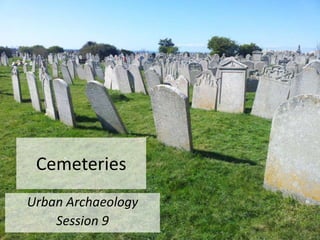
Cemeteries
Urban Archaeology
    Session 9
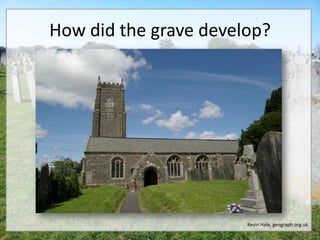
How did the grave develop?


                       Kevin Hale, geograph.org.uk
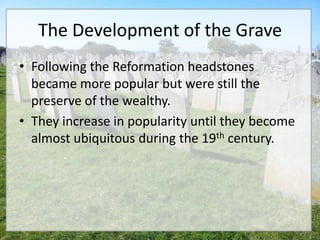
The Development of the Grave
• Following the Reformation headstones
  became more popular but were still the
  preserve of the wealthy.
• They increase in popularity until they become
  almost ubiquitous during the 19th century.
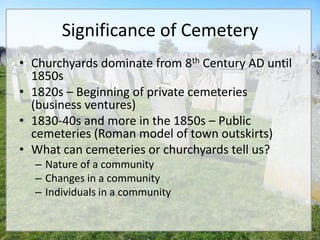
Significance of Cemetery
• Churchyards dominate from 8th Century AD until
  1850s
• 1820s – Beginning of private cemeteries
  (business ventures)
• 1830-40s and more in the 1850s – Public
  cemeteries (Roman model of town outskirts)
• What can cemeteries or churchyards tell us?
  – Nature of a community
  – Changes in a community
  – Individuals in a community
The Cemetery
• English Heritage definition:
    –   Churchyards: a burial ground around a church or other
    –   place of worship
    –   Burial grounds: a pre-Victorian place of burial without a
    –   place of worship
    –   Cemeteries: a landscaped place of burial
• See also the Cemetery Research Group’s definition
http://www.york.ac.uk/chp/crg/cemeterydef.htm
• 1650s+ - NonConformist grounds founded, followed by Quaker and
   Jewish
• In 2006, the Ministry of Justice Burial Grounds Survey found just
   under 10,000 burial grounds
http://www.justice.gov.uk/statistics/previous-stats/burial-grounds-
survey
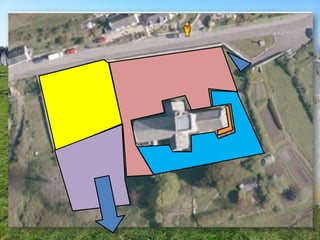
Whole Community
Locations of graves in churchyards tell us about the
social status of the individual:
• Church internment (and the closer to main altar
  the better) or in private chapel/crypts – wealthy /
  political significance
• Eastern side of churchyard – higher classes
• Southern side – lesser status
• Northern corner – unbaptized, suicide,
  excommunicated
Headstone styles
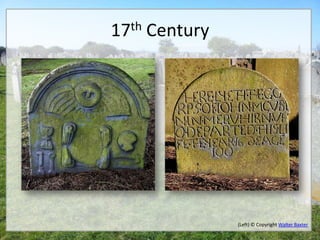
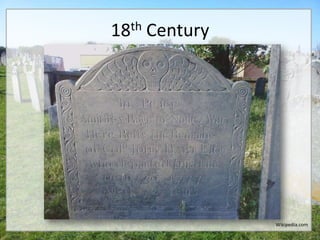
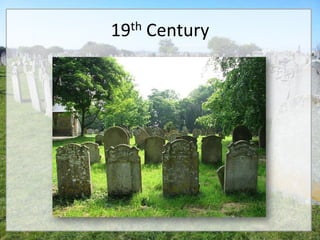
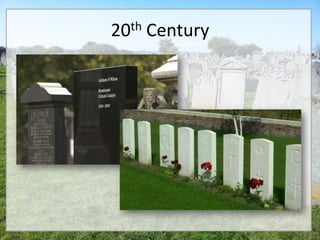
• 17th Century, personal inscriptions begin
• 18th Century, higher status individuals being
  being buried outside of the church, so from
  here onwards, more elaborate memorials exist
17th Century


               (Left) © Copyright Walter Baxter
18th Century


               Wikipedia.com
19th Century
20th Century
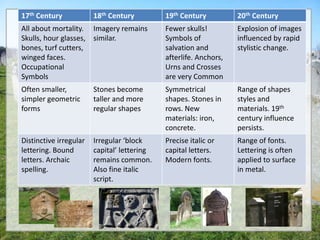
17th Century            18th Century         19th Century          20th Century
All about mortality. Imagery remains         Fewer skulls!         Explosion of images
Skulls, hour glasses, similar.               Symbols of            influenced by rapid
bones, turf cutters,                         salvation and         stylistic change.
winged faces.                                afterlife. Anchors,
Occupational                                 Urns and Crosses
Symbols                                      are very Common
Often smaller,          Stones become        Symmetrical           Range of shapes
simpler geometric       taller and more      shapes. Stones in     styles and
forms                   regular shapes       rows. New             materials. 19th
                                             materials: iron,      century influence
                                             concrete.             persists.
Distinctive irregular   Irregular ‘block     Precise italic or     Range of fonts.
lettering. Bound        capital’ lettering   capital letters.      Lettering is often
letters. Archaic        remains common.      Modern fonts.         applied to surface
spelling.               Also fine italic                           in metal.
                        script.
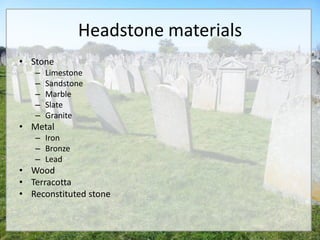
Headstone materials
• Stone
   –   Limestone
   –   Sandstone
   –   Marble
   –   Slate
   –   Granite
• Metal
   – Iron
   – Bronze
   – Lead
• Wood
• Terracotta
• Reconstituted stone
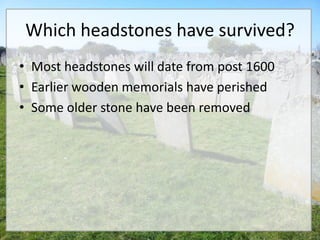
Which headstones have survived?
• Most headstones will date from post 1600
• Earlier wooden memorials have perished
• Some older stone have been removed
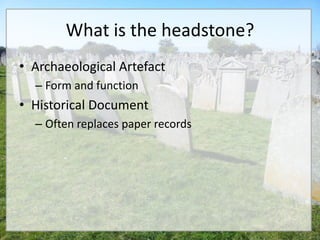
What is the headstone?
• Archaeological Artefact
  – Form and function
• Historical Document
  – Often replaces paper records
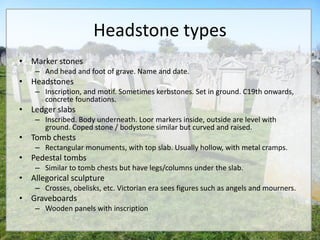
Headstone types
• Marker stones
    – And head and foot of grave. Name and date.
• Headstones
    – Inscription, and motif. Sometimes kerbstones. Set in ground. C19th onwards,
      concrete foundations.
• Ledger slabs
    – Inscribed. Body underneath. Loor markers inside, outside are level with
      ground. Coped stone / bodystone similar but curved and raised.
• Tomb chests
    – Rectangular monuments, with top slab. Usually hollow, with metal cramps.
• Pedestal tombs
    – Similar to tomb chests but have legs/columns under the slab.
• Allegorical sculpture
    – Crosses, obelisks, etc. Victorian era sees figures such as angels and mourners.
• Graveboards
    – Wooden panels with inscription
Reading a headstone
Information:
• Name
• Date of birth and death
Additional information:
• Occupation
• Family links
• Nature of death
• Beliefs & Actions in Life
Community
   history from
   headstones
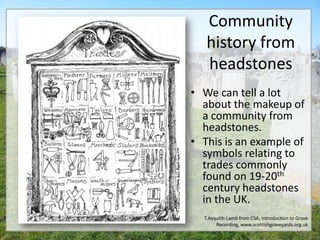
• We can tell a lot
  about the makeup of
  a community from
  headstones.
• This is an example of
  symbols relating to
  trades commonly
  found on 19-20th
  century headstones
  in the UK.
  T.Asquith-Lamb from CSA, Introduction to Grave
       Recording, www.scottishgraveyards.org.uk
Beliefs
• There are numerous indexes available online,
  some more accurate than others.
• The Church Monuments Society has a
  comprehensive glossary of 20th century
  symbols:
  http://www.churchmonumentssociety.org/Sy
  mbolism_on_Monuments.html
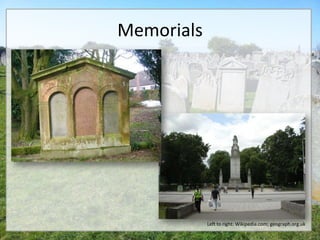
Memorials


            Left to right: Wikipedia.com; geograph.org.uk
Locating headstones
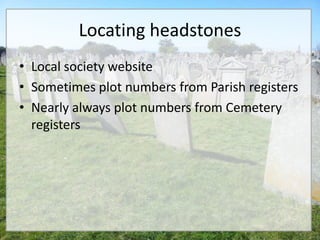
• Local society website
• Sometimes plot numbers from Parish registers
• Nearly always plot numbers from Cemetery
  registers
Mapping headstones
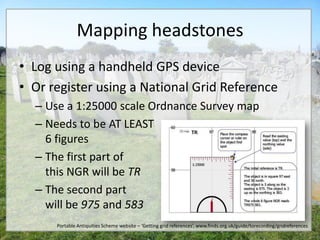
• Log using a handheld GPS device
• Or register using a National Grid Reference
  – Use a 1:25000 scale Ordnance Survey map
  – Needs to be AT LEAST
    6 figures
  – The first part of
    this NGR will be TR
  – The second part
    will be 975 and 583
      Portable Antiquities Scheme website – ‘Getting grid references’, www.finds.org.uk/guide/torecording/gridreferences
Mapping headstones
• Or get a NGR online (see www.finds.org.uk for
  instructions to use these websites):
  – Magic - http://www.magic.gov.uk (although this might
    change following Government reorganisations).
  – Wheresthepath -
     http://wtp2.appspot.com/wheresthepath.htm (OS
    and web mapping services side by side, brilliant!)
  – Streetmap - http://www.streetmap.co.uk/
  – Nearby.org.uk - http://www.nearby.org.uk/ (great for
    co-ordinate conversions etc)
Cemetery Plans
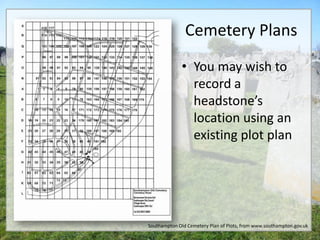
              • You may wish to
                record a
                headstone’s
                location using an
                existing plot plan


Southampton Old Cemetery Plan of Plots, from www.southampton.gov.uk
Recording headstones
Check first at:
• Gravestone Photographic Resource -
  http://www.gravestonephotos.com/index.php
• Local society website
• Local authority website – e.g.
  http://www.eastleigh.gov.uk/our-
  community/cemeteries-in-eastleigh/cemetery-
  database.aspx
Use a standard recording sheet:
• Council for Scottish Archaeology example -
  http://www.scottishgraveyards.org.uk/downloads/10G
  BasicForm.pdf
Enhance the Record!
•   Draw the headstone/s
•   Photograph the headstone/s
•   Photogrammetry on headstone/s
•   Reflectance Transformation Imaging on
    headstone/s

Urban Archaeology Session 9: Cemeteries

  • 1.
  • 2.
    How did thegrave develop? Kevin Hale, geograph.org.uk
  • 3.
    The Development ofthe Grave • Following the Reformation headstones became more popular but were still the preserve of the wealthy. • They increase in popularity until they become almost ubiquitous during the 19th century.
  • 4.
    Significance of Cemetery •Churchyards dominate from 8th Century AD until 1850s • 1820s – Beginning of private cemeteries (business ventures) • 1830-40s and more in the 1850s – Public cemeteries (Roman model of town outskirts) • What can cemeteries or churchyards tell us? – Nature of a community – Changes in a community – Individuals in a community
  • 5.
    The Cemetery • EnglishHeritage definition: – Churchyards: a burial ground around a church or other – place of worship – Burial grounds: a pre-Victorian place of burial without a – place of worship – Cemeteries: a landscaped place of burial • See also the Cemetery Research Group’s definition http://www.york.ac.uk/chp/crg/cemeterydef.htm • 1650s+ - NonConformist grounds founded, followed by Quaker and Jewish • In 2006, the Ministry of Justice Burial Grounds Survey found just under 10,000 burial grounds http://www.justice.gov.uk/statistics/previous-stats/burial-grounds- survey
  • 6.
    Whole Community Locations ofgraves in churchyards tell us about the social status of the individual: • Church internment (and the closer to main altar the better) or in private chapel/crypts – wealthy / political significance • Eastern side of churchyard – higher classes • Southern side – lesser status • Northern corner – unbaptized, suicide, excommunicated
  • 8.
    Headstone styles • 17thCentury, personal inscriptions begin • 18th Century, higher status individuals being being buried outside of the church, so from here onwards, more elaborate memorials exist
  • 9.
    17th Century (Left) © Copyright Walter Baxter
  • 10.
    18th Century Wikipedia.com
  • 11.
  • 12.
  • 13.
    17th Century 18th Century 19th Century 20th Century All about mortality. Imagery remains Fewer skulls! Explosion of images Skulls, hour glasses, similar. Symbols of influenced by rapid bones, turf cutters, salvation and stylistic change. winged faces. afterlife. Anchors, Occupational Urns and Crosses Symbols are very Common Often smaller, Stones become Symmetrical Range of shapes simpler geometric taller and more shapes. Stones in styles and forms regular shapes rows. New materials. 19th materials: iron, century influence concrete. persists. Distinctive irregular Irregular ‘block Precise italic or Range of fonts. lettering. Bound capital’ lettering capital letters. Lettering is often letters. Archaic remains common. Modern fonts. applied to surface spelling. Also fine italic in metal. script.
  • 14.
    Headstone materials • Stone – Limestone – Sandstone – Marble – Slate – Granite • Metal – Iron – Bronze – Lead • Wood • Terracotta • Reconstituted stone
  • 15.
    Which headstones havesurvived? • Most headstones will date from post 1600 • Earlier wooden memorials have perished • Some older stone have been removed
  • 16.
    What is theheadstone? • Archaeological Artefact – Form and function • Historical Document – Often replaces paper records
  • 17.
    Headstone types • Markerstones – And head and foot of grave. Name and date. • Headstones – Inscription, and motif. Sometimes kerbstones. Set in ground. C19th onwards, concrete foundations. • Ledger slabs – Inscribed. Body underneath. Loor markers inside, outside are level with ground. Coped stone / bodystone similar but curved and raised. • Tomb chests – Rectangular monuments, with top slab. Usually hollow, with metal cramps. • Pedestal tombs – Similar to tomb chests but have legs/columns under the slab. • Allegorical sculpture – Crosses, obelisks, etc. Victorian era sees figures such as angels and mourners. • Graveboards – Wooden panels with inscription
  • 18.
    Reading a headstone Information: •Name • Date of birth and death Additional information: • Occupation • Family links • Nature of death • Beliefs & Actions in Life
  • 19.
    Community history from headstones • We can tell a lot about the makeup of a community from headstones. • This is an example of symbols relating to trades commonly found on 19-20th century headstones in the UK. T.Asquith-Lamb from CSA, Introduction to Grave Recording, www.scottishgraveyards.org.uk
  • 20.
    Beliefs • There arenumerous indexes available online, some more accurate than others. • The Church Monuments Society has a comprehensive glossary of 20th century symbols: http://www.churchmonumentssociety.org/Sy mbolism_on_Monuments.html
  • 21.
    Memorials Left to right: Wikipedia.com; geograph.org.uk
  • 22.
    Locating headstones • Localsociety website • Sometimes plot numbers from Parish registers • Nearly always plot numbers from Cemetery registers
  • 23.
    Mapping headstones • Logusing a handheld GPS device • Or register using a National Grid Reference – Use a 1:25000 scale Ordnance Survey map – Needs to be AT LEAST 6 figures – The first part of this NGR will be TR – The second part will be 975 and 583 Portable Antiquities Scheme website – ‘Getting grid references’, www.finds.org.uk/guide/torecording/gridreferences
  • 24.
    Mapping headstones • Orget a NGR online (see www.finds.org.uk for instructions to use these websites): – Magic - http://www.magic.gov.uk (although this might change following Government reorganisations). – Wheresthepath - http://wtp2.appspot.com/wheresthepath.htm (OS and web mapping services side by side, brilliant!) – Streetmap - http://www.streetmap.co.uk/ – Nearby.org.uk - http://www.nearby.org.uk/ (great for co-ordinate conversions etc)
  • 25.
    Cemetery Plans • You may wish to record a headstone’s location using an existing plot plan Southampton Old Cemetery Plan of Plots, from www.southampton.gov.uk
  • 26.
    Recording headstones Check firstat: • Gravestone Photographic Resource - http://www.gravestonephotos.com/index.php • Local society website • Local authority website – e.g. http://www.eastleigh.gov.uk/our- community/cemeteries-in-eastleigh/cemetery- database.aspx Use a standard recording sheet: • Council for Scottish Archaeology example - http://www.scottishgraveyards.org.uk/downloads/10G BasicForm.pdf
  • 27.
    Enhance the Record! • Draw the headstone/s • Photograph the headstone/s • Photogrammetry on headstone/s • Reflectance Transformation Imaging on headstone/s

Editor's Notes

  • #22 War MemorialsFamily MemorialsEvent MemorialsIndividual Memorials