Upholding Accountability
and Integrity in
Cooperatives Through
Policies and Decision
Making
A paper presented by Josefina B. Bitonio
Regional Director, CDA Dagupan Extension
Office, April 6, 2016 during the 9th Annual
National Micoop Forum
Punta Villa, Resort and Hotel, Iloilo City
• Foremost, I would like to express my sincere
gratitude to our host Ms. Evelia Bardos –
Tizon Group Head Micoop and her team for
their warm welcome and making it possible
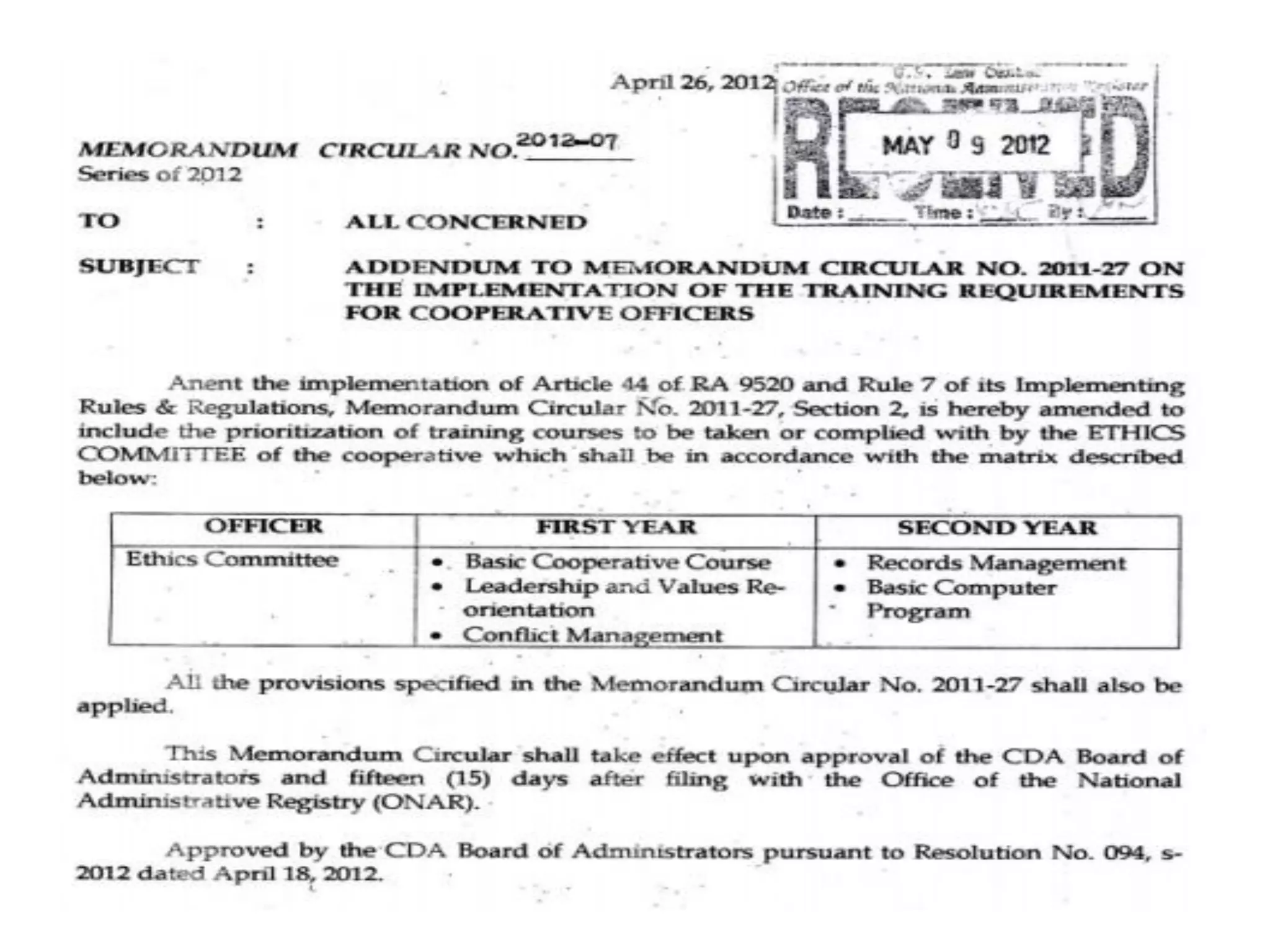
for me to join your annual event here at Iloilo.
• My respect and appreciation to Dr. Mercy
Gabasa of CDA Iloilo Extension office for
assisting us during the event.
• To all Micoop representatives coming from
Luzon, Visayas and Mindanao – Mabuhay po
kayo.
Co-operatives, NGOs and community
groups are being increasingly used
as development agencies by policy-
makers, because they are thought to
provide more accountable, effective
and equitable services in many areas
than public or private agencies.
Brett, E. A. (2008)
Cooperatives claim to
be dominated by
motivations based
on democracy and
self-sacrifice rather
than self-interest.
Brett, E. A. (2008)
According to Talent Culture
http://www.talentculture.com/why-accountability-in-the-workplace-matters/
The Workplace
Accountability Study
recently revealed that
82% of respondents
have no ability to hold
other accountable, but
91% of people rank
accountability as one of
the top development
needs they’d like to see
at their organization.
http://www.talentculture.com/why-accountability-in-the-workplace-matters/
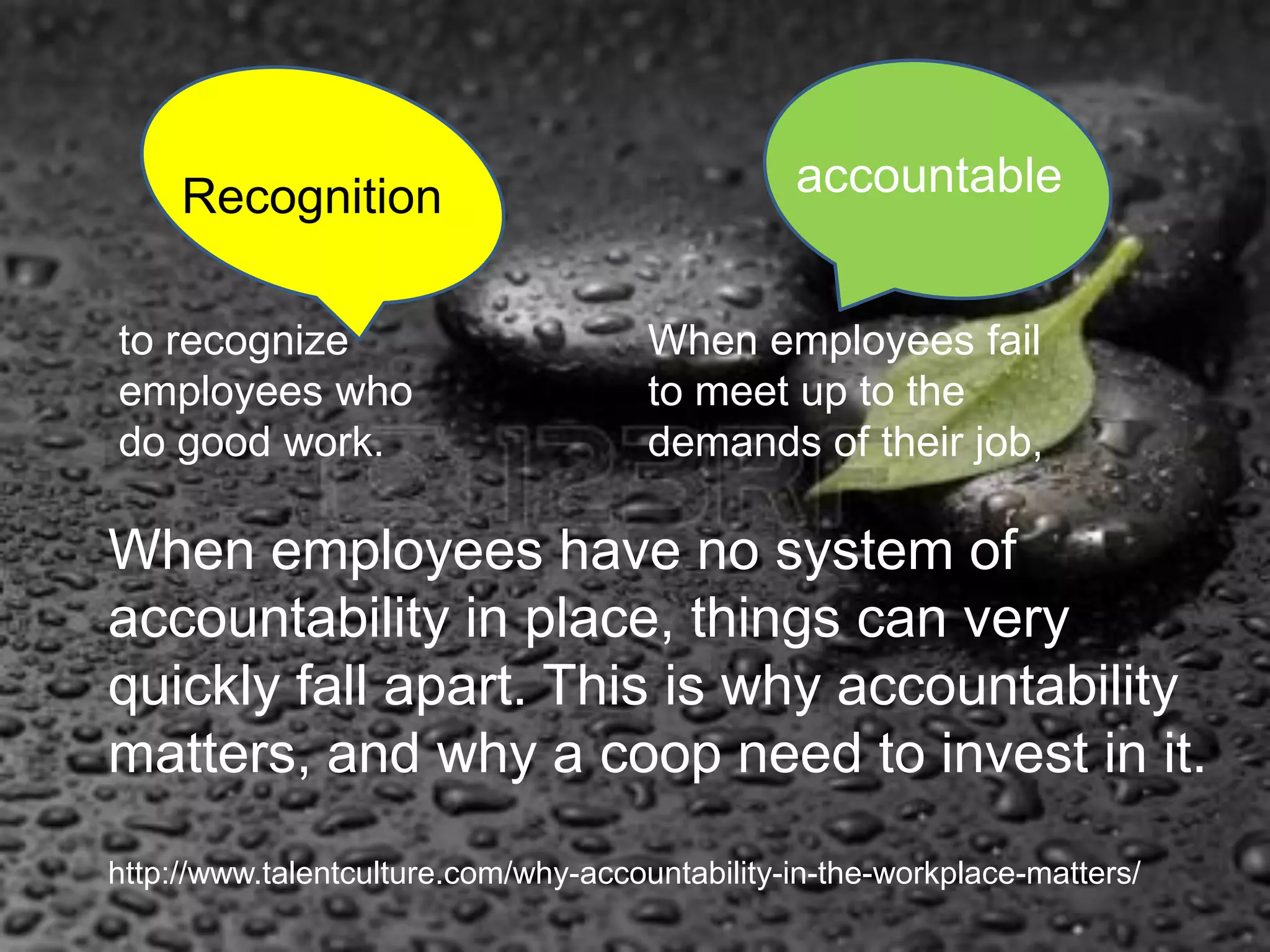
When employees have no system of
accountability in place, things can very
quickly fall apart. This is why accountability
matters, and why a coop need to invest in it.
Recognition accountable
When employees fail
to meet up to the
demands of their job,
to recognize
employees who
do good work.
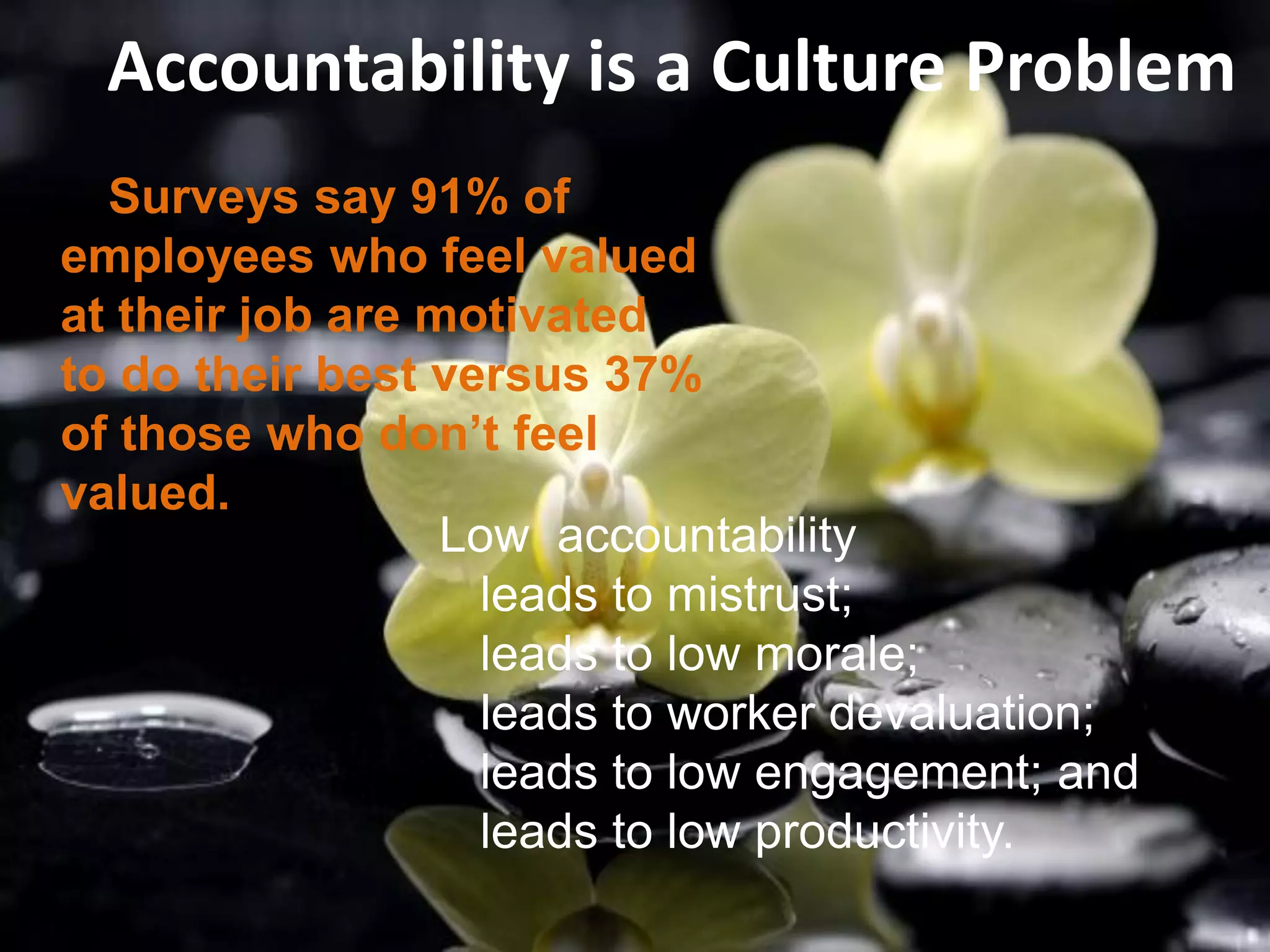
Accountability is a Culture Problem
Surveys say 91% of
employees who feel valued
at their job are motivated
to do their best versus 37%
of those who don’t feel
valued.
Low accountability
leads to mistrust;
leads to low morale;
leads to worker devaluation;
leads to low engagement; and
leads to low productivity.
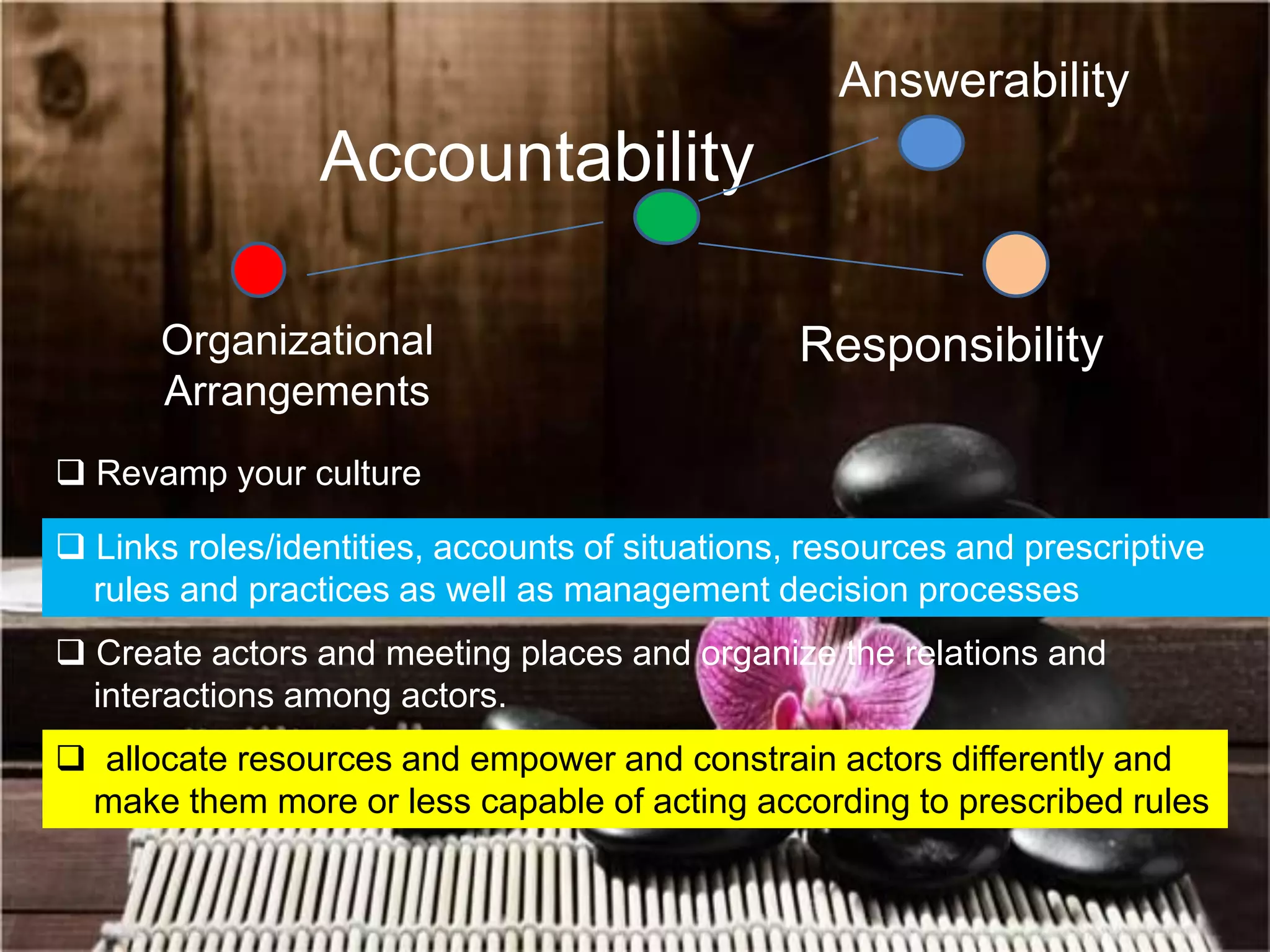
 Links roles/identities, accounts of situations, resources and prescriptive
rules and practices as well as management decision processes
 Create actors and meeting places and organize the relations and
interactions among actors.
 allocate resources and empower and constrain actors differently and
make them more or less capable of acting according to prescribed rules
Accountability
Organizational
Arrangements
Answerability
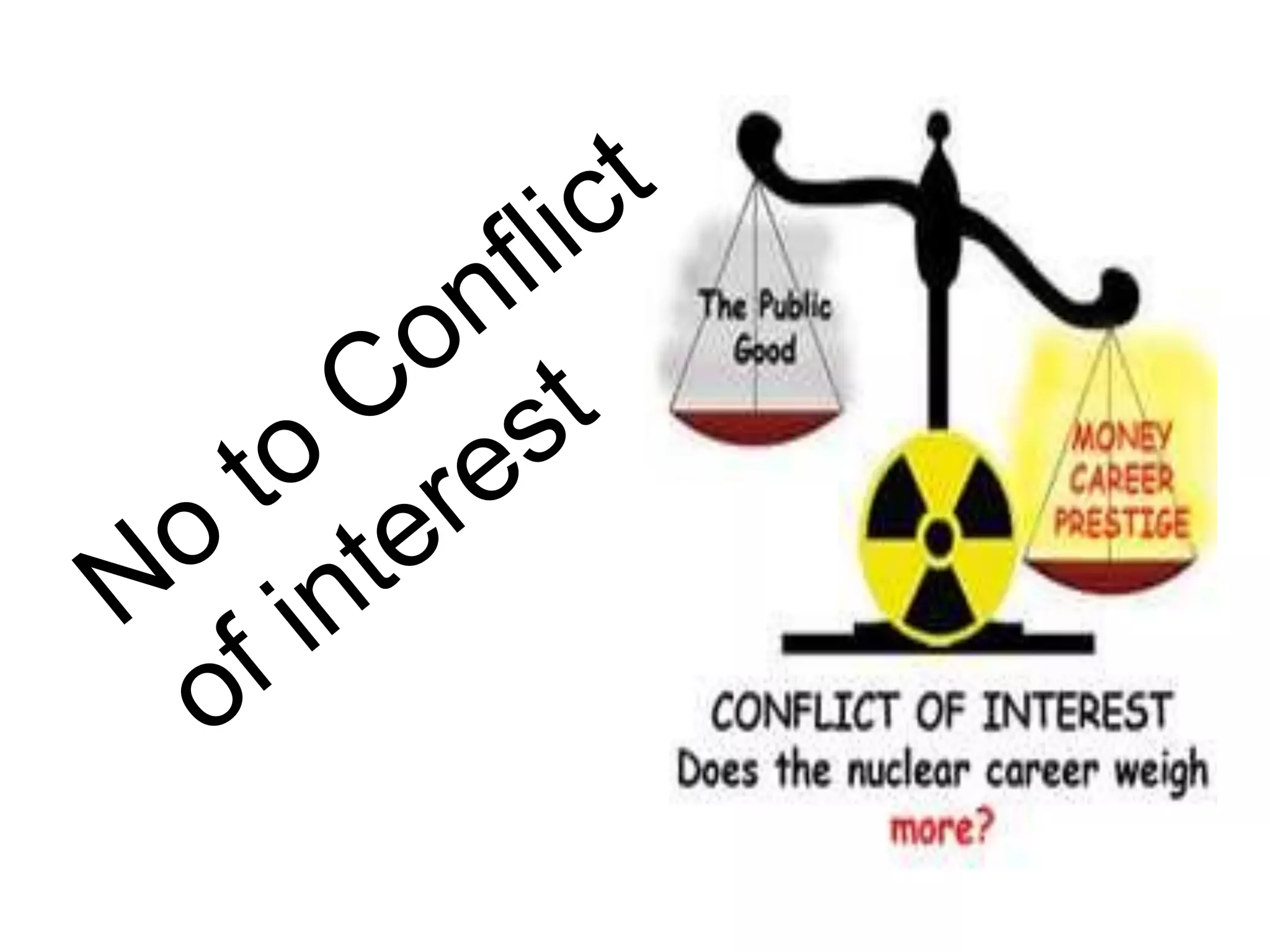
Responsibility
 Revamp your culture
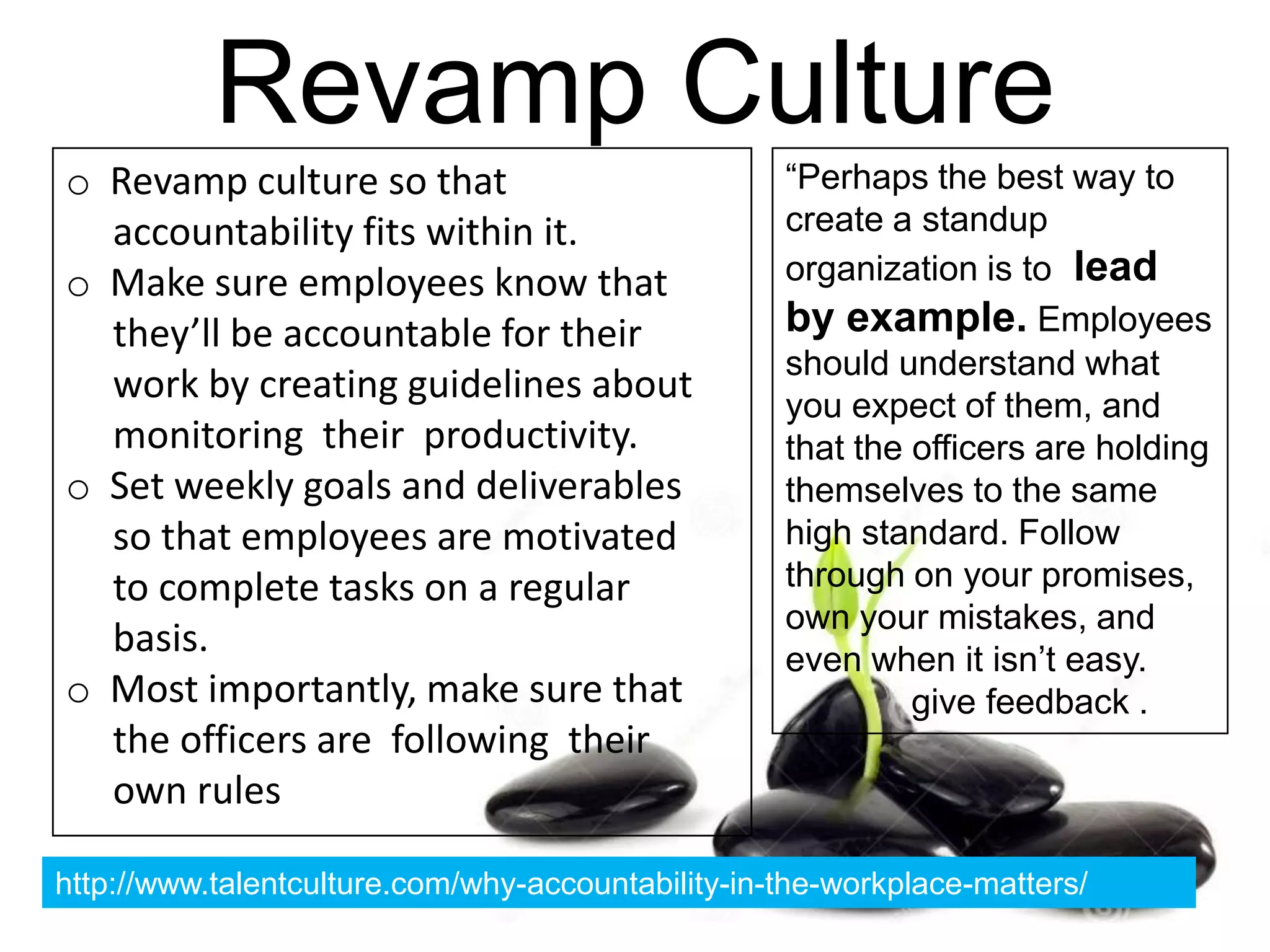
Revamp Culture
o Revamp culture so that
accountability fits within it.
o Make sure employees know that
they’ll be accountable for their
work by creating guidelines about
monitoring their productivity.
o Set weekly goals and deliverables
so that employees are motivated
to complete tasks on a regular
basis.
o Most importantly, make sure that
the officers are following their
own rules
“Perhaps the best way to
create a standup
organization is to lead
by example. Employees
should understand what
you expect of them, and
that the officers are holding
themselves to the same
high standard. Follow
through on your promises,
own your mistakes, and
even when it isn’t easy.
give feedback .
http://www.talentculture.com/why-accountability-in-the-workplace-matters/
Creation of a unitary culture in
which values and norms are shared
by all employees. The support and
leadership of top management is
crucial to create an organizational
culture that evokes a uniform
response to ethical issues
Chen, 1997
• It would appear that working in
organizational settings
characterized by a more compliant
cooperative form of management in
which people engage each other
freely in shaping the culture is more
conducive to promoting ethical
awareness and behavior.
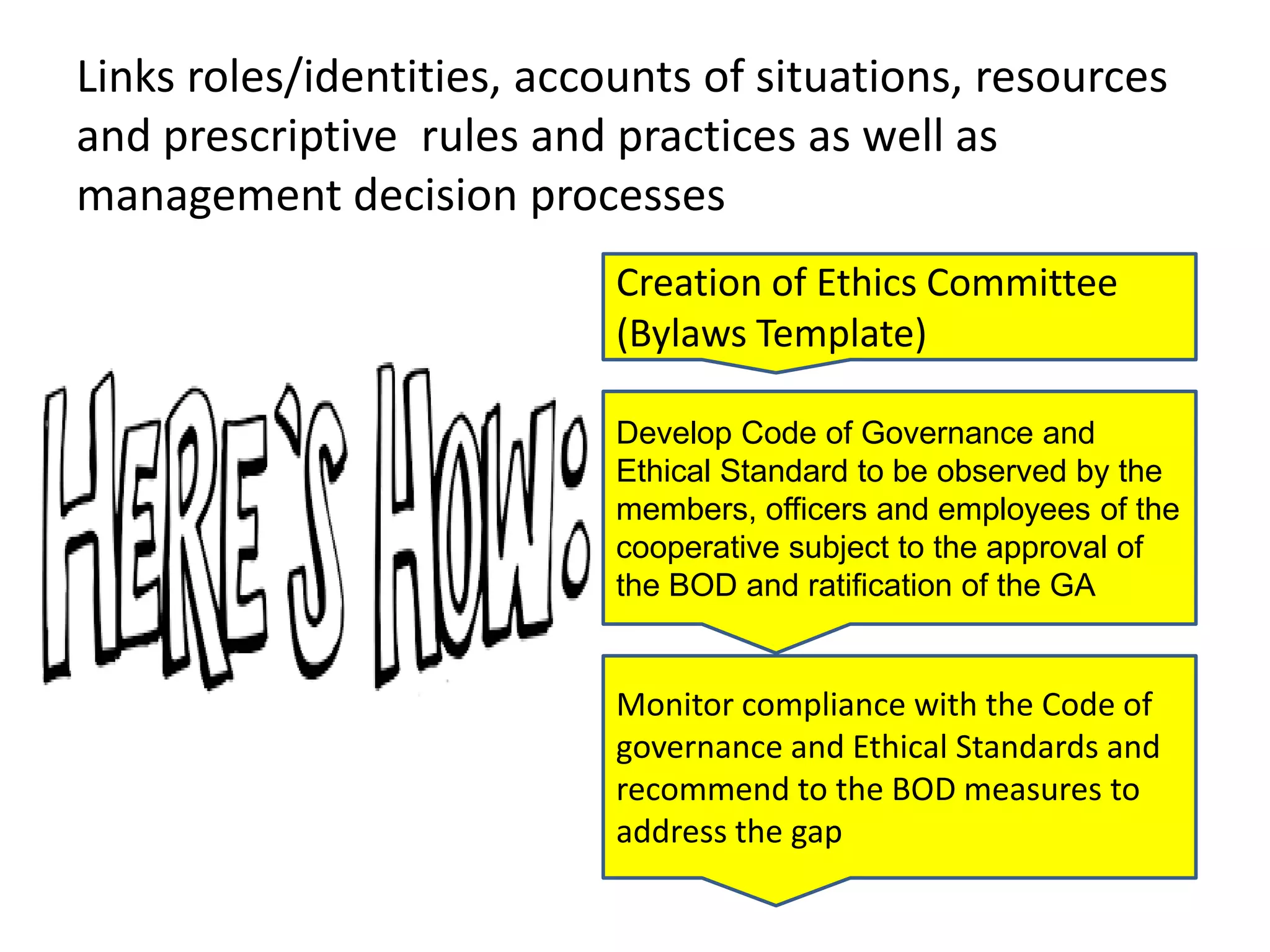
Links roles/identities, accounts of situations, resources
and prescriptive rules and practices as well as
management decision processes
Creation of Ethics Committee
(Bylaws Template)
Develop Code of Governance and
Ethical Standard to be observed by the
members, officers and employees of the
cooperative subject to the approval of
the BOD and ratification of the GA
Monitor compliance with the Code of
governance and Ethical Standards and
recommend to the BOD measures to
address the gap
Create actors and meeting places and
organize the relations and
interactions among actors
An Ethics Committee is created
and shall be composed of three
(3) members to be appointed by
the Board of Directors. Within
ten (10)days after their
appointment, they shall elect
from among themselves a
Chairman, Vice-Chairman and a
Secretary who shall serve for a
term of one (1) year or until
successors shall have been
appointed and qualified
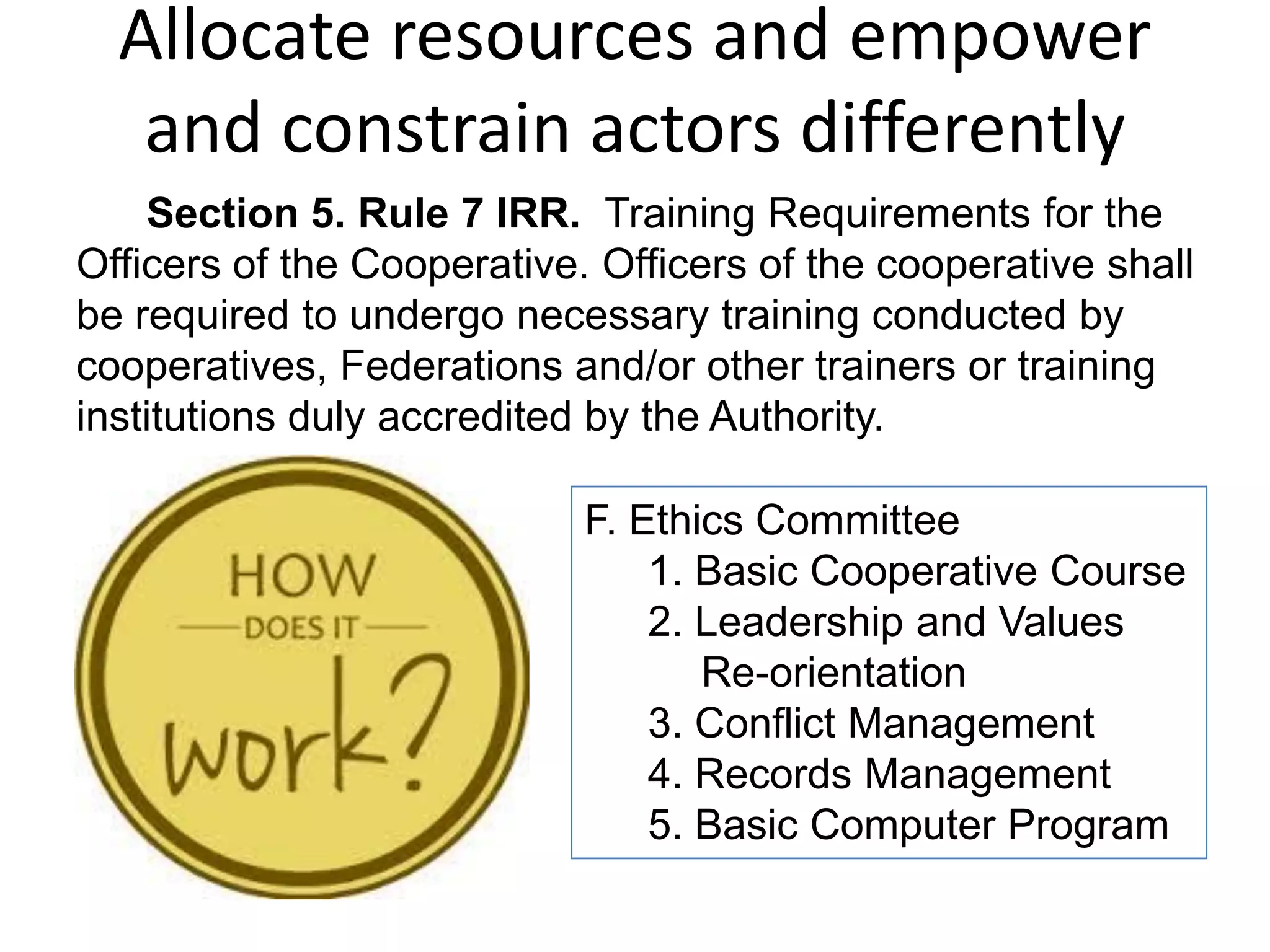
Allocate resources and empower
and constrain actors differently
F. Ethics Committee
1. Basic Cooperative Course
2. Leadership and Values
Re-orientation
3. Conflict Management
4. Records Management
5. Basic Computer Program
Section 5. Rule 7 IRR. Training Requirements for the
Officers of the Cooperative. Officers of the cooperative shall
be required to undergo necessary training conducted by
cooperatives, Federations and/or other trainers or training
institutions duly accredited by the Authority.
MC NO. 2011-14
Standard Training Curricula
for Cooperative Officers
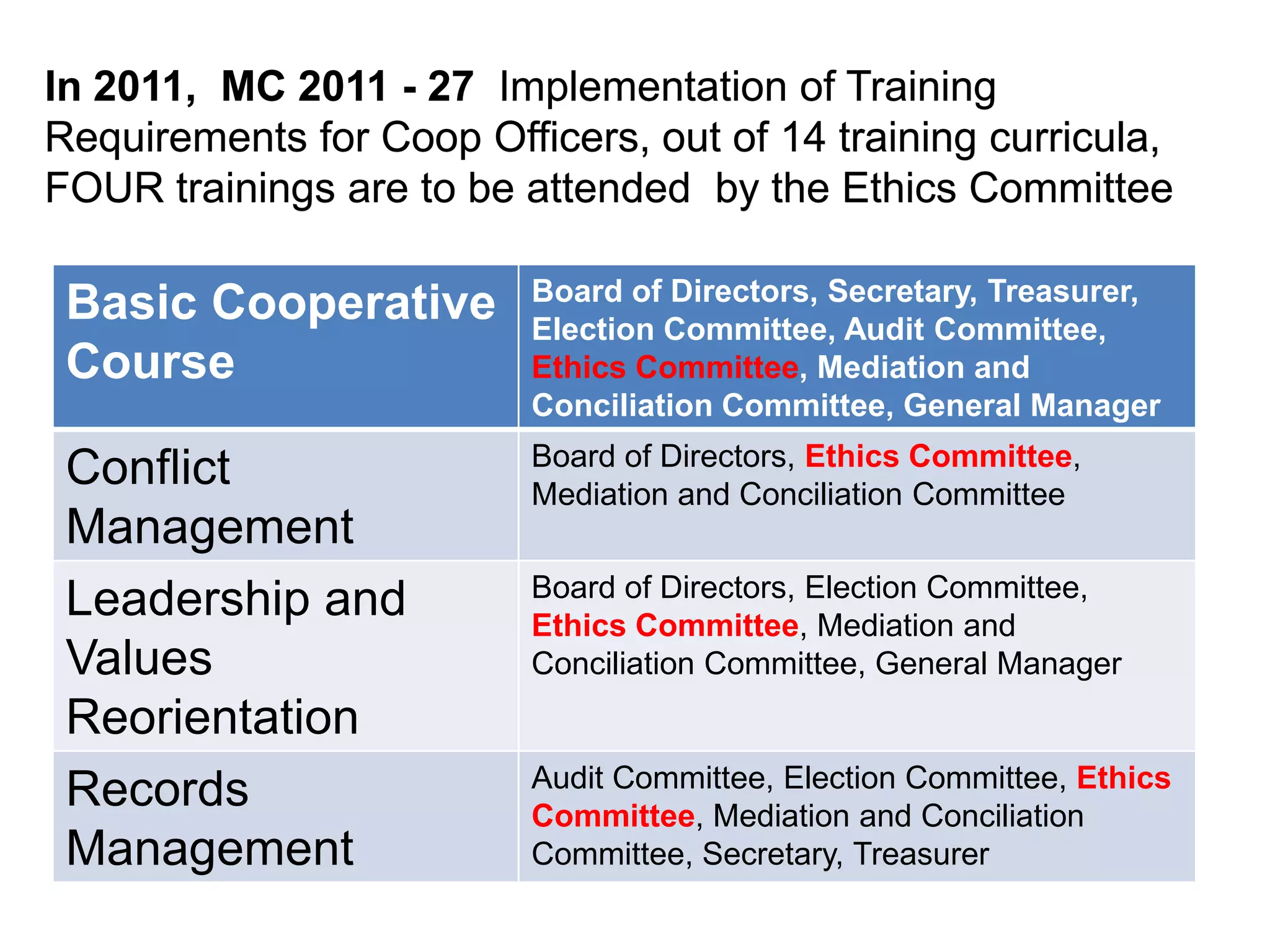
Basic Cooperative
Course
Board of Directors, Secretary, Treasurer,
Election Committee, Audit Committee,
Ethics Committee, Mediation and
Conciliation Committee, General Manager
Conflict
Management
Board of Directors, Ethics Committee,
Mediation and Conciliation Committee
Leadership and
Values
Reorientation
Board of Directors, Election Committee,
Ethics Committee, Mediation and
Conciliation Committee, General Manager
Records
Management
Audit Committee, Election Committee, Ethics
Committee, Mediation and Conciliation
Committee, Secretary, Treasurer
In 2011, MC 2011 - 27 Implementation of Training
Requirements for Coop Officers, out of 14 training curricula,
FOUR trainings are to be attended by the Ethics Committee
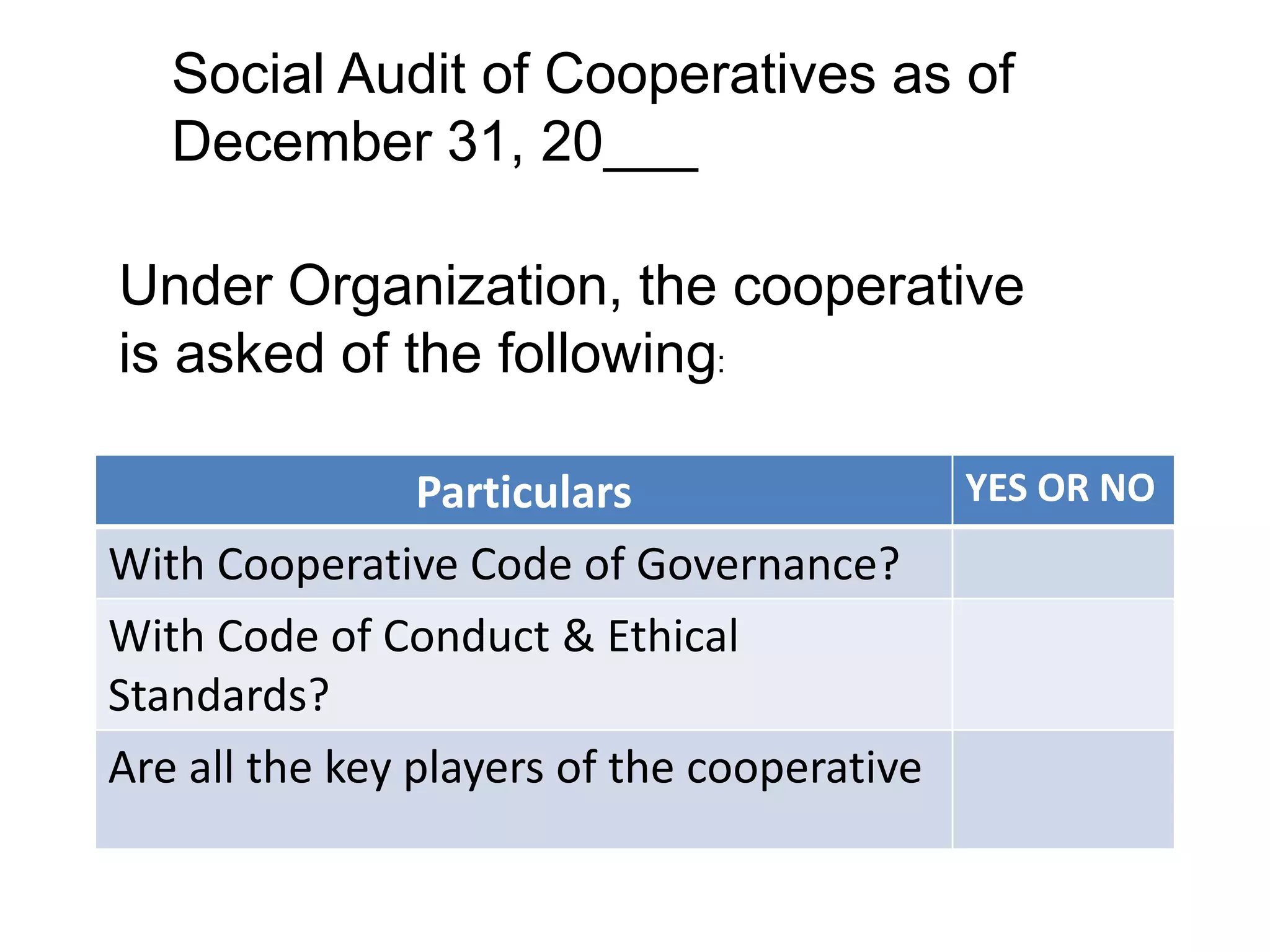
Social Audit of Cooperatives as of
December 31, 20___
Under Organization, the cooperative
is asked of the following:
Particulars YES OR NO
With Cooperative Code of Governance?
With Code of Conduct & Ethical
Standards?
Are all the key players of the cooperative
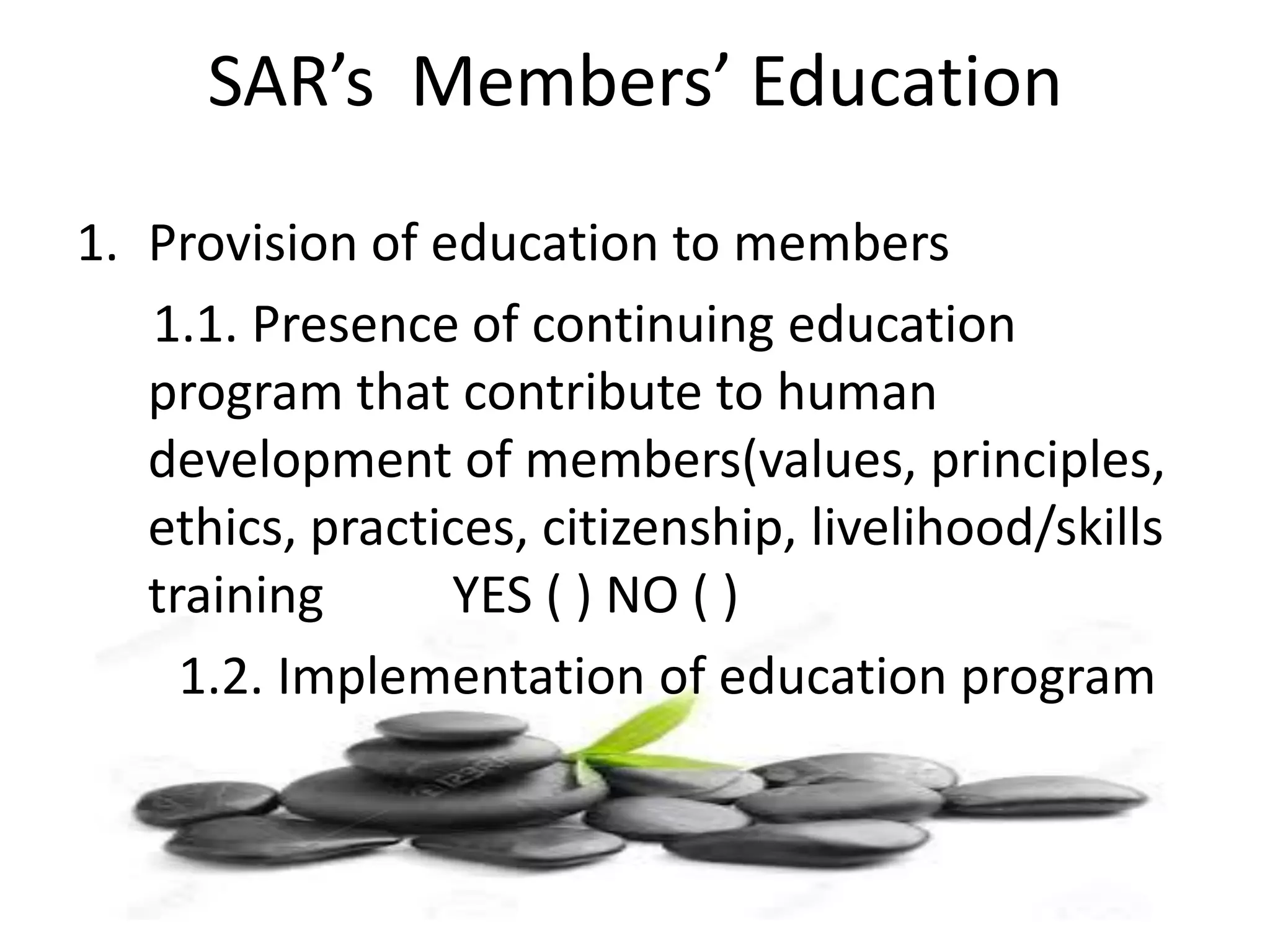
SAR’s Members’ Education
1. Provision of education to members
1.1. Presence of continuing education
program that contribute to human
development of members(values, principles,
ethics, practices, citizenship, livelihood/skills
training YES ( ) NO ( )
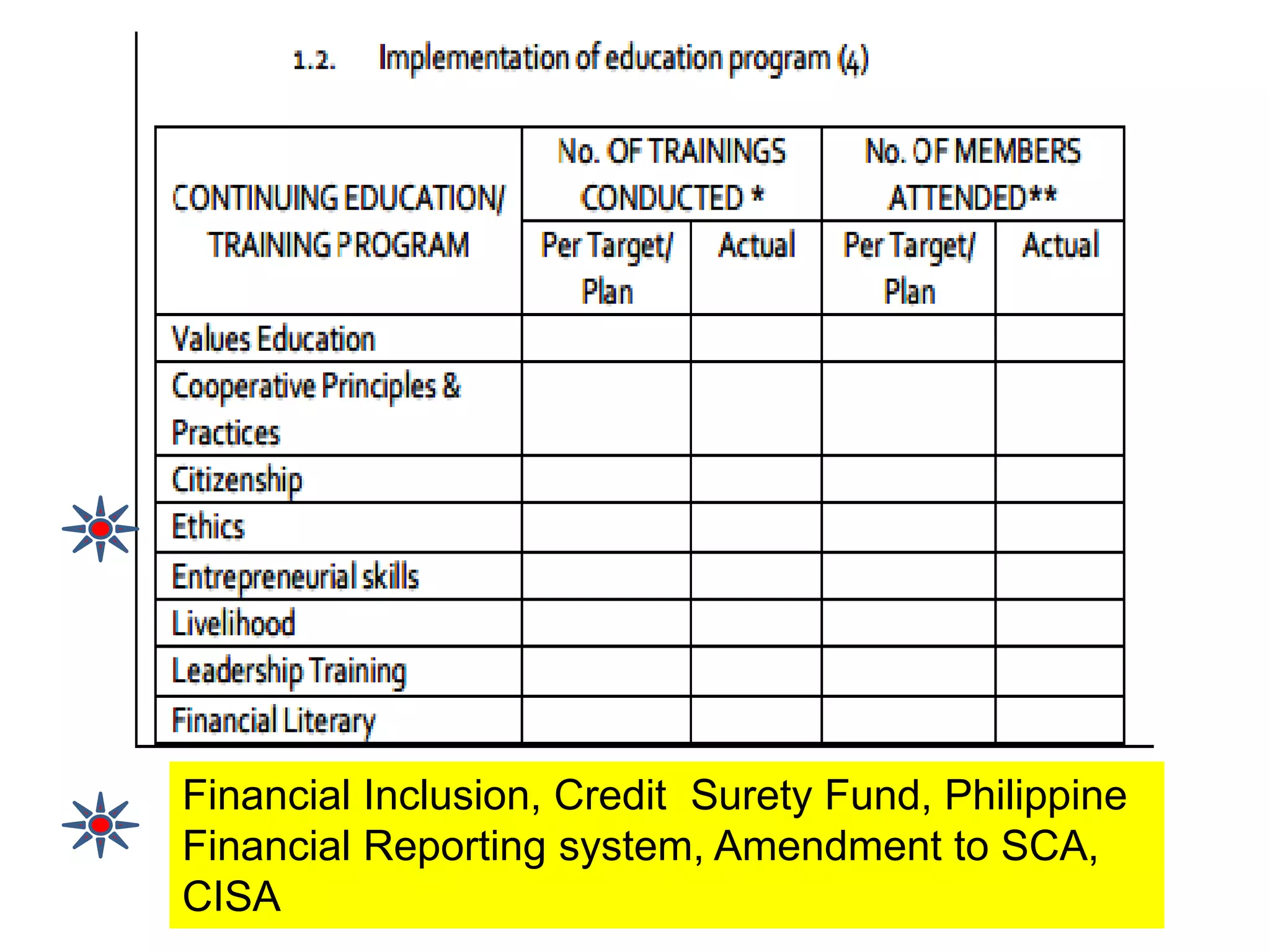
1.2. Implementation of education program
Financial Inclusion, Credit Surety Fund, Philippine
Financial Reporting system, Amendment to SCA,
CISA
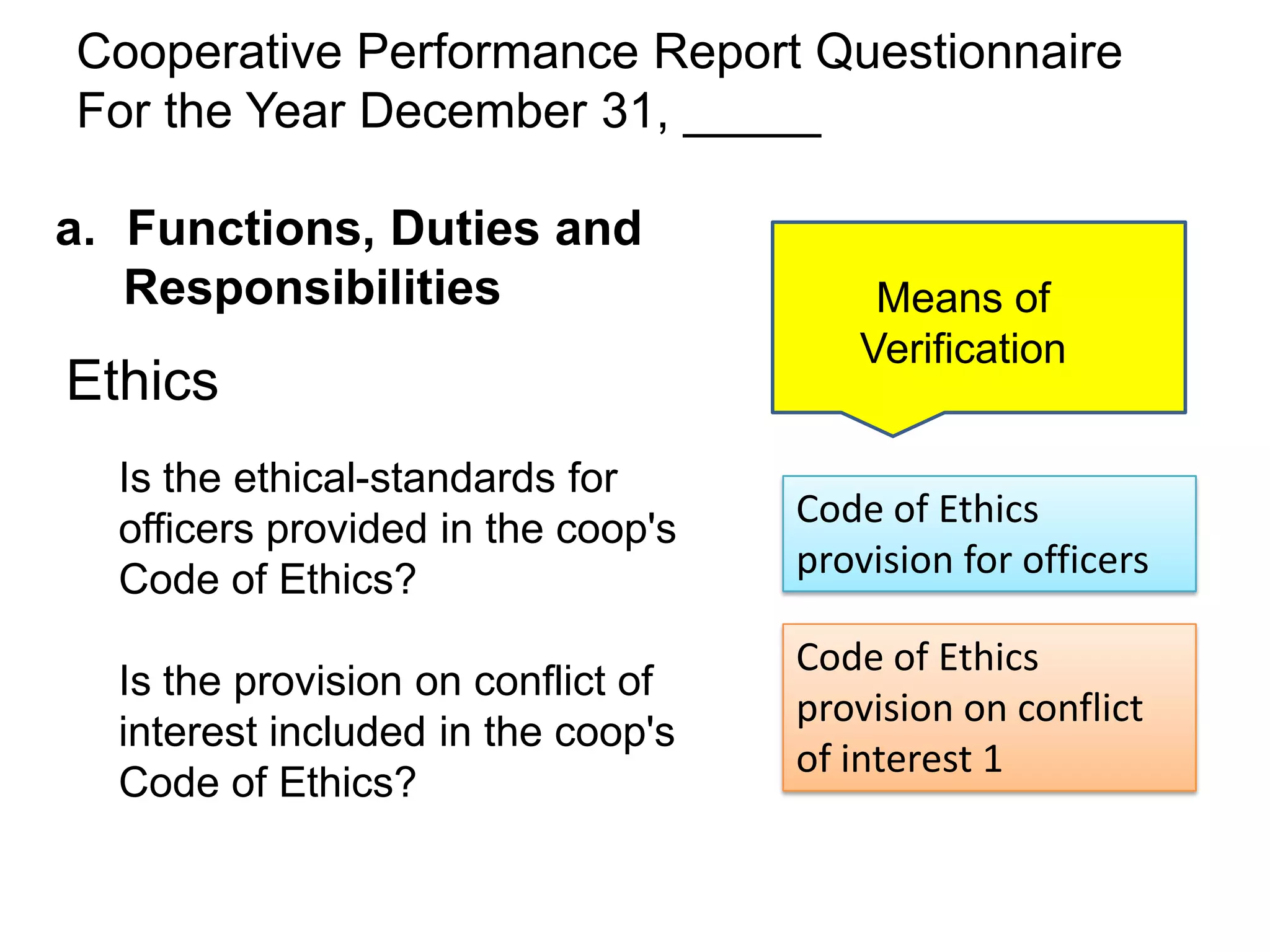
Cooperative Performance Report Questionnaire
For the Year December 31, _____
Is the ethical-standards for
officers provided in the coop's
Code of Ethics?
Is the provision on conflict of
interest included in the coop's
Code of Ethics?
Ethics
Code of Ethics
provision for officers
Code of Ethics
provision on conflict
of interest 1
a. Functions, Duties and
Responsibilities Means of
Verification
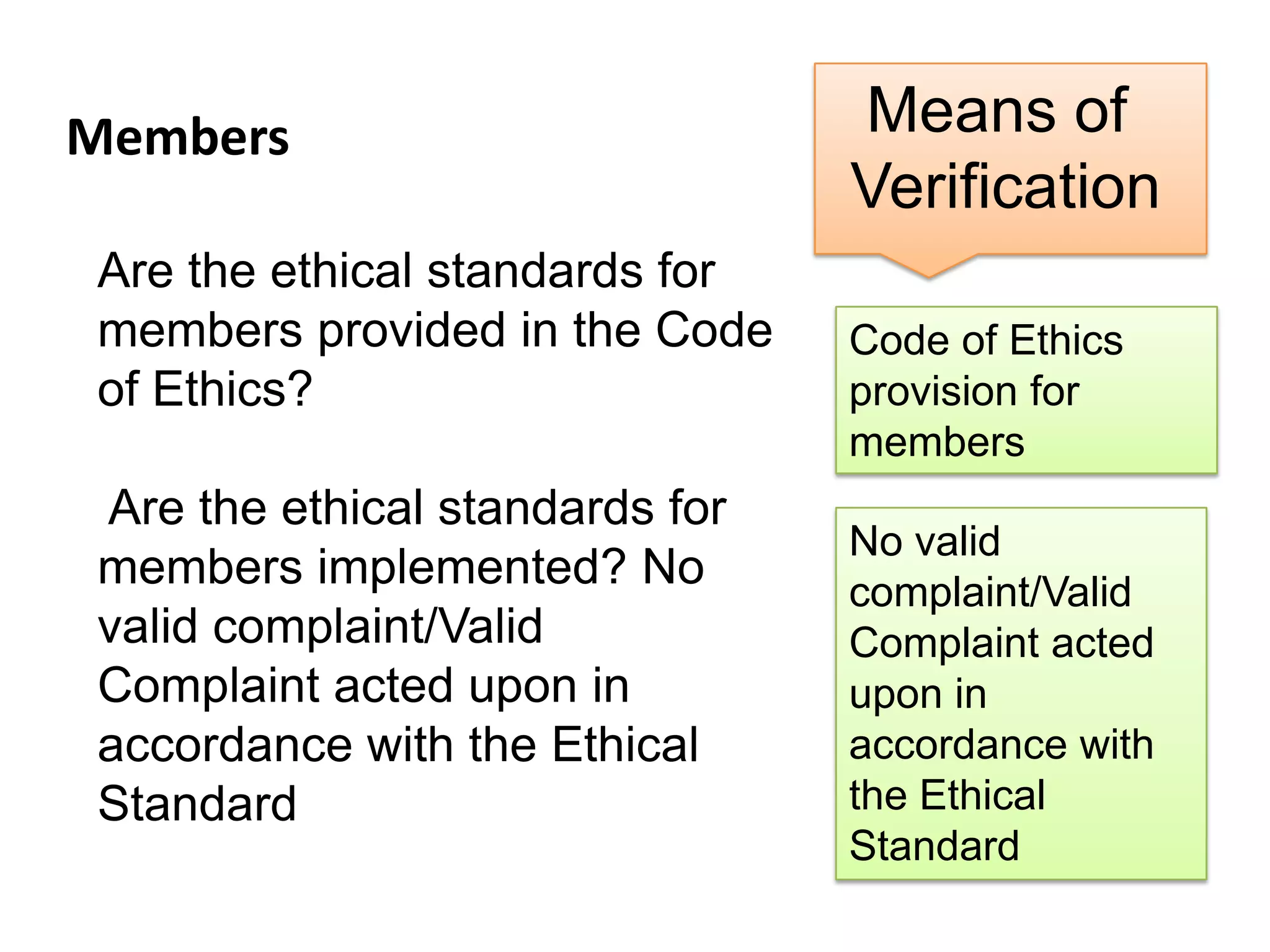
Members
Are the ethical standards for
members provided in the Code
of Ethics?
Are the ethical standards for
members implemented? No
valid complaint/Valid
Complaint acted upon in
accordance with the Ethical
Standard
Code of Ethics
provision for
members
No valid
complaint/Valid
Complaint acted
upon in
accordance with
the Ethical
Standard
Means of
Verification
Inspection Instrument
Compliance with RA 9520
64. The Cooperative has a
Cooperative Code of
Governance and Ethical
Standard?
None: Period of compliance
12 months
• They guide behavior and stabilize
expectations.
• Help assure ethical
and accountable behavior
• How those polices are executed, and
the accountability arrangements.
• Have guidelines or a process to deal
with ethical issues
Importance of Cooperative Code
of Governance and Ethical
Standard
• Society in general will benefit as
employees and cooperatives are
better prepared to identify and
address issues in an ethical
manner.
Anecdotal vs.
Statistics
Performance of coops on
Social and Financial
Accountability
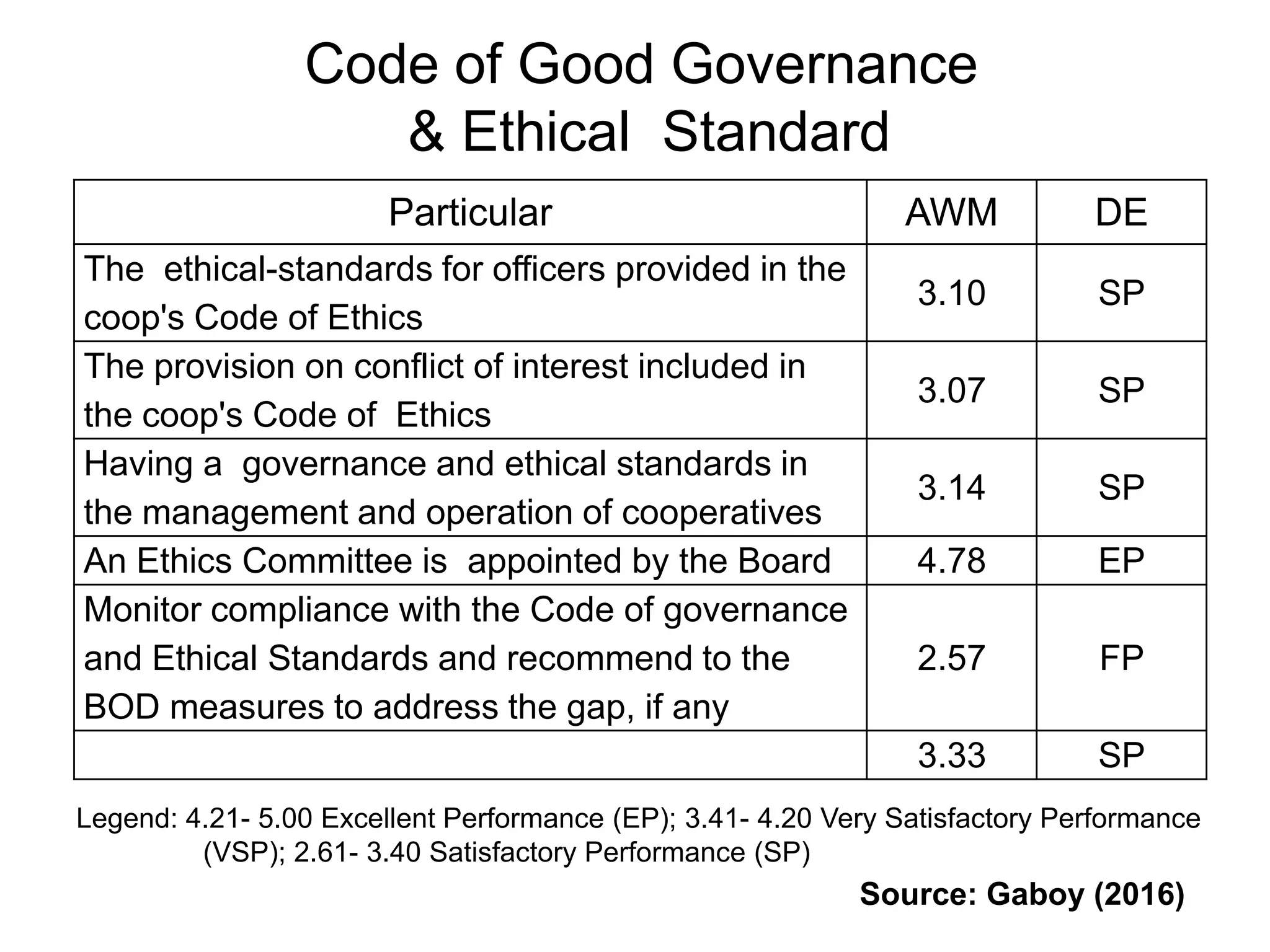
Particular AWM DE
The ethical-standards for officers provided in the
coop's Code of Ethics
3.10 SP
The provision on conflict of interest included in
the coop's Code of Ethics
3.07 SP
Having a governance and ethical standards in
the management and operation of cooperatives
3.14 SP
An Ethics Committee is appointed by the Board 4.78 EP
Monitor compliance with the Code of governance
and Ethical Standards and recommend to the
BOD measures to address the gap, if any
2.57 FP
3.33 SP
Code of Good Governance
& Ethical Standard
Legend: 4.21- 5.00 Excellent Performance (EP); 3.41- 4.20 Very Satisfactory Performance
(VSP); 2.61- 3.40 Satisfactory Performance (SP)
Source: Gaboy (2016)
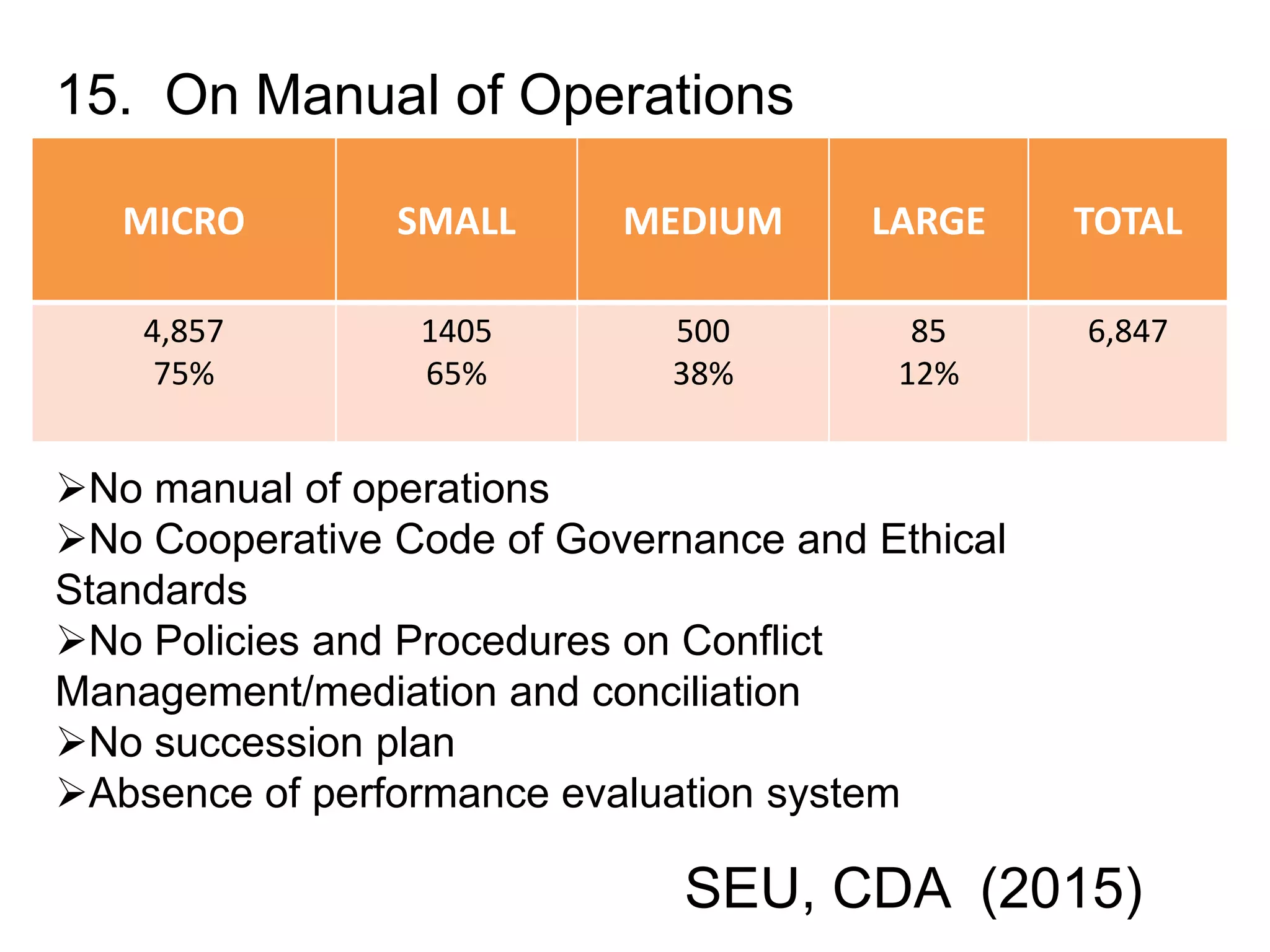
15. On Manual of Operations
MICRO SMALL MEDIUM LARGE TOTAL
4,857
75%
1405
65%
500
38%
85
12%
6,847
No manual of operations
No Cooperative Code of Governance and Ethical
Standards
No Policies and Procedures on Conflict
Management/mediation and conciliation
No succession plan
Absence of performance evaluation system
SEU, CDA (2015)
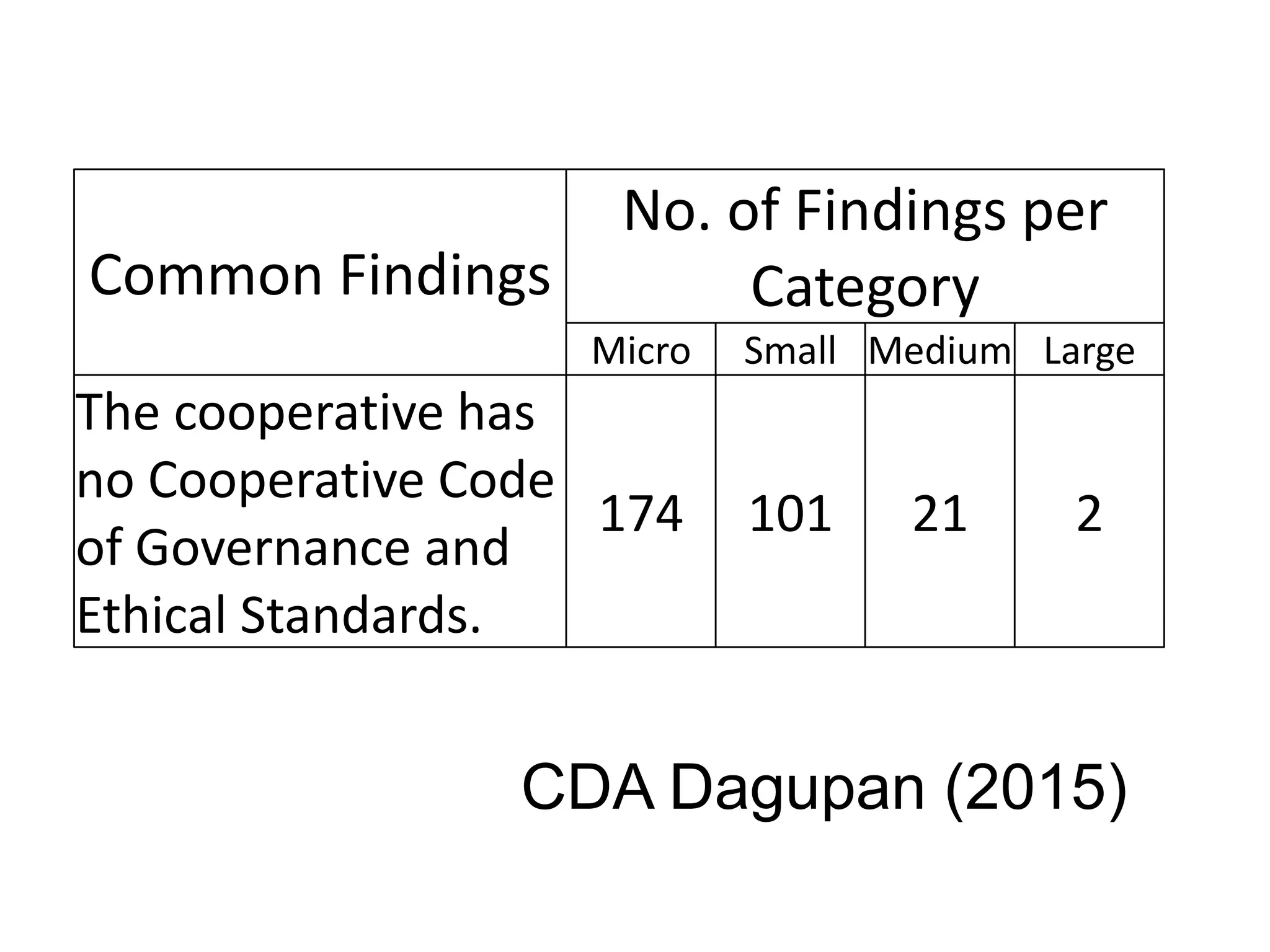
Common Findings
No. of Findings per
Category
Micro Small Medium Large
The cooperative has
no Cooperative Code
of Governance and
Ethical Standards.
174 101 21 2
CDA Dagupan (2015)
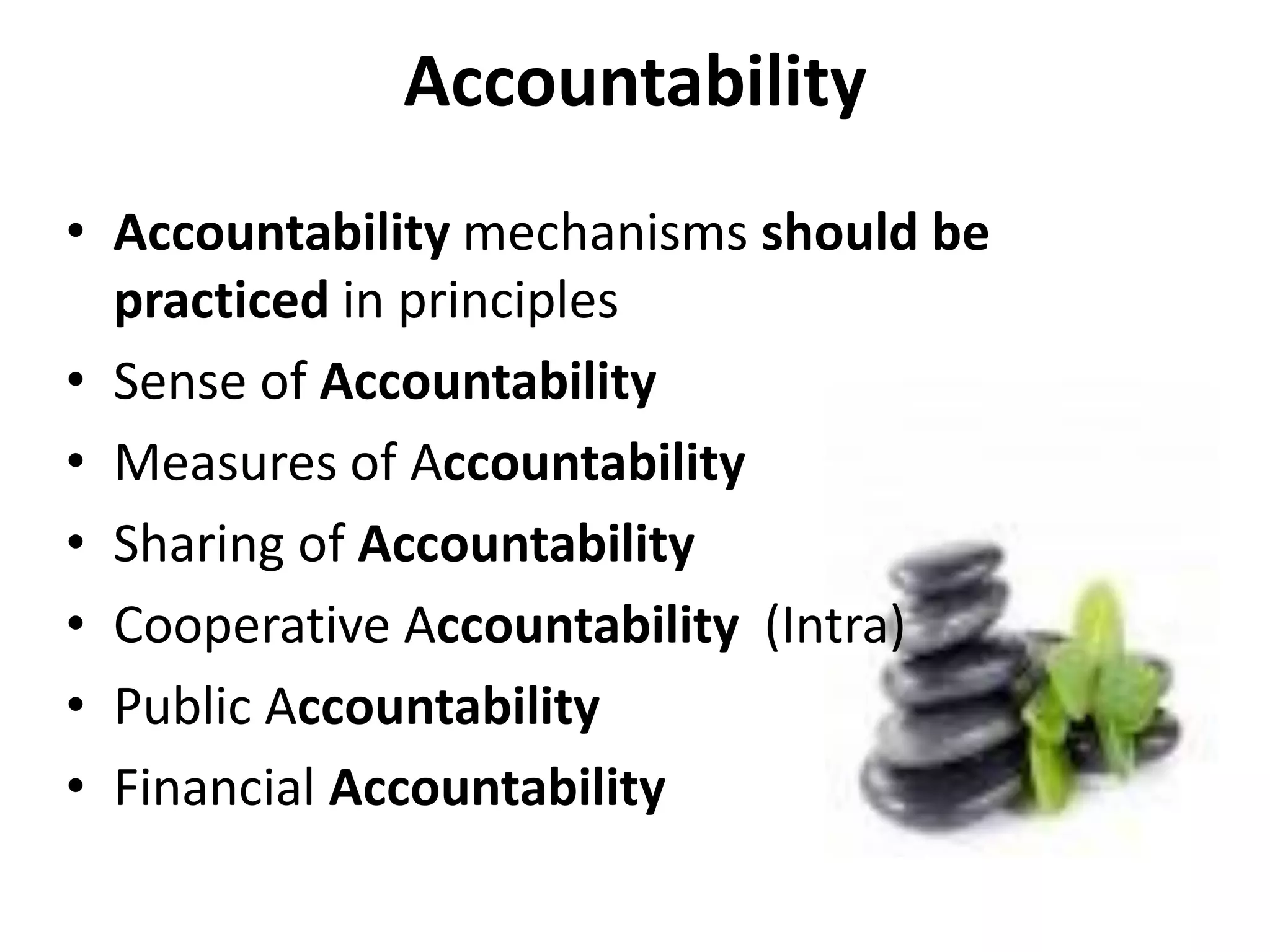
Accountability
• Accountability mechanisms should be
practiced in principles
• Sense of Accountability
• Measures of Accountability
• Sharing of Accountability
• Cooperative Accountability (Intra)
• Public Accountability
• Financial Accountability
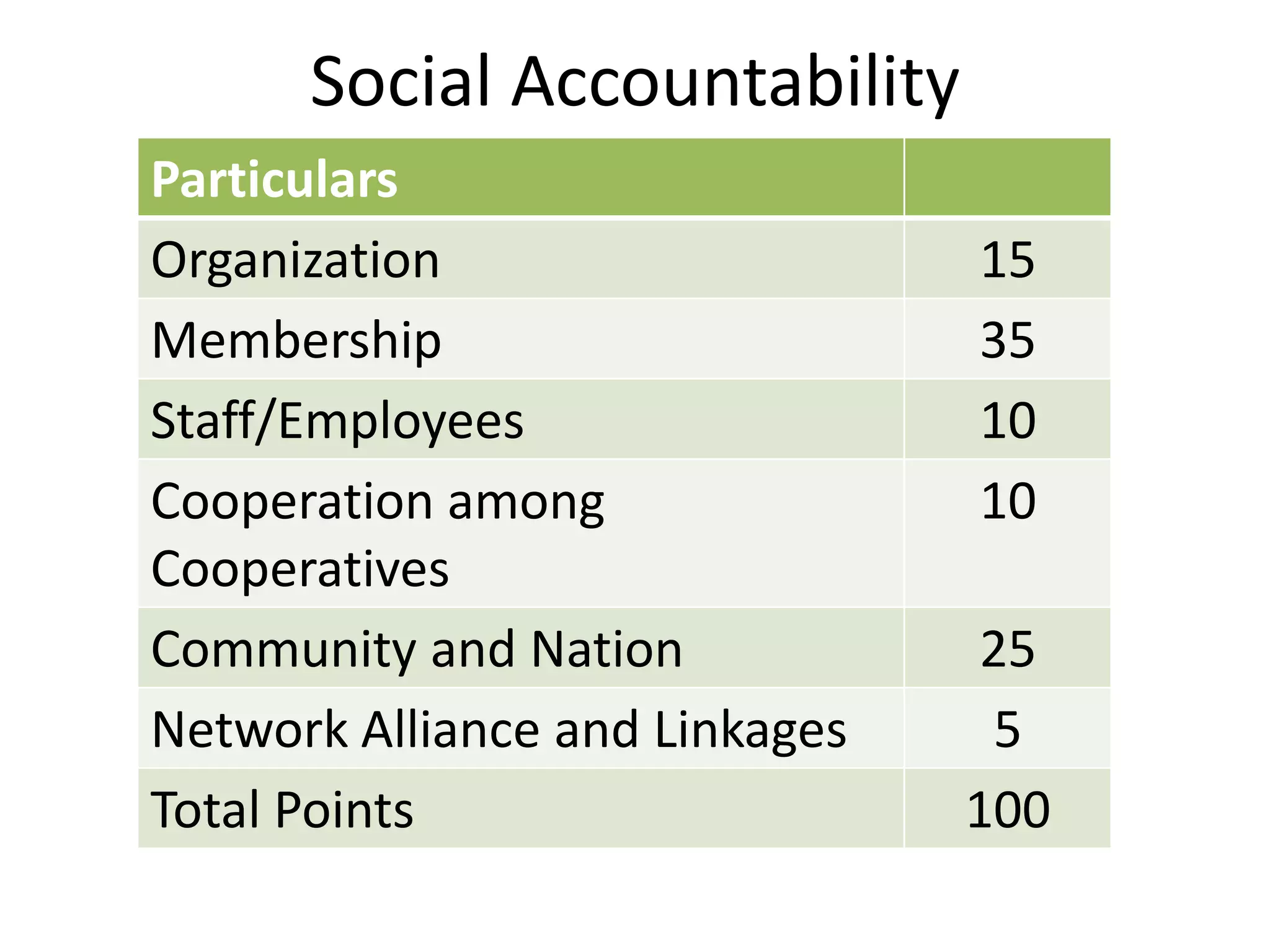
Social Accountability
Particulars
Organization 15
Membership 35
Staff/Employees 10
Cooperation among
Cooperatives
10
Community and Nation 25
Network Alliance and Linkages 5
Total Points 100
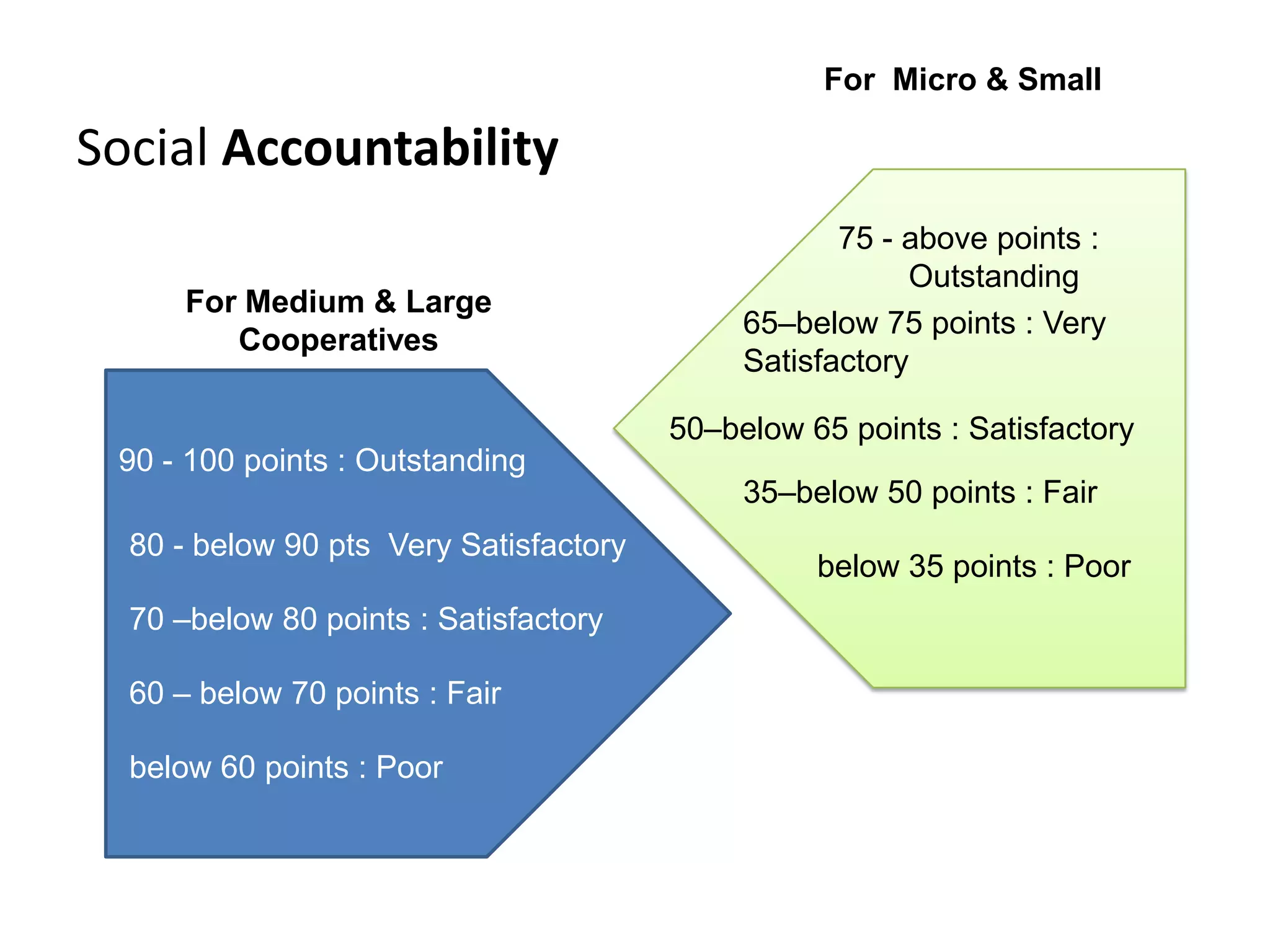
Social Accountability
90 - 100 points : Outstanding
80 - below 90 pts Very Satisfactory
70 –below 80 points : Satisfactory
60 – below 70 points : Fair
below 60 points : Poor
For Medium & Large
Cooperatives
75 - above points :
Outstanding
65–below 75 points : Very
Satisfactory
50–below 65 points : Satisfactory
35–below 50 points : Fair
below 35 points : Poor
For Micro & Small
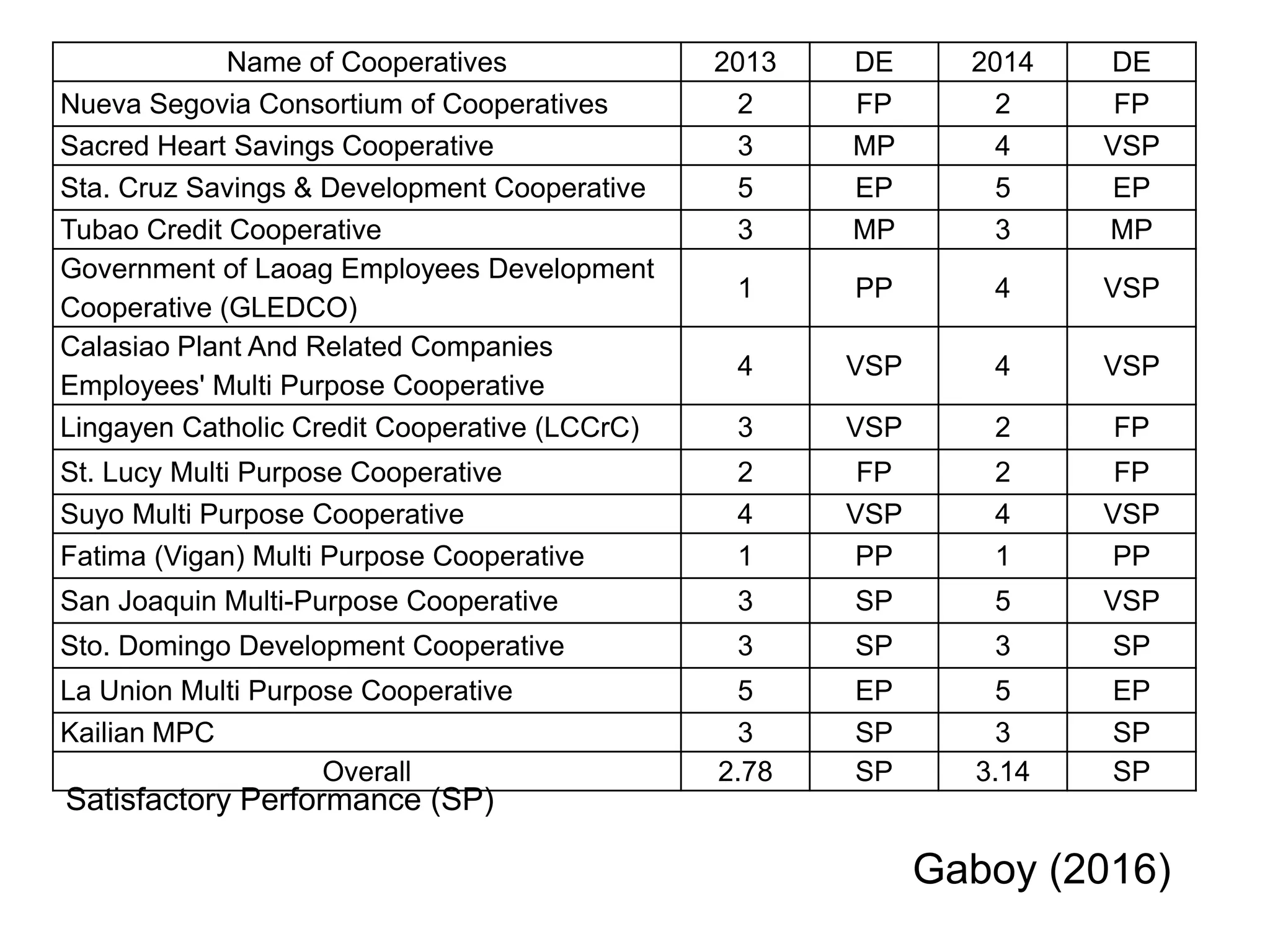
Name of Cooperatives 2013 DE 2014 DE
Nueva Segovia Consortium of Cooperatives 2 FP 2 FP
Sacred Heart Savings Cooperative 3 MP 4 VSP
Sta. Cruz Savings & Development Cooperative 5 EP 5 EP
Tubao Credit Cooperative 3 MP 3 MP
Government of Laoag Employees Development
Cooperative (GLEDCO)
1 PP 4 VSP
Calasiao Plant And Related Companies
Employees' Multi Purpose Cooperative
4 VSP 4 VSP
Lingayen Catholic Credit Cooperative (LCCrC) 3 VSP 2 FP
St. Lucy Multi Purpose Cooperative 2 FP 2 FP
Suyo Multi Purpose Cooperative 4 VSP 4 VSP
Fatima (Vigan) Multi Purpose Cooperative 1 PP 1 PP
San Joaquin Multi-Purpose Cooperative 3 SP 5 VSP
Sto. Domingo Development Cooperative 3 SP 3 SP
La Union Multi Purpose Cooperative 5 EP 5 EP
Kailian MPC 3 SP 3 SP
Overall 2.78 SP 3.14 SP
Satisfactory Performance (SP)
Gaboy (2016)
Social Responsibility
• The coop as a people’s
organization has a heavy social
responsibility that requires a
human and nationalistic stand,
discharge the functions and
render services in the most
professional manner, exercise
judiciousness and sincerity to
everyone and be responsive to
the needs not only the
membership but also to the
general public.
Performance Accountability
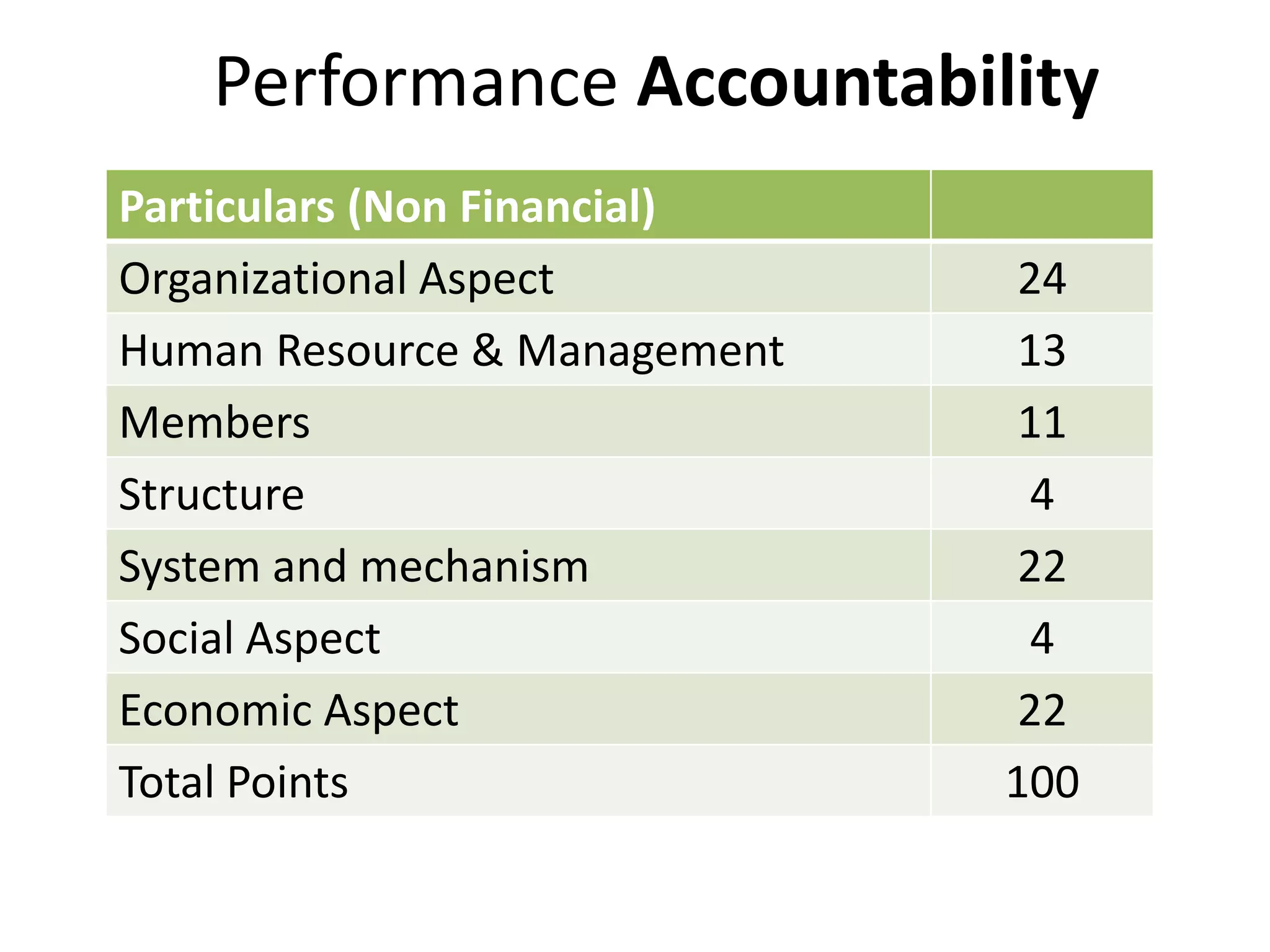
Particulars (Non Financial)
Organizational Aspect 24
Human Resource & Management 13
Members 11
Structure 4
System and mechanism 22
Social Aspect 4
Economic Aspect 22
Total Points 100
Performance Accountability
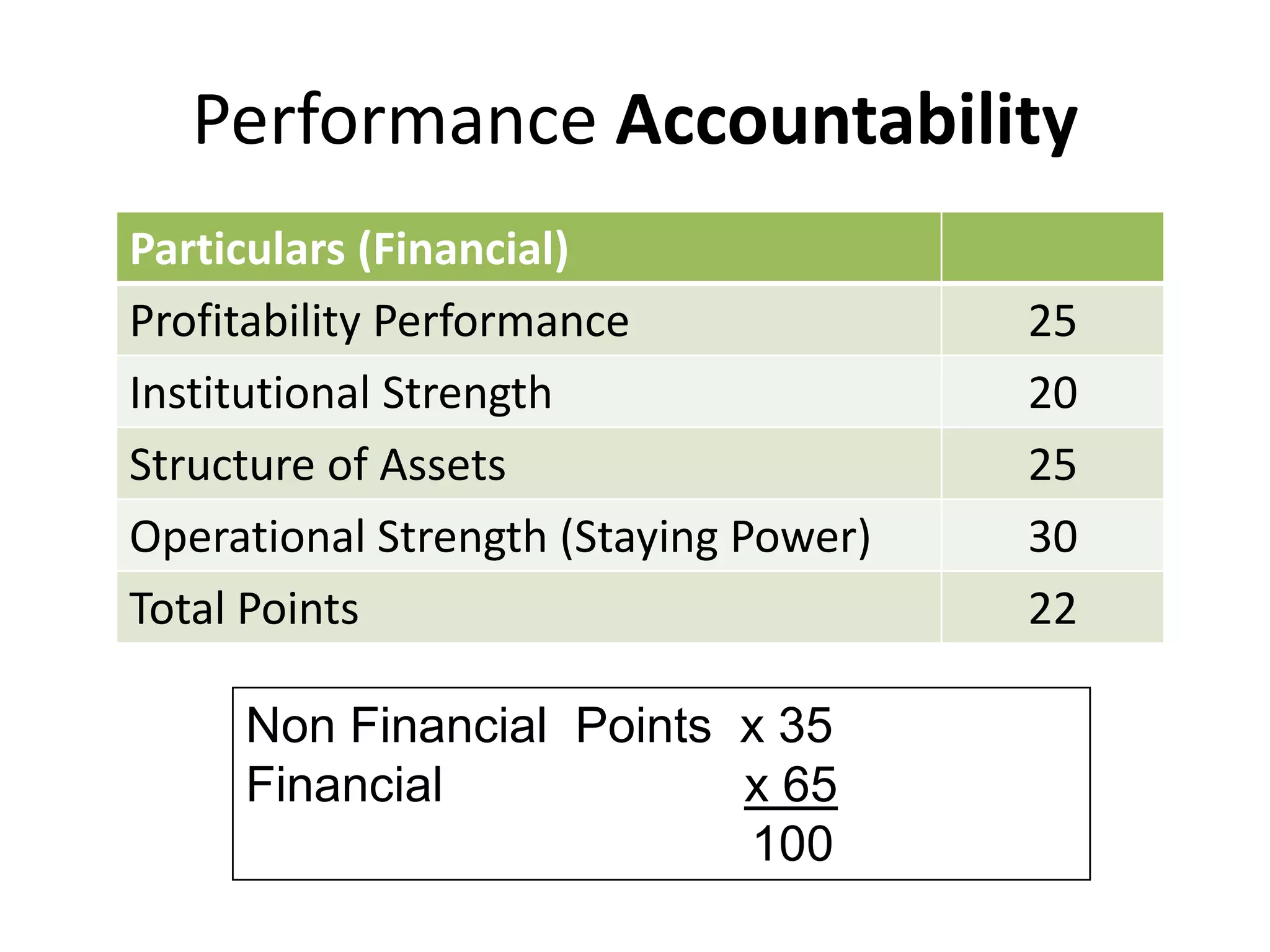
Particulars (Financial)
Profitability Performance 25
Institutional Strength 20
Structure of Assets 25
Operational Strength (Staying Power) 30
Total Points 22
Non Financial Points x 35
Financial x 65
100
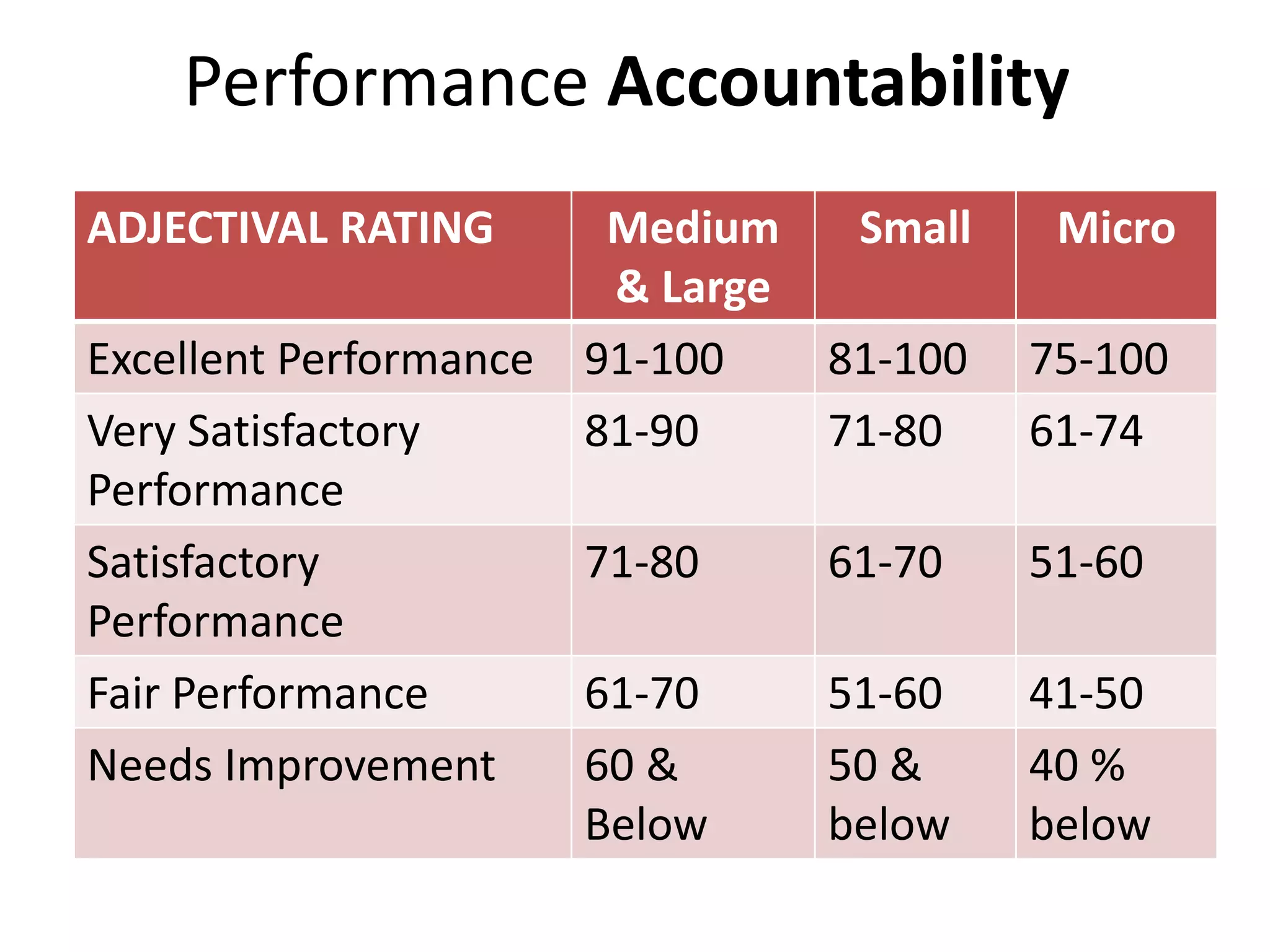
Performance Accountability
ADJECTIVAL RATING Medium
& Large
Small Micro
Excellent Performance 91-100 81-100 75-100
Very Satisfactory
Performance
81-90 71-80 61-74
Satisfactory
Performance
71-80 61-70 51-60
Fair Performance 61-70 51-60 41-50
Needs Improvement 60 &
Below
50 &
below
40 %
below
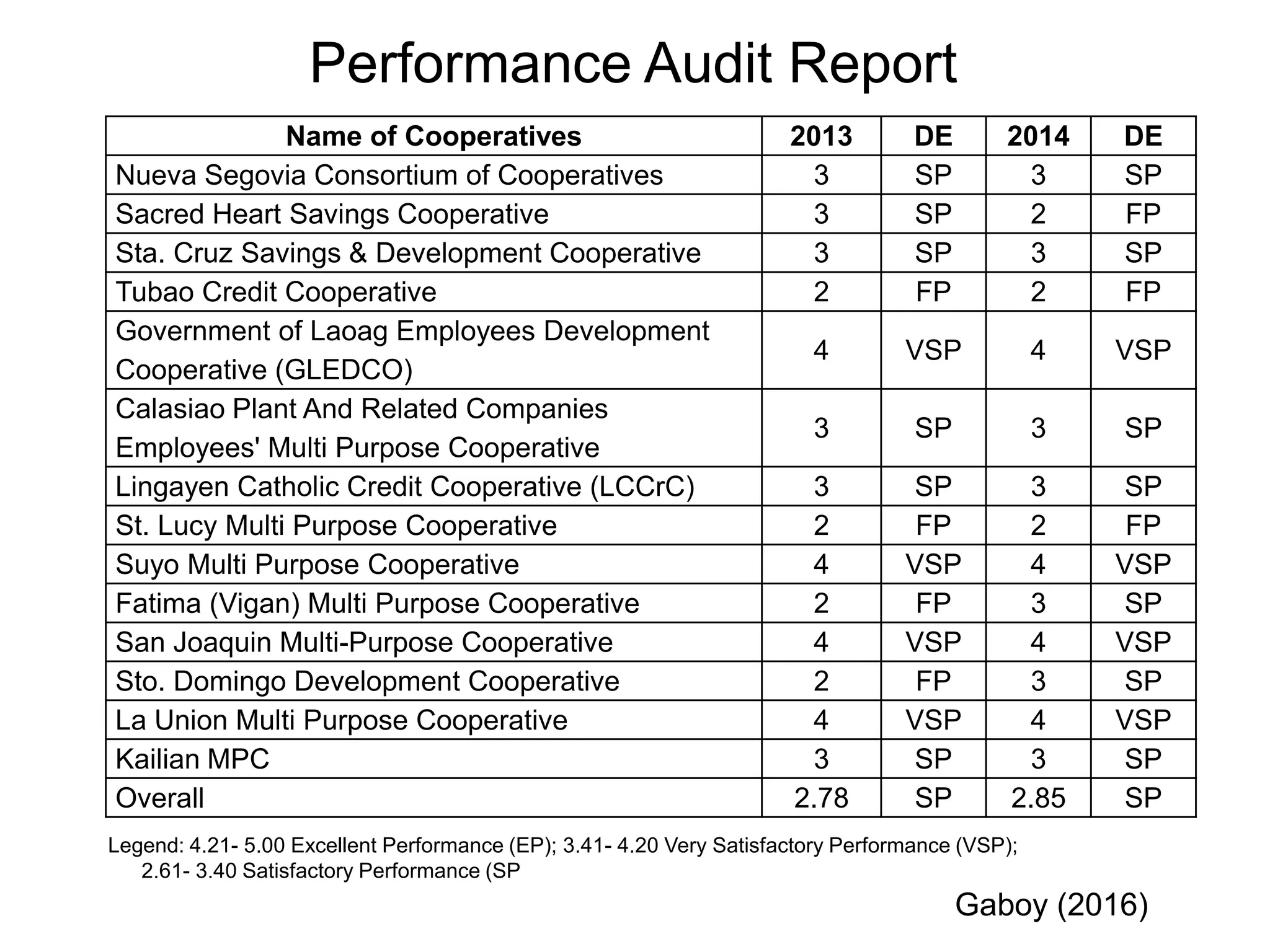
Name of Cooperatives 2013 DE 2014 DE
Nueva Segovia Consortium of Cooperatives 3 SP 3 SP
Sacred Heart Savings Cooperative 3 SP 2 FP
Sta. Cruz Savings & Development Cooperative 3 SP 3 SP
Tubao Credit Cooperative 2 FP 2 FP
Government of Laoag Employees Development
Cooperative (GLEDCO)
4 VSP 4 VSP
Calasiao Plant And Related Companies
Employees' Multi Purpose Cooperative
3 SP 3 SP
Lingayen Catholic Credit Cooperative (LCCrC) 3 SP 3 SP
St. Lucy Multi Purpose Cooperative 2 FP 2 FP
Suyo Multi Purpose Cooperative 4 VSP 4 VSP
Fatima (Vigan) Multi Purpose Cooperative 2 FP 3 SP
San Joaquin Multi-Purpose Cooperative 4 VSP 4 VSP
Sto. Domingo Development Cooperative 2 FP 3 SP
La Union Multi Purpose Cooperative 4 VSP 4 VSP
Kailian MPC 3 SP 3 SP
Overall 2.78 SP 2.85 SP
Legend: 4.21- 5.00 Excellent Performance (EP); 3.41- 4.20 Very Satisfactory Performance (VSP);
2.61- 3.40 Satisfactory Performance (SP
Performance Audit Report
Gaboy (2016)
Where to get a copy of the Code of
Conduct and Ethical Standard?
• CEO/Manager
• Human Resources
• Compliance Officers
• Legal Services
• BOD Kit
• Ethics Committee
• Secretary
The Board Governance
The Board of Directors is primarily
responsible for the governance of the
cooperative. It is the governing body upon
whom the management of the cooperative is
vested. The administration and management of
the affairs of the cooperative is the primary duty
of the Board
Spell out as: strategic planning, direction setting and
policy formulation activities, including review and
redirection of unresponsive and obsolete policies
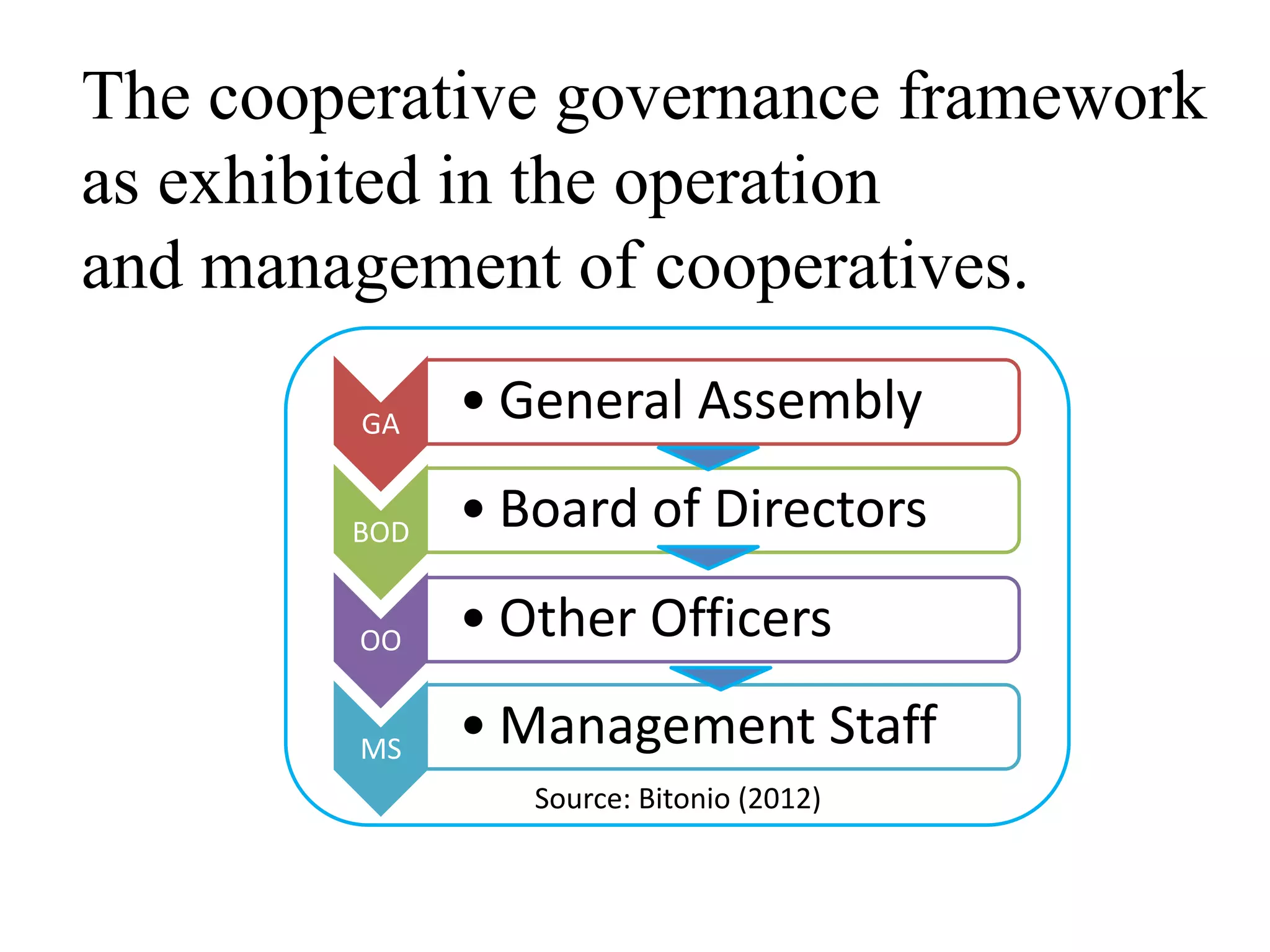
The cooperative governance framework
as exhibited in the operation
and management of cooperatives.
GA • General Assembly
BOD • Board of Directors
OO • Other Officers
MS • Management Staff
Source: Bitonio (2012)
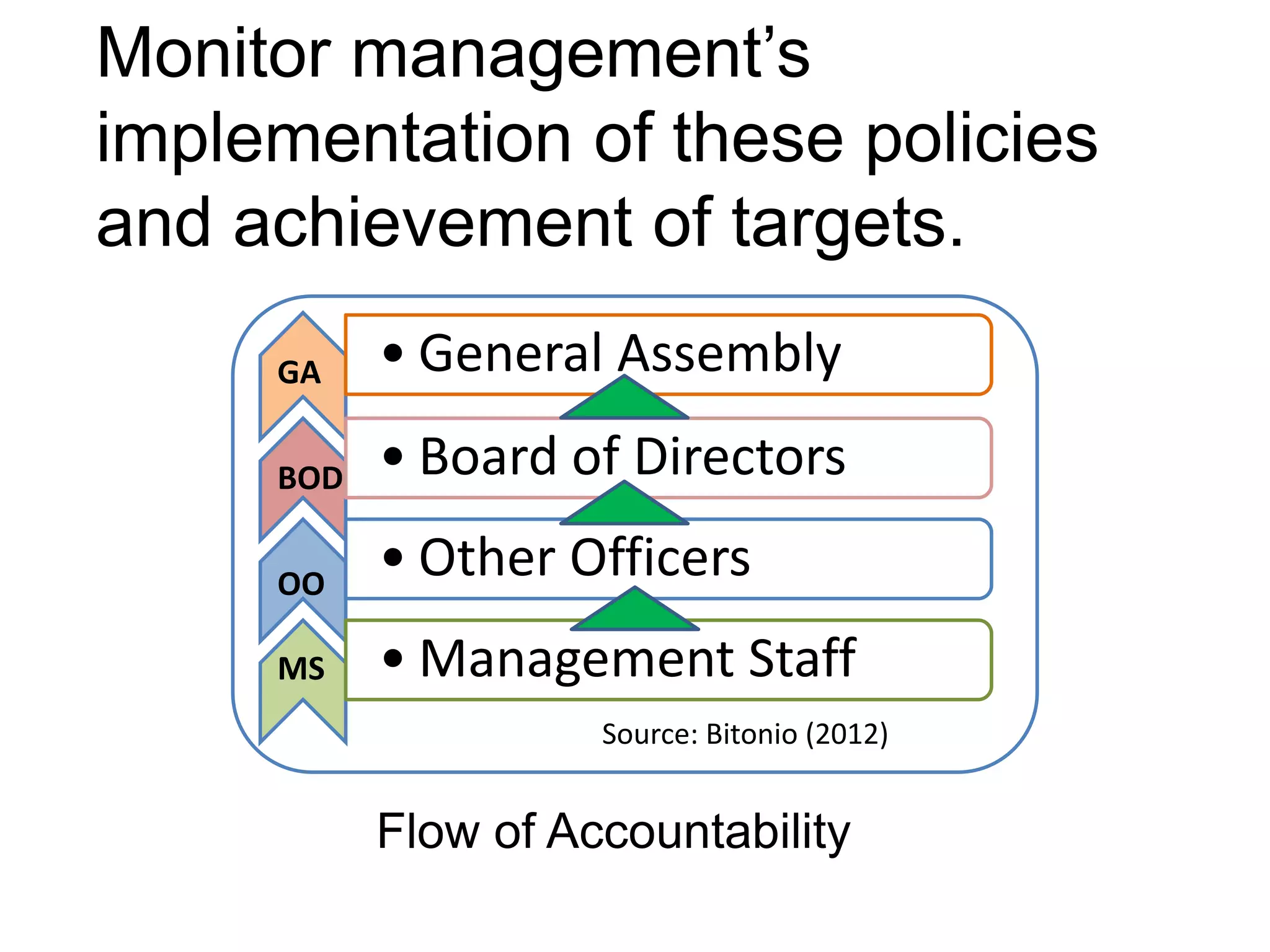
• General Assembly
• Board of Directors
• Other Officers
• Management Staff
Source: Bitonio (2012)
GA
BOD
OO
MS
Flow of Accountability
Monitor management’s
implementation of these policies
and achievement of targets.
Got Ethics?
The Five Ps
of Ethical
Power?
The Power of Ethical Management written by
Ken Blanchard and Norman Vincent Peale
Purpose
The meaning and direction
of your life. It’s the driving
force of why you do what
you want to do.
Pride a healthy sense of
pride springs from a
positive self-image
and confidence in
one’s abilities. A
proper sense of pride
mixed with a good
dose of humility is the
balance we are
seeking.The “I” Institution
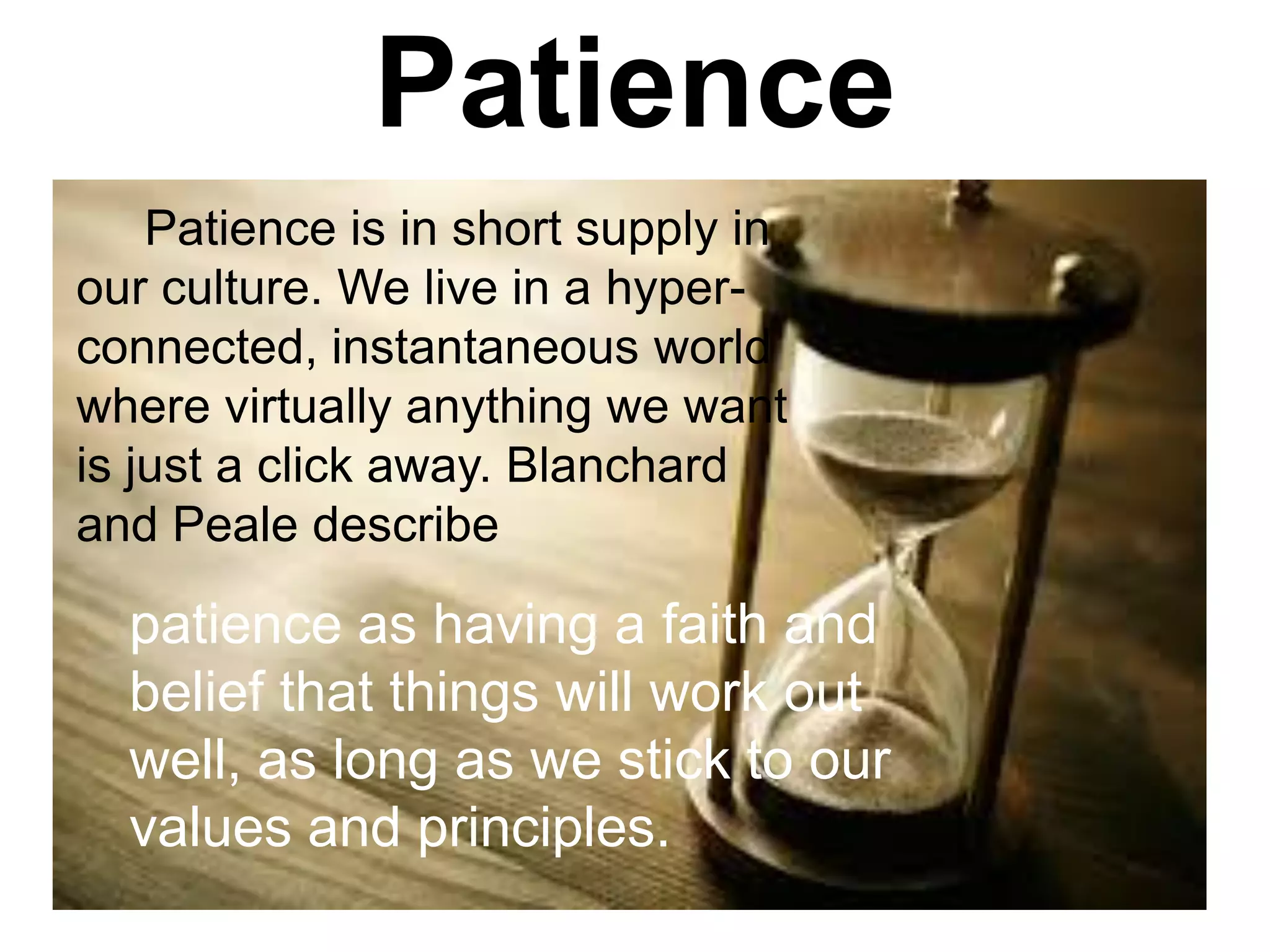
Patience
Patience is in short supply in
our culture. We live in a hyper-
connected, instantaneous world
where virtually anything we want
is just a click away. Blanchard
and Peale describe
patience as having a faith and
belief that things will work out
well, as long as we stick to our
values and principles.
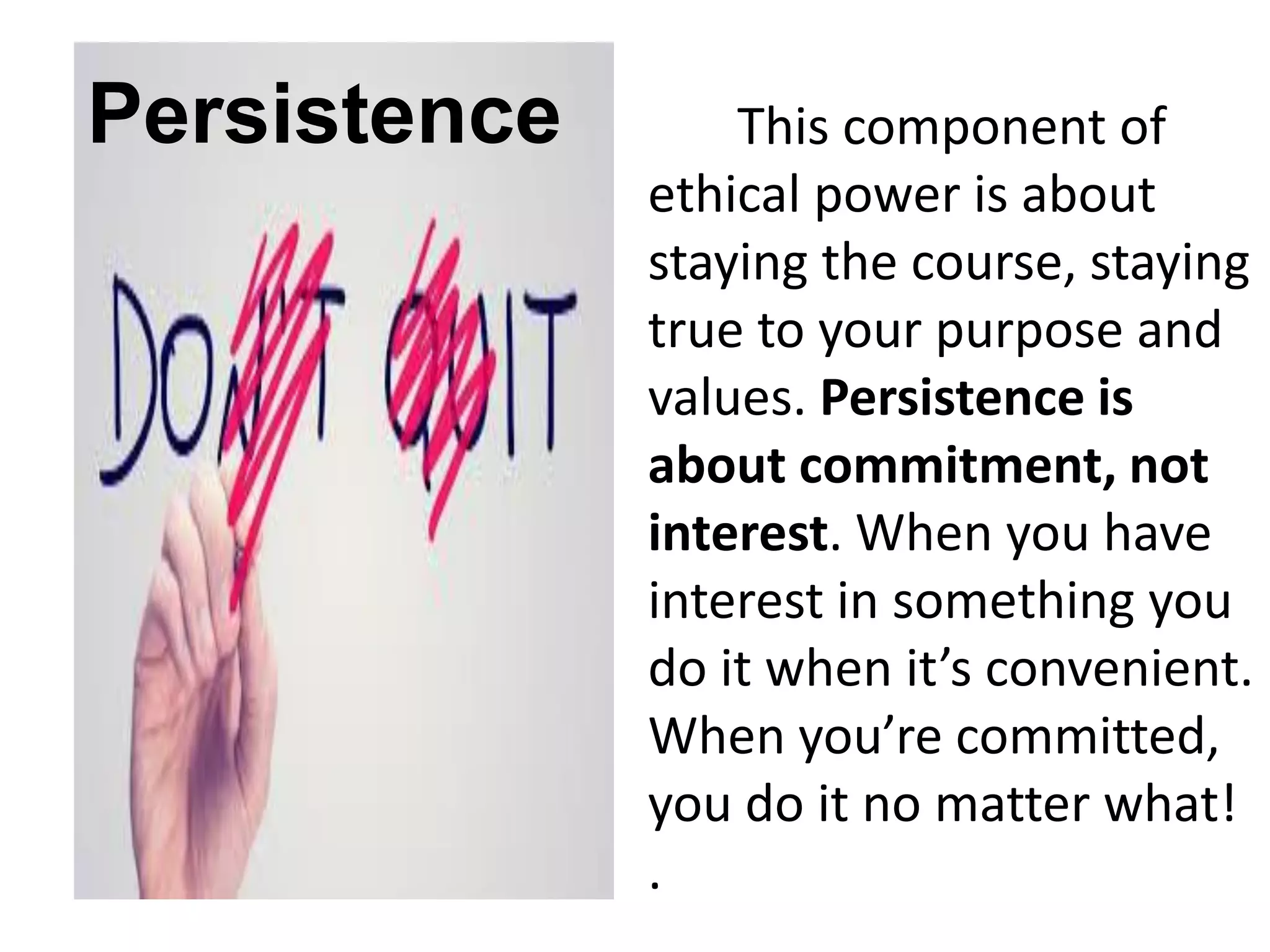
Persistence This component of
ethical power is about
staying the course, staying
true to your purpose and
values. Persistence is
about commitment, not
interest. When you have
interest in something you
do it when it’s convenient.
When you’re committed,
you do it no matter what!
.
Perspective
All the other elements
of ethical power emanate
from the core of
perspective. Perspective
is about having the big
picture view of situations
and understanding what’s
truly important.
If you lose one in a war
its OK
If you lose 100 in a war
that’s something
If you lose your DISCIPLINE
You lost everything. . .
Source: Unknown
Ethical Sensitivity
• Ethical sensitivity is the ability of
an individual to recognize the
ethical nature of a situation in a
professional context (Shaub et
al., 1993).
• Behaving ethically depends on
the ability to recognize that
ethical issues exist, to see from
an ethical point of view.
• Cooperatives can construct
cultures that can exercise good
or bad influences depending on
their goals, policies, structures
and strategies (Brown, 1987).
Behaving Ethically
Behaving ethically depends on
the ability to recognize that
ethical issues exist, to see from an
ethical point of view. This ability
to see and respond ethically may
be related more to attributes of
cooperative culture than to
attributes of individual
employees.
Efforts to increase ethical standards and
decrease pressure to behave unethically should
therefore concentrate on the organization and
its culture.
• Distinguish between right
and wrong, take the time to
examine the situation and
rely upon your ethical
power.
Some notable examples include:
questionable decisions concerning
product design that sacrifice quality in
an effort to reduce cost, lack of concern
for environmental damage, and doubtful
standards affecting the safety of
employees, customers and other
stakeholders. While many factors
certainly contribute to problems such as
these, evidence suggests that they are
primarily caused by the lack of a
cooperative culture that explicitly
promotes and encourages ethical
decision making
Chen, et all, 1997
Business Activities Harmful to
Individuals, Communities and Society
Defined as the quality of being honest and
having strong moral principles; moral
uprightness
Trust Principle #1:
It Starts with Integrity
Leaders in high-trust organizations
must serve as living examples of
integrity and trustworthiness – and not
just at the office and during business
hours
Joel Peterson Chairman, JetBlue Airways. Stanford Business School
Trustworthy people are
trustworthy when it comes to
family, friends or colleagues.
Obligations to show respect,
to consider the welfare of
others, and to keep your word
don’t end when you leave the
office.
Joel Peterson Chairman, JetBlue Airways. Stanford Business School
Mistrust and politics are
expensive, time-consuming and
dispiriting. When a company has
a reputation for fair dealing, its
costs drop: trust cuts the time
spent second-guessing, worrying,
and lawyering. Trust strengthens
every part of any deal: its
durability, its potential profitability,
and its flexibility.
Integrity is a habit
Leaders who strive to do the right
thing under all circumstances know
that being trustworthy takes effort,
awareness and work. Trustworthy
leaders have generally worked long
and hard on their own character
building.
Joel Peterson Chairman, JetBlue Airways. Stanford Business School
They’re often quite intentional about fixing
things about themselves, about receiving
feedback, learning from it and making
changes. In the same way a mechanic keeps a
car in top running condition, high-trust
individuals monitor and tune their behavior,
always striving to do better by team members
and customers alike.
Integrity is a habit
Joel Peterson Chairman, JetBlue Airways. Stanford Business School
Good member relationships
are based on integrity and trust,
and it is against the cooperative’s
policy to engage in unethical or
illegal activity to win or keep
business. Officers are expected
to act in an ethical manner at all
times when performing job and
conducting business matters.
Joel Peterson Chairman, JetBlue Airways. Stanford Business School
Anyone wanting to build
a high-trust organization
must start by looking in the
mirror. Personal character
is foundational
for interpersonal trust. and
organizations in which
leaders have integrity stand
a much better chance of
building trust from the top
down, and bottom up.
Story of
CEO
Morgan
https://inspirationalstories.quora.com/A-reply-from-CEO-of-J-P-
Morgan-to-a-pretty-girl-seeking-a-rich-husband
http://www.slideshare.net/jobitonio/ceo-morgan
Integrity
• Managing for organizational integrity
• Moral integrity
• Personal integrity
• Professional Integrity
• Procedural integrity
• Safeguarding Integrity
• Institutional integrity
• Jurisdictional Integrity
• Scientific and Political Integrity
• Quality and integrity of the knowledge
• Intellectual integrity
• Structural integrity
• Ecosystem integrity
• Environmental integrity
• Constitutional integrity
How do we
uphold
accountability and
integrity in
cooperatives
through policies
and decision
making?
• Powers, functions
and responsibilities of
all officers, key
management staff
should be included in
the Code of
Governance and
Conduct for
Cooperatives
Conclusion
• Also to include
members’ benefit
such as: voting
right, power of
inspection, right to
information, right
to ISC/PR,
appraisal right of
their share capital,
• The Code to include
standard of personal
conduct and dealings,
rights, and privileges
• Efforts to strengthen the
ethical conduct of employees
must occur at the institutional
level with focus on providing
a cooperative culture that
promotes and encourages
ethical behavior and allows
employees to “voice” their
concerns
• Use of suggestion boxes and
Opportunity For Improvement (OFIs)
programs. Encouraging employees to
submit suggestions for improvement
provides an opportunity for
management to involve staff in
decision making and problem solving.
• Facilitating continuous quality
improvement through better
communication among
workers and managers.
(meetings, feedback
mechanisms,etc).
• Cooperatives employing a balanced
mix of financial and non-financial
factors including job satisfaction,
control and authority, opportunities for
continuous education and personal
growth, and peer recognition for goal
achievement. The reward structure
can also be used to encourage
concern for others which stimulates
ethical behavior.
• Treating co-workers as
customers implicitly
emphasizes the need to
respect one’s co-workers and
therefore may increase
worker’s sensitivity to ethical
issues arising out of
authority/subordinate work
relationships and work-place
safety
Produce
information
that decision
makers need
and use
in policy
decisions
Investigation
• To cooperate fully with any
appropriately authorized
internal or external
investigation, including but
not limited to those involving
ethical issues or complaints
of discrimination or
harassment. Never withhold,
tamper with or fail to
communicate relevant
information in connection with
an investigation.
The Ethics Committee shall conduct
the initial investigation or inquiry,
upon receipt of complaint involving
violations of the Coe of Governance
and Ethical Standard
Information should be
undiluted and reliable
Protecting Stakeholder
• Each of us has a moral, legal and ethical
obligation to protect confidential information
that, if improperly disclosed, could be harmful
to our members, peers or stakeholders. This
includes data such as member financial
information, employee health or other
personal information, non-public corporate
financial data, legal facts and strategic
information and plans.
• Exercise particular care to
protect the premature
disclosure of information
that could have a
competitive, financial or
other material impact on
the coop
A Safe, Healthy Workplace
• To ensure equal employment opportunity
without discrimination. The coop shall recruit,
hire, train, and promote individuals and
administer all personnel actions, without
regard to race, color, religion, creed, age, sex,
sexual orientation, disability, citizenship,
national origin or ancestry, martial status,
status as a disabled veteran, genetic
information or any characteristic protected by
applicable law.
• Provide employees with a
healthy, safe and productive
work environment. This
environment extends beyond
the physical surroundings and
includes how we treat each
other.
The coop places great value on
maintaining and supporting its diverse
workforce, on creating a workplace
characterized by civility of speech and
behavior and on welcoming, accepting
and rewarding each person according to
his or her contribution to coop’s goals.
Workplace violence policy applies to
violent or threatening conduct of any kind,
whether it is directed against a employee,
member or outside party and whether it
occurs on property.
Conflicts of Interest
Avoiding Conflicts of Interest.
Employees are expected to uphold
the coop value of integrity in all
business dealings. This includes
avoiding conflicts of interest on the
job.
Compensation of the Board is
subject to the approval of the general
assembly or if the by laws so provided
except that no additional compensation
other than per diems on the first year of
existence and in the preceding calendar
year when a cooperative reported a net
loss.
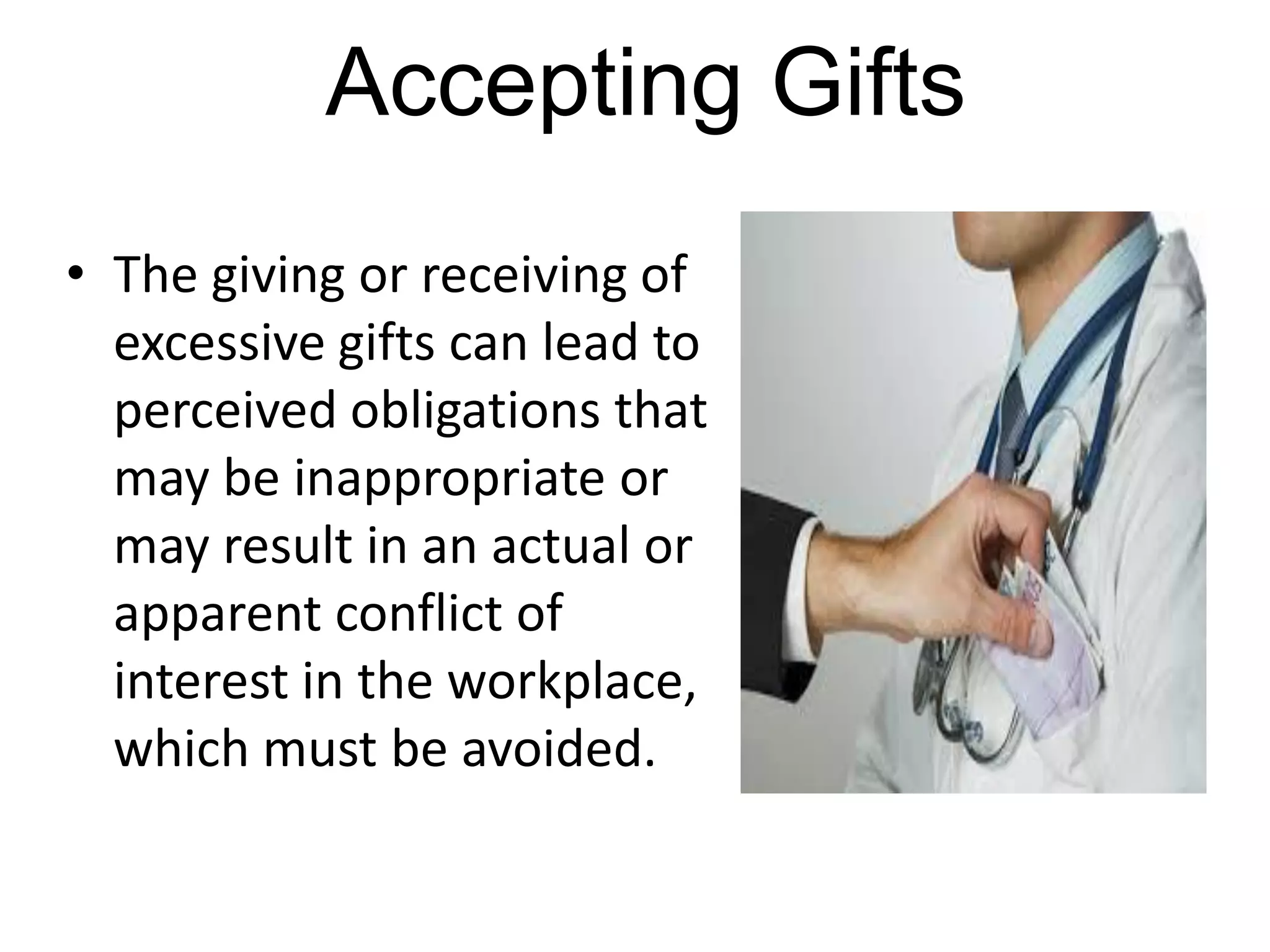
Accepting Gifts
• The giving or receiving of
excessive gifts can lead to
perceived obligations that
may be inappropriate or
may result in an actual or
apparent conflict of
interest in the workplace,
which must be avoided.
• No gift should be accepted if
there is a possibility that it would
jeopardize coops' reputation.
This policy extends to includes
member-owners, suppliers,
investors and rating agencies that
do business with or have an
interest in coop.
• It is your responsibility under the
Code to avoid situations in which
loyalty to coop could be
compromised. Determining whether a
particular situation would create a
conflict of interest, or an appearance
of a conflict, may require the analysis
of the specific factual circumstances
and the consideration of many
factors.
Bribes, Kickback and
other Illegal Payments
• No coop funds or
assets may be paid,
loaned or disbursed
as bribes, kickbacks
or other illegal or
unethical payments.
Related Party Business Dealings
Highly critical to notify your manager of any
business relationship or proposed business
transaction that the coop may have with any
company in which you or an immediate family
member has a direct or indirect interest or from
which you or an immediate family member may
derive a benefit, if such a relationship or
transaction might give rise to a conflict of interest.
Fair Dealing
• Coop to deal fairly with all third
parties including members, suppliers,
financial institutions, competitors and
employees. When transacting
business, no employee should take
unfair advantage of anyone through
manipulation, concealment, abuse of
privileged information,
misrepresentation of material facts or
any other unfair practice.
Financial Records
• The coop’s accounting records must be
complete, accurate and in reasonable
detail. These records include books of
original entry and other financial
information used for internal
management’s decision-making and
external reporting.
• The underlying transactions must
be properly authorized and
recorded on a timely basis in
order to permit preparation of
financial statements in
accordance with generally
accepted accounting principles
and to maintain accountability of
assets.
• All funds and assets must be fully
and properly recorded on coop’s
books. The coop has to establish
internal accounting controls and
records management policies to
meet both legal and business.
Maintain and adhere to these
controls and policies.
Accounting and Control Irregularities
• The coop is committed to comply with
applicable securities laws and generally
accepted accounting principles.
Accordingly, employees have the
responsibilities to report any suspected
instance of fraud or other irregularities that
involve management or other employees
who have a significant role in coop’s
accounting, internal control or audit
matters.
• Report immediately any
information regarding suspected
fraud or irregularity in accounting,
internal accounting controls or
auditing matters to the Audit
Committee or to make
anonymous reports
• There must be a policy on
transparency whereby books of
accounts anybody minutes of
meetings are properly kept and made
accessible to members and regular
financial reports are religiously
prepared and made known to
members and other parties as
authorized by law.
Commitment
• Recognizing the importance of good
governance, and good conduct is a
necessary component of what constitute a
sound strategic business, thus, the
officers, staff and members commit to
follow standard provided in the Code of
Conduct and Ethical Standard.
• Include in the Oath of Office
Offenses &
Violations
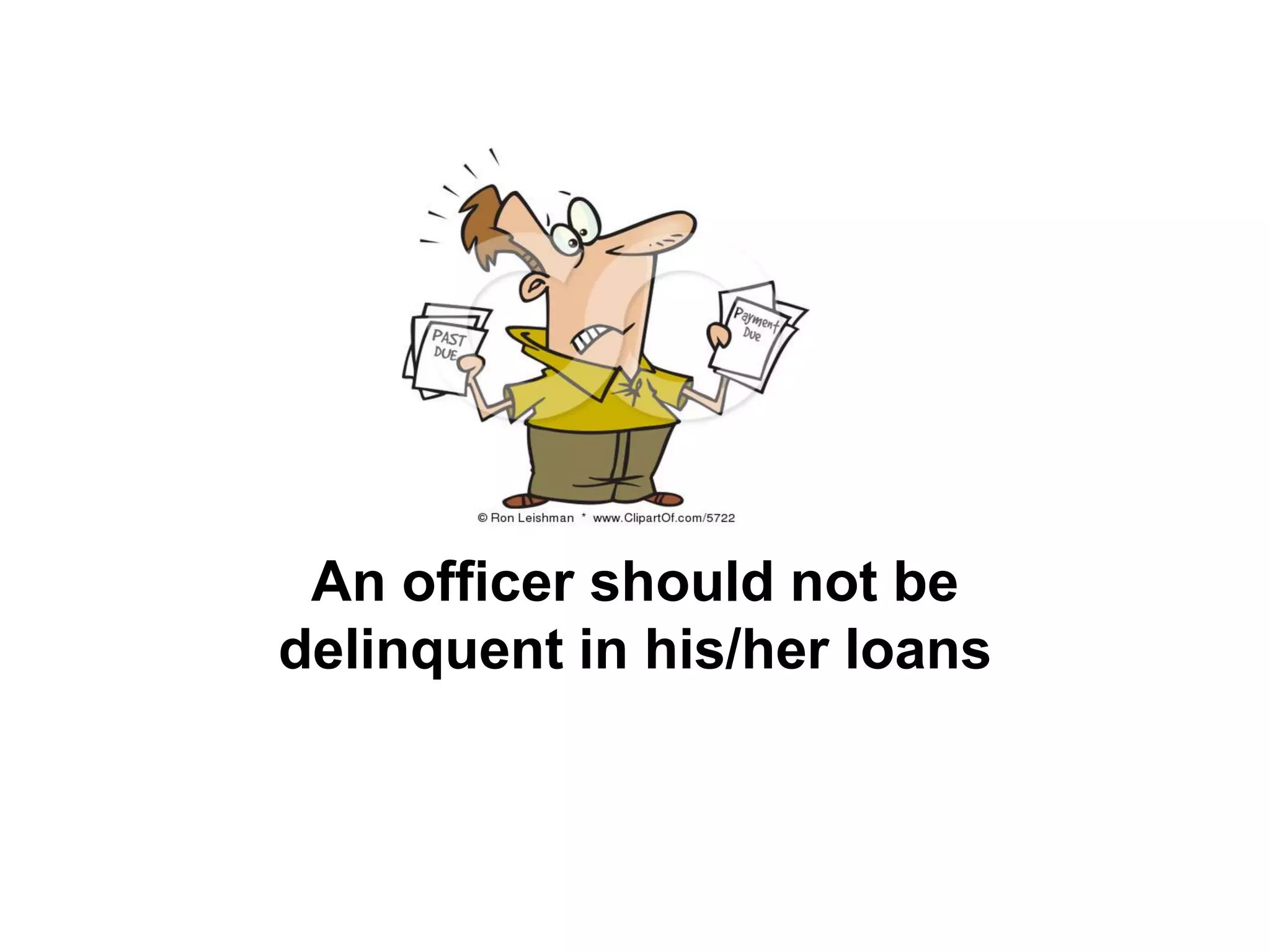
An officer should not be
delinquent in his/her loans
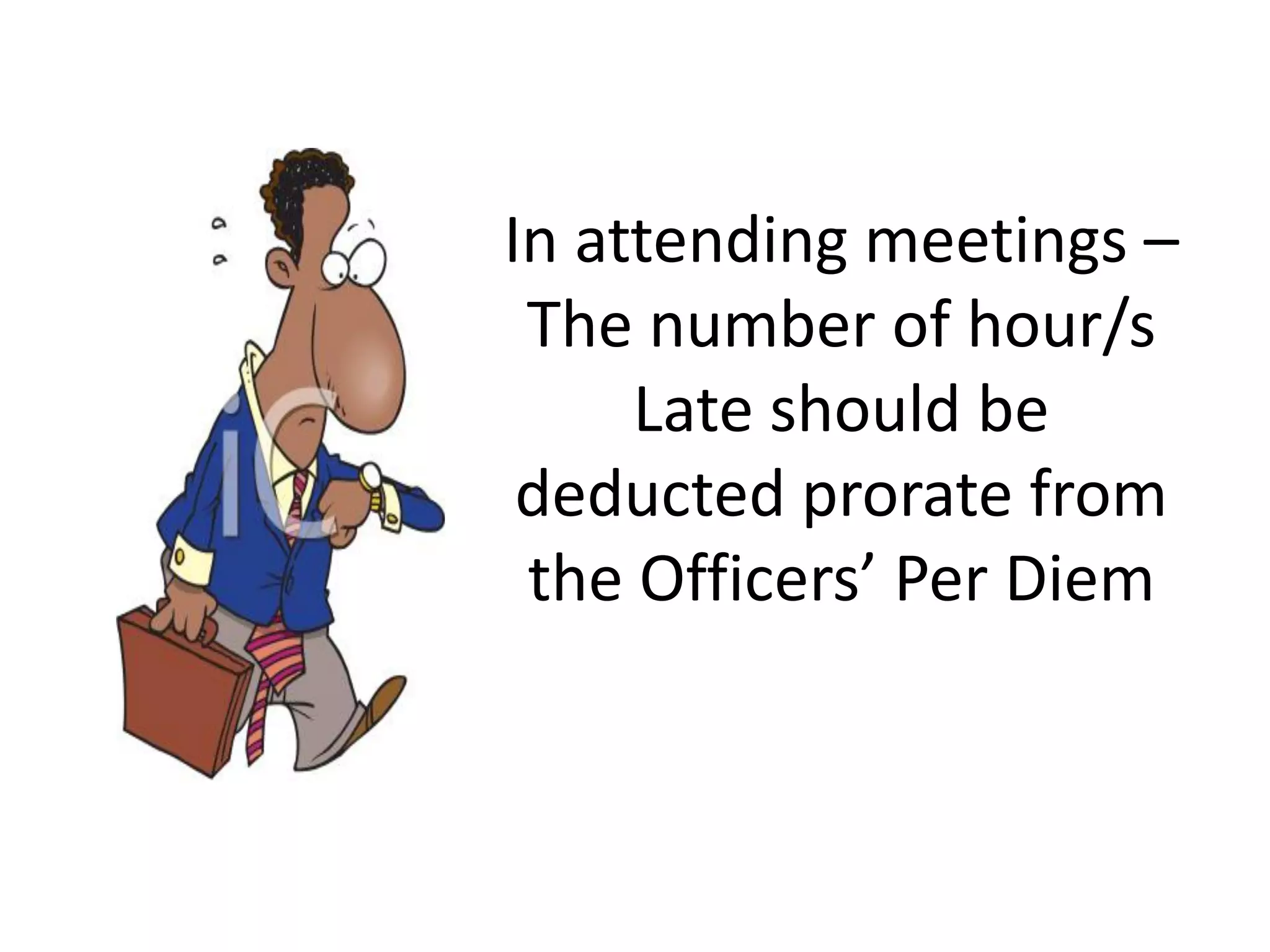
In attending meetings –
The number of hour/s
Late should be
deducted prorate from
the Officers’ Per Diem
Do not wear slippers, shorts and
sleeveless shirts during
meetings
Wear Uniform
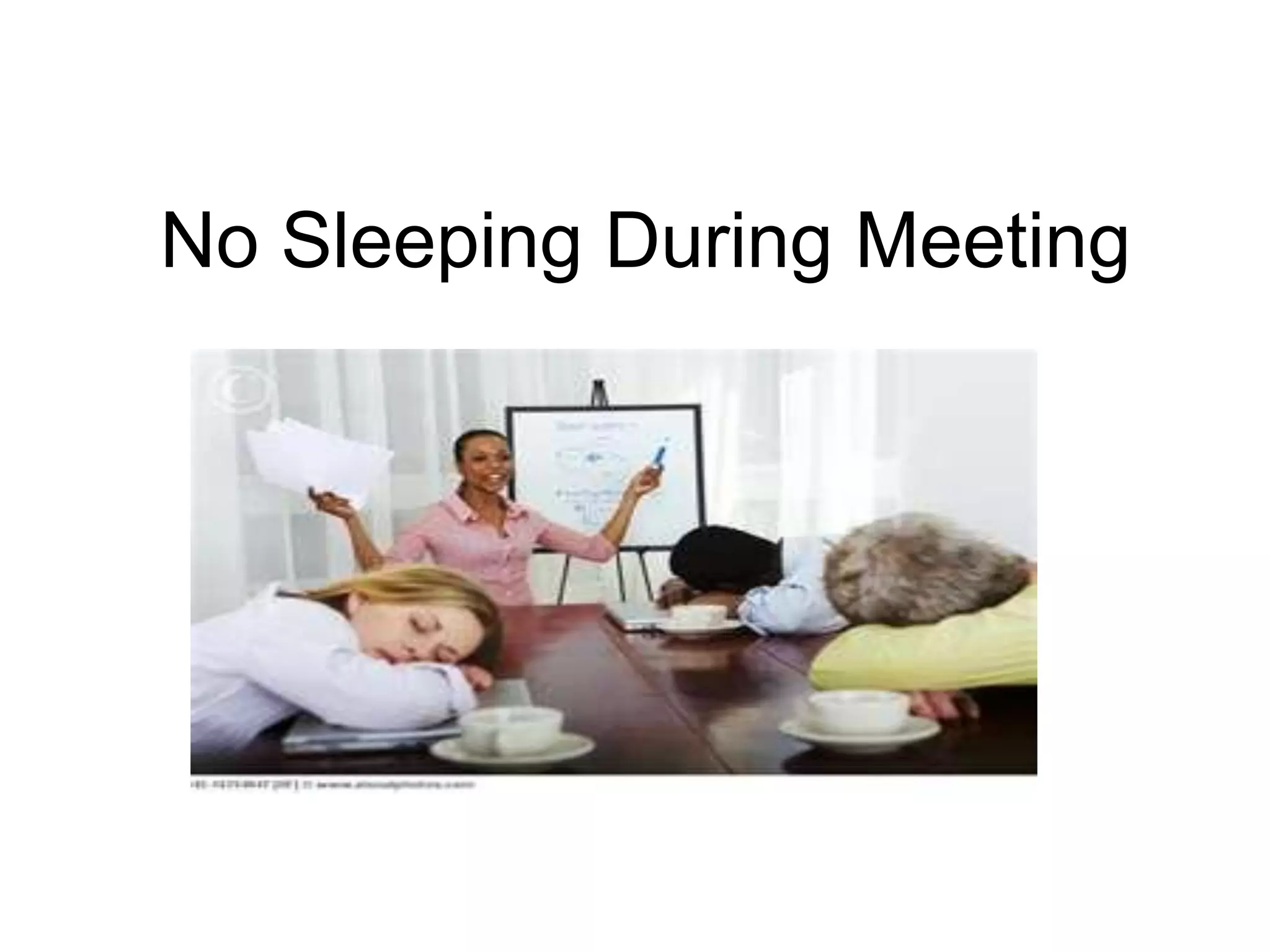
No Sleeping During Meeting
No Text and Call during Meeting
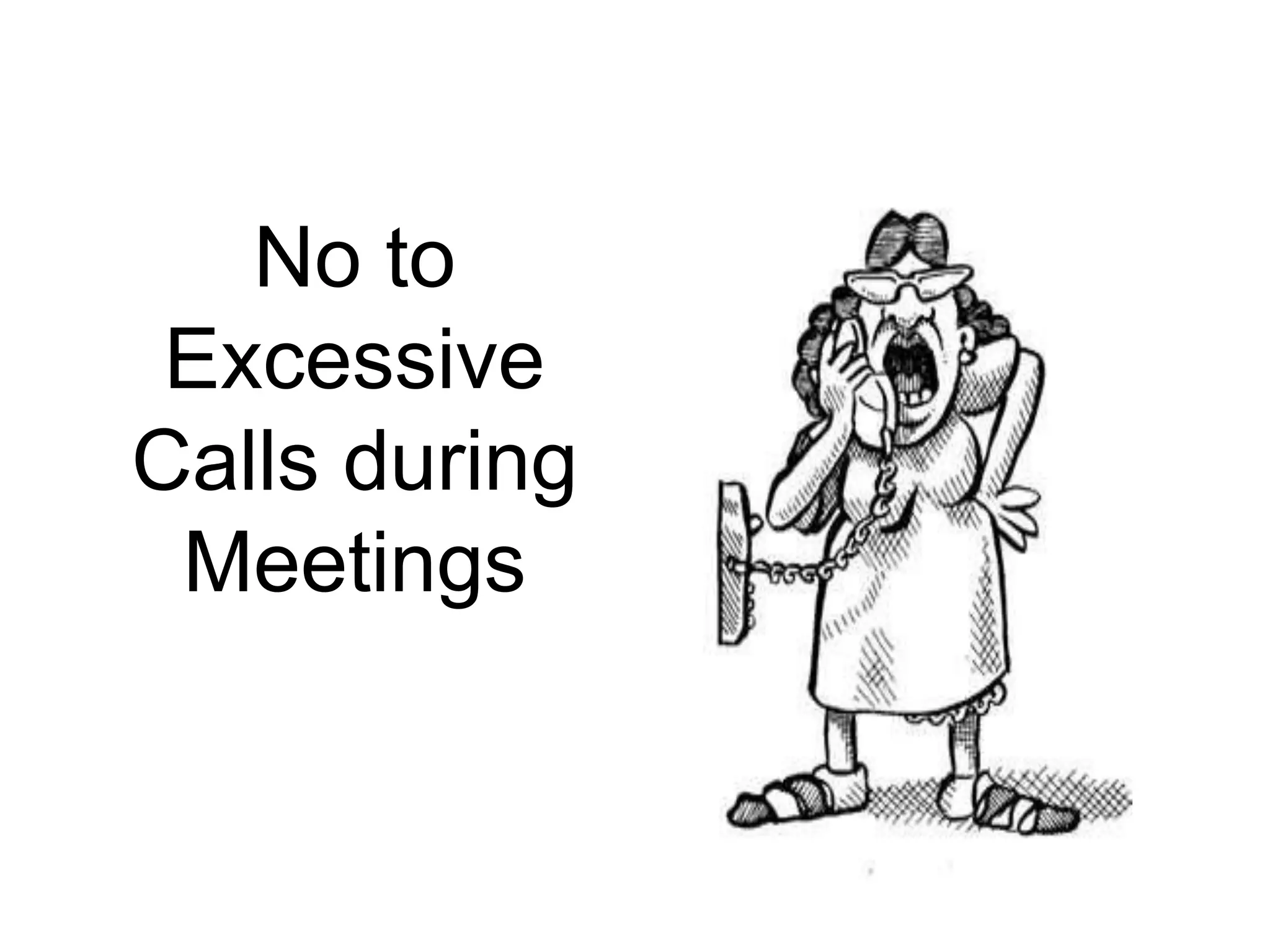
No to
Excessive
Calls during
Meetings
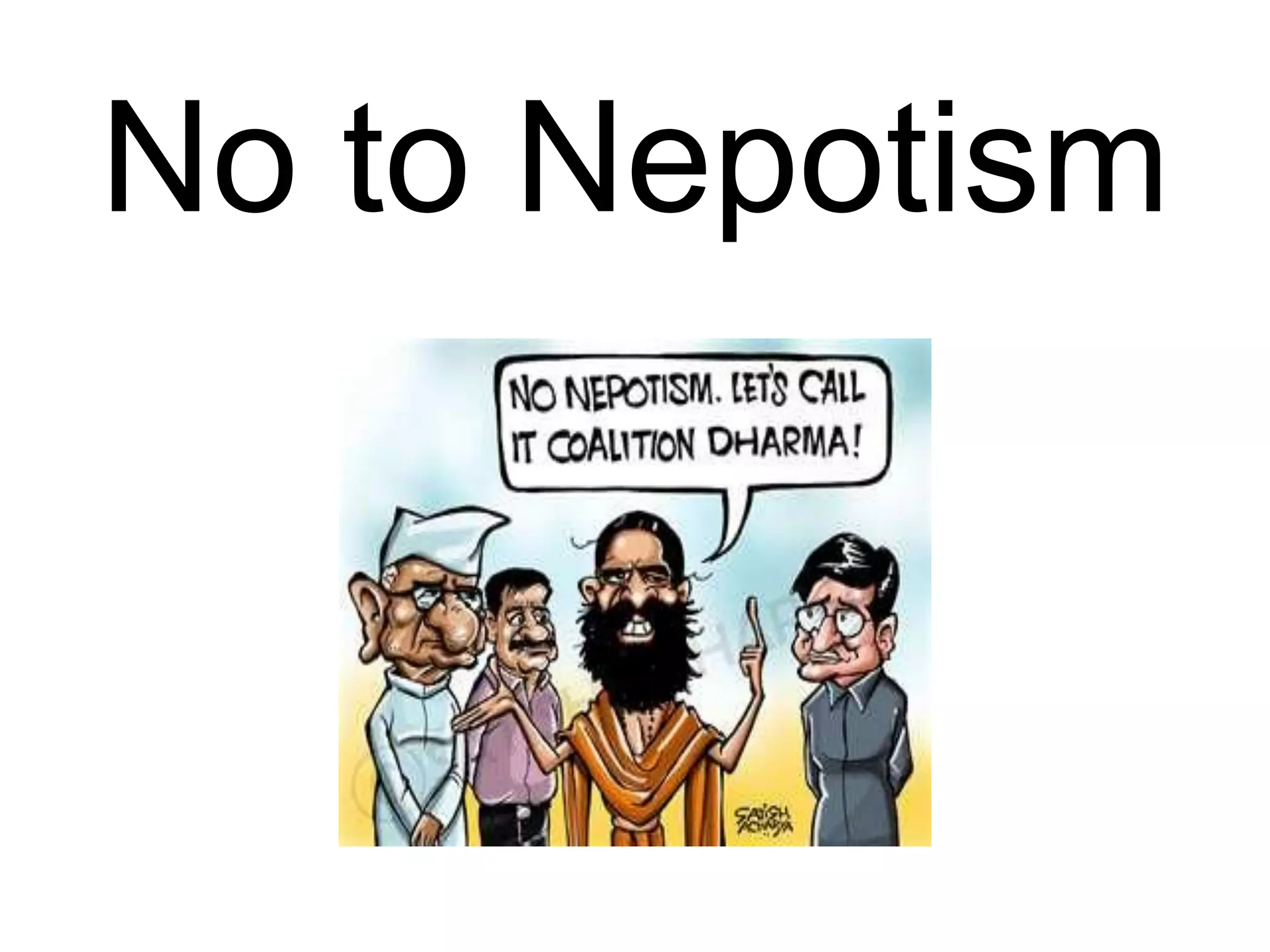
No to Nepotism
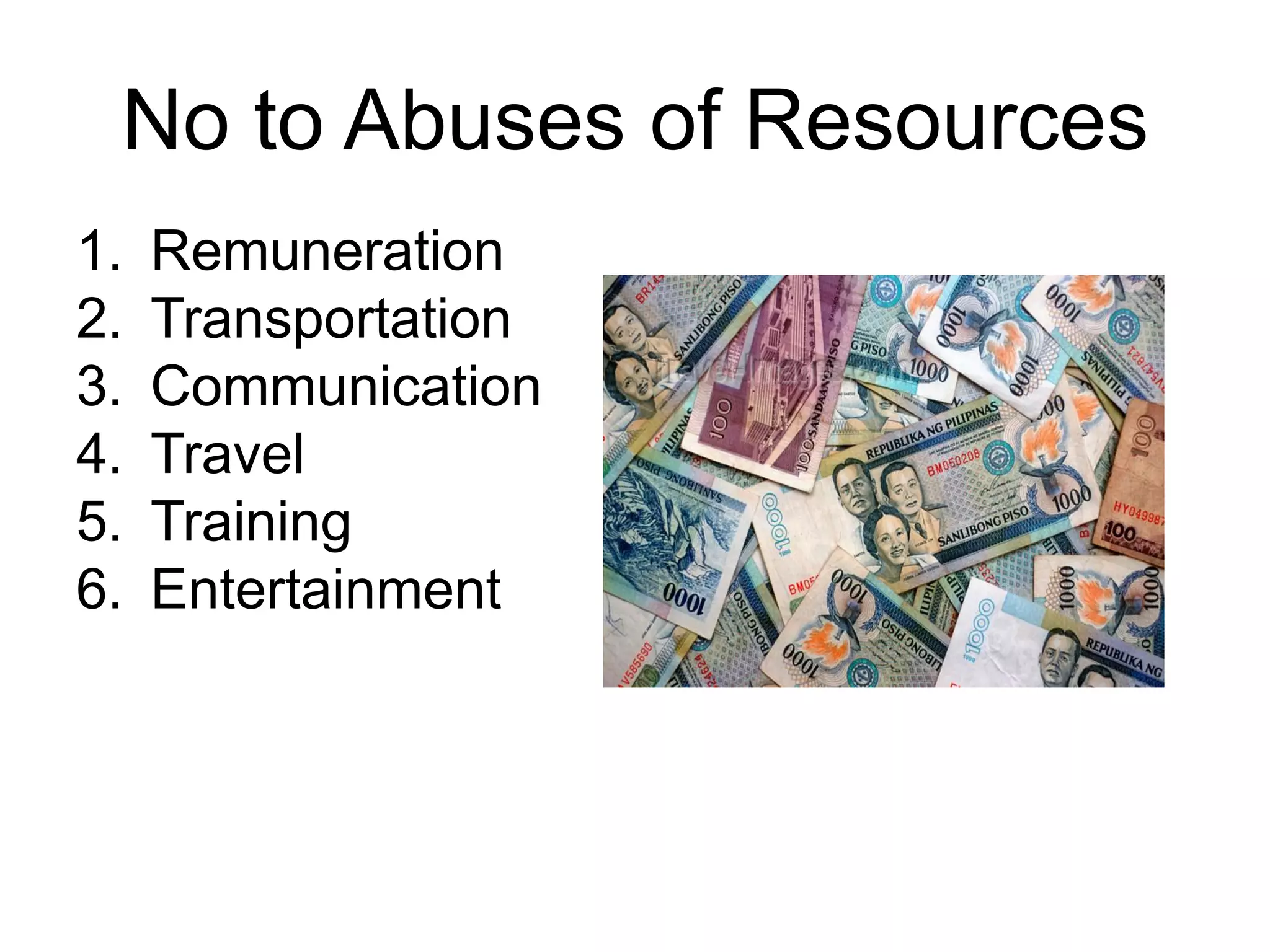
No to Abuses of Resources
1. Remuneration
2. Transportation
3. Communication
4. Travel
5. Training
6. Entertainment
No to Commissions
(kickbacks)
No to Board
interference in
management duties
No to Strongman
leadership
Non to Excessive spending for
non-earning assets (building,
cars, computers etc.)
No to Falsifying financial
information
No to incomplete
and false records
No to overspending
No to irregular
external audits
No to accepting free or greatly
discounted products,
services or other items of an
extraordinary value that are
suitable for personal use
from an employee or
representative of a supplier,
vendor, subcontractor,
consultant or competitor of
the Cooperative
Personal interests or activities
that are or could only be
reasonably accomplished
using Cooperative, material,
equipment or proprietary
information (e.g., working for
an outside interest - whether
paid or unpaid - whose
activities could only
reasonably be conducted
during normal business
hours)is prohibited.
Directly or indirectly
acquiring or turning
any business
opportunity which
ought to be available
to the Cooperative to
your own or someone
else’s personal
advantage is
prohibited.
5 S
• Smile
• Sit
• Sleep
• Snore
• Sign the voucher
Directors, officers and committee members, who
willfully and knowingly vote for or assent to
patently unlawful acts, or who are guilty of gross
negligence or bad faith in directing the affairs of
the Cooperative or acquire any personal or
pecuniary interest in conflict with their duties as
Directors, officers or committee members shall
be liable jointly and severally for all damages
resulting therefrom to the Cooperative, members
and other persons.
Liabilities of Directors, Officers
and Committee Members.
When a director, officer or committee
member attempts to acquire, or acquires in
violation of his duties, any interest or equity
adverse to the Cooperative in respect to any
matter which has been reposed in him in
confidence, he shall, as a trustee for the
Cooperative, be liable for damages or loss of
profits which otherwise would have accrued to
the Cooperative.
Liabilities of Directors, Officers
and Committee Members.
Possible
Penalties
1.Letter Reminder
2.One on One meeting
3.Hearing
4.If found guilty: suspension or
termination depending on the
degree of violations committed
Upholding  Accountability and Integrity In Cooperatives Through Policies and Decision Making Process

Upholding Accountability and Integrity In Cooperatives Through Policies and Decision Making Process

  • 1.
    Upholding Accountability and Integrityin Cooperatives Through Policies and Decision Making A paper presented by Josefina B. Bitonio Regional Director, CDA Dagupan Extension Office, April 6, 2016 during the 9th Annual National Micoop Forum Punta Villa, Resort and Hotel, Iloilo City
  • 2.
    • Foremost, Iwould like to express my sincere gratitude to our host Ms. Evelia Bardos – Tizon Group Head Micoop and her team for their warm welcome and making it possible for me to join your annual event here at Iloilo. • My respect and appreciation to Dr. Mercy Gabasa of CDA Iloilo Extension office for assisting us during the event. • To all Micoop representatives coming from Luzon, Visayas and Mindanao – Mabuhay po kayo.
  • 3.
    Co-operatives, NGOs andcommunity groups are being increasingly used as development agencies by policy- makers, because they are thought to provide more accountable, effective and equitable services in many areas than public or private agencies. Brett, E. A. (2008)
  • 4.
    Cooperatives claim to bedominated by motivations based on democracy and self-sacrifice rather than self-interest. Brett, E. A. (2008)
  • 5.
    According to TalentCulture http://www.talentculture.com/why-accountability-in-the-workplace-matters/ The Workplace Accountability Study recently revealed that 82% of respondents have no ability to hold other accountable, but 91% of people rank accountability as one of the top development needs they’d like to see at their organization.
  • 6.
    http://www.talentculture.com/why-accountability-in-the-workplace-matters/ When employees haveno system of accountability in place, things can very quickly fall apart. This is why accountability matters, and why a coop need to invest in it. Recognition accountable When employees fail to meet up to the demands of their job, to recognize employees who do good work.
  • 7.
    Accountability is aCulture Problem Surveys say 91% of employees who feel valued at their job are motivated to do their best versus 37% of those who don’t feel valued. Low accountability leads to mistrust; leads to low morale; leads to worker devaluation; leads to low engagement; and leads to low productivity.
  • 8.
     Links roles/identities,accounts of situations, resources and prescriptive rules and practices as well as management decision processes  Create actors and meeting places and organize the relations and interactions among actors.  allocate resources and empower and constrain actors differently and make them more or less capable of acting according to prescribed rules Accountability Organizational Arrangements Answerability Responsibility  Revamp your culture
  • 9.
    Revamp Culture o Revampculture so that accountability fits within it. o Make sure employees know that they’ll be accountable for their work by creating guidelines about monitoring their productivity. o Set weekly goals and deliverables so that employees are motivated to complete tasks on a regular basis. o Most importantly, make sure that the officers are following their own rules “Perhaps the best way to create a standup organization is to lead by example. Employees should understand what you expect of them, and that the officers are holding themselves to the same high standard. Follow through on your promises, own your mistakes, and even when it isn’t easy. give feedback . http://www.talentculture.com/why-accountability-in-the-workplace-matters/
  • 10.
    Creation of aunitary culture in which values and norms are shared by all employees. The support and leadership of top management is crucial to create an organizational culture that evokes a uniform response to ethical issues Chen, 1997
  • 11.
    • It wouldappear that working in organizational settings characterized by a more compliant cooperative form of management in which people engage each other freely in shaping the culture is more conducive to promoting ethical awareness and behavior.
  • 12.
    Links roles/identities, accountsof situations, resources and prescriptive rules and practices as well as management decision processes Creation of Ethics Committee (Bylaws Template) Develop Code of Governance and Ethical Standard to be observed by the members, officers and employees of the cooperative subject to the approval of the BOD and ratification of the GA Monitor compliance with the Code of governance and Ethical Standards and recommend to the BOD measures to address the gap
  • 13.
    Create actors andmeeting places and organize the relations and interactions among actors An Ethics Committee is created and shall be composed of three (3) members to be appointed by the Board of Directors. Within ten (10)days after their appointment, they shall elect from among themselves a Chairman, Vice-Chairman and a Secretary who shall serve for a term of one (1) year or until successors shall have been appointed and qualified
  • 14.
    Allocate resources andempower and constrain actors differently F. Ethics Committee 1. Basic Cooperative Course 2. Leadership and Values Re-orientation 3. Conflict Management 4. Records Management 5. Basic Computer Program Section 5. Rule 7 IRR. Training Requirements for the Officers of the Cooperative. Officers of the cooperative shall be required to undergo necessary training conducted by cooperatives, Federations and/or other trainers or training institutions duly accredited by the Authority.
  • 15.
    MC NO. 2011-14 StandardTraining Curricula for Cooperative Officers
  • 16.
    Basic Cooperative Course Board ofDirectors, Secretary, Treasurer, Election Committee, Audit Committee, Ethics Committee, Mediation and Conciliation Committee, General Manager Conflict Management Board of Directors, Ethics Committee, Mediation and Conciliation Committee Leadership and Values Reorientation Board of Directors, Election Committee, Ethics Committee, Mediation and Conciliation Committee, General Manager Records Management Audit Committee, Election Committee, Ethics Committee, Mediation and Conciliation Committee, Secretary, Treasurer In 2011, MC 2011 - 27 Implementation of Training Requirements for Coop Officers, out of 14 training curricula, FOUR trainings are to be attended by the Ethics Committee
  • 18.
    Social Audit ofCooperatives as of December 31, 20___ Under Organization, the cooperative is asked of the following: Particulars YES OR NO With Cooperative Code of Governance? With Code of Conduct & Ethical Standards? Are all the key players of the cooperative
  • 19.
    SAR’s Members’ Education 1.Provision of education to members 1.1. Presence of continuing education program that contribute to human development of members(values, principles, ethics, practices, citizenship, livelihood/skills training YES ( ) NO ( ) 1.2. Implementation of education program
  • 20.
    Financial Inclusion, CreditSurety Fund, Philippine Financial Reporting system, Amendment to SCA, CISA
  • 21.
    Cooperative Performance ReportQuestionnaire For the Year December 31, _____ Is the ethical-standards for officers provided in the coop's Code of Ethics? Is the provision on conflict of interest included in the coop's Code of Ethics? Ethics Code of Ethics provision for officers Code of Ethics provision on conflict of interest 1 a. Functions, Duties and Responsibilities Means of Verification
  • 22.
    Members Are the ethicalstandards for members provided in the Code of Ethics? Are the ethical standards for members implemented? No valid complaint/Valid Complaint acted upon in accordance with the Ethical Standard Code of Ethics provision for members No valid complaint/Valid Complaint acted upon in accordance with the Ethical Standard Means of Verification
  • 23.
    Inspection Instrument Compliance withRA 9520 64. The Cooperative has a Cooperative Code of Governance and Ethical Standard? None: Period of compliance 12 months
  • 24.
    • They guidebehavior and stabilize expectations. • Help assure ethical and accountable behavior • How those polices are executed, and the accountability arrangements. • Have guidelines or a process to deal with ethical issues Importance of Cooperative Code of Governance and Ethical Standard
  • 25.
    • Society ingeneral will benefit as employees and cooperatives are better prepared to identify and address issues in an ethical manner.
  • 26.
    Anecdotal vs. Statistics Performance ofcoops on Social and Financial Accountability
  • 27.
    Particular AWM DE Theethical-standards for officers provided in the coop's Code of Ethics 3.10 SP The provision on conflict of interest included in the coop's Code of Ethics 3.07 SP Having a governance and ethical standards in the management and operation of cooperatives 3.14 SP An Ethics Committee is appointed by the Board 4.78 EP Monitor compliance with the Code of governance and Ethical Standards and recommend to the BOD measures to address the gap, if any 2.57 FP 3.33 SP Code of Good Governance & Ethical Standard Legend: 4.21- 5.00 Excellent Performance (EP); 3.41- 4.20 Very Satisfactory Performance (VSP); 2.61- 3.40 Satisfactory Performance (SP) Source: Gaboy (2016)
  • 28.
    15. On Manualof Operations MICRO SMALL MEDIUM LARGE TOTAL 4,857 75% 1405 65% 500 38% 85 12% 6,847 No manual of operations No Cooperative Code of Governance and Ethical Standards No Policies and Procedures on Conflict Management/mediation and conciliation No succession plan Absence of performance evaluation system SEU, CDA (2015)
  • 29.
    Common Findings No. ofFindings per Category Micro Small Medium Large The cooperative has no Cooperative Code of Governance and Ethical Standards. 174 101 21 2 CDA Dagupan (2015)
  • 30.
    Accountability • Accountability mechanismsshould be practiced in principles • Sense of Accountability • Measures of Accountability • Sharing of Accountability • Cooperative Accountability (Intra) • Public Accountability • Financial Accountability
  • 31.
    Social Accountability Particulars Organization 15 Membership35 Staff/Employees 10 Cooperation among Cooperatives 10 Community and Nation 25 Network Alliance and Linkages 5 Total Points 100
  • 32.
    Social Accountability 90 -100 points : Outstanding 80 - below 90 pts Very Satisfactory 70 –below 80 points : Satisfactory 60 – below 70 points : Fair below 60 points : Poor For Medium & Large Cooperatives 75 - above points : Outstanding 65–below 75 points : Very Satisfactory 50–below 65 points : Satisfactory 35–below 50 points : Fair below 35 points : Poor For Micro & Small
  • 33.
    Name of Cooperatives2013 DE 2014 DE Nueva Segovia Consortium of Cooperatives 2 FP 2 FP Sacred Heart Savings Cooperative 3 MP 4 VSP Sta. Cruz Savings & Development Cooperative 5 EP 5 EP Tubao Credit Cooperative 3 MP 3 MP Government of Laoag Employees Development Cooperative (GLEDCO) 1 PP 4 VSP Calasiao Plant And Related Companies Employees' Multi Purpose Cooperative 4 VSP 4 VSP Lingayen Catholic Credit Cooperative (LCCrC) 3 VSP 2 FP St. Lucy Multi Purpose Cooperative 2 FP 2 FP Suyo Multi Purpose Cooperative 4 VSP 4 VSP Fatima (Vigan) Multi Purpose Cooperative 1 PP 1 PP San Joaquin Multi-Purpose Cooperative 3 SP 5 VSP Sto. Domingo Development Cooperative 3 SP 3 SP La Union Multi Purpose Cooperative 5 EP 5 EP Kailian MPC 3 SP 3 SP Overall 2.78 SP 3.14 SP Satisfactory Performance (SP) Gaboy (2016)
  • 34.
    Social Responsibility • Thecoop as a people’s organization has a heavy social responsibility that requires a human and nationalistic stand, discharge the functions and render services in the most professional manner, exercise judiciousness and sincerity to everyone and be responsive to the needs not only the membership but also to the general public.
  • 35.
    Performance Accountability Particulars (NonFinancial) Organizational Aspect 24 Human Resource & Management 13 Members 11 Structure 4 System and mechanism 22 Social Aspect 4 Economic Aspect 22 Total Points 100
  • 36.
    Performance Accountability Particulars (Financial) ProfitabilityPerformance 25 Institutional Strength 20 Structure of Assets 25 Operational Strength (Staying Power) 30 Total Points 22 Non Financial Points x 35 Financial x 65 100
  • 37.
    Performance Accountability ADJECTIVAL RATINGMedium & Large Small Micro Excellent Performance 91-100 81-100 75-100 Very Satisfactory Performance 81-90 71-80 61-74 Satisfactory Performance 71-80 61-70 51-60 Fair Performance 61-70 51-60 41-50 Needs Improvement 60 & Below 50 & below 40 % below
  • 38.
    Name of Cooperatives2013 DE 2014 DE Nueva Segovia Consortium of Cooperatives 3 SP 3 SP Sacred Heart Savings Cooperative 3 SP 2 FP Sta. Cruz Savings & Development Cooperative 3 SP 3 SP Tubao Credit Cooperative 2 FP 2 FP Government of Laoag Employees Development Cooperative (GLEDCO) 4 VSP 4 VSP Calasiao Plant And Related Companies Employees' Multi Purpose Cooperative 3 SP 3 SP Lingayen Catholic Credit Cooperative (LCCrC) 3 SP 3 SP St. Lucy Multi Purpose Cooperative 2 FP 2 FP Suyo Multi Purpose Cooperative 4 VSP 4 VSP Fatima (Vigan) Multi Purpose Cooperative 2 FP 3 SP San Joaquin Multi-Purpose Cooperative 4 VSP 4 VSP Sto. Domingo Development Cooperative 2 FP 3 SP La Union Multi Purpose Cooperative 4 VSP 4 VSP Kailian MPC 3 SP 3 SP Overall 2.78 SP 2.85 SP Legend: 4.21- 5.00 Excellent Performance (EP); 3.41- 4.20 Very Satisfactory Performance (VSP); 2.61- 3.40 Satisfactory Performance (SP Performance Audit Report Gaboy (2016)
  • 39.
    Where to geta copy of the Code of Conduct and Ethical Standard? • CEO/Manager • Human Resources • Compliance Officers • Legal Services • BOD Kit • Ethics Committee • Secretary
  • 40.
    The Board Governance TheBoard of Directors is primarily responsible for the governance of the cooperative. It is the governing body upon whom the management of the cooperative is vested. The administration and management of the affairs of the cooperative is the primary duty of the Board Spell out as: strategic planning, direction setting and policy formulation activities, including review and redirection of unresponsive and obsolete policies
  • 41.
    The cooperative governanceframework as exhibited in the operation and management of cooperatives. GA • General Assembly BOD • Board of Directors OO • Other Officers MS • Management Staff Source: Bitonio (2012)
  • 42.
    • General Assembly •Board of Directors • Other Officers • Management Staff Source: Bitonio (2012) GA BOD OO MS Flow of Accountability Monitor management’s implementation of these policies and achievement of targets.
  • 43.
    Got Ethics? The FivePs of Ethical Power? The Power of Ethical Management written by Ken Blanchard and Norman Vincent Peale
  • 44.
    Purpose The meaning anddirection of your life. It’s the driving force of why you do what you want to do.
  • 45.
    Pride a healthysense of pride springs from a positive self-image and confidence in one’s abilities. A proper sense of pride mixed with a good dose of humility is the balance we are seeking.The “I” Institution
  • 46.
    Patience Patience is inshort supply in our culture. We live in a hyper- connected, instantaneous world where virtually anything we want is just a click away. Blanchard and Peale describe patience as having a faith and belief that things will work out well, as long as we stick to our values and principles.
  • 47.
    Persistence This componentof ethical power is about staying the course, staying true to your purpose and values. Persistence is about commitment, not interest. When you have interest in something you do it when it’s convenient. When you’re committed, you do it no matter what! .
  • 48.
    Perspective All the otherelements of ethical power emanate from the core of perspective. Perspective is about having the big picture view of situations and understanding what’s truly important.
  • 49.
    If you loseone in a war its OK If you lose 100 in a war that’s something If you lose your DISCIPLINE You lost everything. . . Source: Unknown
  • 50.
    Ethical Sensitivity • Ethicalsensitivity is the ability of an individual to recognize the ethical nature of a situation in a professional context (Shaub et al., 1993). • Behaving ethically depends on the ability to recognize that ethical issues exist, to see from an ethical point of view. • Cooperatives can construct cultures that can exercise good or bad influences depending on their goals, policies, structures and strategies (Brown, 1987).
  • 51.
    Behaving Ethically Behaving ethicallydepends on the ability to recognize that ethical issues exist, to see from an ethical point of view. This ability to see and respond ethically may be related more to attributes of cooperative culture than to attributes of individual employees. Efforts to increase ethical standards and decrease pressure to behave unethically should therefore concentrate on the organization and its culture.
  • 52.
    • Distinguish betweenright and wrong, take the time to examine the situation and rely upon your ethical power.
  • 53.
    Some notable examplesinclude: questionable decisions concerning product design that sacrifice quality in an effort to reduce cost, lack of concern for environmental damage, and doubtful standards affecting the safety of employees, customers and other stakeholders. While many factors certainly contribute to problems such as these, evidence suggests that they are primarily caused by the lack of a cooperative culture that explicitly promotes and encourages ethical decision making Chen, et all, 1997 Business Activities Harmful to Individuals, Communities and Society
  • 54.
    Defined as thequality of being honest and having strong moral principles; moral uprightness
  • 55.
    Trust Principle #1: ItStarts with Integrity Leaders in high-trust organizations must serve as living examples of integrity and trustworthiness – and not just at the office and during business hours Joel Peterson Chairman, JetBlue Airways. Stanford Business School
  • 56.
    Trustworthy people are trustworthywhen it comes to family, friends or colleagues. Obligations to show respect, to consider the welfare of others, and to keep your word don’t end when you leave the office. Joel Peterson Chairman, JetBlue Airways. Stanford Business School
  • 57.
    Mistrust and politicsare expensive, time-consuming and dispiriting. When a company has a reputation for fair dealing, its costs drop: trust cuts the time spent second-guessing, worrying, and lawyering. Trust strengthens every part of any deal: its durability, its potential profitability, and its flexibility.
  • 58.
    Integrity is ahabit Leaders who strive to do the right thing under all circumstances know that being trustworthy takes effort, awareness and work. Trustworthy leaders have generally worked long and hard on their own character building. Joel Peterson Chairman, JetBlue Airways. Stanford Business School
  • 59.
    They’re often quiteintentional about fixing things about themselves, about receiving feedback, learning from it and making changes. In the same way a mechanic keeps a car in top running condition, high-trust individuals monitor and tune their behavior, always striving to do better by team members and customers alike. Integrity is a habit Joel Peterson Chairman, JetBlue Airways. Stanford Business School
  • 60.
    Good member relationships arebased on integrity and trust, and it is against the cooperative’s policy to engage in unethical or illegal activity to win or keep business. Officers are expected to act in an ethical manner at all times when performing job and conducting business matters. Joel Peterson Chairman, JetBlue Airways. Stanford Business School
  • 61.
    Anyone wanting tobuild a high-trust organization must start by looking in the mirror. Personal character is foundational for interpersonal trust. and organizations in which leaders have integrity stand a much better chance of building trust from the top down, and bottom up.
  • 62.
  • 63.
    Integrity • Managing fororganizational integrity • Moral integrity • Personal integrity • Professional Integrity • Procedural integrity • Safeguarding Integrity • Institutional integrity
  • 64.
    • Jurisdictional Integrity •Scientific and Political Integrity • Quality and integrity of the knowledge • Intellectual integrity • Structural integrity • Ecosystem integrity • Environmental integrity • Constitutional integrity
  • 65.
    How do we uphold accountabilityand integrity in cooperatives through policies and decision making?
  • 66.
    • Powers, functions andresponsibilities of all officers, key management staff should be included in the Code of Governance and Conduct for Cooperatives Conclusion
  • 67.
    • Also toinclude members’ benefit such as: voting right, power of inspection, right to information, right to ISC/PR, appraisal right of their share capital,
  • 68.
    • The Codeto include standard of personal conduct and dealings, rights, and privileges
  • 69.
    • Efforts tostrengthen the ethical conduct of employees must occur at the institutional level with focus on providing a cooperative culture that promotes and encourages ethical behavior and allows employees to “voice” their concerns
  • 70.
    • Use ofsuggestion boxes and Opportunity For Improvement (OFIs) programs. Encouraging employees to submit suggestions for improvement provides an opportunity for management to involve staff in decision making and problem solving.
  • 71.
    • Facilitating continuousquality improvement through better communication among workers and managers. (meetings, feedback mechanisms,etc).
  • 72.
    • Cooperatives employinga balanced mix of financial and non-financial factors including job satisfaction, control and authority, opportunities for continuous education and personal growth, and peer recognition for goal achievement. The reward structure can also be used to encourage concern for others which stimulates ethical behavior.
  • 73.
    • Treating co-workersas customers implicitly emphasizes the need to respect one’s co-workers and therefore may increase worker’s sensitivity to ethical issues arising out of authority/subordinate work relationships and work-place safety
  • 74.
  • 75.
    Investigation • To cooperatefully with any appropriately authorized internal or external investigation, including but not limited to those involving ethical issues or complaints of discrimination or harassment. Never withhold, tamper with or fail to communicate relevant information in connection with an investigation.
  • 76.
    The Ethics Committeeshall conduct the initial investigation or inquiry, upon receipt of complaint involving violations of the Coe of Governance and Ethical Standard
  • 77.
  • 78.
    Protecting Stakeholder • Eachof us has a moral, legal and ethical obligation to protect confidential information that, if improperly disclosed, could be harmful to our members, peers or stakeholders. This includes data such as member financial information, employee health or other personal information, non-public corporate financial data, legal facts and strategic information and plans.
  • 79.
    • Exercise particularcare to protect the premature disclosure of information that could have a competitive, financial or other material impact on the coop
  • 80.
    A Safe, HealthyWorkplace • To ensure equal employment opportunity without discrimination. The coop shall recruit, hire, train, and promote individuals and administer all personnel actions, without regard to race, color, religion, creed, age, sex, sexual orientation, disability, citizenship, national origin or ancestry, martial status, status as a disabled veteran, genetic information or any characteristic protected by applicable law.
  • 81.
    • Provide employeeswith a healthy, safe and productive work environment. This environment extends beyond the physical surroundings and includes how we treat each other.
  • 82.
    The coop placesgreat value on maintaining and supporting its diverse workforce, on creating a workplace characterized by civility of speech and behavior and on welcoming, accepting and rewarding each person according to his or her contribution to coop’s goals.
  • 83.
    Workplace violence policyapplies to violent or threatening conduct of any kind, whether it is directed against a employee, member or outside party and whether it occurs on property.
  • 84.
    Conflicts of Interest AvoidingConflicts of Interest. Employees are expected to uphold the coop value of integrity in all business dealings. This includes avoiding conflicts of interest on the job.
  • 85.
    Compensation of theBoard is subject to the approval of the general assembly or if the by laws so provided except that no additional compensation other than per diems on the first year of existence and in the preceding calendar year when a cooperative reported a net loss.
  • 86.
    Accepting Gifts • Thegiving or receiving of excessive gifts can lead to perceived obligations that may be inappropriate or may result in an actual or apparent conflict of interest in the workplace, which must be avoided.
  • 87.
    • No giftshould be accepted if there is a possibility that it would jeopardize coops' reputation. This policy extends to includes member-owners, suppliers, investors and rating agencies that do business with or have an interest in coop.
  • 88.
    • It isyour responsibility under the Code to avoid situations in which loyalty to coop could be compromised. Determining whether a particular situation would create a conflict of interest, or an appearance of a conflict, may require the analysis of the specific factual circumstances and the consideration of many factors.
  • 89.
    Bribes, Kickback and otherIllegal Payments • No coop funds or assets may be paid, loaned or disbursed as bribes, kickbacks or other illegal or unethical payments.
  • 90.
    Related Party BusinessDealings Highly critical to notify your manager of any business relationship or proposed business transaction that the coop may have with any company in which you or an immediate family member has a direct or indirect interest or from which you or an immediate family member may derive a benefit, if such a relationship or transaction might give rise to a conflict of interest.
  • 91.
    Fair Dealing • Coopto deal fairly with all third parties including members, suppliers, financial institutions, competitors and employees. When transacting business, no employee should take unfair advantage of anyone through manipulation, concealment, abuse of privileged information, misrepresentation of material facts or any other unfair practice.
  • 92.
    Financial Records • Thecoop’s accounting records must be complete, accurate and in reasonable detail. These records include books of original entry and other financial information used for internal management’s decision-making and external reporting.
  • 93.
    • The underlyingtransactions must be properly authorized and recorded on a timely basis in order to permit preparation of financial statements in accordance with generally accepted accounting principles and to maintain accountability of assets.
  • 94.
    • All fundsand assets must be fully and properly recorded on coop’s books. The coop has to establish internal accounting controls and records management policies to meet both legal and business. Maintain and adhere to these controls and policies.
  • 95.
    Accounting and ControlIrregularities • The coop is committed to comply with applicable securities laws and generally accepted accounting principles. Accordingly, employees have the responsibilities to report any suspected instance of fraud or other irregularities that involve management or other employees who have a significant role in coop’s accounting, internal control or audit matters.
  • 96.
    • Report immediatelyany information regarding suspected fraud or irregularity in accounting, internal accounting controls or auditing matters to the Audit Committee or to make anonymous reports
  • 97.
    • There mustbe a policy on transparency whereby books of accounts anybody minutes of meetings are properly kept and made accessible to members and regular financial reports are religiously prepared and made known to members and other parties as authorized by law.
  • 98.
    Commitment • Recognizing theimportance of good governance, and good conduct is a necessary component of what constitute a sound strategic business, thus, the officers, staff and members commit to follow standard provided in the Code of Conduct and Ethical Standard. • Include in the Oath of Office
  • 99.
  • 100.
    An officer shouldnot be delinquent in his/her loans
  • 101.
    In attending meetings– The number of hour/s Late should be deducted prorate from the Officers’ Per Diem
  • 102.
    Do not wearslippers, shorts and sleeveless shirts during meetings
  • 103.
  • 104.
  • 105.
    No Text andCall during Meeting
  • 106.
  • 108.
  • 109.
    No to Abusesof Resources 1. Remuneration 2. Transportation 3. Communication 4. Travel 5. Training 6. Entertainment
  • 110.
  • 111.
    No to Board interferencein management duties
  • 112.
  • 113.
    Non to Excessivespending for non-earning assets (building, cars, computers etc.)
  • 114.
    No to Falsifyingfinancial information
  • 115.
    No to incomplete andfalse records
  • 116.
  • 117.
  • 118.
    No to acceptingfree or greatly discounted products, services or other items of an extraordinary value that are suitable for personal use from an employee or representative of a supplier, vendor, subcontractor, consultant or competitor of the Cooperative
  • 119.
    Personal interests oractivities that are or could only be reasonably accomplished using Cooperative, material, equipment or proprietary information (e.g., working for an outside interest - whether paid or unpaid - whose activities could only reasonably be conducted during normal business hours)is prohibited.
  • 120.
    Directly or indirectly acquiringor turning any business opportunity which ought to be available to the Cooperative to your own or someone else’s personal advantage is prohibited.
  • 121.
    5 S • Smile •Sit • Sleep • Snore • Sign the voucher
  • 122.
    Directors, officers andcommittee members, who willfully and knowingly vote for or assent to patently unlawful acts, or who are guilty of gross negligence or bad faith in directing the affairs of the Cooperative or acquire any personal or pecuniary interest in conflict with their duties as Directors, officers or committee members shall be liable jointly and severally for all damages resulting therefrom to the Cooperative, members and other persons. Liabilities of Directors, Officers and Committee Members.
  • 123.
    When a director,officer or committee member attempts to acquire, or acquires in violation of his duties, any interest or equity adverse to the Cooperative in respect to any matter which has been reposed in him in confidence, he shall, as a trustee for the Cooperative, be liable for damages or loss of profits which otherwise would have accrued to the Cooperative. Liabilities of Directors, Officers and Committee Members.
  • 124.
    Possible Penalties 1.Letter Reminder 2.One onOne meeting 3.Hearing 4.If found guilty: suspension or termination depending on the degree of violations committed