ADOPTED FROM THE MODULE OF CITY COOPERATIVE DEVELOPMENT OFFICE OF DAVAO CITY
GOVERNANCE &
MANAGEMENT
OF
COOPERATIVES
The word “governance” is from a
Greek word, “Gobernare”, which
means to steer or to direct.
What is Governance?
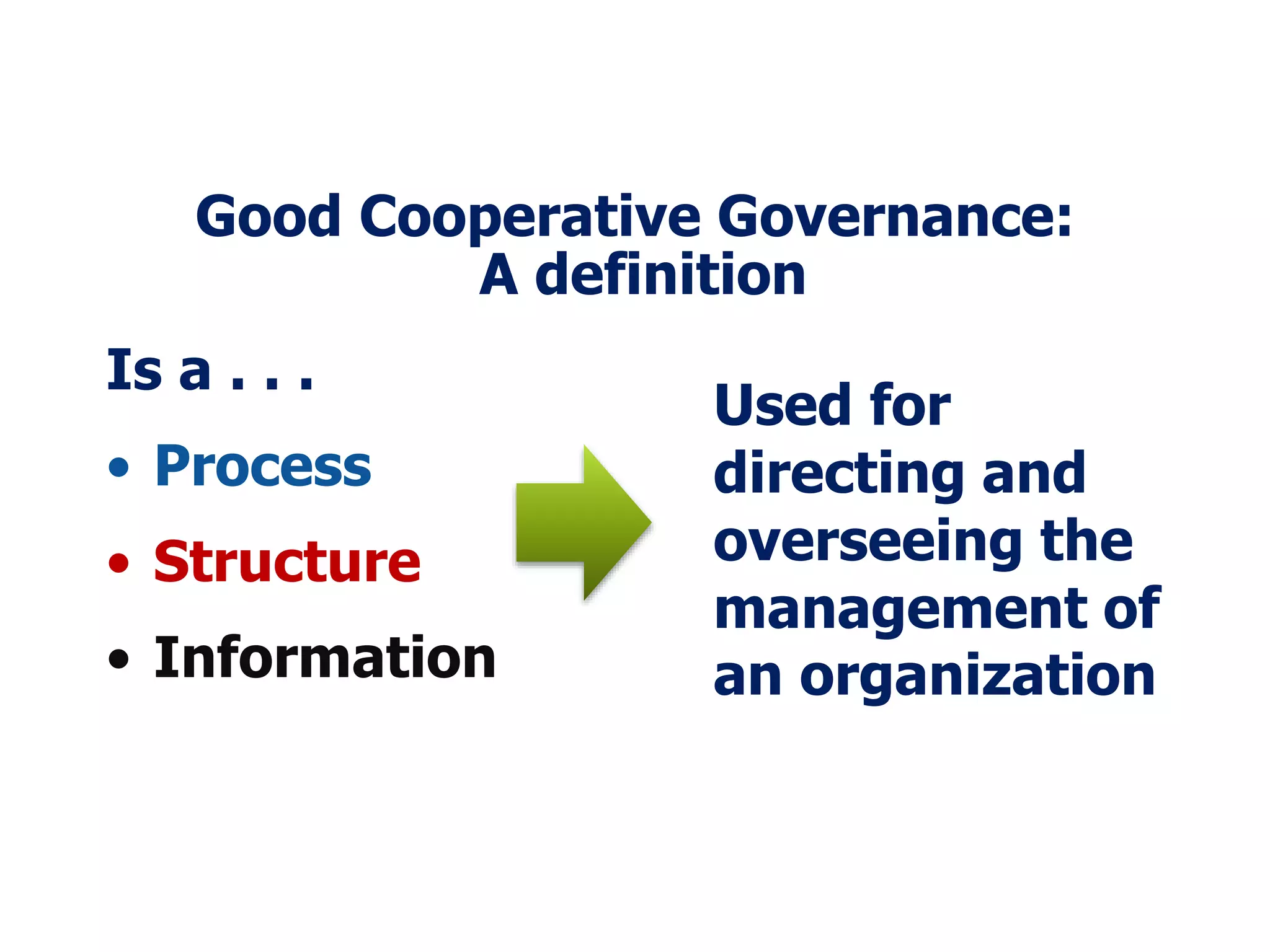
Good Cooperative Governance:
A definition
Is a . . .
• Process
• Structure
• Information
Used for
directing and
overseeing the
management of
an organization
Basic Principles of
Coop Good Governance
1.Independence.
2.A Coop has basic rights, but it also
has basic duties and obligations (to
members, to community, to country)
3.Collegial decision making.
4.Loyalty of the BOD is to the Coop.
5.Ensure Long-term sustainability.
6.Be fair to all.
Basic Principles of Coop Good Governance
7. Transparency in all dealings.
8. Accountability of officers, staff and
members.
9. Accountability of officers, staff and
members.
10. Social Responsibility
11. Go beyond the ordinary.
12. Best deals for members
13. Adopt a Code of Ethics
Basic Principles of Coop Good
Governance
1. Individual governance
2. Internal Governance
3. External governance
AREAS OF GOVERNANCE
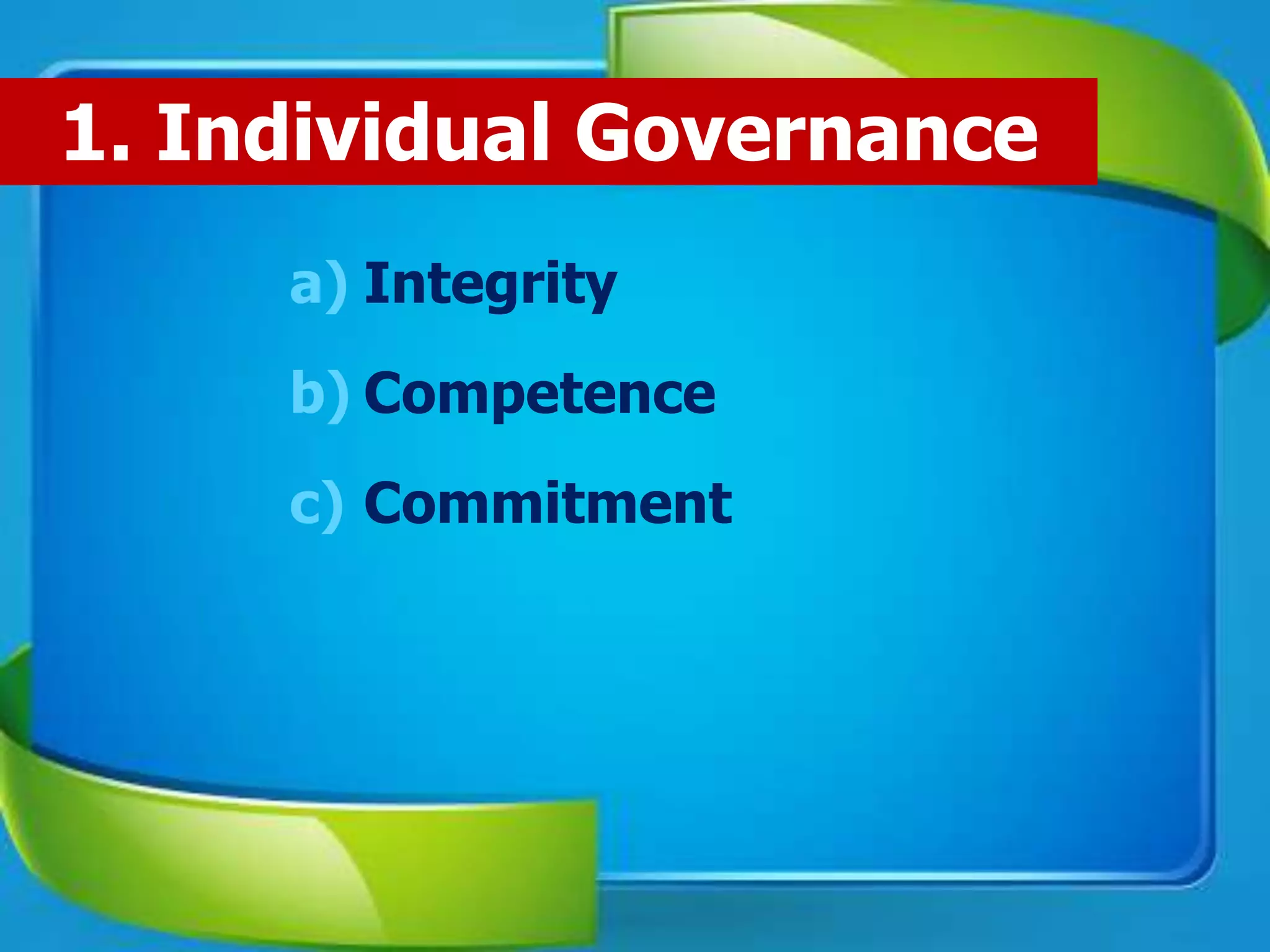
a) Integrity
b) Competence
c) Commitment
1. Individual Governance
a) Structure
b) Continuity
c) Balance
d) Accountability
2. Internal Governance
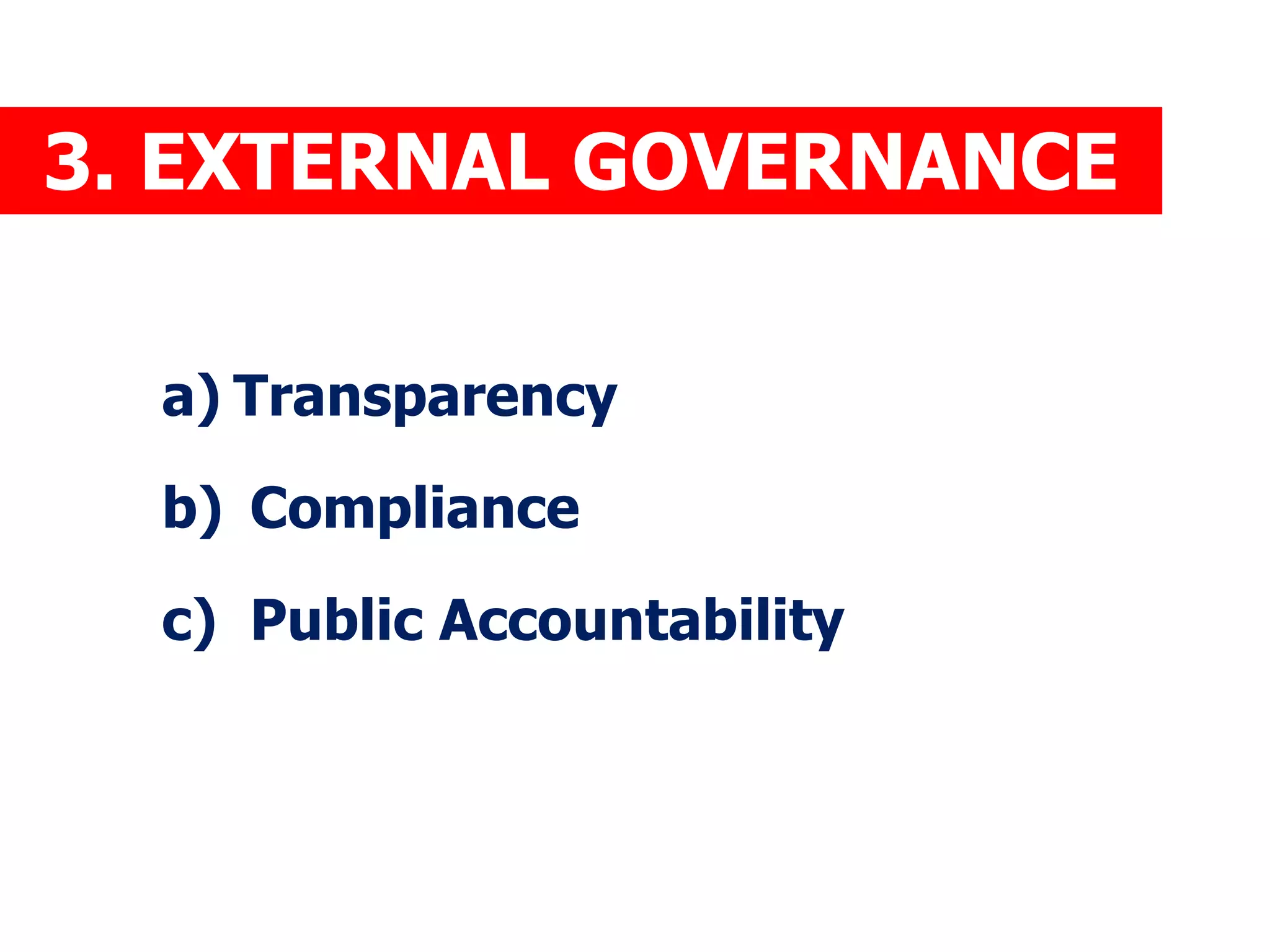
a) Transparency
b) Compliance
c) Public Accountability
3. EXTERNAL GOVERNANCE
Eight (8) Characteristics
of
Good Governance
Characteristics of Good Governance
Consensus
oriented
Participatory
Follows the
rule of law
Effective and
Efficient
Accountable
Transparent
Responsive
Equitable and
inclusive
Source: United Nations Economic and Social Commission for Asia and the Pacific
(UNESCAP)
GOOD
GOVERNANCE
Benefits of Effective
Governance
⮚ Promotes economic/
financial stability and
facilitates growth
Benefits of Effective Governance
⮚ Greater respect for
organizational brand
First choice for financial services
in our community!
Benefits of Effective
Governance
Four (4) Abuses of
Cooperative
Governance
1. Conflict of interest
2. Nepotism
3. Cronyism
4. Insider cliques
1. Abuse of Power
1. Remuneration
2. Transportation
3. Communication
4. Travel
5. Training
6. Entertainment
2. Abuse of Resources
1. Non-market interest rates on
Dividends, loan and savings;
2. Commissions (kickbacks);
3. Waiver of fees;
4. Loan renewals, extensions etc.;
5. Inflated collateral guarantees ;
6. Loan charge-offs
3. Abuse of Products & Services
1. Paying dividends at the
expense of creating loan loss
provisions and/or building
capital
2. Charging-off, instead of
collecting delinquent loans
3. Excessive spending for non-
earning assets (building, cars,
computers etc.)
4. Falsifying financial information
4. Abuse of Institution
1. Absence of clear duties and
responsibilities;
2. Board interference in
management duties;
3. Double standards (elitism);
4. Large salary disparities (CEO
& others);
5. Concentration of Power:
Strongman leadership;
6. Creative accounting
Generic Markers of Poor
Governance
Presence of Code of
Governance &
Ethical Standards
for Cooperatives
( Officers, Employees, and Members)
An officer should not
be delinquent in his/
her loans.
In attending meetings-
The number of hour/s
late should be deducted
from the officers’ Per
Diem.
Do not wear slippers,
shorts and sleeveless
shirts.
Wear uniform
No Sleeping
During Meeting
No Text and Call during
Meeting
No to Excessive
Calls during
Meetings
Module 2
Functions of
Management
in the Cooperative
Functions & Responsibilities of the
Officers of the Cooperative
(Section 4. Rule 7, IRR, RA
9520)
Management in the cooperative context
- Articles of Cooperation and By-Laws
- Approved Manual of Policies and
Procedures
- Approved Cooperative Plans and
Programs.
- Code of Conduct and Ethical
Standards for a cooperative, the
Officers, Members and
Management staff
Cooperative Management Context
Principles of Management
By: Henri Fayol
(Founder of Modern Management)
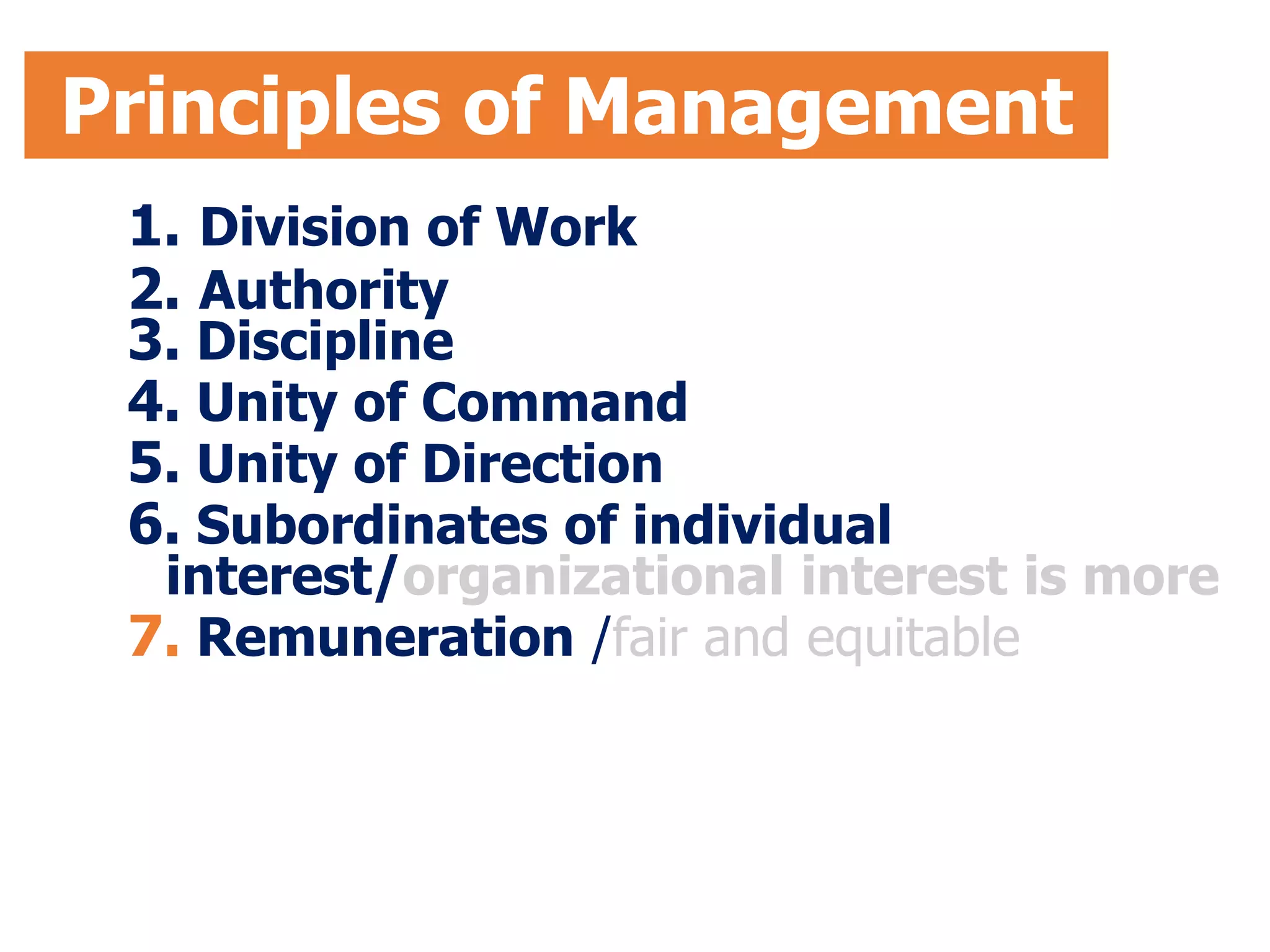
1. Division of Work
2. Authority
3. Discipline
4. Unity of Command
5. Unity of Direction
6. Subordinates of individual
interest/organizational interest is more
7. Remuneration /fair and equitable
Principles of Management
8. Centralization or Decentralization
9. Scalar chain (Line of Authority)
10. Order
11. Equity
12. Stability/Tenure of Personnel
13. Initiative
14.Esprit de Corps/group
cohesiveness
Principles of Management
Cooperative Business Management
Functions
•Is the process of getting activities
completed efficiently and effectively
with and through other people.
•The act of getting people together to
accomplish desired goals.
Meaning of Management
❖TEAM-TOGETHER EVERYONE
ACHIEVES MORE.
❖Board of Directors- elected by the
members
❖Professional business manager hired
by the Board
Management TEAM-
DIRECTOR FUNCTIONS
• The Board of Directors provides direction to the affairs of
the business to ensure development and growth in
products, markets and positive financial results. PODCC
is recognized.
MANAGER FUNCTIONS:
RESPONSIBILITY –Organizing and operating the cooperative in a way
that will optimize the benefits members desire.
- resources are the managers capabilities, physical facilities,
employees and the net worth of the business- 4 functions are
recognized- POMC.
MANAGEMENT FUNCTIONS
.
DIRECTORS HIRED
MANAGEMENT
P-PLANNING P-PLANNING
O-ORGANIZING O-ORGANIZING
D-DIRECTING M-MOTIVATING
C-COORDINATING C-CONTROLLING
C-CONTROLLING
FULFILLING THE FUNCTIONS
BOARD -PLANNING MANAGER- PLANNING
LONG TERM AND BROAD IN
SCOPE-STRATEGIC PLANNING
PREPARATIONS
-SET GOALS AND OBJECTIVES
FOR DAY TO DAY
OPERATIONS, DESIGN
OPERATING PROCEDURES
AND METHODS & MAKE
FINANCIAL PROJECTIONS
ORGANIZING
-ARRANGING ALL GROUPS OF
HUMAN RESOURCES-HIRING
COMPETENT MANAGER AND
DESIGN THE OVERALL
OPERATIONAL STRUCTURE
GROUPING OPERATIONAL
PROCESSES, ASSETS AND
PERSONNEL ESTABLISHING
FOR EFFICIENT DAY-TO-DAY
BUSINESS OPERATIONS.
FULFILLING THE FUNCTIONS
BOARD MANAGER
DIRECTING MOTIVATING
*SETTING WELL-
DEFINED,CLEARLY UNDERSTOOD,
AND CONSISTENTLY
ADMINISTERED POLICIES
*APPROVED SHORT TERM AND
MEDIUM TERM PLANS OF THE
MANAGER, REVIEWING
REPORTS AND MAKING
DECISIONS ABOUT LONG TERM
PLANS.
-COACHING AND LEADING
COOP EMPLOYEES, MEMBERS
AND COSTUMERS.
-CREATE POSITIVE EMPLOYEE
WORKING CONDITIONS,LIASON
AND SPOKE PERSON FOR THE
BUSINESSNESS, ITS OWNERS
AND OTHER STAKEHOLDERS.
-STAFFING,TRAINING,
MOBILIZING PERSONNEL-
FULFILLING THE FIVE FUNCTIONS
BOARD MANAGER
COORDINATING
-COORDINATE ALL PHASES OF THE BUSINESS
SO THAT EACH SUPPORT THE OTHER.
Integration to accomplish pre determined goals
and objectives.
CONTROLLING:
*EXERCISE CONTROL BY KEEPING THEM
INFORMED OF THE PROGRESS OF THE
BUSINESS,
*ASSURING ACCEPTABLE PERFORMANCE.
INTERPRET TRENDS AND RESULTS AND KNOW
WHEN TO INITIATE CORRECTIVE ACTION.
*PREVENTING UNAUTHORIZED ACTIONS AND
KEEPING MEMBERS INFORMED OF THE
PROGRESS.
*ACCEPTING AND APPROVING MANAGEMENT
REPORTS, REVIEWS FINANCIAL AND PHYSICAL
FACILITIES.
Controlling:
*Assures satisfactory
performance in all phases
of business.
*Measuring and
evaluating the results of
employees performance,
executing board policies
and overseeing physical
assets are critical to
accomplishing coop goals
and objectives
*Concerns unmet goals
and objectives and
decisions of how, when
and what correctives
What the Boards want in
a Manager?
Committed to Cooperative’s ideals
so that everyone speaks the same language and the
same goals
Respectful of the Board of Directors
knows the board's role and trusts the directors to do
their job properly
A communicator
one who keeps the board informed of what’s going on,
both good and bad
Provides accurate and timely reports, the coops financial
statements, and forecasts with clear explanations.
WHAT THE BOARDS WANT IN A MANAGER?
Results-oriented
works to achieve agreed-upon goals
Innovative
interprets the needs of the cooperative and makes
professional recommendations to the board
A leader
has the ability to attract, develop, and retain competent
staff
Listener
accepts input from the board
WHAT THE BOARDS WANT IN A MANAGER?
Open-minded
receptive to change and willing to listen to ideas and
opinions he or she may not agree with or may not want to
hear
A team player
does not play favorites among
board members or expect directors
to be a rubber stamp
An educator
provides training opportunities for staff and volunteers
Career-minded
continues his or her own professional development
WHAT THE BOARDS WANT IN A MANAGER?
What the Managers want
in Board of Directors?
Board Effectiveness
Ways to develop the desired traits for
effective performance of Directors
-Understands and respects ,TRUST the respective roles of the
OTHER board and CEO
WHAT THE MANAGER WANTS IN BOARD OF
DIRECTORS?
-Sets management goals and evaluation
criteria
-Gives fair and honest periodic evaluations
-Comes to the meeting prepared
-Make decisive and timely decisions
-Provides resources to get the job done
-Sets firm but clear policies and controls
and reviews them periodically
-Is available when needed
-Recognizes the CEO and staff members for
a job well done
-Visits the Cooperative office
occasionally
to see what goes on, meet staff, find out
who does what, how they do it, and why
WHAT THE MANAGER WANTS IN BOARD OF
DIRECTORS?
-Avoids taking over the CEO’s role
Does not interfere directly with staff
-Listens to the CEO
-Avoids seeking special favors for
himself or on behalf of relatives
and friends
Is motivated and interested
in growing through
educational opportunities
WHAT THE MANAGER WANTS IN BOARD OF
DIRECTORS?
Is ready to
innovate
Asks: What needs
to be done
Acts without being
pushed
WHAT THE MANAGER WANTS IN BOARD OF
DIRECTORS?
CODE OF CONDUCT
for the
Members of the Board of Directors
▪ Board members shall attend and actively
participate in Board meetings, including
voting in motions and making policy and
other duties as prescribed.
▪ A code of conduct of Board of Directors
provides ethical guidelines to which
members shall adhere in the
performance of their duties.
• At the time an Oath of office is taken,
members will sign their affirmation
pledging to uphold the letter and spirit
of this Code of Conduct, Ethics and
Standards as prescribed.
•The Board may give orders and
directions to the Manager, but not to
other members of the management.
• The board shall not direct the
Manager with respect to specific
operational decisions or with respect
to the day – to – day operation of the
organization.
•While board members are responsible
for officially appointing members of the
organization, they shall not interfere in
the operational responsibilities of
recruitment and promotion.
• Board members shall always conduct
their business in a manner that does
not conflict with the public interest
and dignity of the individual, with
respect and commitment for rights of
the public.
What we are today is the result of our own
past actions;
Whatever we wish to be In the future
depends on our present actions;
Decide how you have to act now.
We are responsible for what we are, whatever
we wish ourselves to be. We have the power
to make ourselves.
“Apply yourself. Get all the
education you can, but
then, by God, do
something. Don’t just
stand there, make it
happen”
Legendary president
of the Chrysler
Corporation
Governance
Quote
Handling a Successful meeting
2. Decide according to the will of
the majority what shall be
done.
Social Security Law
PHILHEALTH
Pag-ibig
BMBE Law
Retirement Act
Income Tax
Business Permit
and other related Laws
COMPLIANCE TO LABOR LAWS
OTHER RELATED LAWS
SSS LAW
RA 8282
PHILHEALTH
RA No. 7875
AN ACT INSTITUTING A
NATIONAL HEALTH INSURANCE
PROGRAM FOR ALL FILIPINOS
AND ESTABLISHING THE
PHILIPPINE HEALTH INSURANCE
CORPORATION FOR THE
PURPOSE
PAG-IBIG
HOME DEVELOPMENT MUTUAL FUND LAW
• PD 1752 as amended;
• RA 7752; and
• RA 9679
RA 9679
“Home Development Mutual Fund
Law of 2009, otherwise known as
Pag-IBIG (Pagtutulungan sa
kinabukasan: Ikaw, Bangko,
Industriya at Gobyerno) Fund”
Governance & Management Audit
MEMORANDUM CIRCULAR NO. 2017-05
Series of 2017
GOVERNANCE AND MANAGEMENT
AUDIT REPORT FOR COOPERATIVES
(PERFORMANCE AUDIT REPORT)
Legal Basis
1. Article 53 of R.A. 9520
“Every cooperative shall draw up regular
reports of its Program of activities,
including those in pursuance of their
socio-civic undertakings, showing their
progress & achievements at the end of
every fiscal year.”
Legal Basis
2. Article 80 of R.A. 9520
“ Cooperatives registered under this Code
shall be subject to an annual financial,
performance, and social audit.”
3. Rule 8, Section 2 (b) of the IRR of R.A.
9520
Definition of Terms
⮚ Governance and Management Audit
Working Paper – refers to the working
paper to be used by the Audit Committee
or Internal Auditor in analysing/assessing
the performance of the cooperative in a
form to be prescribed by the Authority.
Definition of Terms
⮚ Governance and Management Audit
Report – refers to the summary report of
analysis/assessment to be undertaken by
the cooperative based on the result of the
audit using the tool prescribed by the
Authority.
Purpose
⮚ To determine the presence of the
documents needed to be maintained by
every cooperative in the operation and
management of its business;
⮚ Regulatory and supervisory tool of CDA in
programming the roadmap of
developmental intervention for
management and governance of
cooperatives;
Purpose
⮚ Management tool of cooperative to
identify problem areas in its governance
and management practices.
Coverage
⮚ This Guideline shall govern and cover all
registered cooperatives, regardless of
types and categories, except for micro
cooperatives which have the option to use
and/or submit the report.
Governance and Management Audit
Working Paper
⮚This document must be filled up by the
Internal Auditor or the Audit Committee in
coordination with the responsible person/s in
the key units of the cooperative signifying the
presence of the documents being asked.
⮚ The remarks portion should indicate findings
in the document whether it is not in the
possession by the right person, found to be
incomplete in substance, or the document is
not duly signed by responsible officers.
Governance and Management Audit
Working Paper
2 Major Components
⮚ Governance Reports
⮚ Management Report/Records
Governance and Management Audit Working
Paper
Governance and Management Audit Working
Paper
Governance and Management Audit Working
Paper
Governance and Management Audit Report
- Shall at least include the following parts:
⮚ Basic Information
⮚ Executive Summary
⮚ Objectives and Scope of the Audit
⮚ Observation/Findings
⮚ Recommendation and Conclusion
Governance and Management Audit Report
(Annex A. Format Template)
Governance and Management Audit Report
(Annex B. Sample Report)
Period of Submission and Sanctions
⮚ This Governance and Management Audit
Report shall be submitted by the cooperative
to the CDA not later than 120 days from the
end of each Calendar Year as attachment to
the CAPR.
⮚ The cooperative who failed to submit the
report shall not be issued Certificate of
Compliance (COC) or may also be subjected
to a procedural process of cancellation.
GUSTO MO BANG…
Negosyo mo’y Legal subalit
Sa Income Tax ay walang binabayaran?
Walang malaking Pampasweldo
Sa mga Empleyado kaya’t
Minimum Wage hindi Masasakop?
PWES! Bagay sa’yo ito!
BMBE LAW
Barangay Micro Business Enterprise
AN ACT TO PROMOTE THE
ESTABLISHMENT OF
BARANGAY MICRO BUSINESS
ENTERPRISES (BMBEs),
PROVIDING INCENTIVES AND
BENEFITS THEREFOR, AND
FOR OTHER PURPOSES.
It stands for BARANGAY MICRO BUSINESS ENTERPRISE.
According to Section 3(b) of RA 9178, otherwise known as the
BARANGAY MICRO BUSINESS ENTERPRISE ACT OF
2002, a BMBE is:
“Any business entity or enterprise engaged in the production,
processing or manufacturing of products or commodities,
including agro-processing, trading and services, whose total assets
including those arising from loans but exclusive of the land on
which the particular business entity's office, plant and equipment
are situated, shall not be more than Three Million Pesos
(P3,000,000.00)”
This Act aims to encourage formalization of
informal or underground businesses by giving
Incentives and benefits to certified BMBEs.
In recent years, the responsibility to issue Certificate of
Authority was transferred from the Municipal Treasurer
to the Department of Trade and Industry (DTI) through
its Negosyo Center.
They removed the
required registration
fee, and the process can
be completed in three
(3) easy steps.
Section 4. Republic Act No. 9178
Registration and Fees
Three (3) Easy Steps to
Register as BMBE:
Step 1: Accomplish BMBE
Form and submit to the
Negosyo Center/DTI Office
where business is located with
the following.
1. Certificates of Registration
• Certificate of Business Name
Registration from the DTI (for
Sole Proprietors)
• Certificate of registration from
the SEC (for Corporations)
• Certificate of Registration
from the CDA (for
Cooperatives)
2. Financial Statement/Pre-
Three (3) Easy Steps to
Register as BMBE:
Step 2: DTI will evaluate the
Eligibility of the Application.
Step 3: If qualified, within 15
working days, DTI issues
Certificate of Authority valid
for 2 years.
What are
the
Benefits
of
becoming
BMBE-
Certified?
REGISTERED BMBES CAN AVAIL OF THE
FOLLOWING INCENTIVES:
1. Income tax exemption from income
arising from the operations of the
enterprise;
2. Exemption from the coverage of the
Minimum Wage Law (BMBE).
Employees will still receive the same
social security and health care
benefits as other employees;
3. Priority to a special credit window set
up specifically for the financing
requirements of BMBEs; and
4. Technology transfer, production and
management training, and marketing
Section 7. Republic Act No. 9178
Exemption from Taxes and Fees
All BMBEs shall be exempt from tax for income arising from the
operations of the enterprise.
The LGUs are encouraged either to reduce the amount of local taxes,
fees and charges imposed or to exempt BMBEs from local taxes, fees
and charges.
COOP
Section 8. Republic Act No. 9178
Exemption from the Coverage of the Minimum Wage
Law
The BMBEs shall be exempt from the coverage of the Minimum
Wage Law: Provided, That all employees covered under this Act
shall be entitled to the same benefits given to any regular
employee such as social security and healthcare benefits.
Section 9. Republic Act No. 9178
Credit Delivery
WHO MAY AVAIL OF THE SPECIAL
CREDIT WINDOW FOR BMBEs?
Only registered BMBEs may take
advantage of the credit facility and
other benefits granted under the law.
This means that the enterprise must
first have a Certificate of Authority
which authorizes it to operate as a
BMBE.
Section 10. Republic Act No. 9178
Technology Transfer, Production and Management Training, and
Marketing Assistance
What are the agencies mandated to provide
assistance in the areas of technology transfer,
production and management training, marketing
assistance?
1. Department of Trade and Industry (DTI)
2. Department of Science and Technology (DOST)
3. University of the Philippines Institute for Small Scale
Industries (UP-ISSI)
4. Cooperative Development Authority (CDA)
5. Technical Education and Skills Development
Authority (TESDA)
6. Technology and Livelihood Resource Center (TLRC)
THANK YOU …..

Governance-and-Management-of-CooperativesNov.-5 (5).ppt

  • 1.
    ADOPTED FROM THEMODULE OF CITY COOPERATIVE DEVELOPMENT OFFICE OF DAVAO CITY GOVERNANCE & MANAGEMENT OF COOPERATIVES
  • 2.
    The word “governance”is from a Greek word, “Gobernare”, which means to steer or to direct. What is Governance?
  • 3.
    Good Cooperative Governance: Adefinition Is a . . . • Process • Structure • Information Used for directing and overseeing the management of an organization
  • 4.
    Basic Principles of CoopGood Governance
  • 5.
    1.Independence. 2.A Coop hasbasic rights, but it also has basic duties and obligations (to members, to community, to country) 3.Collegial decision making. 4.Loyalty of the BOD is to the Coop. 5.Ensure Long-term sustainability. 6.Be fair to all. Basic Principles of Coop Good Governance
  • 6.
    7. Transparency inall dealings. 8. Accountability of officers, staff and members. 9. Accountability of officers, staff and members. 10. Social Responsibility 11. Go beyond the ordinary. 12. Best deals for members 13. Adopt a Code of Ethics Basic Principles of Coop Good Governance
  • 7.
    1. Individual governance 2.Internal Governance 3. External governance AREAS OF GOVERNANCE
  • 8.
    a) Integrity b) Competence c)Commitment 1. Individual Governance
  • 9.
    a) Structure b) Continuity c)Balance d) Accountability 2. Internal Governance
  • 10.
    a) Transparency b) Compliance c)Public Accountability 3. EXTERNAL GOVERNANCE
  • 11.
  • 12.
    Characteristics of GoodGovernance Consensus oriented Participatory Follows the rule of law Effective and Efficient Accountable Transparent Responsive Equitable and inclusive Source: United Nations Economic and Social Commission for Asia and the Pacific (UNESCAP) GOOD GOVERNANCE
  • 13.
  • 14.
    ⮚ Promotes economic/ financialstability and facilitates growth Benefits of Effective Governance
  • 15.
    ⮚ Greater respectfor organizational brand First choice for financial services in our community! Benefits of Effective Governance
  • 16.
    Four (4) Abusesof Cooperative Governance
  • 17.
    1. Conflict ofinterest 2. Nepotism 3. Cronyism 4. Insider cliques 1. Abuse of Power
  • 18.
    1. Remuneration 2. Transportation 3.Communication 4. Travel 5. Training 6. Entertainment 2. Abuse of Resources
  • 19.
    1. Non-market interestrates on Dividends, loan and savings; 2. Commissions (kickbacks); 3. Waiver of fees; 4. Loan renewals, extensions etc.; 5. Inflated collateral guarantees ; 6. Loan charge-offs 3. Abuse of Products & Services
  • 20.
    1. Paying dividendsat the expense of creating loan loss provisions and/or building capital 2. Charging-off, instead of collecting delinquent loans 3. Excessive spending for non- earning assets (building, cars, computers etc.) 4. Falsifying financial information 4. Abuse of Institution
  • 21.
    1. Absence ofclear duties and responsibilities; 2. Board interference in management duties; 3. Double standards (elitism); 4. Large salary disparities (CEO & others); 5. Concentration of Power: Strongman leadership; 6. Creative accounting Generic Markers of Poor Governance
  • 22.
    Presence of Codeof Governance & Ethical Standards for Cooperatives ( Officers, Employees, and Members)
  • 23.
    An officer shouldnot be delinquent in his/ her loans.
  • 24.
    In attending meetings- Thenumber of hour/s late should be deducted from the officers’ Per Diem.
  • 25.
    Do not wearslippers, shorts and sleeveless shirts.
  • 26.
  • 27.
  • 28.
    No Text andCall during Meeting
  • 29.
    No to Excessive Callsduring Meetings
  • 30.
  • 31.
    Functions & Responsibilitiesof the Officers of the Cooperative (Section 4. Rule 7, IRR, RA 9520) Management in the cooperative context
  • 32.
    - Articles ofCooperation and By-Laws - Approved Manual of Policies and Procedures - Approved Cooperative Plans and Programs. - Code of Conduct and Ethical Standards for a cooperative, the Officers, Members and Management staff Cooperative Management Context
  • 33.
    Principles of Management By:Henri Fayol (Founder of Modern Management)
  • 34.
    1. Division ofWork 2. Authority 3. Discipline 4. Unity of Command 5. Unity of Direction 6. Subordinates of individual interest/organizational interest is more 7. Remuneration /fair and equitable Principles of Management
  • 35.
    8. Centralization orDecentralization 9. Scalar chain (Line of Authority) 10. Order 11. Equity 12. Stability/Tenure of Personnel 13. Initiative 14.Esprit de Corps/group cohesiveness Principles of Management
  • 36.
  • 37.
    •Is the processof getting activities completed efficiently and effectively with and through other people. •The act of getting people together to accomplish desired goals. Meaning of Management
  • 38.
    ❖TEAM-TOGETHER EVERYONE ACHIEVES MORE. ❖Boardof Directors- elected by the members ❖Professional business manager hired by the Board Management TEAM-
  • 39.
    DIRECTOR FUNCTIONS • TheBoard of Directors provides direction to the affairs of the business to ensure development and growth in products, markets and positive financial results. PODCC is recognized. MANAGER FUNCTIONS: RESPONSIBILITY –Organizing and operating the cooperative in a way that will optimize the benefits members desire. - resources are the managers capabilities, physical facilities, employees and the net worth of the business- 4 functions are recognized- POMC.
  • 40.
    MANAGEMENT FUNCTIONS . DIRECTORS HIRED MANAGEMENT P-PLANNINGP-PLANNING O-ORGANIZING O-ORGANIZING D-DIRECTING M-MOTIVATING C-COORDINATING C-CONTROLLING C-CONTROLLING
  • 41.
    FULFILLING THE FUNCTIONS BOARD-PLANNING MANAGER- PLANNING LONG TERM AND BROAD IN SCOPE-STRATEGIC PLANNING PREPARATIONS -SET GOALS AND OBJECTIVES FOR DAY TO DAY OPERATIONS, DESIGN OPERATING PROCEDURES AND METHODS & MAKE FINANCIAL PROJECTIONS ORGANIZING -ARRANGING ALL GROUPS OF HUMAN RESOURCES-HIRING COMPETENT MANAGER AND DESIGN THE OVERALL OPERATIONAL STRUCTURE GROUPING OPERATIONAL PROCESSES, ASSETS AND PERSONNEL ESTABLISHING FOR EFFICIENT DAY-TO-DAY BUSINESS OPERATIONS.
  • 42.
    FULFILLING THE FUNCTIONS BOARDMANAGER DIRECTING MOTIVATING *SETTING WELL- DEFINED,CLEARLY UNDERSTOOD, AND CONSISTENTLY ADMINISTERED POLICIES *APPROVED SHORT TERM AND MEDIUM TERM PLANS OF THE MANAGER, REVIEWING REPORTS AND MAKING DECISIONS ABOUT LONG TERM PLANS. -COACHING AND LEADING COOP EMPLOYEES, MEMBERS AND COSTUMERS. -CREATE POSITIVE EMPLOYEE WORKING CONDITIONS,LIASON AND SPOKE PERSON FOR THE BUSINESSNESS, ITS OWNERS AND OTHER STAKEHOLDERS. -STAFFING,TRAINING, MOBILIZING PERSONNEL-
  • 43.
    FULFILLING THE FIVEFUNCTIONS BOARD MANAGER COORDINATING -COORDINATE ALL PHASES OF THE BUSINESS SO THAT EACH SUPPORT THE OTHER. Integration to accomplish pre determined goals and objectives. CONTROLLING: *EXERCISE CONTROL BY KEEPING THEM INFORMED OF THE PROGRESS OF THE BUSINESS, *ASSURING ACCEPTABLE PERFORMANCE. INTERPRET TRENDS AND RESULTS AND KNOW WHEN TO INITIATE CORRECTIVE ACTION. *PREVENTING UNAUTHORIZED ACTIONS AND KEEPING MEMBERS INFORMED OF THE PROGRESS. *ACCEPTING AND APPROVING MANAGEMENT REPORTS, REVIEWS FINANCIAL AND PHYSICAL FACILITIES. Controlling: *Assures satisfactory performance in all phases of business. *Measuring and evaluating the results of employees performance, executing board policies and overseeing physical assets are critical to accomplishing coop goals and objectives *Concerns unmet goals and objectives and decisions of how, when and what correctives
  • 44.
    What the Boardswant in a Manager?
  • 46.
    Committed to Cooperative’sideals so that everyone speaks the same language and the same goals Respectful of the Board of Directors knows the board's role and trusts the directors to do their job properly A communicator one who keeps the board informed of what’s going on, both good and bad Provides accurate and timely reports, the coops financial statements, and forecasts with clear explanations. WHAT THE BOARDS WANT IN A MANAGER?
  • 47.
    Results-oriented works to achieveagreed-upon goals Innovative interprets the needs of the cooperative and makes professional recommendations to the board A leader has the ability to attract, develop, and retain competent staff Listener accepts input from the board WHAT THE BOARDS WANT IN A MANAGER?
  • 48.
    Open-minded receptive to changeand willing to listen to ideas and opinions he or she may not agree with or may not want to hear A team player does not play favorites among board members or expect directors to be a rubber stamp An educator provides training opportunities for staff and volunteers Career-minded continues his or her own professional development WHAT THE BOARDS WANT IN A MANAGER?
  • 49.
    What the Managerswant in Board of Directors?
  • 50.
    Board Effectiveness Ways todevelop the desired traits for effective performance of Directors
  • 51.
    -Understands and respects,TRUST the respective roles of the OTHER board and CEO WHAT THE MANAGER WANTS IN BOARD OF DIRECTORS? -Sets management goals and evaluation criteria -Gives fair and honest periodic evaluations -Comes to the meeting prepared -Make decisive and timely decisions -Provides resources to get the job done -Sets firm but clear policies and controls and reviews them periodically -Is available when needed -Recognizes the CEO and staff members for a job well done
  • 52.
    -Visits the Cooperativeoffice occasionally to see what goes on, meet staff, find out who does what, how they do it, and why WHAT THE MANAGER WANTS IN BOARD OF DIRECTORS? -Avoids taking over the CEO’s role Does not interfere directly with staff -Listens to the CEO -Avoids seeking special favors for himself or on behalf of relatives and friends
  • 53.
    Is motivated andinterested in growing through educational opportunities WHAT THE MANAGER WANTS IN BOARD OF DIRECTORS?
  • 54.
    Is ready to innovate Asks:What needs to be done Acts without being pushed WHAT THE MANAGER WANTS IN BOARD OF DIRECTORS?
  • 55.
    CODE OF CONDUCT forthe Members of the Board of Directors
  • 56.
    ▪ Board membersshall attend and actively participate in Board meetings, including voting in motions and making policy and other duties as prescribed. ▪ A code of conduct of Board of Directors provides ethical guidelines to which members shall adhere in the performance of their duties.
  • 57.
    • At thetime an Oath of office is taken, members will sign their affirmation pledging to uphold the letter and spirit of this Code of Conduct, Ethics and Standards as prescribed.
  • 58.
    •The Board maygive orders and directions to the Manager, but not to other members of the management.
  • 59.
    • The boardshall not direct the Manager with respect to specific operational decisions or with respect to the day – to – day operation of the organization.
  • 60.
    •While board membersare responsible for officially appointing members of the organization, they shall not interfere in the operational responsibilities of recruitment and promotion.
  • 61.
    • Board membersshall always conduct their business in a manner that does not conflict with the public interest and dignity of the individual, with respect and commitment for rights of the public.
  • 62.
    What we aretoday is the result of our own past actions; Whatever we wish to be In the future depends on our present actions; Decide how you have to act now. We are responsible for what we are, whatever we wish ourselves to be. We have the power to make ourselves.
  • 63.
    “Apply yourself. Getall the education you can, but then, by God, do something. Don’t just stand there, make it happen” Legendary president of the Chrysler Corporation Governance Quote
  • 65.
    Handling a Successfulmeeting 2. Decide according to the will of the majority what shall be done.
  • 67.
    Social Security Law PHILHEALTH Pag-ibig BMBELaw Retirement Act Income Tax Business Permit and other related Laws COMPLIANCE TO LABOR LAWS
  • 68.
  • 69.
  • 70.
  • 71.
    RA No. 7875 ANACT INSTITUTING A NATIONAL HEALTH INSURANCE PROGRAM FOR ALL FILIPINOS AND ESTABLISHING THE PHILIPPINE HEALTH INSURANCE CORPORATION FOR THE PURPOSE
  • 72.
  • 73.
    HOME DEVELOPMENT MUTUALFUND LAW • PD 1752 as amended; • RA 7752; and • RA 9679
  • 74.
    RA 9679 “Home DevelopmentMutual Fund Law of 2009, otherwise known as Pag-IBIG (Pagtutulungan sa kinabukasan: Ikaw, Bangko, Industriya at Gobyerno) Fund”
  • 75.
    Governance & ManagementAudit MEMORANDUM CIRCULAR NO. 2017-05 Series of 2017 GOVERNANCE AND MANAGEMENT AUDIT REPORT FOR COOPERATIVES (PERFORMANCE AUDIT REPORT)
  • 76.
    Legal Basis 1. Article53 of R.A. 9520 “Every cooperative shall draw up regular reports of its Program of activities, including those in pursuance of their socio-civic undertakings, showing their progress & achievements at the end of every fiscal year.”
  • 77.
    Legal Basis 2. Article80 of R.A. 9520 “ Cooperatives registered under this Code shall be subject to an annual financial, performance, and social audit.” 3. Rule 8, Section 2 (b) of the IRR of R.A. 9520
  • 78.
    Definition of Terms ⮚Governance and Management Audit Working Paper – refers to the working paper to be used by the Audit Committee or Internal Auditor in analysing/assessing the performance of the cooperative in a form to be prescribed by the Authority.
  • 79.
    Definition of Terms ⮚Governance and Management Audit Report – refers to the summary report of analysis/assessment to be undertaken by the cooperative based on the result of the audit using the tool prescribed by the Authority.
  • 80.
    Purpose ⮚ To determinethe presence of the documents needed to be maintained by every cooperative in the operation and management of its business; ⮚ Regulatory and supervisory tool of CDA in programming the roadmap of developmental intervention for management and governance of cooperatives;
  • 81.
    Purpose ⮚ Management toolof cooperative to identify problem areas in its governance and management practices.
  • 82.
    Coverage ⮚ This Guidelineshall govern and cover all registered cooperatives, regardless of types and categories, except for micro cooperatives which have the option to use and/or submit the report.
  • 83.
    Governance and ManagementAudit Working Paper ⮚This document must be filled up by the Internal Auditor or the Audit Committee in coordination with the responsible person/s in the key units of the cooperative signifying the presence of the documents being asked. ⮚ The remarks portion should indicate findings in the document whether it is not in the possession by the right person, found to be incomplete in substance, or the document is not duly signed by responsible officers.
  • 84.
    Governance and ManagementAudit Working Paper 2 Major Components ⮚ Governance Reports ⮚ Management Report/Records
  • 85.
    Governance and ManagementAudit Working Paper
  • 86.
    Governance and ManagementAudit Working Paper
  • 87.
    Governance and ManagementAudit Working Paper
  • 88.
    Governance and ManagementAudit Report - Shall at least include the following parts: ⮚ Basic Information ⮚ Executive Summary ⮚ Objectives and Scope of the Audit ⮚ Observation/Findings ⮚ Recommendation and Conclusion
  • 89.
    Governance and ManagementAudit Report (Annex A. Format Template)
  • 90.
    Governance and ManagementAudit Report (Annex B. Sample Report)
  • 91.
    Period of Submissionand Sanctions ⮚ This Governance and Management Audit Report shall be submitted by the cooperative to the CDA not later than 120 days from the end of each Calendar Year as attachment to the CAPR. ⮚ The cooperative who failed to submit the report shall not be issued Certificate of Compliance (COC) or may also be subjected to a procedural process of cancellation.
  • 92.
    GUSTO MO BANG… Negosyomo’y Legal subalit Sa Income Tax ay walang binabayaran? Walang malaking Pampasweldo Sa mga Empleyado kaya’t Minimum Wage hindi Masasakop? PWES! Bagay sa’yo ito! BMBE LAW Barangay Micro Business Enterprise
  • 94.
    AN ACT TOPROMOTE THE ESTABLISHMENT OF BARANGAY MICRO BUSINESS ENTERPRISES (BMBEs), PROVIDING INCENTIVES AND BENEFITS THEREFOR, AND FOR OTHER PURPOSES.
  • 95.
    It stands forBARANGAY MICRO BUSINESS ENTERPRISE. According to Section 3(b) of RA 9178, otherwise known as the BARANGAY MICRO BUSINESS ENTERPRISE ACT OF 2002, a BMBE is: “Any business entity or enterprise engaged in the production, processing or manufacturing of products or commodities, including agro-processing, trading and services, whose total assets including those arising from loans but exclusive of the land on which the particular business entity's office, plant and equipment are situated, shall not be more than Three Million Pesos (P3,000,000.00)” This Act aims to encourage formalization of informal or underground businesses by giving Incentives and benefits to certified BMBEs.
  • 96.
    In recent years,the responsibility to issue Certificate of Authority was transferred from the Municipal Treasurer to the Department of Trade and Industry (DTI) through its Negosyo Center. They removed the required registration fee, and the process can be completed in three (3) easy steps. Section 4. Republic Act No. 9178 Registration and Fees
  • 97.
    Three (3) EasySteps to Register as BMBE: Step 1: Accomplish BMBE Form and submit to the Negosyo Center/DTI Office where business is located with the following. 1. Certificates of Registration • Certificate of Business Name Registration from the DTI (for Sole Proprietors) • Certificate of registration from the SEC (for Corporations) • Certificate of Registration from the CDA (for Cooperatives) 2. Financial Statement/Pre-
  • 98.
    Three (3) EasySteps to Register as BMBE: Step 2: DTI will evaluate the Eligibility of the Application. Step 3: If qualified, within 15 working days, DTI issues Certificate of Authority valid for 2 years.
  • 99.
  • 100.
    REGISTERED BMBES CANAVAIL OF THE FOLLOWING INCENTIVES: 1. Income tax exemption from income arising from the operations of the enterprise; 2. Exemption from the coverage of the Minimum Wage Law (BMBE). Employees will still receive the same social security and health care benefits as other employees; 3. Priority to a special credit window set up specifically for the financing requirements of BMBEs; and 4. Technology transfer, production and management training, and marketing
  • 101.
    Section 7. RepublicAct No. 9178 Exemption from Taxes and Fees All BMBEs shall be exempt from tax for income arising from the operations of the enterprise. The LGUs are encouraged either to reduce the amount of local taxes, fees and charges imposed or to exempt BMBEs from local taxes, fees and charges. COOP
  • 102.
    Section 8. RepublicAct No. 9178 Exemption from the Coverage of the Minimum Wage Law The BMBEs shall be exempt from the coverage of the Minimum Wage Law: Provided, That all employees covered under this Act shall be entitled to the same benefits given to any regular employee such as social security and healthcare benefits.
  • 103.
    Section 9. RepublicAct No. 9178 Credit Delivery WHO MAY AVAIL OF THE SPECIAL CREDIT WINDOW FOR BMBEs? Only registered BMBEs may take advantage of the credit facility and other benefits granted under the law. This means that the enterprise must first have a Certificate of Authority which authorizes it to operate as a BMBE.
  • 104.
    Section 10. RepublicAct No. 9178 Technology Transfer, Production and Management Training, and Marketing Assistance What are the agencies mandated to provide assistance in the areas of technology transfer, production and management training, marketing assistance? 1. Department of Trade and Industry (DTI) 2. Department of Science and Technology (DOST) 3. University of the Philippines Institute for Small Scale Industries (UP-ISSI) 4. Cooperative Development Authority (CDA) 5. Technical Education and Skills Development Authority (TESDA) 6. Technology and Livelihood Resource Center (TLRC)
  • 105.