Lucila M. Peart Ph. D.
           Resource Person
Cooperative Officers Course
           June 27-28, 2012
Learning Objective
 Formulate effective
    policies for
  implementation
Policy
    a statement that provides
    guidelines for actions to
    attain the established
    objectives of the cooperative
    and reflect the cooperative’s
    basic philosophy
Policy
 • a principle or rule to guide
   decisions and achieve
   rational outcome(s)
 • contain the 'what' (needs to
   be done) and the 'why’
Policy
 • express the means by which
   the cooperative’s agreed
   objectives are to be achieved
 • can be considered as a
   "Statement of Intent" or a
   "Commitment“
Characteristics of Policy
 • conforms to cooperative
   values, principles,
   vision/mission, current
   strategies/goals/ objectives
 • should deal with a recognized
   need
Characteristics of Policy
clearly indicates the
conditions, to whom, and to
what extent it applies
specifies who is responsible
for applying it
clear and simple
Characteristics of Policy
covers broad or basic area of
operations
generally long-term commitments
established by the Board
does not conflict with other
cooperative policies
Functions of Policy
• Provides framework in which
  actions are to be executed
• Serves as a tool for quality
  improvement within the
  organization.
Functions of Policy
• Promotes efficiency within
  the organization in that ideas
  do not continually have to be
  deliberated
Functions of Policy
• Ensures consistency in the
  performance of activities
  especially in cases where
  operating units are
  geographically or
  strategically scattered
Functions of Policy
Ensures compliance with legal
and other requirements of the
organization
Guidelines for Writing,
    Implementing
and Evaluating Policies
Identify
 Cooperative leaders must select
the general areas to be covered by
policy (e.g. board and management
functions, organization, public
relations, finances, sales/
marketing/production and
employee relations)
Formulate
   Ideas for changing current
 policy or introducing new policy
 may come from the members,
 directors, management, employees,
 or paid consultants.
Adopt
    The board, after considering
the various recommendations,
should agree on a final format
that clearly explains all aspects
of policy
• Before finalization, obtain
  policy acceptance by getting
  opinions and reactions of all
  those affected. A majority vote
  is needed for adoption.
Implement
   The manager is responsible
for carrying out board policy by
developing procedures to be
followed, issuing instructions,
and making sure concerned
individuals understand, accept,
and observe adopted policies.
Distribute
    All policy should be in
 written form, collected in a
 manual, classified as to subject
 matter and distributed to
 persons concerned with
 administering them.
Implement
    The manager is responsible
 for carrying out board policy by
 developing procedures to be
 followed, issuing instructions,
 and making sure concerned
 individuals understand, accept,
 and observe adopted policies.
Control
    This is the board’s
 management responsibility to
 determine if the manager is
 carrying out the established
 policy.
Periodic reports from the
manager on aspects of the
cooperative’s operation are
needed and not just at the end
of the business year
Review and Evaluate
    This is the job of the board
and management in judging
the effect of any given policy
to the entire organization.
Guidelines for Writing,
    Implementing
and Evaluating Policies
Identify
     Cooperative leaders must select
the general areas to be covered by
policy (e.g. board and management
functions, organization, public
relations, finances, sales/ marketing
/production and employee
relations)
Formulate
   Ideas for changing current
policy or introducing new
policy may come from the
members, directors,
management, employees, or
paid consultants.
Adopt
    The board, after
 considering the various
 recommendations, should
 agree on a final format
 that clearly explains all
 aspects of policy.
• Before finalization, obtain
  policy acceptance by getting
  opinions and reactions of all
  those affected. A majority vote
  is needed for adoption.
Distribute
    All policy should be in
 written form, collected in a
 manual, classified as to subject
 matter and distributed to
 persons concerned with
 administering them.
Implement
   The manager is responsible for
carrying out board policy by
developing procedures to be
followed, issuing instructions,
and making sure concerned
individuals understand, accept,
and observe adopted policies.
Control
     This is the board’s
 management responsibility
 to determine if the manager
 is carrying out the
 established policy.
• Periodic reports from the
  manager on aspects of the
  cooperative’s operation
  are needed and not just at
  the end of the business
  year
Review and Evaluate
    This is the job of the
 board and management in
 judging the effect of any
 given policy to the entire
 organization.
Sample Policies
Authority
Management is authorized by the
BOD to take whatever actions are
necessary to conduct the business of
the cooperative, including
operations, control of all expenses,
and membership activities within
the framework of policies established
by the board.
Board’s Duty to Follow Legal
Documents
 • The AC & BL in conjunction
   with the membership
   agreement and other contracts
   with members of the
   cooperative form the basis
   under which the cooperative
   operates.
As a result, each board member is
 responsible for reading and
 understanding the basic tenants
 of all legal documents and of
 ensuring that the board of
 directors as a whole follow any
 requirements they contain for
 either the board or the
 cooperative.
Board Supervision of Manager
  The BOD shall have absolute
authority and responsibility to
select the manager, negotiate the
manager’s salary, develop and
revise the manager’s job
description.
Assign duties to the
manager, and terminate
employment in cases where
the manager is not
performing to the board’s
standards.
Credit to Directors
    The coop shall not
 extend credit to any
 director on any terms or in
 any amounts not available
 to any other members of
 the cooperative.
Employment of Relatives
   Employment of immediate
 relatives (husband, wife, child,
 sibling, parent, grand parent,
 aunt, uncle, nephew, niece) of
 any salaried or regular full-
 time employee/board member/
 supervisor/shall be prohibited.
Major types of policies in the
        cooperative
 Product policy
 Production policy
 Marketing policy
 Purchasing policy
 Personnel policy
 Lending policy
 Membership policy
Policy Formulation
• a process typically includes an
  attempt to assess as many areas
  of potential policy impact as
  possible, to lessen the chances
  that a given policy will have
  unexpected or unintended
  consequences
Policy Formulation
• involves the crafting of
  alternatives or options for dealing
  with a problem
• may also refer to the process of
  making important organizational
  decisions
Components
1. Purpose statement
    - an outline as to why the
   organization is issuing
   the policy, and what its
   desired effect or outcome
   of the policy should be.
Components
2. Applicability and scope
  – a statement describing
 who the policy affects and
 which actions are
 impacted by the policy.
Components
   Applicability and scope
may expressly exclude
certain people,
organizations or actions
from the policy
requirements.
Components
   Applicability and scope
is used to focus the policy
on only the desired targets,
and avoid unintended
consequences where
possible.
Components
3. Effective date
   - indicates when the
 policy comes into force.
Components
4. Responsibilities Section -
 indicates who and what
 offices within the
 organizations are
 responsible for carrying out
 individual policy
 statements.
Components
5. Policy statements
 - indicates the specific
 regulations, requirements,
 or modifications to
 organizational behavior
 that the policy is creating
Additional Sections
6. Background
  - indicates any reasons,
 history, and intent
 (referred to as motivating
 factors) that led to the
 creation of the policy.
Additional Sections
7. Definitions
   - provide clear and
 unambiguous definitions
 for terms and concepts
 found in the policy
 documents.
Ethical,
Strategic and
 Operational
   Policies
Ethical Policy
 contains a set of core
 values and approaches to
 the process of doing
 business on a daily basis.
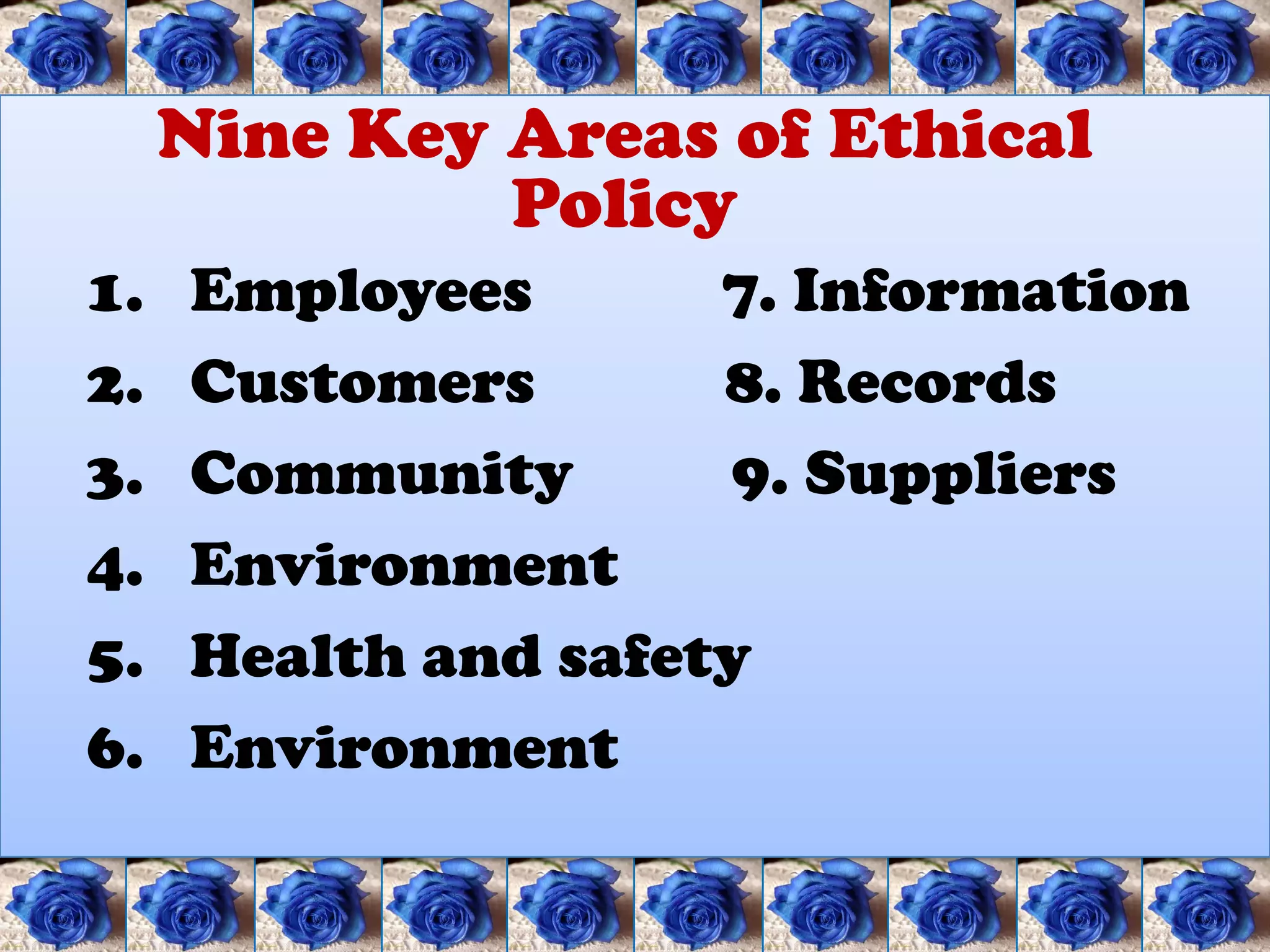
Nine Key Areas of Ethical
              Policy
1.   Employees       7. Information
2.   Customers       8. Records
3.   Community       9. Suppliers
4.   Environment
5.   Health and safety
6.   Environment
Strategic Policy
- aligns organization’s
vision and lead the way to
its mission
- Should be mission driven
rather than reactive to
unexpected conditions
Strategic Policy
- should delineate the
coping mechanisms to deal
with unexpected issues,
and the conditions under
which ad hoc decisions can,
within limits, override
policy
Strategic Policy
 deals with the substance of what you are
about, defines the business you are in
also includes routine matters such as
work rules, team etiquette, travel,
purchasing, order processing and
transactions where unwritten
rules are detrimental to productivity
and consistent performance.
• the instruments and
  practices by which
  organizations rationalize
  and continuously improve
  the work they do through
  available knowledge and
  technology
Operational Policy
• includes team synergy, decision
  structures, methods,
  standards, systems and
  procedures that yield high
  performance and consistently
  respond to changing
  circumstances.
Operational Policy
• deal with the process of
  getting the job done
• Helps the employees devote
  their attention to activities
  and practices with bottom-
  line impact.
Policy
Development
  Process
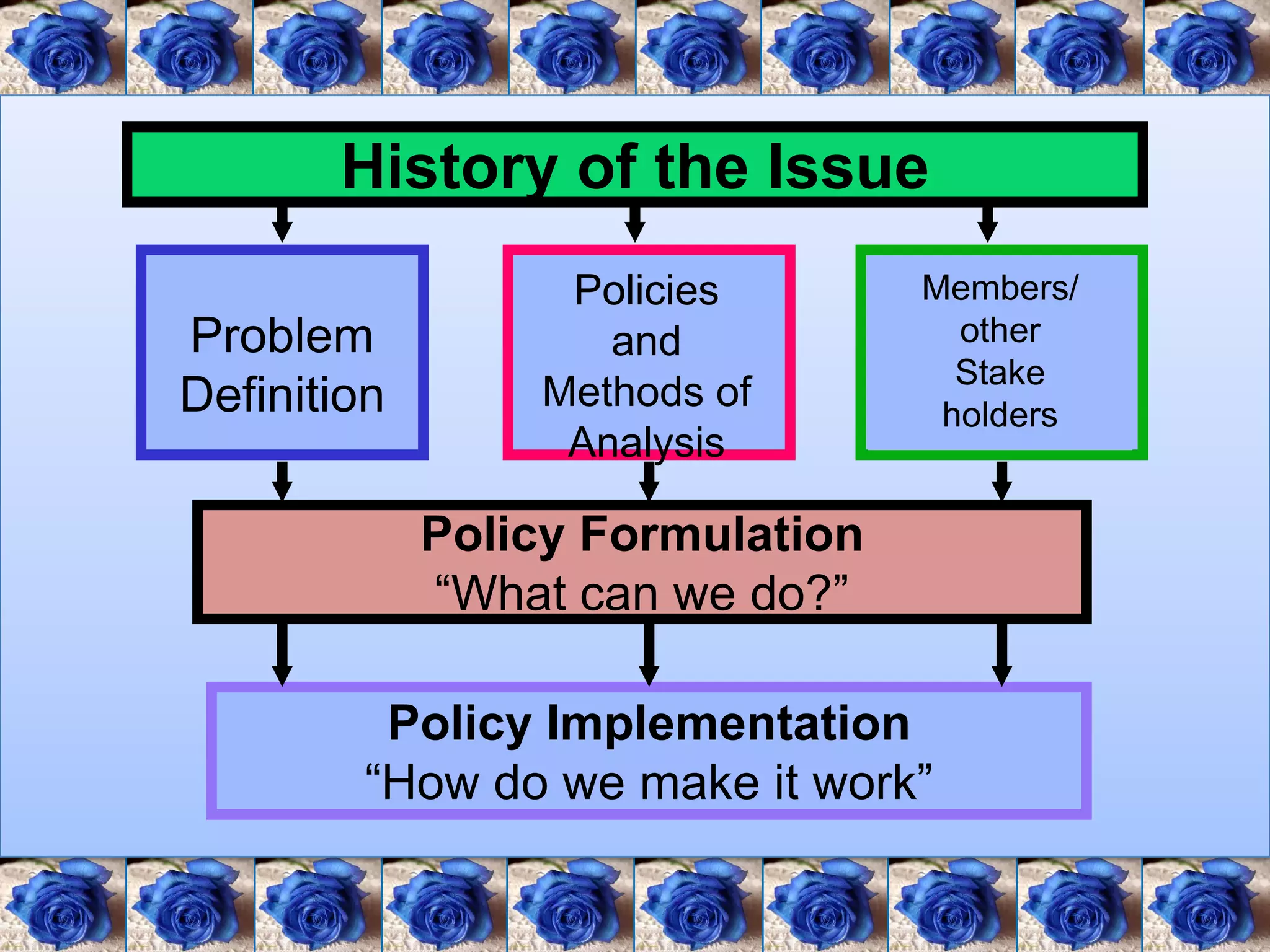
History of the Issue
                  Policies        Members/
Problem             and             other
                                    Stake
Definition       Methods of        holders
                  Analysis

             Policy Formulation
             “What can we do?”

          Policy Implementation
         “How do we make it work”
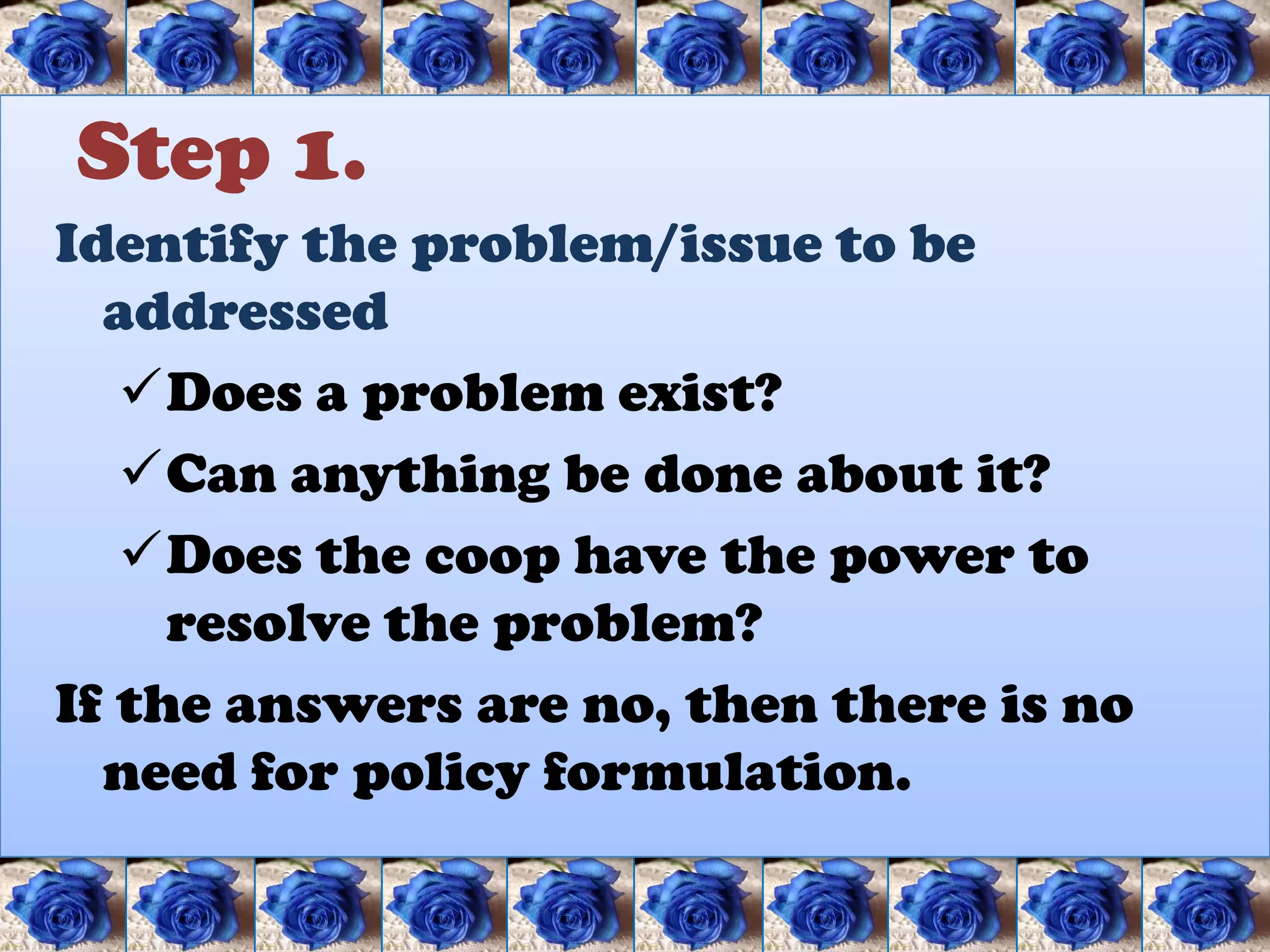
Step 1.
Identify the problem/issue to be
  addressed
   Does a problem exist?
   Can anything be done about it?
   Does the coop have the power to
     resolve the problem?
If the answers are no, then there is no
  need for policy formulation.
Step 2.
Determine the objectives
• After a policy problem is
  identified, a statement of goals is
  adopted.
• The goals are what the adopted
  policy alternative should
  accomplish.
Step 3.
Identify Alternative Policies
• Collect information from
  other internal functional
  units regarding their
  related policies.
• Consult appropriate individuals
  directly involved in the
  operation to obtain
  ideas/insights
• Consider experiences of other
  coops with similar problems
  from reported research findings,
  etc.
Step 4.
Assess alternative policies
 Evaluate expected outcomes,
  effects and impacts of each
  policy alternative
 Do the predicted outcomes meet
  the desired goals?
Show/determine strengths
 & weaknesses of each
 alternative
Describe the best and
 worst case scenario for
 each alternative
Step 5.
Choose course of action
• Adopt the “best” policy
  base on the specific
  objectives.
Step 6.
Monitor implementation
Policy monitoring refers to the
 process of determining how the
 policy is being adopted in
 relation to objectives and coop
 operation.
Basis for policy monitoring
Financial and non-financial
 records/documents
feedback from clients
diary entries of staff
ratings by clients
tests, observation, and physical
 evidence.
Step 7.
Evaluate implementation
was the problem correctly
 identified, or was the correct
 problem identified?
is the policy having the desired
 effect?
 are there any modification
 needed?
Monitoring Implementation
         of Policy
monitor the efficiency and
 effectiveness of policies
informs decision-makers
 of the consequences of
 actions and changes in the
 environment
Step 7.
Evaluate implementation
was the problem correctly identified,
 or was the correct problem identified?
is the policy having the desired effect?
 are there any modification needed?
Monitoring Implementation
         of Policy
helps determine the need for
 further action, and possible
 changes and improvements in
 policy statements and plans, or
 in actions taken to implement
 them.
Guides to
Monitoring Policy
Implementation
Have a clear purpose for policy and
          plan monitoring
  Is it for accountability to the
 community (to show you have provided
 a means of managing what you said you
 would manage and achieved the
 organization’s goals?
   Is it for continuous improvement of
  the organization? OR
   both?
Policy effectiveness
monitoring is systematic and
involves tracking and
evaluating whether and how
well policy implementation is
resolving the issues/problems
identified.
 Is the policy achieving its
  objectives?
 Are the assigned personnel
  delivering on anticipated
  outcomes?
 Does the policy cover the most
  important things?
 Are there emerging issues that
  are not being addressed?
Be systematic and apply a
    consistent approach
There is no one right approach to
policy effectiveness monitoring.
The approach taken should be
flexible.
Ensure the approach used is
relevant to your situation.
Be systematic and apply a consistent
             approach
     The monitoring process includes:
• being clear about the purpose and
  goals
• stating what will be monitored and
  why
• developing indicators
• consistent collection of data
• analyzing, interpreting and
presenting information
• reviewing the policy
   or delivery of implementation
• a continuous review and
reporting cycle, making policy
changes and adjustments as
necessary
Include questions about WHY, HOW,
WHO, WHAT, WHERE, WHEN to monitor

 Review the issues/problems,
 objectives, organizational and
 functional structure vis-à-vis
 policy/ies being implemented
Share ideas and allow for
        training
Train people and develop
learning environments for
staff.
Get external guidance where
necessary.
THANK YOU!!!

Policy Formulation for Cooperatives

  • 1.
    Lucila M. PeartPh. D. Resource Person Cooperative Officers Course June 27-28, 2012
  • 2.
    Learning Objective Formulateeffective policies for implementation
  • 3.
    Policy a statement that provides guidelines for actions to attain the established objectives of the cooperative and reflect the cooperative’s basic philosophy
  • 4.
    Policy • aprinciple or rule to guide decisions and achieve rational outcome(s) • contain the 'what' (needs to be done) and the 'why’
  • 5.
    Policy • expressthe means by which the cooperative’s agreed objectives are to be achieved • can be considered as a "Statement of Intent" or a "Commitment“
  • 6.
    Characteristics of Policy • conforms to cooperative values, principles, vision/mission, current strategies/goals/ objectives • should deal with a recognized need
  • 7.
    Characteristics of Policy clearlyindicates the conditions, to whom, and to what extent it applies specifies who is responsible for applying it clear and simple
  • 8.
    Characteristics of Policy coversbroad or basic area of operations generally long-term commitments established by the Board does not conflict with other cooperative policies
  • 9.
    Functions of Policy •Provides framework in which actions are to be executed • Serves as a tool for quality improvement within the organization.
  • 10.
    Functions of Policy •Promotes efficiency within the organization in that ideas do not continually have to be deliberated
  • 11.
    Functions of Policy •Ensures consistency in the performance of activities especially in cases where operating units are geographically or strategically scattered
  • 12.
    Functions of Policy Ensurescompliance with legal and other requirements of the organization
  • 13.
    Guidelines for Writing, Implementing and Evaluating Policies
  • 14.
    Identify Cooperative leadersmust select the general areas to be covered by policy (e.g. board and management functions, organization, public relations, finances, sales/ marketing/production and employee relations)
  • 15.
    Formulate Ideas for changing current policy or introducing new policy may come from the members, directors, management, employees, or paid consultants.
  • 16.
    Adopt The board, after considering the various recommendations, should agree on a final format that clearly explains all aspects of policy
  • 17.
    • Before finalization,obtain policy acceptance by getting opinions and reactions of all those affected. A majority vote is needed for adoption.
  • 18.
    Implement The manager is responsible for carrying out board policy by developing procedures to be followed, issuing instructions, and making sure concerned individuals understand, accept, and observe adopted policies.
  • 19.
    Distribute All policy should be in written form, collected in a manual, classified as to subject matter and distributed to persons concerned with administering them.
  • 20.
    Implement The manager is responsible for carrying out board policy by developing procedures to be followed, issuing instructions, and making sure concerned individuals understand, accept, and observe adopted policies.
  • 21.
    Control This is the board’s management responsibility to determine if the manager is carrying out the established policy.
  • 22.
    Periodic reports fromthe manager on aspects of the cooperative’s operation are needed and not just at the end of the business year
  • 23.
    Review and Evaluate This is the job of the board and management in judging the effect of any given policy to the entire organization.
  • 24.
    Guidelines for Writing, Implementing and Evaluating Policies
  • 25.
    Identify Cooperative leaders must select the general areas to be covered by policy (e.g. board and management functions, organization, public relations, finances, sales/ marketing /production and employee relations)
  • 26.
    Formulate Ideas for changing current policy or introducing new policy may come from the members, directors, management, employees, or paid consultants.
  • 27.
    Adopt The board, after considering the various recommendations, should agree on a final format that clearly explains all aspects of policy.
  • 28.
    • Before finalization,obtain policy acceptance by getting opinions and reactions of all those affected. A majority vote is needed for adoption.
  • 29.
    Distribute All policy should be in written form, collected in a manual, classified as to subject matter and distributed to persons concerned with administering them.
  • 30.
    Implement The manager is responsible for carrying out board policy by developing procedures to be followed, issuing instructions, and making sure concerned individuals understand, accept, and observe adopted policies.
  • 31.
    Control This is the board’s management responsibility to determine if the manager is carrying out the established policy.
  • 32.
    • Periodic reportsfrom the manager on aspects of the cooperative’s operation are needed and not just at the end of the business year
  • 33.
    Review and Evaluate This is the job of the board and management in judging the effect of any given policy to the entire organization.
  • 34.
  • 35.
    Authority Management is authorizedby the BOD to take whatever actions are necessary to conduct the business of the cooperative, including operations, control of all expenses, and membership activities within the framework of policies established by the board.
  • 36.
    Board’s Duty toFollow Legal Documents • The AC & BL in conjunction with the membership agreement and other contracts with members of the cooperative form the basis under which the cooperative operates.
  • 37.
    As a result,each board member is responsible for reading and understanding the basic tenants of all legal documents and of ensuring that the board of directors as a whole follow any requirements they contain for either the board or the cooperative.
  • 38.
    Board Supervision ofManager The BOD shall have absolute authority and responsibility to select the manager, negotiate the manager’s salary, develop and revise the manager’s job description.
  • 39.
    Assign duties tothe manager, and terminate employment in cases where the manager is not performing to the board’s standards.
  • 40.
    Credit to Directors The coop shall not extend credit to any director on any terms or in any amounts not available to any other members of the cooperative.
  • 41.
    Employment of Relatives Employment of immediate relatives (husband, wife, child, sibling, parent, grand parent, aunt, uncle, nephew, niece) of any salaried or regular full- time employee/board member/ supervisor/shall be prohibited.
  • 42.
    Major types ofpolicies in the cooperative Product policy Production policy Marketing policy Purchasing policy Personnel policy Lending policy Membership policy
  • 43.
    Policy Formulation • aprocess typically includes an attempt to assess as many areas of potential policy impact as possible, to lessen the chances that a given policy will have unexpected or unintended consequences
  • 44.
    Policy Formulation • involvesthe crafting of alternatives or options for dealing with a problem • may also refer to the process of making important organizational decisions
  • 45.
    Components 1. Purpose statement - an outline as to why the organization is issuing the policy, and what its desired effect or outcome of the policy should be.
  • 46.
    Components 2. Applicability andscope – a statement describing who the policy affects and which actions are impacted by the policy.
  • 47.
    Components Applicability and scope may expressly exclude certain people, organizations or actions from the policy requirements.
  • 48.
    Components Applicability and scope is used to focus the policy on only the desired targets, and avoid unintended consequences where possible.
  • 49.
    Components 3. Effective date - indicates when the policy comes into force.
  • 50.
    Components 4. Responsibilities Section- indicates who and what offices within the organizations are responsible for carrying out individual policy statements.
  • 51.
    Components 5. Policy statements - indicates the specific regulations, requirements, or modifications to organizational behavior that the policy is creating
  • 52.
    Additional Sections 6. Background - indicates any reasons, history, and intent (referred to as motivating factors) that led to the creation of the policy.
  • 53.
    Additional Sections 7. Definitions - provide clear and unambiguous definitions for terms and concepts found in the policy documents.
  • 54.
  • 55.
    Ethical Policy  containsa set of core values and approaches to the process of doing business on a daily basis.
  • 56.
    Nine Key Areasof Ethical Policy 1. Employees 7. Information 2. Customers 8. Records 3. Community 9. Suppliers 4. Environment 5. Health and safety 6. Environment
  • 57.
    Strategic Policy - alignsorganization’s vision and lead the way to its mission - Should be mission driven rather than reactive to unexpected conditions
  • 58.
    Strategic Policy - shoulddelineate the coping mechanisms to deal with unexpected issues, and the conditions under which ad hoc decisions can, within limits, override policy
  • 59.
    Strategic Policy  dealswith the substance of what you are about, defines the business you are in also includes routine matters such as work rules, team etiquette, travel, purchasing, order processing and transactions where unwritten rules are detrimental to productivity and consistent performance.
  • 60.
    • the instrumentsand practices by which organizations rationalize and continuously improve the work they do through available knowledge and technology
  • 61.
    Operational Policy • includesteam synergy, decision structures, methods, standards, systems and procedures that yield high performance and consistently respond to changing circumstances.
  • 62.
    Operational Policy • dealwith the process of getting the job done • Helps the employees devote their attention to activities and practices with bottom- line impact.
  • 63.
  • 64.
    History of theIssue Policies Members/ Problem and other Stake Definition Methods of holders Analysis Policy Formulation “What can we do?” Policy Implementation “How do we make it work”
  • 65.
    Step 1. Identify theproblem/issue to be addressed Does a problem exist? Can anything be done about it? Does the coop have the power to resolve the problem? If the answers are no, then there is no need for policy formulation.
  • 66.
    Step 2. Determine theobjectives • After a policy problem is identified, a statement of goals is adopted. • The goals are what the adopted policy alternative should accomplish.
  • 67.
    Step 3. Identify AlternativePolicies • Collect information from other internal functional units regarding their related policies.
  • 68.
    • Consult appropriateindividuals directly involved in the operation to obtain ideas/insights • Consider experiences of other coops with similar problems from reported research findings, etc.
  • 69.
    Step 4. Assess alternativepolicies Evaluate expected outcomes, effects and impacts of each policy alternative Do the predicted outcomes meet the desired goals?
  • 70.
    Show/determine strengths &weaknesses of each alternative Describe the best and worst case scenario for each alternative
  • 71.
    Step 5. Choose courseof action • Adopt the “best” policy base on the specific objectives.
  • 72.
    Step 6. Monitor implementation Policymonitoring refers to the process of determining how the policy is being adopted in relation to objectives and coop operation.
  • 73.
    Basis for policymonitoring Financial and non-financial records/documents feedback from clients diary entries of staff ratings by clients tests, observation, and physical evidence.
  • 74.
    Step 7. Evaluate implementation wasthe problem correctly identified, or was the correct problem identified? is the policy having the desired effect?  are there any modification needed?
  • 75.
    Monitoring Implementation of Policy monitor the efficiency and effectiveness of policies informs decision-makers of the consequences of actions and changes in the environment
  • 76.
    Step 7. Evaluate implementation wasthe problem correctly identified, or was the correct problem identified? is the policy having the desired effect?  are there any modification needed?
  • 77.
    Monitoring Implementation of Policy helps determine the need for further action, and possible changes and improvements in policy statements and plans, or in actions taken to implement them.
  • 78.
  • 79.
    Have a clearpurpose for policy and plan monitoring  Is it for accountability to the community (to show you have provided a means of managing what you said you would manage and achieved the organization’s goals?  Is it for continuous improvement of the organization? OR  both?
  • 80.
    Policy effectiveness monitoring issystematic and involves tracking and evaluating whether and how well policy implementation is resolving the issues/problems identified.
  • 81.
     Is thepolicy achieving its objectives?  Are the assigned personnel delivering on anticipated outcomes?  Does the policy cover the most important things?  Are there emerging issues that are not being addressed?
  • 82.
    Be systematic andapply a consistent approach There is no one right approach to policy effectiveness monitoring. The approach taken should be flexible. Ensure the approach used is relevant to your situation.
  • 83.
    Be systematic andapply a consistent approach The monitoring process includes: • being clear about the purpose and goals • stating what will be monitored and why • developing indicators • consistent collection of data
  • 84.
    • analyzing, interpretingand presenting information • reviewing the policy or delivery of implementation • a continuous review and reporting cycle, making policy changes and adjustments as necessary
  • 85.
    Include questions aboutWHY, HOW, WHO, WHAT, WHERE, WHEN to monitor Review the issues/problems, objectives, organizational and functional structure vis-à-vis policy/ies being implemented
  • 86.
    Share ideas andallow for training Train people and develop learning environments for staff. Get external guidance where necessary.
  • 87.