 Alexander B. Raquepo
Cooperative Governance Practitioner and Advocate
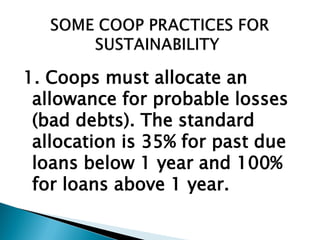
1. Coops must allocate an
allowance for probable losses
(bad debts). The standard
allocation is 35% for past due
loans below 1 year and 100%
for loans above 1 year.
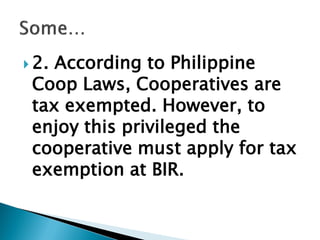
 2. According to Philippine
Coop Laws, Cooperatives are
tax exempted. However, to
enjoy this privileged the
cooperative must apply for tax
exemption at BIR.
 3. Cooperatives are required to
submit yearly reports to the
Cooperative Development
Authority (CDA), a requirement in
getting a Certificate of Operation
(CO). A Certificate of Good
Standing (CGS) is also issued by
CDA for coops who have sound
financial conditions.
 4. Regular monitoring of
DOSRI (Directors, Officers,
Staff and Related Interests)
must be undertaken. A
separate report must be
prepared.
 5. Cooperatives are required to
use the approved Standard Chart
of Accounts (SCA) and must
compute its COOP-PESOS Rating
every month. COOP-PESOS is a
rating system developed by CDA
to evaluate the soundness and
stability of cooperatives.
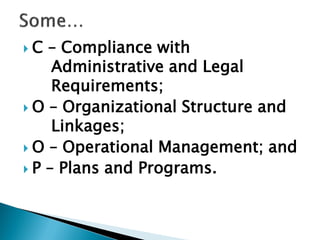
 C – Compliance with
Administrative and Legal
Requirements;
 O – Organizational Structure and
Linkages;
 O – Operational Management; and
 P – Plans and Programs.
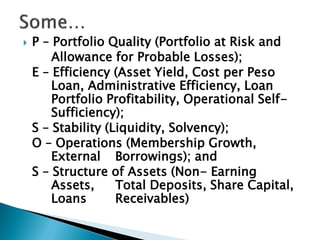
 P – Portfolio Quality (Portfolio at Risk and
Allowance for Probable Losses);
E – Efficiency (Asset Yield, Cost per Peso
Loan, Administrative Efficiency, Loan
Portfolio Profitability, Operational Self-
Sufficiency);
S – Stability (Liquidity, Solvency);
O – Operations (Membership Growth,
External Borrowings); and
S – Structure of Assets (Non- Earning
Assets, Total Deposits, Share Capital,
Loans Receivables)
 6. The basic qualification of
Board of Directors will be at
least College graduate or 3
years experience in business.
Once elected, they are
required to undergo a coop
governance course.
 7. Loan delinquency is now
computed based on Portfolio
At Risk (PAR) and not based on
loan maturity.
 8. Cooperatives are required
to fund its Reserve Funds. This
fund must be deposited
separately.
 9. Coops are encouraged to
network or link with other
coops or become active
members of apex
organizations.
 10. Cooperatives must be
externally audited yearly by an
independent CPA accredited
by CDA or PICPA.
 11. Coop records must be
updated and regularly audited
by the Audit and Inventory
Committee.
 12. Loans must be properly
documented with all the
necessary attachments
complete and duly signed.
 13. The cooperative must have
a continuous capital build up
(both share and savings) to
minimize outside loans.
 14. Remember this- “Your
cooperative is in the business
of business and is not a social
welfare organization.” All
transactions therefore must be
treated in a business manner.
 15. Monthly meeting of the BODs is a
must and also the Committees (Credit,
Audit, Education, etc.). During this
BOD monthly meeting, the GM must
report the operations of the
cooperative.
 16. Cooperatives must have a
regular Annual Plan and Budget
and a 5-Year Strategic Plan.

Some Important Cooperative Practices

  • 1.
     Alexander B.Raquepo Cooperative Governance Practitioner and Advocate
  • 2.
    1. Coops mustallocate an allowance for probable losses (bad debts). The standard allocation is 35% for past due loans below 1 year and 100% for loans above 1 year.
  • 3.
     2. Accordingto Philippine Coop Laws, Cooperatives are tax exempted. However, to enjoy this privileged the cooperative must apply for tax exemption at BIR.
  • 4.
     3. Cooperativesare required to submit yearly reports to the Cooperative Development Authority (CDA), a requirement in getting a Certificate of Operation (CO). A Certificate of Good Standing (CGS) is also issued by CDA for coops who have sound financial conditions.
  • 5.
     4. Regularmonitoring of DOSRI (Directors, Officers, Staff and Related Interests) must be undertaken. A separate report must be prepared.
  • 6.
     5. Cooperativesare required to use the approved Standard Chart of Accounts (SCA) and must compute its COOP-PESOS Rating every month. COOP-PESOS is a rating system developed by CDA to evaluate the soundness and stability of cooperatives.
  • 7.
     C –Compliance with Administrative and Legal Requirements;  O – Organizational Structure and Linkages;  O – Operational Management; and  P – Plans and Programs.
  • 8.
     P –Portfolio Quality (Portfolio at Risk and Allowance for Probable Losses); E – Efficiency (Asset Yield, Cost per Peso Loan, Administrative Efficiency, Loan Portfolio Profitability, Operational Self- Sufficiency); S – Stability (Liquidity, Solvency); O – Operations (Membership Growth, External Borrowings); and S – Structure of Assets (Non- Earning Assets, Total Deposits, Share Capital, Loans Receivables)
  • 9.
     6. Thebasic qualification of Board of Directors will be at least College graduate or 3 years experience in business. Once elected, they are required to undergo a coop governance course.
  • 10.
     7. Loandelinquency is now computed based on Portfolio At Risk (PAR) and not based on loan maturity.
  • 11.
     8. Cooperativesare required to fund its Reserve Funds. This fund must be deposited separately.
  • 12.
     9. Coopsare encouraged to network or link with other coops or become active members of apex organizations.
  • 13.
     10. Cooperativesmust be externally audited yearly by an independent CPA accredited by CDA or PICPA.
  • 14.
     11. Cooprecords must be updated and regularly audited by the Audit and Inventory Committee.
  • 15.
     12. Loansmust be properly documented with all the necessary attachments complete and duly signed.
  • 16.
     13. Thecooperative must have a continuous capital build up (both share and savings) to minimize outside loans.
  • 17.
     14. Rememberthis- “Your cooperative is in the business of business and is not a social welfare organization.” All transactions therefore must be treated in a business manner.
  • 18.
     15. Monthlymeeting of the BODs is a must and also the Committees (Credit, Audit, Education, etc.). During this BOD monthly meeting, the GM must report the operations of the cooperative.
  • 19.
     16. Cooperativesmust have a regular Annual Plan and Budget and a 5-Year Strategic Plan.