Updated Research and Study on
Community Forestry
Assoc. Professor Grahame Applegate & Professor John Herbohn
Tropical Forests and People Research Centre
University of the Sunshine Coast, Australia
Community Forestry in the Asia Pacific
Many countries in the Asia Pacific have developed substantial
forest restoration policies based on community forestry
initiatives
• Philippines: National Greening Program – 7.1 M Ha from
2017-2028
• Indonesia: reforest 5.5 M Ha from 2015-2018
• China: Increased forest cover by over 120 M Ha since 1949
• Viet Nam: Greening the Barren Hills Program and the 5 Million
Hectares Reforestation Program
• At a regional scale APEC forum in 2015 pledged to boost
forest land by 20 M ha by 2020
Criteria for success are based on short term biophysical metrics
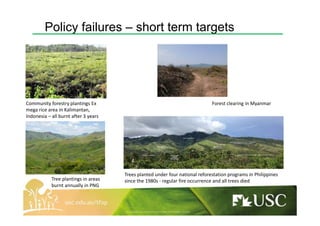
Policy failures – short term targets
Community forestry plantings Ex
mega rice area in Kalimantan,
Indonesia – all burnt after 3 years
Forest clearing in Myanmar
Tree plantings in areas
burnt annually in PNG
Trees planted under four national reforestation programs in Philippines
since the 1980s - regular fire occurrence and all trees died
Community forestry and forest restoration
• Community forestry is the
mechanism through which forest
landscape restoration will be
implemented in many Asia-Pacific
countries
• Success of community influenced
by large array of factors
• Policies are based on short term
headline grabbing targets
• Politics
• Donors
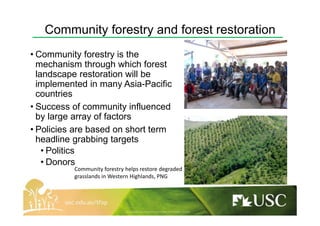
Community forestry helps restore degraded
grasslands in Western Highlands, PNG
CFG
success
Social stratification
Capacity building
Socio-economic and
gender inequality
Project timeframe
+
Benefits
+
Land and forest
productivity
+
+
Cohesion
Conflict Motivation
Material assistance
Government
support
Patronage Corruption
Intra-CFG
governance
Property
rights
Extra-legal tenure
mechanisms
Tree tenure
Land tenure
+
--
-- +
+
--
--
Extra-CFG
governance
++
--
+
+
+
+
+
Legislative support
Practical
assistance
+
+
--
+
+
+
Bonding social
capital
Bridging social
capital
Participation
+
--
+
+
Harvest rights
+
+
+
+
Bonding social
capital
Bonding social
capital
Bonding social
capital
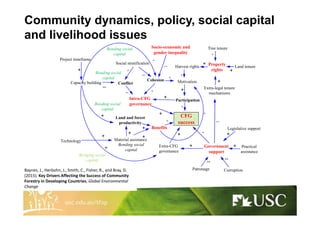
Community dynamics, policy, social capital
and livelihood issues
Baynes, J., Herbohn, J., Smith, C., Fisher, R., and Bray, D.
(2015). Key Drivers Affecting the Success of Community
Forestry in Developing Countries, Global Environmental
Change
Technology
+
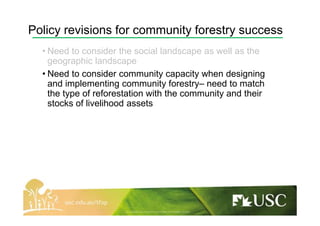
Policy revisions for community forestry success
• Need to consider the social landscape as well as the
geographic landscape
• Need to consider community capacity when designing
and implementing community forestry– need to match
the type of reforestation with the community and their
stocks of livelihood assets
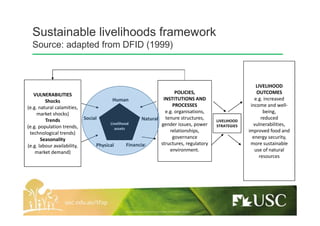
Sustainable livelihoods framework
Source: adapted from DFID (1999)
VULNERABILITIES
Shocks
(e.g. natural calamities,
market shocks)
Trends
(e.g. population trends,
technological trends)
Seasonality
(e.g. labour availability,
market demand)
POLICIES,
INSTITUTIONS AND
PROCESSES
e.g. organisations,
tenure structures,
gender issues, power
relationships,
governance
structures, regulatory
environment.
LIVELIHOOD
STRATEGIES
LIVELIHOOD
OUTCOMES
e.g. increased
income and well-
being,
reduced
vulnerabilities,
improved food and
energy security,
more sustainable
use of natural
resources
Livelihood
assets
Social
Physical Financial
Natural
Human
Likelihoodofcommunityforestry
success
Existing capacity of community/smallholders
implementing community forestry
(Human, Natural, Financial, Physical, Social capital)
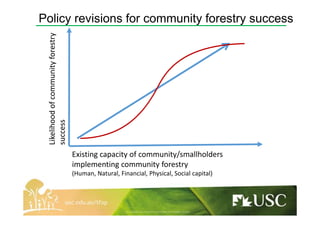
Policy revisions for community forestry success
Likelihoodofcommunityforestry
success
Existing capacity of community/smallholders to
implement community forestry
(Human, Natural, Financial, Physical, Social capital)
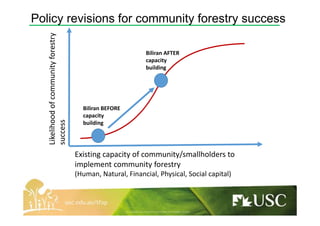
Biliran BEFORE
capacity
building
Biliran AFTER
capacity
building
Policy revisions for community forestry success
• Need to consider the social landscape as well as the
geographic landscape
• Need to consider community capacity when designing
and implementing community forestry– need to match
the type of reforestation with the community and their
stocks of livelihood assets
• Livelihoods need to be incorporated into almost all
projects
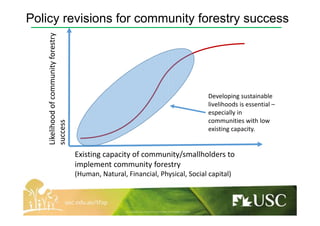
Likelihoodofcommunityforestry
success
Existing capacity of community/smallholders to
implement community forestry
(Human, Natural, Financial, Physical, Social capital)
Developing sustainable
livelihoods is essential –
especially in
communities with low
existing capacity.
Policy revisions for community forestry success
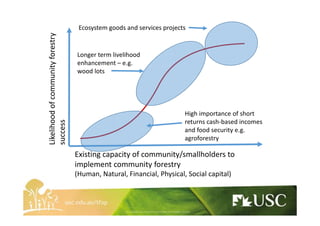
Likelihoodofcommunityforestry
success
Existing capacity of community/smallholders to
implement community forestry
(Human, Natural, Financial, Physical, Social capital)
High importance of short
returns cash-based incomes
and food security e.g.
agroforestry
Longer term livelihood
enhancement – e.g.
wood lots
Ecosystem goods and services projects
Policy revisions for community forestry
• Need to consider the social landscape as well as the
geographic landscape
• Need to consider community capacity when designing and
implementing community forestry – need to match the type
of reforestation with the community and their stocks of
livelihood assets
• Livelihoods need to be incorporated into almost all projects
• Indicators used to measure success of community forestry
need to move from simple targets associated with area
planted, seedlings in a nursery and short term survival of
seedlings to include indicators of long term success (e.g.
livelihood activities, long term survival of trees etc)

Updated research and study on Community Forestry

  • 1.
    Updated Research andStudy on Community Forestry Assoc. Professor Grahame Applegate & Professor John Herbohn Tropical Forests and People Research Centre University of the Sunshine Coast, Australia
  • 2.
    Community Forestry inthe Asia Pacific Many countries in the Asia Pacific have developed substantial forest restoration policies based on community forestry initiatives • Philippines: National Greening Program – 7.1 M Ha from 2017-2028 • Indonesia: reforest 5.5 M Ha from 2015-2018 • China: Increased forest cover by over 120 M Ha since 1949 • Viet Nam: Greening the Barren Hills Program and the 5 Million Hectares Reforestation Program • At a regional scale APEC forum in 2015 pledged to boost forest land by 20 M ha by 2020 Criteria for success are based on short term biophysical metrics
  • 3.
    Policy failures –short term targets Community forestry plantings Ex mega rice area in Kalimantan, Indonesia – all burnt after 3 years Forest clearing in Myanmar Tree plantings in areas burnt annually in PNG Trees planted under four national reforestation programs in Philippines since the 1980s - regular fire occurrence and all trees died
  • 4.
    Community forestry andforest restoration • Community forestry is the mechanism through which forest landscape restoration will be implemented in many Asia-Pacific countries • Success of community influenced by large array of factors • Policies are based on short term headline grabbing targets • Politics • Donors Community forestry helps restore degraded grasslands in Western Highlands, PNG
  • 5.
    CFG success Social stratification Capacity building Socio-economicand gender inequality Project timeframe + Benefits + Land and forest productivity + + Cohesion Conflict Motivation Material assistance Government support Patronage Corruption Intra-CFG governance Property rights Extra-legal tenure mechanisms Tree tenure Land tenure + -- -- + + -- -- Extra-CFG governance ++ -- + + + + + Legislative support Practical assistance + + -- + + + Bonding social capital Bridging social capital Participation + -- + + Harvest rights + + + + Bonding social capital Bonding social capital Bonding social capital Community dynamics, policy, social capital and livelihood issues Baynes, J., Herbohn, J., Smith, C., Fisher, R., and Bray, D. (2015). Key Drivers Affecting the Success of Community Forestry in Developing Countries, Global Environmental Change Technology +
  • 6.
    Policy revisions forcommunity forestry success • Need to consider the social landscape as well as the geographic landscape • Need to consider community capacity when designing and implementing community forestry– need to match the type of reforestation with the community and their stocks of livelihood assets
  • 7.
    Sustainable livelihoods framework Source:adapted from DFID (1999) VULNERABILITIES Shocks (e.g. natural calamities, market shocks) Trends (e.g. population trends, technological trends) Seasonality (e.g. labour availability, market demand) POLICIES, INSTITUTIONS AND PROCESSES e.g. organisations, tenure structures, gender issues, power relationships, governance structures, regulatory environment. LIVELIHOOD STRATEGIES LIVELIHOOD OUTCOMES e.g. increased income and well- being, reduced vulnerabilities, improved food and energy security, more sustainable use of natural resources Livelihood assets Social Physical Financial Natural Human
  • 8.
    Likelihoodofcommunityforestry success Existing capacity ofcommunity/smallholders implementing community forestry (Human, Natural, Financial, Physical, Social capital) Policy revisions for community forestry success
  • 9.
    Likelihoodofcommunityforestry success Existing capacity ofcommunity/smallholders to implement community forestry (Human, Natural, Financial, Physical, Social capital) Biliran BEFORE capacity building Biliran AFTER capacity building Policy revisions for community forestry success
  • 10.
    Policy revisions forcommunity forestry success • Need to consider the social landscape as well as the geographic landscape • Need to consider community capacity when designing and implementing community forestry– need to match the type of reforestation with the community and their stocks of livelihood assets • Livelihoods need to be incorporated into almost all projects
  • 11.
    Likelihoodofcommunityforestry success Existing capacity ofcommunity/smallholders to implement community forestry (Human, Natural, Financial, Physical, Social capital) Developing sustainable livelihoods is essential – especially in communities with low existing capacity. Policy revisions for community forestry success
  • 12.
    Likelihoodofcommunityforestry success Existing capacity ofcommunity/smallholders to implement community forestry (Human, Natural, Financial, Physical, Social capital) High importance of short returns cash-based incomes and food security e.g. agroforestry Longer term livelihood enhancement – e.g. wood lots Ecosystem goods and services projects
  • 13.
    Policy revisions forcommunity forestry • Need to consider the social landscape as well as the geographic landscape • Need to consider community capacity when designing and implementing community forestry – need to match the type of reforestation with the community and their stocks of livelihood assets • Livelihoods need to be incorporated into almost all projects • Indicators used to measure success of community forestry need to move from simple targets associated with area planted, seedlings in a nursery and short term survival of seedlings to include indicators of long term success (e.g. livelihood activities, long term survival of trees etc)