FLR is different to past
reforestation approaches
• Holistic approach that addresses the need to balance multiple objectives,
including improving rural livelihoods, conserving biodiversity, increasing
agricultural production, promoting carbon storage, and increasing
provision of multiple ecosystem services
• Livelihoods and community engagement are fundamental to success –
people first
• Need to develop best practices and guidelines to enable diverse and
improved modes of reforestation to be applied at a landscape scale
(social and natural sciences as well as practical issues)
• best practices and guidelines critical for encouraging secure investments
in restoration.
• Many lessons to be learnt from the Asia-Pacific
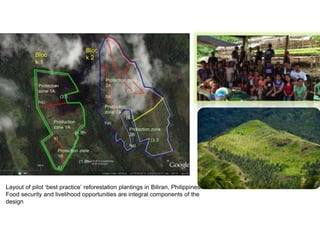
Bloc
k 1
Bloc
k 2
Protection
zone 1A
(3.5
ha)
Production
zone 1A
(4.9h
a)
Protection zone
1B
(1.6h
a)
Protection zone
2A
(1.6
ha)
Production
zone 2A
(6.3
ha)
Protection zone
2B
(3.3
ha)
Agroforestry
zone
(5.3
ha)
Layout of pilot ‘best practice’ reforestation plantings in Biliran, Philippines.
Food security and livelihood opportunities are integral components of the
design
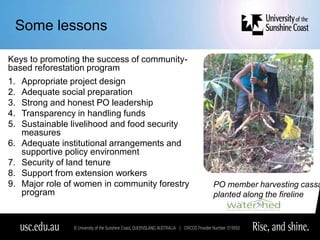
Some lessons
Keys to promoting the success of community-
based reforestation program
1. Appropriate project design
2. Adequate social preparation
3. Strong and honest PO leadership
4. Transparency in handling funds
5. Sustainable livelihood and food security
measures
6. Adequate institutional arrangements and
supportive policy environment
7. Security of land tenure
8. Support from extension workers
9. Major role of women in community forestry
program
PO member harvesting cassa
planted along the fireline
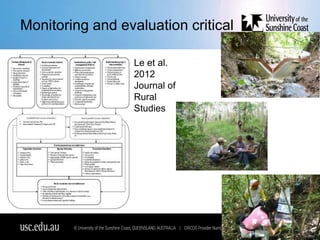
Monitoring and evaluation critical
Le et al.
2012
Journal of
Rural
Studies
Understanding and
managing secondary
tropical forests
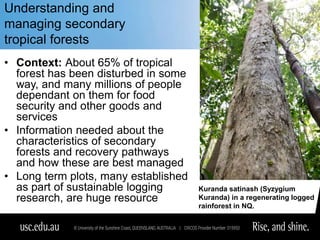
• Context: About 65% of tropical
forest has been disturbed in some
way, and many millions of people
dependant on them for food
security and other goods and
services
• Information needed about the
characteristics of secondary
forests and recovery pathways
and how these are best managed
• Long term plots, many established
as part of sustainable logging
research, are huge resource
Kuranda satinash (Syzygium
Kuranda) in a regenerating logged
rainforest in NQ.
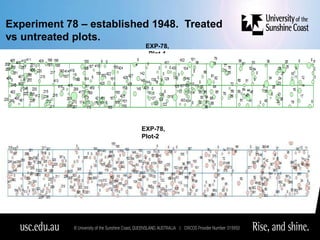
EXP-78,
Plot-1
EXP-78,
Plot-2
Experiment 78 – established 1948. Treated
vs untreated plots.
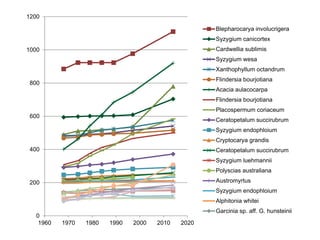
0
200
400
600
800
1000
1200
1960 1970 1980 1990 2000 2010 2020
Blepharocarya involucrigera
Syzygium canicortex
Cardwellia sublimis
Syzygium wesa
Xanthophyllum octandrum
Flindersia bourjotiana
Acacia aulacocarpa
Flindersia bourjotiana
Placospermum coriaceum
Ceratopetalum succirubrum
Syzygium endophloium
Cryptocarya grandis
Ceratopetalum succirubrum
Syzygium luehmannii
Polyscias australiana
Austromyrtus
Syzygium endophloium
Alphitonia whitei
Garcinia sp. aff. G. hunsteinii
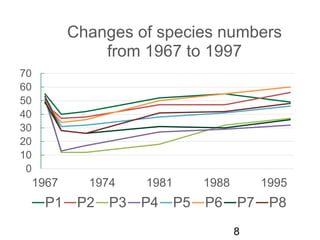
0
10
20
30
40
50
60
70
1967 1974 1981 1988 1995
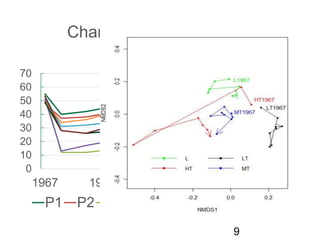
Changes of species numbers
from 1967 to 1997
P1 P2 P3 P4 P5 P6 P7 P8
8
0
10
20
30
40
50
60
70
1967 1974 1981 1988 1995
Changes of species numbers
from 1967 to 1997
P1 P2 P3 P4 P5 P6 P7 P8
9
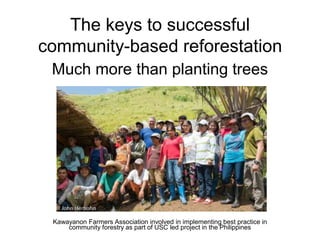
The keys to successful
community-based reforestation
Much more than planting trees
Kawayanon Farmers Association involved in implementing best practice in
community forestry as part of USC led project in the Philippines
CFG
success
Social stratification
Capacity building
Socio-economic and
gender inequality
Project timeframe
+
Benefits
+
Land and forest
productivity
+
+
Cohesion
Conflict Motivation
Material assistance
Government
support
Patronage Corruption
Intra-CFG
governance
Property
rights
Extra-legal tenure
mechanisms
Tree tenure
Land tenure
+
--
-- +
+
--
--
Extra-CFG
governance
++
--
+
+
+
+
+
Legislative support
Practical
assistance
+
+
--
+
+
+
Bonding social
capital
Bridging social
capital
Participation
+
--
+
+
Harvest rights
+
+
+
+
Bonding social
capital
Bonding social
capital
Bonding social
capital
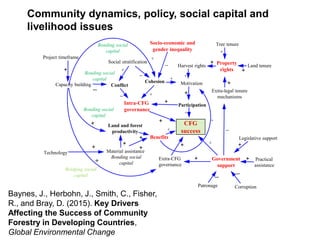
Community dynamics, policy, social capital and
livelihood issues
Baynes, J., Herbohn, J., Smith, C., Fisher,
R., and Bray, D. (2015). Key Drivers
Affecting the Success of Community
Forestry in Developing Countries,
Global Environmental Change
Technology
+
Fig. 1. Conceptual model used for assessing reforestation success on Leyte Island, the
Philippines (Source: Le, Smith, Herbohn, Harrison 2012 Journal of Rural Studies)
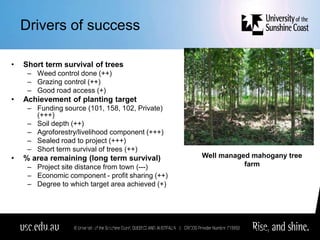
Drivers of success
• Short term survival of trees
– Weed control done (++)
– Grazing control (++)
– Good road access (+)
• Achievement of planting target
– Funding source (101, 158, 102, Private)
(+++)
– Soil depth (++)
– Agroforestry/livelihood component (+++)
– Sealed road to project (+++)
– Short term survival of trees (++)
• % area remaining (long term survival)
– Project site distance from town (---)
– Economic component - profit sharing (++)
– Degree to which target area achieved (+)
Source: Le, H.D., Smith, C and Herbohn, J.L. (2013).
Well managed mahogany tree
farm
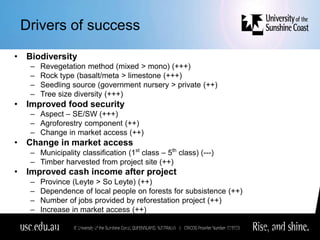
Drivers of success
• Biodiversity
– Revegetation method (mixed > mono) (+++)
– Rock type (basalt/meta > limestone (+++)
– Seedling source (government nursery > private (++)
– Tree size diversity (+++)
• Improved food security
– Aspect – SE/SW (+++)
– Agroforestry component (++)
– Change in market access (++)
• Change in market access
– Municipality classification (1st
class – 5th
class) (---)
– Timber harvested from project site (++)
• Improved cash income after project
– Province (Leyte > So Leyte) (++)
– Dependence of local people on forests for subsistence (++)
– Number of jobs provided by reforestation project (++)
– Increase in market access (++)
– Education, information or awareness building campaign done (++)
Source: Le, H.D., Smith, C and Herbohn, J.L. (2013). What

Community Forestry in Australia

  • 1.
    FLR is differentto past reforestation approaches • Holistic approach that addresses the need to balance multiple objectives, including improving rural livelihoods, conserving biodiversity, increasing agricultural production, promoting carbon storage, and increasing provision of multiple ecosystem services • Livelihoods and community engagement are fundamental to success – people first • Need to develop best practices and guidelines to enable diverse and improved modes of reforestation to be applied at a landscape scale (social and natural sciences as well as practical issues) • best practices and guidelines critical for encouraging secure investments in restoration. • Many lessons to be learnt from the Asia-Pacific
  • 2.
    Bloc k 1 Bloc k 2 Protection zone1A (3.5 ha) Production zone 1A (4.9h a) Protection zone 1B (1.6h a) Protection zone 2A (1.6 ha) Production zone 2A (6.3 ha) Protection zone 2B (3.3 ha) Agroforestry zone (5.3 ha) Layout of pilot ‘best practice’ reforestation plantings in Biliran, Philippines. Food security and livelihood opportunities are integral components of the design
  • 3.
    Some lessons Keys topromoting the success of community- based reforestation program 1. Appropriate project design 2. Adequate social preparation 3. Strong and honest PO leadership 4. Transparency in handling funds 5. Sustainable livelihood and food security measures 6. Adequate institutional arrangements and supportive policy environment 7. Security of land tenure 8. Support from extension workers 9. Major role of women in community forestry program PO member harvesting cassa planted along the fireline
  • 4.
    Monitoring and evaluationcritical Le et al. 2012 Journal of Rural Studies
  • 5.
    Understanding and managing secondary tropicalforests • Context: About 65% of tropical forest has been disturbed in some way, and many millions of people dependant on them for food security and other goods and services • Information needed about the characteristics of secondary forests and recovery pathways and how these are best managed • Long term plots, many established as part of sustainable logging research, are huge resource Kuranda satinash (Syzygium Kuranda) in a regenerating logged rainforest in NQ.
  • 6.
    EXP-78, Plot-1 EXP-78, Plot-2 Experiment 78 –established 1948. Treated vs untreated plots.
  • 7.
    0 200 400 600 800 1000 1200 1960 1970 19801990 2000 2010 2020 Blepharocarya involucrigera Syzygium canicortex Cardwellia sublimis Syzygium wesa Xanthophyllum octandrum Flindersia bourjotiana Acacia aulacocarpa Flindersia bourjotiana Placospermum coriaceum Ceratopetalum succirubrum Syzygium endophloium Cryptocarya grandis Ceratopetalum succirubrum Syzygium luehmannii Polyscias australiana Austromyrtus Syzygium endophloium Alphitonia whitei Garcinia sp. aff. G. hunsteinii
  • 8.
    0 10 20 30 40 50 60 70 1967 1974 19811988 1995 Changes of species numbers from 1967 to 1997 P1 P2 P3 P4 P5 P6 P7 P8 8
  • 9.
    0 10 20 30 40 50 60 70 1967 1974 19811988 1995 Changes of species numbers from 1967 to 1997 P1 P2 P3 P4 P5 P6 P7 P8 9
  • 10.
    The keys tosuccessful community-based reforestation Much more than planting trees Kawayanon Farmers Association involved in implementing best practice in community forestry as part of USC led project in the Philippines
  • 11.
    CFG success Social stratification Capacity building Socio-economicand gender inequality Project timeframe + Benefits + Land and forest productivity + + Cohesion Conflict Motivation Material assistance Government support Patronage Corruption Intra-CFG governance Property rights Extra-legal tenure mechanisms Tree tenure Land tenure + -- -- + + -- -- Extra-CFG governance ++ -- + + + + + Legislative support Practical assistance + + -- + + + Bonding social capital Bridging social capital Participation + -- + + Harvest rights + + + + Bonding social capital Bonding social capital Bonding social capital Community dynamics, policy, social capital and livelihood issues Baynes, J., Herbohn, J., Smith, C., Fisher, R., and Bray, D. (2015). Key Drivers Affecting the Success of Community Forestry in Developing Countries, Global Environmental Change Technology +
  • 12.
    Fig. 1. Conceptualmodel used for assessing reforestation success on Leyte Island, the Philippines (Source: Le, Smith, Herbohn, Harrison 2012 Journal of Rural Studies)
  • 13.
    Drivers of success •Short term survival of trees – Weed control done (++) – Grazing control (++) – Good road access (+) • Achievement of planting target – Funding source (101, 158, 102, Private) (+++) – Soil depth (++) – Agroforestry/livelihood component (+++) – Sealed road to project (+++) – Short term survival of trees (++) • % area remaining (long term survival) – Project site distance from town (---) – Economic component - profit sharing (++) – Degree to which target area achieved (+) Source: Le, H.D., Smith, C and Herbohn, J.L. (2013). Well managed mahogany tree farm
  • 14.
    Drivers of success •Biodiversity – Revegetation method (mixed > mono) (+++) – Rock type (basalt/meta > limestone (+++) – Seedling source (government nursery > private (++) – Tree size diversity (+++) • Improved food security – Aspect – SE/SW (+++) – Agroforestry component (++) – Change in market access (++) • Change in market access – Municipality classification (1st class – 5th class) (---) – Timber harvested from project site (++) • Improved cash income after project – Province (Leyte > So Leyte) (++) – Dependence of local people on forests for subsistence (++) – Number of jobs provided by reforestation project (++) – Increase in market access (++) – Education, information or awareness building campaign done (++) Source: Le, H.D., Smith, C and Herbohn, J.L. (2013). What