Forests, Trees and Agroforestry -An overview
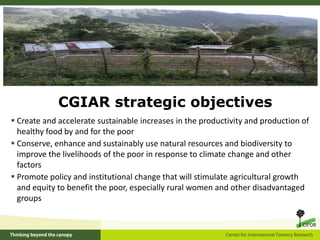
CGIAR strategic objectivesCreate and accelerate sustainable increases in the productivity and production of healthy food by and for the poor
Conserve, enhance and sustainably use natural resources and biodiversity to improve the livelihoods of the poor in response to climate change and other factors
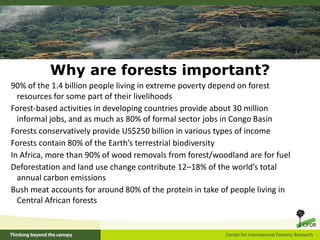
Promote policy and institutional change that will stimulate agricultural growth and equity to benefit the poor, especially rural women and other disadvantaged groupsWhy are forests important?90% of the 1.4 billion people living in extreme poverty depend on forest resources for some part of their livelihoodsForest-based activities in developing countries provide about 30 million informal jobs, and as much as 80% of formal sector jobs in Congo BasinForests conservatively provide US$250 billion in various types of incomeForests contain 80% of the Earth’s terrestrial biodiversityIn Africa, more than 90% of wood removals from forest/woodland are for fuelDeforestation and land use change contribute 12–18% of the world’s total annual carbon emissionsBush meat accounts for around 80% of the protein in take of people living in Central African forests
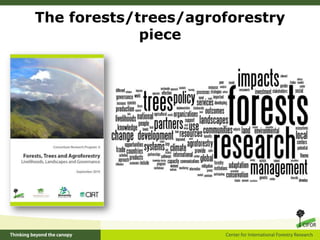
The forests/trees/agroforestry piece
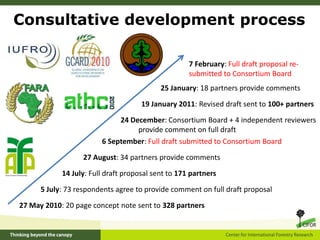
Consultative development process7 February: Full draft proposal re-submitted to Consortium Board25 January: 18 partners provide comments 19 January 2011: Revised draft sent to 100+ partners24 December: Consortium Board + 4 independent reviewers	 provide comment on full draft 6 September: Full draft submitted to Consortium Board27 August: 34 partners provide comments 14 July: Full draft proposal sent to 171 partners5 July: 73 respondents agree to provide comment on full draft proposal 27 May 2010: 20 page concept note sent to 328 partners
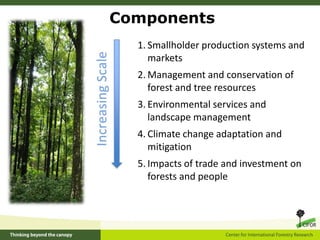
 ComponentsSmallholder production systems and marketsManagement and conservation of forest and tree resourcesEnvironmental services and landscape managementClimate change adaptation and mitigationImpacts of trade and investment on forests and people
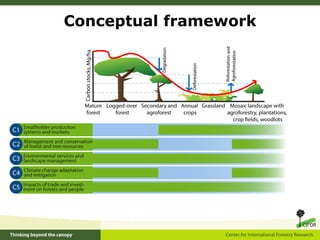
Conceptual framework
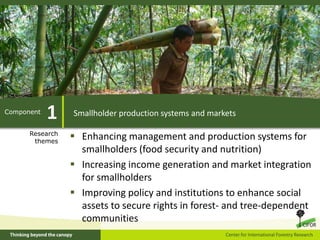
1Smallholder production systems and marketsComponentResearchthemesEnhancing management and production systems for smallholders (food security and nutrition)
Increasing income generation and market integration for smallholders
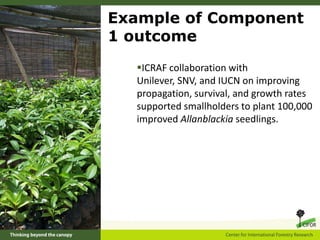
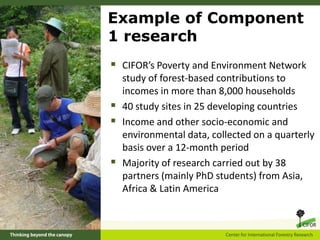
Improving policy and institutions to enhance social assets to secure rights in forest- and tree-dependent communitiesExample of Component 1 outcomeICRAF collaboration with Unilever, SNV, and IUCN on improving propagation, survival, and growth rates supported smallholders to plant 100,000 improved Allanblackia seedlings.Example of Component 1 researchCIFOR’s Poverty and Environment Network study of forest-based contributions to incomes in more than 8,000 households
40 study sites in 25 developing countries
Income and other socio-economic and environmental data, collected on a quarterly basis over a 12-month period
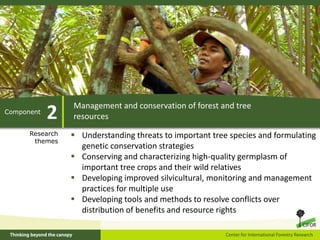
Majority of research carried out by 38 partners (mainly PhD students) from Asia, Africa & Latin America2Management and conservation of forest and tree resourcesComponentResearchthemesUnderstanding threats to important tree species and formulating genetic conservation strategies
Conserving and characterizing high-quality germplasm of important tree crops and their wild relatives
Developing improved silvicultural, monitoring and management practices for multiple use
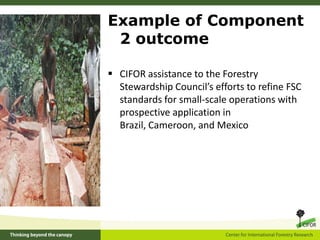
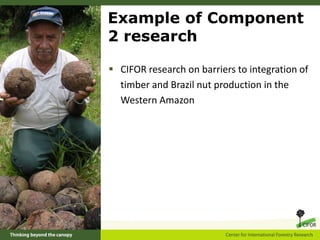
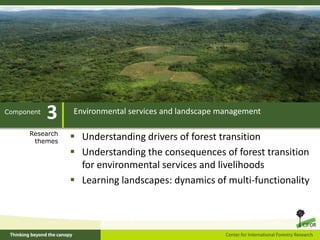
Developing tools and methods to resolve conflicts over distribution of benefits and resource rightsExample of Component 2 outcomeCIFOR assistance to the Forestry Stewardship Council’s efforts to refine FSC standards for small-scale operations with prospective application in Brazil, Cameroon, and Mexico Example of Component 2 researchCIFOR research on barriers to integration of timber and Brazil nut production in the Western Amazon3Environmental services and landscape managementComponentResearchthemesUnderstanding drivers of forest transition
Understanding the consequences of forest transition for environmental services and livelihoods
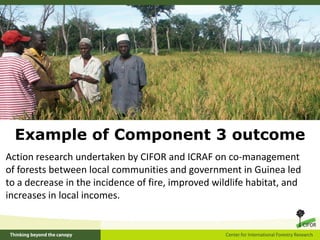
Learning landscapes: dynamics of multi-functionalityExample of Component 3 outcomeAction research undertaken by CIFOR and ICRAF on co-management of forests between local communities and government in Guinea led to a decrease in the incidence of fire, improved wildlife habitat, and increases in local incomes.
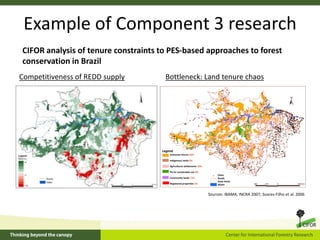
Example of Component 3 researchCIFOR analysis of tenure constraints to PES-based approaches to forest conservation in BrazilCompetitiveness of REDD supplyBottleneck: Land tenure chaosLegendUnknown tenure 53%Indigenous lands 9%Agricultural settlements 10%PA for sustainable use 9%Community lands <1%Registered properties 1%CitiesRoadsState limitsWaterSources: IBAMA, INCRA 2007, Soares-Filho et al. 2006
4Climate change adaptation and mitigationComponentResearchthemesHarnessing forests, trees and agroforestry for climate change mitigation
Enhancing climate change adaptation
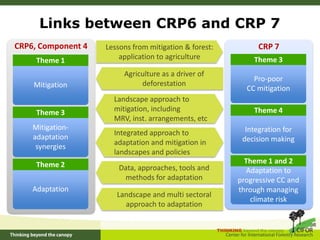
Understanding synergies between climate change mitigation and adaptationLinks between CRP6 and CRP 7Theme 1Theme 2Theme 3Theme 3Theme 1 and 2Theme 4MitigationAdaptationMitigation-adaptation synergiesPro-poor CC mitigationAdaptation to progressive CC and through managing climate riskIntegration for decision makingCRP6, Component 4CRP 7Lessons from mitigation & forest: application to agricultureAgriculture as a driver of deforestationLandscape approach to mitigation, including MRV, inst. arrangements, etcIntegrated approach to adaptation and mitigation in landscapes and policiesData, approaches, tools and methods for adaptationLandscape and multi sectoral approach to adaptation
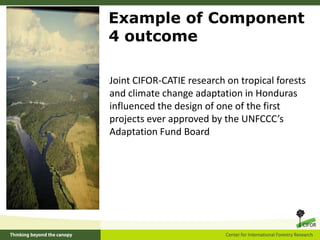
Example of Component 4 outcomeJoint CIFOR-CATIE research on tropical forests and climate change adaptation in Honduras influenced the design of one of the first projects ever approved by the UNFCCC’s Adaptation Fund Board
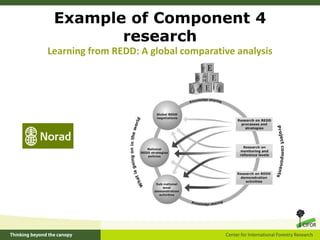
Example of Component 4 researchLearning from REDD: A global comparative analysis
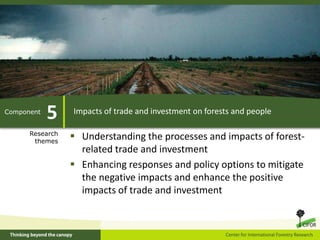
5Impacts of trade and investment on forests and peopleComponentResearchthemesUnderstanding the processes and impacts of forest-related trade and investment
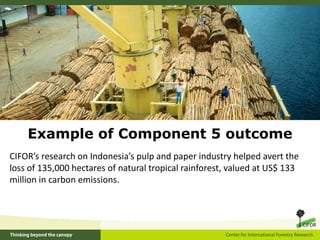
Enhancing responses and policy options to mitigate the negative impacts and enhance the positive impacts of trade and investmentExample of Component 5 outcomeCIFOR’s research on Indonesia’s pulp and paper industry helped avert the loss of 135,000 hectares of natural tropical rainforest, valued at US$ 133 million in carbon emissions.
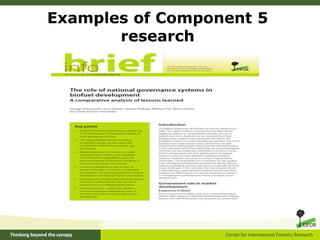
Examples of Component 5 research
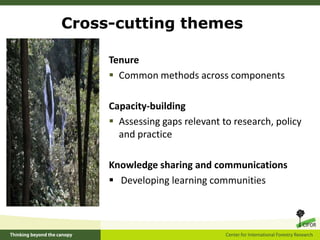
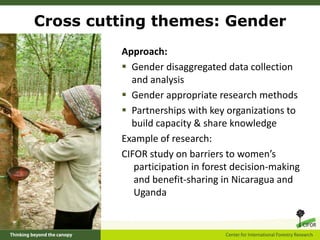
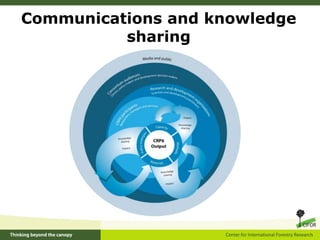
Cross-cutting themesTenureCommon methods across componentsCapacity-buildingAssessing gaps relevant to research, policy and practiceKnowledge sharing and communications   Developing learning communitiesApproach:Gender disaggregated data collection and analysisGender appropriate research methodsPartnerships with key organizations to build capacity & share knowledgeExample of research:CIFOR study on barriers to women’s participation in forest decision-making and benefit-sharing in Nicaragua and UgandaCross cutting themes: Gender
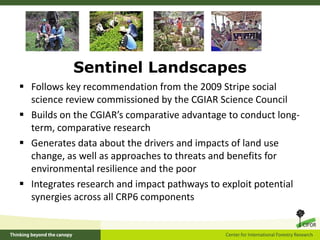
Sentinel LandscapesFollows key recommendation from the 2009 Stripe social science review commissioned by the CGIAR Science Council

CGIAR Research Program 6 - An overview

  • 1.
    Forests, Trees andAgroforestry -An overview
  • 2.
    CGIAR strategic objectivesCreateand accelerate sustainable increases in the productivity and production of healthy food by and for the poor
  • 3.
    Conserve, enhance andsustainably use natural resources and biodiversity to improve the livelihoods of the poor in response to climate change and other factors
  • 4.
    Promote policy andinstitutional change that will stimulate agricultural growth and equity to benefit the poor, especially rural women and other disadvantaged groupsWhy are forests important?90% of the 1.4 billion people living in extreme poverty depend on forest resources for some part of their livelihoodsForest-based activities in developing countries provide about 30 million informal jobs, and as much as 80% of formal sector jobs in Congo BasinForests conservatively provide US$250 billion in various types of incomeForests contain 80% of the Earth’s terrestrial biodiversityIn Africa, more than 90% of wood removals from forest/woodland are for fuelDeforestation and land use change contribute 12–18% of the world’s total annual carbon emissionsBush meat accounts for around 80% of the protein in take of people living in Central African forests
  • 5.
  • 6.
    Consultative development process7February: Full draft proposal re-submitted to Consortium Board25 January: 18 partners provide comments 19 January 2011: Revised draft sent to 100+ partners24 December: Consortium Board + 4 independent reviewers provide comment on full draft 6 September: Full draft submitted to Consortium Board27 August: 34 partners provide comments 14 July: Full draft proposal sent to 171 partners5 July: 73 respondents agree to provide comment on full draft proposal 27 May 2010: 20 page concept note sent to 328 partners
  • 7.
    ComponentsSmallholder productionsystems and marketsManagement and conservation of forest and tree resourcesEnvironmental services and landscape managementClimate change adaptation and mitigationImpacts of trade and investment on forests and people
  • 8.
  • 9.
    1Smallholder production systemsand marketsComponentResearchthemesEnhancing management and production systems for smallholders (food security and nutrition)
  • 10.
    Increasing income generationand market integration for smallholders
  • 11.
    Improving policy andinstitutions to enhance social assets to secure rights in forest- and tree-dependent communitiesExample of Component 1 outcomeICRAF collaboration with Unilever, SNV, and IUCN on improving propagation, survival, and growth rates supported smallholders to plant 100,000 improved Allanblackia seedlings.Example of Component 1 researchCIFOR’s Poverty and Environment Network study of forest-based contributions to incomes in more than 8,000 households
  • 12.
    40 study sitesin 25 developing countries
  • 13.
    Income and othersocio-economic and environmental data, collected on a quarterly basis over a 12-month period
  • 14.
    Majority of researchcarried out by 38 partners (mainly PhD students) from Asia, Africa & Latin America2Management and conservation of forest and tree resourcesComponentResearchthemesUnderstanding threats to important tree species and formulating genetic conservation strategies
  • 15.
    Conserving and characterizinghigh-quality germplasm of important tree crops and their wild relatives
  • 16.
    Developing improved silvicultural,monitoring and management practices for multiple use
  • 17.
    Developing tools andmethods to resolve conflicts over distribution of benefits and resource rightsExample of Component 2 outcomeCIFOR assistance to the Forestry Stewardship Council’s efforts to refine FSC standards for small-scale operations with prospective application in Brazil, Cameroon, and Mexico Example of Component 2 researchCIFOR research on barriers to integration of timber and Brazil nut production in the Western Amazon3Environmental services and landscape managementComponentResearchthemesUnderstanding drivers of forest transition
  • 18.
    Understanding the consequencesof forest transition for environmental services and livelihoods
  • 19.
    Learning landscapes: dynamicsof multi-functionalityExample of Component 3 outcomeAction research undertaken by CIFOR and ICRAF on co-management of forests between local communities and government in Guinea led to a decrease in the incidence of fire, improved wildlife habitat, and increases in local incomes.
  • 20.
    Example of Component3 researchCIFOR analysis of tenure constraints to PES-based approaches to forest conservation in BrazilCompetitiveness of REDD supplyBottleneck: Land tenure chaosLegendUnknown tenure 53%Indigenous lands 9%Agricultural settlements 10%PA for sustainable use 9%Community lands <1%Registered properties 1%CitiesRoadsState limitsWaterSources: IBAMA, INCRA 2007, Soares-Filho et al. 2006
  • 21.
    4Climate change adaptationand mitigationComponentResearchthemesHarnessing forests, trees and agroforestry for climate change mitigation
  • 22.
  • 23.
    Understanding synergies betweenclimate change mitigation and adaptationLinks between CRP6 and CRP 7Theme 1Theme 2Theme 3Theme 3Theme 1 and 2Theme 4MitigationAdaptationMitigation-adaptation synergiesPro-poor CC mitigationAdaptation to progressive CC and through managing climate riskIntegration for decision makingCRP6, Component 4CRP 7Lessons from mitigation & forest: application to agricultureAgriculture as a driver of deforestationLandscape approach to mitigation, including MRV, inst. arrangements, etcIntegrated approach to adaptation and mitigation in landscapes and policiesData, approaches, tools and methods for adaptationLandscape and multi sectoral approach to adaptation
  • 24.
    Example of Component4 outcomeJoint CIFOR-CATIE research on tropical forests and climate change adaptation in Honduras influenced the design of one of the first projects ever approved by the UNFCCC’s Adaptation Fund Board
  • 25.
    Example of Component4 researchLearning from REDD: A global comparative analysis
  • 26.
    5Impacts of tradeand investment on forests and peopleComponentResearchthemesUnderstanding the processes and impacts of forest-related trade and investment
  • 27.
    Enhancing responses andpolicy options to mitigate the negative impacts and enhance the positive impacts of trade and investmentExample of Component 5 outcomeCIFOR’s research on Indonesia’s pulp and paper industry helped avert the loss of 135,000 hectares of natural tropical rainforest, valued at US$ 133 million in carbon emissions.
  • 28.
  • 29.
    Cross-cutting themesTenureCommon methodsacross componentsCapacity-buildingAssessing gaps relevant to research, policy and practiceKnowledge sharing and communications Developing learning communitiesApproach:Gender disaggregated data collection and analysisGender appropriate research methodsPartnerships with key organizations to build capacity & share knowledgeExample of research:CIFOR study on barriers to women’s participation in forest decision-making and benefit-sharing in Nicaragua and UgandaCross cutting themes: Gender
  • 30.
    Sentinel LandscapesFollows keyrecommendation from the 2009 Stripe social science review commissioned by the CGIAR Science Council
  • 31.
    Builds on theCGIAR’s comparative advantage to conduct long-term, comparative research
  • 32.
    Generates data aboutthe drivers and impacts of land use change, as well as approaches to threats and benefits for environmental resilience and the poor
  • 33.
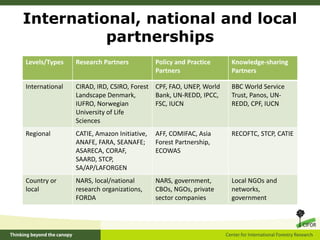
    Integrates research andimpact pathways to exploit potential synergies across all CRP6 componentsInternational, national and local partnerships
  • 34.
  • 35.