CGIAR Research Program on
Forests, Trees and Agroforestry
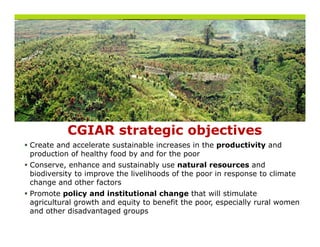
CGIAR strategic objectives
Create and accelerate sustainable increases in the productivity and
production of healthy food by and for the poor
Conserve, enhance and sustainably use natural resources and
biodiversity to improve the livelihoods of the poor in response to climate
change and other factors
Promote policy and institutional change that will stimulate
agricultural growth and equity to benefit the poor especially rural women
                                              poor,
and other disadvantaged groups
The forests/trees/agroforestry
           /     / g         y
      contribution: CRP6
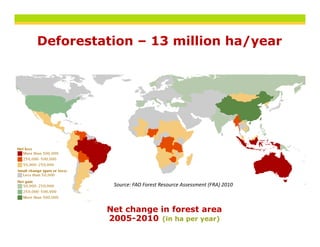
Deforestation – 13 million ha/year
                             /y


          Source: FAO Forest Resource Assessment (FRA) 2010


         Net change in forest area
         2005-2010 (in ha per year)
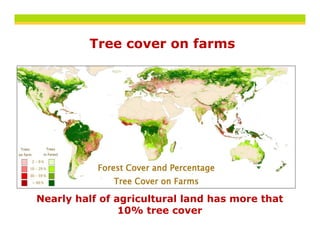
Tree cover on farms


Nearly half of agricultural land has more that
                10% tree cover
Why are forests and trees
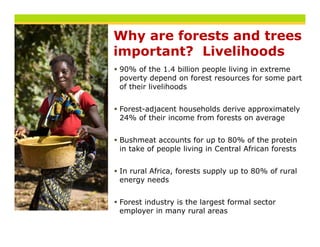
important? Livelihoods
90% of the 1.4 billion people living in extreme
poverty depend on forest resources for some part
of their livelihoods


Forest-adjacent
Forest adjacent households derive approximately
24% of their income from forests on average


Bushmeat accounts for up to 80% of the protein
in take of people living in Central African forests


In rural Africa, forests supply up to 80% of rural
         Africa
energy needs


Forest industry is the largest formal sector
employer in many rural areas
Why are forests and trees
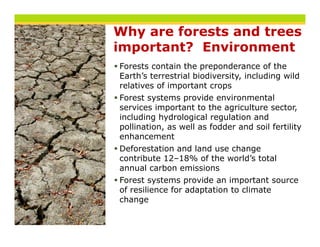
important? Environment
Forests contain the preponderance of the
Earth s
Earth’s terrestrial biodiversity, including wild
                    biodiversity
relatives of important crops
Forest systems provide environmental
services important to the agriculture sector
                                       sector,
including hydrological regulation and
pollination, as well as fodder and soil fertility
enhancement
Deforestation and land use change
contribute 12–18% of the world’s total
annual carbon emissions
Forest systems provide an important source
of resilience for adaptation to climate
change
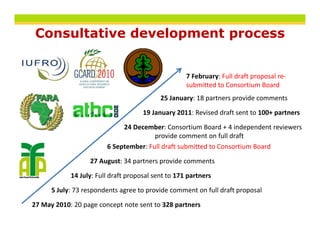
Consultative development process


                                                    7 February: Full draft proposal re‐
                                                    7 February: Full draft proposal re‐
                                                    submitted to Consortium Board
                                           25 January: 18 partners provide comments 
                                     19 January 2011: Revised draft sent to 100+ partners

                             24 December: Consortium Board + 4 independent reviewers
                                       p
                                       provide comment on full draft 
                        6 September: Full draft submitted to Consortium Board

                  27 August: 34 partners provide comments 

            14 July: Full draft proposal sent to 171 partners

      5 July: 73 respondents agree to provide comment on full draft proposal 
27 May 2010: 20 page concept note sent to 328 partners 
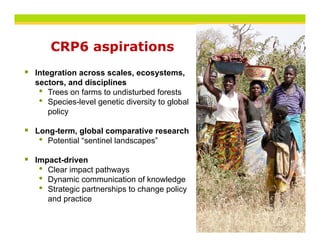
CRP6 aspirations
Integration across scales, ecosystems,
    g                             y
sectors, and disciplines
 • Trees on farms to undisturbed forests
 • Species-level genetic diversity to global
    policy

Long-term, global comparative research
 • Potential “sentinel landscapes”
Impact-driven
 • Clear impact pathways
 • Dynamic communication of knowledge
 • Strategic partnerships to change policy
   and practice
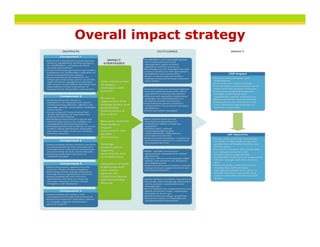
Overall impact strategy
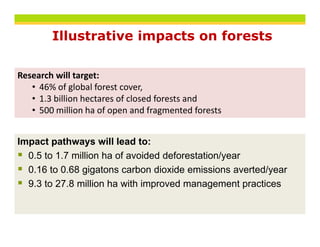
Illustrative impacts on forests

Research will target:
Research will target:
   • 46% of global forest cover, 
   • 1.3 billion hectares of closed forests and 
   • 500 illi h f
     500 million ha of open and fragmented forests
                                df         t df  t


Impact pathways will lead to:
I     t th            ill l d t
  0.5 to 1.7 million ha of avoided deforestation/year
  0.16 0 68
  0 16 to 0.68 gigatons carbon dioxide emissions averted/year
  9.3 to 27.8 million ha with improved management practices
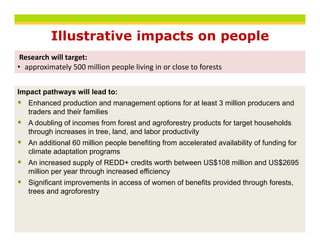
Illustrative impacts on people
 Research will target:
• approximately 500 million people living in or close to forests


Impact pathways will lead to:
   Enhanced production and management options for at least 3 million producers and
   traders and their families
   A doubling of incomes from forest and agroforestry products for target households
   through increases in tree, land, and labor productivity
   An additional 60 million people benefiting from accelerated availability of funding for
   climate adaptation programs
   An increased supply of REDD+ credits worth between US$108 million and US$2695
   million per year through increased efficiency
   Significant improvements in access of women of benefits provided through forests,
   trees and agroforestry
Components
   p

 Smallholder production systems and
 markets
 Management and conservation of forest
 and tree resources
 Environmental services and l d
             l            d landscape
 management
 Climate change adaptation and mitigation
 Impacts of trade and investment on
 forests and people
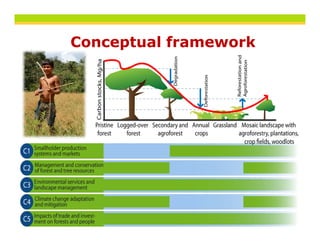
Conceptual framework
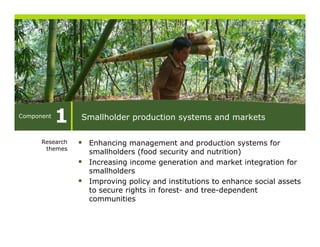
Component
            1    Smallholder production systems and markets

      Research    Enhancing management and production systems for
       themes
                  smallholders (food security and nutrition)
                  Increasing income generation and market integration for
                  smallholders
                  Improving policy and institutions to enhance social assets
                  to secure rights in forest- and tree-dependent
                  communities
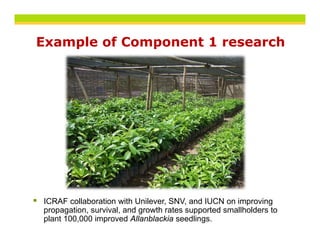
Example of Component 1 research


ICRAF collaboration with Unilever SNV and IUCN on improving
                          Unilever, SNV,
propagation, survival, and growth rates supported smallholders to
plant 100,000 improved Allanblackia seedlings.
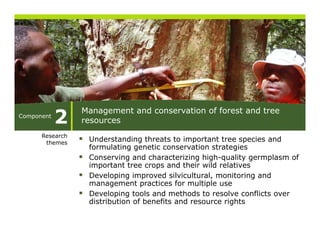
2
                 Management and conservation of forest and tree
                 M         t  d         ti    ff     t   dt
Component
                 resources
      Research
       themes
                  Understanding threats to important tree species and
                  formulating genetic conservation strategies
                  Conserving and characterizing high-quality germplasm of
                  important tree crops and their wild relatives
                  Developing improved silvicultural, monitoring and
                  management practices for multiple use
                  Developing tools and methods to resolve conflicts over
                  distribution of benefits and resource rights
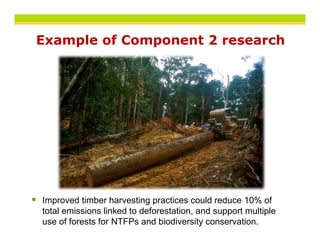
Example of Component 2 research
    p         p


Improved timber harvesting practices could reduce 10% of
total emissions linked to deforestation, and support multiple
use of forests for NTFPs and biodiversity conservation.
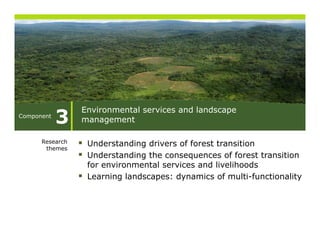
3
                 Environmental services and l d
                 E i       t l     i      d landscape
Component
                 management

      Research    Understanding drivers of forest transition
       themes
                  Understanding the consequences of forest transition
                  for environmental services and livelihoods
                  Learning landscapes: dynamics of multi-functionality
Example of Component 3 research


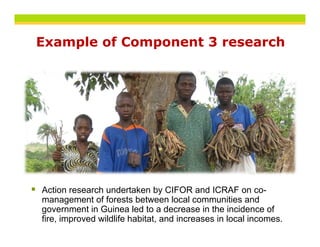
Action research undertaken by CIFOR and ICRAF on co-
management of forests between local communities and
government in Guinea led to a decrease in the incidence of
fire, improved wildlife habitat, and increases in local incomes.
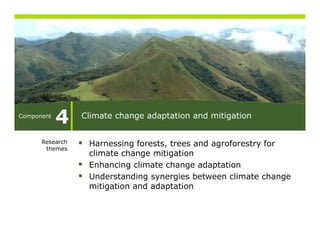
Component
            4    Climate change adaptation and mitigation


      Research    Harnessing forests, trees and agroforestry for
       themes
                  climate change mitigation
                  Enhancing climate change adaptation
                  Understanding synergies between climate change
                  mitigation and adaptation
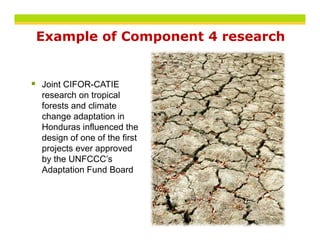
Example of Component 4 research


Joint CIFOR-CATIE
research on tropical
forests and climate
change adaptation in
Honduras influenced the
design of one of the first
projects ever approved
by the UNFCCC’s
Adaptation Fund Board
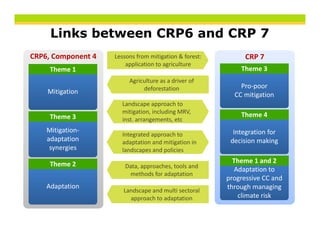
Links between CRP6 and CRP 7
CRP6, Component 4   Lessons from mitigation & forest:          CRP 7
                        application to agriculture
     Theme 1                                                 Theme 3
                         Agriculture as a driver of 
                              deforestation                  Pro‐poor 
    Mitigation                                             CC mitigation
                      Landscape approach to 
                      mitigation, including MRV, 
     Theme 3                                                 Theme 4
                      inst. arrangements, etc
    Mitigation‐                                            Integration for 
                      Integrated approach to 
    adaptation 
    adaptation        adaptation and mitigation in        decision making
                                                          d ii        ki
     synergies        landscapes and policies

     Theme 2                                               Theme 1 and 2
                        Data, approaches, tools and 
                                                            Adaptation to 
                                                            Adaptation to
                         methods for adaptation
                                                         progressive CC and 
    Adaptation                                           through managing 
                       Landscape and multi sectoral
                         approach to adaptation
                          pp            p                    climate risk
Component
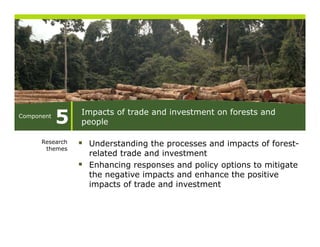
            5    Impacts of trade and investment on forests and
                 people

      Research    Understanding the processes and impacts of forest-
       themes
                  related trade and investment
                  Enhancing responses and policy options to mitigate
                  the negative impacts and enhance the positive
                  impacts of trade and investment
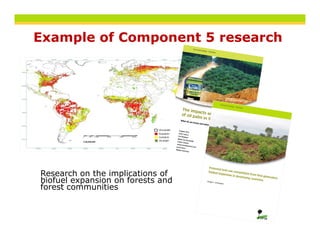
Example of Component 5 research


Research on the implications of
        h    h      l         f
biofuel expansion on forests and
forest communities
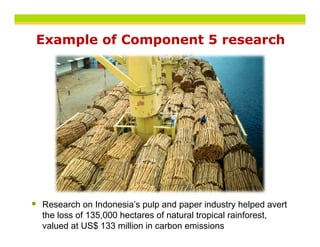
Example of Component 5 research
    p         p


Research on Indonesia’s pulp and paper industry helped avert
R        h    I d    i ’    l    d         i d t h l d       t
the loss of 135,000 hectares of natural tropical rainforest,
valued at US$ 133 million in carbon emissions
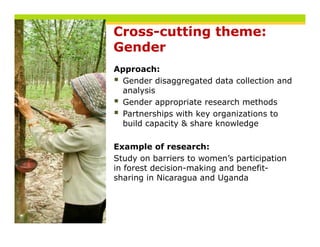
Cross-cutting theme:
Gender
Approach:
  Gender disaggregated data collection and
  analysis
  Gender appropriate research methods
  Partnerships with key organizations to
  build capacity & share knowledge

Example of research:
Study on barriers to women’s participation
in forest decision-making and benefit-
          decision making     benefit
sharing in Nicaragua and Uganda
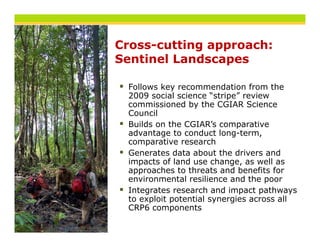
Cross-cutting approach:
Sentinel Landscapes

 Follows key recommendation from the
 2009 social science “stripe” review
 commissioned by the CGIAR Science
                 y
 Council
 Builds on the CGIAR’s comparative
 advantage to conduct long-term,
 comparative research
          ti           h
 Generates data about the drivers and
 impacts of land use change, as well as
 approaches to threats and benefits for
 environmental resilience and the poor
 Integrates research and impact pathways
 to exploit potential synergies across all
 CRP6 components
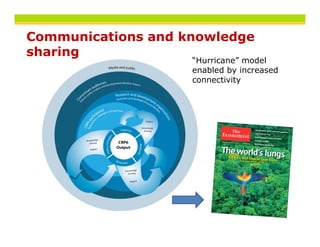
Communications and knowledge
sharing
                    “Hurricane” model
                    enabled by increased
                    connectivity
                            i i
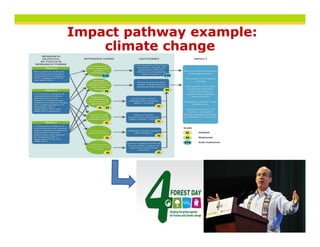
Impact pathway example:
    climate change
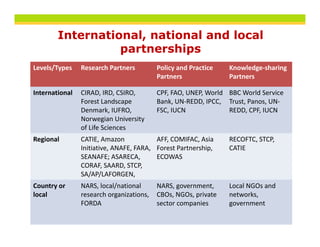
International, national and local
                  partnerships
                     t     hi
Levels/Types    Research Partners        Policy and Practice     Knowledge‐sharing 
                                         Partners                Partners

International   CIRAD, IRD, CSIRO,       CPF, FAO, UNEP, World  BBC World Service 
                Forest Landscape         Bank, UN‐REDD, IPCC,  Trust, Panos, UN‐
                Denmark, IUFRO, 
                D        k IUFRO         FSC, IUCN 
                                         FSC IUCN               REDD, CPF, IUCN
                                                                REDD CPF IUCN
                Norwegian University 
                of Life Sciences
Regional        CATIE, Amazon 
                CATIE Amazon              AFF, COMIFAC, Asia 
                                          AFF COMIFAC Asia       RECOFTC, STCP, 
                                                                 RECOFTC STCP
                Initiative, ANAFE, FARA,  Forest Partnership,    CATIE 
                SEANAFE; ASARECA,         ECOWAS
                CORAF, SAARD, STCP, 
                SA/AP/LAFORGEN, 
Country or      NARS, local/national     NARS, government,       Local NGOs and 
local           research organizations,  CBOs, NGOs, private     networks, 
                FORDA                    sector companies 
                                            t         i          government t
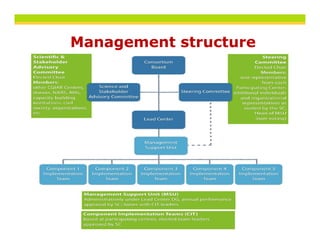
Management structure
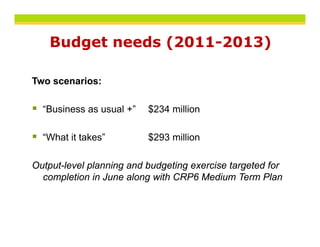
Budget needs (2011-2013)
                 (2011 2013)

Two scenarios:

  “Business as usual +”
   Business          +    $234 million

  “What it takes”
   What takes             $293 million

Output-level planning and budgeting exercise targeted for
   p         p      g        g    g             g
  completion in June along with CRP6 Medium Term Plan
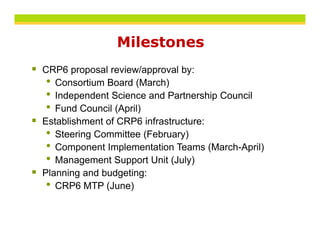
Milestones
CRP6 proposal review/approval by:
 • Consortium Board (March)
 • Independent Science and Partnership Council
 • Fund Council (April)
Establishment of CRP6 infrastructure:
 • Steering Committee (
          g             (February)
                                y)
 • Component Implementation Teams (March-April)
 • Management Support Unit (July)
Planning and b d ti
Pl    i     d budgeting:
 • CRP6 MTP (June)
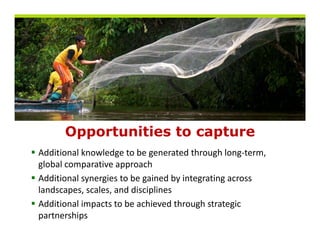
Opportunities to capture
       pp                p
Additional knowledge to be generated through long‐term, 
global comparative approach
Additional synergies to be gained by integrating across 
landscapes, scales, and disciplines
Additional impacts to be achieved through strategic 
Additi   li      t t b      hi d th       h t t i
partnerships
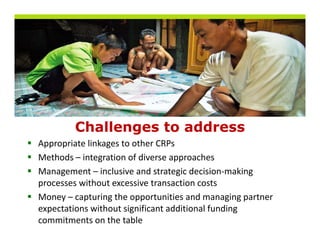
Challenges to address
Appropriate linkages to other CRPs
Methods – integration of diverse approaches
Management – inclusive and strategic decision‐making 
Management inclusive and strategic decision making
processes without excessive transaction costs
Money – capturing the opportunities and managing partner 
     y     p     g       pp                     g gp
expectations without significant additional funding 
commitments on the table 
http://www.cifor.cgiar.org/crp6/

CGIAR Research Program on Forests, Trees and Agroforestry

  • 1.
    CGIAR Research Programon Forests, Trees and Agroforestry
  • 2.
    CGIAR strategic objectives Createand accelerate sustainable increases in the productivity and production of healthy food by and for the poor Conserve, enhance and sustainably use natural resources and biodiversity to improve the livelihoods of the poor in response to climate change and other factors Promote policy and institutional change that will stimulate agricultural growth and equity to benefit the poor especially rural women poor, and other disadvantaged groups
  • 3.
    The forests/trees/agroforestry / / g y contribution: CRP6
  • 4.
    Deforestation – 13million ha/year /y Source: FAO Forest Resource Assessment (FRA) 2010 Net change in forest area 2005-2010 (in ha per year)
  • 5.
    Tree cover onfarms Nearly half of agricultural land has more that 10% tree cover
  • 6.
    Why are forestsand trees important? Livelihoods 90% of the 1.4 billion people living in extreme poverty depend on forest resources for some part of their livelihoods Forest-adjacent Forest adjacent households derive approximately 24% of their income from forests on average Bushmeat accounts for up to 80% of the protein in take of people living in Central African forests In rural Africa, forests supply up to 80% of rural Africa energy needs Forest industry is the largest formal sector employer in many rural areas
  • 7.
    Why are forestsand trees important? Environment Forests contain the preponderance of the Earth s Earth’s terrestrial biodiversity, including wild biodiversity relatives of important crops Forest systems provide environmental services important to the agriculture sector sector, including hydrological regulation and pollination, as well as fodder and soil fertility enhancement Deforestation and land use change contribute 12–18% of the world’s total annual carbon emissions Forest systems provide an important source of resilience for adaptation to climate change
  • 8.
    Consultative development process 7 February: Full draft proposal re‐ 7 February: Full draft proposal re‐ submitted to Consortium Board 25 January: 18 partners provide comments  19 January 2011: Revised draft sent to 100+ partners 24 December: Consortium Board + 4 independent reviewers p provide comment on full draft  6 September: Full draft submitted to Consortium Board 27 August: 34 partners provide comments  14 July: Full draft proposal sent to 171 partners 5 July: 73 respondents agree to provide comment on full draft proposal  27 May 2010: 20 page concept note sent to 328 partners 
  • 9.
    CRP6 aspirations Integration acrossscales, ecosystems, g y sectors, and disciplines • Trees on farms to undisturbed forests • Species-level genetic diversity to global policy Long-term, global comparative research • Potential “sentinel landscapes” Impact-driven • Clear impact pathways • Dynamic communication of knowledge • Strategic partnerships to change policy and practice
  • 10.
  • 11.
    Illustrative impacts onforests Research will target: Research will target: • 46% of global forest cover,  • 1.3 billion hectares of closed forests and  • 500 illi h f 500 million ha of open and fragmented forests df t df t Impact pathways will lead to: I t th ill l d t 0.5 to 1.7 million ha of avoided deforestation/year 0.16 0 68 0 16 to 0.68 gigatons carbon dioxide emissions averted/year 9.3 to 27.8 million ha with improved management practices
  • 12.
    Illustrative impacts onpeople Research will target: • approximately 500 million people living in or close to forests Impact pathways will lead to: Enhanced production and management options for at least 3 million producers and traders and their families A doubling of incomes from forest and agroforestry products for target households through increases in tree, land, and labor productivity An additional 60 million people benefiting from accelerated availability of funding for climate adaptation programs An increased supply of REDD+ credits worth between US$108 million and US$2695 million per year through increased efficiency Significant improvements in access of women of benefits provided through forests, trees and agroforestry
  • 13.
    Components p Smallholder production systems and markets Management and conservation of forest and tree resources Environmental services and l d l d landscape management Climate change adaptation and mitigation Impacts of trade and investment on forests and people
  • 14.
  • 15.
    Component 1 Smallholder production systems and markets Research Enhancing management and production systems for themes smallholders (food security and nutrition) Increasing income generation and market integration for smallholders Improving policy and institutions to enhance social assets to secure rights in forest- and tree-dependent communities
  • 16.
    Example of Component1 research ICRAF collaboration with Unilever SNV and IUCN on improving Unilever, SNV, propagation, survival, and growth rates supported smallholders to plant 100,000 improved Allanblackia seedlings.
  • 17.
    2 Management and conservation of forest and tree M t d ti ff t dt Component resources Research themes Understanding threats to important tree species and formulating genetic conservation strategies Conserving and characterizing high-quality germplasm of important tree crops and their wild relatives Developing improved silvicultural, monitoring and management practices for multiple use Developing tools and methods to resolve conflicts over distribution of benefits and resource rights
  • 18.
    Example of Component2 research p p Improved timber harvesting practices could reduce 10% of total emissions linked to deforestation, and support multiple use of forests for NTFPs and biodiversity conservation.
  • 19.
    3 Environmental services and l d E i t l i d landscape Component management Research Understanding drivers of forest transition themes Understanding the consequences of forest transition for environmental services and livelihoods Learning landscapes: dynamics of multi-functionality
  • 20.
    Example of Component3 research Action research undertaken by CIFOR and ICRAF on co- management of forests between local communities and government in Guinea led to a decrease in the incidence of fire, improved wildlife habitat, and increases in local incomes.
  • 21.
    Component 4 Climate change adaptation and mitigation Research Harnessing forests, trees and agroforestry for themes climate change mitigation Enhancing climate change adaptation Understanding synergies between climate change mitigation and adaptation
  • 22.
    Example of Component4 research Joint CIFOR-CATIE research on tropical forests and climate change adaptation in Honduras influenced the design of one of the first projects ever approved by the UNFCCC’s Adaptation Fund Board
  • 23.
    Links between CRP6and CRP 7 CRP6, Component 4 Lessons from mitigation & forest:  CRP 7 application to agriculture Theme 1 Theme 3 Agriculture as a driver of  deforestation Pro‐poor  Mitigation CC mitigation Landscape approach to  mitigation, including MRV,  Theme 3 Theme 4 inst. arrangements, etc Mitigation‐ Integration for  Integrated approach to  adaptation  adaptation adaptation and mitigation in  decision making d ii ki synergies landscapes and policies Theme 2 Theme 1 and 2 Data, approaches, tools and  Adaptation to  Adaptation to methods for adaptation progressive CC and  Adaptation through managing  Landscape and multi sectoral approach to adaptation pp p climate risk
  • 24.
    Component 5 Impacts of trade and investment on forests and people Research Understanding the processes and impacts of forest- themes related trade and investment Enhancing responses and policy options to mitigate the negative impacts and enhance the positive impacts of trade and investment
  • 25.
    Example of Component5 research Research on the implications of h h l f biofuel expansion on forests and forest communities
  • 26.
    Example of Component5 research p p Research on Indonesia’s pulp and paper industry helped avert R h I d i ’ l d i d t h l d t the loss of 135,000 hectares of natural tropical rainforest, valued at US$ 133 million in carbon emissions
  • 27.
    Cross-cutting theme: Gender Approach: Gender disaggregated data collection and analysis Gender appropriate research methods Partnerships with key organizations to build capacity & share knowledge Example of research: Study on barriers to women’s participation in forest decision-making and benefit- decision making benefit sharing in Nicaragua and Uganda
  • 28.
    Cross-cutting approach: Sentinel Landscapes Follows key recommendation from the 2009 social science “stripe” review commissioned by the CGIAR Science y Council Builds on the CGIAR’s comparative advantage to conduct long-term, comparative research ti h Generates data about the drivers and impacts of land use change, as well as approaches to threats and benefits for environmental resilience and the poor Integrates research and impact pathways to exploit potential synergies across all CRP6 components
  • 29.
    Communications and knowledge sharing “Hurricane” model enabled by increased connectivity i i
  • 30.
  • 31.
    International, national andlocal partnerships t hi Levels/Types Research Partners Policy and Practice  Knowledge‐sharing  Partners Partners International CIRAD, IRD, CSIRO,  CPF, FAO, UNEP, World  BBC World Service  Forest Landscape  Bank, UN‐REDD, IPCC,  Trust, Panos, UN‐ Denmark, IUFRO,  D k IUFRO FSC, IUCN  FSC IUCN REDD, CPF, IUCN REDD CPF IUCN Norwegian University  of Life Sciences Regional CATIE, Amazon  CATIE Amazon AFF, COMIFAC, Asia  AFF COMIFAC Asia RECOFTC, STCP,  RECOFTC STCP Initiative, ANAFE, FARA,  Forest Partnership,  CATIE  SEANAFE; ASARECA,  ECOWAS CORAF, SAARD, STCP,  SA/AP/LAFORGEN,  Country or  NARS, local/national  NARS, government,  Local NGOs and  local research organizations,  CBOs, NGOs, private  networks,  FORDA sector companies  t i government t
  • 32.
  • 33.
    Budget needs (2011-2013) (2011 2013) Two scenarios: “Business as usual +” Business + $234 million “What it takes” What takes $293 million Output-level planning and budgeting exercise targeted for p p g g g g completion in June along with CRP6 Medium Term Plan
  • 34.
    Milestones CRP6 proposal review/approvalby: • Consortium Board (March) • Independent Science and Partnership Council • Fund Council (April) Establishment of CRP6 infrastructure: • Steering Committee ( g (February) y) • Component Implementation Teams (March-April) • Management Support Unit (July) Planning and b d ti Pl i d budgeting: • CRP6 MTP (June)
  • 35.
    Opportunities to capture pp p Additional knowledge to be generated through long‐term,  global comparative approach Additional synergies to be gained by integrating across  landscapes, scales, and disciplines Additional impacts to be achieved through strategic  Additi li t t b hi d th h t t i partnerships
  • 36.
    Challenges to address Appropriatelinkages to other CRPs Methods – integration of diverse approaches Management – inclusive and strategic decision‐making  Management inclusive and strategic decision making processes without excessive transaction costs Money – capturing the opportunities and managing partner  y p g pp g gp expectations without significant additional funding  commitments on the table 
  • 37.