Governing natural forest regeneration
Manuel R. Guariguata
World Conference on Ecological Restoration
28 August 2017
The “three pillars” of forest governance
1. Policy, legal, institutional and
regulatory frameworks within and
outside the forest sector
2. Planning and decision-making
processes
3. Implementation, enforcement and
compliance
The key variables of “good” forest governance
• Clear user rights and responsibilities
• Participation by those who depend on forests
• Accountability of both users and decision-
makers
• Monitoring of management outcomes
• Enforcement of property rights
• Institutional capacities
From central - to - local
Governing secondary forest
permanence – selected
examples
Peru – agricultural and environmental benefits
of secondary forests politically divorced
 Land use planning falls under Ministry of Environment
yet Ministry of Agriculture governs land use change by
issuing titles and permits
 Hence the Ministry of Environment has little leverage
to support secondary forest conservation in spite of
implementing REDD+ payments
Indonesia – forestry agencies largely control
‘degraded’ forest landscapes, funneling capital
subsidies to companies for masssive land use
change (displacing local communities) Ucayali, Perú
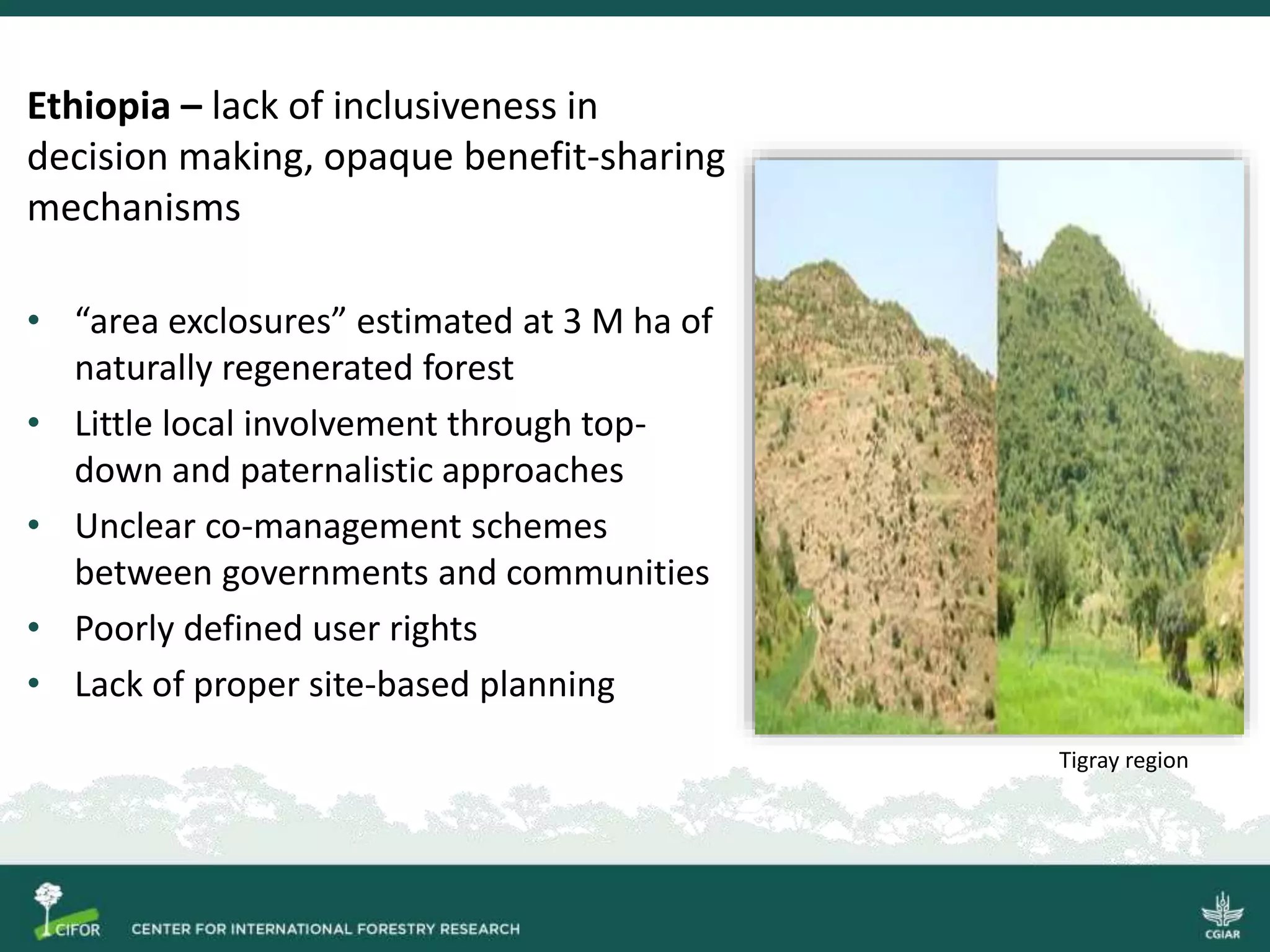
Ethiopia – lack of inclusiveness in
decision making, opaque benefit-sharing
mechanisms
• “area exclosures” estimated at 3 M ha of
naturally regenerated forest
• Little local involvement through top-
down and paternalistic approaches
• Unclear co-management schemes
between governments and communities
• Poorly defined user rights
• Lack of proper site-based planning
Tigray region
Mexico, Costa Rica – technocratic approaches may disregard
local needs
• A secondary forest needs a “management
plan” if above 4 m2/ha and 15 trees/ha
(dbh > 25 cm)
 Limits traditional harvesting of small-diameter
trees and incentivizes clearing
 These thresholds need modification to allow
young forest use without overregulation
• Up until 2016, timber harvesting in
secondary forests had to avoid establishing
monoespecific stands
 Monocyclic systems are just recently allowed
Moving forward?
• Recognize that secondary forests are part
of highly dynamic socio-ecological
systems unlikely to be managed — most
often than not — by a single government
sector or scientific discipline
• Traditional forest classification systems
often obviate the socioecological
dimension…“domestic forests” instead?
• Promote curricular innovation and
stimulate cross-disciplinarity
Ucayali, Peru
“Is this a (Guazuma) plantation? No—trees are not
spaced 2 m x 2 m” (government forester, 2015)
• Understand what drives or hampers the permanence of
secondary forests both from the top-down and the bottom-
up.
• What would be the “right balance” between regulatory
enforcement and incentive-based conservation through
sustainable use to ensure permanence?
?
?
cifor.org
blog.cifor.org
ForestsTreesAgroforestry.org
Barr & Sayer. 2012. Biol. Cons. 154: 9-19
Birhane et al. Int. For. Rev. (in press)
Guariguata & Brancalion. 2014. Forests 5(12)
Henao. 2014. M.Sc. Thesis, CATIE.
Lemenih & Kassa. 2014. Forests 5(8)
Michon et al. 2007. Ecol. Soc. 12(2)
Ravikumar et al. 2015. Int. J. Comms. 9(2)
Roman-Dañobeytia et al. 2014. Forests 5(5)
Schwartz et al. 2017. Env. Res. Lett. 12
Vieira et al. 2014. Forests 5(7)
Obrigado

Governing natural forest regeneration

  • 1.
    Governing natural forestregeneration Manuel R. Guariguata World Conference on Ecological Restoration 28 August 2017
  • 2.
    The “three pillars”of forest governance 1. Policy, legal, institutional and regulatory frameworks within and outside the forest sector 2. Planning and decision-making processes 3. Implementation, enforcement and compliance
  • 3.
    The key variablesof “good” forest governance • Clear user rights and responsibilities • Participation by those who depend on forests • Accountability of both users and decision- makers • Monitoring of management outcomes • Enforcement of property rights • Institutional capacities From central - to - local
  • 4.
  • 5.
    Peru – agriculturaland environmental benefits of secondary forests politically divorced  Land use planning falls under Ministry of Environment yet Ministry of Agriculture governs land use change by issuing titles and permits  Hence the Ministry of Environment has little leverage to support secondary forest conservation in spite of implementing REDD+ payments Indonesia – forestry agencies largely control ‘degraded’ forest landscapes, funneling capital subsidies to companies for masssive land use change (displacing local communities) Ucayali, Perú
  • 6.
    Ethiopia – lackof inclusiveness in decision making, opaque benefit-sharing mechanisms • “area exclosures” estimated at 3 M ha of naturally regenerated forest • Little local involvement through top- down and paternalistic approaches • Unclear co-management schemes between governments and communities • Poorly defined user rights • Lack of proper site-based planning Tigray region
  • 7.
    Mexico, Costa Rica– technocratic approaches may disregard local needs • A secondary forest needs a “management plan” if above 4 m2/ha and 15 trees/ha (dbh > 25 cm)  Limits traditional harvesting of small-diameter trees and incentivizes clearing  These thresholds need modification to allow young forest use without overregulation • Up until 2016, timber harvesting in secondary forests had to avoid establishing monoespecific stands  Monocyclic systems are just recently allowed
  • 8.
    Moving forward? • Recognizethat secondary forests are part of highly dynamic socio-ecological systems unlikely to be managed — most often than not — by a single government sector or scientific discipline • Traditional forest classification systems often obviate the socioecological dimension…“domestic forests” instead? • Promote curricular innovation and stimulate cross-disciplinarity Ucayali, Peru “Is this a (Guazuma) plantation? No—trees are not spaced 2 m x 2 m” (government forester, 2015)
  • 9.
    • Understand whatdrives or hampers the permanence of secondary forests both from the top-down and the bottom- up. • What would be the “right balance” between regulatory enforcement and incentive-based conservation through sustainable use to ensure permanence? ? ?
  • 10.
    cifor.org blog.cifor.org ForestsTreesAgroforestry.org Barr & Sayer.2012. Biol. Cons. 154: 9-19 Birhane et al. Int. For. Rev. (in press) Guariguata & Brancalion. 2014. Forests 5(12) Henao. 2014. M.Sc. Thesis, CATIE. Lemenih & Kassa. 2014. Forests 5(8) Michon et al. 2007. Ecol. Soc. 12(2) Ravikumar et al. 2015. Int. J. Comms. 9(2) Roman-Dañobeytia et al. 2014. Forests 5(5) Schwartz et al. 2017. Env. Res. Lett. 12 Vieira et al. 2014. Forests 5(7) Obrigado

Editor's Notes

  • #9 Say something about the photo, when we took foresters they said it was not a plantation since it was not 3x3; Herborn et al on what drives success