The role and perspectives of forest
 communities in the forest reform process
Presentation to International Conference on Forest
 Tenure, Governance and Enterprise - Cameroon
                     May 2009

       Charles Meshack (TFCG, Tanzania)
Outline
1. What community organization
participated in the reform process?
2. What was my role & unique
perspectives?
3. What has been the role of my
organization in reforms?
4. What other specific roles the
organization has played?
5. What impacts?
6. What are the lessons learned
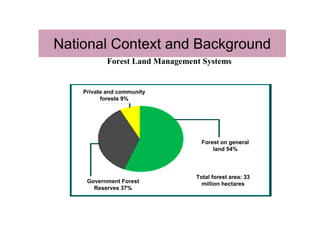
National Context and Background
            Forest Land Management Systems


    Private and community
          forests 9%


                                   Forest on general
                                       land 54%


                                 Total forest area: 33
     Government Forest             million hectares
       Reserves 37%
What Community Organizations?
NGOs and CBO
These included
Tanzania Forest Conservation Group – TFCG
Village Natural Resource Committees – VNRC
Lawyer Environment Action Team – LEAT
Wildlife Conservation Society of Tanzania - WCST
LAMP/OURGUT
WWF
CARE International
Community Forest Network (MJUMITA),
My role & Perspectives?
Facilitation
 • Involving communities on the ground – 1996 before the
   establishment of Forest Policy 1998

 Participation
  Provide input/comments in the drafting of the Forest
  Policy
  Consultative Meetings/workshops in the preparation of
  Forest Policy 1998, National Forest Programe (NFP
  2002), Forest Act 2002.
My role & Perspectives?
Trainer
 • Facilitating and Training Decision makers and
   practitioners on Participatory Forest Management

 Editor
  Community newsletter produced in Kiswahili

 Producing articles/papers
 Writing articles/papers in newspapers and Journals
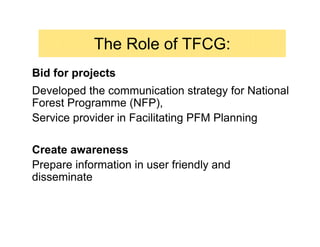
The Role of TFCG:
Identifying scope of reform;
Resulted after implementing the policies:
e.g. By providing feedback – Harmonization of Participatory
Forest Resource Assessment methodology
Two different Participatory Forest Management (PFM)
guidelines (Community Based Forest Management – CBFM
& Draft Joint Forest Management – JFM)
Informing decision makers and politicians
Participate in public trade show – by displaying the
achievements and challenges of PFM
Prepare and disseminate targeted materials e.g. Mass
media – Television, video show, newspapers
Prepare displays during parliament session
The Role of TFCG:
Bid for projects
Developed the communication strategy for National
Forest Programme (NFP),
Service provider in Facilitating PFM Planning

Create awareness
Prepare information in user friendly and
disseminate
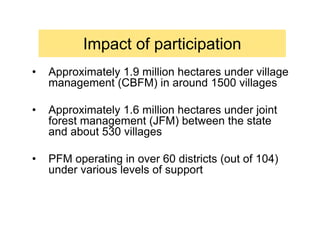
Impact of participation
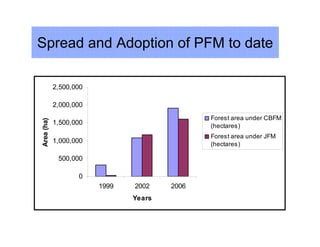
•   Approximately 1.9 million hectares under village
    management (CBFM) in around 1500 villages

•   Approximately 1.6 million hectares under joint
    forest management (JFM) between the state
    and about 530 villages

•   PFM operating in over 60 districts (out of 104)
    under various levels of support
Spread and Adoption of PFM to date

            2,500,000

            2,000,000
                                              Forest area under CBFM
Area (ha)


            1,500,000                         (hectares)
                                              Forest area under JFM
            1,000,000                         (hectares)

             500,000

                   0
                        1999   2002    2006
                               Years
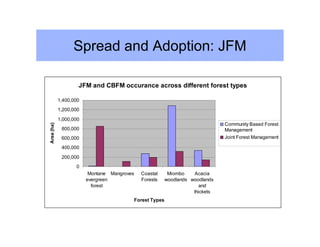
Spread and Adoption: JFM

                    JFM and CBFM occurance across different forest types

            1,400,000
            1,200,000

            1,000,000
                                                                                  Community Based Forest
Area (ha)


             800,000                                                              Management
             600,000                                                              Joint Forest Management

             400,000

             200,000
                   0
                         Montane Mangroves     Coastal       Miombo    Acacia
                        evergreen              Forests      woodlands woodlands
                          forest                                          and
                                                                       thickets
                                             Forest Types
Impact on Livelihoods

Joint Forest Management
•   Much of donor funds for early PFM directed towards
    “catchment” forests with high biodiversity values – with
    limited use potential under prevailing laws
•   Government has not provided guidance on benefit / cost
    sharing in JFM arrangements
•   Reduction in fines over time as illegal activities drop –
    negative incentives
•   Increases in wildlife populations causing conflicts
•   “Elite capture” within the village management – uneven
    share of costs and benefits within the village
Impact on Livelihoods
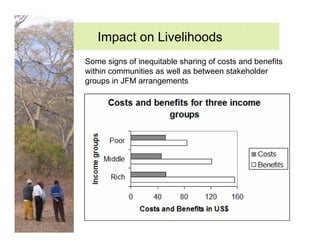
Some signs of inequitable sharing of costs and benefits
within communities as well as between stakeholder
groups in JFM arrangements
Impact on Livelihoods
Community Based Forest Management
- Degraded forest resource base = low potential to
  generate revenue in first years
- Increases in wildlife populations causing conflicts
- Some resistance by communities and districts to start
  harvesting
- Some villages now harvesting modest amounts (eg
  revenues around 10-15,000 USD per year)
- Some interesting new opportunities where
  communities are gaining rights over large areas of
  valuable miombo woodlands – potential forest
  revenues up to USD 70,000/village/year
Impacts on governance
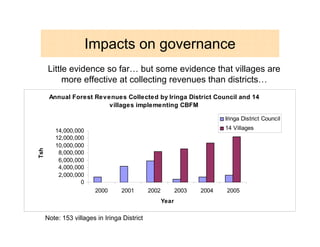
       Little evidence so far… but some evidence that villages are
            more effective at collecting revenues than districts…
       Annual Forest Revenues Collected by Iringa District Council and 14
                         villages implementing CBFM

                                                                          Iringa District Council

         14,000,000                                                       14 Villages
         12,000,000
         10,000,000
Tsh


          8,000,000
          6,000,000
          4,000,000
          2,000,000
                  0
                        2000      2001        2002          2003   2004   2005
                                                     Year

      Note: 153 villages in Iringa District
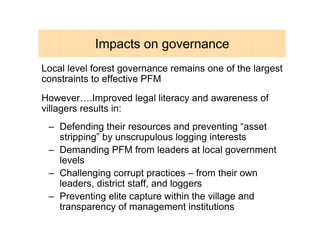
Impacts on governance
Local level forest governance remains one of the largest
constraints to effective PFM
However….Improved legal literacy and awareness of
villagers results in:
 – Defending their resources and preventing “asset
   stripping” by unscrupulous logging interests
 – Demanding PFM from leaders at local government
   levels
 – Challenging corrupt practices – from their own
   leaders, district staff, and loggers
 – Preventing elite capture within the village and
   transparency of management institutions
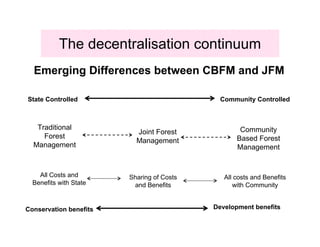
The decentralisation continuum
  Emerging Differences between CBFM and JFM

State Controlled                             Community Controlled


   Traditional                                     Community
                          Joint Forest
     Forest                                       Based Forest
                          Management
  Management                                      Management


    All Costs and       Sharing of Costs      All costs and Benefits
  Benefits with State    and Benefits            with Community


Conservation benefits                      Development benefits
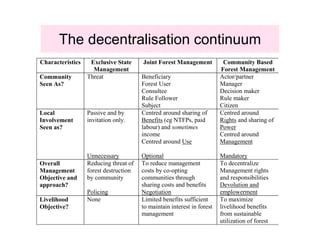
The decentralisation continuum
Characteristics    Exclusive State     Joint Forest Management           Community Based
                    Management                                          Forest Management
Community         Threat               Beneficiary                      Actor/partner
Seen As?                               Forest User                      Manager
                                       Consultee                        Decision maker
                                       Rule Follower                    Rule maker
                                       Subject                          Citizen
Local             Passive and by       Centred around sharing of        Centred around
Involvement       invitation only.     Benefits (eg NTFPs, paid         Rights and sharing of
Seen as?                               labour) and sometimes            Power
                                       income                           Centred around
                                       Centred around Use               Management

                  Unnecessary          Optional                         Mandatory
Overall           Reducing threat of   To reduce management             To decentralize
Management        forest destruction   costs by co-opting               Management rights
Objective and     by community         communities through              and responsibilities
approach?                              sharing costs and benefits       Devolution and
                  Policing             Negotiation                      emplowerment
Livelihood        None                 Limited benefits sufficient      To maximize
Objective?                             to maintain interest in forest   livelihood benefits
                                       management                       from sustainable
                                                                        utilization of forest
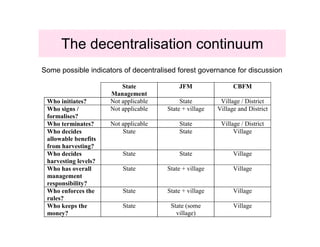
The decentralisation continuum
Some possible indicators of decentralised forest governance for discussion

                          State            JFM                 CBFM
                      Management
 Who initiates?       Not applicable        State         Village / District
 Who signs /          Not applicable   State + village   Village and District
 formalises?
 Who terminates?      Not applicable       State          Village / District
 Who decides              State            State               Village
 allowable benefits
 from harvesting?
 Who decides              State            State               Village
 harvesting levels?
 Who has overall          State        State + village         Village
 management
 responsibility?
 Who enforces the         State        State + village         Village
 rules?
 Who keeps the            State         State (some            Village
 money?                                   village)
Conclusions and Lessons Learned

Both JFM and CBFM are spreading rapidly and now cover more
than 10% of the total forest area of mainland Tanzania
Effective forest management tool that devolves management
responsibility to lower levels and leads to improvements over open
access management regimes
Joint Forest Management remains problematic, if it is to realise its
two other objectives of improved livelihoods and local governance
Conflicts have emerged due to:
 - Limited benefits available (especially catchment forests)
 - Lack of cost-benefit sharing mechanism and ratios
 - Crop raiding from wildlife
 - Elite capture of the few benefits
 As a result, management costs to communities often exceeds
   benefits
Conclusions and Lessons Learned

Community Based Forest Management promises greater returns to
livelihoods, but in many cases these have yet to materialise.
Some areas generating revenues from their forests which are
enough to maintain PFM process with a surplus to community
development
Evidence that massive increases in efficiency in forest revenue
collection when responsibilities devolved from district to village
Single most effective mechanism for improving local forest
governance is civic education and legal literacy around rights,
responsibilities and returns from sustainable and community based
forest management systems
Rolling out of PFM nationally requires working top-down (laws,
regulations, guidelines) and bottom –up (awareness)

Charles Meshack: The role and perspectives of forest communities in the forest reform process

  • 1.
    The role andperspectives of forest communities in the forest reform process Presentation to International Conference on Forest Tenure, Governance and Enterprise - Cameroon May 2009 Charles Meshack (TFCG, Tanzania)
  • 2.
    Outline 1. What communityorganization participated in the reform process? 2. What was my role & unique perspectives? 3. What has been the role of my organization in reforms? 4. What other specific roles the organization has played? 5. What impacts? 6. What are the lessons learned
  • 3.
    National Context andBackground Forest Land Management Systems Private and community forests 9% Forest on general land 54% Total forest area: 33 Government Forest million hectares Reserves 37%
  • 4.
    What Community Organizations? NGOsand CBO These included Tanzania Forest Conservation Group – TFCG Village Natural Resource Committees – VNRC Lawyer Environment Action Team – LEAT Wildlife Conservation Society of Tanzania - WCST LAMP/OURGUT WWF CARE International Community Forest Network (MJUMITA),
  • 5.
    My role &Perspectives? Facilitation • Involving communities on the ground – 1996 before the establishment of Forest Policy 1998 Participation Provide input/comments in the drafting of the Forest Policy Consultative Meetings/workshops in the preparation of Forest Policy 1998, National Forest Programe (NFP 2002), Forest Act 2002.
  • 6.
    My role &Perspectives? Trainer • Facilitating and Training Decision makers and practitioners on Participatory Forest Management Editor Community newsletter produced in Kiswahili Producing articles/papers Writing articles/papers in newspapers and Journals
  • 7.
    The Role ofTFCG: Identifying scope of reform; Resulted after implementing the policies: e.g. By providing feedback – Harmonization of Participatory Forest Resource Assessment methodology Two different Participatory Forest Management (PFM) guidelines (Community Based Forest Management – CBFM & Draft Joint Forest Management – JFM) Informing decision makers and politicians Participate in public trade show – by displaying the achievements and challenges of PFM Prepare and disseminate targeted materials e.g. Mass media – Television, video show, newspapers Prepare displays during parliament session
  • 8.
    The Role ofTFCG: Bid for projects Developed the communication strategy for National Forest Programme (NFP), Service provider in Facilitating PFM Planning Create awareness Prepare information in user friendly and disseminate
  • 9.
    Impact of participation • Approximately 1.9 million hectares under village management (CBFM) in around 1500 villages • Approximately 1.6 million hectares under joint forest management (JFM) between the state and about 530 villages • PFM operating in over 60 districts (out of 104) under various levels of support
  • 10.
    Spread and Adoptionof PFM to date 2,500,000 2,000,000 Forest area under CBFM Area (ha) 1,500,000 (hectares) Forest area under JFM 1,000,000 (hectares) 500,000 0 1999 2002 2006 Years
  • 11.
    Spread and Adoption:JFM JFM and CBFM occurance across different forest types 1,400,000 1,200,000 1,000,000 Community Based Forest Area (ha) 800,000 Management 600,000 Joint Forest Management 400,000 200,000 0 Montane Mangroves Coastal Miombo Acacia evergreen Forests woodlands woodlands forest and thickets Forest Types
  • 12.
    Impact on Livelihoods JointForest Management • Much of donor funds for early PFM directed towards “catchment” forests with high biodiversity values – with limited use potential under prevailing laws • Government has not provided guidance on benefit / cost sharing in JFM arrangements • Reduction in fines over time as illegal activities drop – negative incentives • Increases in wildlife populations causing conflicts • “Elite capture” within the village management – uneven share of costs and benefits within the village
  • 13.
    Impact on Livelihoods Somesigns of inequitable sharing of costs and benefits within communities as well as between stakeholder groups in JFM arrangements
  • 14.
    Impact on Livelihoods CommunityBased Forest Management - Degraded forest resource base = low potential to generate revenue in first years - Increases in wildlife populations causing conflicts - Some resistance by communities and districts to start harvesting - Some villages now harvesting modest amounts (eg revenues around 10-15,000 USD per year) - Some interesting new opportunities where communities are gaining rights over large areas of valuable miombo woodlands – potential forest revenues up to USD 70,000/village/year
  • 15.
    Impacts on governance Little evidence so far… but some evidence that villages are more effective at collecting revenues than districts… Annual Forest Revenues Collected by Iringa District Council and 14 villages implementing CBFM Iringa District Council 14,000,000 14 Villages 12,000,000 10,000,000 Tsh 8,000,000 6,000,000 4,000,000 2,000,000 0 2000 2001 2002 2003 2004 2005 Year Note: 153 villages in Iringa District
  • 16.
    Impacts on governance Locallevel forest governance remains one of the largest constraints to effective PFM However….Improved legal literacy and awareness of villagers results in: – Defending their resources and preventing “asset stripping” by unscrupulous logging interests – Demanding PFM from leaders at local government levels – Challenging corrupt practices – from their own leaders, district staff, and loggers – Preventing elite capture within the village and transparency of management institutions
  • 17.
    The decentralisation continuum Emerging Differences between CBFM and JFM State Controlled Community Controlled Traditional Community Joint Forest Forest Based Forest Management Management Management All Costs and Sharing of Costs All costs and Benefits Benefits with State and Benefits with Community Conservation benefits Development benefits
  • 18.
    The decentralisation continuum Characteristics Exclusive State Joint Forest Management Community Based Management Forest Management Community Threat Beneficiary Actor/partner Seen As? Forest User Manager Consultee Decision maker Rule Follower Rule maker Subject Citizen Local Passive and by Centred around sharing of Centred around Involvement invitation only. Benefits (eg NTFPs, paid Rights and sharing of Seen as? labour) and sometimes Power income Centred around Centred around Use Management Unnecessary Optional Mandatory Overall Reducing threat of To reduce management To decentralize Management forest destruction costs by co-opting Management rights Objective and by community communities through and responsibilities approach? sharing costs and benefits Devolution and Policing Negotiation emplowerment Livelihood None Limited benefits sufficient To maximize Objective? to maintain interest in forest livelihood benefits management from sustainable utilization of forest
  • 19.
    The decentralisation continuum Somepossible indicators of decentralised forest governance for discussion State JFM CBFM Management Who initiates? Not applicable State Village / District Who signs / Not applicable State + village Village and District formalises? Who terminates? Not applicable State Village / District Who decides State State Village allowable benefits from harvesting? Who decides State State Village harvesting levels? Who has overall State State + village Village management responsibility? Who enforces the State State + village Village rules? Who keeps the State State (some Village money? village)
  • 20.
    Conclusions and LessonsLearned Both JFM and CBFM are spreading rapidly and now cover more than 10% of the total forest area of mainland Tanzania Effective forest management tool that devolves management responsibility to lower levels and leads to improvements over open access management regimes Joint Forest Management remains problematic, if it is to realise its two other objectives of improved livelihoods and local governance Conflicts have emerged due to: - Limited benefits available (especially catchment forests) - Lack of cost-benefit sharing mechanism and ratios - Crop raiding from wildlife - Elite capture of the few benefits As a result, management costs to communities often exceeds benefits
  • 21.
    Conclusions and LessonsLearned Community Based Forest Management promises greater returns to livelihoods, but in many cases these have yet to materialise. Some areas generating revenues from their forests which are enough to maintain PFM process with a surplus to community development Evidence that massive increases in efficiency in forest revenue collection when responsibilities devolved from district to village Single most effective mechanism for improving local forest governance is civic education and legal literacy around rights, responsibilities and returns from sustainable and community based forest management systems Rolling out of PFM nationally requires working top-down (laws, regulations, guidelines) and bottom –up (awareness)