
and
for
Maurice Andres Rawlins
NRM Specialist
Asia-Pacific Forestry Week, Philippines February 24, 2016
“Assessing the roles of forests in reducing poverty and
enhancing climate resilience in the Philippines”
Study Background
• Climate change and persistent poverty are challenges
to Philippine’s development progress.
• Climate change is a threat multiplier affecting natural
resources, people’s livelihoods, and the economy;
poorest and vulnerable being affected most.
• Increasing knowledge base on how provisioning
ecosystem services support income of the poor.
• Limited understanding of how regulating ecosystem
services can help enhance the income and climate
resilience of the poor.
Study Objectives
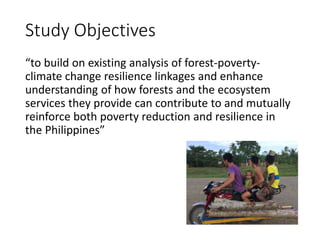
“to build on existing analysis of forest-poverty-
climate change resilience linkages and enhance
understanding of how forests and the ecosystem
services they provide can contribute to and mutually
reinforce both poverty reduction and resilience in
the Philippines”
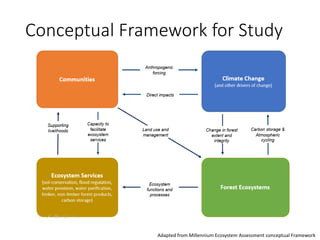
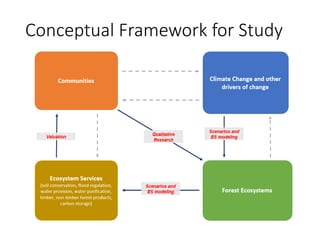
Conceptual Framework for Study
Adapted from Millennium Ecosystem Assessment conceptual Framework
Conceptual Framework for Study
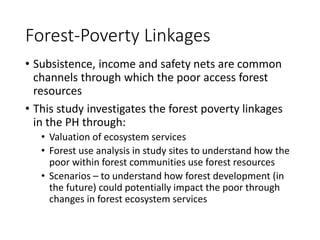
Forest-Poverty Linkages
• Subsistence, income and safety nets are common
channels through which the poor access forest
resources
• This study investigates the forest poverty linkages
in the PH through:
• Valuation of ecosystem services
• Forest use analysis in study sites to understand how the
poor within forest communities use forest resources
• Scenarios – to understand how forest development (in
the future) could potentially impact the poor through
changes in forest ecosystem services
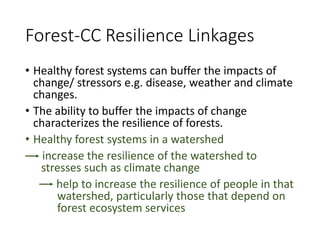
Forest-CC Resilience Linkages
• Healthy forest systems can buffer the impacts of
change/ stressors e.g. disease, weather and climate
changes.
• The ability to buffer the impacts of change
characterizes the resilience of forests.
• Healthy forest systems in a watershed
increase the resilience of the watershed to
stresses such as climate change
help to increase the resilience of people in that
watershed, particularly those that depend on
forest ecosystem services
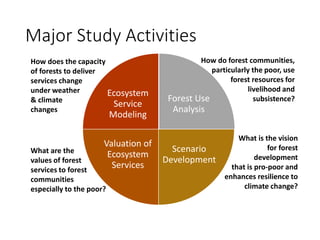
Major Study Activities
Forest Use
Analysis
Scenario
Development
Valuation of
Ecosystem
Services
Ecosystem
Service
Modeling
How do forest communities,
particularly the poor, use
forest resources for
livelihood and
subsistence?
What is the vision
for forest
development
that is pro-poor and
enhances resilience to
climate change?
How does the capacity
of forests to deliver
services change
under weather
& climate
changes
What are the
values of forest
services to forest
communities
especially to the poor?
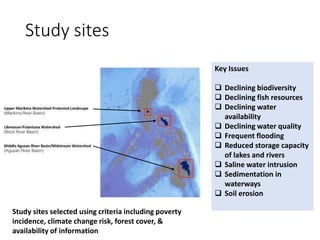
Study sites
Key Issues
 Declining biodiversity
 Declining fish resources
 Declining water
availability
 Declining water quality
 Frequent flooding
 Reduced storage capacity
of lakes and rivers
 Saline water intrusion
 Sedimentation in
waterways
 Soil erosion
Study sites selected using criteria including poverty
incidence, climate change risk, forest cover, &
availability of information
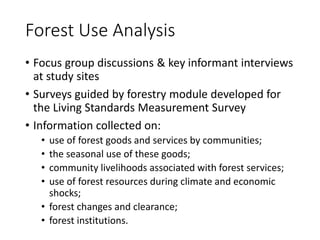
Forest Use Analysis
• Focus group discussions & key informant interviews
at study sites
• Surveys guided by forestry module developed for
the Living Standards Measurement Survey
• Information collected on:
• use of forest goods and services by communities;
• the seasonal use of these goods;
• community livelihoods associated with forest services;
• use of forest resources during climate and economic
shocks;
• forest changes and clearance;
• forest institutions.
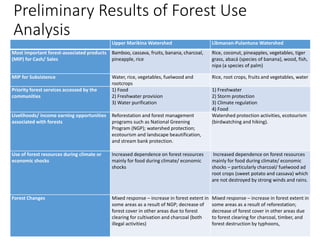
Preliminary Results of Forest Use
Analysis
Upper Marikina Watershed Libmanan-Pulantuna Watershed
Most important forest-associated products
(MIP) for Cash/ Sales
Bamboo, cassava, fruits, banana, charcoal,
pineapple, rice
Rice, coconut, pineapples, vegetables, tiger
grass, abacá (species of banana), wood, fish,
nipa (a species of palm)
MIP for Subsistence Water, rice, vegetables, fuelwood and
rootcrops
Rice, root crops, fruits and vegetables, water
Priority forest services accessed by the
communities
1) Food
2) Freshwater provision
3) Water purification
1) Freshwater
2) Storm protection
3) Climate regulation
4) Food
Livelihoods/ income earning opportunities
associated with forests
Reforestation and forest management
programs such as National Greening
Program (NGP); watershed protection;
ecotourism and landscape beautification,
and stream bank protection.
Watershed protection activities, ecotourism
(birdwatching and hiking).
Use of forest resources during climate or
economic shocks
Increased dependence on forest resources
mainly for food during climate/ economic
shocks
Increased dependence on forest resources
mainly for food during climate/ economic
shocks – particularly charcoal/ fuelwood ad
root crops (sweet potato and cassava) which
are not destroyed by strong winds and rains.
Forest Changes Mixed response – increase in forest extent in
some areas as a result of NGP; decrease of
forest cover in other areas due to forest
clearing for cultivation and charcoal (both
illegal activities)
Mixed response – increase in forest extent in
some areas as a result of reforestation;
decrease of forest cover in other areas due
to forest clearing for charcoal, timber, and
forest destruction by typhoons,
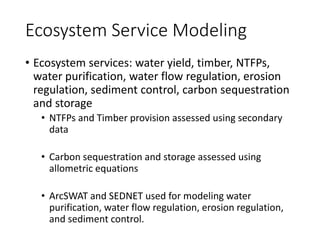
Ecosystem Service Modeling
• Ecosystem services: water yield, timber, NTFPs,
water purification, water flow regulation, erosion
regulation, sediment control, carbon sequestration
and storage
• NTFPs and Timber provision assessed using secondary
data
• Carbon sequestration and storage assessed using
allometric equations
• ArcSWAT and SEDNET used for modeling water
purification, water flow regulation, erosion regulation,
and sediment control.
Ecosystem Service Modeling
• Land cover scenarios integrated with ArcSWAT and
SEDNET
• “Forested Scenario” – complete forest cover across
watershed
• “Conservation Scenario” – all conservation measures in
legislation implemented e.g. riparian forest, forest cover
on steep slopes
• “Agriculture Scenario” – all forest converted to
perennial and annual crops
• “Bare-Urban Scenario” – all forest removed from the
watershed
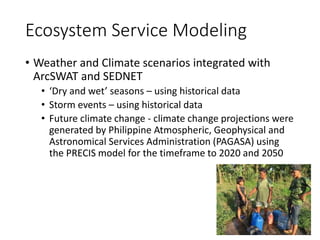
Ecosystem Service Modeling
• Weather and Climate scenarios integrated with
ArcSWAT and SEDNET
• ‘Dry and wet’ seasons – using historical data
• Storm events – using historical data
• Future climate change - climate change projections were
generated by Philippine Atmospheric, Geophysical and
Astronomical Services Administration (PAGASA) using
the PRECIS model for the timeframe to 2020 and 2050
Ecosystem Service Modeling
• A watershed with a greater proportion of forest,
and forests situated in critical areas such as on
steep slopes and within riparian zones:
• For a given storm event, will have a lower peak
discharge, a longer lag time, and lower sediment
generation and sediment flow;
• will have higher levels of stream flow, and less variability
in stream-flow levels over the period of a dry season;
• will have smaller annual variation in water discharge,
and lower sediment generation and sediment flow;
• is more resilient to climate changes as assessed by its
ability to regulate water flows throughout the year
Ecosystem Service Valuation
• Focus on ‘exchange values’
• Similar to SNA 2008 and SEEA 2012 valuation
approach used for Philippines Wealth and the
Valuation of Ecosystem Services project
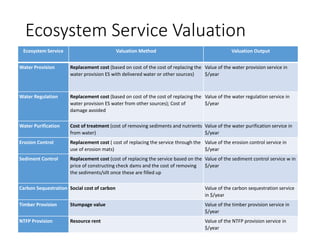
Ecosystem Service Valuation
Ecosystem Service Valuation Method Valuation Output
Water Provision Replacement cost (based on cost of the cost of replacing the
water provision ES with delivered water or other sources)
Value of the water provision service in
$/year
Water Regulation Replacement cost (based on cost of the cost of replacing the
water provision ES water from other sources); Cost of
damage avoided
Value of the water regulation service in
$/year
Water Purification Cost of treatment (cost of removing sediments and nutrients
from water)
Value of the water purification service in
$/year
Erosion Control Replacement cost ( cost of replacing the service through the
use of erosion mats)
Value of the erosion control service in
$/year
Sediment Control Replacement cost (cost of replacing the service based on the
price of constructing check dams and the cost of removing
the sediments/silt once these are filled up
Value of the sediment control service w in
$/year
Carbon Sequestration Social cost of carbon Value of the carbon sequestration service
in $/year
Timber Provision Stumpage value Value of the timber provision service in
$/year
NTFP Provision Resource rent Value of the NTFP provision service in
$/year
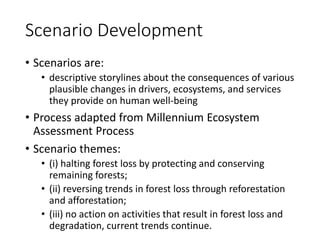
Scenario Development
• Scenarios are:
• descriptive storylines about the consequences of various
plausible changes in drivers, ecosystems, and services
they provide on human well-being
• Process adapted from Millennium Ecosystem
Assessment Process
• Scenario themes:
• (i) halting forest loss by protecting and conserving
remaining forests;
• (ii) reversing trends in forest loss through reforestation
and afforestation;
• (iii) no action on activities that result in forest loss and
degradation, current trends continue.
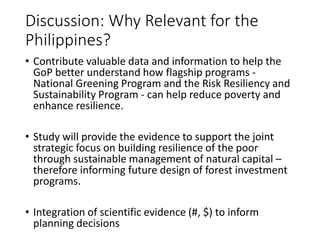
Discussion: Why Relevant for the
Philippines?
• Contribute valuable data and information to help the
GoP better understand how flagship programs -
National Greening Program and the Risk Resiliency and
Sustainability Program - can help reduce poverty and
enhance resilience.
• Study will provide the evidence to support the joint
strategic focus on building resilience of the poor
through sustainable management of natural capital –
therefore informing future design of forest investment
programs.
• Integration of scientific evidence (#, $) to inform
planning decisions
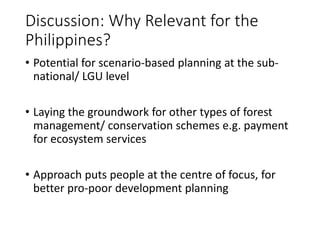
Discussion: Why Relevant for the
Philippines?
• Potential for scenario-based planning at the sub-
national/ LGU level
• Laying the groundwork for other types of forest
management/ conservation schemes e.g. payment
for ecosystem services
• Approach puts people at the centre of focus, for
better pro-poor development planning
Maurice Andres Rawlins
NRM Specialist
Asia-Pacific Forestry Week, Philippines February 24, 2016
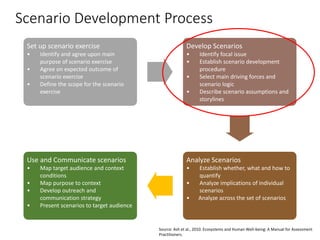
Scenario Development Process
Set up scenario exercise
• Identify and agree upon main
purpose of scenario exercise
• Agree on expected outcome of
scenario exercise
• Define the scope for the scenario
exercise
Develop Scenarios
• Identify focal issue
• Establish scenario development
procedure
• Select main driving forces and
scenario logic
• Describe scenario assumptions and
storylines
Analyze Scenarios
• Establish whether, what and how to
quantify
• Analyze implications of individual
scenarios
• Analyze across the set of scenarios
Use and Communicate scenarios
• Map target audience and context
conditions
• Map purpose to context
• Develop outreach and
communication strategy
• Present scenarios to target audience
Source: Ash et al., 2010. Ecosystems and Human Well-being: A Manual for Assessment
Practitioners.

Knowledge and Innovation for Impact

  • 1.
    and for Maurice Andres Rawlins NRMSpecialist Asia-Pacific Forestry Week, Philippines February 24, 2016 “Assessing the roles of forests in reducing poverty and enhancing climate resilience in the Philippines”
  • 2.
    Study Background • Climatechange and persistent poverty are challenges to Philippine’s development progress. • Climate change is a threat multiplier affecting natural resources, people’s livelihoods, and the economy; poorest and vulnerable being affected most. • Increasing knowledge base on how provisioning ecosystem services support income of the poor. • Limited understanding of how regulating ecosystem services can help enhance the income and climate resilience of the poor.
  • 3.
    Study Objectives “to buildon existing analysis of forest-poverty- climate change resilience linkages and enhance understanding of how forests and the ecosystem services they provide can contribute to and mutually reinforce both poverty reduction and resilience in the Philippines”
  • 4.
    Conceptual Framework forStudy Adapted from Millennium Ecosystem Assessment conceptual Framework
  • 5.
  • 6.
    Forest-Poverty Linkages • Subsistence,income and safety nets are common channels through which the poor access forest resources • This study investigates the forest poverty linkages in the PH through: • Valuation of ecosystem services • Forest use analysis in study sites to understand how the poor within forest communities use forest resources • Scenarios – to understand how forest development (in the future) could potentially impact the poor through changes in forest ecosystem services
  • 7.
    Forest-CC Resilience Linkages •Healthy forest systems can buffer the impacts of change/ stressors e.g. disease, weather and climate changes. • The ability to buffer the impacts of change characterizes the resilience of forests. • Healthy forest systems in a watershed increase the resilience of the watershed to stresses such as climate change help to increase the resilience of people in that watershed, particularly those that depend on forest ecosystem services
  • 8.
    Major Study Activities ForestUse Analysis Scenario Development Valuation of Ecosystem Services Ecosystem Service Modeling How do forest communities, particularly the poor, use forest resources for livelihood and subsistence? What is the vision for forest development that is pro-poor and enhances resilience to climate change? How does the capacity of forests to deliver services change under weather & climate changes What are the values of forest services to forest communities especially to the poor?
  • 9.
    Study sites Key Issues Declining biodiversity  Declining fish resources  Declining water availability  Declining water quality  Frequent flooding  Reduced storage capacity of lakes and rivers  Saline water intrusion  Sedimentation in waterways  Soil erosion Study sites selected using criteria including poverty incidence, climate change risk, forest cover, & availability of information
  • 10.
    Forest Use Analysis •Focus group discussions & key informant interviews at study sites • Surveys guided by forestry module developed for the Living Standards Measurement Survey • Information collected on: • use of forest goods and services by communities; • the seasonal use of these goods; • community livelihoods associated with forest services; • use of forest resources during climate and economic shocks; • forest changes and clearance; • forest institutions.
  • 11.
    Preliminary Results ofForest Use Analysis Upper Marikina Watershed Libmanan-Pulantuna Watershed Most important forest-associated products (MIP) for Cash/ Sales Bamboo, cassava, fruits, banana, charcoal, pineapple, rice Rice, coconut, pineapples, vegetables, tiger grass, abacá (species of banana), wood, fish, nipa (a species of palm) MIP for Subsistence Water, rice, vegetables, fuelwood and rootcrops Rice, root crops, fruits and vegetables, water Priority forest services accessed by the communities 1) Food 2) Freshwater provision 3) Water purification 1) Freshwater 2) Storm protection 3) Climate regulation 4) Food Livelihoods/ income earning opportunities associated with forests Reforestation and forest management programs such as National Greening Program (NGP); watershed protection; ecotourism and landscape beautification, and stream bank protection. Watershed protection activities, ecotourism (birdwatching and hiking). Use of forest resources during climate or economic shocks Increased dependence on forest resources mainly for food during climate/ economic shocks Increased dependence on forest resources mainly for food during climate/ economic shocks – particularly charcoal/ fuelwood ad root crops (sweet potato and cassava) which are not destroyed by strong winds and rains. Forest Changes Mixed response – increase in forest extent in some areas as a result of NGP; decrease of forest cover in other areas due to forest clearing for cultivation and charcoal (both illegal activities) Mixed response – increase in forest extent in some areas as a result of reforestation; decrease of forest cover in other areas due to forest clearing for charcoal, timber, and forest destruction by typhoons,
  • 12.
    Ecosystem Service Modeling •Ecosystem services: water yield, timber, NTFPs, water purification, water flow regulation, erosion regulation, sediment control, carbon sequestration and storage • NTFPs and Timber provision assessed using secondary data • Carbon sequestration and storage assessed using allometric equations • ArcSWAT and SEDNET used for modeling water purification, water flow regulation, erosion regulation, and sediment control.
  • 13.
    Ecosystem Service Modeling •Land cover scenarios integrated with ArcSWAT and SEDNET • “Forested Scenario” – complete forest cover across watershed • “Conservation Scenario” – all conservation measures in legislation implemented e.g. riparian forest, forest cover on steep slopes • “Agriculture Scenario” – all forest converted to perennial and annual crops • “Bare-Urban Scenario” – all forest removed from the watershed
  • 14.
    Ecosystem Service Modeling •Weather and Climate scenarios integrated with ArcSWAT and SEDNET • ‘Dry and wet’ seasons – using historical data • Storm events – using historical data • Future climate change - climate change projections were generated by Philippine Atmospheric, Geophysical and Astronomical Services Administration (PAGASA) using the PRECIS model for the timeframe to 2020 and 2050
  • 15.
    Ecosystem Service Modeling •A watershed with a greater proportion of forest, and forests situated in critical areas such as on steep slopes and within riparian zones: • For a given storm event, will have a lower peak discharge, a longer lag time, and lower sediment generation and sediment flow; • will have higher levels of stream flow, and less variability in stream-flow levels over the period of a dry season; • will have smaller annual variation in water discharge, and lower sediment generation and sediment flow; • is more resilient to climate changes as assessed by its ability to regulate water flows throughout the year
  • 16.
    Ecosystem Service Valuation •Focus on ‘exchange values’ • Similar to SNA 2008 and SEEA 2012 valuation approach used for Philippines Wealth and the Valuation of Ecosystem Services project
  • 17.
    Ecosystem Service Valuation EcosystemService Valuation Method Valuation Output Water Provision Replacement cost (based on cost of the cost of replacing the water provision ES with delivered water or other sources) Value of the water provision service in $/year Water Regulation Replacement cost (based on cost of the cost of replacing the water provision ES water from other sources); Cost of damage avoided Value of the water regulation service in $/year Water Purification Cost of treatment (cost of removing sediments and nutrients from water) Value of the water purification service in $/year Erosion Control Replacement cost ( cost of replacing the service through the use of erosion mats) Value of the erosion control service in $/year Sediment Control Replacement cost (cost of replacing the service based on the price of constructing check dams and the cost of removing the sediments/silt once these are filled up Value of the sediment control service w in $/year Carbon Sequestration Social cost of carbon Value of the carbon sequestration service in $/year Timber Provision Stumpage value Value of the timber provision service in $/year NTFP Provision Resource rent Value of the NTFP provision service in $/year
  • 18.
    Scenario Development • Scenariosare: • descriptive storylines about the consequences of various plausible changes in drivers, ecosystems, and services they provide on human well-being • Process adapted from Millennium Ecosystem Assessment Process • Scenario themes: • (i) halting forest loss by protecting and conserving remaining forests; • (ii) reversing trends in forest loss through reforestation and afforestation; • (iii) no action on activities that result in forest loss and degradation, current trends continue.
  • 19.
    Discussion: Why Relevantfor the Philippines? • Contribute valuable data and information to help the GoP better understand how flagship programs - National Greening Program and the Risk Resiliency and Sustainability Program - can help reduce poverty and enhance resilience. • Study will provide the evidence to support the joint strategic focus on building resilience of the poor through sustainable management of natural capital – therefore informing future design of forest investment programs. • Integration of scientific evidence (#, $) to inform planning decisions
  • 20.
    Discussion: Why Relevantfor the Philippines? • Potential for scenario-based planning at the sub- national/ LGU level • Laying the groundwork for other types of forest management/ conservation schemes e.g. payment for ecosystem services • Approach puts people at the centre of focus, for better pro-poor development planning
  • 21.
    Maurice Andres Rawlins NRMSpecialist Asia-Pacific Forestry Week, Philippines February 24, 2016
  • 22.
    Scenario Development Process Setup scenario exercise • Identify and agree upon main purpose of scenario exercise • Agree on expected outcome of scenario exercise • Define the scope for the scenario exercise Develop Scenarios • Identify focal issue • Establish scenario development procedure • Select main driving forces and scenario logic • Describe scenario assumptions and storylines Analyze Scenarios • Establish whether, what and how to quantify • Analyze implications of individual scenarios • Analyze across the set of scenarios Use and Communicate scenarios • Map target audience and context conditions • Map purpose to context • Develop outreach and communication strategy • Present scenarios to target audience Source: Ash et al., 2010. Ecosystems and Human Well-being: A Manual for Assessment Practitioners.