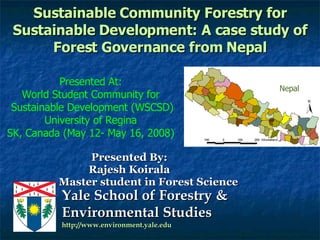
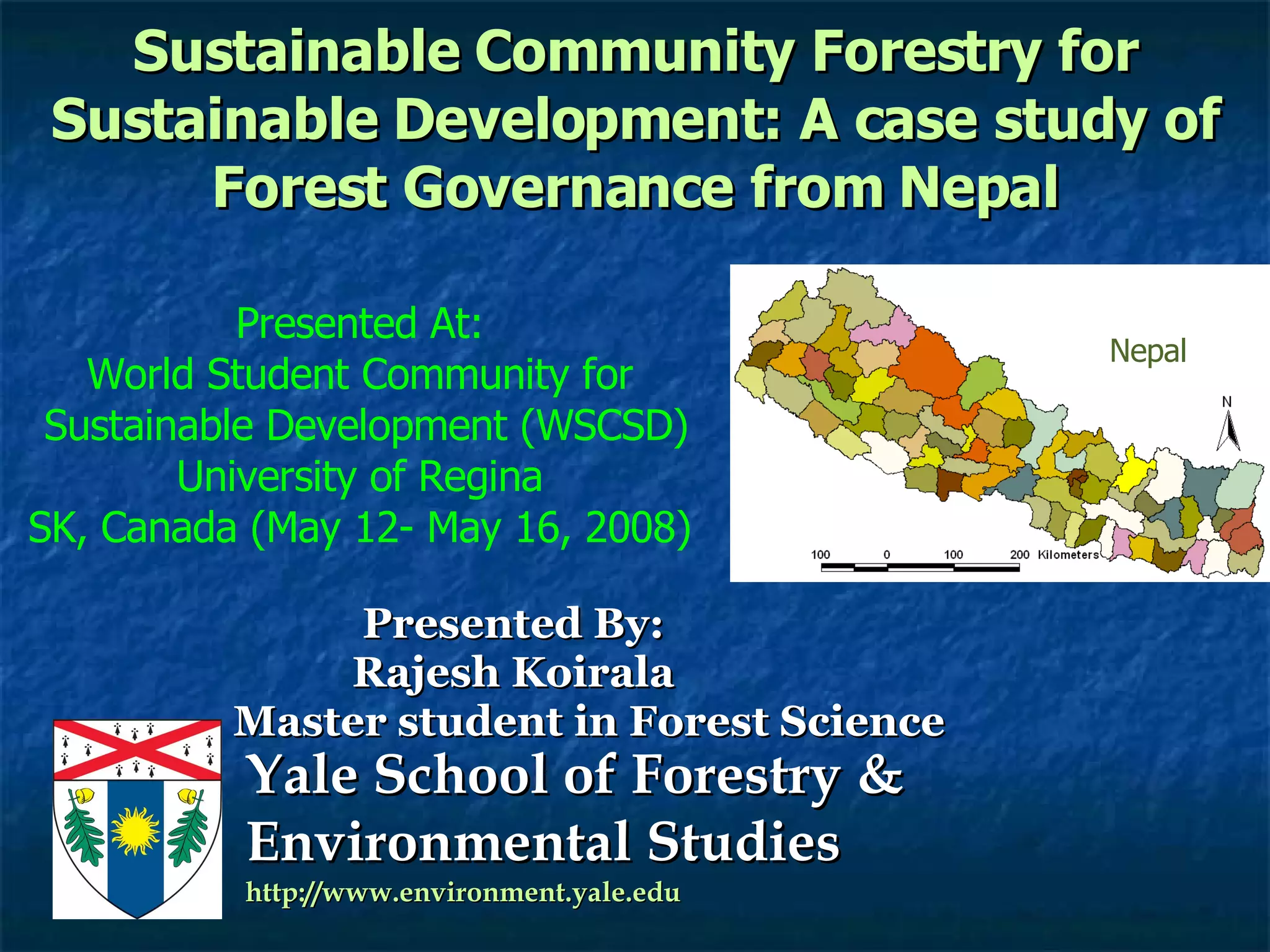

Sustainable Community Forestry for Sustainable Development: A case study of Forest Governance from Nepal Presented By: Rajesh Koirala Master student in Forest Science Presented At: World Student Community for Sustainable Development (WSCSD) University of Regina SK, Canada (May 12- May 16, 2008) Nepal
Presentation Outline Introduction Achievements Forest Governance  Sustainable Forest Management Livelihood and Sustainability Conclusion References Acknowledgement Questions
Introduction  Development of Community Forestry in Nepal: From basic needs to MDGs Part of the national forest handed over to a group of people called a Community Forest User Group for its  protection ,  management  and  utilization  as per the provisions developed in the operational plan Steps:  Recognition of Users, Formation of  Community Forest User  Group (CFUG)  and  Community Forest User Committee (CFUC),  Development of a Constitution & an operational plan, Approval of the operational plan, Monitoring & Evaluation of the Operational plan and Revision.
Industrial Development model, Forest  Nationalization Act, 1957 National Forest Plan (1976) - Panchayat Forest and Panchayat Protected Forest First/second national workshop on community forestry-basic needs Master Plan for Forestry Sector (MPFS), 1978 Forest Act (1993) & Forest regulation (1995) Third national workshop (1998) on community forestry-  social justice, equity, gender balance and good governance
1,640,239 households ( 35% of total population  of Nepal) of 14,258 Forest User Groups (600 only women user groups) are managing the 1,187,000 ha forest ( 25% of total forest ) of Nepal  (Kanel, 2004)   In 2002, the annual income of the Department of Forest was Nepalese Rupees (NRs)  550 million  with a total budget of 680 million, but the community forest  (25% of the total forest)  earned more than  740 million   (Kanel, 2004)  Fourth national workshop on Community Forestry (2004)-  Sustainable Development (SD),   Millennium Development Goals (MDG)
Achievements: 1. Good Forest Governance A broad term with enough flexibility for contextual differences for different purposes  Exercise of power, decision making system, and implementation in Forest User Groups (CFUG) For poor and marginalized people: opportunity for their involvement in public policy  greater likelihood of being treated equally by the law, more space to associate and pursue interests,  better chance of bureaucrats behaving responsibly towards them  (Pokharel & Grosen, 2000).
Indicators  of Good Forest Governance  (RECOFTC, 2001)  rule of law, compliance with rules and decisions,  transparency, accountability,  decentralization and devolution of power and authority,  defined roles and responsibilities,  participatory decision-making,  gender sensitivity, equity,  representation and user balance,  bi-directional flow of information horizontally and vertically
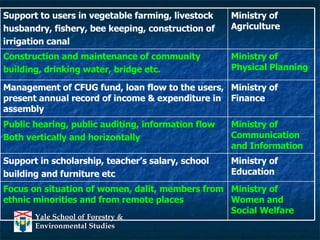
contd. Studies reflecting good forest governance  (Branney and Yadav, 1998; Malla, 2000; Pokharel, 2003; Pokharel, 2004;  Pokharel, 2005) CFUGs functioning as a small nation delivering services analogous to 16 ministries of a country  (Pokharel, 2005)
Ministry of Education Support in scholarship, teacher’s salary, school  building and furniture etc   Ministry of Women and Social Welfare Focus on situation of women, dalit, members from ethnic minorities and from remote places  Ministry of Communication and Information Public hearing, public auditing, information flow  Both vertically and horizontally  Ministry of Finance Management of CFUG fund, loan flow to the users, present annual record of income & expenditure in assembly  Ministry of Physical Planning   Construction and maintenance of community  building, drinking water, bridge etc. Ministry of Agriculture   Support to users in vegetable farming, livestock  husbandry, fishery, bee keeping, construction of  irrigation canal
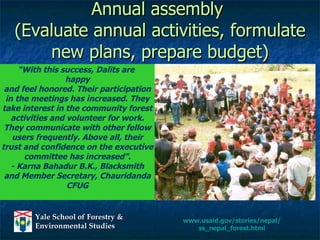
Annual assembly  (Evaluate annual activities, formulate new plans, prepare budget) “ With this success, Dalits are  happy and feel honored. Their participation in the meetings has increased. They take interest in the community forest activities and volunteer for work. They communicate with other fellow users frequently. Above all, their trust and confidence on the executive committee has increased”. - Karna Bahadur B.K., Blacksmith and Member Secretary, Chauridanda CFUG www.usaid.gov/stories/nepal/ ss_nepal_forest.html
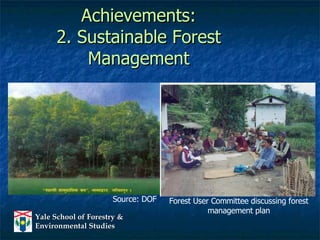
Achievements: 2. Sustainable Forest Management Forest User Committee discussing forest  management plan  Source: DOF
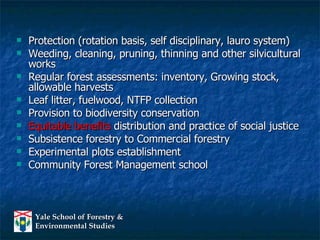
Protection (rotation basis, self disciplinary, lauro system) Weeding, cleaning, pruning, thinning and other silvicultural works Regular forest assessments: inventory, Growing stock, allowable harvests Leaf litter, fuelwood, NTFP collection Provision to biodiversity conservation Equitable benefits  distribution and practice of social justice Subsistence forestry to Commercial forestry Experimental plots establishment Community Forest Management school
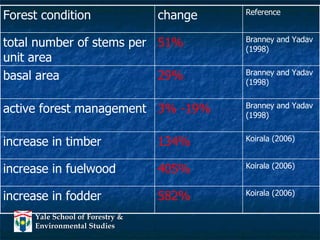
Reference change Forest condition Koirala (2006)  405% increase in fuelwood Koirala (2006)  582% increase in fodder Koirala (2006)  134% increase in timber Branney and Yadav (1998)  3% -19% active forest management  Branney and Yadav (1998)  29%  basal area  Branney and Yadav (1998)  51%  total number of stems per unit area
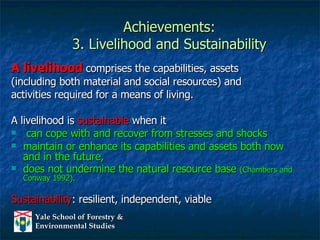
Achievements: 3. Livelihood and Sustainability A livelihood  comprises the capabilities, assets  (including both material and social resources) and  activities required for a means of living.  A livelihood is  sustainable  when it can cope with and recover from stresses and shocks  maintain or enhance its capabilities and assets both now and in the future,  does not undermine the natural resource base  (Chambers and Conway 1992). Sustainability : resilient, independent, viable
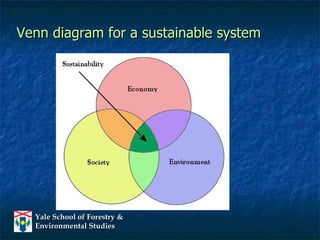
Venn diagram for a sustainable system
Environmental sustainability   productivity of life-supporting natural resources is  maintained for future generations Economic sustainability  level of expenditure can be sustained over time Social sustainability  social exclusion minimized and social equity and  social cohesion maximized Institutional sustainability   potentiality of current structures and processes  capable of functioning over long term
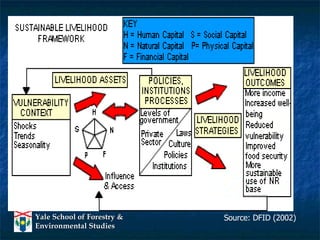
Source: DFID (2002)
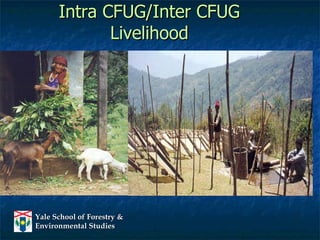
Livelihood approaches in CF: Livelihood capital generation (Natural capital, Physical, Financial, social) Well being ranking (criteria- Livelihood capitals) Intra CFUG enterprises (Bamboo, sal leaves, bee keeping, goat keeping) Inter CFUG enterprises (Paper making, juice making) NSCFP’s FREELIFE approach
Intra CFUG/Inter CFUG Livelihood
Conclusion World's poorest country- global leader in engaging communities in forest management  (World Bank, 2001) Crucial factors for the success of Community Forestry dynamic and adaptive nature of the program restructuring and reformulation of policy devolution of authority to local communities   Concepts replicated in buffer zone management and watershed management To achieve national goal of poverty alleviation and global goal of sustainable development:  good forest governance sustainable forest management  livelihood
References Bhattacharya, A.K. and Basnyat, B. 2003 . An analytical study of operational plans and constitution of Community Forests User Groups at Nepal’s Western Terai. Banko Jankari, 13 (1): 3-14.  Branney, P. and Yadav, K.P. 1998.  Changes in Community Forestry Condition and Management 1994-98: Analysis of Information for the Forest Resource Assessment Study and Socio-Economic Study of the Koshi Hills. Project report G/NUKCFP/32, NUKCFP, Kathmandu. DFID. 2000.  Sustainable Livelihoods Guidance Sheets. Department for International Develoment. www.livelihood.org/info/info_guidancesheets.htm Accessed on February 11, 2006. Gilmour, D. A. and Fisher, R. J. 1991.  Villagers, Forests and Foresters: The Philosophy, Process and Practice of community forestry in Nepal. Kathmandu: Sahayogi Press. Kanel, K. R. 2004.  Twenty-five Years of Community Forestry: contribution to millennium Development Goals. In (eds) Kanel, K. S., Mathema, P., Kanel, B.R., Niaurla, D. R., Sharma, A. R., and Gautam, M. Proceeding of the Fourth workshop on community Forestry, Dec. 2004.  Community Forestry Division, DOF, Kathmandu, Nepal Koirala , R. 2006.  Forest Governance: Gender, Poverty and Social Equity Perspective. A Case Study from Community Forest User Groups of Dolakha District. A Project Paper submitted as a Partial Fulfillment of the Requirement for the Degree of Bachelor of Science in Forestry, Tribhuvan University Institute of Forestry, Pokhara Campus, Nepal (unpublished) Malla, Y.B. 2000.  Impact of Community Forestry Policy on Rural Livelihoods and Food Security in Nepal. Unasylva, 51 (202):37-45. Pokharel, B. K. 2004.  Contribution of Community Forestry to People’s Livelihoods and Forest Sustainability: Experience from Nepal. World Rain Forest Movement, Montevideo, Uruguay. http://www.wrm.org.uy/countries/Asia/Nepal.html (Access date March 5, 2008) Pokharel, B. K. 2005.  Community Forest User Groups: Institution to protect Democracy and vehicle for local Development. Journal of Forest and Livelihood, 4(2): 64 RECOFTC. 2001.  International Conference on Advancing Community Forestry: Innovations and Experiences.  Chiang Mai, Thailand. www.recoftc.org(Accessed on 25th Dec.2005) World Bank. 2001.  Community Forestry in Nepal. World Bank Operations Evaluation Department. Precis, 217: 1-4.
Acknowledgement Nnaemeka (Meka) Okochi, Kristina Nelson and all members of Organizing Committee of the Student Summit for Sustainability,  World Student Community for Sustainable Development (WSCSD), University of Regina, SK, Canada   Prof. Tim Gregoire, Prof. Mark Ashton, Prof. Graeme Berlyn Yale University, School of Forestry and Environmental Studies Dr. Bharat Kr. Pokharel (Nepal Swiss Community Forestry Project) All my SFES friends All the Conference participants
 

Koirala

  • 1.
    Sustainable Community Forestryfor Sustainable Development: A case study of Forest Governance from Nepal Presented By: Rajesh Koirala Master student in Forest Science Presented At: World Student Community for Sustainable Development (WSCSD) University of Regina SK, Canada (May 12- May 16, 2008) Nepal
  • 2.
    Presentation Outline IntroductionAchievements Forest Governance Sustainable Forest Management Livelihood and Sustainability Conclusion References Acknowledgement Questions
  • 3.
    Introduction Developmentof Community Forestry in Nepal: From basic needs to MDGs Part of the national forest handed over to a group of people called a Community Forest User Group for its protection , management and utilization as per the provisions developed in the operational plan Steps: Recognition of Users, Formation of Community Forest User Group (CFUG) and Community Forest User Committee (CFUC), Development of a Constitution & an operational plan, Approval of the operational plan, Monitoring & Evaluation of the Operational plan and Revision.
  • 4.
    Industrial Development model,Forest Nationalization Act, 1957 National Forest Plan (1976) - Panchayat Forest and Panchayat Protected Forest First/second national workshop on community forestry-basic needs Master Plan for Forestry Sector (MPFS), 1978 Forest Act (1993) & Forest regulation (1995) Third national workshop (1998) on community forestry- social justice, equity, gender balance and good governance
  • 5.
    1,640,239 households (35% of total population of Nepal) of 14,258 Forest User Groups (600 only women user groups) are managing the 1,187,000 ha forest ( 25% of total forest ) of Nepal (Kanel, 2004) In 2002, the annual income of the Department of Forest was Nepalese Rupees (NRs) 550 million with a total budget of 680 million, but the community forest (25% of the total forest) earned more than 740 million (Kanel, 2004) Fourth national workshop on Community Forestry (2004)- Sustainable Development (SD), Millennium Development Goals (MDG)
  • 6.
    Achievements: 1. GoodForest Governance A broad term with enough flexibility for contextual differences for different purposes Exercise of power, decision making system, and implementation in Forest User Groups (CFUG) For poor and marginalized people: opportunity for their involvement in public policy greater likelihood of being treated equally by the law, more space to associate and pursue interests, better chance of bureaucrats behaving responsibly towards them (Pokharel & Grosen, 2000).
  • 7.
    Indicators ofGood Forest Governance (RECOFTC, 2001) rule of law, compliance with rules and decisions, transparency, accountability, decentralization and devolution of power and authority, defined roles and responsibilities, participatory decision-making, gender sensitivity, equity, representation and user balance, bi-directional flow of information horizontally and vertically
  • 8.
    contd. Studies reflectinggood forest governance (Branney and Yadav, 1998; Malla, 2000; Pokharel, 2003; Pokharel, 2004; Pokharel, 2005) CFUGs functioning as a small nation delivering services analogous to 16 ministries of a country (Pokharel, 2005)
  • 9.
    Ministry of EducationSupport in scholarship, teacher’s salary, school building and furniture etc Ministry of Women and Social Welfare Focus on situation of women, dalit, members from ethnic minorities and from remote places Ministry of Communication and Information Public hearing, public auditing, information flow Both vertically and horizontally Ministry of Finance Management of CFUG fund, loan flow to the users, present annual record of income & expenditure in assembly Ministry of Physical Planning Construction and maintenance of community building, drinking water, bridge etc. Ministry of Agriculture Support to users in vegetable farming, livestock husbandry, fishery, bee keeping, construction of irrigation canal
  • 10.
    Annual assembly (Evaluate annual activities, formulate new plans, prepare budget) “ With this success, Dalits are happy and feel honored. Their participation in the meetings has increased. They take interest in the community forest activities and volunteer for work. They communicate with other fellow users frequently. Above all, their trust and confidence on the executive committee has increased”. - Karna Bahadur B.K., Blacksmith and Member Secretary, Chauridanda CFUG www.usaid.gov/stories/nepal/ ss_nepal_forest.html
  • 11.
    Achievements: 2. SustainableForest Management Forest User Committee discussing forest management plan Source: DOF
  • 12.
    Protection (rotation basis,self disciplinary, lauro system) Weeding, cleaning, pruning, thinning and other silvicultural works Regular forest assessments: inventory, Growing stock, allowable harvests Leaf litter, fuelwood, NTFP collection Provision to biodiversity conservation Equitable benefits distribution and practice of social justice Subsistence forestry to Commercial forestry Experimental plots establishment Community Forest Management school
  • 13.
    Reference change Forestcondition Koirala (2006) 405% increase in fuelwood Koirala (2006) 582% increase in fodder Koirala (2006) 134% increase in timber Branney and Yadav (1998) 3% -19% active forest management Branney and Yadav (1998) 29% basal area Branney and Yadav (1998) 51% total number of stems per unit area
  • 14.
    Achievements: 3. Livelihoodand Sustainability A livelihood comprises the capabilities, assets (including both material and social resources) and activities required for a means of living. A livelihood is sustainable when it can cope with and recover from stresses and shocks maintain or enhance its capabilities and assets both now and in the future, does not undermine the natural resource base (Chambers and Conway 1992). Sustainability : resilient, independent, viable
  • 15.
    Venn diagram fora sustainable system
  • 16.
    Environmental sustainability productivity of life-supporting natural resources is maintained for future generations Economic sustainability level of expenditure can be sustained over time Social sustainability social exclusion minimized and social equity and social cohesion maximized Institutional sustainability potentiality of current structures and processes capable of functioning over long term
  • 17.
  • 18.
    Livelihood approaches inCF: Livelihood capital generation (Natural capital, Physical, Financial, social) Well being ranking (criteria- Livelihood capitals) Intra CFUG enterprises (Bamboo, sal leaves, bee keeping, goat keeping) Inter CFUG enterprises (Paper making, juice making) NSCFP’s FREELIFE approach
  • 19.
  • 20.
    Conclusion World's poorestcountry- global leader in engaging communities in forest management (World Bank, 2001) Crucial factors for the success of Community Forestry dynamic and adaptive nature of the program restructuring and reformulation of policy devolution of authority to local communities Concepts replicated in buffer zone management and watershed management To achieve national goal of poverty alleviation and global goal of sustainable development: good forest governance sustainable forest management livelihood
  • 21.
    References Bhattacharya, A.K.and Basnyat, B. 2003 . An analytical study of operational plans and constitution of Community Forests User Groups at Nepal’s Western Terai. Banko Jankari, 13 (1): 3-14. Branney, P. and Yadav, K.P. 1998. Changes in Community Forestry Condition and Management 1994-98: Analysis of Information for the Forest Resource Assessment Study and Socio-Economic Study of the Koshi Hills. Project report G/NUKCFP/32, NUKCFP, Kathmandu. DFID. 2000. Sustainable Livelihoods Guidance Sheets. Department for International Develoment. www.livelihood.org/info/info_guidancesheets.htm Accessed on February 11, 2006. Gilmour, D. A. and Fisher, R. J. 1991. Villagers, Forests and Foresters: The Philosophy, Process and Practice of community forestry in Nepal. Kathmandu: Sahayogi Press. Kanel, K. R. 2004. Twenty-five Years of Community Forestry: contribution to millennium Development Goals. In (eds) Kanel, K. S., Mathema, P., Kanel, B.R., Niaurla, D. R., Sharma, A. R., and Gautam, M. Proceeding of the Fourth workshop on community Forestry, Dec. 2004. Community Forestry Division, DOF, Kathmandu, Nepal Koirala , R. 2006. Forest Governance: Gender, Poverty and Social Equity Perspective. A Case Study from Community Forest User Groups of Dolakha District. A Project Paper submitted as a Partial Fulfillment of the Requirement for the Degree of Bachelor of Science in Forestry, Tribhuvan University Institute of Forestry, Pokhara Campus, Nepal (unpublished) Malla, Y.B. 2000. Impact of Community Forestry Policy on Rural Livelihoods and Food Security in Nepal. Unasylva, 51 (202):37-45. Pokharel, B. K. 2004. Contribution of Community Forestry to People’s Livelihoods and Forest Sustainability: Experience from Nepal. World Rain Forest Movement, Montevideo, Uruguay. http://www.wrm.org.uy/countries/Asia/Nepal.html (Access date March 5, 2008) Pokharel, B. K. 2005. Community Forest User Groups: Institution to protect Democracy and vehicle for local Development. Journal of Forest and Livelihood, 4(2): 64 RECOFTC. 2001. International Conference on Advancing Community Forestry: Innovations and Experiences. Chiang Mai, Thailand. www.recoftc.org(Accessed on 25th Dec.2005) World Bank. 2001. Community Forestry in Nepal. World Bank Operations Evaluation Department. Precis, 217: 1-4.
  • 22.
    Acknowledgement Nnaemeka (Meka)Okochi, Kristina Nelson and all members of Organizing Committee of the Student Summit for Sustainability, World Student Community for Sustainable Development (WSCSD), University of Regina, SK, Canada Prof. Tim Gregoire, Prof. Mark Ashton, Prof. Graeme Berlyn Yale University, School of Forestry and Environmental Studies Dr. Bharat Kr. Pokharel (Nepal Swiss Community Forestry Project) All my SFES friends All the Conference participants
  • 23.