
Update on Current HR Issues 


                               1
Workplace Accommodation: Duty of 
Employers vs. Employees 
Presenter: Cristina Wendel
           Partner
           Employment & Labour


                                    2
What is Workplace Accommodation?
• Workplace accommodation is the requirement to make 
  reasonable changes and adjustments to the workplace to 
  avoid a negative impact on an employee in relation to a 
  protected ground

• The purpose is to ensure equal treatment to employees 
  without discrimination


                                                             3
What are the Employer’s Duties in the 
Workplace Accommodation Process?

• Employers have the primary duty and responsibility to make 
  reasonable efforts to the point of undue hardship to 
  accommodate employees who face barriers and discrimination 
  in their employment based on the protected grounds


                                                            4
What is Involved in Satisfying the 
Employer’s Duties?
• Initiating the accommodation process
• Determining if or how the employee can be accommodated
• Reviewing/requesting/obtaining appropriate medical 
  information
• Discussing accommodation options with the employee
• Considering the employee’s reasonable concerns and 
  suggestions regarding accommodation
• Implementing accommodation


                                                           5
What is Involved in Satisfying the 
Employer’s Duties?
• Training and managing staff – management, supervisors and 
  coworkers
• Treating the employee with respect and dignity
• Respecting the employee’s privacy
• Being flexible and creative when developing accommodation 
  options
• Having ongoing follow‐up and flexibility
• Justifying a refusal to accommodate


                                                               6
What are the Employee’s Duties in the 
Workplace Accommodation Process?
• An employee seeking accommodation in the workplace has the 
  duty to:
  – Inform the employer of the need for accommodation
  – Provide the employer with sufficient information to substantiate the 
    need for accommodation and to enable the employer to develop 
    reasonable accommodation
  – Actively participate and cooperate with the employer in the 
    accommodation process
  – Facilitate the implementation of a reasonable accommodation 
    proposal 
  – Accept reasonable accommodation


                                                                            7
What Role do Unions Play in the 
Workplace Accommodation Process?
• May share the employer’s responsibility to provide reasonable 
  accommodation
• Cannot rely on the collective agreement to avoid the duty to 
  accommodate
• May be in breach of human rights obligations if they sign a 
  collective agreement containing a discriminatory clause or if 
  they stand in the way of a reasonable accommodation 
  proposal


                                                                   8
To What Extent is Workplace 
Accommodation Required?

• Accommodation is required to the point of undue hardship.

• What is undue hardship?
   – No clear definition
   – Case by case basis
   – The hardship must be substantial – i.e. some degree of hardship is 
     acceptable


                                                                           9
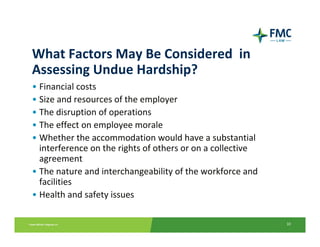
What Factors May Be Considered  in 
Assessing Undue Hardship?
• Financial costs
• Size and resources of the employer
• The disruption of operations
• The effect on employee morale
• Whether the accommodation would have a substantial 
  interference on the rights of others or on a collective 
  agreement
• The nature and interchangeability of the workforce and 
  facilities
• Health and safety issues

                                                             10
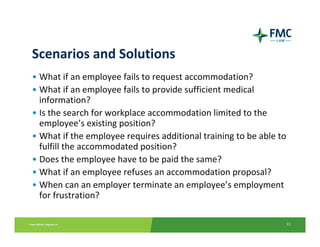
Scenarios and Solutions
• What if an employee fails to request accommodation?
• What if an employee fails to provide sufficient medical 
  information?
• Is the search for workplace accommodation limited to the 
  employee’s existing position?
• What if the employee requires additional training to be able to 
  fulfill the accommodated position?
• Does the employee have to be paid the same?
• What if an employee refuses an accommodation proposal?
• When can an employer terminate an employee’s employment 
  for frustration? 

                                                                 11
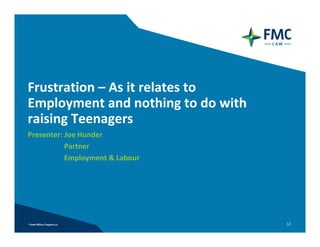
Frustration – As it relates to 
Employment and nothing to do with 
raising Teenagers
Presenter: Joe Hunder 
           Partner
           Employment & Labour


                                     12
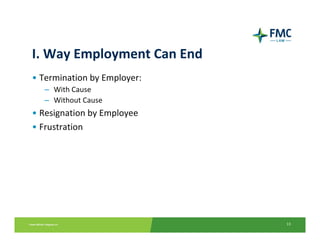
I. Way Employment Can End
• Termination by Employer:
  – With Cause
  – Without Cause
• Resignation by Employee
• Frustration


                             13
II. Doctrine of Frustration explained in the 
context of Employment


                                            14
Frustration – How does it arise in 
Employment?

• In Alberta each employment relationship is based on the law 
  of contract.

• Frustration is a legal doctrine that can bring about the end of 
  any contractual relationship.


                                                                     15
Significance of Frustration
• No obligation to provide notice or pay in lieu of notice.

• Obligation to accommodate may be discharged as employer is 
  likely at the point of undue hardship.


                                                                16
What is Frustration? Legal Definition
• Frustration occurs when:
    – There is a change of circumstances;
    – The change is both unforeseen and not reasonably foreseeable;
    – The change of circumstances renders the effect of the contract completely 
      different from what the parties intended or anticipated.


• [P]ut shortly frustration …[occurs] when the events and facts on which it is 
  founded have destroyed the subject matter of the contract, or have, by an 
  interruption of performance thereunder so critical or protracted as to bring 
  an end in a full and fair sense the contract as a whole, so superseded that it 
  can be truly affirmed that no resumption is reasonably possible.
a) [Lord Strathcona Steamship Co. v. Dominion Coal Co. [1926] A.C. 108 (P.C.)]


                                                                                   17
Events that could be considered 
Frustration 
• Any critical supervening event of prolonged duration not 
  within the contemplation of the parties and through no fault 
  of the parties makes the employment contract incapable of 
  being performed and which radically alters the original 
  agreement:
   – Death
   – Loss of a designation/qualification
• Most commonly arises in the context of an employee suffering 
  a permanent disabling illness/disability.


                                                                  18
III. Frustration in Illness/Disability Cases

• The Central Question:

   – Is the employee suffering from a permanent disabling illness/condition 
     which ought to bring about the end of the employment contract?


                                                                           19
Frustration in Illness/Disability Cases
• What is permanent?

• How long must an employee be off work?


                                           20
Frustration in Illness/Disability Cases
• Employer needs to be satisfied on solid and documented 
  evidence that the employee’s illness/condition is permanent.

• Permanent:  Continuing or enduring without marked change in 
  status or condition.

• An employee being in receipt of long term disability benefits 
  will not be enough to make the determination that an 
  employee has a permanent illness/condition.


                                                                   21
Frustration in Illness/Disability Cases
• How long must an employee be off work? 

  – Fact driven inquiry into whether an employee’s condition/illness is 
    permanent.  This will depend on the circumstances.

  – Usually long period of time (in excess of 2 – 3 years).


                                                                           22
IV.  Take Aways
• Employment relationship can end through contractual 
  frustration.

• When employment contract is frustrated employer relieved of 
  providing notice/pay in lieu of notice and duty to 
  accommodate can be discharged.

• Key is determining whether employee is suffering from a 
  permanent illness/condition.

• Do not assume condition is permanent.

                                                             23
Social Media Background Checks


Presenter: Alison Walsh
           Associate
           Employment & Labour


                                 24
What is a social media background check?
• Social media background checks include:
   – Searches conducted by HR on prospective employees by searching 
     social mediate sites such as Facebook, Twitter, Linkedin or Blogs, etc; 
     or 
   – Hiring a professional screening companies to perform background 
     checks.
• Section 33 of the Personal Information Protection Act (PIPA):
   – When employers search for information about prospective employees, 
     the collection, use and disclose of that information is subject to the 
     privacy provisions of PIPA.


                                                                                25
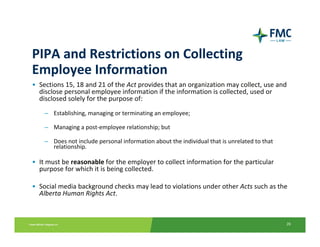
PIPA and Restrictions on Collecting 
Employee Information
• Sections 15, 18 and 21 of the Act provides that an organization may collect, use and 
  disclose personal employee information if the information is collected, used or 
  disclosed solely for the purpose of:
    – Establishing, managing or terminating an employee;

    – Managing a post‐employee relationship; but

    – Does not include personal information about the individual that is unrelated to that 
      relationship.

• It must be reasonable for the employer to collect information for the particular 
  purpose for which it is being collected.  

• Social media background checks may lead to violations under other Acts such as the 
  Alberta Human Rights Act. 


                                                                                              26
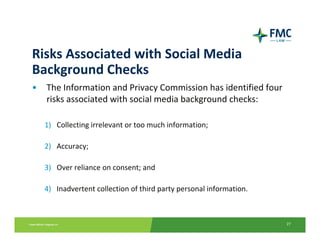
Risks Associated with Social Media 
Background Checks
•   The Information and Privacy Commission has identified four 
    risks associated with social media background checks:

    1) Collecting irrelevant or too much information;

    2) Accuracy;

    3) Over reliance on consent; and

    4) Inadvertent collection of third party personal information.


                                                                     27
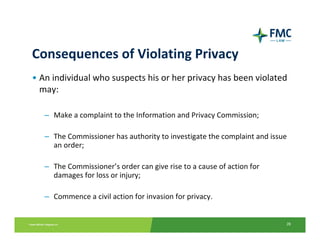
Consequences of Violating Privacy
• An individual who suspects his or her privacy has been violated 
  may:

   – Make a complaint to the Information and Privacy Commission; 

   – The Commissioner has authority to investigate the complaint and issue 
     an order;

   – The Commissioner’s order can give rise to a cause of action for 
     damages for loss or injury;

   – Commence a civil action for invasion for privacy.


                                                                          28
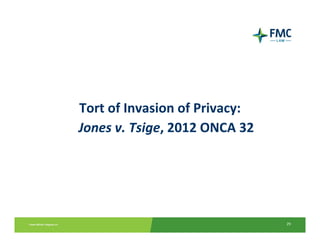
Tort of Invasion of Privacy: 
Jones v. Tsige, 2012 ONCA 32


                                29
Jones v. Tsige, 2012 ONCA 32

• Elements of the action of invasion of privacy are:

   – An intentional intrusion;

   – Into the seclusion of another or his private affairs or concerns;

   – Which is highly offensive to a reasonable person.


                                                                         30
Jones v. Tsige, 2012 ONCA 32
• Limitations on action for invasion of privacy:

   – A claim will only arise for a deliberate and significant invasion of 
     personal privacy;

   – It is only intrusions into matters such as one’s financial or health 
     records, sexual practices and orientation, employment diary or private 
     correspondence that, viewed objectively on the reasonable person
     standard, can be described as highly offensive; and

   – No right to privacy is absolute and many claims for the protection of 
     privacy will have to be reconciled with, and even yield to such 
     competing claims as protection of freedom of expression and freedom 
     of press.


                                                                             31
Strategies to Avoid Invading Privacy
•   Suggested guidelines of the Information and Privacy 
    Commission:

    1) Recognize that any information collected about individuals is personal 
       information or personal employee information and is subject to 
       privacy laws, whether or not the information is publicly available 
       online or whether it is online but subject to limited access as a result 
       of privacy settings or other restrictions; 

    2) Conduct a privacy impact assessment including an assessment of the 
       risks associated with your use of social media as a component of
       background checks. 


                                                                               32
Factors to Consider when Conducting an 
Assessment
• Find out what privacy law applies and review it, ensuring that there is 
  authority to collect and use personal information; 
• Identify the purposes for using social media to collect personal
  information; 
• Determine whether the identified purposes for the collection and use of 
  personal information are authorized; 
• Consider and assess other, less intrusive, measures that meet the same 
  purposes; 
• Identify the types and amounts of personal information likely to be 
  collected in the course of a social media background check including 
  collateral personal information about other people that may be 
  inadvertently collected as a result of the social media background check;

                                                                              33
Factors to Consider when Conducting an 
Assessment
• Identify the risks associated with the collection and use of this personal 
  information including risks resulting from actions taken based on 
  inaccurate information; 
• Ensure that the appropriate policies, procedures and controls are in place 
  to address the risks related to the collection, use, disclosure, retention, 
  accuracy and protection of personal information. 
• If the collection is authorized, notify the individual that you will be 
  performing a social media background check and tell them what you will be 
  checking and what the legal authority is for collecting it; 
• Be prepared to provide access to the information you collected and used to 
  make a decision about an employee or volunteer. (Office of the Information and 
  Privacy Commission of Alberta, Guidelines for Social Media Background Checks, December 2011)


                                                                                                 34
Strategies to Avoid Invading Privacy
• The Information and Privacy Commission cautions that if you 
  are considering conducting a social media background check:
   – Do not wait until after you conduct a social media background check to 
     evaluate compliance with privacy legislation;
   – Do not assume in advance that a social media background check will 
     only retrieve information about one individual and not about multiple 
     individuals;
   – Do not perform a social media background check from a personal 
     account in an attempt to avoid privacy laws;
   – Do not attempt to avoid privacy obligations by contracting a third party 
     to carry out background checks; and
   – Do not perform a social media background check thinking that an 
     individual will not find out about it. (Office of the Information and Privacy Commission 
      of Alberta, Guidelines for Social Media Background Checks, December 2011)


                                                                                            35
Employees vs. Independent 
Contractors: What you need to know! 
Presenter: Fausto Franceschi
           Partner
           Employment & Labour


                                       36
Benefits to Employer in Retaining Services 
of an Independent Contractor
• Save on benefits and other employer costs
• Short term or project specific assistance
• Assistance in non‐core areas
• Expertise of Contractor vs. In‐house Capability
• No withholding obligations
• No termination obligations


                                                    37
Benefits to Worker of Being an 
Independent Contractor

• Flexibility
• Income Splitting
• Claiming of Expenses that are Otherwise not Deductible 
  against Employment Income
• Potential for Greater Earnings?


                                                            38
Key Implications
• Income Tax
• Employment insurance
• CPP
• GST
• Employment Standards
• Common Law Termination Obligations
• Employment Benefits and Insurance
• Workers’ Compensation
• Vicarious Liability


                                       39
Calling Someone an Independent 
Contractor Does Not Necessarily Make 
Him One
• Four tests:
   –   Control test
   –   Fourfold test
   –   Organization or Integration test
   –   Enterprise test


                                          40
Other Factors

• Does the worker hire his own helpers?

• Subcontracting of tasks?

• Exclusive employment?


                                          41
No One Test is Determinative

• Search for the true relationship based on examining all of the 
  possible factors

• Central question: Is the worker performing the services 
  performing them in business on his own account?


                                                                    42
Written Contracts

• Good Idea

• Not determinative but serves as intention of the parties


                                                             43
Incorporation

• Not determinative, but useful


                                  44
Context is Important

• Protective legislation will be interpreted broadly
     (eg. Employment Standards legislation)


                                                       45
Conclusion
• Many factors to be considered when determining whether a 
  worker is an employee or independent contractor

• Ultimate determination is fact specific


                                                              46
Questions?


             47
The preceding presentation contains examples of the kinds of 
  issues companies dealing with HR issues could face. If you 
  are faced with one of these issues, please retain 
  professional assistance as each situation is unique.
Thank you for Joining Us

Joe Hunder          780.423.7354    e: joe.hunder@fmc‐law.com
Adrian Elmslie      780.423.7364    e: adrian.elmslie@fmc‐law.com
Cristina Wendel     780.423.7353    e: cristina.wendel@fmc‐law.com
Fausto Franceschi   780.423.7348    e: fausto.franceschi@fmc‐law.com
Alison Walsh        780.423.7147    e: alison.walsh@fmc‐law.com


                                                                       49

Update on Current HR Issues