SafeWork Summit - Niagara
September 24, 2013
Ramada Jordan Beacon Harbourside Hotel & Suites
Presented by
Stuart E. Rudner
Employment Law:
Discipline & Dismissal
2
Dismissals
 2 types: With cause or without
cause
 If with cause, no further
obligation to employee
 Otherwise, need to assess
employee’s entitlements to
notice/pay in lieu/severance
 No “near cause”
3
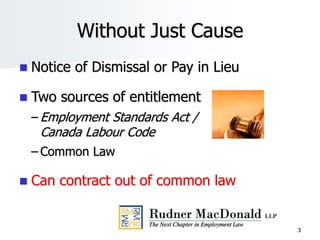
Without Just Cause
 Notice of Dismissal or Pay in Lieu
 Two sources of entitlement
– Employment Standards Act /
Canada Labour Code
– Common Law
 Can contract out of common law
4
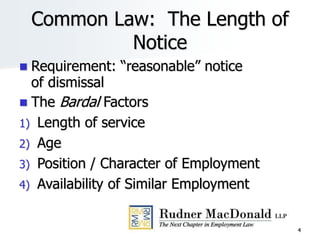
Common Law: The Length of
Notice
 Requirement: “reasonable” notice
of dismissal
 The Bardal Factors
1) Length of service
2) Age
3) Position / Character of Employment
4) Availability of Similar Employment
What is “reasonable”?
 No “rule of thumb” or direct 1:1
relationship between years of service and
months of reasonable notice
 Beware the short-term employee
 Inducement
5
The Changing Times
 End of mandatory retirement, people
working longer --> Wrongful dismissal
claims by workers in 70s and 80s!
 Recent decision:
I do not think there is a place in this social reality
for an automatic presumption that persons should
or would naturally retire on reaching senior age.
6
The Changing Times
Di Tomaso v. Crown Metal Packaging Canada
LP:
there is recent jurisprudence suggesting
that, if anything, (position/character of
employment) is today a factor of declining
relative importance.
7
8
Without Cause: Options
 Working notice
– must allow opportunity to
look for new employment
 Salary & benefit continuance
 Lump-sum
 Combination
 Dangers of failing to continue benefits
9
For Just Cause
 Capital Punishment of Employment Law
 Employer must prove:
1. that the alleged misconduct took place,
and
2. that the nature or degree of misconduct warranted
dismissal, bearing in mind all relevant
circumstances
 Proportionality is guiding principle – “punishment
must fit the crime”
The Contextual Approach
 Employer must consider all circumstances,
not just alleged misconduct
– Length of service
– Disciplinary history
– Nature of position
– Degree of trust required
 Same set of facts can yield different
results
10
11
Just Cause: Performance Issues
Employer must:
 Set a clear, reasonable standard
 Communicate expectations
 Measure the performance
 Take appropriate action
– Warnings (verbal and written) – document
everything!
– Counseling
– Training
 Allow reasonable time for improvement
Breach of Policies
In order to discipline, must show:
1. That there was a clearly worded policy
in place at the time of the alleged
infraction;
2. That the employee in question was
aware, or ought to have been aware, of
the policy;
12
3. That the policy was consistently
enforced;
4. That it was clear that breaches of the
policy would lead to discipline, up to and
including dismissal; and
5. That the policy was reasonable.
13
Safety Policies
 Policies must be consistently enforced:
Plester v. Polyone Canada Inc. (2011)
 “Lock-out” cases rarely justify dismissal in
absence of other factors: Alberici
Construction Ltd. v. Electrical Workers
Local 353 (2011)
14
 Lifting wheelchair-bound employee via
forklift – not cause: Barton v. Rona
Ontario Inc. (2012)
 Lighting co-worker on fire – not cause:
Dryco Drywall Supplies Ltd. And Teamsters
Local Union No. 213 (2012)
15
“Zero Tolerance”
 Courts will not necessarily accept this –
will determine appropriate punishment
Teck Coal Ltd. v. U.S.W., Local 9346 (2011)
 Employee riding on truck, undid seatbelt,
stepped out onto deck, held onto
doorframe & tossed apple into grader
 5 day suspension imposed
16
17
Threats & Violence After Bill 168
 Employee with history of anger issues
 “Don’t talk about Brian - he’s dead.”
“Yes, and you will be too.”
 the utterance of a threat of violence – for the purpose of
intimidation - constitutes an act of violence
 this is true regardless of whether or not:
– the person issuing the threat has any intention to follow through
– the person issuing the threat has any ability to follow through
– the person receiving the threat feels afraid
18
 employers cannot ignore, dismiss, or trivialize reported
threats and incidents
 reported incidents must be thoroughly investigated and
addressed
 when considering how to discipline an employee for
uttering a threat, an employer must:
– place extra weight on the seriousness of this sort of misconduct
– assess the likelihood that the misconduct could or would be
repeated if the worker remained in the workplace
– act in a manner which gives due consideration to the safety of
other workers
Contrast with Overwaitea Food Group and
UFCW, Local 1518 (FS Grievance), Re
 Grievor found to have threatened to bring
gun into store
 Allowed to continue working – employer
not concerned
 Dishonest in investigation
 Just cause found
19
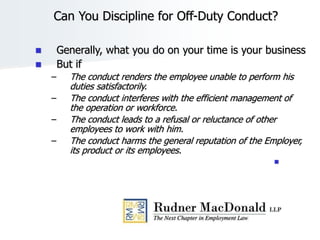
Can You Discipline for Off-Duty Conduct?
 Generally, what you do on your time is your business
 But if
– The conduct renders the employee unable to perform his
duties satisfactorily.
– The conduct interferes with the efficient management of
the operation or workforce.
– The conduct leads to a refusal or reluctance of other
employees to work with him.
– The conduct harms the general reputation of the Employer,
its product or its employees.

21
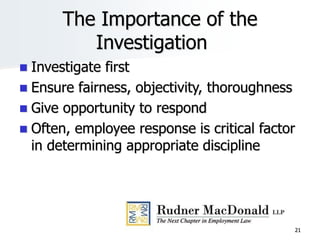
The Importance of the
Investigation
 Investigate first
 Ensure fairness, objectivity, thoroughness
 Give opportunity to respond
 Often, employee response is critical factor
in determining appropriate discipline
22
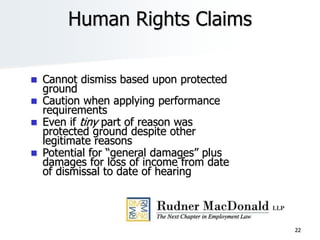
Human Rights Claims
 Cannot dismiss based upon protected
ground
 Caution when applying performance
requirements
 Even if tiny part of reason was
protected ground despite other
legitimate reasons
 Potential for “general damages” plus
damages for loss of income from date
of dismissal to date of hearing
Employment Agreements
 Use them!
 Do it properly
– Before there’s already an agreement
– With consideration
– Explained and understood
– Independent legal advice
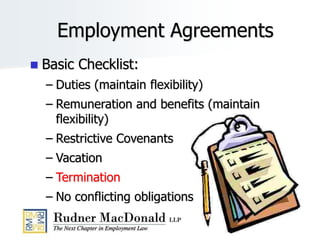
Employment Agreements
 Basic Checklist:
– Duties (maintain flexibility)
– Remuneration and benefits (maintain
flexibility)
– Restrictive Covenants
– Vacation
– Termination
– No conflicting obligations
Employment Agreements
 Basic Checklist (cont’d):
– Hours of work
– Vacation / holidays
– Dress code
– Alcohol
– Conflict of interest
– Expenses
– etc
Termination Clauses
 Enforceable if done properly
 Avoid uncertainty of “reasonable
notice”
 Reduce dismissal costs
 Don’t go below employment
standards
 Address benefits
 Use clear
language 26
Protecting the Organization
A. Have a policy
B. Use clear and unambiguous language
C. Update the policy as technology changes
D. Publicize the policy
E. Make employees aware of concerns
F. Ensure supervisors and managers are aware
of the policy and how to monitor;
G. Monitor behaviour
H. Discipline violators
28
Stuart E. Rudner
srudner@rudnermacdonald.com
647.255.3100
www.rudnermacdonald.com
Twitter: @CanadianHRLaw
LinkedIn: Connect with me and join the
Canadian HR Law Group
Blog: Canadian HR Law
http://www.hrreporter.com/blog/canadian-hr-law
Google+: Canadian HR Law
Thank you

Employment Law: Discipline & Dismissal

  • 1.
    SafeWork Summit -Niagara September 24, 2013 Ramada Jordan Beacon Harbourside Hotel & Suites Presented by Stuart E. Rudner Employment Law: Discipline & Dismissal
  • 2.
    2 Dismissals  2 types:With cause or without cause  If with cause, no further obligation to employee  Otherwise, need to assess employee’s entitlements to notice/pay in lieu/severance  No “near cause”
  • 3.
    3 Without Just Cause Notice of Dismissal or Pay in Lieu  Two sources of entitlement – Employment Standards Act / Canada Labour Code – Common Law  Can contract out of common law
  • 4.
    4 Common Law: TheLength of Notice  Requirement: “reasonable” notice of dismissal  The Bardal Factors 1) Length of service 2) Age 3) Position / Character of Employment 4) Availability of Similar Employment
  • 5.
    What is “reasonable”? No “rule of thumb” or direct 1:1 relationship between years of service and months of reasonable notice  Beware the short-term employee  Inducement 5
  • 6.
    The Changing Times End of mandatory retirement, people working longer --> Wrongful dismissal claims by workers in 70s and 80s!  Recent decision: I do not think there is a place in this social reality for an automatic presumption that persons should or would naturally retire on reaching senior age. 6
  • 7.
    The Changing Times DiTomaso v. Crown Metal Packaging Canada LP: there is recent jurisprudence suggesting that, if anything, (position/character of employment) is today a factor of declining relative importance. 7
  • 8.
    8 Without Cause: Options Working notice – must allow opportunity to look for new employment  Salary & benefit continuance  Lump-sum  Combination  Dangers of failing to continue benefits
  • 9.
    9 For Just Cause Capital Punishment of Employment Law  Employer must prove: 1. that the alleged misconduct took place, and 2. that the nature or degree of misconduct warranted dismissal, bearing in mind all relevant circumstances  Proportionality is guiding principle – “punishment must fit the crime”
  • 10.
    The Contextual Approach Employer must consider all circumstances, not just alleged misconduct – Length of service – Disciplinary history – Nature of position – Degree of trust required  Same set of facts can yield different results 10
  • 11.
    11 Just Cause: PerformanceIssues Employer must:  Set a clear, reasonable standard  Communicate expectations  Measure the performance  Take appropriate action – Warnings (verbal and written) – document everything! – Counseling – Training  Allow reasonable time for improvement
  • 12.
    Breach of Policies Inorder to discipline, must show: 1. That there was a clearly worded policy in place at the time of the alleged infraction; 2. That the employee in question was aware, or ought to have been aware, of the policy; 12
  • 13.
    3. That thepolicy was consistently enforced; 4. That it was clear that breaches of the policy would lead to discipline, up to and including dismissal; and 5. That the policy was reasonable. 13
  • 14.
    Safety Policies  Policiesmust be consistently enforced: Plester v. Polyone Canada Inc. (2011)  “Lock-out” cases rarely justify dismissal in absence of other factors: Alberici Construction Ltd. v. Electrical Workers Local 353 (2011) 14
  • 15.
     Lifting wheelchair-boundemployee via forklift – not cause: Barton v. Rona Ontario Inc. (2012)  Lighting co-worker on fire – not cause: Dryco Drywall Supplies Ltd. And Teamsters Local Union No. 213 (2012) 15
  • 16.
    “Zero Tolerance”  Courtswill not necessarily accept this – will determine appropriate punishment Teck Coal Ltd. v. U.S.W., Local 9346 (2011)  Employee riding on truck, undid seatbelt, stepped out onto deck, held onto doorframe & tossed apple into grader  5 day suspension imposed 16
  • 17.
    17 Threats & ViolenceAfter Bill 168  Employee with history of anger issues  “Don’t talk about Brian - he’s dead.” “Yes, and you will be too.”  the utterance of a threat of violence – for the purpose of intimidation - constitutes an act of violence  this is true regardless of whether or not: – the person issuing the threat has any intention to follow through – the person issuing the threat has any ability to follow through – the person receiving the threat feels afraid
  • 18.
    18  employers cannotignore, dismiss, or trivialize reported threats and incidents  reported incidents must be thoroughly investigated and addressed  when considering how to discipline an employee for uttering a threat, an employer must: – place extra weight on the seriousness of this sort of misconduct – assess the likelihood that the misconduct could or would be repeated if the worker remained in the workplace – act in a manner which gives due consideration to the safety of other workers
  • 19.
    Contrast with OverwaiteaFood Group and UFCW, Local 1518 (FS Grievance), Re  Grievor found to have threatened to bring gun into store  Allowed to continue working – employer not concerned  Dishonest in investigation  Just cause found 19
  • 20.
    Can You Disciplinefor Off-Duty Conduct?  Generally, what you do on your time is your business  But if – The conduct renders the employee unable to perform his duties satisfactorily. – The conduct interferes with the efficient management of the operation or workforce. – The conduct leads to a refusal or reluctance of other employees to work with him. – The conduct harms the general reputation of the Employer, its product or its employees. 
  • 21.
    21 The Importance ofthe Investigation  Investigate first  Ensure fairness, objectivity, thoroughness  Give opportunity to respond  Often, employee response is critical factor in determining appropriate discipline
  • 22.
    22 Human Rights Claims Cannot dismiss based upon protected ground  Caution when applying performance requirements  Even if tiny part of reason was protected ground despite other legitimate reasons  Potential for “general damages” plus damages for loss of income from date of dismissal to date of hearing
  • 23.
    Employment Agreements  Usethem!  Do it properly – Before there’s already an agreement – With consideration – Explained and understood – Independent legal advice
  • 24.
    Employment Agreements  BasicChecklist: – Duties (maintain flexibility) – Remuneration and benefits (maintain flexibility) – Restrictive Covenants – Vacation – Termination – No conflicting obligations
  • 25.
    Employment Agreements  BasicChecklist (cont’d): – Hours of work – Vacation / holidays – Dress code – Alcohol – Conflict of interest – Expenses – etc
  • 26.
    Termination Clauses  Enforceableif done properly  Avoid uncertainty of “reasonable notice”  Reduce dismissal costs  Don’t go below employment standards  Address benefits  Use clear language 26
  • 27.
    Protecting the Organization A.Have a policy B. Use clear and unambiguous language C. Update the policy as technology changes D. Publicize the policy E. Make employees aware of concerns F. Ensure supervisors and managers are aware of the policy and how to monitor; G. Monitor behaviour H. Discipline violators
  • 28.
    28 Stuart E. Rudner srudner@rudnermacdonald.com 647.255.3100 www.rudnermacdonald.com Twitter:@CanadianHRLaw LinkedIn: Connect with me and join the Canadian HR Law Group Blog: Canadian HR Law http://www.hrreporter.com/blog/canadian-hr-law Google+: Canadian HR Law Thank you