Update on Contraception
             Quizmasters: Dr Hariharan C
                          Dr Ajay SD


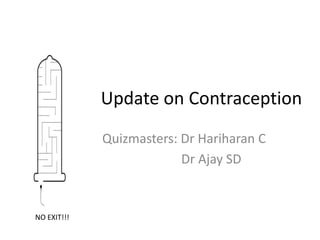
NO EXIT!!!
• “We want far better reasons for having
  children than not knowing how to
  prevent them.”
Round I
•   True or False
•   8 questions
•   10 marks each
•   No Bonus marks
• 1. Levonorgestrel Emergency Contraception
     has no absolute medical contraindications
• TRUE!
• EC has no evidence-based absolute
  contraindications, because pregnancy for women
  who have concurrent medical problems (including
  thromboembolic and liver disease) would pose a
  greater threat than 1-day doses of estrogen or
  progestin
 (Medical eligibility criteria for contraceptive use. 3rd edition.
 Geneva (Switzerland): World Health Organization; 2004.
2. If ECPs failed to prevent pregnancy, a
  woman has a greater chance of that
  pregnancy being an ectopic pregnancy.
• False
• To date, no evidence suggests that ECPs
  increase the risk of ectopic pregnancy.
  Worldwide studies of progestin-only ECPs,
  including a United States Food and Drug
  Administration review, have not found higher
  rates of ectopic pregnancy after ECPs failed
  than are found among pregnancies generally.
• 3. Subcutaneous DMPA (DMPA-SC) is not as
     effective as IM DMPA
• False.
• A formulation of DMPA has been developed specifically for injection into
  the tissue just under the skin (subcutaneously).
• The hormonal dose of the new subcutaneous formulation (DMPA-SC) is
  30% less than for DMPA formulated for injection into the muscle— 104 mg
  instead of 150 mg. Thus, it may cause fewer side effects, such as weight
  gain. Contraceptive effectiveness is similar.
• Like users of intramuscular DMPA, users of DMPA-SC have an injection
  every
• 3 months. DMPA-SC will be available in prefilled syringes, including the
  single-use Uniject system. These prefilled syringes will have special short
  needles meant for subcutaneous injection. With these syringes, women
  could inject DMPA themselves. DMPA-SC was approved by USFDA in
  December 2004 under the name “depo-subQ provera 104.”
• 4. DMPA permanently decreases the bone
     mineral density
• False
• Although DMPA use decreases bone
  density, Research has not found that DMPA users
  of any age are likely to have more broken bones.
• When DMPA use stops, bone density increases
  again for women of reproductive age.
• Among adults who stop using DMPA, after 2 to
  3years their bone density appears to be similar to
  that of women who have not used DMPA.
5. Efficacy of LAM method is 98% in first six
  months postpartum
• True.
• As commonly used, there will be about 2 pregnancies per 100 women
  using LAM in the first 6 months after childbirth. This means that 98 of
  every 100 women relying on LAM will not become pregnant

• The lactational amenorrhea method (LAM) requires 3 conditions. All 3
  must be met:
  1. The mother’s monthly bleeding has not returned
  2. The baby is fully or nearly fully breastfed and is fed often, day and night
  3. The baby is less than 6 months old
• “Fully breastfeeding” includes both exclusive breastfeeding (the infant
  receives no other liquid or food, not even water, in addition to breast milk)
  and almost-exclusive breastfeeding (the infant receives
  vitamins, water, juice, or other nutrients once in a while in addition to
  breast milk).

• “Nearly fully breastfeeding” means that the infant receives some liquid or
  food in addition to breast milk, but the majority of feedings (more than
  three-fourths of all feeds) are breast milk.
6. Condoms do not have any absolute
  contraindications for their use
• False
• Know Latex allergy is an absolute
  contraindication for use of condom
• 7. While calculating fertile period, the
  woman should subtract 18 from her shortest
  cycle and 11 from her longest cycle in the
  last six months
• True
• The woman should update these calculations each
  month, always using the 6 most recent cycles.
• Example:
• If the shortest of her last 6 cycles was 27 days, 27 – 18
  = 9. She starts avoiding unprotected sex on day 9.
• If the longest of her last 6 cycles was 31 days, 31 – 11 =
  20. She can have unprotected sex again on day 21.
• Thus, she must avoid unprotected sex from day 9
  through day 20 of her cycle.
• 8. Spermicides increase the risk
    of transmission of HIV
• True
• “It would be a service to mankind if the pill
  were available in slot machines and the
  cigarette were placed on prescription.”
Round II
• Medical disorders and contraception
• 4Questions, 10 marks each
• Bonus marks: 5
1. In a woman on ATT for pulmonary
  tuberculosis, the best form of contraception
  would be:
• A. Second generation COC
• B. POPs
• C. Progesterone implant
• D. DMPA
2. All of the following are contraindications to
  COCs EXCEPT
• A. Migraine with aura
• B. varicose veins
• C. age more than 35 yrs and smoker
• D. Hypertension
3. Contraceptive of choice in Ischemic heart
   disease is
a. Cu-T
b. Drospirenone containing OCPs
c. Progesterone Implants
d. Depo- Provera
4. Which of the following are safe in benign
  breast disease
a. COCs
b. Mini-pills
c. Implants
d. All of the above.
• “I want to tell you a terrific story about oral
  contraception. I asked this girl to sleep with
  me and she said "No." ~Woody Allen”
Round III
Male and female sterilization
6 questions
10 marks each
5 marks bonus points
1. Request for reversal of tubal sterilization is
   seen in
a. 1%
b. 3%
c. 5%
d. 10%
2. Which of the following is a permanently
  irreversible method of sterilization?
a. Madlener’s
b. Irving’s
c. Kroner’s
d. Parkland
3. In laparoscopic sterilization, which of the
  following is associated with highest failure
  rates
a. Hulka clips
b. Falope rings
c. Bipolar coagulation
d. Monopolar coagulation
4. Which of the following methods are
   associated with highest rates of ectopic
   pregnancy in case of failure
a. Electrocautery
b. Silastic bands
c. Tubal resection
d. Hysteroscopic occlusion
• Approximately half (50%) of pregnancies that
  follow a failed electrocoagulation procedure
  are ectopic, compared with only 10 percent
  following failure of a ring, clip, or tubal
  resection method (Hatcher and
  colleagues, 1990; Hendrix and
  associates, 1999)
5. All of the following are known complications
  of male sterilization except
a. Anti sperm antibody formation
b. Wound granuloma
c. Erectile dysfunction
d. Scrotal pain.
6. Typically it takes around______ ejaculations
  before a man becomes azoospermic after
  vasectomy
a. 10
b. 20
c. 30
d. 40
• “A birth control pill for men, that's fair. It
  makes more sense to take the bullets out of
  the gun than to wear a bulletproof vest.”
Round IV
• Rapid fire
• 3 min
• 10 marks per correct answer
1. Efficacy of COCs on typical use is___
2. Commonest cause of failure of tubal ligation is______
3. What should be done if a woman on COCs misses 3
   pills?
4. Prolonged use of COCs has been associated with
   ________ cancer
5. The life of Implanon is ________
6. The life of NET-EN is______
7. Commonest side effects of the Yuzpe regimen is____
8. Enlist two non contraceptive benefits of condoms
9. What is the pearl index if no contraception is used?
10. A potential problem with Drospirenone containing
   OCPs is________
1. Efficacy of DMPA on typical use is______
2. After male sterilization, an alternative method should always
    be used for a period of____ months
3. Commonest cause of discontinuing DMPA is _____
4. Alternative method should be considered if a woman on
    Cerazette delays her daily dose by____ hours
5. The life of Cu T 380A is________ years
6. The life of Jadelle is_______
7. Commonest side effect of LNG for EC is______
8. Enlist two non contraceptive benefits of Mirena apart from
    AUB.
9. The efficacy of the cervical diaphragm on typical use is_____
10. Most important problem with use of progestasert is_______
Life of contraceptives
•   Norplant- 5 years
•   Jadelle- 5 years
•   Implanon- 3 years
•   CuT 380A- 10 years
•   Nova T- 5 years
•   Multiload 375- 5 years
•   Multiload 250- 3 years
• “We all worry about the population
  explosion, but we don't worry about it at the
  right time.”
Thank You.
Update on contraception

Update on contraception

  • 1.
    Update on Contraception Quizmasters: Dr Hariharan C Dr Ajay SD NO EXIT!!!
  • 2.
    • “We wantfar better reasons for having children than not knowing how to prevent them.”
  • 3.
    Round I • True or False • 8 questions • 10 marks each • No Bonus marks
  • 4.
    • 1. LevonorgestrelEmergency Contraception has no absolute medical contraindications
  • 5.
    • TRUE! • EChas no evidence-based absolute contraindications, because pregnancy for women who have concurrent medical problems (including thromboembolic and liver disease) would pose a greater threat than 1-day doses of estrogen or progestin (Medical eligibility criteria for contraceptive use. 3rd edition. Geneva (Switzerland): World Health Organization; 2004.
  • 6.
    2. If ECPsfailed to prevent pregnancy, a woman has a greater chance of that pregnancy being an ectopic pregnancy.
  • 7.
    • False • Todate, no evidence suggests that ECPs increase the risk of ectopic pregnancy. Worldwide studies of progestin-only ECPs, including a United States Food and Drug Administration review, have not found higher rates of ectopic pregnancy after ECPs failed than are found among pregnancies generally.
  • 8.
    • 3. SubcutaneousDMPA (DMPA-SC) is not as effective as IM DMPA
  • 9.
    • False. • Aformulation of DMPA has been developed specifically for injection into the tissue just under the skin (subcutaneously). • The hormonal dose of the new subcutaneous formulation (DMPA-SC) is 30% less than for DMPA formulated for injection into the muscle— 104 mg instead of 150 mg. Thus, it may cause fewer side effects, such as weight gain. Contraceptive effectiveness is similar. • Like users of intramuscular DMPA, users of DMPA-SC have an injection every • 3 months. DMPA-SC will be available in prefilled syringes, including the single-use Uniject system. These prefilled syringes will have special short needles meant for subcutaneous injection. With these syringes, women could inject DMPA themselves. DMPA-SC was approved by USFDA in December 2004 under the name “depo-subQ provera 104.”
  • 10.
    • 4. DMPApermanently decreases the bone mineral density
  • 11.
    • False • AlthoughDMPA use decreases bone density, Research has not found that DMPA users of any age are likely to have more broken bones. • When DMPA use stops, bone density increases again for women of reproductive age. • Among adults who stop using DMPA, after 2 to 3years their bone density appears to be similar to that of women who have not used DMPA.
  • 12.
    5. Efficacy ofLAM method is 98% in first six months postpartum
  • 13.
    • True. • Ascommonly used, there will be about 2 pregnancies per 100 women using LAM in the first 6 months after childbirth. This means that 98 of every 100 women relying on LAM will not become pregnant • The lactational amenorrhea method (LAM) requires 3 conditions. All 3 must be met: 1. The mother’s monthly bleeding has not returned 2. The baby is fully or nearly fully breastfed and is fed often, day and night 3. The baby is less than 6 months old • “Fully breastfeeding” includes both exclusive breastfeeding (the infant receives no other liquid or food, not even water, in addition to breast milk) and almost-exclusive breastfeeding (the infant receives vitamins, water, juice, or other nutrients once in a while in addition to breast milk). • “Nearly fully breastfeeding” means that the infant receives some liquid or food in addition to breast milk, but the majority of feedings (more than three-fourths of all feeds) are breast milk.
  • 14.
    6. Condoms donot have any absolute contraindications for their use
  • 15.
    • False • KnowLatex allergy is an absolute contraindication for use of condom
  • 16.
    • 7. Whilecalculating fertile period, the woman should subtract 18 from her shortest cycle and 11 from her longest cycle in the last six months
  • 17.
    • True • Thewoman should update these calculations each month, always using the 6 most recent cycles. • Example: • If the shortest of her last 6 cycles was 27 days, 27 – 18 = 9. She starts avoiding unprotected sex on day 9. • If the longest of her last 6 cycles was 31 days, 31 – 11 = 20. She can have unprotected sex again on day 21. • Thus, she must avoid unprotected sex from day 9 through day 20 of her cycle.
  • 19.
    • 8. Spermicidesincrease the risk of transmission of HIV
  • 20.
  • 21.
    • “It wouldbe a service to mankind if the pill were available in slot machines and the cigarette were placed on prescription.”
  • 22.
    Round II • Medicaldisorders and contraception • 4Questions, 10 marks each • Bonus marks: 5
  • 23.
    1. In awoman on ATT for pulmonary tuberculosis, the best form of contraception would be: • A. Second generation COC • B. POPs • C. Progesterone implant • D. DMPA
  • 24.
    2. All ofthe following are contraindications to COCs EXCEPT • A. Migraine with aura • B. varicose veins • C. age more than 35 yrs and smoker • D. Hypertension
  • 25.
    3. Contraceptive ofchoice in Ischemic heart disease is a. Cu-T b. Drospirenone containing OCPs c. Progesterone Implants d. Depo- Provera
  • 26.
    4. Which ofthe following are safe in benign breast disease a. COCs b. Mini-pills c. Implants d. All of the above.
  • 27.
    • “I wantto tell you a terrific story about oral contraception. I asked this girl to sleep with me and she said "No." ~Woody Allen”
  • 28.
    Round III Male andfemale sterilization 6 questions 10 marks each 5 marks bonus points
  • 29.
    1. Request forreversal of tubal sterilization is seen in a. 1% b. 3% c. 5% d. 10%
  • 30.
    2. Which ofthe following is a permanently irreversible method of sterilization? a. Madlener’s b. Irving’s c. Kroner’s d. Parkland
  • 31.
    3. In laparoscopicsterilization, which of the following is associated with highest failure rates a. Hulka clips b. Falope rings c. Bipolar coagulation d. Monopolar coagulation
  • 33.
    4. Which ofthe following methods are associated with highest rates of ectopic pregnancy in case of failure a. Electrocautery b. Silastic bands c. Tubal resection d. Hysteroscopic occlusion
  • 34.
    • Approximately half(50%) of pregnancies that follow a failed electrocoagulation procedure are ectopic, compared with only 10 percent following failure of a ring, clip, or tubal resection method (Hatcher and colleagues, 1990; Hendrix and associates, 1999)
  • 35.
    5. All ofthe following are known complications of male sterilization except a. Anti sperm antibody formation b. Wound granuloma c. Erectile dysfunction d. Scrotal pain.
  • 36.
    6. Typically ittakes around______ ejaculations before a man becomes azoospermic after vasectomy a. 10 b. 20 c. 30 d. 40
  • 37.
    • “A birthcontrol pill for men, that's fair. It makes more sense to take the bullets out of the gun than to wear a bulletproof vest.”
  • 38.
    Round IV • Rapidfire • 3 min • 10 marks per correct answer
  • 40.
    1. Efficacy ofCOCs on typical use is___ 2. Commonest cause of failure of tubal ligation is______ 3. What should be done if a woman on COCs misses 3 pills? 4. Prolonged use of COCs has been associated with ________ cancer 5. The life of Implanon is ________ 6. The life of NET-EN is______ 7. Commonest side effects of the Yuzpe regimen is____ 8. Enlist two non contraceptive benefits of condoms 9. What is the pearl index if no contraception is used? 10. A potential problem with Drospirenone containing OCPs is________
  • 41.
    1. Efficacy ofDMPA on typical use is______ 2. After male sterilization, an alternative method should always be used for a period of____ months 3. Commonest cause of discontinuing DMPA is _____ 4. Alternative method should be considered if a woman on Cerazette delays her daily dose by____ hours 5. The life of Cu T 380A is________ years 6. The life of Jadelle is_______ 7. Commonest side effect of LNG for EC is______ 8. Enlist two non contraceptive benefits of Mirena apart from AUB. 9. The efficacy of the cervical diaphragm on typical use is_____ 10. Most important problem with use of progestasert is_______
  • 43.
    Life of contraceptives • Norplant- 5 years • Jadelle- 5 years • Implanon- 3 years • CuT 380A- 10 years • Nova T- 5 years • Multiload 375- 5 years • Multiload 250- 3 years
  • 44.
    • “We allworry about the population explosion, but we don't worry about it at the right time.”
  • 46.