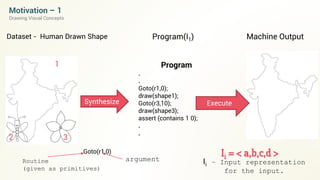
Motivation – 1
Drawing Visual Concepts
Dataset - Human Drawn Shape
Synthesize
Program
.
.
Goto(r1,0);
draw(shape1);
Goto(r3,10);
draw(shape3);
assert (contains 1 0);
.
.
Execute
Goto(r1,0)
Routine
(given as primitives)
argument
Machine OutputProgram(I1)
Ii – Input representation
for the input.
1
2 3
Motivation – 2
Learning Morphological Rules
Style, styled
hatch,hatched
Articulate,articulated
Pay,paid
Lay,laid
Need,needed
Program
if [ property1.value1 == True ]
(stem + d)
elseif [ property3.value2 > 5 ]
(stem +ed)
Elseif [property4.value5 == “y”]
(stem + id)
Synthesize Execute
Style, styled
hatch,hatched
Articulate,articulated
Pay,paid
Lay,laid
Need,needed
Run,ran
Noise
<stem, word in past tense>
Program(snatch) = snatched
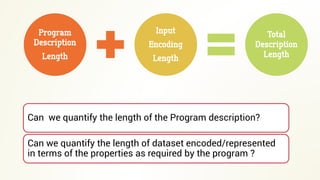
Can we quantify the length of the Program description?
Can we quantify the length of dataset encoded/represented
in terms of the properties as required by the program ?
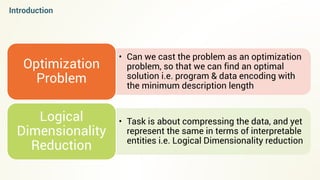
• Can we cast the problem as an optimization
problem, so that we can find an optimal
solution i.e. program & data encoding with
the minimum description length
Optimization
Problem
• Task is about compressing the data, and yet
represent the same in terms of interpretable
entities i.e. Logical Dimensionality reduction
Logical
Dimensionality
Reduction
Introduction
Problem Framing
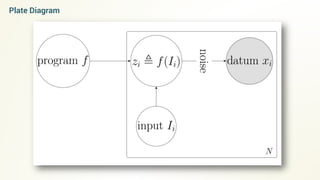
Description length priors over programs Pf (·), (eg, linguistic rules)
Priors over the inputs I, PI (·) to f,(eg, stems)
N observations, { xi }i = 1 to N , (eg, words)
Noise model: Px|z(· | ·) , where z I is defined as f(Ii)
Plate Diagram
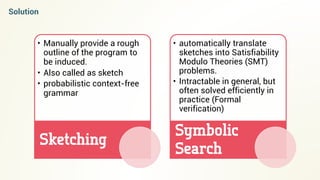
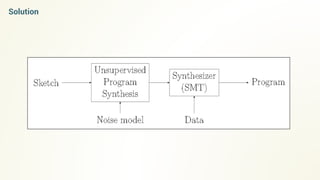
Solution
• Manually provide a rough
outline of the program to
be induced.
• Also called as sketch
• probabilistic context-free
grammar
• automatically translate
sketches into Satisfiability
Modulo Theories (SMT)
problems.
• Intractable in general, but
often solved efficiently in
practice (Formal
verification)
Solution
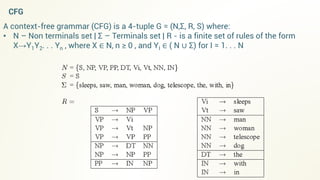
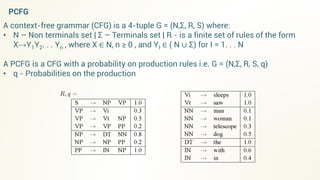
A context-free grammar (CFG) is a 4-tuple G = (N,Σ, R, S) where:
• N – Non terminals set | Σ – Terminals set | R - is a finite set of rules of the form
X→Y1Y2. . . Yn , where X ∈ N, n ≥ 0 , and YI ∈ ( N ∪ Σ) for I = 1. . . N
CFG
A context-free grammar (CFG) is a 4-tuple G = (N,Σ, R, S) where:
• N – Non terminals set | Σ – Terminals set | R - is a finite set of rules of the form
X→Y1Y2. . . Yn , where X ∈ N, n ≥ 0 , and YI ∈ ( N ∪ Σ) for I = 1. . . N
A PCFG is a CFG with a probability on production rules i.e. G = (N,Σ, R, S, q)
• q - Probabilities on the production
PCFG
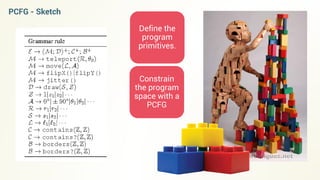
PCFG - Sketch
Define the
program
primitives.
Constrain
the program
space with a
PCFG
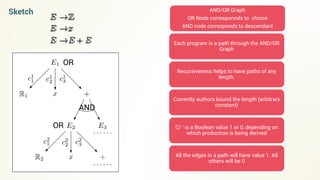
Sketch AND/OR Graph
OR Node corresponnds to choice
AND node corresponds to descendant
Each program is a path through the AND/OR
Graph
Recursiveness helps to have paths of any
length.
Currently authors bound the length (arbitrary
constant)
Ci
j – is a Boolean value 1 or 0, depending on
which production is being derived
All the edges in a path will have value 1. All
others will be 0
OR
AND
OR
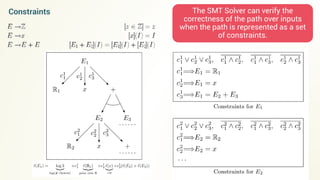
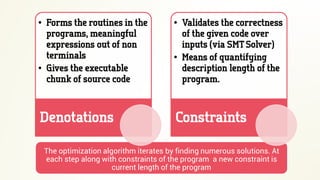
Constraints The SMT Solver can verify the
correctness of the path over inputs
when the path is represented as a set
of constraints.
Denotations
Mathematical Objects, that describe
the meaning of entities in a
language
Every node in the selected path has
a denotation
In denotation, each non-terminal is
an expression (or a routine), which
takes an input I and the range for
the output is known
The path will give the sequence of
the routines with the appropriate
values for the arguments, which is
obtained from the input
[Expression] (Input) = Output
The output is dependent on the input
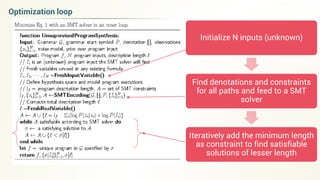
The optimization algorithm iterates by finding numerous solutions. At
each step along with constraints of the program a new constraint is
current length of the program
Initialize N inputs (unknown)
Find denotations and constraints
for all paths and feed to a SMT
solver
Iteratively add the minimum length
as constraint to find satisfiable
solutions of lesser length
Optimization loop
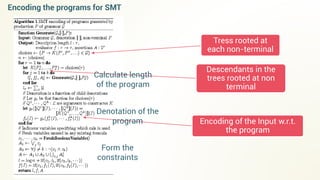
Tress rooted at
each non-terminal
Descendants in the
trees rooted at non
terminal
Encoding of the Input w.r.t.
the program
Encoding the programs for SMT
Calculate length
of the program
Denotation of the
program
Form the
constraints
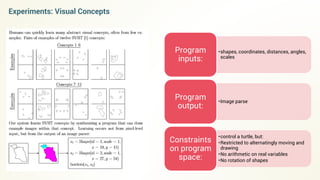
•shapes, coordinates, distances, angles,
scales
Program
inputs:
•Image parse
Program
output:
•control a turtle, but:
•Restricted to alternatingly moving and
drawing
•No arithmetic on real variables
•No rotation of shapes
Constraints
on program
space:
Experiments: Visual Concepts
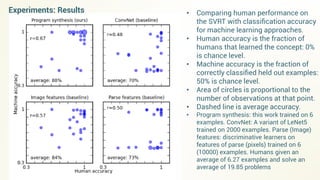
• Comparing human performance on
the SVRT with classification accuracy
for machine learning approaches.
• Human accuracy is the fraction of
humans that learned the concept: 0%
is chance level.
• Machine accuracy is the fraction of
correctly classified held out examples:
50% is chance level.
• Area of circles is proportional to the
number of observations at that point.
• Dashed line is average accuracy.
• Program synthesis: this work trained on 6
examples. ConvNet: A variant of LeNet5
trained on 2000 examples. Parse (Image)
features: discriminative learners on
features of parse (pixels) trained on 6
(10000) examples. Humans given an
average of 6.27 examples and solve an
average of 19.85 problems
Experiments: Results
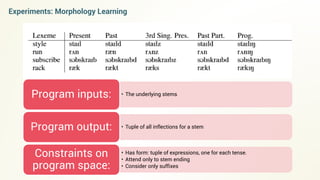
Experiments: Morphology Learning
• The underlying stemsProgram inputs:
• Tuple of all inflections for a stemProgram output:
• Has form: tuple of expressions, one for each tense.
• Attend only to stem ending
• Consider only suffixes
Constraints on
program space:
Experiments: Results
Thanks

Unsupervised program synthesis

  • 2.
    Motivation – 1 DrawingVisual Concepts Dataset - Human Drawn Shape Synthesize Program . . Goto(r1,0); draw(shape1); Goto(r3,10); draw(shape3); assert (contains 1 0); . . Execute Goto(r1,0) Routine (given as primitives) argument Machine OutputProgram(I1) Ii – Input representation for the input. 1 2 3
  • 3.
    Motivation – 2 LearningMorphological Rules Style, styled hatch,hatched Articulate,articulated Pay,paid Lay,laid Need,needed Program if [ property1.value1 == True ] (stem + d) elseif [ property3.value2 > 5 ] (stem +ed) Elseif [property4.value5 == “y”] (stem + id) Synthesize Execute Style, styled hatch,hatched Articulate,articulated Pay,paid Lay,laid Need,needed Run,ran Noise <stem, word in past tense> Program(snatch) = snatched
  • 4.
    Can we quantifythe length of the Program description? Can we quantify the length of dataset encoded/represented in terms of the properties as required by the program ?
  • 5.
    • Can wecast the problem as an optimization problem, so that we can find an optimal solution i.e. program & data encoding with the minimum description length Optimization Problem • Task is about compressing the data, and yet represent the same in terms of interpretable entities i.e. Logical Dimensionality reduction Logical Dimensionality Reduction Introduction
  • 6.
    Problem Framing Description lengthpriors over programs Pf (·), (eg, linguistic rules) Priors over the inputs I, PI (·) to f,(eg, stems) N observations, { xi }i = 1 to N , (eg, words) Noise model: Px|z(· | ·) , where z I is defined as f(Ii)
  • 7.
  • 8.
    Solution • Manually providea rough outline of the program to be induced. • Also called as sketch • probabilistic context-free grammar • automatically translate sketches into Satisfiability Modulo Theories (SMT) problems. • Intractable in general, but often solved efficiently in practice (Formal verification)
  • 9.
  • 10.
    A context-free grammar(CFG) is a 4-tuple G = (N,Σ, R, S) where: • N – Non terminals set | Σ – Terminals set | R - is a finite set of rules of the form X→Y1Y2. . . Yn , where X ∈ N, n ≥ 0 , and YI ∈ ( N ∪ Σ) for I = 1. . . N CFG
  • 11.
    A context-free grammar(CFG) is a 4-tuple G = (N,Σ, R, S) where: • N – Non terminals set | Σ – Terminals set | R - is a finite set of rules of the form X→Y1Y2. . . Yn , where X ∈ N, n ≥ 0 , and YI ∈ ( N ∪ Σ) for I = 1. . . N A PCFG is a CFG with a probability on production rules i.e. G = (N,Σ, R, S, q) • q - Probabilities on the production PCFG
  • 12.
    PCFG - Sketch Definethe program primitives. Constrain the program space with a PCFG
  • 13.
    Sketch AND/OR Graph ORNode corresponnds to choice AND node corresponds to descendant Each program is a path through the AND/OR Graph Recursiveness helps to have paths of any length. Currently authors bound the length (arbitrary constant) Ci j – is a Boolean value 1 or 0, depending on which production is being derived All the edges in a path will have value 1. All others will be 0 OR AND OR
  • 14.
    Constraints The SMTSolver can verify the correctness of the path over inputs when the path is represented as a set of constraints.
  • 15.
    Denotations Mathematical Objects, thatdescribe the meaning of entities in a language Every node in the selected path has a denotation In denotation, each non-terminal is an expression (or a routine), which takes an input I and the range for the output is known The path will give the sequence of the routines with the appropriate values for the arguments, which is obtained from the input [Expression] (Input) = Output The output is dependent on the input
  • 16.
    The optimization algorithmiterates by finding numerous solutions. At each step along with constraints of the program a new constraint is current length of the program
  • 17.
    Initialize N inputs(unknown) Find denotations and constraints for all paths and feed to a SMT solver Iteratively add the minimum length as constraint to find satisfiable solutions of lesser length Optimization loop
  • 18.
    Tress rooted at eachnon-terminal Descendants in the trees rooted at non terminal Encoding of the Input w.r.t. the program Encoding the programs for SMT Calculate length of the program Denotation of the program Form the constraints
  • 19.
    •shapes, coordinates, distances,angles, scales Program inputs: •Image parse Program output: •control a turtle, but: •Restricted to alternatingly moving and drawing •No arithmetic on real variables •No rotation of shapes Constraints on program space: Experiments: Visual Concepts
  • 20.
    • Comparing humanperformance on the SVRT with classification accuracy for machine learning approaches. • Human accuracy is the fraction of humans that learned the concept: 0% is chance level. • Machine accuracy is the fraction of correctly classified held out examples: 50% is chance level. • Area of circles is proportional to the number of observations at that point. • Dashed line is average accuracy. • Program synthesis: this work trained on 6 examples. ConvNet: A variant of LeNet5 trained on 2000 examples. Parse (Image) features: discriminative learners on features of parse (pixels) trained on 6 (10000) examples. Humans given an average of 6.27 examples and solve an average of 19.85 problems Experiments: Results
  • 21.
    Experiments: Morphology Learning •The underlying stemsProgram inputs: • Tuple of all inflections for a stemProgram output: • Has form: tuple of expressions, one for each tense. • Attend only to stem ending • Consider only suffixes Constraints on program space:
  • 22.
  • 23.