Introduction to DS
                   Definition
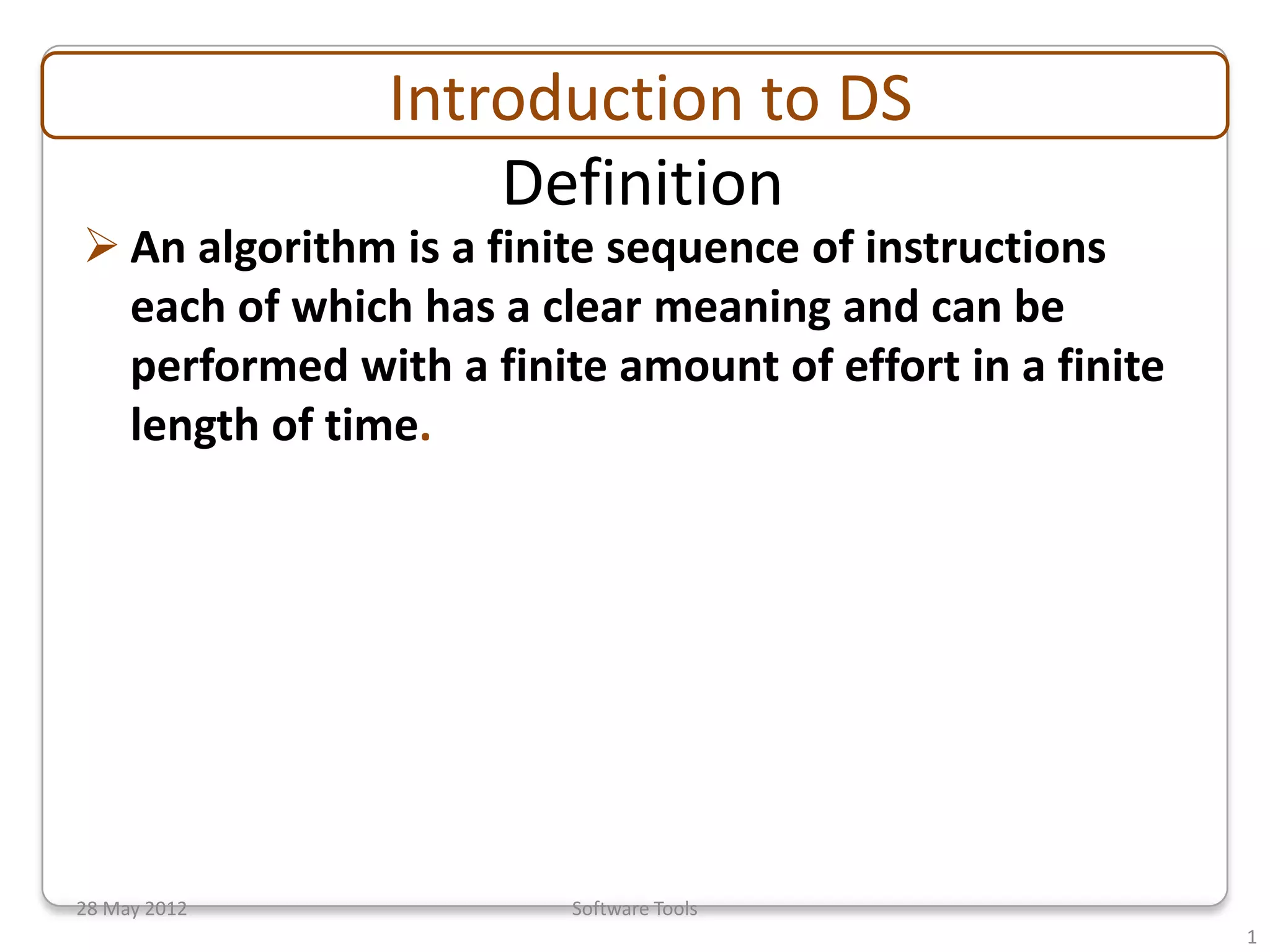
 An algorithm is a finite sequence of instructions
  each of which has a clear meaning and can be
  performed with a finite amount of effort in a finite
  length of time.


28 May 2012             Software Tools
                                                         1
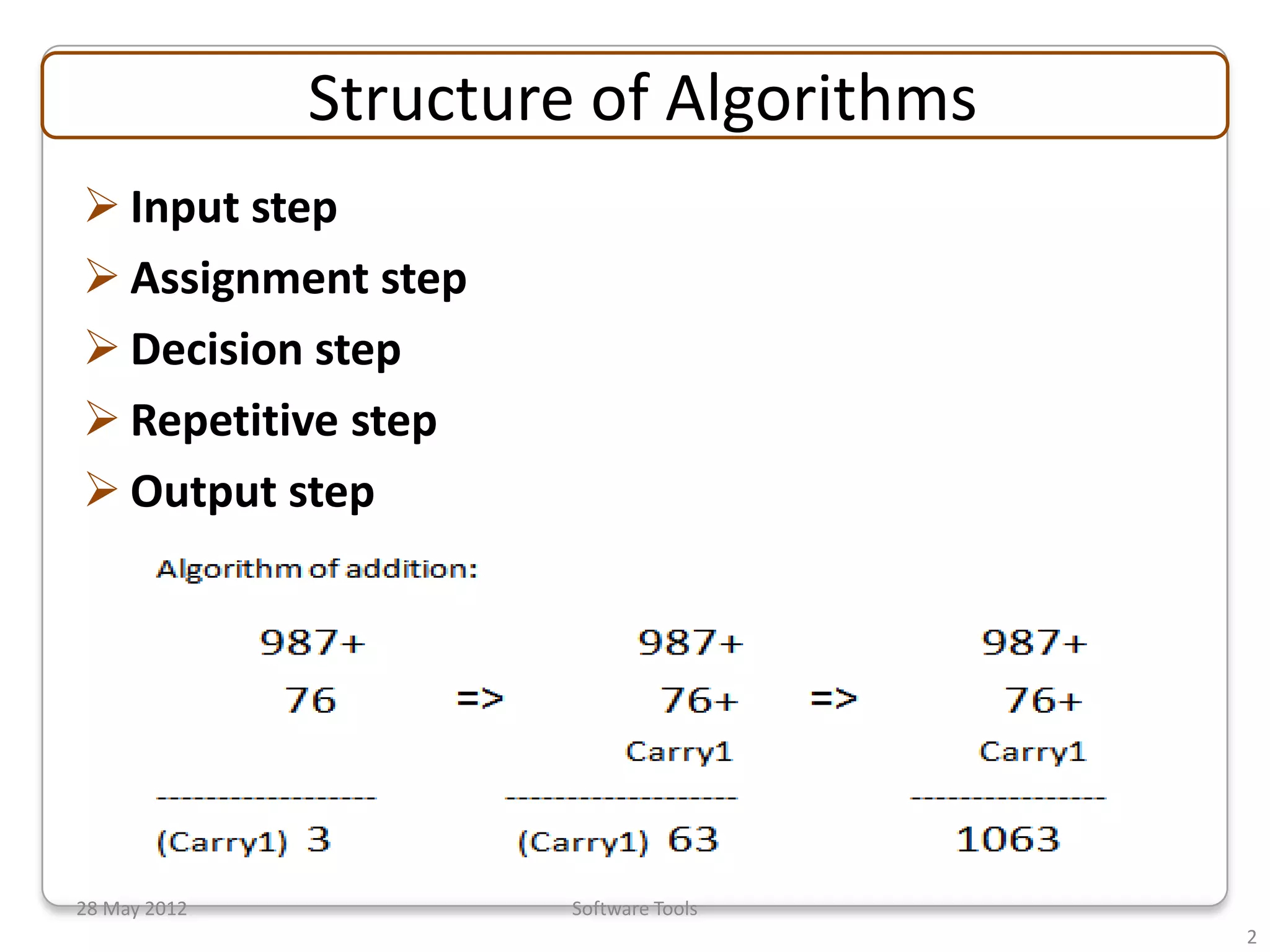
Structure of Algorithms
 Input step
 Assignment step
 Decision step
 Repetitive step
 Output step


28 May 2012            Software Tools
                                        2
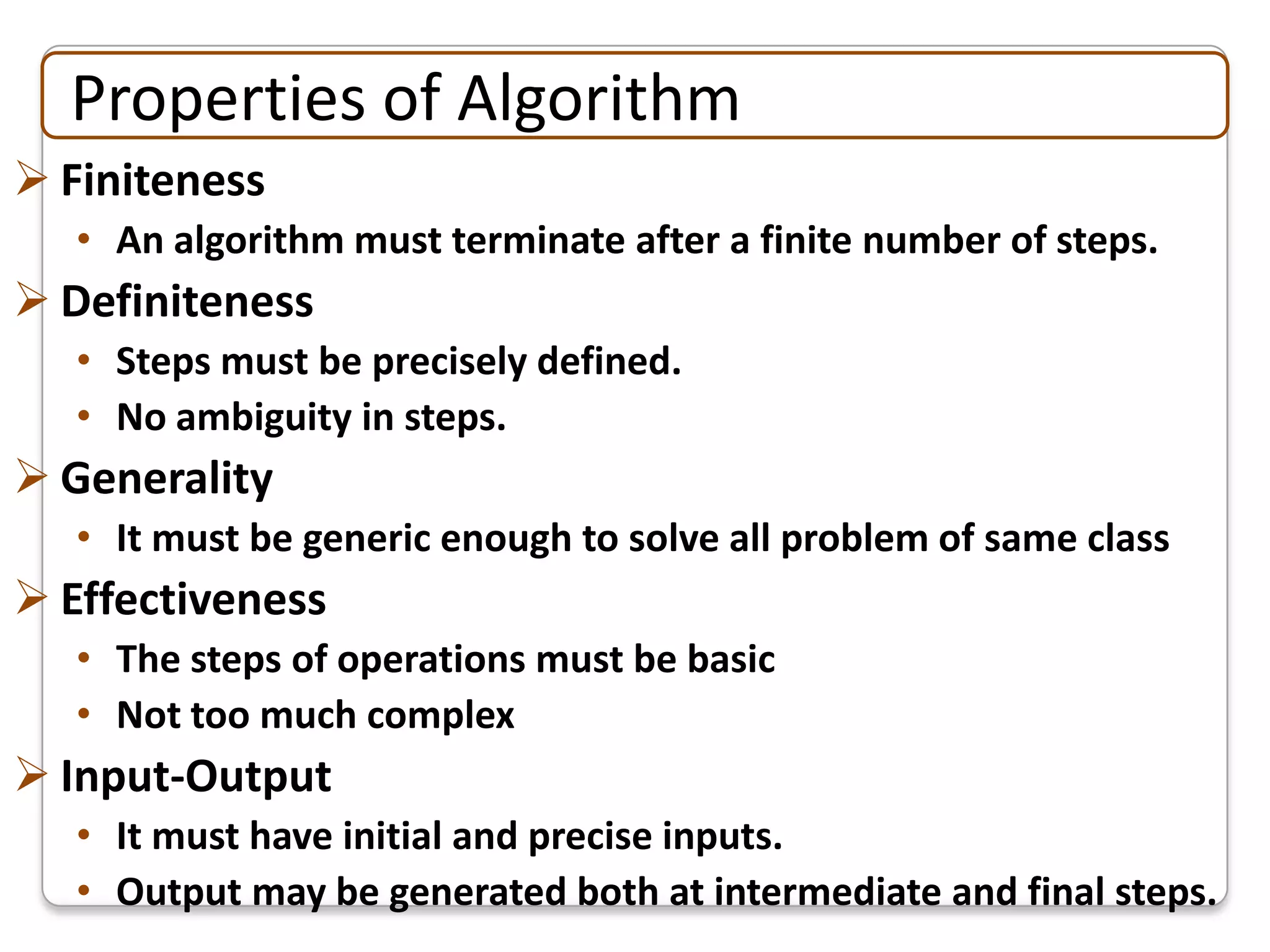
Properties of Algorithm
 Finiteness
   • An algorithm must terminate after a finite number of steps.
 Definiteness
   • Steps must be precisely defined.
   • No ambiguity in steps.
 Generality
   • It must be generic enough to solve all problem of same class
 Effectiveness
   • The steps of operations must be basic
   • Not too much complex
 Input-Output
   • It must have initial and precise inputs.
   • Output may be generated both at intermediate and final steps.
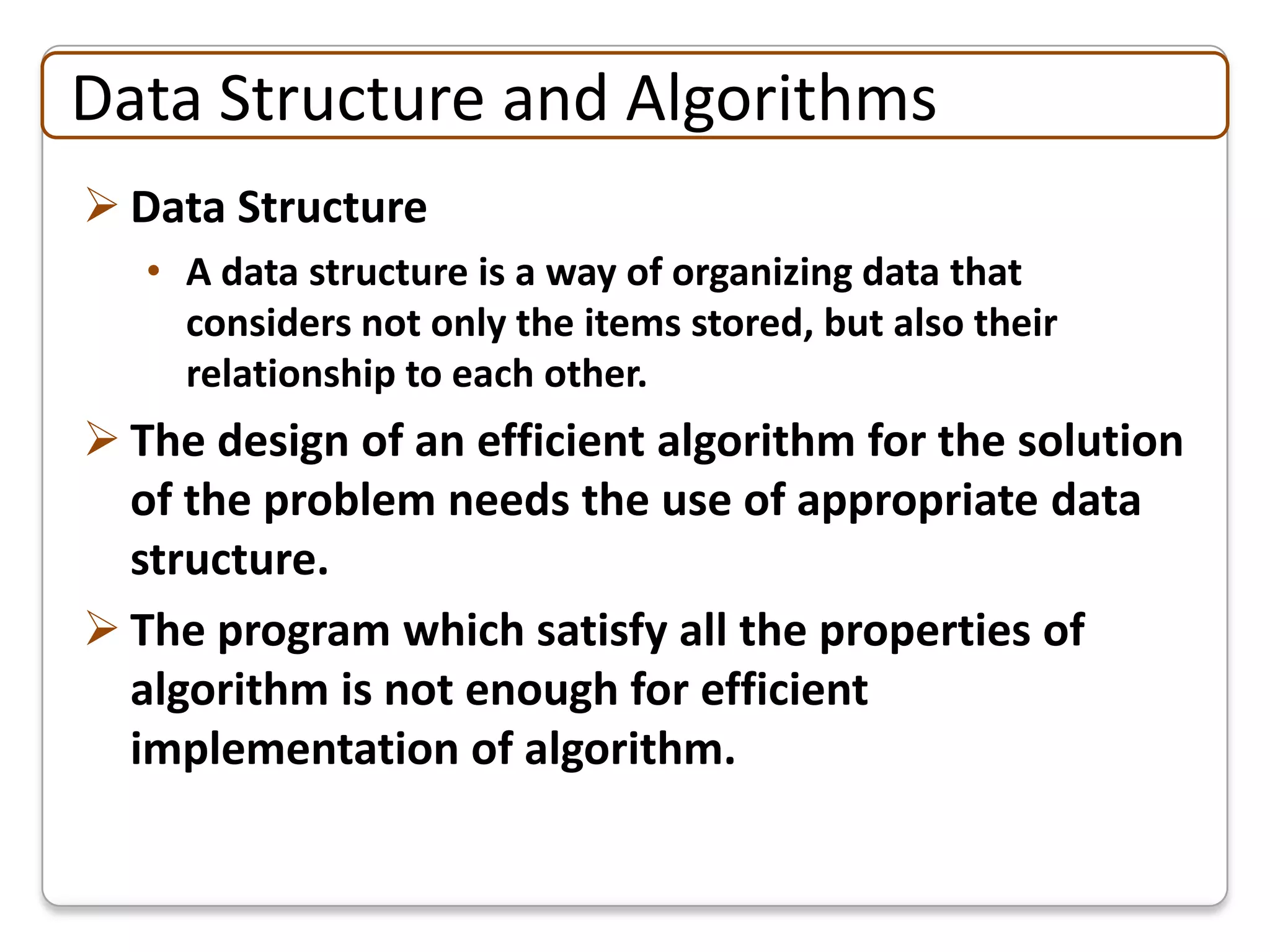
Data Structure and Algorithms
 Data Structure
   • A data structure is a way of organizing data that
     considers not only the items stored, but also their
     relationship to each other.
 The design of an efficient algorithm for the solution
  of the problem needs the use of appropriate data
  structure.
 The program which satisfy all the properties of
  algorithm is not enough for efficient
  implementation of algorithm.
Cont…
 It is important to arrange the data in well
  structured manner to prepare efficient algorithm.
 Thus, for the design of efficient solution of a
  problem, it is essential that algorithm goes hand in
  hand with appropriate data structure.


28 May 2012             Software Tools
                                                         5
Efficiency of Algorithm
 One problem can be solved in many ways then to
  choose the best one among them we required to
  measure the performance of algorithm.
 The performance of algorithm can be measured by
  two main parameter:
  • Time
  • Space
Efficiency of Algorithm (Cont…)
 Empirical or posterior testing approach
   • Implement the complete algorithms and execute them
     for various instances of the problems.
   • The time taken for execution of the programs is noted.
   • Algorithm taking less time is considered as the best
     among all.
   • Its disadvantage is that it depend on various factors like –
         machine on which it is executed.
Efficiency of Algorithm (Cont…)
         Programming language with which it is implemented
         Skills of a programmer
 Theoretical or apriori approach
   • Mathematically determine the resources such as time
     and space needed by algorithm in form of a function of a
     parameter related to the instance of the problem
     considered.
   • This approach is entirely machine, language and program
     independent.
   • It allows to study the efficiency of the algorithm on any
     input size instance.
Asymptotic Notation
 Apriori analysis uses asymptotic notations to
  express the time complexity of algorithms.
 Asymptotic notations are meaningful
  approximations of functions that represent the
  time and space complexity of a program.
Asymptotic Notation (Cont…)
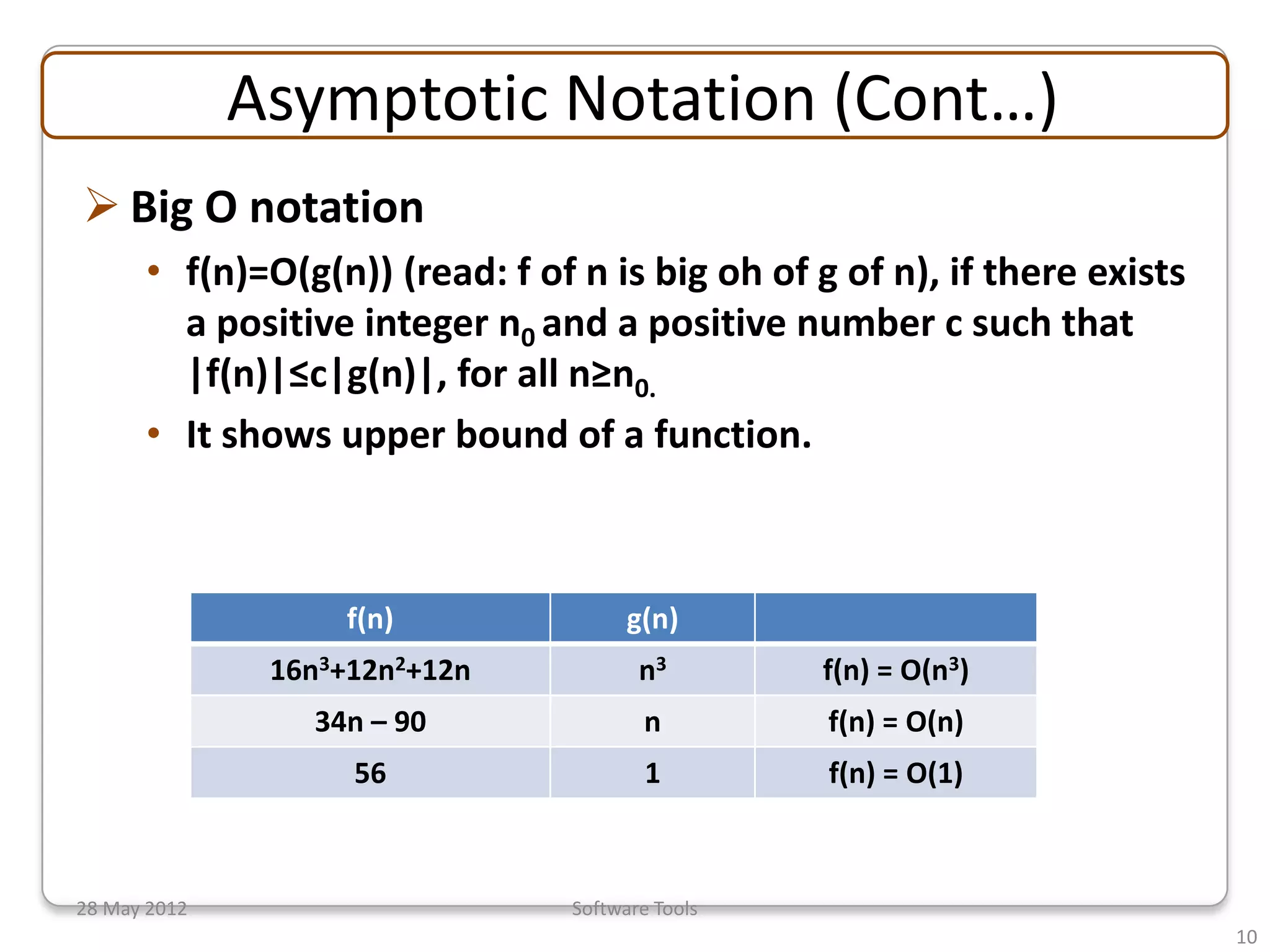
 Big O notation
      • f(n)=O(g(n)) (read: f of n is big oh of g of n), if there exists
        a positive integer n0 and a positive number c such that
        |f(n)|≤c|g(n)|, for all n≥n0.
      • It shows upper bound of a function.


                   f(n)                g(n)
               16n3+12n2+12n            n3        f(n) = O(n3)
                 34n – 90                n        f(n) = O(n)
                    56                   1        f(n) = O(1)


28 May 2012                      Software Tools
                                                                           10
Asymptotic Notation (Cont…)
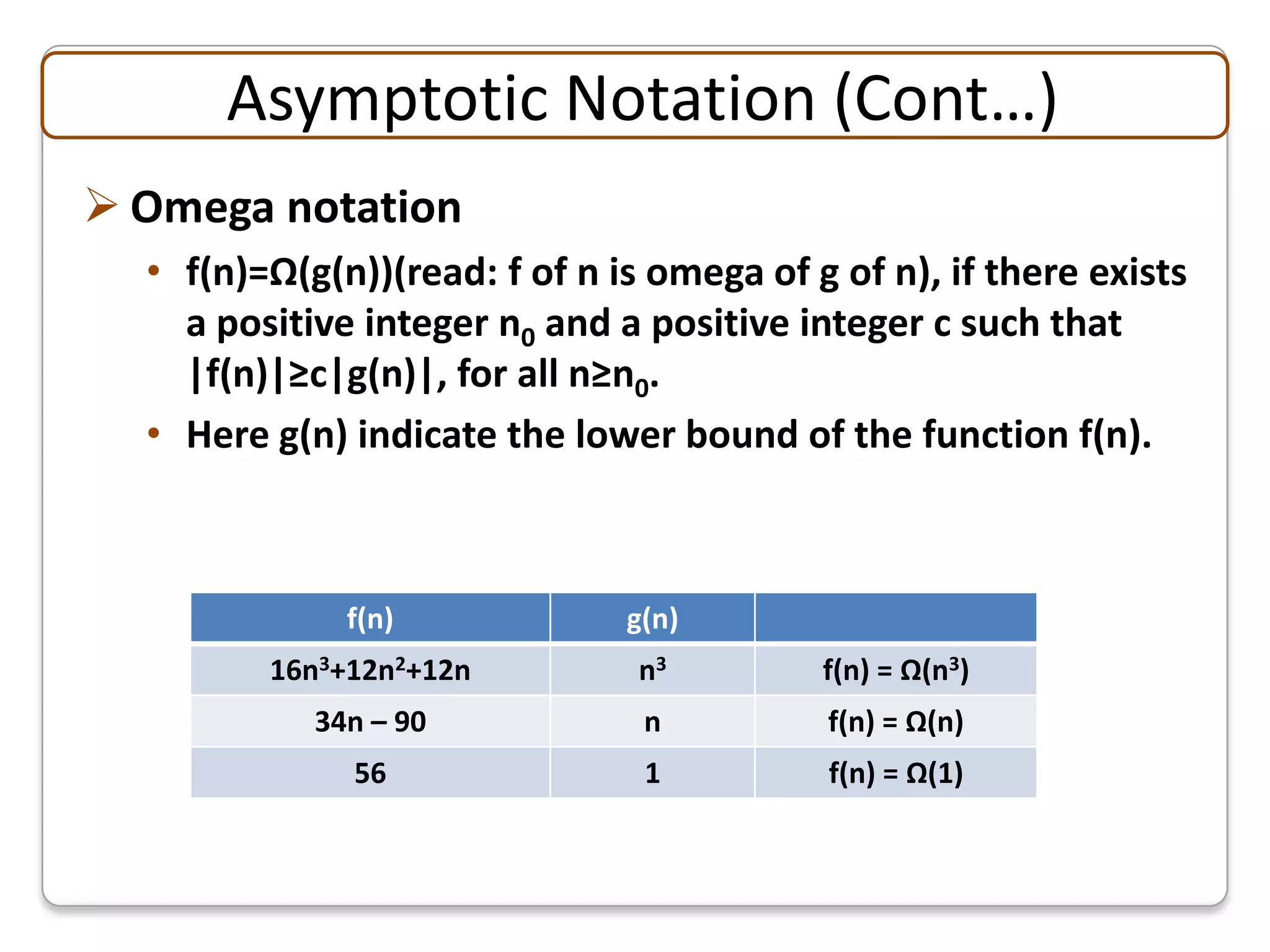
 Omega notation
  • f(n)=Ω(g(n))(read: f of n is omega of g of n), if there exists
    a positive integer n0 and a positive integer c such that
    |f(n)|≥c|g(n)|, for all n≥n0.
  • Here g(n) indicate the lower bound of the function f(n).


              f(n)             g(n)
         16n3+12n2+12n          n3         f(n) = Ω(n3)
            34n – 90            n          f(n) = Ω(n)
              56                1          f(n) = Ω(1)
Asymptotic Notation (Cont…)
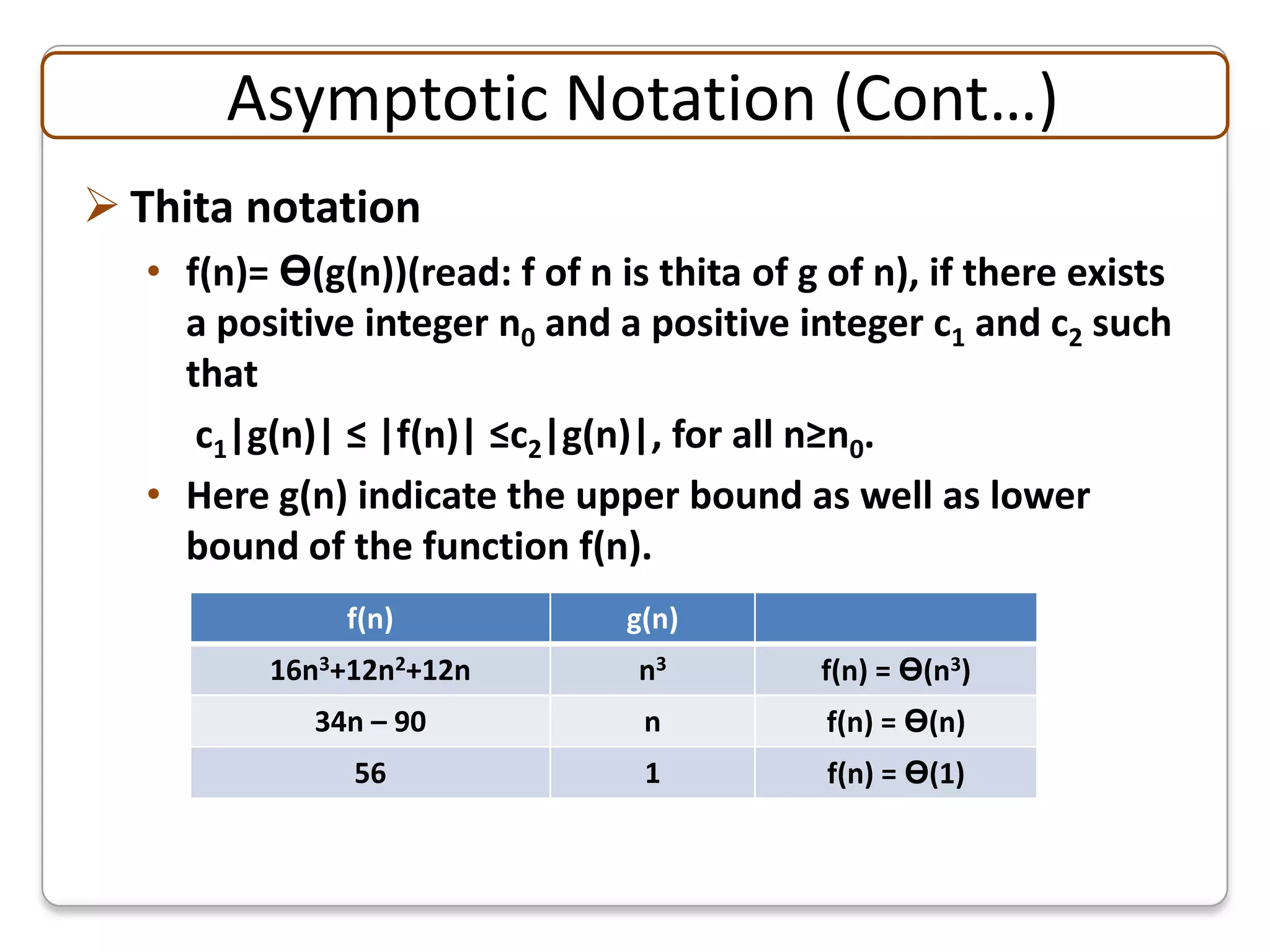
 Thita notation
   • f(n)= Ө(g(n))(read: f of n is thita of g of n), if there exists
     a positive integer n0 and a positive integer c1 and c2 such
     that
      c1|g(n)| ≤ |f(n)| ≤c2|g(n)|, for all n≥n0.
   • Here g(n) indicate the upper bound as well as lower
     bound of the function f(n).
               f(n)              g(n)
          16n3+12n2+12n           n3         f(n) = Ө(n3)
             34n – 90             n           f(n) = Ө(n)
                56                1           f(n) = Ө(1)
Asymptotic Notation (Cont…)
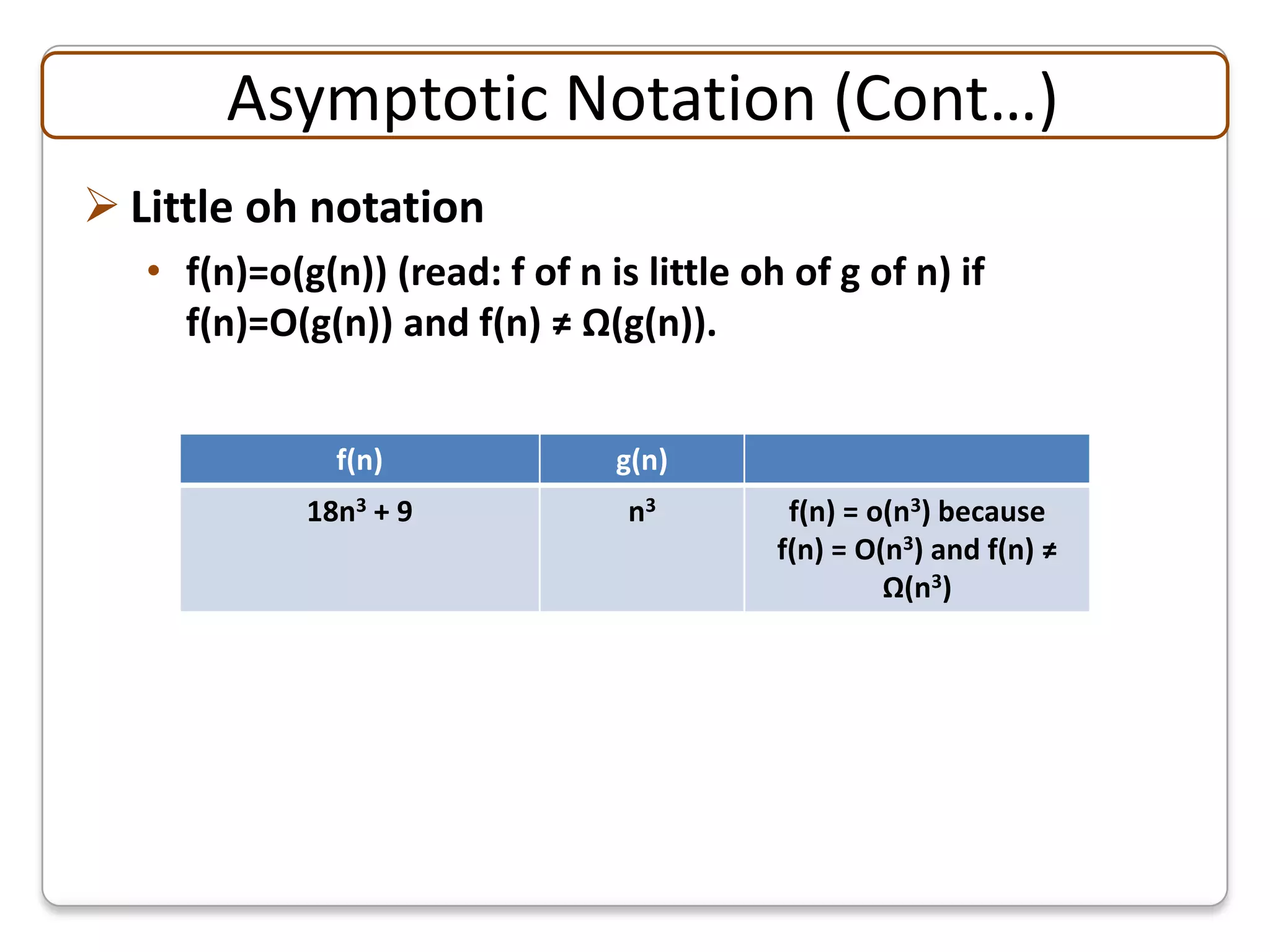
 Little oh notation
   • f(n)=o(g(n)) (read: f of n is little oh of g of n) if
     f(n)=O(g(n)) and f(n) ≠ Ω(g(n)).


               f(n)              g(n)
             18n3 + 9             n3         f(n) = o(n3) because
                                            f(n) = O(n3) and f(n) ≠
                                                     Ω(n3)
Average, Best and Worst Cases
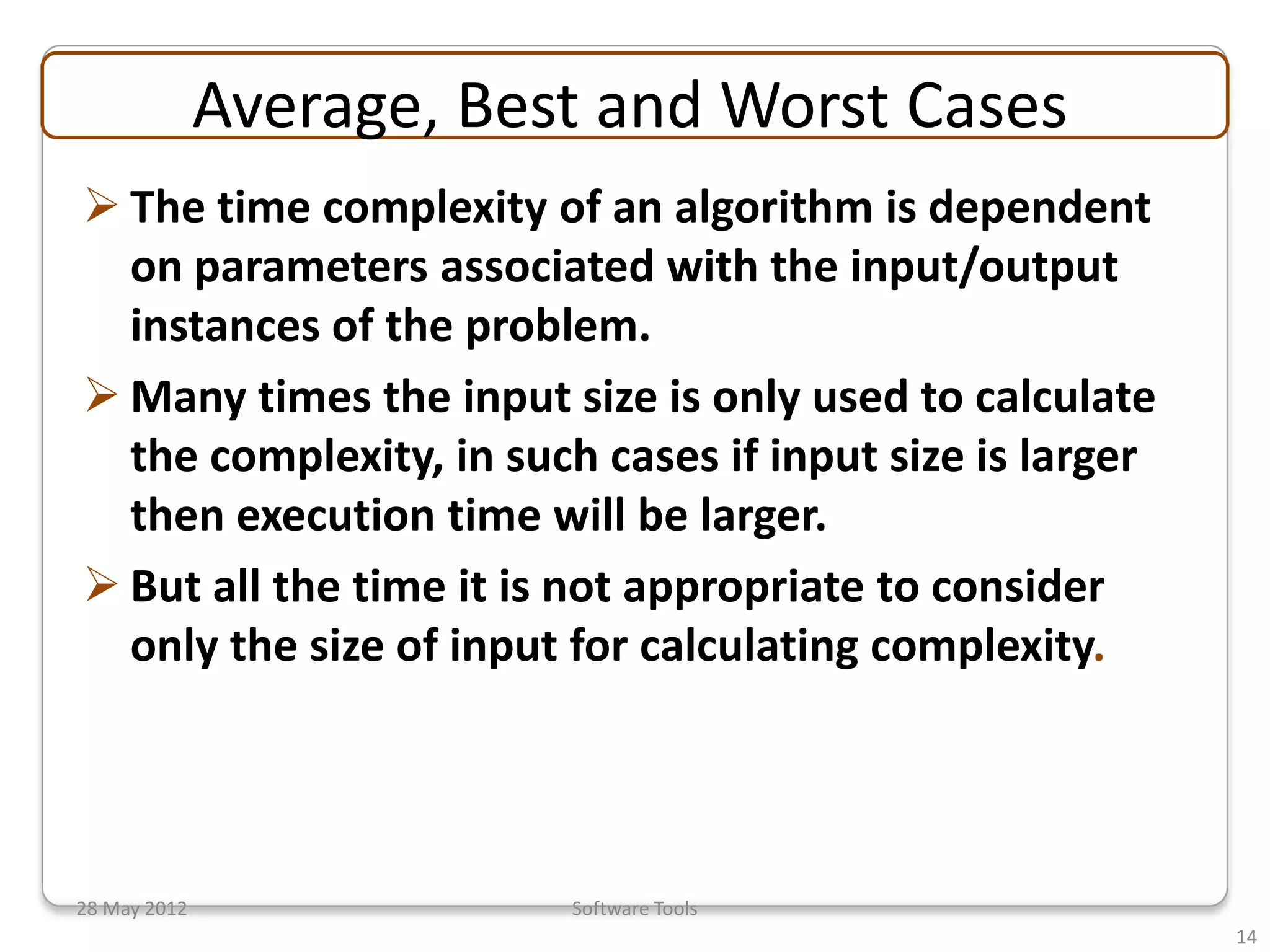
 The time complexity of an algorithm is dependent
  on parameters associated with the input/output
  instances of the problem.
 Many times the input size is only used to calculate
  the complexity, in such cases if input size is larger
  then execution time will be larger.
 But all the time it is not appropriate to consider
  only the size of input for calculating complexity.


28 May 2012               Software Tools
                                                          14
Cont…
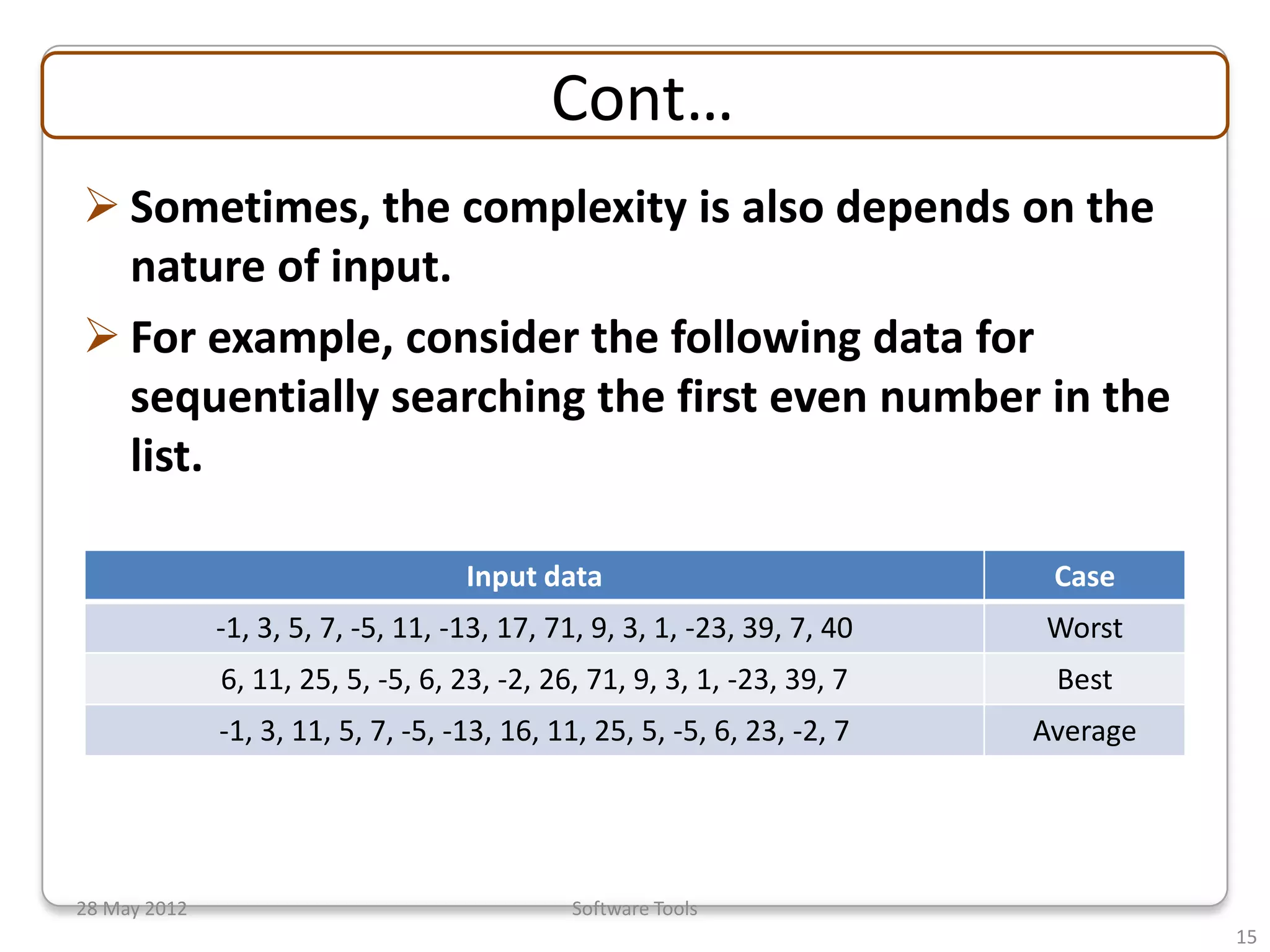
 Sometimes, the complexity is also depends on the
  nature of input.
 For example, consider the following data for
  sequentially searching the first even number in the
  list.

                                    Input data                             Case
              -1, 3, 5, 7, -5, 11, -13, 17, 71, 9, 3, 1, -23, 39, 7, 40   Worst
              6, 11, 25, 5, -5, 6, 23, -2, 26, 71, 9, 3, 1, -23, 39, 7     Best
              -1, 3, 11, 5, 7, -5, -13, 16, 11, 25, 5, -5, 6, 23, -2, 7   Average


28 May 2012                                  Software Tools
                                                                                    15
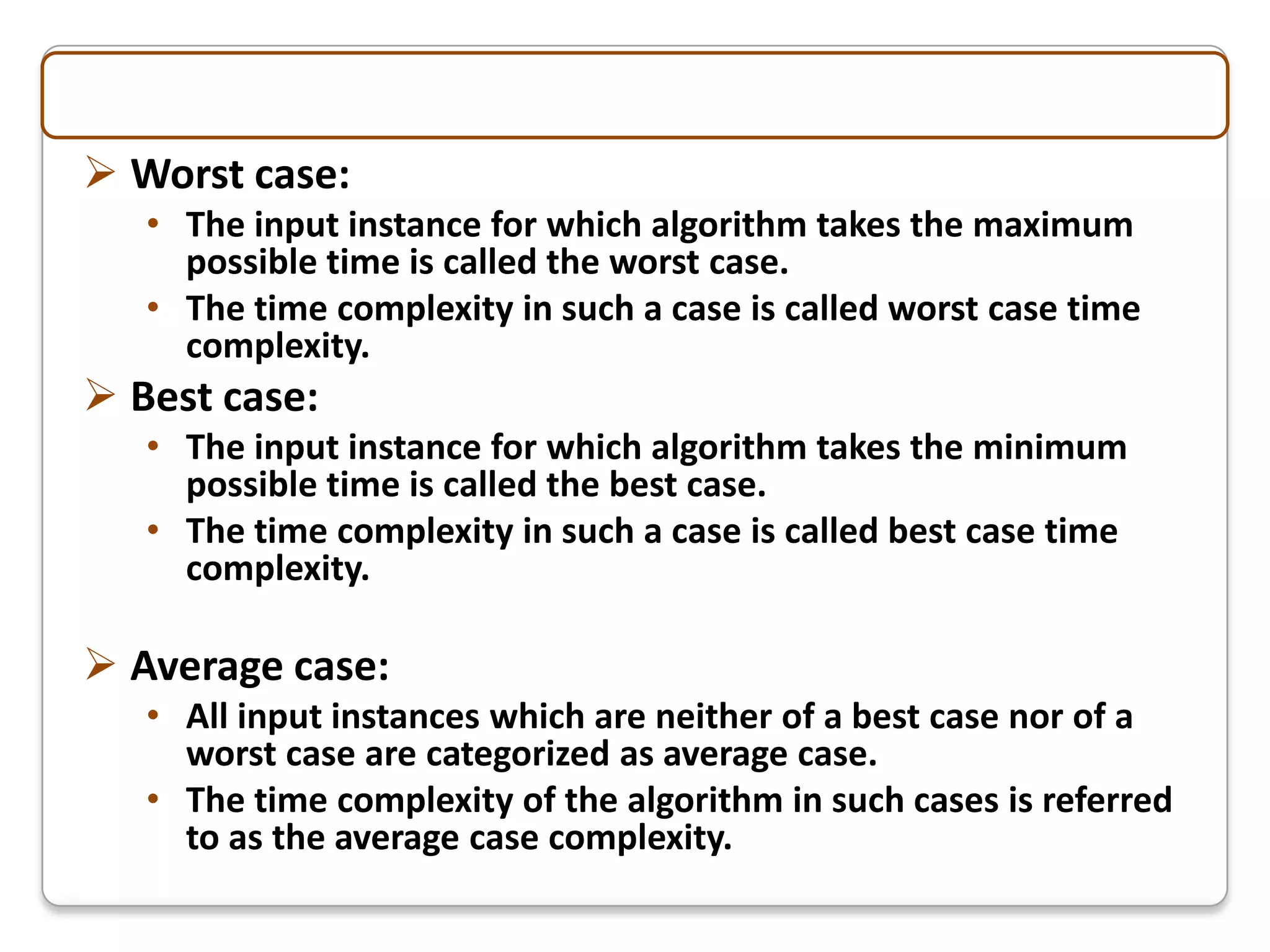
 Worst case:
   • The input instance for which algorithm takes the maximum
     possible time is called the worst case.
   • The time complexity in such a case is called worst case time
     complexity.
 Best case:
   • The input instance for which algorithm takes the minimum
     possible time is called the best case.
   • The time complexity in such a case is called best case time
     complexity.

 Average case:
   • All input instances which are neither of a best case nor of a
     worst case are categorized as average case.
   • The time complexity of the algorithm in such cases is referred
     to as the average case complexity.

Unit 1

  • 1.
    Introduction to DS Definition  An algorithm is a finite sequence of instructions each of which has a clear meaning and can be performed with a finite amount of effort in a finite length of time. 28 May 2012 Software Tools 1
  • 2.
    Structure of Algorithms Input step  Assignment step  Decision step  Repetitive step  Output step 28 May 2012 Software Tools 2
  • 3.
    Properties of Algorithm Finiteness • An algorithm must terminate after a finite number of steps.  Definiteness • Steps must be precisely defined. • No ambiguity in steps.  Generality • It must be generic enough to solve all problem of same class  Effectiveness • The steps of operations must be basic • Not too much complex  Input-Output • It must have initial and precise inputs. • Output may be generated both at intermediate and final steps.
  • 4.
    Data Structure andAlgorithms  Data Structure • A data structure is a way of organizing data that considers not only the items stored, but also their relationship to each other.  The design of an efficient algorithm for the solution of the problem needs the use of appropriate data structure.  The program which satisfy all the properties of algorithm is not enough for efficient implementation of algorithm.
  • 5.
    Cont…  It isimportant to arrange the data in well structured manner to prepare efficient algorithm.  Thus, for the design of efficient solution of a problem, it is essential that algorithm goes hand in hand with appropriate data structure. 28 May 2012 Software Tools 5
  • 6.
    Efficiency of Algorithm One problem can be solved in many ways then to choose the best one among them we required to measure the performance of algorithm.  The performance of algorithm can be measured by two main parameter: • Time • Space
  • 7.
    Efficiency of Algorithm(Cont…)  Empirical or posterior testing approach • Implement the complete algorithms and execute them for various instances of the problems. • The time taken for execution of the programs is noted. • Algorithm taking less time is considered as the best among all. • Its disadvantage is that it depend on various factors like –  machine on which it is executed.
  • 8.
    Efficiency of Algorithm(Cont…)  Programming language with which it is implemented  Skills of a programmer  Theoretical or apriori approach • Mathematically determine the resources such as time and space needed by algorithm in form of a function of a parameter related to the instance of the problem considered. • This approach is entirely machine, language and program independent. • It allows to study the efficiency of the algorithm on any input size instance.
  • 9.
    Asymptotic Notation  Apriorianalysis uses asymptotic notations to express the time complexity of algorithms.  Asymptotic notations are meaningful approximations of functions that represent the time and space complexity of a program.
  • 10.
    Asymptotic Notation (Cont…) Big O notation • f(n)=O(g(n)) (read: f of n is big oh of g of n), if there exists a positive integer n0 and a positive number c such that |f(n)|≤c|g(n)|, for all n≥n0. • It shows upper bound of a function. f(n) g(n) 16n3+12n2+12n n3 f(n) = O(n3) 34n – 90 n f(n) = O(n) 56 1 f(n) = O(1) 28 May 2012 Software Tools 10
  • 11.
    Asymptotic Notation (Cont…) Omega notation • f(n)=Ω(g(n))(read: f of n is omega of g of n), if there exists a positive integer n0 and a positive integer c such that |f(n)|≥c|g(n)|, for all n≥n0. • Here g(n) indicate the lower bound of the function f(n). f(n) g(n) 16n3+12n2+12n n3 f(n) = Ω(n3) 34n – 90 n f(n) = Ω(n) 56 1 f(n) = Ω(1)
  • 12.
    Asymptotic Notation (Cont…) Thita notation • f(n)= Ө(g(n))(read: f of n is thita of g of n), if there exists a positive integer n0 and a positive integer c1 and c2 such that c1|g(n)| ≤ |f(n)| ≤c2|g(n)|, for all n≥n0. • Here g(n) indicate the upper bound as well as lower bound of the function f(n). f(n) g(n) 16n3+12n2+12n n3 f(n) = Ө(n3) 34n – 90 n f(n) = Ө(n) 56 1 f(n) = Ө(1)
  • 13.
    Asymptotic Notation (Cont…) Little oh notation • f(n)=o(g(n)) (read: f of n is little oh of g of n) if f(n)=O(g(n)) and f(n) ≠ Ω(g(n)). f(n) g(n) 18n3 + 9 n3 f(n) = o(n3) because f(n) = O(n3) and f(n) ≠ Ω(n3)
  • 14.
    Average, Best andWorst Cases  The time complexity of an algorithm is dependent on parameters associated with the input/output instances of the problem.  Many times the input size is only used to calculate the complexity, in such cases if input size is larger then execution time will be larger.  But all the time it is not appropriate to consider only the size of input for calculating complexity. 28 May 2012 Software Tools 14
  • 15.
    Cont…  Sometimes, thecomplexity is also depends on the nature of input.  For example, consider the following data for sequentially searching the first even number in the list. Input data Case -1, 3, 5, 7, -5, 11, -13, 17, 71, 9, 3, 1, -23, 39, 7, 40 Worst 6, 11, 25, 5, -5, 6, 23, -2, 26, 71, 9, 3, 1, -23, 39, 7 Best -1, 3, 11, 5, 7, -5, -13, 16, 11, 25, 5, -5, 6, 23, -2, 7 Average 28 May 2012 Software Tools 15
  • 16.
     Worst case: • The input instance for which algorithm takes the maximum possible time is called the worst case. • The time complexity in such a case is called worst case time complexity.  Best case: • The input instance for which algorithm takes the minimum possible time is called the best case. • The time complexity in such a case is called best case time complexity.  Average case: • All input instances which are neither of a best case nor of a worst case are categorized as average case. • The time complexity of the algorithm in such cases is referred to as the average case complexity.