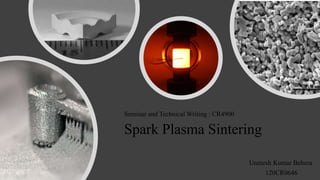
Spark Plasma Sintering
Seminar and Technical Writing : CR4900
Unmesh Kumar Behera
120CR0646
Contents…
• Introduction
• Principles of Spark Plasma Sintering
• Advantages of Spark Plasma Sintering
• Microstructural Evolution
• Densification Mechanisms
• Process Parameters and Their Influence
• Spark Plasma Sintering of Ceramics
• Spark Plasma Sintering of Metals and Alloys
• Applications of Spark Plasma Sintered Materials
• Challenges and Future Developments
• Conclusion
• References
Spark Plasma Sintering
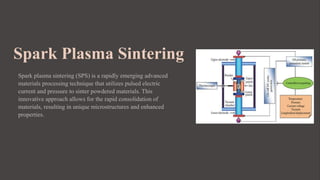
Spark plasma sintering (SPS) is a rapidly emerging advanced
materials processing technique that utilizes pulsed electric
current and pressure to sinter powdered materials. This
innovative approach allows for the rapid consolidation of
materials, resulting in unique microstructures and enhanced
properties.
Ua
Introduction
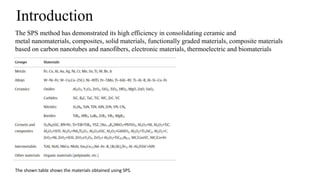
The SPS method has demonstrated its high efficiency in consolidating ceramic and
metal nanomaterials, composites, solid materials, functionally graded materials, composite materials
based on carbon nanotubes and nanofibers, electronic materials, thermoelectric and biomaterials
The shown table shows the materials obtained using SPS.
Principles of Spark Plasma Sintering
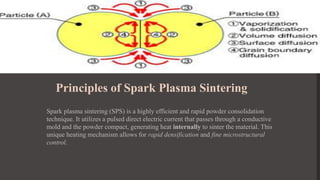
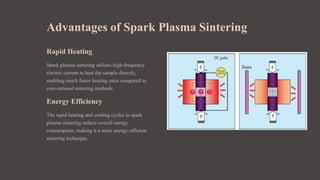
Spark plasma sintering (SPS) is a highly efficient and rapid powder consolidation
technique. It utilizes a pulsed direct electric current that passes through a conductive
mold and the powder compact, generating heat internally to sinter the material. This
unique heating mechanism allows for rapid densification and fine microstructural
control.
Advantages of Spark Plasma Sintering
Rapid Heating
Spark plasma sintering utilizes high-frequency
electric current to heat the sample directly,
enabling much faster heating rates compared to
conventional sintering methods.
Energy Efficiency
The rapid heating and cooling cycles in spark
plasma sintering reduce overall energy
consumption, making it a more energy-efficient
sintering technique.
Advantages of Spark Plasma Sintering (Contd.)
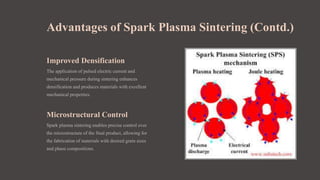
Improved Densification
The application of pulsed electric current and
mechanical pressure during sintering enhances
densification and produces materials with excellent
mechanical properties.
Microstructural Control
Spark plasma sintering enables precise control over
the microstructure of the final product, allowing for
the fabrication of materials with desired grain sizes
and phase compositions.
Microstructural Evolution during Spark
Plasma Sintering
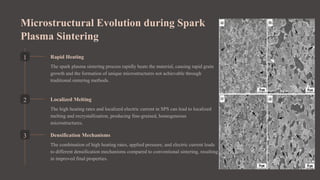
1 Rapid Heating
The spark plasma sintering process rapidly heats the material, causing rapid grain
growth and the formation of unique microstructures not achievable through
traditional sintering methods.
2 Localized Melting
The high heating rates and localized electric current in SPS can lead to localized
melting and recrystallization, producing fine-grained, homogeneous
microstructures.
3 Densification Mechanisms
The combination of high heating rates, applied pressure, and electric current leads
to different densification mechanisms compared to conventional sintering, resulting
in improved final properties.
Densification Mechanisms in
Spark Plasma Sintering
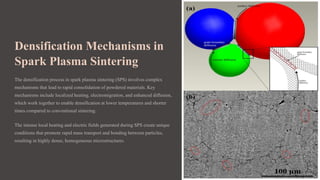
The densification process in spark plasma sintering (SPS) involves complex
mechanisms that lead to rapid consolidation of powdered materials. Key
mechanisms include localized heating, electromigration, and enhanced diffusion,
which work together to enable densification at lower temperatures and shorter
times compared to conventional sintering.
The intense local heating and electric fields generated during SPS create unique
conditions that promote rapid mass transport and bonding between particles,
resulting in highly dense, homogeneous microstructures.
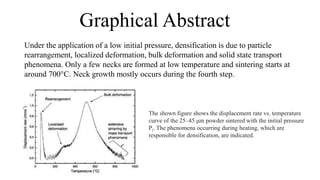
Graphical Abstract
Under the application of a low initial pressure, densification is due to particle
rearrangement, localized deformation, bulk deformation and solid state transport
phenomena. Only a few necks are formed at low temperature and sintering starts at
around 700°C. Neck growth mostly occurs during the fourth step.
The shown figure shows the displacement rate vs. temperature
curve of the 25–45 μm powder sintered with the initial pressure
Pi. The phenomena occurring during heating, which are
responsible for densification, are indicated.
Process Parameters and Their Influence
Temperature
The sintering temperature
is a critical parameter, as it
affects the densification,
grain growth, and
microstructural evolution
of the material.
Pressure
The applied pressure during
spark plasma sintering helps
drive the densification
process and can influence
the final density and
mechanical properties of the
sintered part.
Heating Rate
The heating rate controls
the rate of thermal
energy input, which can
impact the kinetics of
the sintering process and
the quality of the final
product.
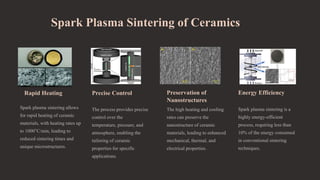
Spark Plasma Sintering of Ceramics
Rapid Heating
Spark plasma sintering allows
for rapid heating of ceramic
materials, with heating rates up
to 1000°C/min, leading to
reduced sintering times and
unique microstructures.
Precise Control
The process provides precise
control over the
temperature, pressure, and
atmosphere, enabling the
tailoring of ceramic
properties for specific
applications.
Preservation of
Nanostructures
The high heating and cooling
rates can preserve the
nanostructure of ceramic
materials, leading to enhanced
mechanical, thermal, and
electrical properties.
Energy Efficiency
Spark plasma sintering is a
highly energy-efficient
process, requiring less than
10% of the energy consumed
in conventional sintering
techniques.
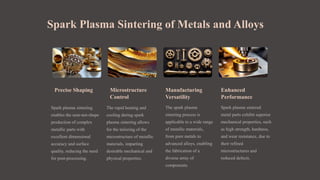
Spark Plasma Sintering of Metals and Alloys
Precise Shaping
Spark plasma sintering
enables the near-net-shape
production of complex
metallic parts with
excellent dimensional
accuracy and surface
quality, reducing the need
for post-processing.
Microstructure
Control
The rapid heating and
cooling during spark
plasma sintering allows
for the tailoring of the
microstructure of metallic
materials, imparting
desirable mechanical and
physical properties.
Manufacturing
Versatility
The spark plasma
sintering process is
applicable to a wide range
of metallic materials,
from pure metals to
advanced alloys, enabling
the fabrication of a
diverse array of
components.
Enhanced
Performance
Spark plasma sintered
metal parts exhibit superior
mechanical properties, such
as high strength, hardness,
and wear resistance, due to
their refined
microstructures and
reduced defects.
Applications of Spark Plasma Sintered Materials
1
Advanced Ceramics
High-performance structural, thermal, and electronic ceramics
2
Functional Materials
Thermoelectrics, piezoelectrics, and sensor applications
3
Metal Matrix Composites
Light-weight, high-strength materials for
aerospace and automotive
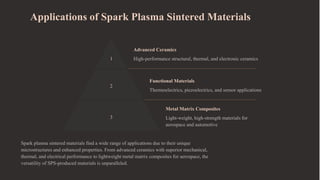
Spark plasma sintered materials find a wide range of applications due to their unique
microstructures and enhanced properties. From advanced ceramics with superior mechanical,
thermal, and electrical performance to lightweight metal matrix composites for aerospace, the
versatility of SPS-produced materials is unparalleled.
Challenges and Future Developments in
Spark Plasma Sintering
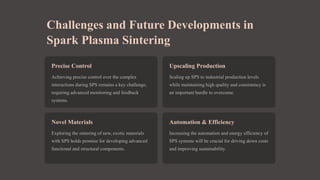
Precise Control
Achieving precise control over the complex
interactions during SPS remains a key challenge,
requiring advanced monitoring and feedback
systems.
Upscaling Production
Scaling up SPS to industrial production levels
while maintaining high quality and consistency is
an important hurdle to overcome.
Novel Materials
Exploring the sintering of new, exotic materials
with SPS holds promise for developing advanced
functional and structural components.
Automation & Efficiency
Increasing the automation and energy efficiency of
SPS systems will be crucial for driving down costs
and improving sustainability.
Conclusion
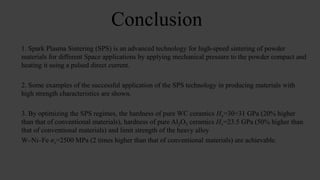
1. Spark Plasma Sintering (SPS) is an advanced technology for high-speed sintering of powder
materials for different Space applications by applying mechanical pressure to the powder compact and
heating it using a pulsed direct current.
2. Some examples of the successful application of the SPS technology in producing materials with
high strength characteristics are shown.
3. By optimizing the SPS regimes, the hardness of pure WC ceramics Hv=30÷31 GPa (20% higher
than that of conventional materials), hardness of pure Al2O3 ceramics Hv=23.5 GPa (50% higher than
that of conventional materials) and limit strength of the heavy alloy
W–Ni–Fe σт=2500 MPa (2 times higher than that of conventional materials) are achievable.
References..
1. N.N., Smirnov, A.I., Nazarenko, A.B., Kiselev, Modelling of the space debris evolution based on
continua mechanics. Google Scholar
2. M. Tokita, The potential of spark plasma sintering (SPS) method for the fabrication on an industrial
scale of functionally graded materials. Google Scholar
3. T. Takeuchi, M. Tabuchi, Y. Suyama, H. Kageyama, Preparation of dense BaTiO3 ceramics with
submicrometer grains by spark plasma sintering. Google Scholar
4. Z. Shen, M. Johnsson, Z. Zhao, M. Nygren, Spark plasma sintering of alumina. Google Scholar
THANK YOU

UNMESH BEHERA_120CR0646.pptx - Spark Plasma Sintering

  • 1.
    Spark Plasma Sintering Seminarand Technical Writing : CR4900 Unmesh Kumar Behera 120CR0646
  • 2.
    Contents… • Introduction • Principlesof Spark Plasma Sintering • Advantages of Spark Plasma Sintering • Microstructural Evolution • Densification Mechanisms • Process Parameters and Their Influence • Spark Plasma Sintering of Ceramics • Spark Plasma Sintering of Metals and Alloys • Applications of Spark Plasma Sintered Materials • Challenges and Future Developments • Conclusion • References
  • 3.
    Spark Plasma Sintering Sparkplasma sintering (SPS) is a rapidly emerging advanced materials processing technique that utilizes pulsed electric current and pressure to sinter powdered materials. This innovative approach allows for the rapid consolidation of materials, resulting in unique microstructures and enhanced properties. Ua
  • 4.
    Introduction The SPS methodhas demonstrated its high efficiency in consolidating ceramic and metal nanomaterials, composites, solid materials, functionally graded materials, composite materials based on carbon nanotubes and nanofibers, electronic materials, thermoelectric and biomaterials The shown table shows the materials obtained using SPS.
  • 5.
    Principles of SparkPlasma Sintering Spark plasma sintering (SPS) is a highly efficient and rapid powder consolidation technique. It utilizes a pulsed direct electric current that passes through a conductive mold and the powder compact, generating heat internally to sinter the material. This unique heating mechanism allows for rapid densification and fine microstructural control.
  • 6.
    Advantages of SparkPlasma Sintering Rapid Heating Spark plasma sintering utilizes high-frequency electric current to heat the sample directly, enabling much faster heating rates compared to conventional sintering methods. Energy Efficiency The rapid heating and cooling cycles in spark plasma sintering reduce overall energy consumption, making it a more energy-efficient sintering technique.
  • 7.
    Advantages of SparkPlasma Sintering (Contd.) Improved Densification The application of pulsed electric current and mechanical pressure during sintering enhances densification and produces materials with excellent mechanical properties. Microstructural Control Spark plasma sintering enables precise control over the microstructure of the final product, allowing for the fabrication of materials with desired grain sizes and phase compositions.
  • 8.
    Microstructural Evolution duringSpark Plasma Sintering 1 Rapid Heating The spark plasma sintering process rapidly heats the material, causing rapid grain growth and the formation of unique microstructures not achievable through traditional sintering methods. 2 Localized Melting The high heating rates and localized electric current in SPS can lead to localized melting and recrystallization, producing fine-grained, homogeneous microstructures. 3 Densification Mechanisms The combination of high heating rates, applied pressure, and electric current leads to different densification mechanisms compared to conventional sintering, resulting in improved final properties.
  • 9.
    Densification Mechanisms in SparkPlasma Sintering The densification process in spark plasma sintering (SPS) involves complex mechanisms that lead to rapid consolidation of powdered materials. Key mechanisms include localized heating, electromigration, and enhanced diffusion, which work together to enable densification at lower temperatures and shorter times compared to conventional sintering. The intense local heating and electric fields generated during SPS create unique conditions that promote rapid mass transport and bonding between particles, resulting in highly dense, homogeneous microstructures.
  • 10.
    Graphical Abstract Under theapplication of a low initial pressure, densification is due to particle rearrangement, localized deformation, bulk deformation and solid state transport phenomena. Only a few necks are formed at low temperature and sintering starts at around 700°C. Neck growth mostly occurs during the fourth step. The shown figure shows the displacement rate vs. temperature curve of the 25–45 μm powder sintered with the initial pressure Pi. The phenomena occurring during heating, which are responsible for densification, are indicated.
  • 11.
    Process Parameters andTheir Influence Temperature The sintering temperature is a critical parameter, as it affects the densification, grain growth, and microstructural evolution of the material. Pressure The applied pressure during spark plasma sintering helps drive the densification process and can influence the final density and mechanical properties of the sintered part. Heating Rate The heating rate controls the rate of thermal energy input, which can impact the kinetics of the sintering process and the quality of the final product.
  • 12.
    Spark Plasma Sinteringof Ceramics Rapid Heating Spark plasma sintering allows for rapid heating of ceramic materials, with heating rates up to 1000°C/min, leading to reduced sintering times and unique microstructures. Precise Control The process provides precise control over the temperature, pressure, and atmosphere, enabling the tailoring of ceramic properties for specific applications. Preservation of Nanostructures The high heating and cooling rates can preserve the nanostructure of ceramic materials, leading to enhanced mechanical, thermal, and electrical properties. Energy Efficiency Spark plasma sintering is a highly energy-efficient process, requiring less than 10% of the energy consumed in conventional sintering techniques.
  • 13.
    Spark Plasma Sinteringof Metals and Alloys Precise Shaping Spark plasma sintering enables the near-net-shape production of complex metallic parts with excellent dimensional accuracy and surface quality, reducing the need for post-processing. Microstructure Control The rapid heating and cooling during spark plasma sintering allows for the tailoring of the microstructure of metallic materials, imparting desirable mechanical and physical properties. Manufacturing Versatility The spark plasma sintering process is applicable to a wide range of metallic materials, from pure metals to advanced alloys, enabling the fabrication of a diverse array of components. Enhanced Performance Spark plasma sintered metal parts exhibit superior mechanical properties, such as high strength, hardness, and wear resistance, due to their refined microstructures and reduced defects.
  • 14.
    Applications of SparkPlasma Sintered Materials 1 Advanced Ceramics High-performance structural, thermal, and electronic ceramics 2 Functional Materials Thermoelectrics, piezoelectrics, and sensor applications 3 Metal Matrix Composites Light-weight, high-strength materials for aerospace and automotive Spark plasma sintered materials find a wide range of applications due to their unique microstructures and enhanced properties. From advanced ceramics with superior mechanical, thermal, and electrical performance to lightweight metal matrix composites for aerospace, the versatility of SPS-produced materials is unparalleled.
  • 15.
    Challenges and FutureDevelopments in Spark Plasma Sintering Precise Control Achieving precise control over the complex interactions during SPS remains a key challenge, requiring advanced monitoring and feedback systems. Upscaling Production Scaling up SPS to industrial production levels while maintaining high quality and consistency is an important hurdle to overcome. Novel Materials Exploring the sintering of new, exotic materials with SPS holds promise for developing advanced functional and structural components. Automation & Efficiency Increasing the automation and energy efficiency of SPS systems will be crucial for driving down costs and improving sustainability.
  • 16.
    Conclusion 1. Spark PlasmaSintering (SPS) is an advanced technology for high-speed sintering of powder materials for different Space applications by applying mechanical pressure to the powder compact and heating it using a pulsed direct current. 2. Some examples of the successful application of the SPS technology in producing materials with high strength characteristics are shown. 3. By optimizing the SPS regimes, the hardness of pure WC ceramics Hv=30÷31 GPa (20% higher than that of conventional materials), hardness of pure Al2O3 ceramics Hv=23.5 GPa (50% higher than that of conventional materials) and limit strength of the heavy alloy W–Ni–Fe σт=2500 MPa (2 times higher than that of conventional materials) are achievable.
  • 17.
    References.. 1. N.N., Smirnov,A.I., Nazarenko, A.B., Kiselev, Modelling of the space debris evolution based on continua mechanics. Google Scholar 2. M. Tokita, The potential of spark plasma sintering (SPS) method for the fabrication on an industrial scale of functionally graded materials. Google Scholar 3. T. Takeuchi, M. Tabuchi, Y. Suyama, H. Kageyama, Preparation of dense BaTiO3 ceramics with submicrometer grains by spark plasma sintering. Google Scholar 4. Z. Shen, M. Johnsson, Z. Zhao, M. Nygren, Spark plasma sintering of alumina. Google Scholar
  • 18.