
Presented By-
Shivam Pandey
I.T.
Roll No.- 1303313042
What is Unix?
History Of Unix
Architecture of Unix
Impacts of Unix
Need To Know
Unix Vs Windows
Portable, Multitasking & Multiuser O/S
Written in C & Assembly Language
Released in October 1973
Available in English
Monolithic Kernel
Open Source Software
 Programmable
Source Code
 Available in Different
Flavors-
 Linux
 Ubuntu
 Fedora
 Redhat
Failure of Multics(mid 1960s).
Project UNICS was started in 1970.
Developed at AT&T Bell Labs in late
1970s.
Developed by Ken Thompson, Dennis
Ritchie and others.
Written in C and Assembly Language.
Migration from assembly to higher level
language made it portable.
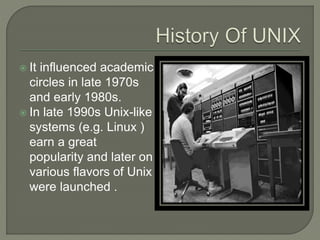
 It influenced academic
circles in late 1970s
and early 1980s.
 In late 1990s Unix-like
systems (e.g. Linux )
earn a great
popularity and later on
various flavors of Unix
were launched .
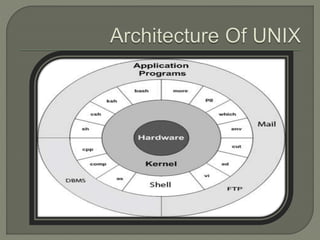
The functioning of Unix is framed in three
levels ---
 Kernel :
1. It interacts with actual hardware in
machine language.
2.It also manages files and also carries
out data transfer between file system
and the hardware.
3. Kernel also manages memory and
handles interrupted issues.
4.It also handles programs running in
memory allocation of CPU.
5.Kernel program is stored in a file
called ‘unix’.
 Shell:
1.It is called the mediator.
2.It interprets the commands and
conveys them to kernel.
3.The shell program is stored in a file
called ‘sh’.
 Tools And Applications :
It consists of software of high level
programming language e.g. mail,
FTP,DBMS etc.
Unix system has significant impact on other
operating system. It won success by--
 Direct Interaction : Since it was written in C
, so it made more effective the interaction
between user and hardware.
 Providing software at nominal fee for
educational and other uses.
 Running on inexpensive hardware.
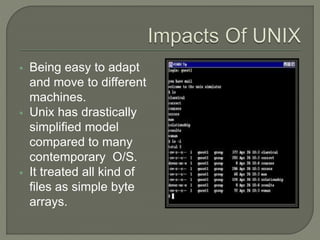
 Being easy to adapt
and move to different
machines.
 Unix has drastically
simplified model
compared to many
contemporary O/S.
 It treated all kind of
files as simple byte
arrays.
Unix-like operating systems (e.g. Linux)
are the fastest growing O/S in the market.
Source code availability provides
availability to “get under the hood” of O/S
design and function.
Unix and unix-like operating system are
virus free.
Unix like O/S are license free.
 Unix and unix-like
operating systems are
mostly used by
hackers due to its
security features.
Windows is licensed operating system
whereas Unix is free of cost.
Unix is open source software i.e. you can
customize it according to your need
whereas this feature is not provided by
windows.
Unix is virus free operating system
whereas windows can be affected by
viruses.
 Unix is more stable
i.e. unix handles high
server load better
than windows and
unix machines rarely
requires reboots while
windows is constantly
needing them.
Unix Operating System

Unix Operating System

  • 1.
  • 2.
    What is Unix? HistoryOf Unix Architecture of Unix Impacts of Unix Need To Know Unix Vs Windows
  • 3.
    Portable, Multitasking &Multiuser O/S Written in C & Assembly Language Released in October 1973 Available in English Monolithic Kernel Open Source Software
  • 4.
     Programmable Source Code Available in Different Flavors-  Linux  Ubuntu  Fedora  Redhat
  • 5.
    Failure of Multics(mid1960s). Project UNICS was started in 1970. Developed at AT&T Bell Labs in late 1970s. Developed by Ken Thompson, Dennis Ritchie and others. Written in C and Assembly Language. Migration from assembly to higher level language made it portable.
  • 6.
     It influencedacademic circles in late 1970s and early 1980s.  In late 1990s Unix-like systems (e.g. Linux ) earn a great popularity and later on various flavors of Unix were launched .
  • 8.
    The functioning ofUnix is framed in three levels ---  Kernel : 1. It interacts with actual hardware in machine language. 2.It also manages files and also carries out data transfer between file system and the hardware.
  • 9.
    3. Kernel alsomanages memory and handles interrupted issues. 4.It also handles programs running in memory allocation of CPU. 5.Kernel program is stored in a file called ‘unix’.  Shell: 1.It is called the mediator.
  • 10.
    2.It interprets thecommands and conveys them to kernel. 3.The shell program is stored in a file called ‘sh’.  Tools And Applications : It consists of software of high level programming language e.g. mail, FTP,DBMS etc.
  • 11.
    Unix system hassignificant impact on other operating system. It won success by--  Direct Interaction : Since it was written in C , so it made more effective the interaction between user and hardware.  Providing software at nominal fee for educational and other uses.  Running on inexpensive hardware.
  • 12.
     Being easyto adapt and move to different machines.  Unix has drastically simplified model compared to many contemporary O/S.  It treated all kind of files as simple byte arrays.
  • 13.
    Unix-like operating systems(e.g. Linux) are the fastest growing O/S in the market. Source code availability provides availability to “get under the hood” of O/S design and function. Unix and unix-like operating system are virus free. Unix like O/S are license free.
  • 14.
     Unix andunix-like operating systems are mostly used by hackers due to its security features.
  • 15.
    Windows is licensedoperating system whereas Unix is free of cost. Unix is open source software i.e. you can customize it according to your need whereas this feature is not provided by windows. Unix is virus free operating system whereas windows can be affected by viruses.
  • 16.
     Unix ismore stable i.e. unix handles high server load better than windows and unix machines rarely requires reboots while windows is constantly needing them.