Presentation by:
Isaac George
14PT15
What am I going to
talk about?
A Brief Introduction…….
Unix (trademarked as UNIX) is a family
of multitasking, multiuser computer operating
systems that derive from the original AT&T Unix,
developed in the 1970s at the Bell Labs research
center by Ken Thompson, Dennis Ritchie, and
others
The history of Unix dates back to the mid-1960s when
the Massachusetts Institute of Technology, AT&T Bell
Labs, and General Electric were jointly developing an
experimental time sharing operating system
called Multics for the GE-645 mainframe. Multics
introduced many innovations, but had many problems.
Bell Labs, frustrated by the size and complexity of
Multics but not the aims, slowly pulled out of the
project. Their last researchers to leave Multics, Ken
Thompson, Dennis Ritchie, Doug McIlroy, and Joe
Ossanna, decided to redo the work on a much smaller
scale.
Some important people in it’s history………………
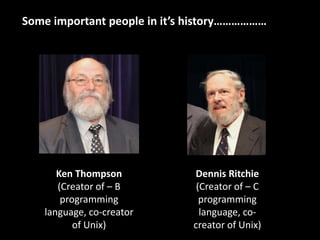
Ken Thompson
(Creator of – B
programming
language, co-creator
of Unix)
Dennis Ritchie
(Creator of – C
programming
language, co-
creator of Unix)
Brian Kernighan
(Co-creator of AWK
and AMPL
programming
languages, co-creator
of Unix)
Douglas McIlroy
(Co-creator of Unix [pipelines],
Also the tools like – diff, tr, sort
and join)
Joe Ossanna
(Co-creator of Unix,
developer of troff [which is
uased to creates documents
like man pages]
Unix Philosophy
According to Douglas McIlroy:
This is the Unix philosophy: Write programs that do one
thing and do it well. Write programs to work together.
Write programs to handle text streams, because that is a
universal interface.
In the end all of it adds up to-
Small is beautiful.
Make each program do one thing well.
Build a prototype as soon as possible.
Choose portability over efficiency.
Store data in flat text files.
Use software leverage to your advantage.
Use shell scripts to increase leverage and portability.
Avoid captive user interfaces.
Make every program a filter.
Why is Unix superior?
• The command line interface.
• Various shells, including their script syntax.
• Builtin programming language support for many languages.
• Common Unix utilities, such as grep, rsync, ssh, lsof, and others.
• All the supported filesystems (ZFS, Ext4, Reiser, UFS, etc.).
• Overall rock-solid stability and reliability.
• Lack of viruses, trojans, and other malware.
• Tremendous networking capabilities (PPoE, TCP/IP, etc.).
• Bulletproof firewall software.
• Overall builtin security in general (MACs, PAM, etc.).
• Quality user/group management.
• System resource usage.
• Both vertical and horizontal scaling.
• Portability.
• Plain text configuration files.
• Open source kernel and user-space software.
• Based on standards (POSIX, FHS, LSB, etc.).
• Vast selection of software choices (various text editors, MUAs, etc.)
• Simplicity in software design- do one thing, and do it well.
• Mind-blowing hardware support.
• Support for hundreds of languages and locales out of the box.
Open-Source Software
Cross-Platform Portability and Open Standards
The Internet and the World Wide Web
The Open-Source Community
Unix Is Fun to Hack
The Lessons of Unix Can Be Applied Elsewhere
GNU
Year - 2038
The original Unix time datatype (time_t) stores a date
and time as a signed long integer (on 32 bit systems a
32-bit integer) representing the number of seconds
since 1 January 1970. During and after 2038, this
number will exceed 231 − 1, the largest number
representable by a signed long integer on 32 bit systems,
causing the Year 2038 problem (also known as the Unix
Millennium bug or Y2K38).
Thank you

Why Unix?

  • 1.
  • 2.
    What am Igoing to talk about?
  • 3.
    A Brief Introduction……. Unix(trademarked as UNIX) is a family of multitasking, multiuser computer operating systems that derive from the original AT&T Unix, developed in the 1970s at the Bell Labs research center by Ken Thompson, Dennis Ritchie, and others
  • 4.
    The history ofUnix dates back to the mid-1960s when the Massachusetts Institute of Technology, AT&T Bell Labs, and General Electric were jointly developing an experimental time sharing operating system called Multics for the GE-645 mainframe. Multics introduced many innovations, but had many problems. Bell Labs, frustrated by the size and complexity of Multics but not the aims, slowly pulled out of the project. Their last researchers to leave Multics, Ken Thompson, Dennis Ritchie, Doug McIlroy, and Joe Ossanna, decided to redo the work on a much smaller scale.
  • 5.
    Some important peoplein it’s history……………… Ken Thompson (Creator of – B programming language, co-creator of Unix) Dennis Ritchie (Creator of – C programming language, co- creator of Unix)
  • 6.
    Brian Kernighan (Co-creator ofAWK and AMPL programming languages, co-creator of Unix) Douglas McIlroy (Co-creator of Unix [pipelines], Also the tools like – diff, tr, sort and join)
  • 7.
    Joe Ossanna (Co-creator ofUnix, developer of troff [which is uased to creates documents like man pages]
  • 8.
    Unix Philosophy According toDouglas McIlroy: This is the Unix philosophy: Write programs that do one thing and do it well. Write programs to work together. Write programs to handle text streams, because that is a universal interface.
  • 9.
    In the endall of it adds up to- Small is beautiful. Make each program do one thing well. Build a prototype as soon as possible. Choose portability over efficiency. Store data in flat text files. Use software leverage to your advantage. Use shell scripts to increase leverage and portability. Avoid captive user interfaces. Make every program a filter.
  • 10.
    Why is Unixsuperior? • The command line interface. • Various shells, including their script syntax. • Builtin programming language support for many languages. • Common Unix utilities, such as grep, rsync, ssh, lsof, and others. • All the supported filesystems (ZFS, Ext4, Reiser, UFS, etc.). • Overall rock-solid stability and reliability. • Lack of viruses, trojans, and other malware. • Tremendous networking capabilities (PPoE, TCP/IP, etc.). • Bulletproof firewall software. • Overall builtin security in general (MACs, PAM, etc.). • Quality user/group management. • System resource usage. • Both vertical and horizontal scaling. • Portability. • Plain text configuration files. • Open source kernel and user-space software. • Based on standards (POSIX, FHS, LSB, etc.). • Vast selection of software choices (various text editors, MUAs, etc.) • Simplicity in software design- do one thing, and do it well. • Mind-blowing hardware support. • Support for hundreds of languages and locales out of the box.
  • 11.
    Open-Source Software Cross-Platform Portabilityand Open Standards The Internet and the World Wide Web The Open-Source Community Unix Is Fun to Hack The Lessons of Unix Can Be Applied Elsewhere
  • 13.
  • 14.
    Year - 2038 Theoriginal Unix time datatype (time_t) stores a date and time as a signed long integer (on 32 bit systems a 32-bit integer) representing the number of seconds since 1 January 1970. During and after 2038, this number will exceed 231 − 1, the largest number representable by a signed long integer on 32 bit systems, causing the Year 2038 problem (also known as the Unix Millennium bug or Y2K38).
  • 15.