UNIVERSAL DESIGN FOR
LEARNING
CHRIS JOHNSTONE
UNIVERSITY OF MINNESOTA
RON MACE, ARCHITECT
• Ron Mace was an architect and wheelchair
user
• Was concerned that not enough architects
considered wheelchair users and other
people with special needs in design
• Introduced the concept of “Universal
Design” – design of buildings for everyone’s
use
(photo of Ron Mace)
EXAMPLES OF UNIVERSAL DESIGN IN ARCHITECTURE
(photo of stairs and ramp)
(photo of sliding door)(photo of accessible kitchen)
UNIVERSAL DESIGN FOR LEARNING (UDL)
• Built on design principles for Universal Design of Architecture
• ”Accessibility” is possible in classrooms if teachers design lessons for all
students
• 3 major principles (next slide)
UNIVERSAL DESIGN FOR LEARNING
• UDL’s three explicit approaches:
• Multiple means of representation
• To present information and content in different ways
• Multiple means of action and expression (also called response)
• Allow students to respond in different ways
• Multiple means of engagement
• Stimulate interest and motivation for learning
FLEXIBLE MEANS OF PRESENTATION
• Offering information in more than one format
• To teach a new concept, a teacher might provide text (a
book), audiovisual (a video or presentation), or hands-on
materials
• Because not all students learn the same way, presenting
materials in flexible ways increases the chances of helping
all students to learn new concepts.
BRAINSTORM
• A teacher usually likes to introduce the concept of photosynthesis
in science class by drawing a flower on the board and having
students take notes.
• Brainstorm three different ways a teacher might present this
material to students.
FLEXIBLE MEANS OF EXPRESSION
• “Expression” is the way that students show what they know and have learned.
• Traditionally, students have shown their knowledge through tests.
• Tests are one way that children show what they know. Other ways are:
• Essays
• Oral presentations
• Group projects
• Drawings
BRAINSTORM
• You have a student who has trouble writing so you decide than an oral
presentation will draw upon the student’s strengths. What other kind of
student might benefit from showing what they know through an oral
presentation?
• What other kind of student might be challenged by an oral presentation? How
might you allow that student to show what they know?
FLEXIBLE MEANS OF ENGAGEMENT: THREE
QUESTIONS
• Have you ever been bored in a classroom?
• Do you ever feel like teachers always teach in the same way?
• Do you wish you had more choice or variety in how you learned?
FLEXIBLE MEANS OF ENGAGEMENT
• Students may remember content better if they are actively engaged in
learning
• Students participate for longer periods of time if they get some choices in
their activities
• Changing activities not only prevents boredom, but increases chances of
building on the strengths of different types of learners in the classroom.
IS UDL JUST OLD WINE IN A
NEW BOTTLE?
In many ways, yes!
(photo of old wine in new bottle)
UDL BUILDS UPON PREVIOUS RESEARCH IN:
• Multisensory learning
• Zone of Proximal Development
• Student learning preference
• Second language learning
UDL AND INCLUSION
• Universal Design focuses on changing how teaching is done, not changing
children
• Teachers using UDL assume that if a child is not learning, the teacher must do
something different
• “Flexibility” allows teachers to experiment and try to find better ways to help
children learn
A CASE EXAMPLE: UNIVERSAL DESIGN AND LITERACY
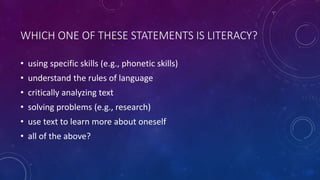
WHICH ONE OF THESE STATEMENTS IS LITERACY?
• using specific skills (e.g., phonetic skills)
• understand the rules of language
• critically analyzing text
• solving problems (e.g., research)
• use text to learn more about oneself
• all of the above?
LITERACY: A FOCUS ON THREE SKILLS
• Foundational skills (phonics, sounding out words)
• Literal comprehension (what is the meaning?)
• Inferential comprehension (deducing and applying meaning where it is not
explicit)
Johnstone & Thurlow, 2012
WHY IS THIS KNOWLEDGE NECESSARY FOR
INCLUSION?
Reading Goal Access Barrier
Foundational skills Students may understand themes in
literature but cannot decode words.
Literal comprehension Students may understand how to decode
words but may not grasp meaning.
Inferential comprehension Students may grasp literal meaning but have
trouble connecting concepts if they are not
explicit.
TWO CONCEPTS TO PROMOTE INCLUSION
• Target vs. Access skills
• Remediation, Accommodations, Accessibility
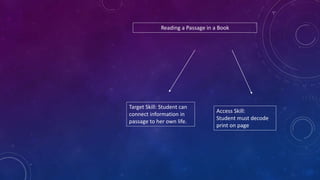
Reading a Passage in a Book
Target Skill: Student can
connect information in
passage to her own life.
Access Skill:
Student must decode
print on page
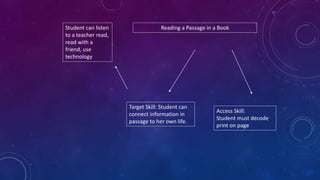
Reading a Passage in a Book
Target Skill: Student can
connect information in
passage to her own life.
Access Skill:
Student must decode
print on page
Student can listen
to a teacher read,
read with a
friend, use
technology
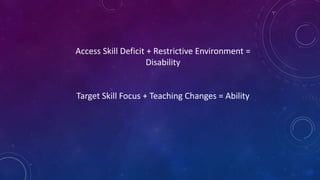
Access Skill Deficit + Restrictive Environment =
Disability
Target Skill Focus + Teaching Changes = Ability
THREE APPROACHES
Remediation Accommodation Accessibility
Work with child one-on-one
or in small groups to
improve access skills.
Student with deficit uses
different means to reach
target skills.
Teacher employs strategies
designed to help all
students reach target skills
(also called Universal
Design).
Edyburn, 2010;
Rose & Meyer, 2002
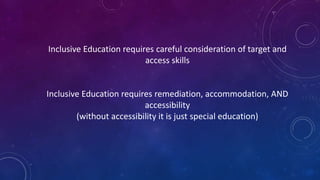
Inclusive Education requires careful consideration of target and
access skills
Inclusive Education requires remediation, accommodation, AND
accessibility
(without accessibility it is just special education)
FINAL THOUGHTS
• Inclusive education requires that we do our work differently.
• One way is to identify the difference between target and access
skills
• Once access skills are identified, accessible teaching strategies
support all students to reach target skills, even if by different
means (Universal Design).

Inclusive and Experiential Education Workshop Day 2: Universal Design for Learning

  • 1.
    UNIVERSAL DESIGN FOR LEARNING CHRISJOHNSTONE UNIVERSITY OF MINNESOTA
  • 2.
    RON MACE, ARCHITECT •Ron Mace was an architect and wheelchair user • Was concerned that not enough architects considered wheelchair users and other people with special needs in design • Introduced the concept of “Universal Design” – design of buildings for everyone’s use (photo of Ron Mace)
  • 3.
    EXAMPLES OF UNIVERSALDESIGN IN ARCHITECTURE (photo of stairs and ramp) (photo of sliding door)(photo of accessible kitchen)
  • 4.
    UNIVERSAL DESIGN FORLEARNING (UDL) • Built on design principles for Universal Design of Architecture • ”Accessibility” is possible in classrooms if teachers design lessons for all students • 3 major principles (next slide)
  • 5.
    UNIVERSAL DESIGN FORLEARNING • UDL’s three explicit approaches: • Multiple means of representation • To present information and content in different ways • Multiple means of action and expression (also called response) • Allow students to respond in different ways • Multiple means of engagement • Stimulate interest and motivation for learning
  • 6.
    FLEXIBLE MEANS OFPRESENTATION • Offering information in more than one format • To teach a new concept, a teacher might provide text (a book), audiovisual (a video or presentation), or hands-on materials • Because not all students learn the same way, presenting materials in flexible ways increases the chances of helping all students to learn new concepts.
  • 7.
    BRAINSTORM • A teacherusually likes to introduce the concept of photosynthesis in science class by drawing a flower on the board and having students take notes. • Brainstorm three different ways a teacher might present this material to students.
  • 8.
    FLEXIBLE MEANS OFEXPRESSION • “Expression” is the way that students show what they know and have learned. • Traditionally, students have shown their knowledge through tests. • Tests are one way that children show what they know. Other ways are: • Essays • Oral presentations • Group projects • Drawings
  • 9.
    BRAINSTORM • You havea student who has trouble writing so you decide than an oral presentation will draw upon the student’s strengths. What other kind of student might benefit from showing what they know through an oral presentation? • What other kind of student might be challenged by an oral presentation? How might you allow that student to show what they know?
  • 10.
    FLEXIBLE MEANS OFENGAGEMENT: THREE QUESTIONS • Have you ever been bored in a classroom? • Do you ever feel like teachers always teach in the same way? • Do you wish you had more choice or variety in how you learned?
  • 11.
    FLEXIBLE MEANS OFENGAGEMENT • Students may remember content better if they are actively engaged in learning • Students participate for longer periods of time if they get some choices in their activities • Changing activities not only prevents boredom, but increases chances of building on the strengths of different types of learners in the classroom.
  • 12.
    IS UDL JUSTOLD WINE IN A NEW BOTTLE? In many ways, yes! (photo of old wine in new bottle)
  • 13.
    UDL BUILDS UPONPREVIOUS RESEARCH IN: • Multisensory learning • Zone of Proximal Development • Student learning preference • Second language learning
  • 14.
    UDL AND INCLUSION •Universal Design focuses on changing how teaching is done, not changing children • Teachers using UDL assume that if a child is not learning, the teacher must do something different • “Flexibility” allows teachers to experiment and try to find better ways to help children learn
  • 15.
    A CASE EXAMPLE:UNIVERSAL DESIGN AND LITERACY
  • 16.
    WHICH ONE OFTHESE STATEMENTS IS LITERACY? • using specific skills (e.g., phonetic skills) • understand the rules of language • critically analyzing text • solving problems (e.g., research) • use text to learn more about oneself • all of the above?
  • 17.
    LITERACY: A FOCUSON THREE SKILLS • Foundational skills (phonics, sounding out words) • Literal comprehension (what is the meaning?) • Inferential comprehension (deducing and applying meaning where it is not explicit) Johnstone & Thurlow, 2012
  • 18.
    WHY IS THISKNOWLEDGE NECESSARY FOR INCLUSION? Reading Goal Access Barrier Foundational skills Students may understand themes in literature but cannot decode words. Literal comprehension Students may understand how to decode words but may not grasp meaning. Inferential comprehension Students may grasp literal meaning but have trouble connecting concepts if they are not explicit.
  • 19.
    TWO CONCEPTS TOPROMOTE INCLUSION • Target vs. Access skills • Remediation, Accommodations, Accessibility
  • 20.
    Reading a Passagein a Book Target Skill: Student can connect information in passage to her own life. Access Skill: Student must decode print on page
  • 21.
    Reading a Passagein a Book Target Skill: Student can connect information in passage to her own life. Access Skill: Student must decode print on page Student can listen to a teacher read, read with a friend, use technology
  • 22.
    Access Skill Deficit+ Restrictive Environment = Disability Target Skill Focus + Teaching Changes = Ability
  • 23.
    THREE APPROACHES Remediation AccommodationAccessibility Work with child one-on-one or in small groups to improve access skills. Student with deficit uses different means to reach target skills. Teacher employs strategies designed to help all students reach target skills (also called Universal Design). Edyburn, 2010; Rose & Meyer, 2002
  • 24.
    Inclusive Education requirescareful consideration of target and access skills Inclusive Education requires remediation, accommodation, AND accessibility (without accessibility it is just special education)
  • 25.
    FINAL THOUGHTS • Inclusiveeducation requires that we do our work differently. • One way is to identify the difference between target and access skills • Once access skills are identified, accessible teaching strategies support all students to reach target skills, even if by different means (Universal Design).