1
International Islamic University Chittagong
January 22, 2024
Tashin Hossain
Department of Computer Science and Engineering
Lecture#7
Agents that Reason Logically
And Propositional Logic
Adjunct Lecturer
Course Information
2
Course Materials:
1. Stuart Russell, Peter Norvig: “Artificial Intelligence A
Modern Approach”, 3rd Edition.
2. Other specific materials and lecture slides
Course Information
3
Segment Contents
03
Game playing: Introduction, Perfect Decisions, Imperfect
Decisions, Alpha-Beta Pruning.
Constraints satisfaction problem: Travelling salesman problem,
graph coloring etc.
04
Propositional and First-Order logic: Knowledge
Representation, Reasoning and Logic; Propositional Logic:
Syntax, Semantics, Validity and Inference, Rules of Inference for
Propositional logic; First-Order Logic: Syntax and Semantics,
Using first-order logic.
Inference in first order logic: Inference Rules Involving
Quantifiers, Example Proof, Generalized Modus Ponens, Forward
and Backward Chaining, Completeness, Resolution.
Course Information
4
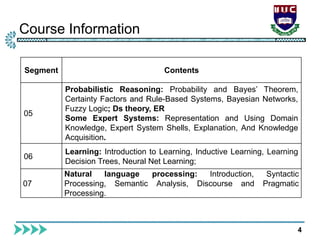
Segment Contents
05
Probabilistic Reasoning: Probability and Bayes’ Theorem,
Certainty Factors and Rule-Based Systems, Bayesian Networks,
Fuzzy Logic; Ds theory, ER
Some Expert Systems: Representation and Using Domain
Knowledge, Expert System Shells, Explanation, And Knowledge
Acquisition.
06
Learning: Introduction to Learning, Inductive Learning, Learning
Decision Trees, Neural Net Learning;
07
Natural language processing: Introduction, Syntactic
Processing, Semantic Analysis, Discourse and Pragmatic
Processing.
5
Agents that Reason
Logically
Knowledge and Reasoning
6
 From the previous lectures it has been shown that an agent that
has goals and searches for solutions to the goals can do better
than one that just reacts to its environment (simple reflex agent)
 We focused mainly on the question of how to carry out the search
(using different search strategies), leaving aside the question of
general methods for describing states and actions
Knowledge and Reasoning
7
 It is necessary to powering the agents with the capacity for general
logical reasoning
 A logical, knowledge-based agent begins with some knowledge of the
world and of its own actions
 It uses logical reasoning to maintain a description of the world as new
precepts arrive and to deduce a course of action that will achieve its goals
 In this lecture we introduce the basic design for a knowledge-
based agent, followed by a simple logical language for expressing
knowledge, and show how it can be used to draw conclusions
about the world and to decide what to do
A Knowledge Based Agent
8
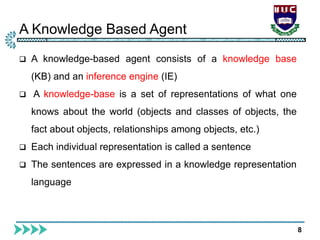
 A knowledge-based agent consists of a knowledge base
(KB) and an inference engine (IE)
 A knowledge-base is a set of representations of what one
knows about the world (objects and classes of objects, the
fact about objects, relationships among objects, etc.)
 Each individual representation is called a sentence
 The sentences are expressed in a knowledge representation
language
A Knowledge Based Agent
9
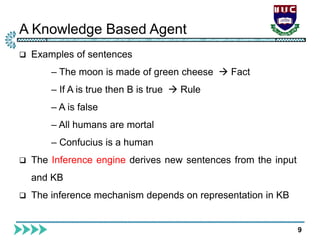
 Examples of sentences
– The moon is made of green cheese  Fact
– If A is true then B is true  Rule
– A is false
– All humans are mortal
– Confucius is a human
 The Inference engine derives new sentences from the input
and KB
 The inference mechanism depends on representation in KB
A Knowledge Based Agent
10
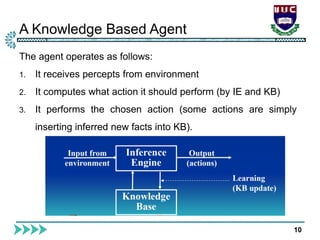
The agent operates as follows:
1. It receives percepts from environment
2. It computes what action it should perform (by IE and KB)
3. It performs the chosen action (some actions are simply
inserting inferred new facts into KB).
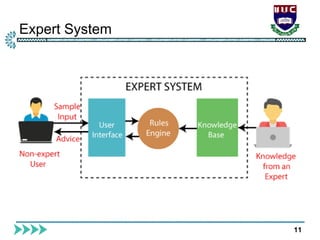
Expert System
11
KB can be Viewed at Different Levels
12
 Knowledge Level
– The most abstract level
– describe agent by saying what it knows
– Example: A taxi agent might know that the Golden Gate Bridge
connects San Francisco with the Marin County
 Logical Level
– The level at which the knowledge is encoded into sentences
– Example: Links(GoldenGateBridge, SanFrancisco, Marin-County)
 Implementation Level
– The physical representation of the sentences in the logical level
– Example: “Links (GoldenGateBridge, SanFrancisco, MarinCounty)”
13
Propositional Logic
What is Proposition?
14
 A proposition is a statement that can be either true or
false; it must be one or the other, and it cannot be both
 The sun rises in the east
 Today is a very hot day
Knowledge and Intelligence
15
 Does knowledge has any role in demonstrating
intelligent behavior?
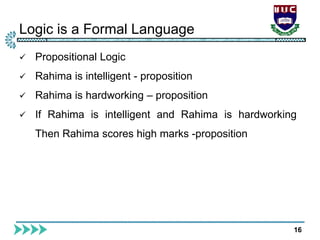
Logic is a Formal Language
16
 Propositional Logic
 Rahima is intelligent - proposition
 Rahima is hardworking – proposition
 If Rahima is intelligent and Rahima is hardworking
Then Rahima scores high marks -proposition
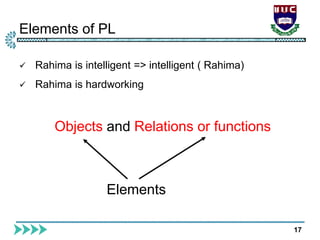
Elements of PL
17
 Rahima is intelligent => intelligent ( Rahima)
 Rahima is hardworking
Objects and Relations or functions
Elements
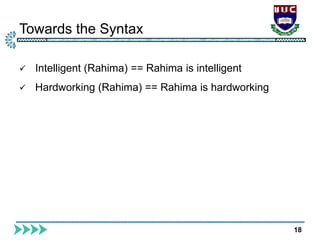
Towards the Syntax
18
 Intelligent (Rahima) == Rahima is intelligent
 Hardworking (Rahima) == Rahima is hardworking
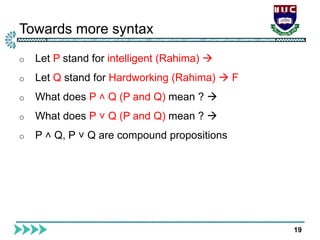
Towards more syntax
19
o Let P stand for intelligent (Rahima) 
o Let Q stand for Hardworking (Rahima)  F
o What does P ˄ Q (P and Q) mean ? 
o What does P ˅ Q (P and Q) mean ? 
o P ˄ Q, P ˅ Q are compound propositions
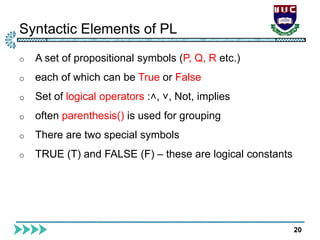
Syntactic Elements of PL
20
o A set of propositional symbols (P, Q, R etc.)
o each of which can be True or False
o Set of logical operators :˄, ˅, Not, implies
o often parenthesis() is used for grouping
o There are two special symbols
o TRUE (T) and FALSE (F) – these are logical constants
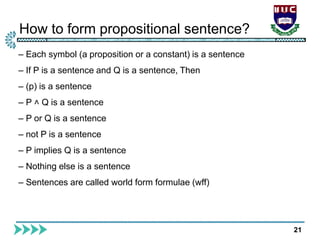
How to form propositional sentence?
21
– Each symbol (a proposition or a constant) is a sentence
– If P is a sentence and Q is a sentence, Then
– (p) is a sentence
– P ˄ Q is a sentence
– P or Q is a sentence
– not P is a sentence
– P implies Q is a sentence
– Nothing else is a sentence
– Sentences are called world form formulae (wff)
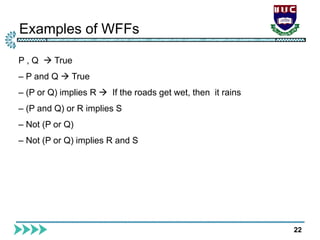
Examples of WFFs
22
P , Q  True
– P and Q  True
– (P or Q) implies R  If the roads get wet, then it rains
– (P and Q) or R implies S
– Not (P or Q)
– Not (P or Q) implies R and S
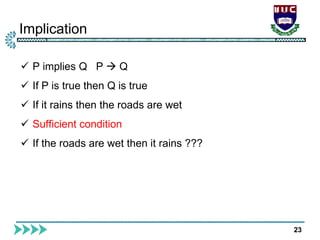
Implication
23
 P implies Q P  Q
 If P is true then Q is true
 If it rains then the roads are wet
 Sufficient condition
 If the roads are wet then it rains ???
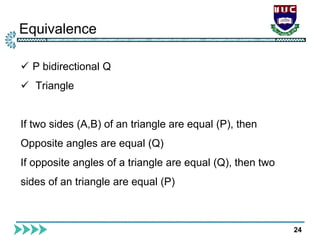
Equivalence
24
 P bidirectional Q
 Triangle
If two sides (A,B) of an triangle are equal (P), then
Opposite angles are equal (Q)
If opposite angles of a triangle are equal (Q), then two
sides of an triangle are equal (P)
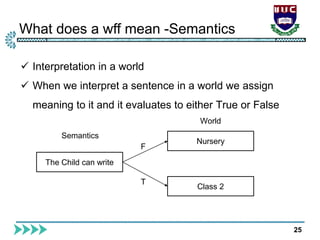
What does a wff mean -Semantics
25
 Interpretation in a world
 When we interpret a sentence in a world we assign
meaning to it and it evaluates to either True or False
The Child can write
Nursery
Class 2
F
T
World
Semantics
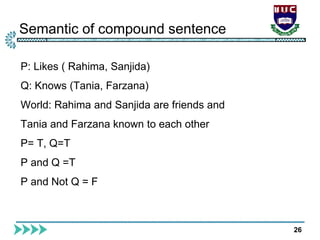
Semantic of compound sentence
26
P: Likes ( Rahima, Sanjida)
Q: Knows (Tania, Farzana)
World: Rahima and Sanjida are friends and
Tania and Farzana known to each other
P= T, Q=T
P and Q =T
P and Not Q = F
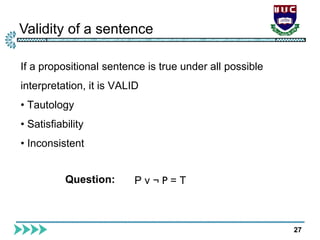
Validity of a sentence
27
If a propositional sentence is true under all possible
interpretation, it is VALID
• Tautology
• Satisfiability
• Inconsistent
P v ¬ P = T
Question:
Validity of a sentence
28
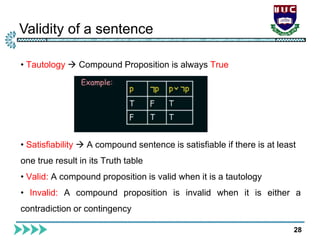
• Tautology  Compound Proposition is always True
• Satisfiability  A compound sentence is satisfiable if there is at least
one true result in its Truth table
• Valid: A compound proposition is valid when it is a tautology
• Invalid: A compound proposition is invalid when it is either a
contradiction or contingency
Validity of a sentence
29
Inconsistency in propositional logic refers to a situation
where a set of propositions or statements leads to a
contradiction, meaning that it's impossible for all the
statements in the set to be simultaneously true
Let's consider a simple example:
Statement A: It is raining.
Statement B: It is not raining.
Quiz
30
Express the following English sentence in the
language of PL
– It rains in July  rains ( July)
– The book is not costly  not costly (book)
– If it rains today and one does not carry umbrella, then
he will be drenched
Rains(today) ^ not carry( umbrella)  drenched(he)
Quiz
31
If P is true and Q is true then are the followings true or
false
– P → Q
– (¬P∨Q) → Q
– (¬P^Q) → P
– P ∨ ¬P
32
Inference in PL
Objectives
33
• Infer the truth value of a proposition
• Reason towards new facts, given a set of propositions
• Prove a proposition given a set of propositional facts
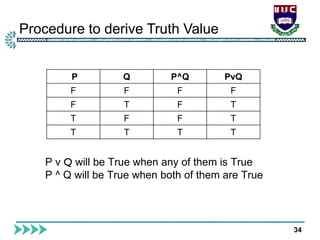
Procedure to derive Truth Value
34
P Q P^Q PvQ
F F F F
F T F T
T F F T
T T T T
P v Q will be True when any of them is True
P ^ Q will be True when both of them are True
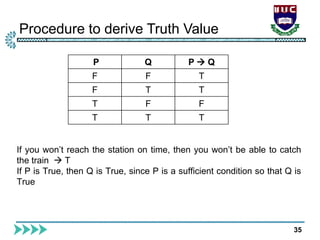
Procedure to derive Truth Value
35
P Q P  Q
F F T
F T T
T F F
T T T
If you won’t reach the station on time, then you won’t be able to catch
the train  T
If P is True, then Q is True, since P is a sufficient condition so that Q is
True
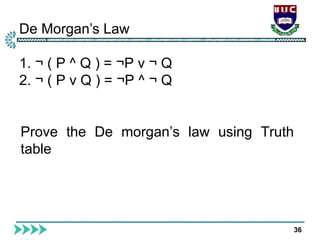
De Morgan’s Law
36
1. ¬ ( P ^ Q ) = ¬P v ¬ Q
2. ¬ ( P v Q ) = ¬P ^ ¬ Q
Prove the De morgan’s law using Truth
table
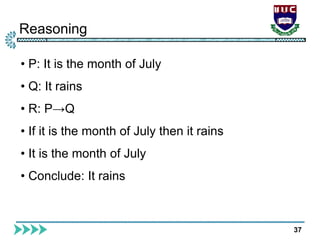
Reasoning
37
• P: It is the month of July
• Q: It rains
• R: P→Q
• If it is the month of July then it rains
• It is the month of July
• Conclude: It rains
Reasoning
38
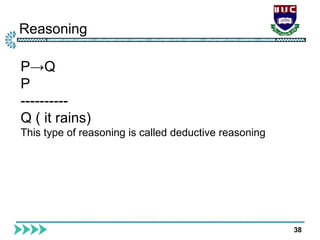
P→Q
P
----------
Q ( it rains)
This type of reasoning is called deductive reasoning
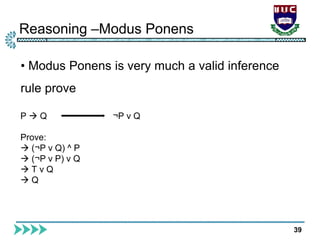
Reasoning –Modus Ponens
39
• Modus Ponens is very much a valid inference
rule prove
P  Q ¬P v Q
Prove:
 (¬P v Q) ^ P
 (¬P v P) v Q
 T v Q
 Q
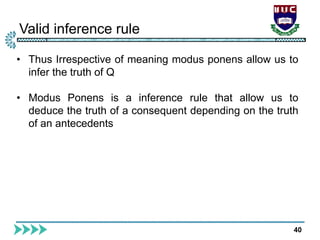
Valid inference rule
40
• Thus Irrespective of meaning modus ponens allow us to
infer the truth of Q
• Modus Ponens is a inference rule that allow us to
deduce the truth of a consequent depending on the truth
of an antecedents
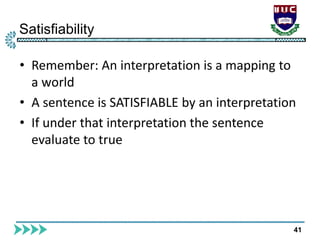
Satisfiability
41
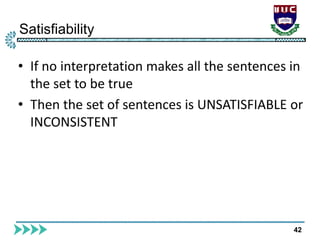
Satisfiability
42
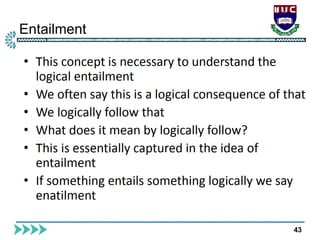
Entailment
43
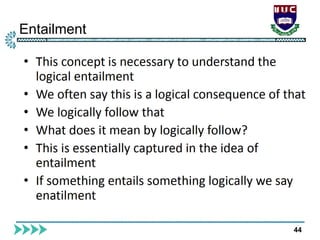
Entailment
44
Entailment
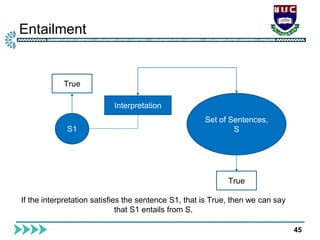
45
Set of Sentences,
S
S1
Interpretation
True
True
If the interpretation satisfies the sentence S1, that is True, then we can say
that S1 entails from S.
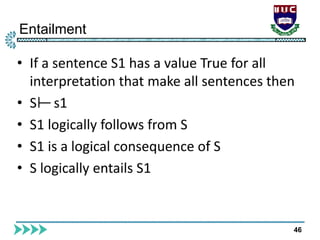
Entailment
46
47
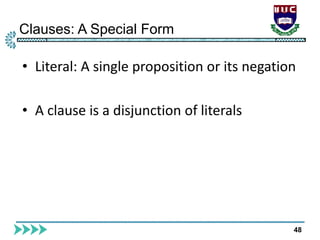
Clauses: A Special Form
48
Converting a compound proposition to
the clausal form
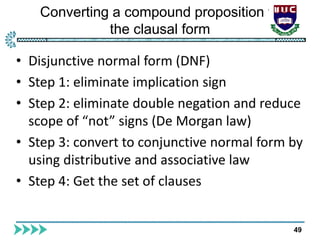
49
Converting a compound proposition to
the clausal form
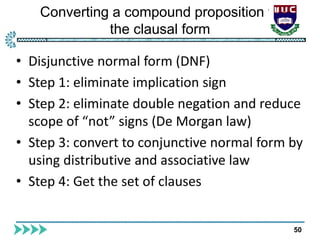
50
Converting a compound proposition to
the clausal form
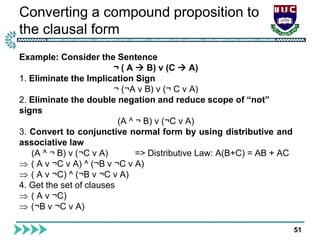
51
Example: Consider the Sentence
¬ ( A  B) v (C  A)
1. Eliminate the Implication Sign
¬ (¬A v B) v (¬ C v A)
2. Eliminate the double negation and reduce scope of “not”
signs
(A ^ ¬ B) v (¬C v A)
3. Convert to conjunctive normal form by using distributive and
associative law
(A ^ ¬ B) v (¬C v A) => Distributive Law: A(B+C) = AB + AC
 ( A v ¬C v A) ^ (¬B v ¬C v A)
 ( A v ¬C) ^ (¬B v ¬C v A)
4. Get the set of clauses
 ( A v ¬C)
 (¬B v ¬C v A)
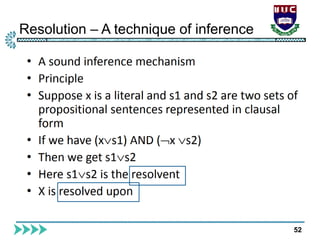
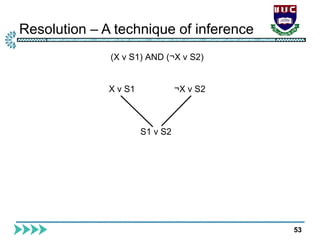
Resolution – A technique of inference
52
Resolution – A technique of inference
53
(X v S1) AND (¬X v S2)
X v S1 ¬X v S2
S1 v S2
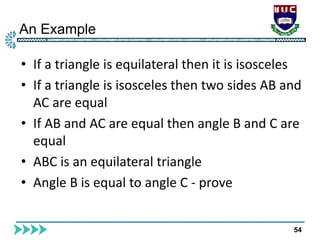
An Example
54
Convert the Sentences into PL
55
Convert the Sentences into Clausal Form
56
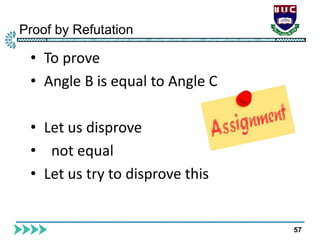
Proof by Refutation
57
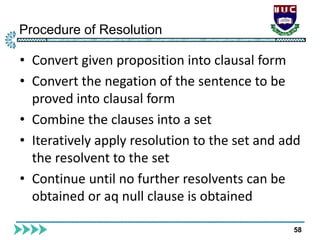
Procedure of Resolution
58
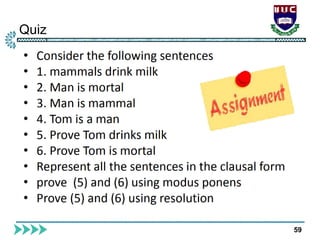
Quiz
59
60
First Order Logic
Objectives
61
Objectives
62
Limitations of PL
63
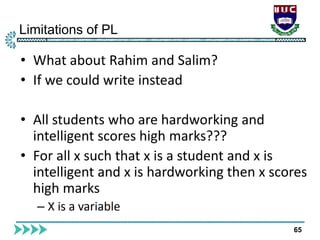
Limitations of PL
64
Limitations of PL
65
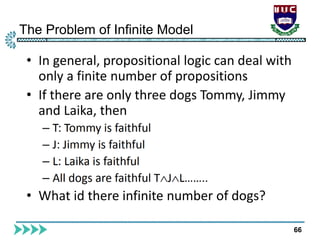
The Problem of Infinite Model
66
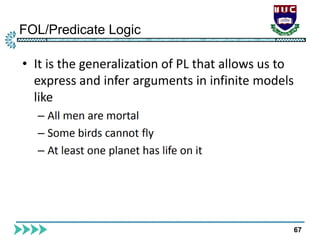
FOL/Predicate Logic
67
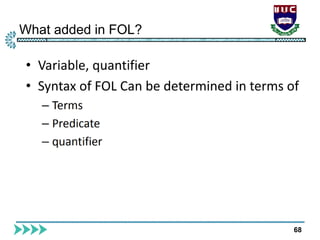
What added in FOL?
68
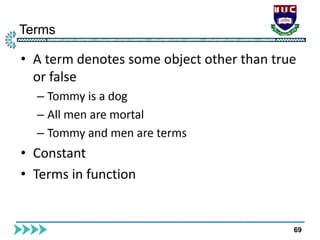
Terms
69
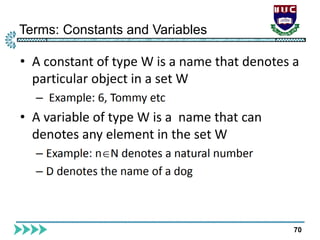
Terms: Constants and Variables
70
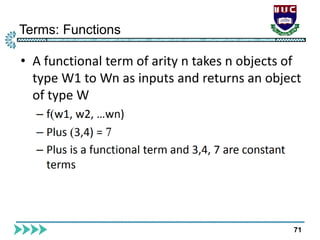
Terms: Functions
71
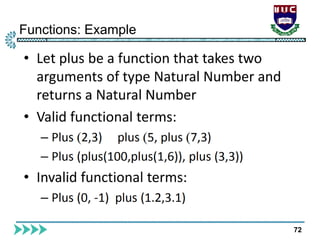
Functions: Example
72
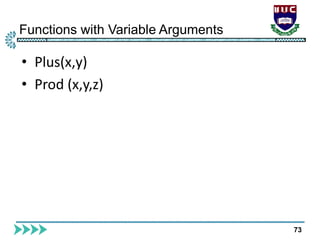
Functions with Variable Arguments
73
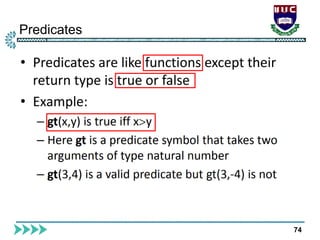
Predicates
74
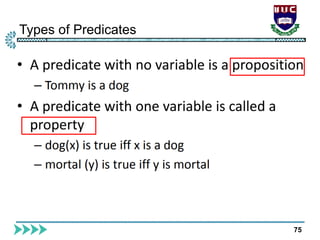
Types of Predicates
75
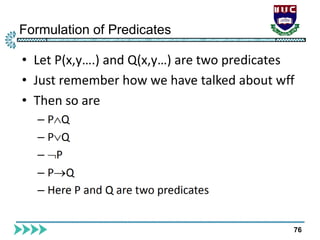
Formulation of Predicates
76
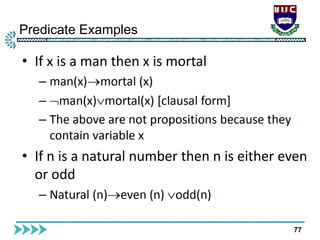
Predicate Examples
77
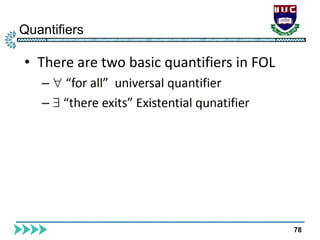
Quantifiers
78
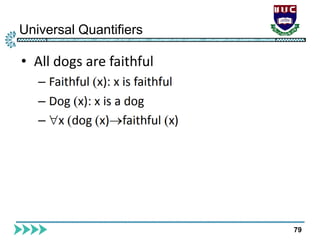
Universal Quantifiers
79
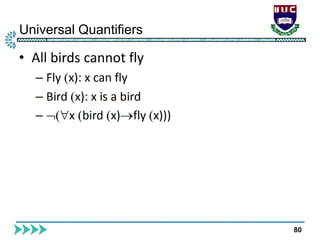
Universal Quantifiers
80
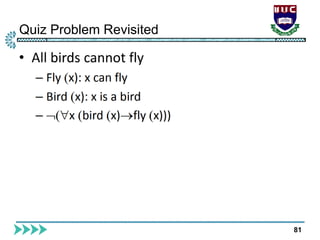
Quiz Problem Revisited
81
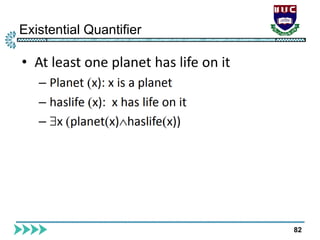
Existential Quantifier
82
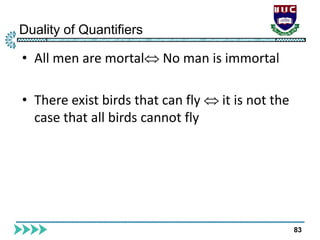
Duality of Quantifiers
83
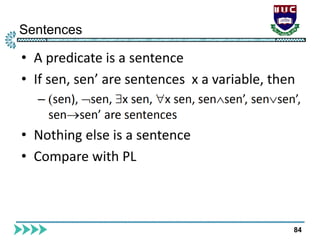
Sentences
84
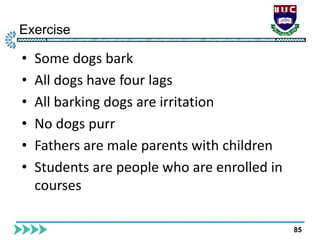
Exercise
85
86
Reasoning in FOL
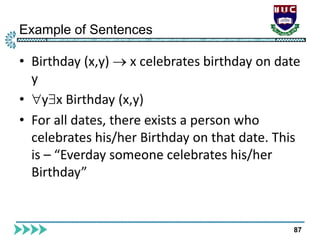
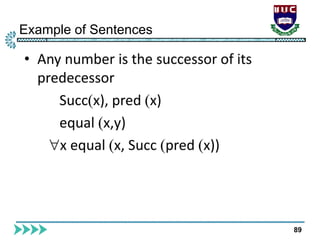
Example of Sentences
87
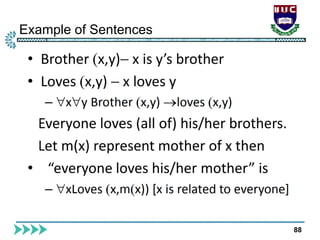
Example of Sentences
88
Example of Sentences
89
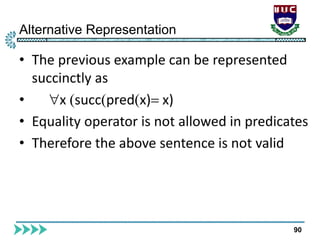
Alternative Representation
90
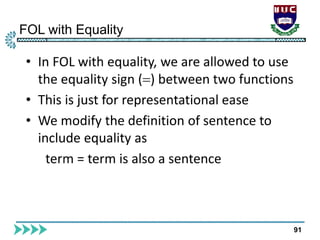
FOL with Equality
91
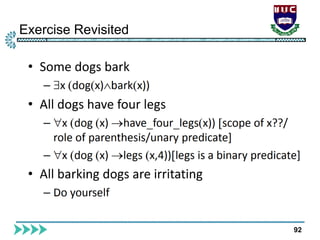
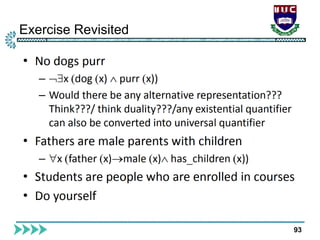
Exercise Revisited
92
Exercise Revisited
93
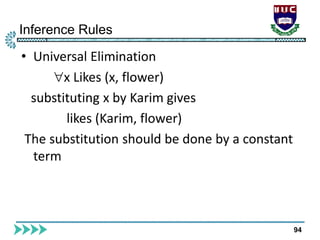
Inference Rules
94
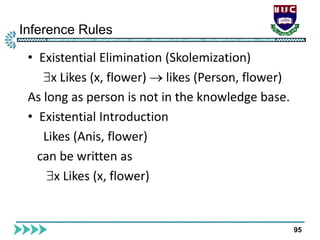
Inference Rules
95
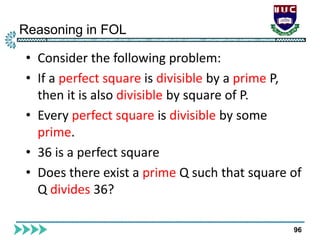
Reasoning in FOL
96
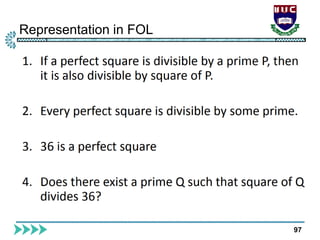
Representation in FOL
97
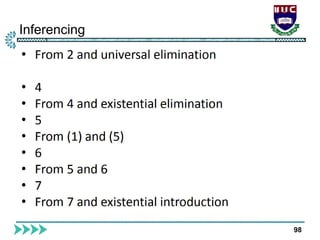
Inferencing
98
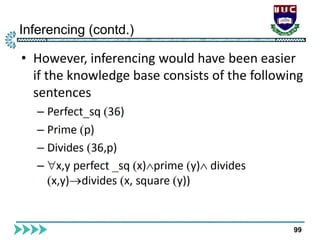
Inferencing (contd.)
99
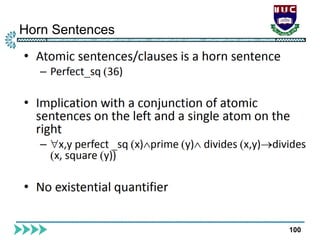
Horn Sentences
100
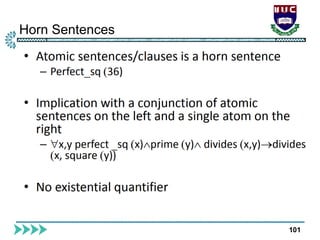
Horn Sentences
101
Horn Sentences
102
Continue…
Next Lecture
103

Knowledge base artificial intelligence.pdf

  • 1.
    1 International Islamic UniversityChittagong January 22, 2024 Tashin Hossain Department of Computer Science and Engineering Lecture#7 Agents that Reason Logically And Propositional Logic Adjunct Lecturer
  • 2.
    Course Information 2 Course Materials: 1.Stuart Russell, Peter Norvig: “Artificial Intelligence A Modern Approach”, 3rd Edition. 2. Other specific materials and lecture slides
  • 3.
    Course Information 3 Segment Contents 03 Gameplaying: Introduction, Perfect Decisions, Imperfect Decisions, Alpha-Beta Pruning. Constraints satisfaction problem: Travelling salesman problem, graph coloring etc. 04 Propositional and First-Order logic: Knowledge Representation, Reasoning and Logic; Propositional Logic: Syntax, Semantics, Validity and Inference, Rules of Inference for Propositional logic; First-Order Logic: Syntax and Semantics, Using first-order logic. Inference in first order logic: Inference Rules Involving Quantifiers, Example Proof, Generalized Modus Ponens, Forward and Backward Chaining, Completeness, Resolution.
  • 4.
    Course Information 4 Segment Contents 05 ProbabilisticReasoning: Probability and Bayes’ Theorem, Certainty Factors and Rule-Based Systems, Bayesian Networks, Fuzzy Logic; Ds theory, ER Some Expert Systems: Representation and Using Domain Knowledge, Expert System Shells, Explanation, And Knowledge Acquisition. 06 Learning: Introduction to Learning, Inductive Learning, Learning Decision Trees, Neural Net Learning; 07 Natural language processing: Introduction, Syntactic Processing, Semantic Analysis, Discourse and Pragmatic Processing.
  • 5.
  • 6.
    Knowledge and Reasoning 6 From the previous lectures it has been shown that an agent that has goals and searches for solutions to the goals can do better than one that just reacts to its environment (simple reflex agent)  We focused mainly on the question of how to carry out the search (using different search strategies), leaving aside the question of general methods for describing states and actions
  • 7.
    Knowledge and Reasoning 7 It is necessary to powering the agents with the capacity for general logical reasoning  A logical, knowledge-based agent begins with some knowledge of the world and of its own actions  It uses logical reasoning to maintain a description of the world as new precepts arrive and to deduce a course of action that will achieve its goals  In this lecture we introduce the basic design for a knowledge- based agent, followed by a simple logical language for expressing knowledge, and show how it can be used to draw conclusions about the world and to decide what to do
  • 8.
    A Knowledge BasedAgent 8  A knowledge-based agent consists of a knowledge base (KB) and an inference engine (IE)  A knowledge-base is a set of representations of what one knows about the world (objects and classes of objects, the fact about objects, relationships among objects, etc.)  Each individual representation is called a sentence  The sentences are expressed in a knowledge representation language
  • 9.
    A Knowledge BasedAgent 9  Examples of sentences – The moon is made of green cheese  Fact – If A is true then B is true  Rule – A is false – All humans are mortal – Confucius is a human  The Inference engine derives new sentences from the input and KB  The inference mechanism depends on representation in KB
  • 10.
    A Knowledge BasedAgent 10 The agent operates as follows: 1. It receives percepts from environment 2. It computes what action it should perform (by IE and KB) 3. It performs the chosen action (some actions are simply inserting inferred new facts into KB).
  • 11.
  • 12.
    KB can beViewed at Different Levels 12  Knowledge Level – The most abstract level – describe agent by saying what it knows – Example: A taxi agent might know that the Golden Gate Bridge connects San Francisco with the Marin County  Logical Level – The level at which the knowledge is encoded into sentences – Example: Links(GoldenGateBridge, SanFrancisco, Marin-County)  Implementation Level – The physical representation of the sentences in the logical level – Example: “Links (GoldenGateBridge, SanFrancisco, MarinCounty)”
  • 13.
  • 14.
    What is Proposition? 14 A proposition is a statement that can be either true or false; it must be one or the other, and it cannot be both  The sun rises in the east  Today is a very hot day
  • 15.
    Knowledge and Intelligence 15 Does knowledge has any role in demonstrating intelligent behavior?
  • 16.
    Logic is aFormal Language 16  Propositional Logic  Rahima is intelligent - proposition  Rahima is hardworking – proposition  If Rahima is intelligent and Rahima is hardworking Then Rahima scores high marks -proposition
  • 17.
    Elements of PL 17 Rahima is intelligent => intelligent ( Rahima)  Rahima is hardworking Objects and Relations or functions Elements
  • 18.
    Towards the Syntax 18 Intelligent (Rahima) == Rahima is intelligent  Hardworking (Rahima) == Rahima is hardworking
  • 19.
    Towards more syntax 19 oLet P stand for intelligent (Rahima)  o Let Q stand for Hardworking (Rahima)  F o What does P ˄ Q (P and Q) mean ?  o What does P ˅ Q (P and Q) mean ?  o P ˄ Q, P ˅ Q are compound propositions
  • 20.
    Syntactic Elements ofPL 20 o A set of propositional symbols (P, Q, R etc.) o each of which can be True or False o Set of logical operators :˄, ˅, Not, implies o often parenthesis() is used for grouping o There are two special symbols o TRUE (T) and FALSE (F) – these are logical constants
  • 21.
    How to formpropositional sentence? 21 – Each symbol (a proposition or a constant) is a sentence – If P is a sentence and Q is a sentence, Then – (p) is a sentence – P ˄ Q is a sentence – P or Q is a sentence – not P is a sentence – P implies Q is a sentence – Nothing else is a sentence – Sentences are called world form formulae (wff)
  • 22.
    Examples of WFFs 22 P, Q  True – P and Q  True – (P or Q) implies R  If the roads get wet, then it rains – (P and Q) or R implies S – Not (P or Q) – Not (P or Q) implies R and S
  • 23.
    Implication 23  P impliesQ P  Q  If P is true then Q is true  If it rains then the roads are wet  Sufficient condition  If the roads are wet then it rains ???
  • 24.
    Equivalence 24  P bidirectionalQ  Triangle If two sides (A,B) of an triangle are equal (P), then Opposite angles are equal (Q) If opposite angles of a triangle are equal (Q), then two sides of an triangle are equal (P)
  • 25.
    What does awff mean -Semantics 25  Interpretation in a world  When we interpret a sentence in a world we assign meaning to it and it evaluates to either True or False The Child can write Nursery Class 2 F T World Semantics
  • 26.
    Semantic of compoundsentence 26 P: Likes ( Rahima, Sanjida) Q: Knows (Tania, Farzana) World: Rahima and Sanjida are friends and Tania and Farzana known to each other P= T, Q=T P and Q =T P and Not Q = F
  • 27.
    Validity of asentence 27 If a propositional sentence is true under all possible interpretation, it is VALID • Tautology • Satisfiability • Inconsistent P v ¬ P = T Question:
  • 28.
    Validity of asentence 28 • Tautology  Compound Proposition is always True • Satisfiability  A compound sentence is satisfiable if there is at least one true result in its Truth table • Valid: A compound proposition is valid when it is a tautology • Invalid: A compound proposition is invalid when it is either a contradiction or contingency
  • 29.
    Validity of asentence 29 Inconsistency in propositional logic refers to a situation where a set of propositions or statements leads to a contradiction, meaning that it's impossible for all the statements in the set to be simultaneously true Let's consider a simple example: Statement A: It is raining. Statement B: It is not raining.
  • 30.
    Quiz 30 Express the followingEnglish sentence in the language of PL – It rains in July  rains ( July) – The book is not costly  not costly (book) – If it rains today and one does not carry umbrella, then he will be drenched Rains(today) ^ not carry( umbrella)  drenched(he)
  • 31.
    Quiz 31 If P istrue and Q is true then are the followings true or false – P → Q – (¬P∨Q) → Q – (¬P^Q) → P – P ∨ ¬P
  • 32.
  • 33.
    Objectives 33 • Infer thetruth value of a proposition • Reason towards new facts, given a set of propositions • Prove a proposition given a set of propositional facts
  • 34.
    Procedure to deriveTruth Value 34 P Q P^Q PvQ F F F F F T F T T F F T T T T T P v Q will be True when any of them is True P ^ Q will be True when both of them are True
  • 35.
    Procedure to deriveTruth Value 35 P Q P  Q F F T F T T T F F T T T If you won’t reach the station on time, then you won’t be able to catch the train  T If P is True, then Q is True, since P is a sufficient condition so that Q is True
  • 36.
    De Morgan’s Law 36 1.¬ ( P ^ Q ) = ¬P v ¬ Q 2. ¬ ( P v Q ) = ¬P ^ ¬ Q Prove the De morgan’s law using Truth table
  • 37.
    Reasoning 37 • P: Itis the month of July • Q: It rains • R: P→Q • If it is the month of July then it rains • It is the month of July • Conclude: It rains
  • 38.
    Reasoning 38 P→Q P ---------- Q ( itrains) This type of reasoning is called deductive reasoning
  • 39.
    Reasoning –Modus Ponens 39 •Modus Ponens is very much a valid inference rule prove P  Q ¬P v Q Prove:  (¬P v Q) ^ P  (¬P v P) v Q  T v Q  Q
  • 40.
    Valid inference rule 40 •Thus Irrespective of meaning modus ponens allow us to infer the truth of Q • Modus Ponens is a inference rule that allow us to deduce the truth of a consequent depending on the truth of an antecedents
  • 41.
  • 42.
  • 43.
  • 44.
  • 45.
    Entailment 45 Set of Sentences, S S1 Interpretation True True Ifthe interpretation satisfies the sentence S1, that is True, then we can say that S1 entails from S.
  • 46.
  • 47.
  • 48.
  • 49.
    Converting a compoundproposition to the clausal form 49
  • 50.
    Converting a compoundproposition to the clausal form 50
  • 51.
    Converting a compoundproposition to the clausal form 51 Example: Consider the Sentence ¬ ( A  B) v (C  A) 1. Eliminate the Implication Sign ¬ (¬A v B) v (¬ C v A) 2. Eliminate the double negation and reduce scope of “not” signs (A ^ ¬ B) v (¬C v A) 3. Convert to conjunctive normal form by using distributive and associative law (A ^ ¬ B) v (¬C v A) => Distributive Law: A(B+C) = AB + AC  ( A v ¬C v A) ^ (¬B v ¬C v A)  ( A v ¬C) ^ (¬B v ¬C v A) 4. Get the set of clauses  ( A v ¬C)  (¬B v ¬C v A)
  • 52.
    Resolution – Atechnique of inference 52
  • 53.
    Resolution – Atechnique of inference 53 (X v S1) AND (¬X v S2) X v S1 ¬X v S2 S1 v S2
  • 54.
  • 55.
  • 56.
    Convert the Sentencesinto Clausal Form 56
  • 57.
  • 58.
  • 59.
  • 60.
  • 61.
  • 62.
  • 63.
  • 64.
  • 65.
  • 66.
    The Problem ofInfinite Model 66
  • 67.
  • 68.
  • 69.
  • 70.
  • 71.
  • 72.
  • 73.
  • 74.
  • 75.
  • 76.
  • 77.
  • 78.
  • 79.
  • 80.
  • 81.
  • 82.
  • 83.
  • 84.
  • 85.
  • 86.
  • 87.
  • 88.
  • 89.
  • 90.
  • 91.
  • 92.
  • 93.
  • 94.
  • 95.
  • 96.
  • 97.
  • 98.
  • 99.
  • 100.
  • 101.
  • 102.
  • 103.