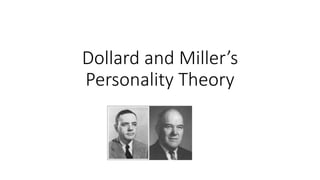
Dollard and Miller’s
Personality Theory
Four fundamentals : for learning
• 1. Drive ( desire, internal force towards object / achievement ) ,
• 2. Cue( hint, clue that stimulus to drive )
• 3.Response(individual behaviour guided by the cue)
• 4.Reward ( reward after reaching the goal )
Types of drive:
• Primary /innate /biological drive (e.g. hunger)
• Secondary /learned drive (e.g. money)
Dollard & Miller the Personality of Development there are
three basic characteristics of infant:
•Specific Reflexes
•Innate Response Hierarchies
•Primary Drives
Four Crucial Situations: –
1. Feeding Situation,
2. Cleanliness Training,
3. Early Sexual Development,
4. Anger Anxiety Conflicts
Bandura Social Learning Theory
Skinner Operant Conditioning
Dollard and
Miller
Bandura Skinner
Drive Observation Reward and
punishment
Drive,
cue,
response,
reward
Attention,
retention,
motor
reproduction,
motivation
Positive and negative
reinforcement
OUTLINE
UNIT-3 Personality.pptx

UNIT-3 Personality.pptx

  • 1.
  • 2.
    Four fundamentals :for learning • 1. Drive ( desire, internal force towards object / achievement ) , • 2. Cue( hint, clue that stimulus to drive ) • 3.Response(individual behaviour guided by the cue) • 4.Reward ( reward after reaching the goal ) Types of drive: • Primary /innate /biological drive (e.g. hunger) • Secondary /learned drive (e.g. money)
  • 4.
    Dollard & Millerthe Personality of Development there are three basic characteristics of infant: •Specific Reflexes •Innate Response Hierarchies •Primary Drives Four Crucial Situations: – 1. Feeding Situation, 2. Cleanliness Training, 3. Early Sexual Development, 4. Anger Anxiety Conflicts
  • 6.
  • 8.
  • 10.
    Dollard and Miller Bandura Skinner DriveObservation Reward and punishment Drive, cue, response, reward Attention, retention, motor reproduction, motivation Positive and negative reinforcement OUTLINE