Dr.C.Grace Indira
Associate Professor
B.Sudha Rani
Research Scholar
 Abstract
 Introduction
 Advantages
 Materials and Methods
 Results
 Conclusions
 Educational Implications
 Suggestions for future research
 References
 Since pandemic learning and teaching has been taking place in an
Expeditious way through on-line. Different implicit meeting manifestos
such as Google meet, WebEx meeting and zoom meeting have been made
use of virtually in every institution related to education from pre-primary to
post doctoral around the world. This proves to be the best platform for both
the teachers and students in learning, though they have to come across
confrontation. This research aims to traverse the pros and cons of online
education by simply interviewing 100 expert teachers from various
subjects. The researcher used random sampling to meet teachers deployed
on their agenda. The results show that inspite of the pros such as flexibility,
reduced costs, more free time, career advancement opportunities, increased
collaborative teaching, personalized teaching, immediate feedback, online
education further restore cons for teachers namely more prone to technical
issues, inability to focus on and lack of direct interaction.
 Almost all qualified teachers are knowledgeable with the main theories of
teaching. Teachers in secondary schools are appointed first and foremost
for their subject expertise. Any teacher must adopt any one of the existing
theories of teaching to make their teaching clear and understandable to
students. Only some teachers enter into teaching without any prior training
or learning. Even they start adopting the existing theories without their
knowledge that they are adopting one of them, as they feel convenient and
ease in the method taken up by them. Because of online education which is
technology-based teaching new theories of teaching and learning become
evident.
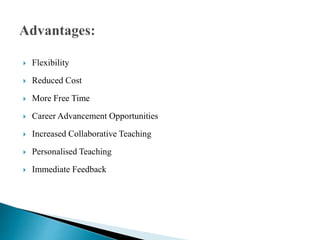
 Flexibility
 Reduced Cost
 More Free Time
 Career Advancement Opportunities
 Increased Collaborative Teaching
 Personalised Teaching
 Immediate Feedback
 Sampling: Teachers teaching in secondary schools were taken as sample. 100
teachers were randomly selected for this study.
 Procedure: Teachers were assured that confidentiality is maintained about their
personal information.
 Instrument: The questionnaire comprised of two sections; first section presents
information about locality, subject qualification, marital status and type of
management. Second part was further sub divided into two sections;
(1)Advantages, and (2) disadvantages of online learning.16 items comprised in the
first sub-section and 15 items comprised in the second sub-section.
 Reliability and Validity: The questionnaire was evaluated by experts in the
educational department before using it for data collection. Corrections were made
in the questionnaire considering the suggestions of experts to ensure its validity.
Pilot study was conducted on 20 teachers to check the reliability and validity of the
questionnaire. Teachers taken for pilot study were excluded from the final sample.
The questionnaire items show high reliability as the coefficient of Cronbach alpha
exceeds 75%.
 Data Analysis: Data collected was analyzed using frequencies and percentage as
part of descriptive statistics through statistical package for social sciences (SPSS).
VARIABLES FREQUENCY PERCENTAGE
LOCALITY:
Urban
Rural
AGE:
<35
35-40
>45
SUBJECT:
Arts
Science
Maths
QUALIFICATION:
B.Ed
M.Ed
MARITAL STATUS:
Married
Unmarried
TYPE OF MANAGEMENT:
Government
Private
50
50
48
32
20
42
35
23
83
17
73
27
55
45
50%
50%
48%
32%
20%
42%
35%
23%
83%
17%
73%
27%
55%
45%
RANK ITEMS AGREE(%)
SOMEWHAT
AGREE(%)
DON’T
AGREE(%)
13
The use of computers raises the level of teachers skills and
performance
67 22 11
10 Helps planning lessons in an interesting way 71 21 8
3
Helps teacher preserve lectures for long periods
&immediate(evaluation) assessment of a student
84 14 2
15 Helps teacher motivate students more pictorially 64 24 12
9 Helps teacher provide excess information to a student 72 21 7
2 Helps raise the level of teacher’s presentation 85 12 3
5 Helps in increasing student-teacher interaction 80 15 5
11 Increases teacher’s interest in teaching 70 22 8
6 Enhances the syllabus 78 18 4
14 Teachers can enrich their subject knowledge further using internet 65 23 12
4
Teachers can communicate directly with students though online
media anytime and anywhere
82 16 2
7
Helps teacher to have communication with parents which helps to
guide them
75 21 4
1 Helps improve teaching 87 11 2
8 Brings down the fright of the teacher to go to school and teach 73 21 6
12 Lessons can be delivered 7*24 69 22 9
16
Improves the communication between teacher and teacher and
63 24 13
RANK ITEMS AGREE(%)
SOMEWHAT
AGREE(%)
DON’T
AGREE(%)
1
Difficult for illiterate parents to follow their children
87 7 6
12
Negatively effects health( health, radiation, obesity, Electromagneticfield )
74 14 12
15
Technical failures may lead to disinterest in teacher
70 16 14
2
Lack of face to face interaction with student
85 7 8
3
Not possible for a teacher to make them participate in class activity and
extra-curricular activities 84 8 8
4
Difficult to change the methods of teaching instantly according to the need
of the student 83 9 8
14
Increases teacher work in making and creating new video lessons
71 16 13
5
Lack of correct evaluation because of cheating of students
82 10 8
13
Lessons the role of teacher is the overall development of student
73 15 12
6
Teachers need to focus more on intellectual development instead of
educational development 81 11 8
9
Teachers need to update their knowledge to make use of technology in a
proper and useful way 77 12 11
 The present study stated that conditions at the time of pandemic brought
about a great and sudden shift in the field of education. To warranty the
safety of students, if is believed that online teaching is best suited to the
existing conditions. So there is an immediate requirement at present for the
introduction and adoption of new faculty development programmes to
enhance the knowledge of teachers to make use of online teaching. Further
studies are to be conducted to minimize the limitations and improve the
standards of teaching. Methods of teaching online are to be developed and
put to practice by the teachers. To put down their burden, they have to
develop interactive sessions of teaching
 Results of this study may be used to plan various online teaching training
programs for teachers.
 This may be insinuated to the course coordinators to give guidance to the
teachers in their planning of teaching.
 This method can be applied at the various stages of teaching.
 The study can be conducted with other relevant variables at different stages and
places of education.
 Teacher education curriculum and school curriculum should contain online
teaching techniques to help in improving the technology by both teachers and
students.
 The present study is limited to secondary school teaching but it may be
extended to the teachers at various levels.
 The study can be further extended by increasing the sample size, with
different variables, with different tools constructed by other researchers.
 The study can be conducted using other methods of research as well.
 Further research must be taken up to curtail the limitations of on-line
teaching to the best possible level.
[1]. Abdelrahim, Y. (2021). How COVID-19 quarantine influenced online exam
cheating: a case of Bangladesh University Students. Journal of Southwest Jiaotong
University, 56(1).
[2]. Amhag, L., Hellström, L., & Stigmar, M. (2019). Teacher educators' use of digital
tools and needs for digital competence in higher education. Journal of Digital
Learning in Teacher Education, 35(4), 203-220. [3]. Barr, R. B., & Tagg, J. (1995).
From teaching to learning—A new paradigm for undergraduate education. Change:
The magazine of higher learning, 27(6), 12-26.
[4]. Brothen, T., & Peterson, G. (2012). Online exam cheating: A natural experiment.
International Journal of Instructional Technology and Distance Learning, 9(2), 15-
20.
[5]. Cao, W., Fang, Z., Hou, G., Han, M., Xu, X., Dong, J., & Zheng, J. (2020). The
psychological impact of the COVID-19 epidemic on college students in China.
Psychiatry research, 287, 112934.
[6]. Coman, C., Țîru, L. G., Meseșan-Schmitz, L., Stanciu, C., & Bularca, M. C.
(2020). Online teaching and learning in higher education during the coronavirus
pandemic: Students’ perspective. Sustainability, 12(24), 10367.
[7].Aithal, P. S., and Aithal, S., 2016. Impact of on-line education on higher education
system. International Journal of Engineering Research and Modern Education
(IJERME), 1(1), pp. 225-235.
THANK YOU

sudha ppt.pptx

  • 1.
  • 2.
     Abstract  Introduction Advantages  Materials and Methods  Results  Conclusions  Educational Implications  Suggestions for future research  References
  • 3.
     Since pandemiclearning and teaching has been taking place in an Expeditious way through on-line. Different implicit meeting manifestos such as Google meet, WebEx meeting and zoom meeting have been made use of virtually in every institution related to education from pre-primary to post doctoral around the world. This proves to be the best platform for both the teachers and students in learning, though they have to come across confrontation. This research aims to traverse the pros and cons of online education by simply interviewing 100 expert teachers from various subjects. The researcher used random sampling to meet teachers deployed on their agenda. The results show that inspite of the pros such as flexibility, reduced costs, more free time, career advancement opportunities, increased collaborative teaching, personalized teaching, immediate feedback, online education further restore cons for teachers namely more prone to technical issues, inability to focus on and lack of direct interaction.
  • 4.
     Almost allqualified teachers are knowledgeable with the main theories of teaching. Teachers in secondary schools are appointed first and foremost for their subject expertise. Any teacher must adopt any one of the existing theories of teaching to make their teaching clear and understandable to students. Only some teachers enter into teaching without any prior training or learning. Even they start adopting the existing theories without their knowledge that they are adopting one of them, as they feel convenient and ease in the method taken up by them. Because of online education which is technology-based teaching new theories of teaching and learning become evident.
  • 5.
     Flexibility  ReducedCost  More Free Time  Career Advancement Opportunities  Increased Collaborative Teaching  Personalised Teaching  Immediate Feedback
  • 6.
     Sampling: Teachersteaching in secondary schools were taken as sample. 100 teachers were randomly selected for this study.  Procedure: Teachers were assured that confidentiality is maintained about their personal information.  Instrument: The questionnaire comprised of two sections; first section presents information about locality, subject qualification, marital status and type of management. Second part was further sub divided into two sections; (1)Advantages, and (2) disadvantages of online learning.16 items comprised in the first sub-section and 15 items comprised in the second sub-section.  Reliability and Validity: The questionnaire was evaluated by experts in the educational department before using it for data collection. Corrections were made in the questionnaire considering the suggestions of experts to ensure its validity. Pilot study was conducted on 20 teachers to check the reliability and validity of the questionnaire. Teachers taken for pilot study were excluded from the final sample. The questionnaire items show high reliability as the coefficient of Cronbach alpha exceeds 75%.  Data Analysis: Data collected was analyzed using frequencies and percentage as part of descriptive statistics through statistical package for social sciences (SPSS).
  • 7.
    VARIABLES FREQUENCY PERCENTAGE LOCALITY: Urban Rural AGE: <35 35-40 >45 SUBJECT: Arts Science Maths QUALIFICATION: B.Ed M.Ed MARITALSTATUS: Married Unmarried TYPE OF MANAGEMENT: Government Private 50 50 48 32 20 42 35 23 83 17 73 27 55 45 50% 50% 48% 32% 20% 42% 35% 23% 83% 17% 73% 27% 55% 45%
  • 8.
    RANK ITEMS AGREE(%) SOMEWHAT AGREE(%) DON’T AGREE(%) 13 Theuse of computers raises the level of teachers skills and performance 67 22 11 10 Helps planning lessons in an interesting way 71 21 8 3 Helps teacher preserve lectures for long periods &immediate(evaluation) assessment of a student 84 14 2 15 Helps teacher motivate students more pictorially 64 24 12 9 Helps teacher provide excess information to a student 72 21 7 2 Helps raise the level of teacher’s presentation 85 12 3 5 Helps in increasing student-teacher interaction 80 15 5 11 Increases teacher’s interest in teaching 70 22 8 6 Enhances the syllabus 78 18 4 14 Teachers can enrich their subject knowledge further using internet 65 23 12 4 Teachers can communicate directly with students though online media anytime and anywhere 82 16 2 7 Helps teacher to have communication with parents which helps to guide them 75 21 4 1 Helps improve teaching 87 11 2 8 Brings down the fright of the teacher to go to school and teach 73 21 6 12 Lessons can be delivered 7*24 69 22 9 16 Improves the communication between teacher and teacher and 63 24 13
  • 9.
    RANK ITEMS AGREE(%) SOMEWHAT AGREE(%) DON’T AGREE(%) 1 Difficultfor illiterate parents to follow their children 87 7 6 12 Negatively effects health( health, radiation, obesity, Electromagneticfield ) 74 14 12 15 Technical failures may lead to disinterest in teacher 70 16 14 2 Lack of face to face interaction with student 85 7 8 3 Not possible for a teacher to make them participate in class activity and extra-curricular activities 84 8 8 4 Difficult to change the methods of teaching instantly according to the need of the student 83 9 8 14 Increases teacher work in making and creating new video lessons 71 16 13 5 Lack of correct evaluation because of cheating of students 82 10 8 13 Lessons the role of teacher is the overall development of student 73 15 12 6 Teachers need to focus more on intellectual development instead of educational development 81 11 8 9 Teachers need to update their knowledge to make use of technology in a proper and useful way 77 12 11
  • 10.
     The presentstudy stated that conditions at the time of pandemic brought about a great and sudden shift in the field of education. To warranty the safety of students, if is believed that online teaching is best suited to the existing conditions. So there is an immediate requirement at present for the introduction and adoption of new faculty development programmes to enhance the knowledge of teachers to make use of online teaching. Further studies are to be conducted to minimize the limitations and improve the standards of teaching. Methods of teaching online are to be developed and put to practice by the teachers. To put down their burden, they have to develop interactive sessions of teaching
  • 11.
     Results ofthis study may be used to plan various online teaching training programs for teachers.  This may be insinuated to the course coordinators to give guidance to the teachers in their planning of teaching.  This method can be applied at the various stages of teaching.  The study can be conducted with other relevant variables at different stages and places of education.  Teacher education curriculum and school curriculum should contain online teaching techniques to help in improving the technology by both teachers and students.
  • 12.
     The presentstudy is limited to secondary school teaching but it may be extended to the teachers at various levels.  The study can be further extended by increasing the sample size, with different variables, with different tools constructed by other researchers.  The study can be conducted using other methods of research as well.  Further research must be taken up to curtail the limitations of on-line teaching to the best possible level.
  • 13.
    [1]. Abdelrahim, Y.(2021). How COVID-19 quarantine influenced online exam cheating: a case of Bangladesh University Students. Journal of Southwest Jiaotong University, 56(1). [2]. Amhag, L., Hellström, L., & Stigmar, M. (2019). Teacher educators' use of digital tools and needs for digital competence in higher education. Journal of Digital Learning in Teacher Education, 35(4), 203-220. [3]. Barr, R. B., & Tagg, J. (1995). From teaching to learning—A new paradigm for undergraduate education. Change: The magazine of higher learning, 27(6), 12-26. [4]. Brothen, T., & Peterson, G. (2012). Online exam cheating: A natural experiment. International Journal of Instructional Technology and Distance Learning, 9(2), 15- 20. [5]. Cao, W., Fang, Z., Hou, G., Han, M., Xu, X., Dong, J., & Zheng, J. (2020). The psychological impact of the COVID-19 epidemic on college students in China. Psychiatry research, 287, 112934. [6]. Coman, C., Țîru, L. G., Meseșan-Schmitz, L., Stanciu, C., & Bularca, M. C. (2020). Online teaching and learning in higher education during the coronavirus pandemic: Students’ perspective. Sustainability, 12(24), 10367. [7].Aithal, P. S., and Aithal, S., 2016. Impact of on-line education on higher education system. International Journal of Engineering Research and Modern Education (IJERME), 1(1), pp. 225-235.
  • 14.