MSME
At Glance
• The Ministry of Micro, Small and Medium Enterprises , a
branch of the Government of India, is the apex body for the
formulation and administration of rules, regulations and laws
relating to micro, small and medium enterprises in India. The
current Minister of Micro, Small and Medium Enterprises
is Giriraj Singh since 03 September 2017.
• The President of India amended the Government of
India (Allocation of Business) Rules, 1961, under the
notification dated 9 May 2007. Pursuant to this amendment,
the Ministry of Agro and Rural Industries (India) and
the Ministry of Small Scale Industries (India) were merged into
a single ministry, the Ministry of Micro, Small and Medium
Enterprises
Introduction
What are Micro, Small & Medium
Enterprises ?
• Definitions of Micro, Small & Medium Enterprises In accordance with the
provision of Micro, Small & Medium Enterprises Development (MSMED) Act,
2006 the Micro, Small and Medium Enterprises (MSME) are classified in two
Classes:
• 1. Manufacturing Enterprises-he enterprises engaged in the manufacture or
production of goods pertaining to any industry specified in the first schedule
to the industries (Development and regulation) Act, 1951) or employing plant
and machinery in the process of value addition to the final product having a
distinct name or character or use. The Manufacturing Enterprise are defined in
terms of investment in Plant & Machinery.
• 2. Service Enterprises:-The enterprises engaged in providing or rendering of
services and are defined in terms of investment in equipment..
• The limit for investment in plant and machinery / equipment for
manufacturing / service enterprises, as notified,vide S.O. 1642(E) dtd.29-09-
2006 are as under
To be continued on Next Page……………..
Manufacturing Sector
Enterprises Investment in plant & machinery
Micro Enterprises Does not exceed twenty five
lakh rupees
Small Enterprises More than twenty five lakh
rupees but does not exceed five
crore rupees
Medium Enterprises More than five crore rupees but
does not exceed ten crore
rupees
Service Sector
Enterprises Investment in equipments
Micro Enterprises
Does not exceed ten lakh
rupees:
Small Enterprises
More than ten lakh rupees but
does not exceed two crore
rupees
Medium Enterprises
More than two crore rupees but
does not exceed five crore
rupees
Some Important Issues
How to Set up new Unit and
Arranging Finance
How to set up New Unit ?
No MSME unit can take off without monetary support. This need for finance can
be classified into following types:
- Long and medium term loans
- Short term or working capital requirements
- Risk Capital
- Seed Capital/Marginal Money
- Bridge loans
Financial assistance in India for MSME units is available from a
variety of institutions. The important ones are:
(i) Commercial/Regional Rural/Co-operative Banks.
(ii) SIDBI: Small Industries Development Bank of India
(refinance and direct lending)
(iii) SFCs/SIDCs: State Financial Corporations (e.g. Delhi
Financial Corporation)/State Industrial Development
Corporations.
• Long and medium term loans are
provided by SFCs, SIDBI and SIDCs.
Banks also finance term loans. This
type of financing is needed to fund
purchase of land, construction of
factory building/shed and for
purchase of machinery and
equipment. The short-term loans are
required for working capital
requirements, which fund the
purchase of raw materials and
consumables, payment of wages and
other immediate manufacturing and
administrative expenses. Such loans
are generally available from
commercial banks. The commercial
banks also sanction composite loan
comprising of working capital and
term loan up to a loan limit of Rs.1
crore.
• - Documentation for Loan Application
- Balance Sheet and Profit Loss Statement for last three
consecutive years of firms owned by promoters
- Income Tax Assessment Certificates of
Partners/Directors
- Proof of Possession of Land/Building
- Architect’s estimate for construction cost
- Partnership deed/Memorandum and Articles of
Associations of Company
- Project Report
- Budgetary Quotations of Plant and Machinery
For loans from financial institutions and commercial banks a formal
application needs to be made. The details of documentation that
need to be provided with the loan application are indicated below:
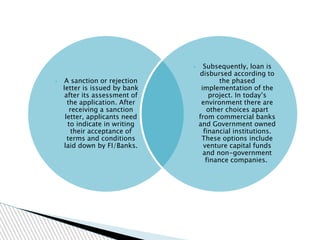
• A sanction or rejection
letter is issued by bank
after its assessment of
the application. After
receiving a sanction
letter, applicants need
to indicate in writing
their acceptance of
terms and conditions
laid down by FI/Banks.
• Subsequently, loan is
disbursed according to
the phased
implementation of the
project. In today’s
environment there are
other choices apart
from commercial banks
and Government owned
financial institutions.
These options include
venture capital funds
and non-government
finance companies.
EXPORT PROMOTION
Schemes & Incentives
• The capability of Indian MSME products to compete in international
markets is reflected in its share of about 34% in national exports. In
case of items like readymade garments, leather goods, processed
foods, engineering items, the performance has been commendable
both in terms of value and their share within the MSME sector while
in some cases like sports goods they account for 100% share to the
total exports of the sector. In view of this, export promotion from
the small scale sector has been accorded high priority in India’s
export promotion strategy which includes simplification of
procedures, incentives for higher production of exports, preferential
treatments to MSMEs in the market development fund,
simplification of duty drawback rules, etc. Products of MSME
exporters are displayed in international exhibitions free of cost
under SIDO Umbrella abroad.
Rationale Behind Export Promotion
Plan Scheme ‘Training and Manpower Development' consists of the
following Components :-
• Participation in the International Exhibitions/ Fairs.
• Training Programmes on Packaging for Exports
• Marketing Development Assistance Scheme for MSME exporters
(MSME-MDA)
• National Award for Quality Products.
MARKETING ASSISTANCE AND EXPORT PROMOTION SCHEME
(I) Participation in the International Exhibitions/ Fairs
Office of the Development Commissioner (MSME) is participating in some of the selected
International Exhibitions/ Fairs since 1985. It is purely promotional scheme to give exposure to the
products of micro, small enterprises which otherwise are not in a position to participate in the
exhibitions/ fairs at their own cost. Under the scheme, exhibits of the selected export-worthy
units are displayed in the exhibition that provides an opportunity to MSEs in demonstrating their
capabilities before the international community. On an average, this Office has been participating
in 8-10 number of International Exhibitions/ Fairs abroad every year and 200 MSEs have been
benefited. For confirm participation, the unit has to send 50% of space hiring charges of their
booked space (min. 6 sq.mtr.) through MSME-Development Institutions (Formerly SISIs) by a DD
favouring PAO (MSME), New Delhi at least 45 days advance of the commencement of the event or
till space is available.100% subsidy on space rent is available to sc/st women entrepreneur and
entrepreneur of NE region. The participating units will also carry/ manage their exhibits (to and
fro) including custom clearance etc. If any body wants more space, they can book in multiple of
1x3 sq.mtr. on pro-rata base and would be required to pay on pro-rata basis. 75% Subsidy on air
fair of economy class to general category of entrepreneur(100% to sc/st women entrepreneur
and entrepreneur of NE region)
To be continued on next Page………
Export Promotion from the small-scale sector has been accorded a high priority in the India's export
promotion strategy. Apart from the number of incentives and facilities to small-scale exporters, the
following plan schemes are in operation for achieving growth in exports.
(II)Training Programmes on Packaging for Exports
India faces formidable hurdle in meeting and matching the packaging requirements of
her exportable products in the markets abroad. The main objective of scheme is to
generate much needed consciousness in the industry about the packaging problems of
MSME exporters and to educate the entrepreneurs about the latest packaging
techniques and designs of the packaging. These programmes on Packaging for Exports
are conducted since 1979 by all the field institutes in collaboration with Indian Institute
of Packaging and GS1 India (formerely EAN India) ( A Bar Code solution provider ). The
programme is of One, Two & Three days duration and 20 to 35 existing and potential
entrepreneurs have been participating in each of the programmes. As per instruction
of IF Wing, only 50-60 percent (20 percent in NE region and J&K) of the total cost of the
programme are recovered from the participants as participation fee. 20-25
programmes are being conducted every year throughout the country.
• (III) Market Development Assistance Scheme for MSME exporters (MSME-MDA)
•
As part of the comprehensive policy package for MSMEs, MSME-MDA scheme has been announced in August 2000 and came
into operation w.e.f. 30 th August, 2001. With a view to increase participation of representatives of participating units, the
provision of MSME-MDA Scheme has been modified recently. The major changes in the earlier scheme are as under:
• 1. (i) the Govt. of India will reimburse the 75% of air fare by economy class and 50% subsidy on space rent. to general
category of Micro manufacturing enterprises.(ii)100% to sc/st women entrepreneur and entrepreneur of NE region (iii) The
total subsidy on air fare, space rent & shipping cost of exhibits will be restricted to Rs.1.25 lakhs per unit for manufacturing
enterprises or actual, whichever is less. (iv) Any unit can avail of this facility only once a year and (v) Only one person of the
participating unit would be eligible for subsidy on air fare. (vi) The booking of minimum 6 Sq. Mtrs. is allowed.
2. The amount of 50% of space hiring charges shall be sent by a DD favoring PAO (MSME), New Delhi through MSME-Dis
(Formerly SISIs)along with passport particulars plus first and last two pages of valid passport of their visiting representatives.
3. The circulars are issued to Director, all MSME-DIs (formerly SISIs) for selection of Small/ Micro manufacturing enterprises
whose products conforming to the International Standards & Quality.
4. One SIDO officer will be deputed to each fair for coordination of MSME-India stall.
In addition, the scheme also provide for financial assistance upto Rs. 2.00 lakhs for commissioning specific market studies
and assistance for initiating/ contesting anti-dumping cases is available to MSME Association limited to 50% of the total cost
of Rs. 1.00 lakh whichever is less. Provision for reimbursement of 75% of one-time registration fee paid to GS1 India by
MSME unit for adoption of Bar Coding (w.e.f. Ist January, 2002).75% of Annual recurring fee of bar code is also available
(w.e.f. 1st June 2007) for the 1st three years periodTo avail financial assistance under the scheme, application may be sent
alongwith requisite documents etc.
(IV) National Award for Quality
Products
The objectives of the scheme are
as follows :-
a.To encourage small scale industries to produce quality
products conforming to national and international
standards.
b.To propagate a culture of quality consciousness amongst
a vast section of Small Scale manufacturing units.
c.To instill a sense of confidence of small industry products
in the minds of the domestic consumers and to enhance the
image of Indian products in export market.
These awards are given on the
basis of recommendation by the
State/ UT Level Selection
Committee and the final selection
by the National level Selection
Committee for every calendar
year.
Packaging for Exports
• Role of packaging for exports has gained much significance in view of trends in the world markets. The
need for better and scientific packaging for exports from small sector was recognised long back. With a
view to acquaint MSME Exporters of the latest Packaging standards, techniques etc. training
programmes on packaging for exports are organised in various parts of the country. These programmes
are organised in association with Indian Institute of Packaging which has requisite expertise on the
subject. Basic objective of these programmes is to generate the much needed consciousness in the
industry and to educate the entrepreneurs about the scientific techniques of Packaging. With the
assistance of EAN India to sensitize Indian exporters about barcoding. 7 training sessions were
conducted in 2000-01 at different locations across the country. However, bar code topic is added in the
said programme.
Technical & Managerial Consultancy Services
• Technical & Managerial Consultancy Services to the MSME manufacturers/exporters is provided through
a network of field offices of this office so as to ensure higher level of production and generation of
higher exports.
National Awards for Quality Products
• With a view to encourage the small scale units for producing Quality goods, National Awards for Quality
Products are given to the outstanding small scale units, who have made significant contribution for
improving quality of their products. The scheme is being operated since 1986. Winners of National
Awards get a Trophy, a Certificate and a Cash Prize of Rs.25,000/-($559.6) National Awards encourage
Small Scale Industries units to produce quality goods which further enables them to enter into export
market.
UNION BUDGET 2018
Impact of Union budget 2018
Budget 2018 has reduced the corporate tax rate for companies with an annual
turnover of up to Rs250 crore to 25%
The Union Budget 2018 on Thursday extended sops to micro, small and medium
enterprises (MSMEs), as part of the government’s efforts to bring businesses
under the formal economy’s fold.
The budget also earmarked Rs3 trillion for 2018-19 under the Pradhan Mantri
Mudra Yojana or Mudra scheme.
MSME’s provided Rs. 3794 crore to provide credit support, capital and interest
subsidy and innovations to this sector.
Top Highlights
Massive formalization of the businesses of MSMEs is taking place in the country
after demonetization and introduction of GST. This is generating enormous
financial information database of MSMEs’ businesses and finances. This big
database will be used for improving financing of MSMEs’ capital requirement,
including working capital,”
In last year’s budget, the government had provided tax sops to MSMEs to make
them more viable, recognizing their importance in economic activity and
generating employment. It had reduced the tax to 25% for companies with
annual revenue of up to Rs50 crore.
This is estimated to have benefited more than 667,000 companies, covering
96% of all companies filing tax returns.
K
E
Y
H
I
G
H
L
I
G
H
T
S
This will benefit the entire class of micro, small and medium
enterprises which accounts for almost 99% of companies
filing their tax returns
The tax cut will leave companies with higher investible
surplus which in turn will create more jobs.
Proposal for setting a target of Rs. 3 lakh crore for lending
under MUDRA YOJNA SCHEME.
Announcement of setting up a model aspirational skill centre
in every district of country.
Proposal to onboard PSB’s and corporates on Trade
Electronic Receivable Discounting system (TreDS) platform
and link it to GSTN. —- Online loan sanctioning facility for
MSMEs will be revamped for quick decision making by the
banks
Thanks

Msme

  • 1.
  • 2.
    • The Ministryof Micro, Small and Medium Enterprises , a branch of the Government of India, is the apex body for the formulation and administration of rules, regulations and laws relating to micro, small and medium enterprises in India. The current Minister of Micro, Small and Medium Enterprises is Giriraj Singh since 03 September 2017. • The President of India amended the Government of India (Allocation of Business) Rules, 1961, under the notification dated 9 May 2007. Pursuant to this amendment, the Ministry of Agro and Rural Industries (India) and the Ministry of Small Scale Industries (India) were merged into a single ministry, the Ministry of Micro, Small and Medium Enterprises Introduction
  • 3.
    What are Micro,Small & Medium Enterprises ? • Definitions of Micro, Small & Medium Enterprises In accordance with the provision of Micro, Small & Medium Enterprises Development (MSMED) Act, 2006 the Micro, Small and Medium Enterprises (MSME) are classified in two Classes: • 1. Manufacturing Enterprises-he enterprises engaged in the manufacture or production of goods pertaining to any industry specified in the first schedule to the industries (Development and regulation) Act, 1951) or employing plant and machinery in the process of value addition to the final product having a distinct name or character or use. The Manufacturing Enterprise are defined in terms of investment in Plant & Machinery. • 2. Service Enterprises:-The enterprises engaged in providing or rendering of services and are defined in terms of investment in equipment.. • The limit for investment in plant and machinery / equipment for manufacturing / service enterprises, as notified,vide S.O. 1642(E) dtd.29-09- 2006 are as under To be continued on Next Page……………..
  • 4.
    Manufacturing Sector Enterprises Investmentin plant & machinery Micro Enterprises Does not exceed twenty five lakh rupees Small Enterprises More than twenty five lakh rupees but does not exceed five crore rupees Medium Enterprises More than five crore rupees but does not exceed ten crore rupees Service Sector Enterprises Investment in equipments Micro Enterprises Does not exceed ten lakh rupees: Small Enterprises More than ten lakh rupees but does not exceed two crore rupees Medium Enterprises More than two crore rupees but does not exceed five crore rupees
  • 5.
    Some Important Issues Howto Set up new Unit and Arranging Finance
  • 6.
    How to setup New Unit ? No MSME unit can take off without monetary support. This need for finance can be classified into following types: - Long and medium term loans - Short term or working capital requirements - Risk Capital - Seed Capital/Marginal Money - Bridge loans
  • 7.
    Financial assistance inIndia for MSME units is available from a variety of institutions. The important ones are: (i) Commercial/Regional Rural/Co-operative Banks. (ii) SIDBI: Small Industries Development Bank of India (refinance and direct lending) (iii) SFCs/SIDCs: State Financial Corporations (e.g. Delhi Financial Corporation)/State Industrial Development Corporations.
  • 8.
    • Long andmedium term loans are provided by SFCs, SIDBI and SIDCs. Banks also finance term loans. This type of financing is needed to fund purchase of land, construction of factory building/shed and for purchase of machinery and equipment. The short-term loans are required for working capital requirements, which fund the purchase of raw materials and consumables, payment of wages and other immediate manufacturing and administrative expenses. Such loans are generally available from commercial banks. The commercial banks also sanction composite loan comprising of working capital and term loan up to a loan limit of Rs.1 crore.
  • 9.
    • - Documentationfor Loan Application - Balance Sheet and Profit Loss Statement for last three consecutive years of firms owned by promoters - Income Tax Assessment Certificates of Partners/Directors - Proof of Possession of Land/Building - Architect’s estimate for construction cost - Partnership deed/Memorandum and Articles of Associations of Company - Project Report - Budgetary Quotations of Plant and Machinery For loans from financial institutions and commercial banks a formal application needs to be made. The details of documentation that need to be provided with the loan application are indicated below:
  • 10.
    • A sanctionor rejection letter is issued by bank after its assessment of the application. After receiving a sanction letter, applicants need to indicate in writing their acceptance of terms and conditions laid down by FI/Banks. • Subsequently, loan is disbursed according to the phased implementation of the project. In today’s environment there are other choices apart from commercial banks and Government owned financial institutions. These options include venture capital funds and non-government finance companies.
  • 11.
  • 12.
    • The capabilityof Indian MSME products to compete in international markets is reflected in its share of about 34% in national exports. In case of items like readymade garments, leather goods, processed foods, engineering items, the performance has been commendable both in terms of value and their share within the MSME sector while in some cases like sports goods they account for 100% share to the total exports of the sector. In view of this, export promotion from the small scale sector has been accorded high priority in India’s export promotion strategy which includes simplification of procedures, incentives for higher production of exports, preferential treatments to MSMEs in the market development fund, simplification of duty drawback rules, etc. Products of MSME exporters are displayed in international exhibitions free of cost under SIDO Umbrella abroad. Rationale Behind Export Promotion
  • 13.
    Plan Scheme ‘Trainingand Manpower Development' consists of the following Components :- • Participation in the International Exhibitions/ Fairs. • Training Programmes on Packaging for Exports • Marketing Development Assistance Scheme for MSME exporters (MSME-MDA) • National Award for Quality Products. MARKETING ASSISTANCE AND EXPORT PROMOTION SCHEME
  • 14.
    (I) Participation inthe International Exhibitions/ Fairs Office of the Development Commissioner (MSME) is participating in some of the selected International Exhibitions/ Fairs since 1985. It is purely promotional scheme to give exposure to the products of micro, small enterprises which otherwise are not in a position to participate in the exhibitions/ fairs at their own cost. Under the scheme, exhibits of the selected export-worthy units are displayed in the exhibition that provides an opportunity to MSEs in demonstrating their capabilities before the international community. On an average, this Office has been participating in 8-10 number of International Exhibitions/ Fairs abroad every year and 200 MSEs have been benefited. For confirm participation, the unit has to send 50% of space hiring charges of their booked space (min. 6 sq.mtr.) through MSME-Development Institutions (Formerly SISIs) by a DD favouring PAO (MSME), New Delhi at least 45 days advance of the commencement of the event or till space is available.100% subsidy on space rent is available to sc/st women entrepreneur and entrepreneur of NE region. The participating units will also carry/ manage their exhibits (to and fro) including custom clearance etc. If any body wants more space, they can book in multiple of 1x3 sq.mtr. on pro-rata base and would be required to pay on pro-rata basis. 75% Subsidy on air fair of economy class to general category of entrepreneur(100% to sc/st women entrepreneur and entrepreneur of NE region) To be continued on next Page……… Export Promotion from the small-scale sector has been accorded a high priority in the India's export promotion strategy. Apart from the number of incentives and facilities to small-scale exporters, the following plan schemes are in operation for achieving growth in exports.
  • 15.
    (II)Training Programmes onPackaging for Exports India faces formidable hurdle in meeting and matching the packaging requirements of her exportable products in the markets abroad. The main objective of scheme is to generate much needed consciousness in the industry about the packaging problems of MSME exporters and to educate the entrepreneurs about the latest packaging techniques and designs of the packaging. These programmes on Packaging for Exports are conducted since 1979 by all the field institutes in collaboration with Indian Institute of Packaging and GS1 India (formerely EAN India) ( A Bar Code solution provider ). The programme is of One, Two & Three days duration and 20 to 35 existing and potential entrepreneurs have been participating in each of the programmes. As per instruction of IF Wing, only 50-60 percent (20 percent in NE region and J&K) of the total cost of the programme are recovered from the participants as participation fee. 20-25 programmes are being conducted every year throughout the country.
  • 16.
    • (III) MarketDevelopment Assistance Scheme for MSME exporters (MSME-MDA) • As part of the comprehensive policy package for MSMEs, MSME-MDA scheme has been announced in August 2000 and came into operation w.e.f. 30 th August, 2001. With a view to increase participation of representatives of participating units, the provision of MSME-MDA Scheme has been modified recently. The major changes in the earlier scheme are as under: • 1. (i) the Govt. of India will reimburse the 75% of air fare by economy class and 50% subsidy on space rent. to general category of Micro manufacturing enterprises.(ii)100% to sc/st women entrepreneur and entrepreneur of NE region (iii) The total subsidy on air fare, space rent & shipping cost of exhibits will be restricted to Rs.1.25 lakhs per unit for manufacturing enterprises or actual, whichever is less. (iv) Any unit can avail of this facility only once a year and (v) Only one person of the participating unit would be eligible for subsidy on air fare. (vi) The booking of minimum 6 Sq. Mtrs. is allowed. 2. The amount of 50% of space hiring charges shall be sent by a DD favoring PAO (MSME), New Delhi through MSME-Dis (Formerly SISIs)along with passport particulars plus first and last two pages of valid passport of their visiting representatives. 3. The circulars are issued to Director, all MSME-DIs (formerly SISIs) for selection of Small/ Micro manufacturing enterprises whose products conforming to the International Standards & Quality. 4. One SIDO officer will be deputed to each fair for coordination of MSME-India stall. In addition, the scheme also provide for financial assistance upto Rs. 2.00 lakhs for commissioning specific market studies and assistance for initiating/ contesting anti-dumping cases is available to MSME Association limited to 50% of the total cost of Rs. 1.00 lakh whichever is less. Provision for reimbursement of 75% of one-time registration fee paid to GS1 India by MSME unit for adoption of Bar Coding (w.e.f. Ist January, 2002).75% of Annual recurring fee of bar code is also available (w.e.f. 1st June 2007) for the 1st three years periodTo avail financial assistance under the scheme, application may be sent alongwith requisite documents etc.
  • 17.
    (IV) National Awardfor Quality Products The objectives of the scheme are as follows :- a.To encourage small scale industries to produce quality products conforming to national and international standards. b.To propagate a culture of quality consciousness amongst a vast section of Small Scale manufacturing units. c.To instill a sense of confidence of small industry products in the minds of the domestic consumers and to enhance the image of Indian products in export market. These awards are given on the basis of recommendation by the State/ UT Level Selection Committee and the final selection by the National level Selection Committee for every calendar year.
  • 18.
    Packaging for Exports •Role of packaging for exports has gained much significance in view of trends in the world markets. The need for better and scientific packaging for exports from small sector was recognised long back. With a view to acquaint MSME Exporters of the latest Packaging standards, techniques etc. training programmes on packaging for exports are organised in various parts of the country. These programmes are organised in association with Indian Institute of Packaging which has requisite expertise on the subject. Basic objective of these programmes is to generate the much needed consciousness in the industry and to educate the entrepreneurs about the scientific techniques of Packaging. With the assistance of EAN India to sensitize Indian exporters about barcoding. 7 training sessions were conducted in 2000-01 at different locations across the country. However, bar code topic is added in the said programme. Technical & Managerial Consultancy Services • Technical & Managerial Consultancy Services to the MSME manufacturers/exporters is provided through a network of field offices of this office so as to ensure higher level of production and generation of higher exports. National Awards for Quality Products • With a view to encourage the small scale units for producing Quality goods, National Awards for Quality Products are given to the outstanding small scale units, who have made significant contribution for improving quality of their products. The scheme is being operated since 1986. Winners of National Awards get a Trophy, a Certificate and a Cash Prize of Rs.25,000/-($559.6) National Awards encourage Small Scale Industries units to produce quality goods which further enables them to enter into export market.
  • 19.
    UNION BUDGET 2018 Impactof Union budget 2018
  • 20.
    Budget 2018 hasreduced the corporate tax rate for companies with an annual turnover of up to Rs250 crore to 25% The Union Budget 2018 on Thursday extended sops to micro, small and medium enterprises (MSMEs), as part of the government’s efforts to bring businesses under the formal economy’s fold. The budget also earmarked Rs3 trillion for 2018-19 under the Pradhan Mantri Mudra Yojana or Mudra scheme. MSME’s provided Rs. 3794 crore to provide credit support, capital and interest subsidy and innovations to this sector. Top Highlights
  • 21.
    Massive formalization ofthe businesses of MSMEs is taking place in the country after demonetization and introduction of GST. This is generating enormous financial information database of MSMEs’ businesses and finances. This big database will be used for improving financing of MSMEs’ capital requirement, including working capital,” In last year’s budget, the government had provided tax sops to MSMEs to make them more viable, recognizing their importance in economic activity and generating employment. It had reduced the tax to 25% for companies with annual revenue of up to Rs50 crore. This is estimated to have benefited more than 667,000 companies, covering 96% of all companies filing tax returns.
  • 22.
    K E Y H I G H L I G H T S This will benefitthe entire class of micro, small and medium enterprises which accounts for almost 99% of companies filing their tax returns The tax cut will leave companies with higher investible surplus which in turn will create more jobs. Proposal for setting a target of Rs. 3 lakh crore for lending under MUDRA YOJNA SCHEME. Announcement of setting up a model aspirational skill centre in every district of country. Proposal to onboard PSB’s and corporates on Trade Electronic Receivable Discounting system (TreDS) platform and link it to GSTN. —- Online loan sanctioning facility for MSMEs will be revamped for quick decision making by the banks
  • 23.