Unit Testing and
         Scaffolding

Course of Software Engineering II
A.A. 2010/2011
                 Valerio Maggio, PhD Student
                       Prof. Sergio Di Martino
Testing Preliminaries
                                                      2

► You're a programmer
  ○ a coder, a developer, or maybe a hacker!

► As such, it's almost impossible that you haven't
  had to sit down with a program that you
  were sure was ready for use
  ○ or worse yet, a program you knew was not ready

► So, you put together a bunch of test to prove the
  correctness of your code
  ○ Let's think about what correctness means
Testing Preliminaries
                                                   3

► Correctness in Testing ?
  ○ Which is the point of view ?

► Different points of view means different types
  of tests (testing)

► Automated tools support
Outline
                                      4


► Testing Taxonomy
  ○ Brief Introduction


► Unit testing with JUnit 4.x
  ○ Main differences with JUnit 3.x
  ○ Backward compatibilities
  ○ JUnit Examples in practice

► Test Scaffolding and Mocking
1. Types of testing


                      5
Example Scenario
                                                     6

► (… not properly related to Computer Science :)

► Please, imagine that you have to test a building
  ○ Test if it has been constructed properly
  ○ Test if it is able to resist to earthquake
  ○ ….


► What types of “testing” will you do?
  ○ Make an educated guess
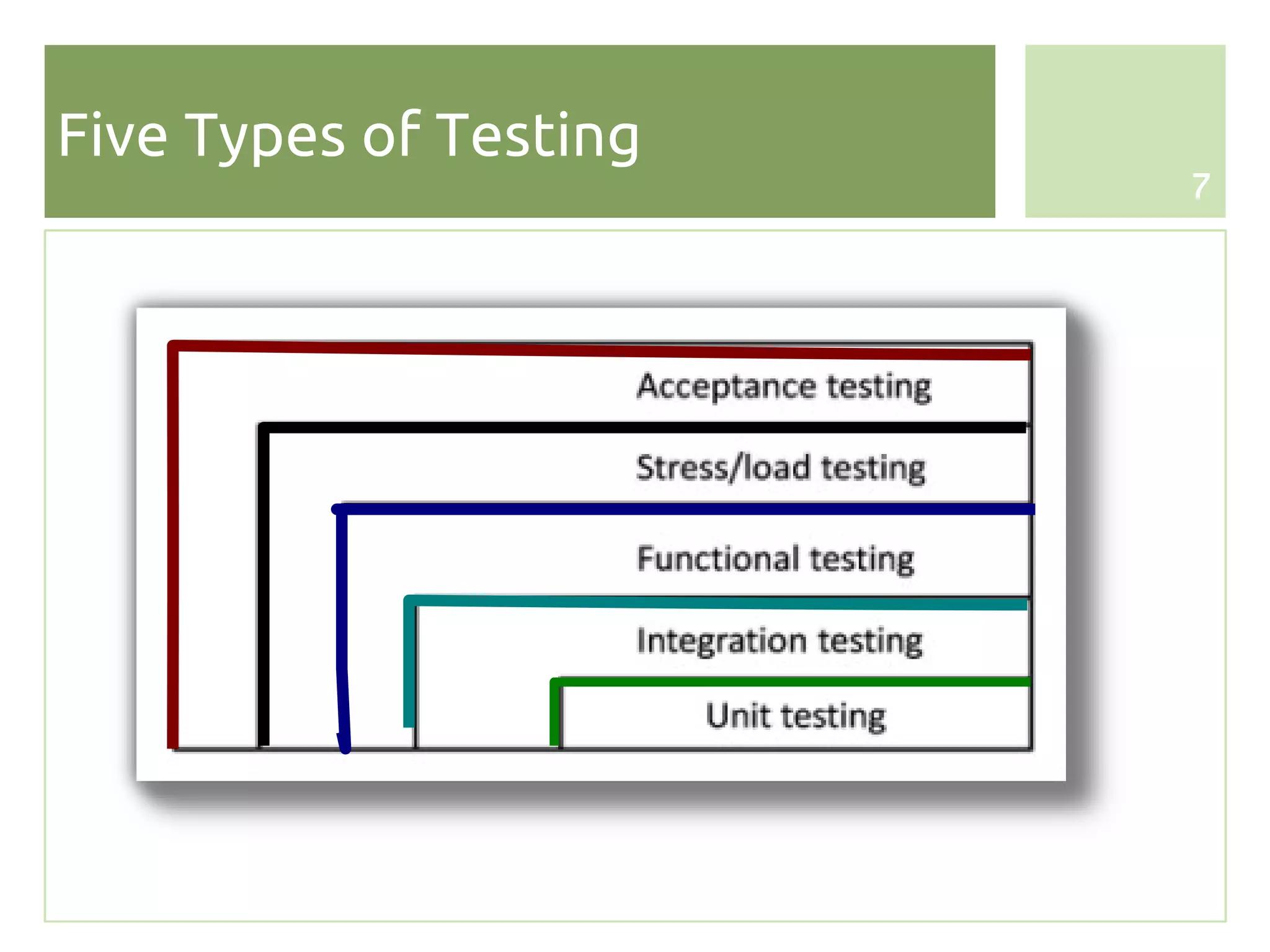
Five Types of Testing
                        7
Unit Testing
                                                 8

► Testing of the smallest pieces of a program
  ○ Individual functions or methods

► Keyword: Unit
  ○ (def) Something is a unit if it there's no
    meaningful way to divide it up further

► Buzz Word:
  ○ Testing in isolation
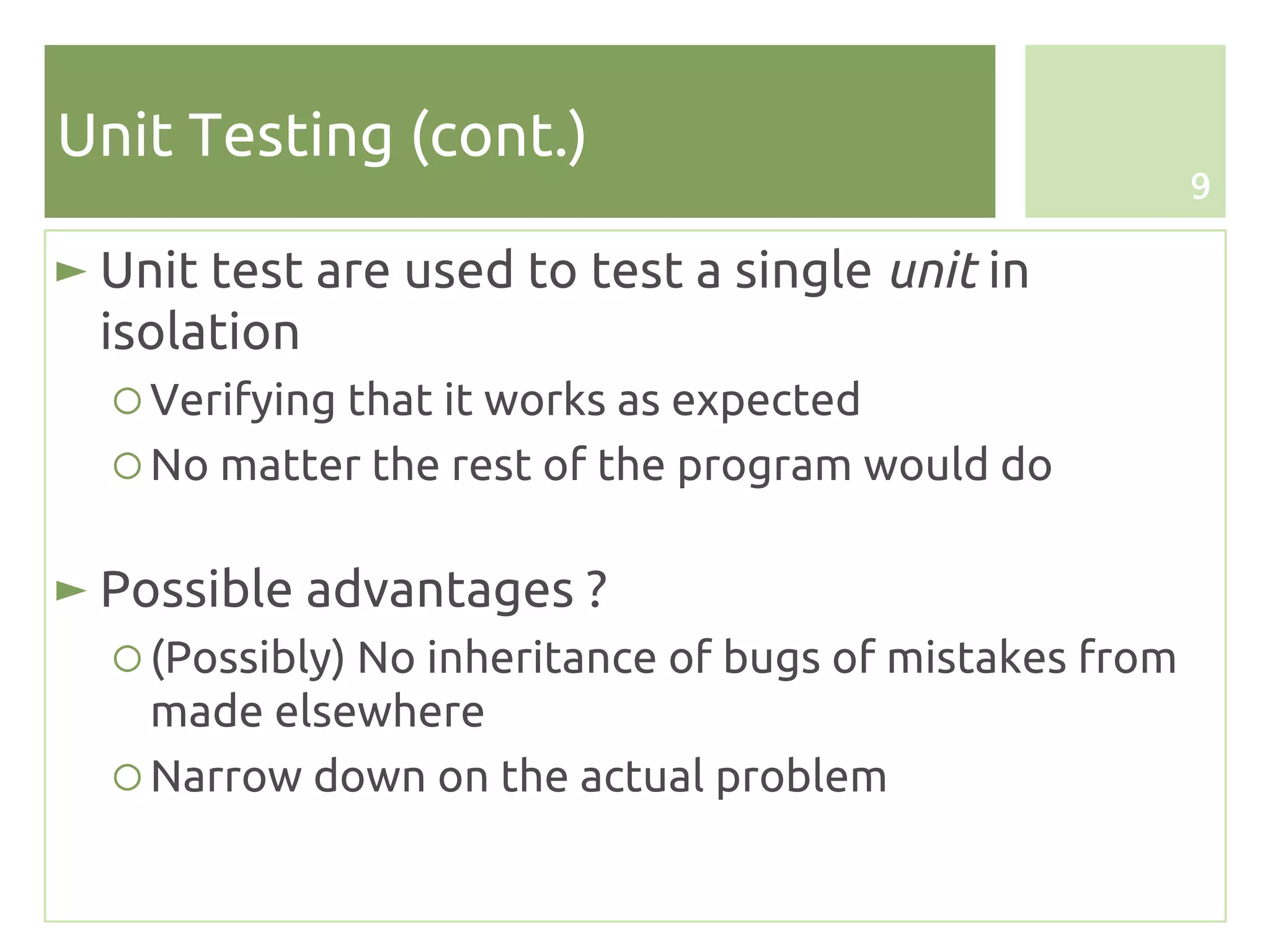
Unit Testing (cont.)
                                                         9

► Unit test are used to test a single unit in
  isolation
  ○ Verifying that it works as expected
  ○ No matter the rest of the program would do

► Possible advantages ?
  ○ (Possibly) No inheritance of bugs of mistakes from
    made elsewhere
  ○ Narrow down on the actual problem
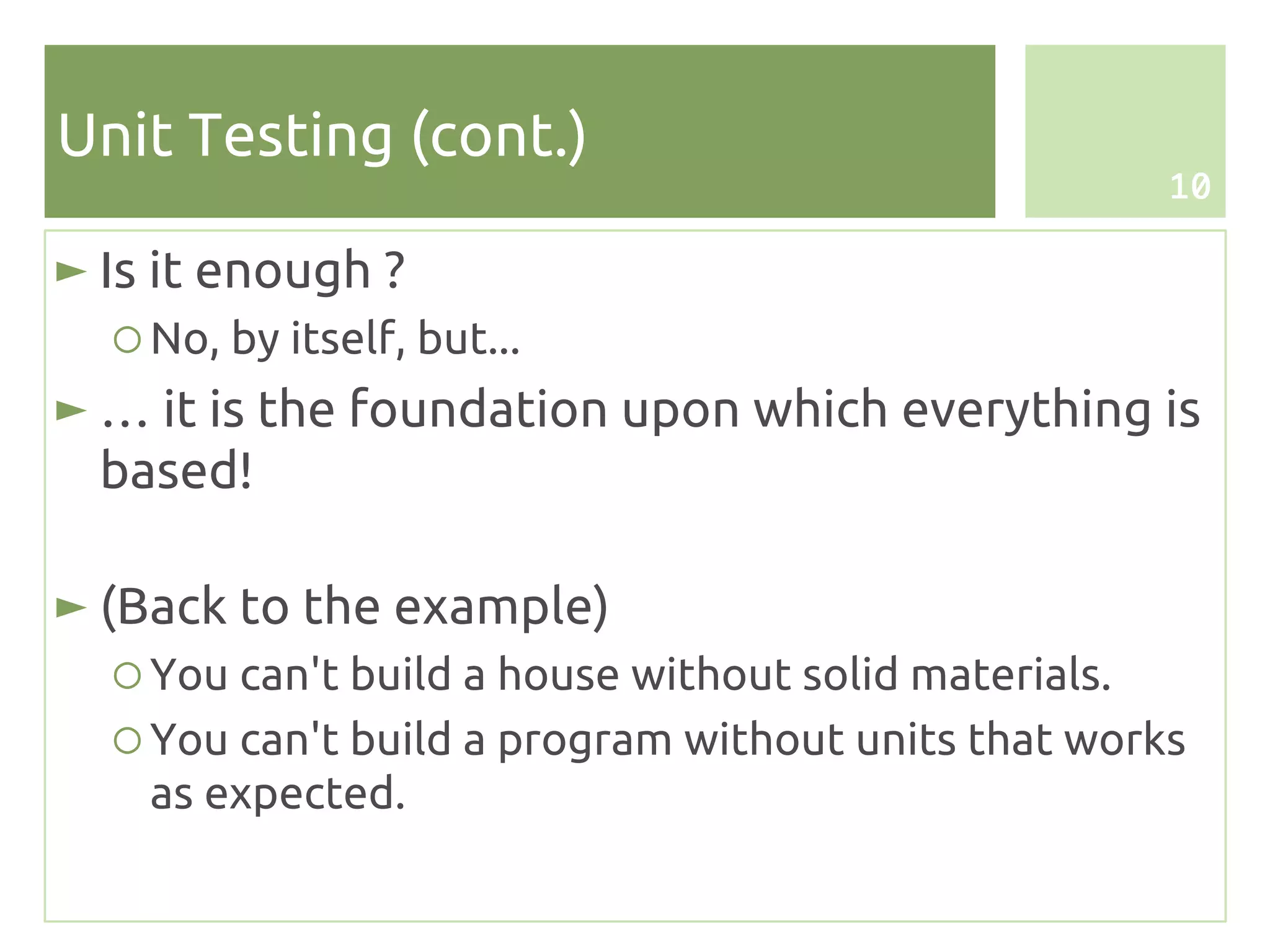
Unit Testing (cont.)
                                                     10

► Is it enough ?
  ○ No, by itself, but...
► … it is the foundation upon which everything is
  based!

► (Back to the example)
  ○ You can't build a house without solid materials.
  ○ You can't build a program without units that works
    as expected.
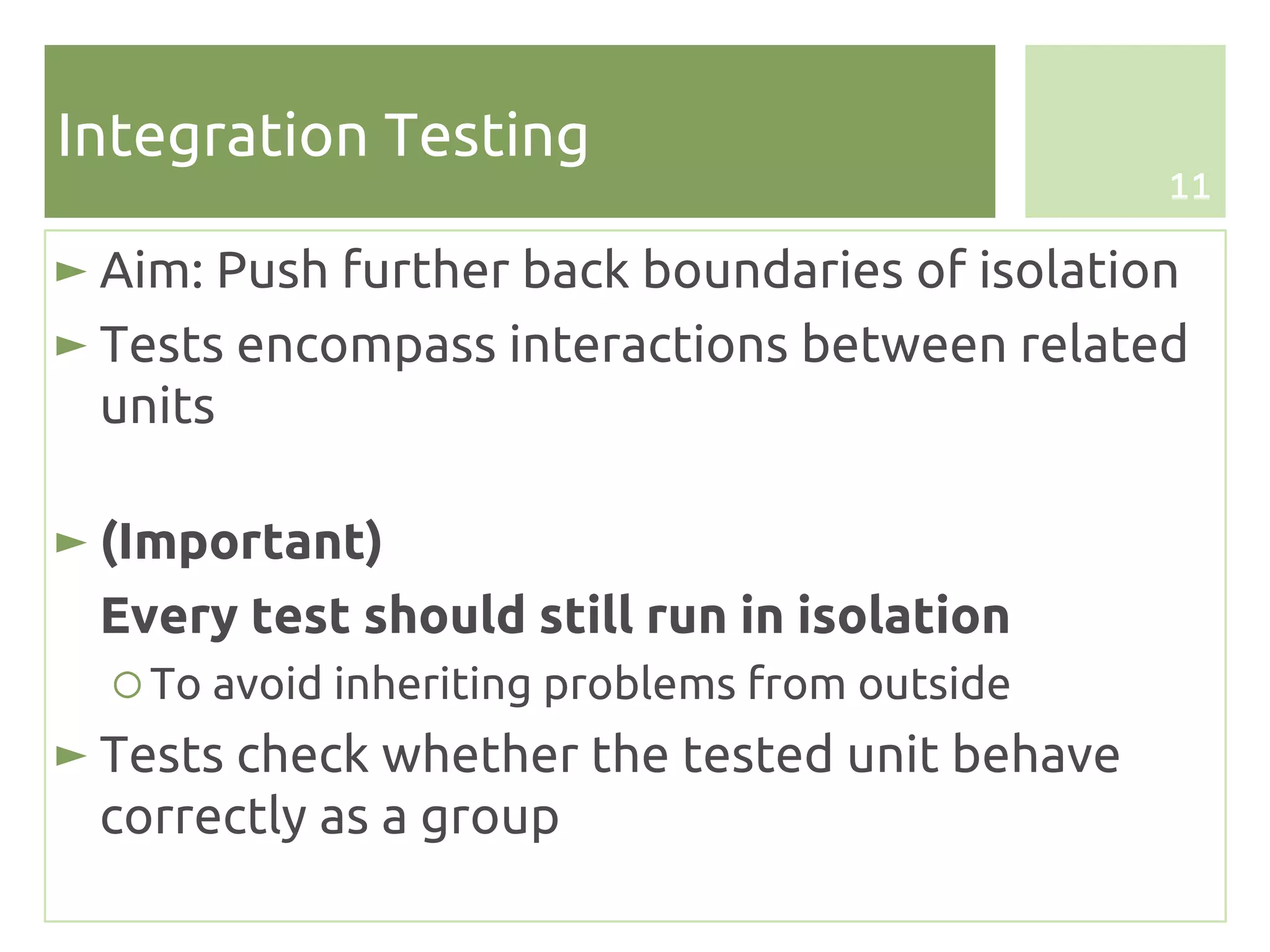
Integration Testing
                                                11

► Aim: Push further back boundaries of isolation
► Tests encompass interactions between related
  units

► (Important)
 Every test should still run in isolation
  ○ To avoid inheriting problems from outside
► Tests check whether the tested unit behave
  correctly as a group
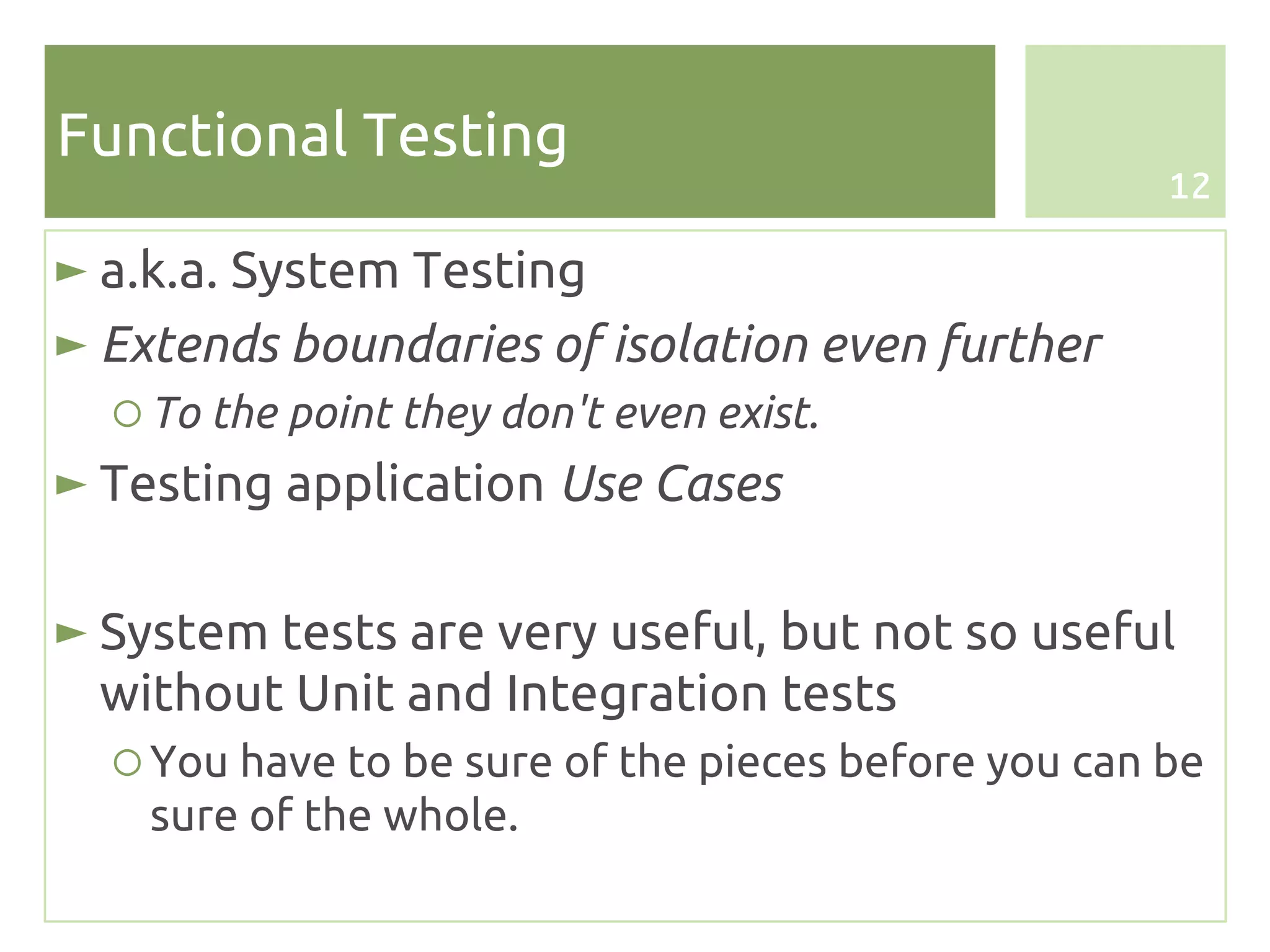
Functional Testing
                                                     12

► a.k.a. System Testing
► Extends boundaries of isolation even further
  ○ To the point they don't even exist.
► Testing application Use Cases

► System tests are very useful, but not so useful
  without Unit and Integration tests
  ○ You have to be sure of the pieces before you can be
    sure of the whole.
Stress and Acceptance Testing
                                                          13

► Stress/Load Testing
  ○ Test of loadings and performances
     ● (Non functional requirements)
  ○ Test if the building is able to resist to the earthquake


► Acceptance Testing
  ○ Last but not least....
  ○ … does the customer get what he or she expected?
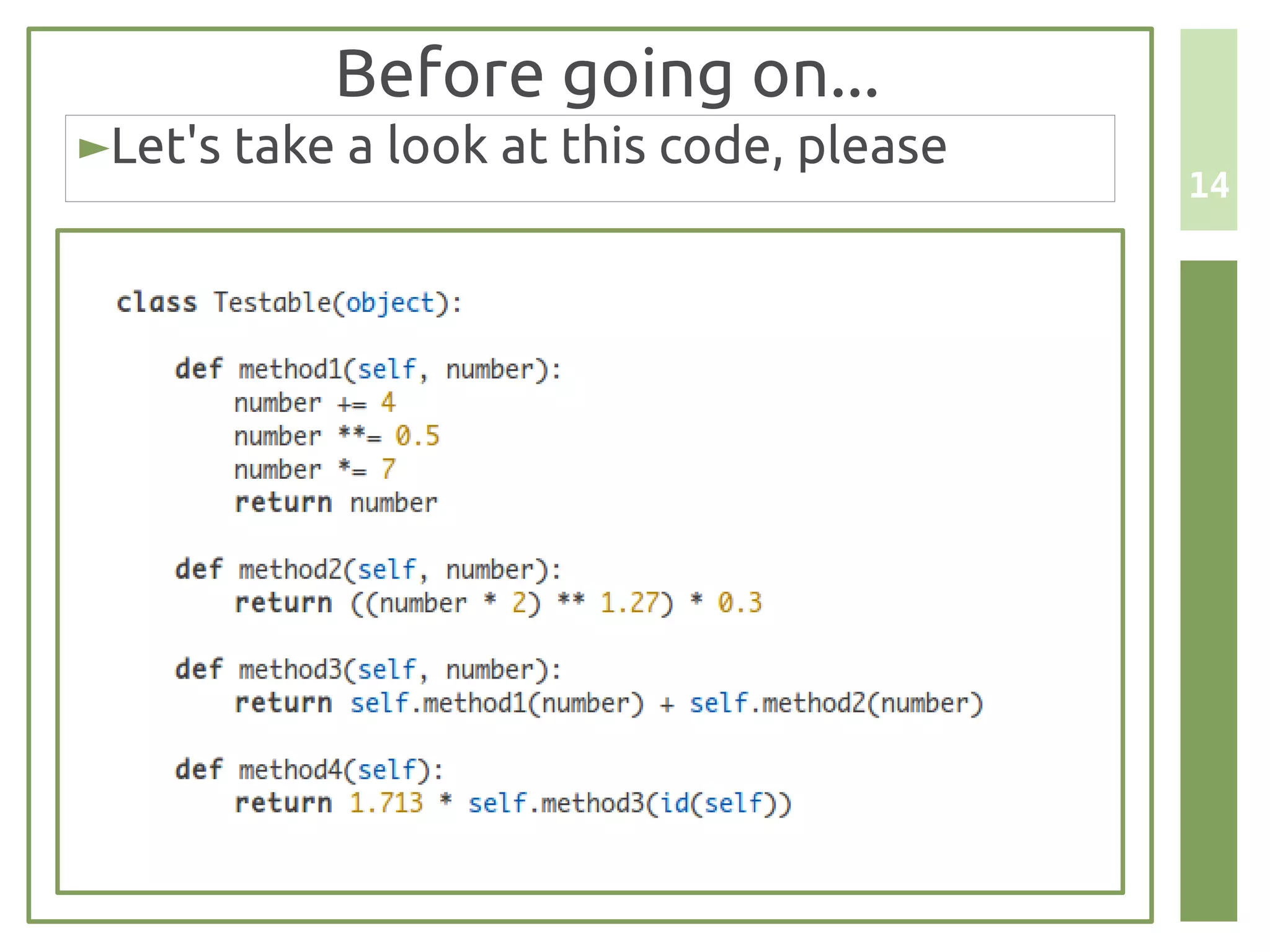
Before going on...
►Let's take a look at this code, please
                                          14
2. JUnit Testing Framework


                             15
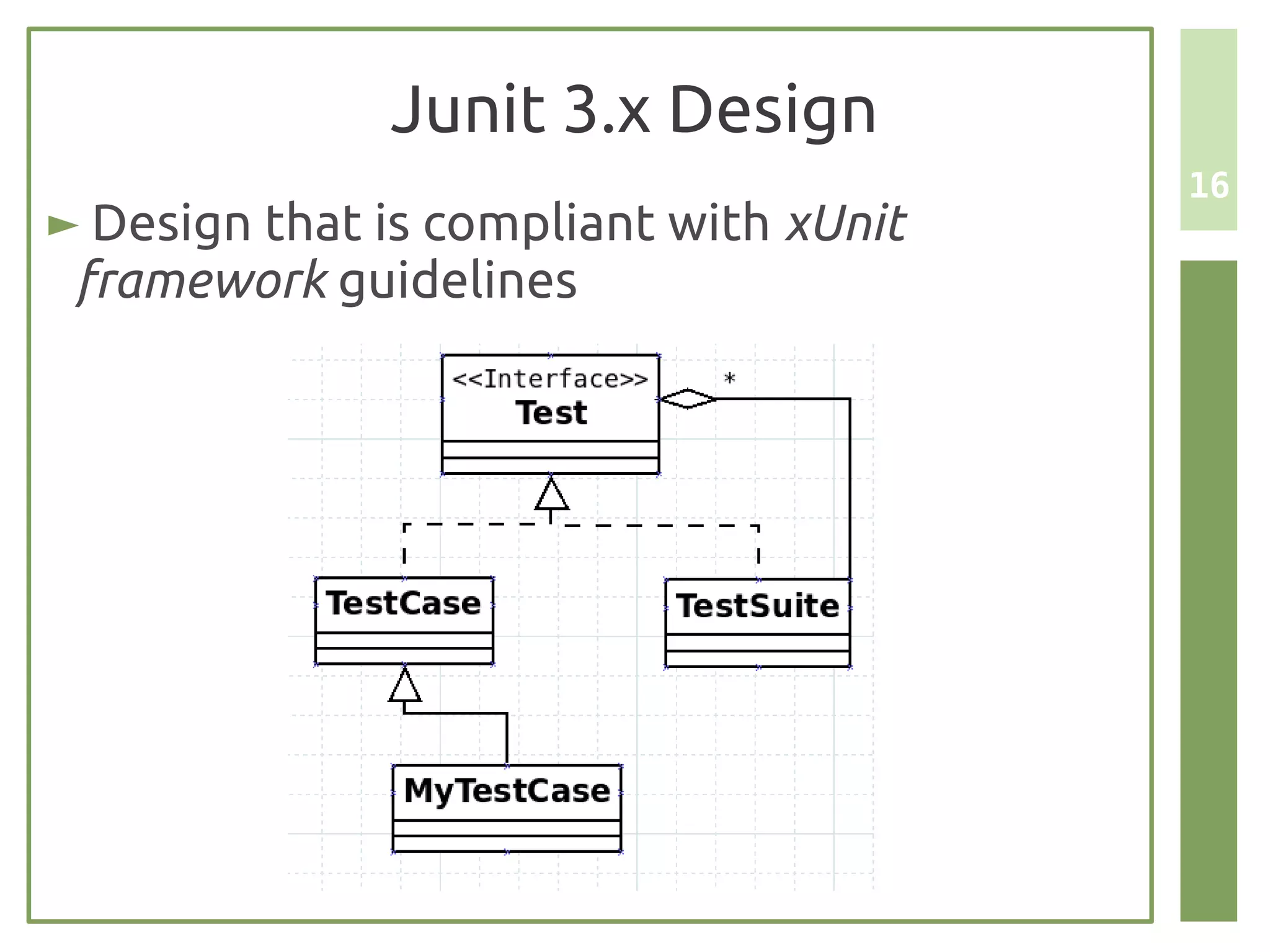
Junit 3.x Design
                                        16
► Design that is compliant with xUnit
 framework guidelines
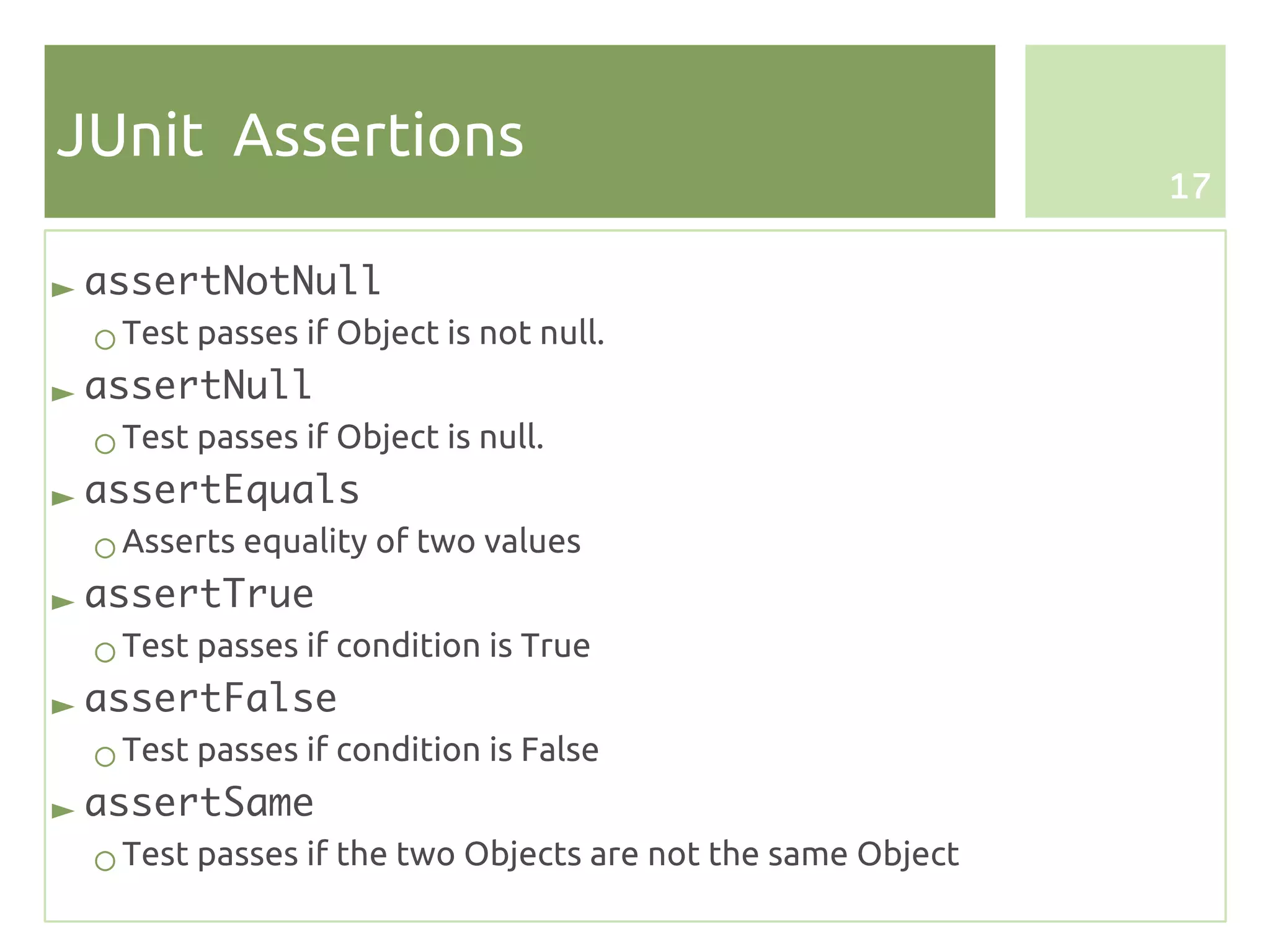
JUnit Assertions
                                                            17


► assertNotNull
 ○ Test passes if Object is not null.
► assertNull
 ○ Test passes if Object is null.
► assertEquals
 ○ Asserts equality of two values
► assertTrue
 ○ Test passes if condition is True
► assertFalse
 ○ Test passes if condition is False
► assertSame
 ○ Test passes if the two Objects are not the same Object
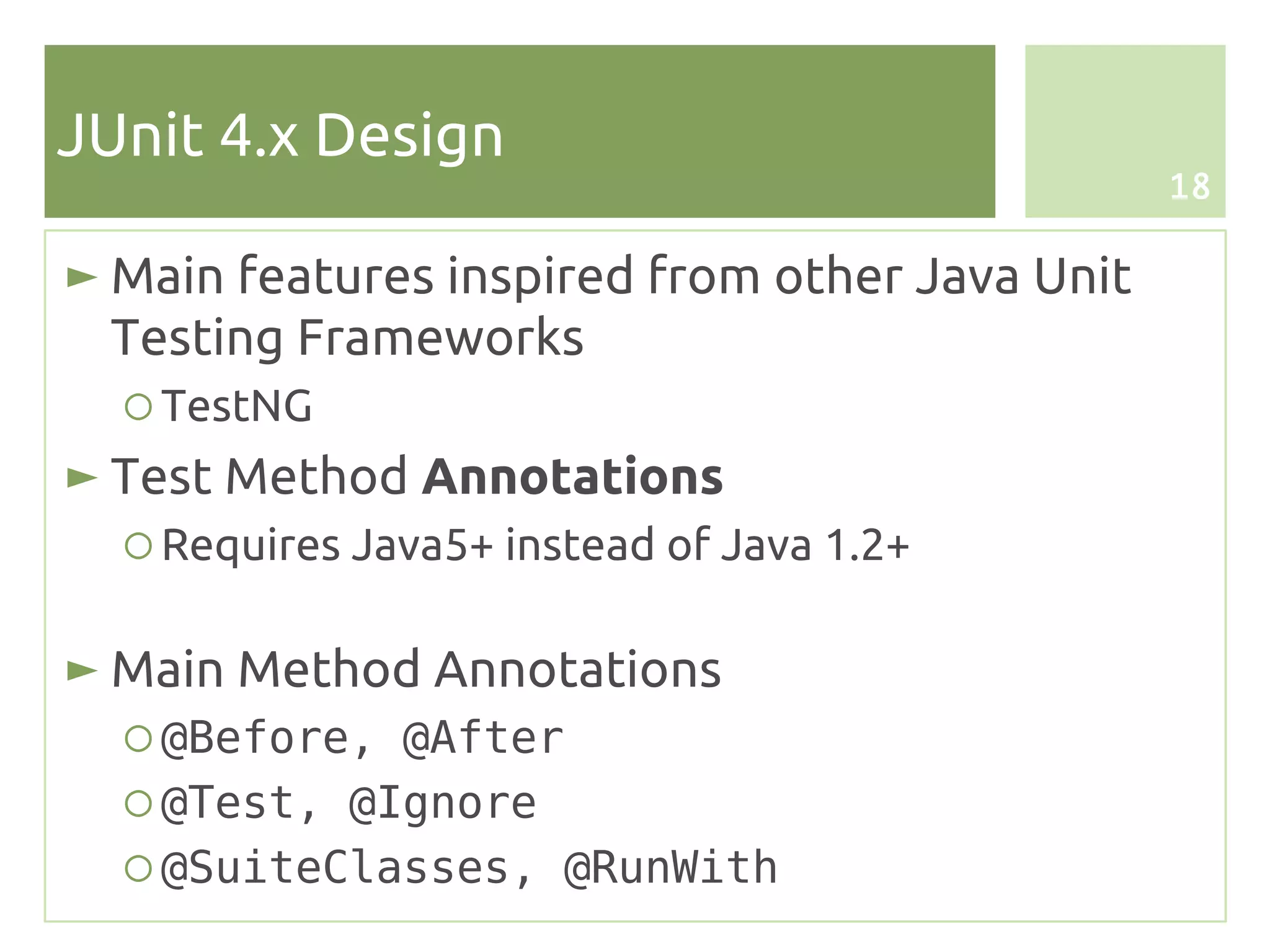
JUnit 4.x Design
                                                18

► Main features inspired from other Java Unit
  Testing Frameworks
  ○ TestNG
► Test Method Annotations
  ○ Requires Java5+ instead of Java 1.2+

► Main Method Annotations
  ○ @Before, @After
  ○ @Test, @Ignore
  ○ @SuiteClasses, @RunWith
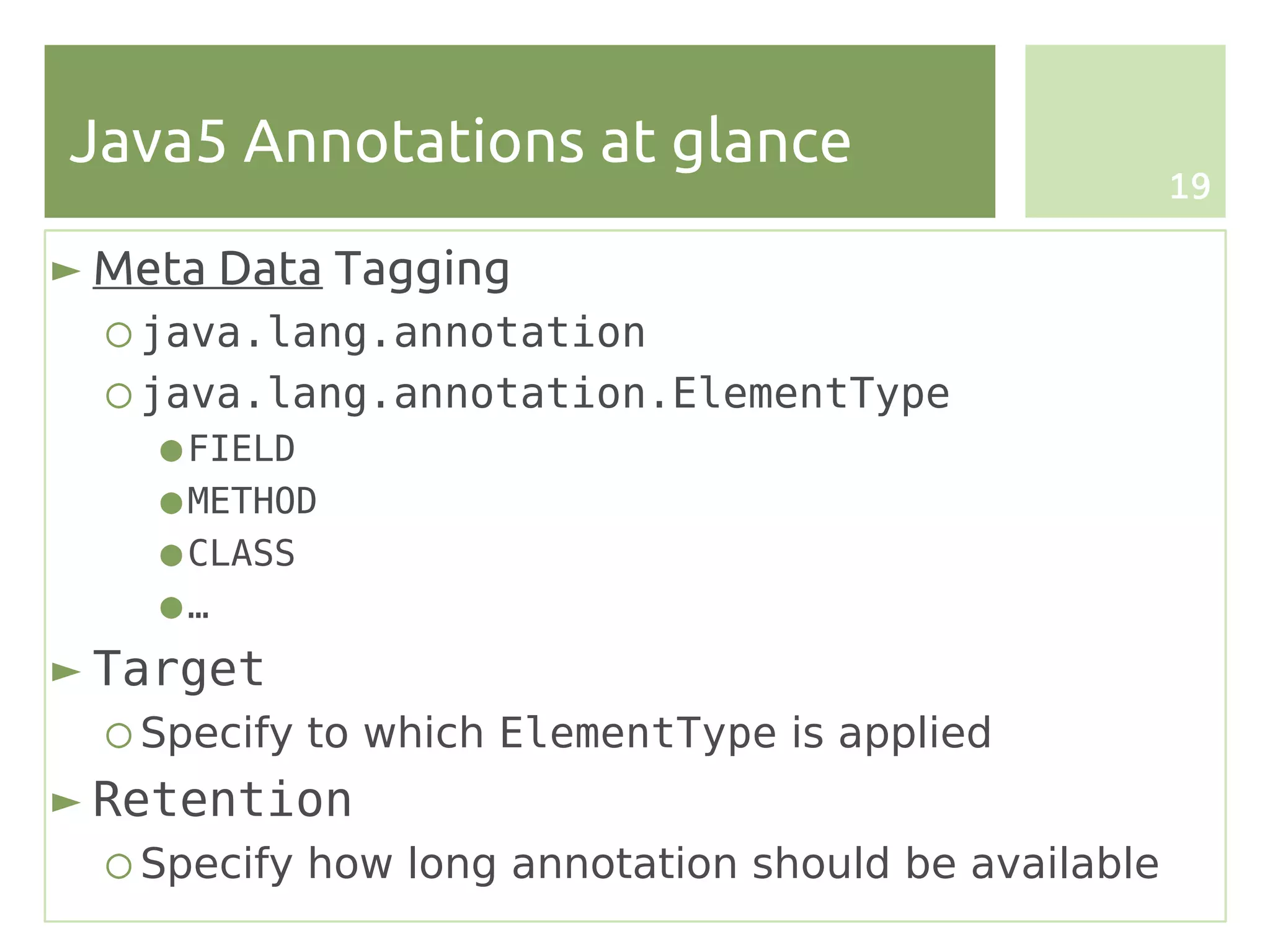
Java5 Annotations at glance
                                                      19

► Meta Data Tagging
  ○ java.lang.annotation
  ○ java.lang.annotation.ElementType
    ● FIELD
    ● METHOD
    ● CLASS
    ●…
► Target
  ○ Specify to which ElementType is applied
► Retention
  ○ Specify how long annotation should be available
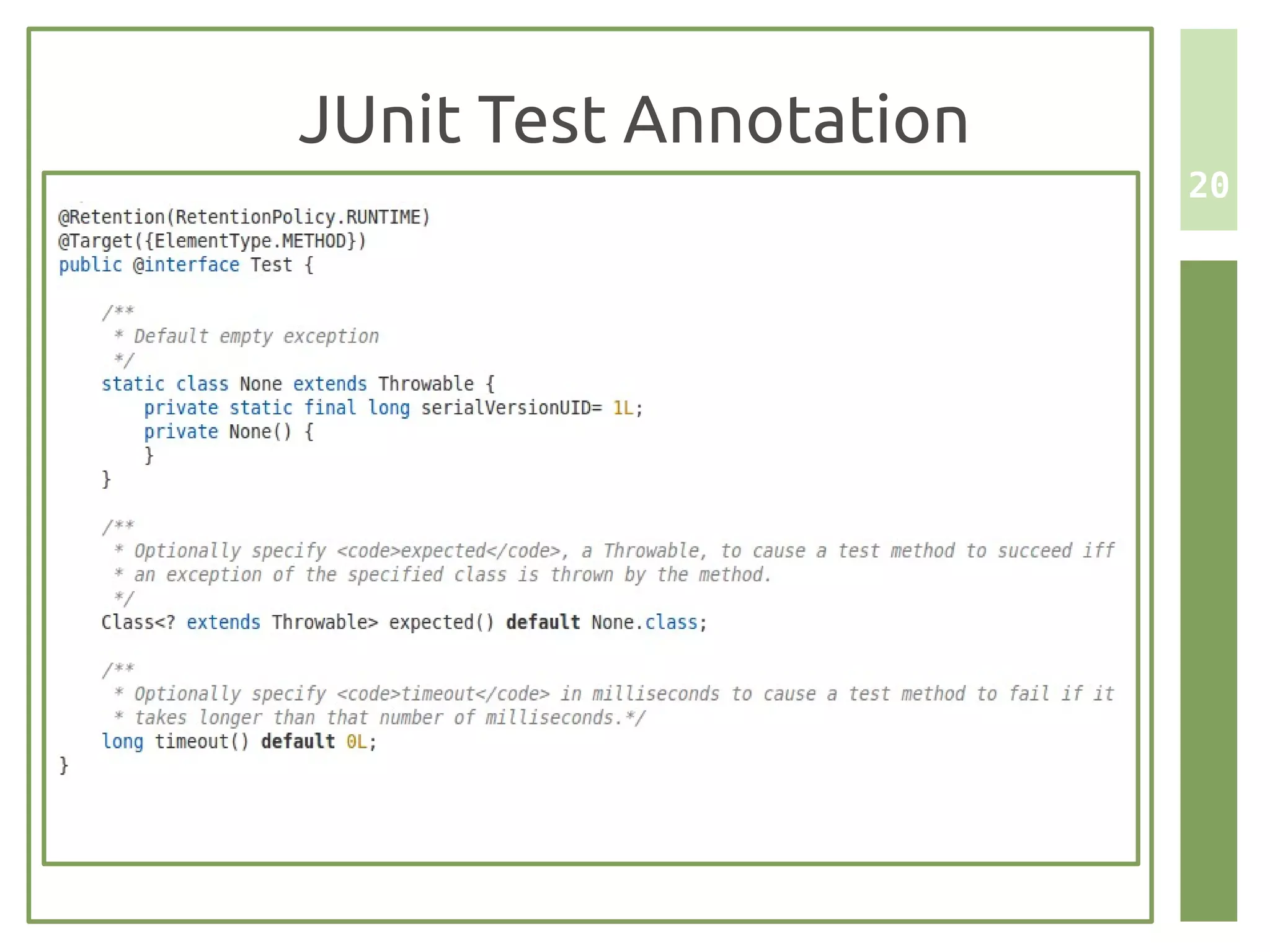
JUnit Test Annotation
                        20
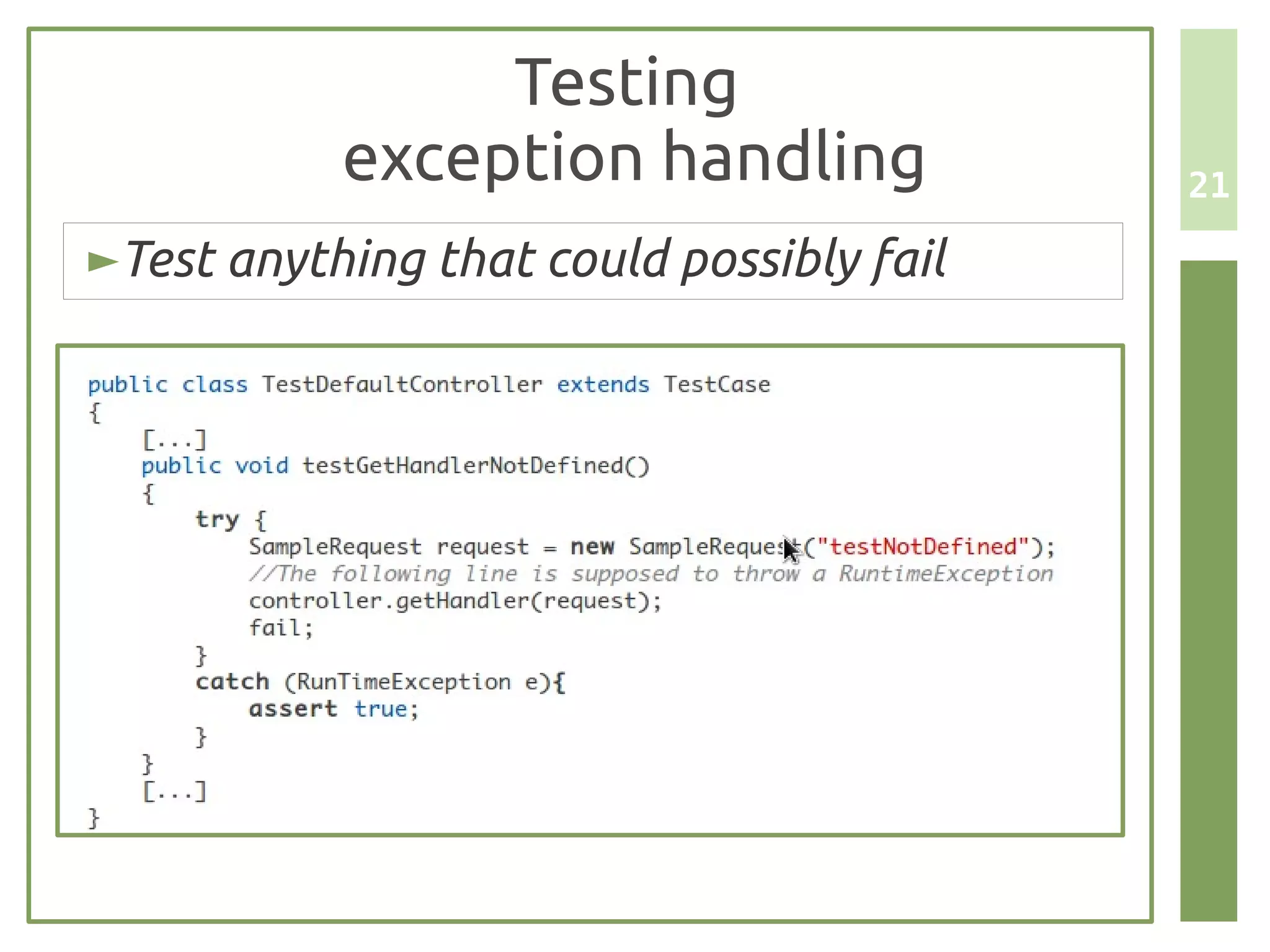
Testing
           exception handling             21

►Test anything that could possibly fail
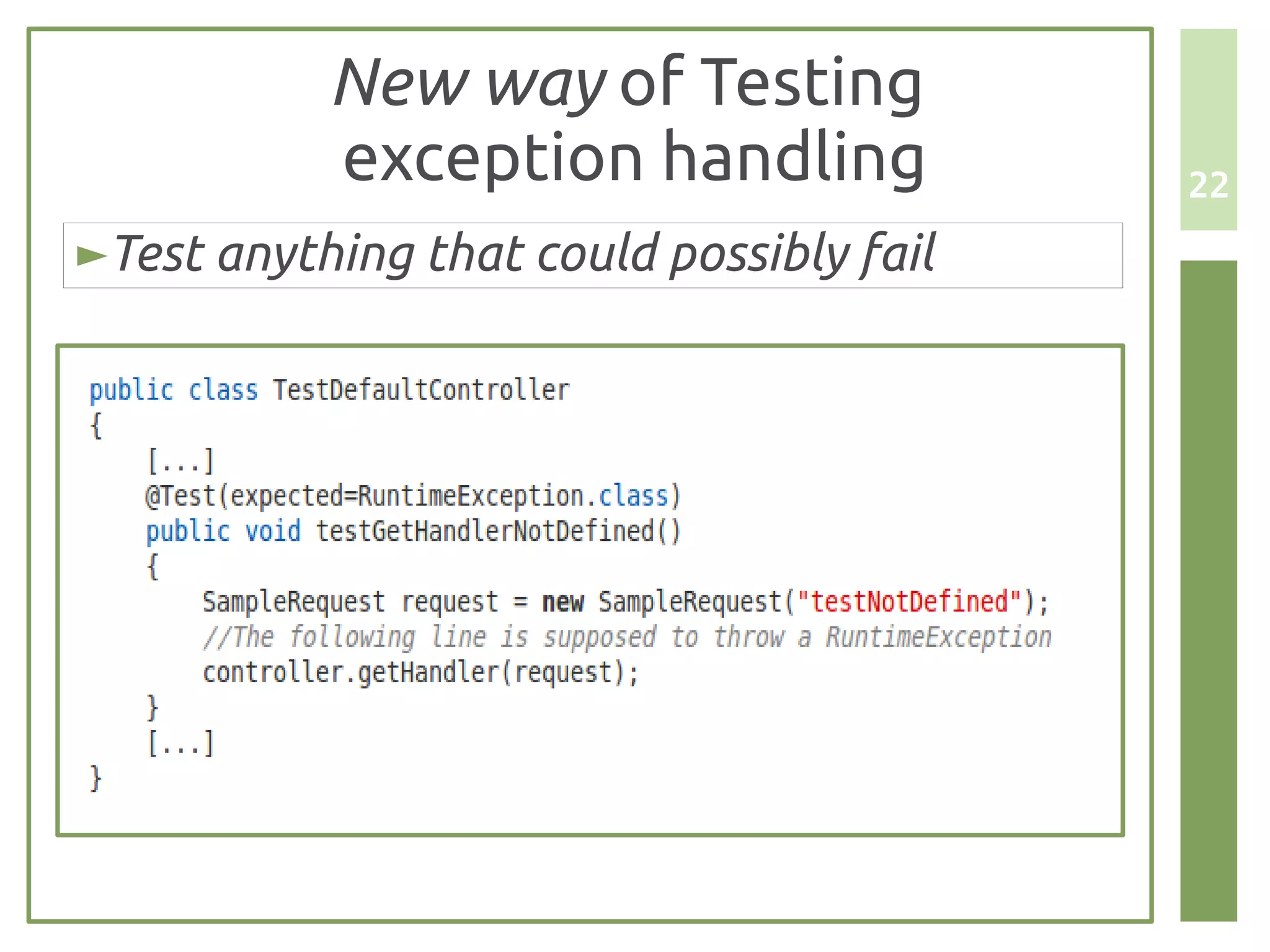
New way of Testing
           exception handling             22

►Test anything that could possibly fail
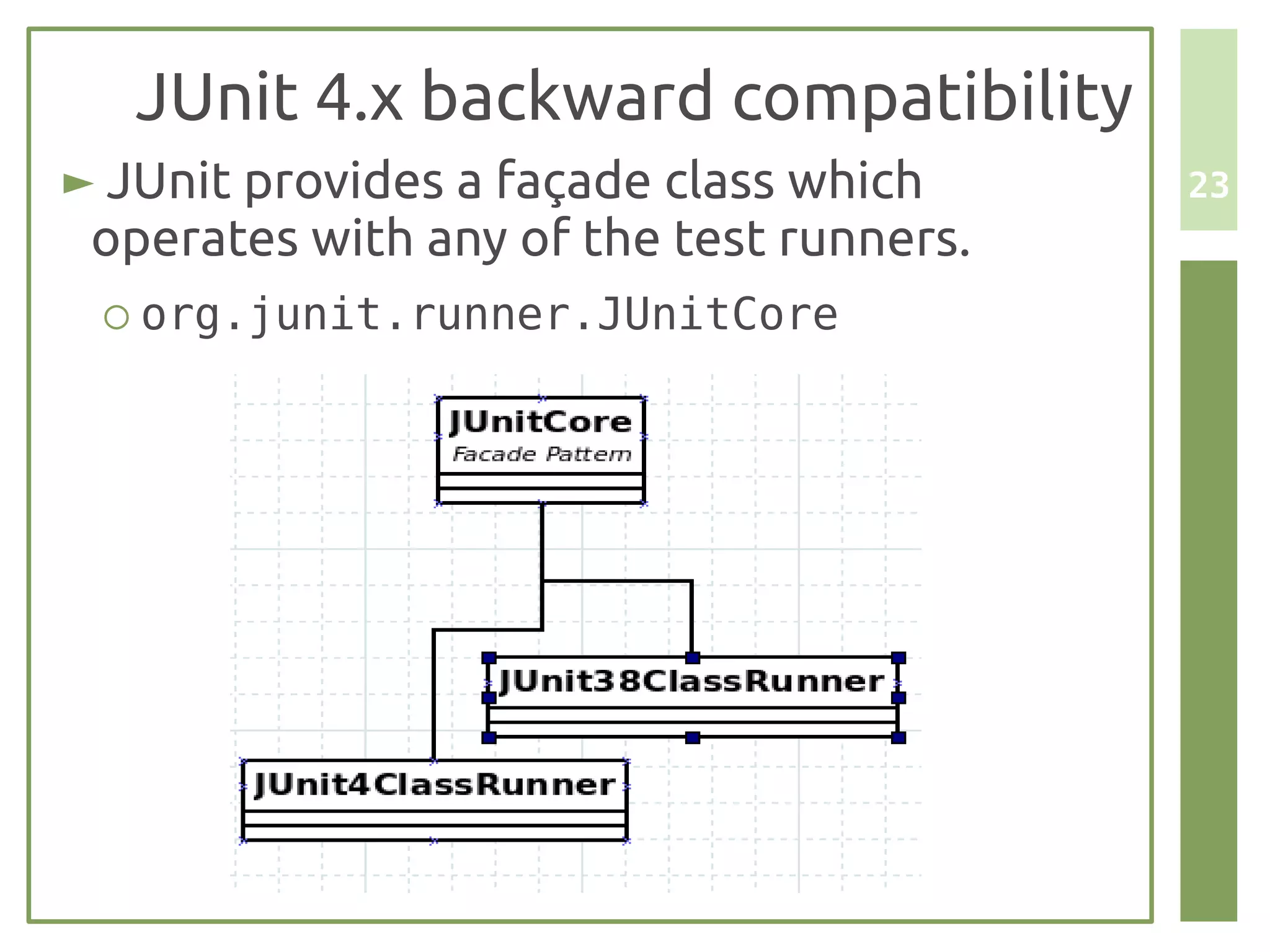
JUnit 4.x backward compatibility
► JUnit provides a façade class which     23
 operates with any of the test runners.
 ○ org.junit.runner.JUnitCore
JUnit Matchers: Hamcrest
                                                    24


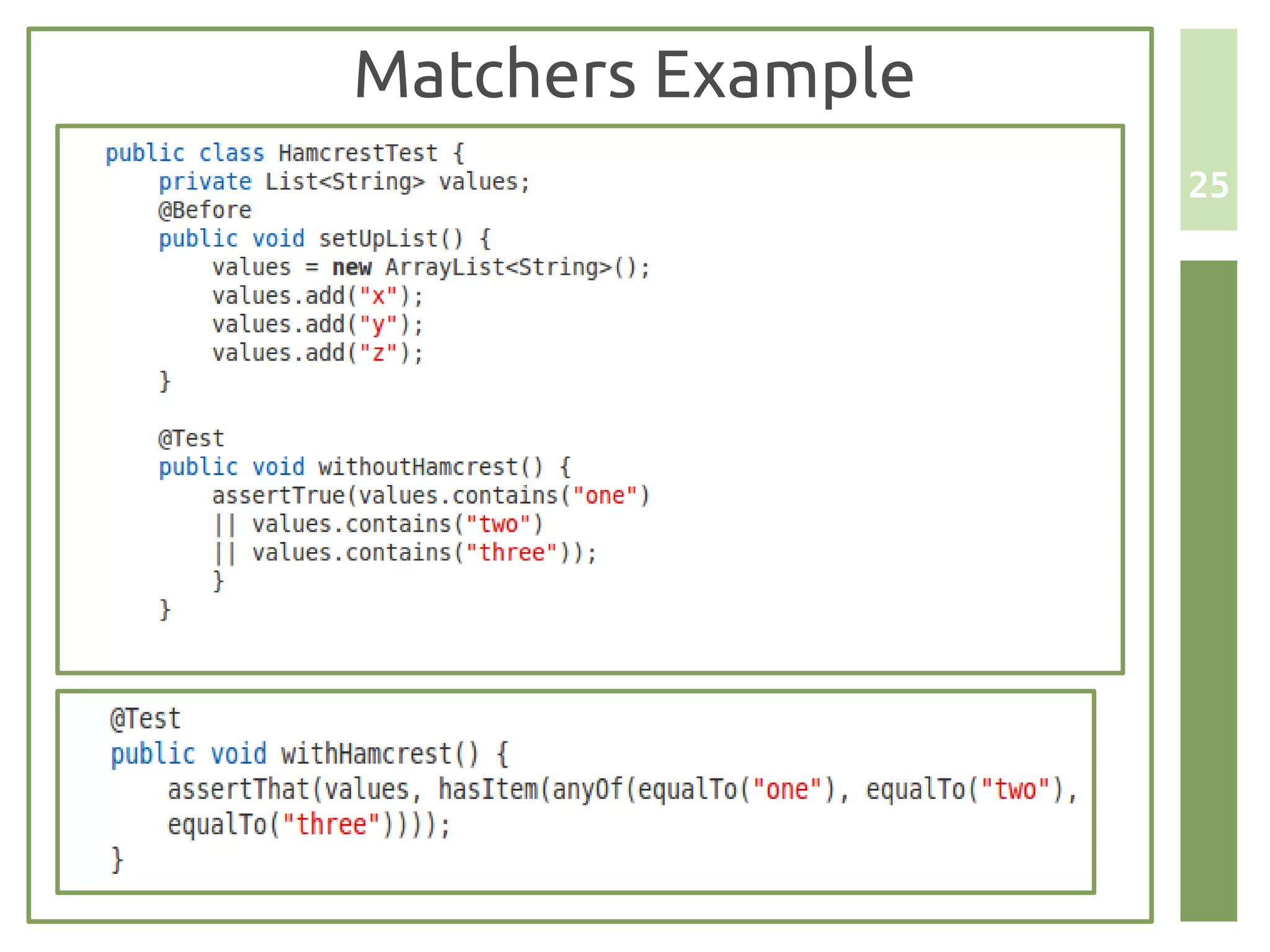
► Junit 4.4+ introduces matchers
  ○ Imported from Hamcrest project
  ○ http://code.google.com/p/hamcrest/

► Matchers improve testing code refactoring
  ○ Writing more and more tests assertion became hard
    to read
  ○ Remember:
    ● Documentation purposes


► Let's do an example …
Matchers Example
                   25
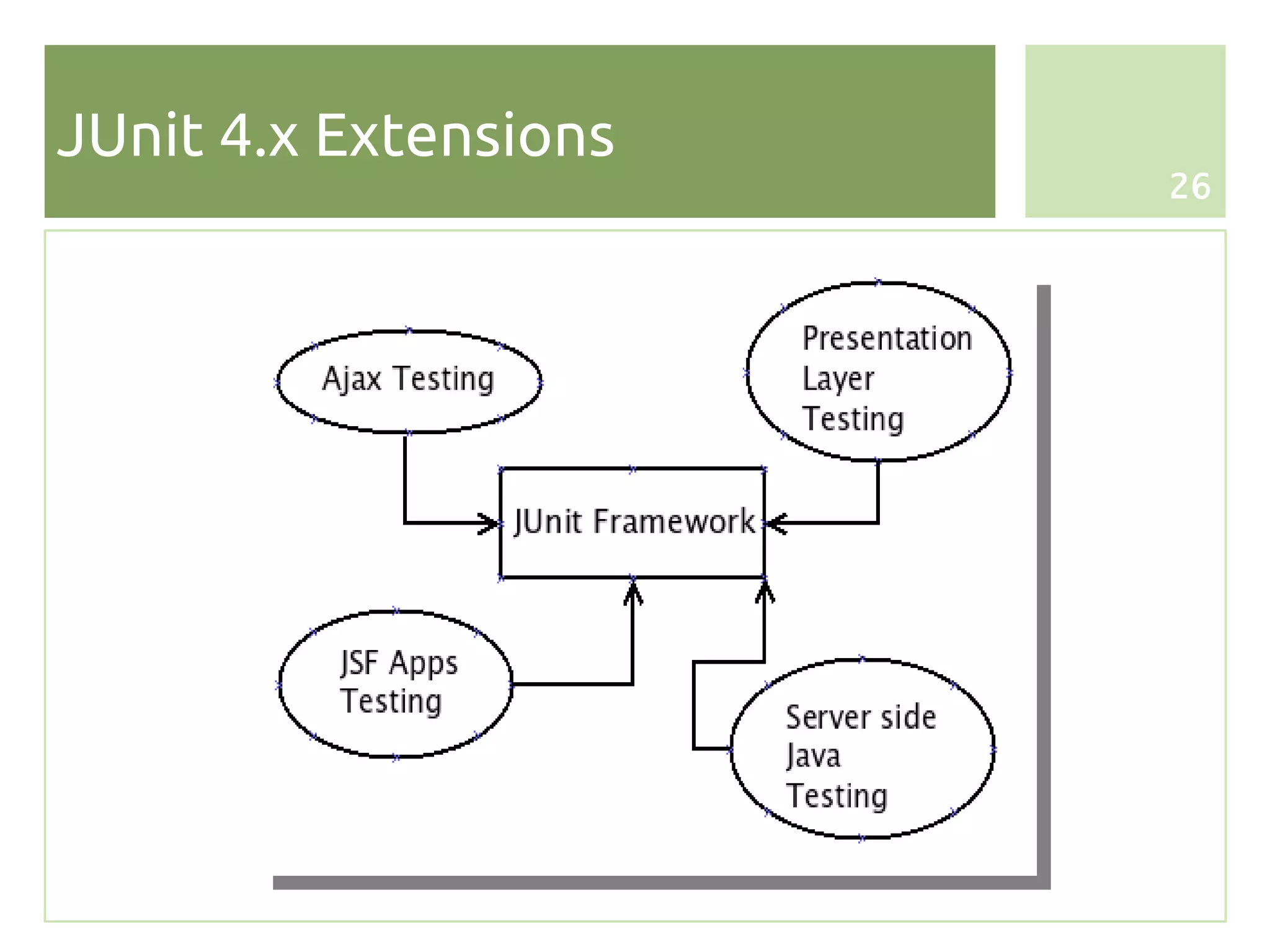
JUnit 4.x Extensions
                       26
3. Testing Scaffolding


 Programming today is a race between software
engineers striving to build bigger and better idiot-
proof programs,
and the Universe trying to produce bigger and
better idiots. So far, the Universe is winning.
 Cit. Rich Cook


                                                       27
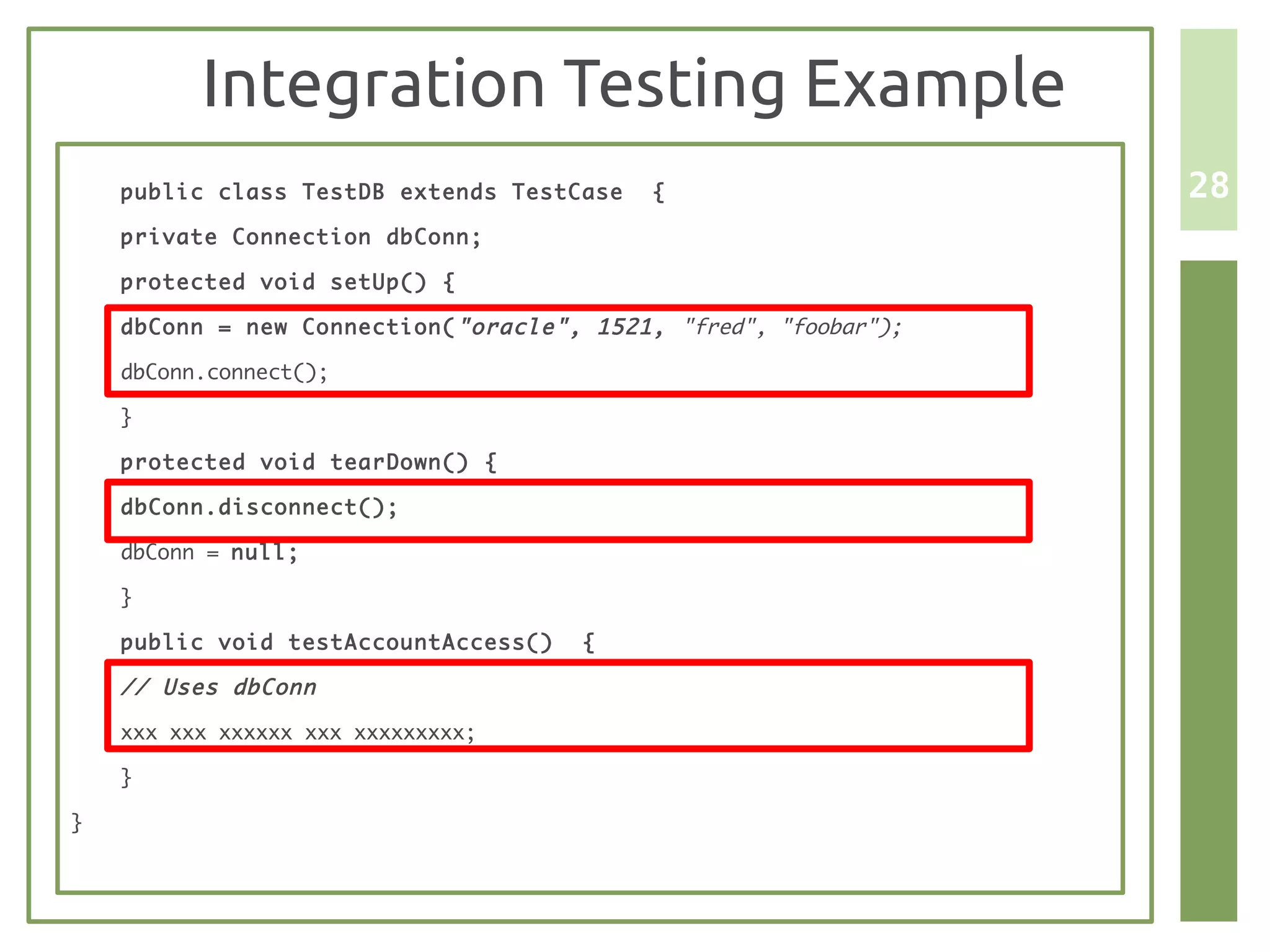
Integration Testing Example
    public class TestDB extends TestCase    {                     28
    private Connection dbConn;

    protected void setUp() {

    dbConn = new Connection( "oracle", 1521, "fred", "foobar");

    dbConn.connect();

    }

    protected void tearDown() {

    dbConn.disconnect();

    dbConn = null;

    }

    public void testAccountAccess()   {

    // Uses dbConn

    xxx xxx xxxxxx xxx xxxxxxxxx;

    }

}
Integration testing problem
                                              29


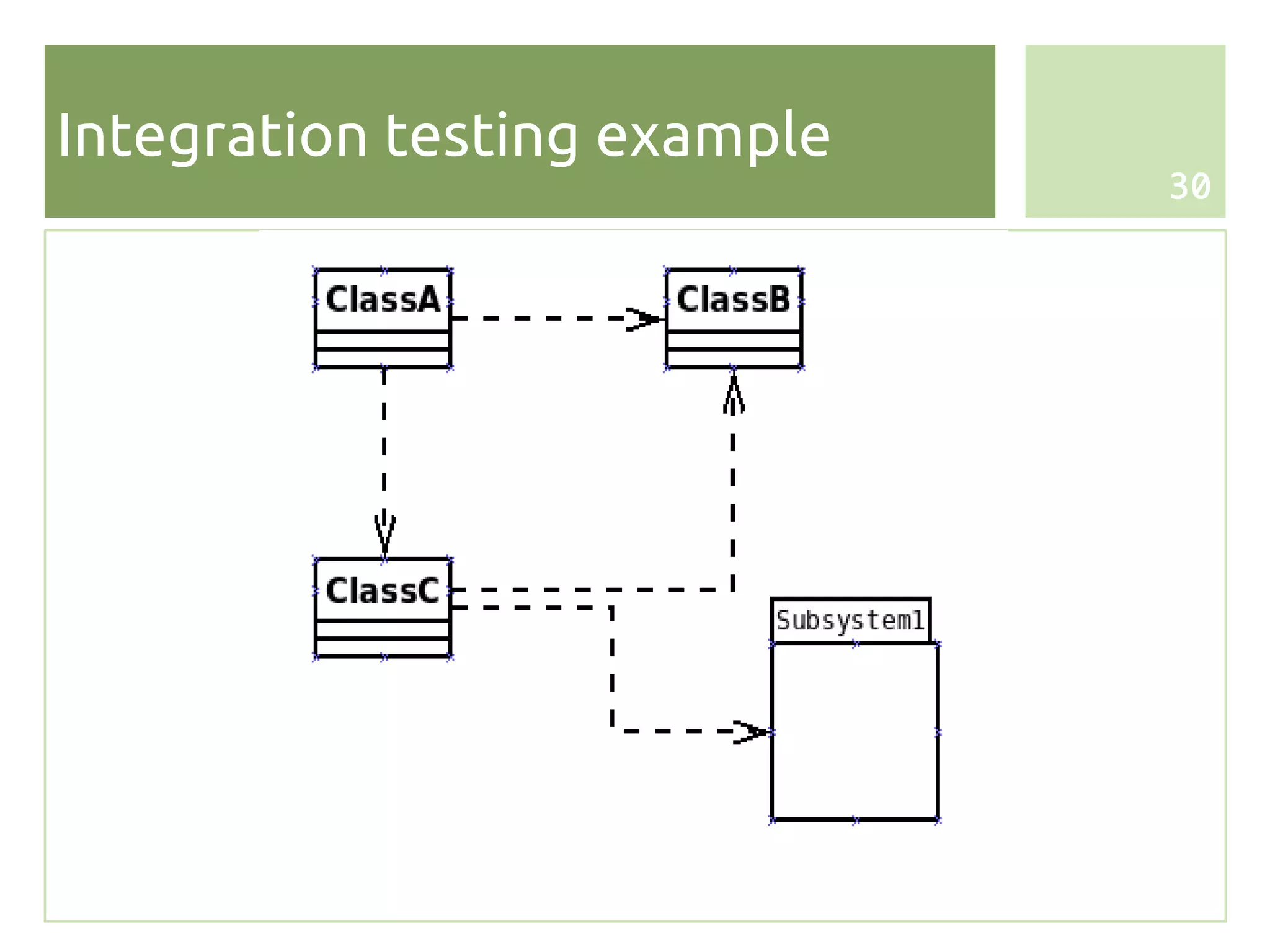
► Integrate multiple components implies to
  decide in which order classes and subsystems
  should be integrated and tested

► CITO Problem
  ○ Class Integration Testing Order Problem

► Solution:
  ○ Topological sort of dependency graph
Integration testing example
                              30
Testing in isolation
                                                     31


► Testing in isolation offers strong benefits
   ○ Test code that have not been written
   ○ Test only a single method (behavior) without side
     effects from other objects

► Focused Integration Testing (!!)

► Solutions ?
   ○ Stubs
   ○ Mocks
   ○…
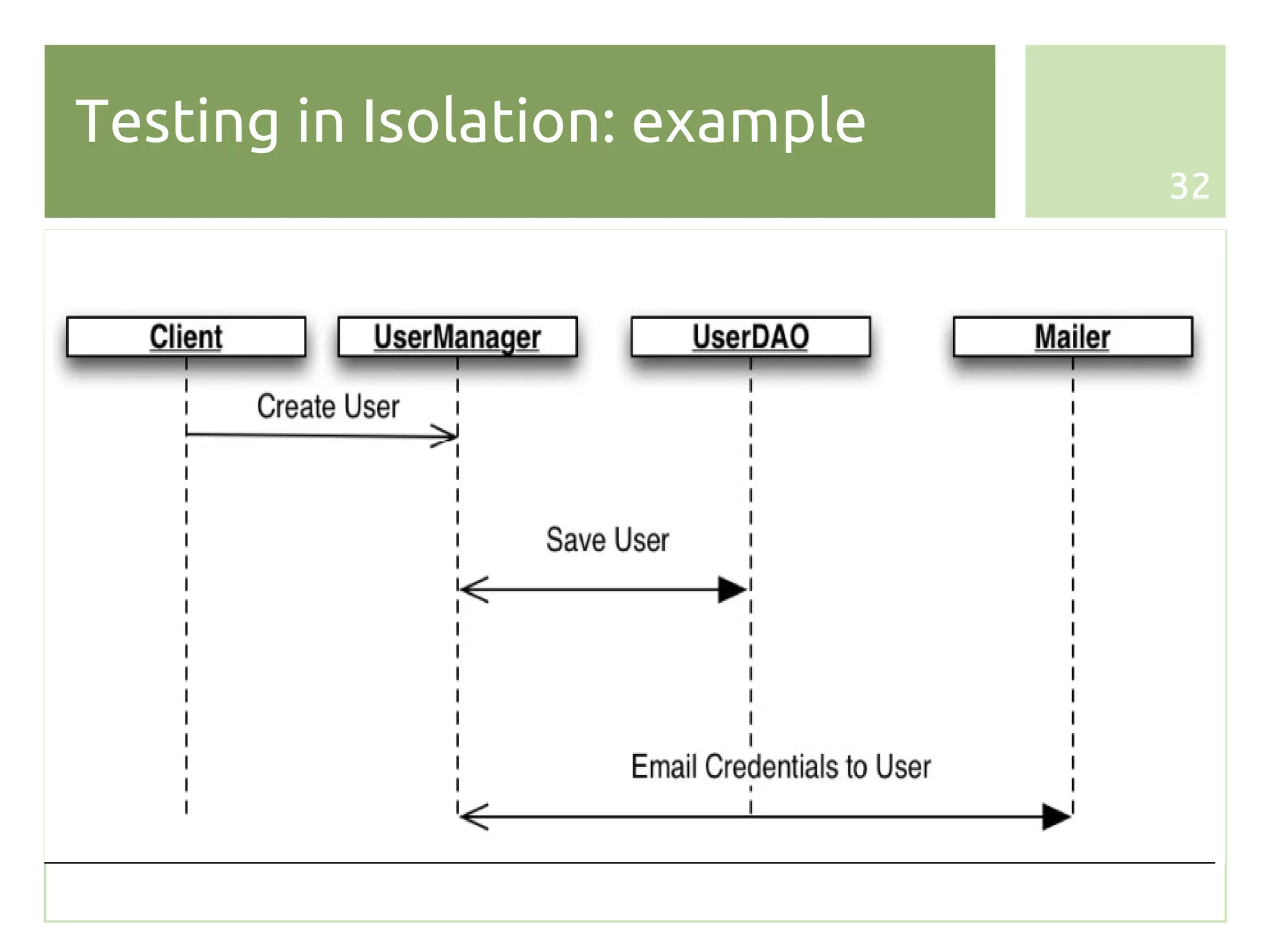
Testing in Isolation: example
                                32
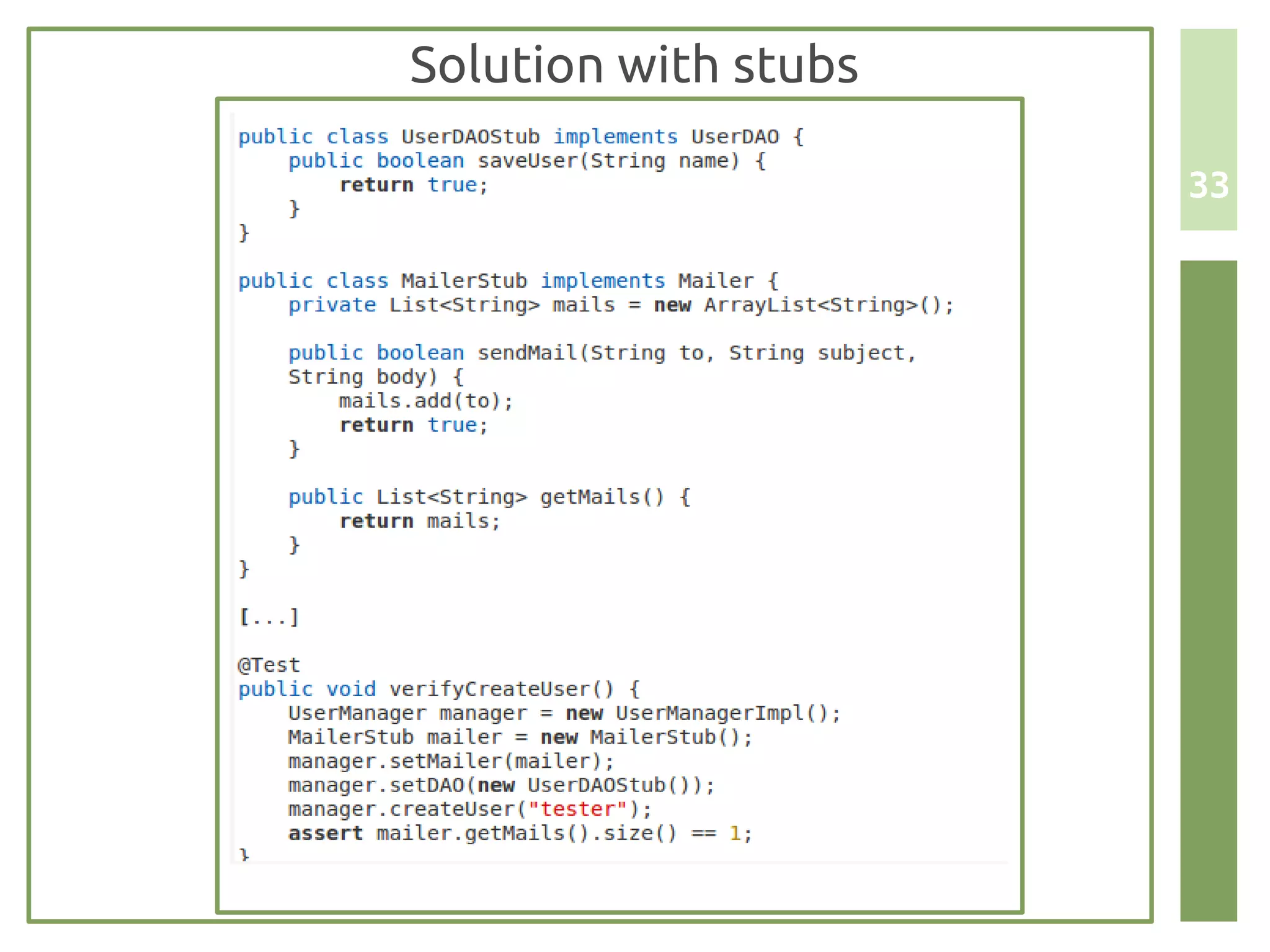
Solution with stubs

                      33
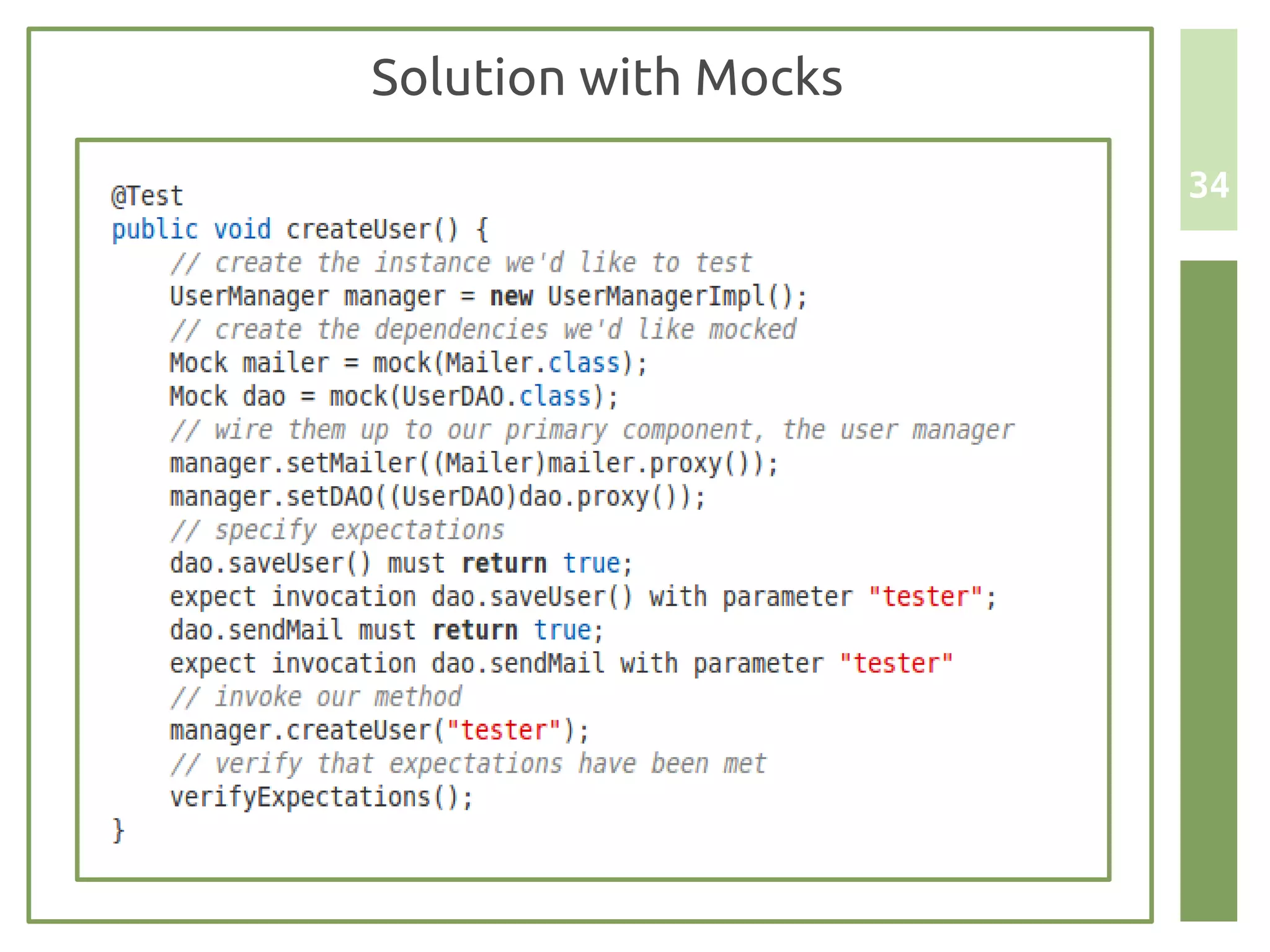
Solution with Mocks

                      34
Key Ideas
                                                             35


  (Ignoring the specifics of codes)
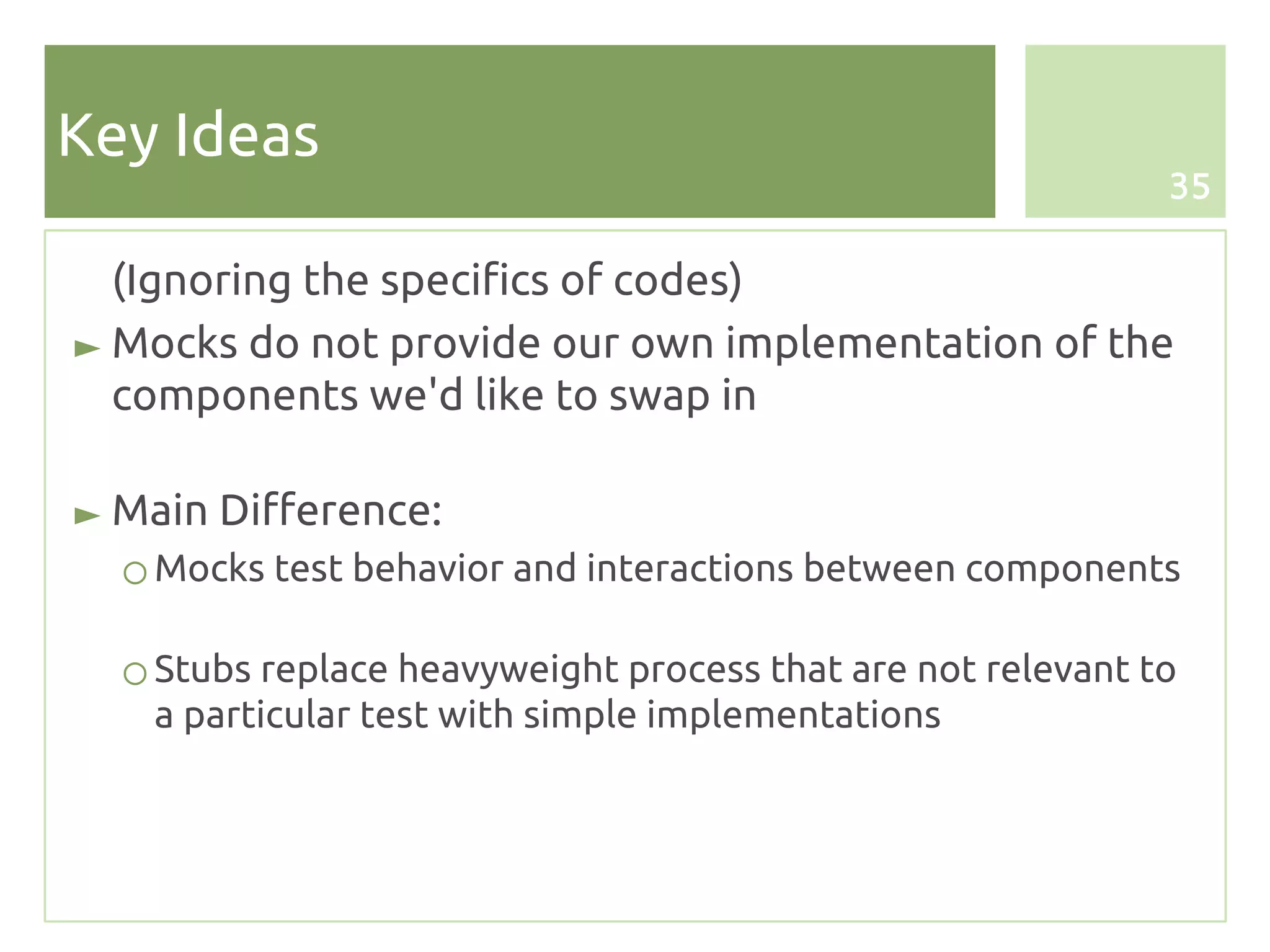
► Mocks do not provide our own implementation of the
  components we'd like to swap in

► Main Difference:
  ○ Mocks test behavior and interactions between components

  ○ Stubs replace heavyweight process that are not relevant to
    a particular test with simple implementations
Naming Problems and
Buzz Worlds                                  36

► Unfortunately, while two components are quite
  distinct, they're used interchangeably.
  ○ Example: spring-mock package

► If we want to be stricter in terms of
  naming, stub objects defined previously
  are
  ○ test doubles

► Test Doubles, Stubs, Mocks, Fake
  Objects… how can we work it out ?
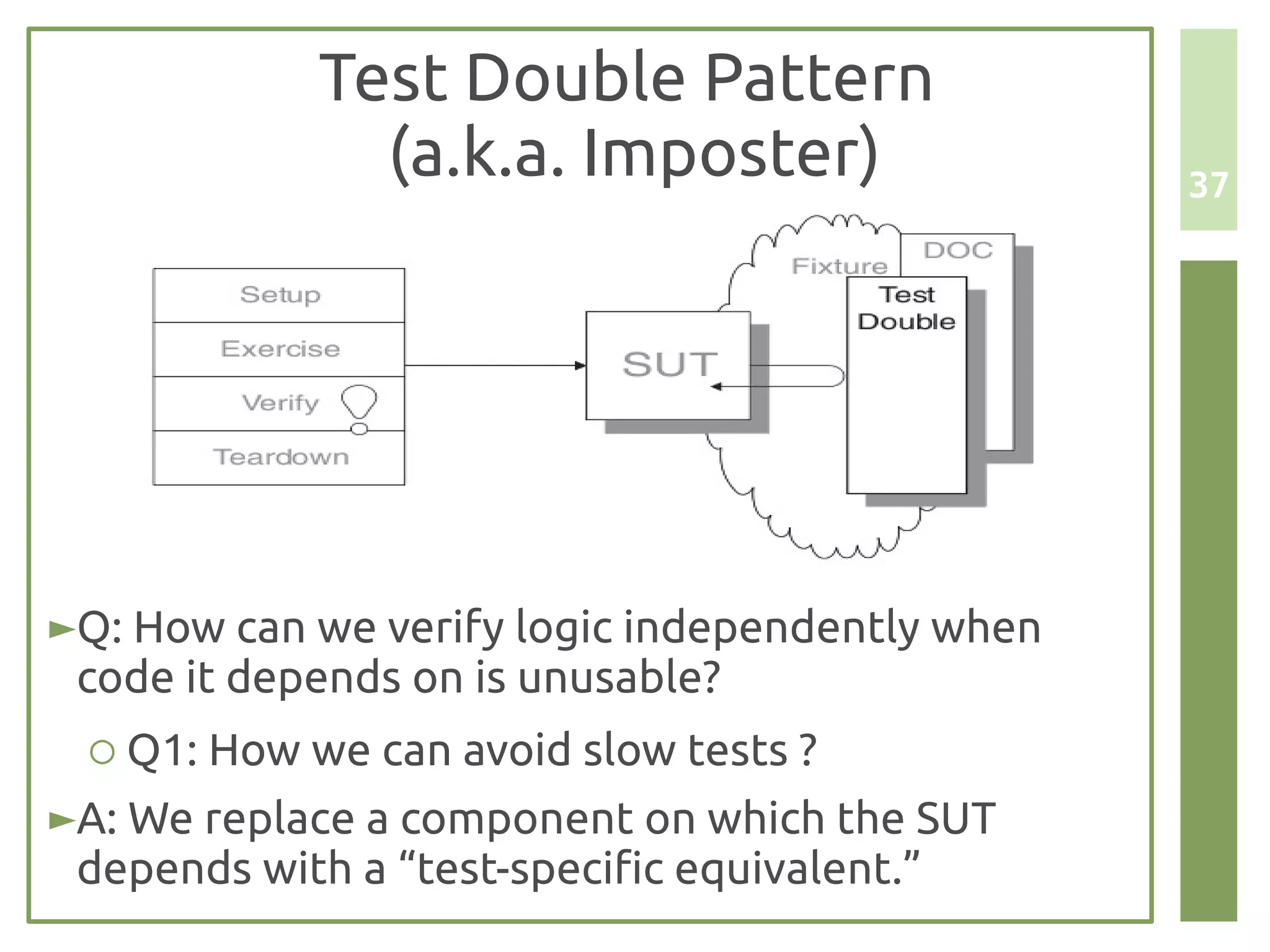
Test Double Pattern
              (a.k.a. Imposter)                  37


►Q: How can we verify logic independently when
 code it depends on is unusable?
 ○ Q1: How we can avoid slow tests ?
►A: We replace a component on which the SUT
 depends with a “test-specific equivalent.”
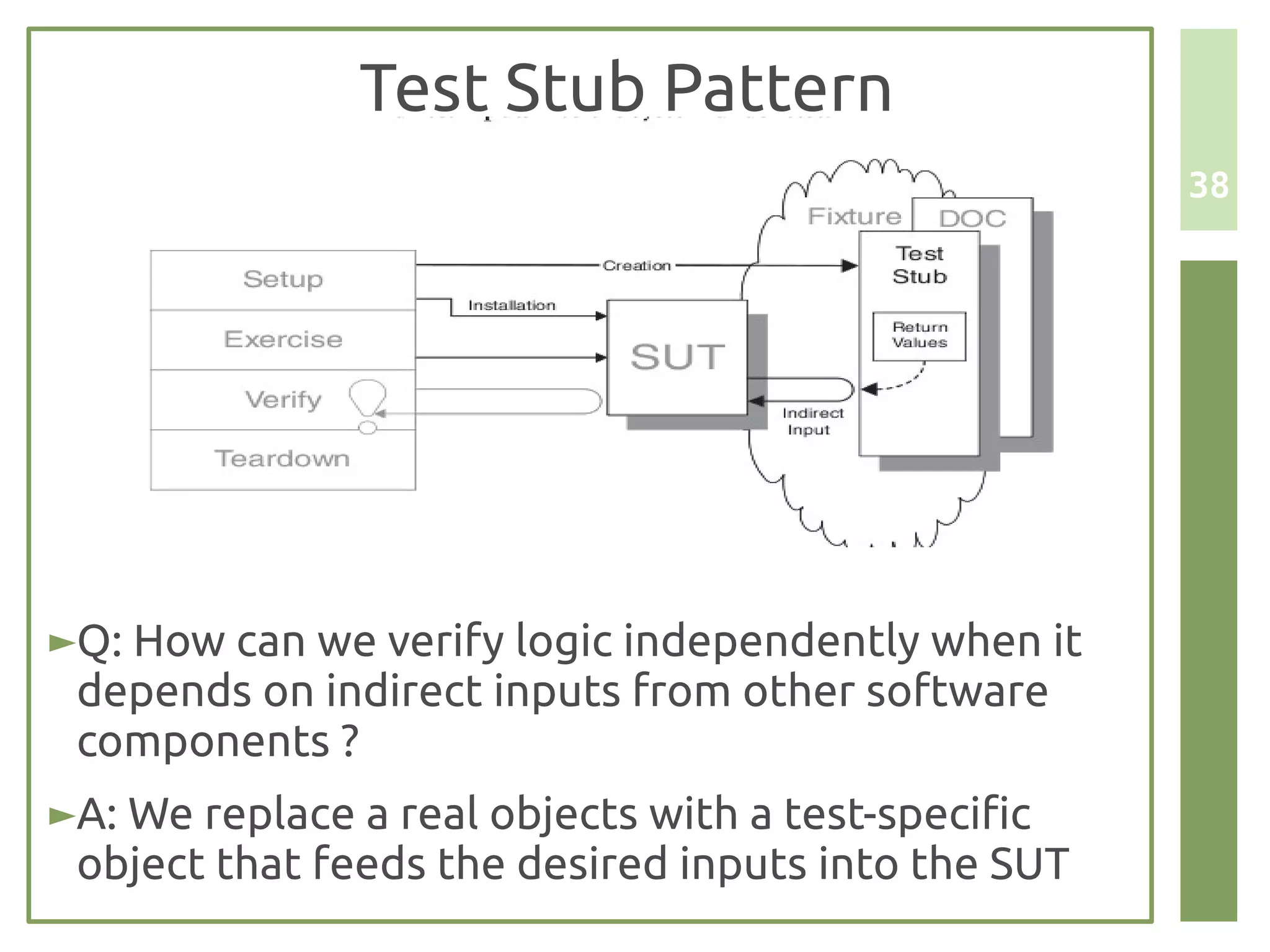
Test Stub Pattern
                                                     38


►Q: How can we verify logic independently when it
 depends on indirect inputs from other software
 components ?
►A: We replace a real objects with a test-specific
 object that feeds the desired inputs into the SUT
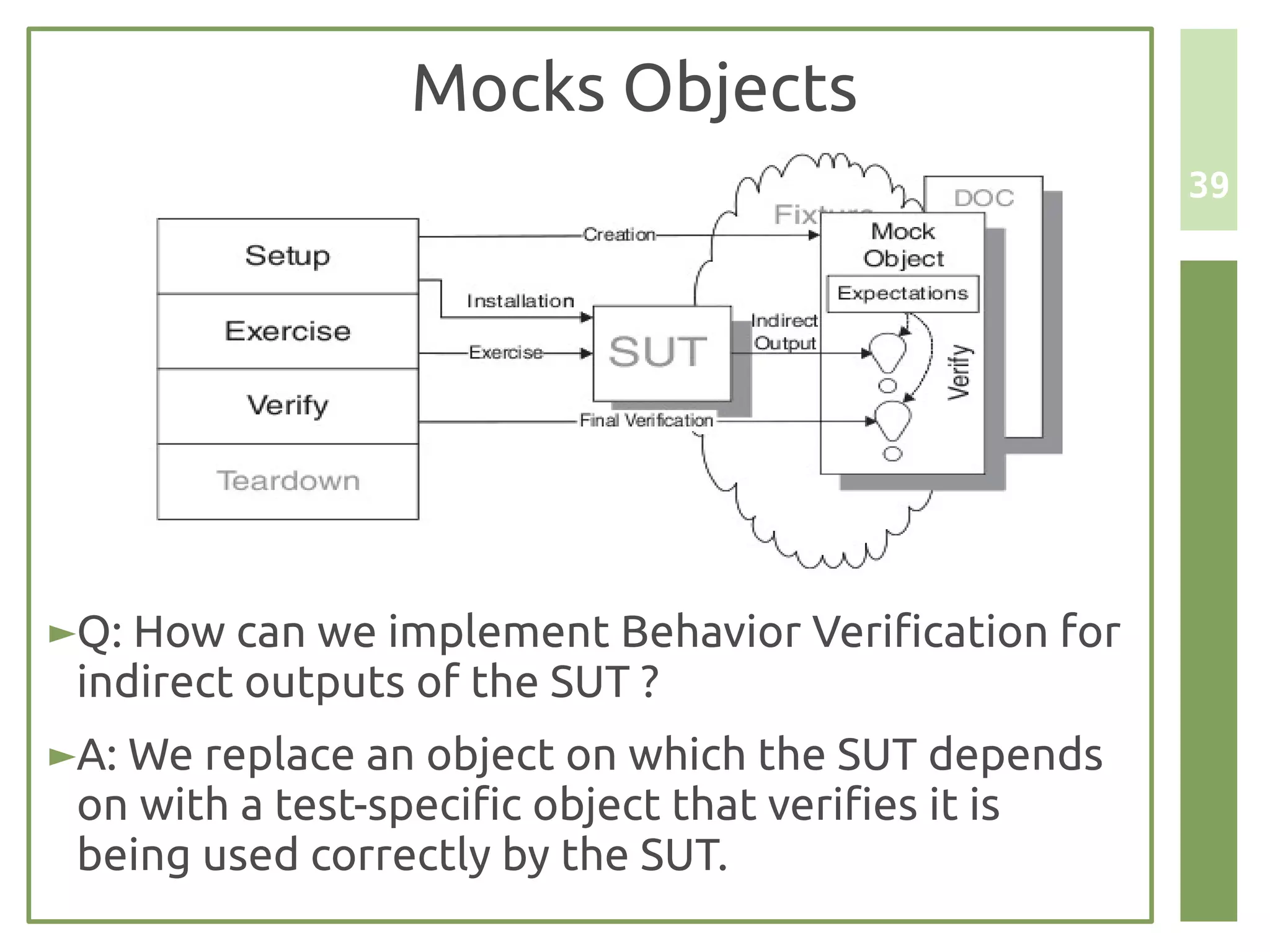
Mocks Objects
                                                      39


►Q: How can we implement Behavior Verification for
 indirect outputs of the SUT ?
►A: We replace an object on which the SUT depends
 on with a test-specific object that verifies it is
 being used correctly by the SUT.
Mock Objects Observations
                                                   40

► Powerful way to implement Behavior
  Verification
  ○ while avoiding Test Code Duplication between
    similar tests.

► It works by delegating the job of verifying the
  indirect outputs of the SUT entirely to a Test
  Double.
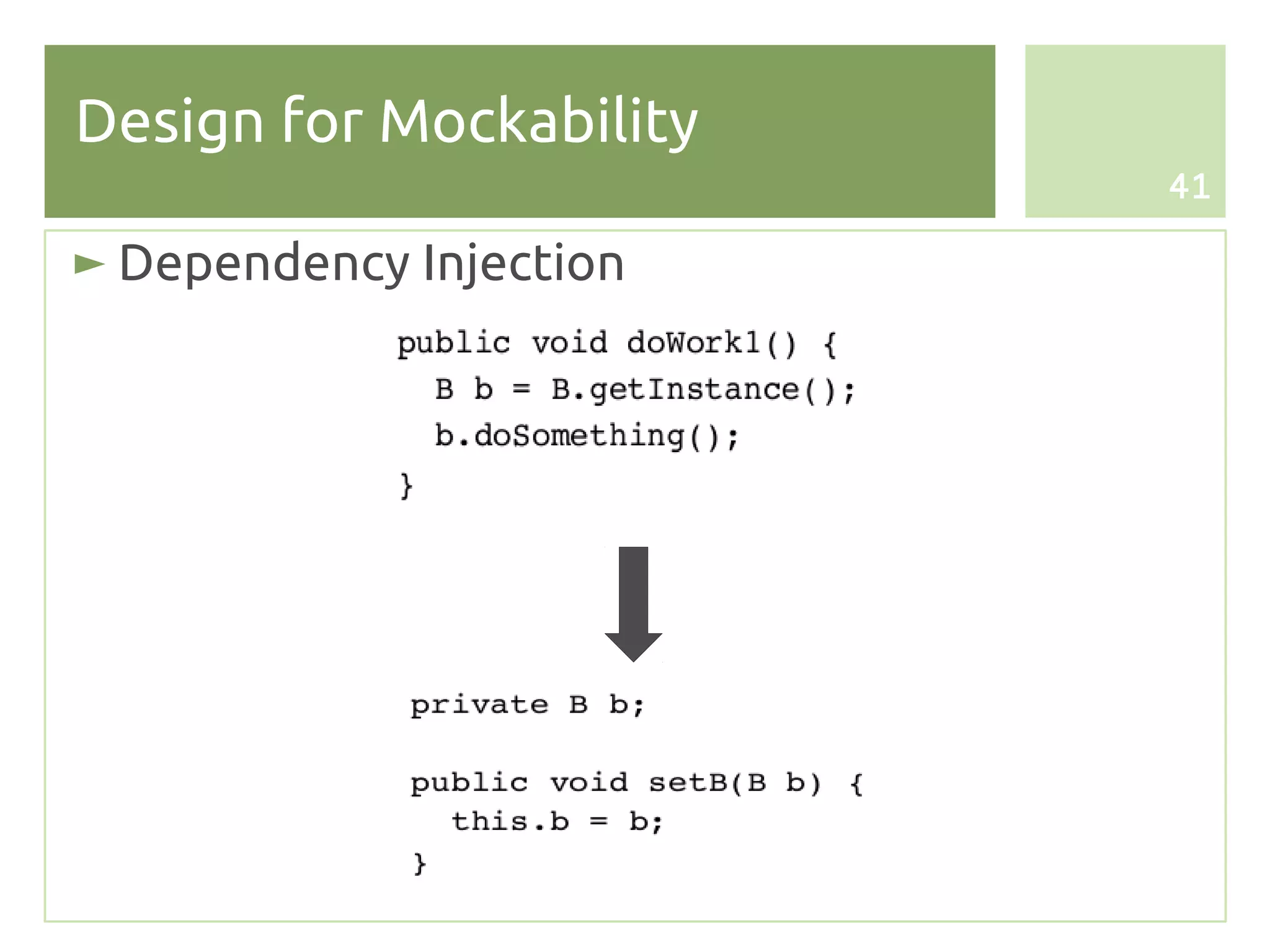
► Important Note: Design for Mockability
  ○ Dependency Injection Pattern
Design for Mockability
                         41

► Dependency Injection
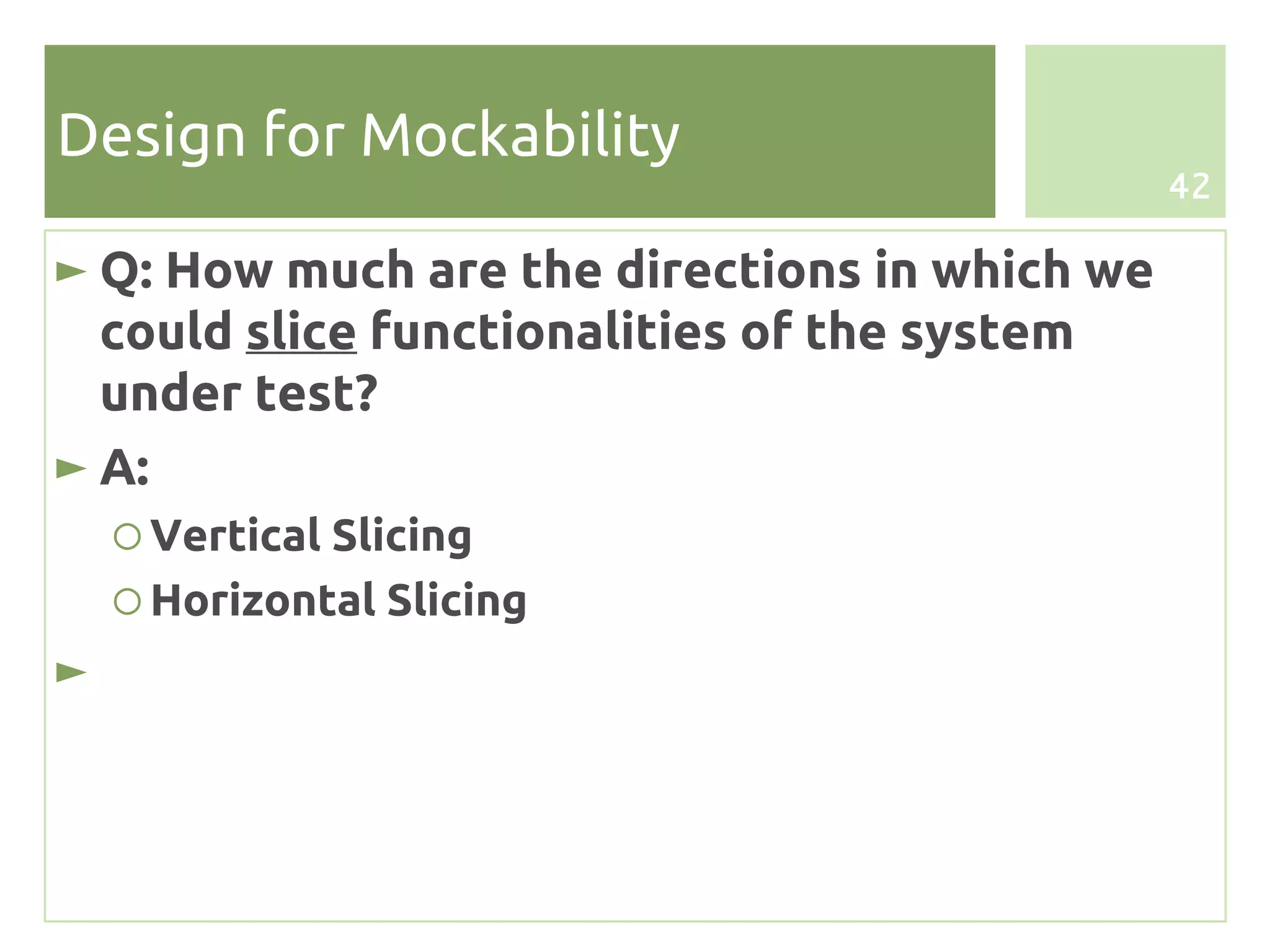
Design for Mockability
                                               42

► Q: How much are the directions in which we
  could slice functionalities of the system
  under test?
► A:
    ○ Vertical Slicing
    ○ Horizontal Slicing
►
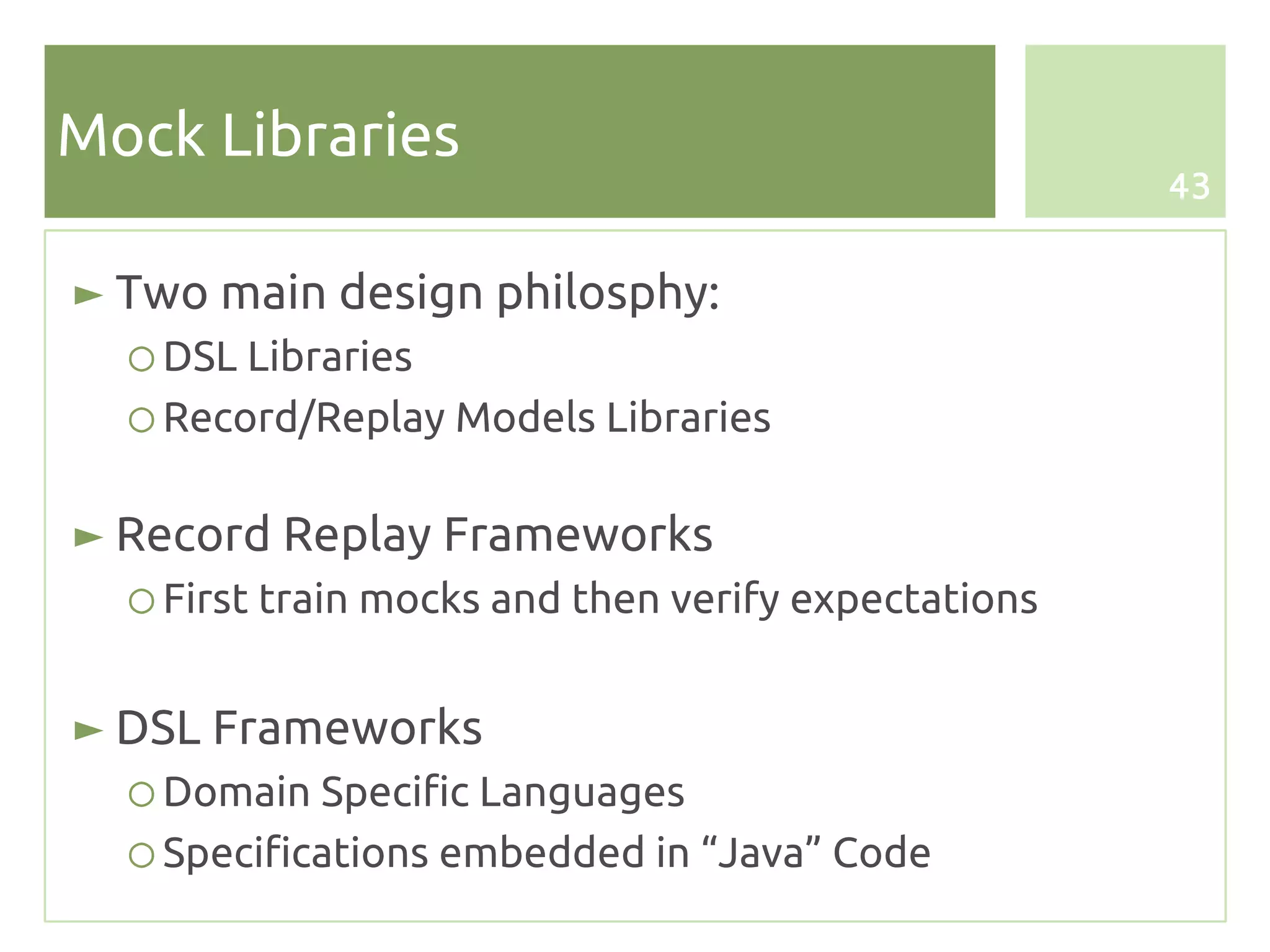
Mock Libraries
                                                     43


► Two main design philosphy:
  ○ DSL Libraries
  ○ Record/Replay Models Libraries

► Record Replay Frameworks
  ○ First train mocks and then verify expectations


► DSL Frameworks
  ○ Domain Specific Languages
  ○ Specifications embedded in “Java” Code
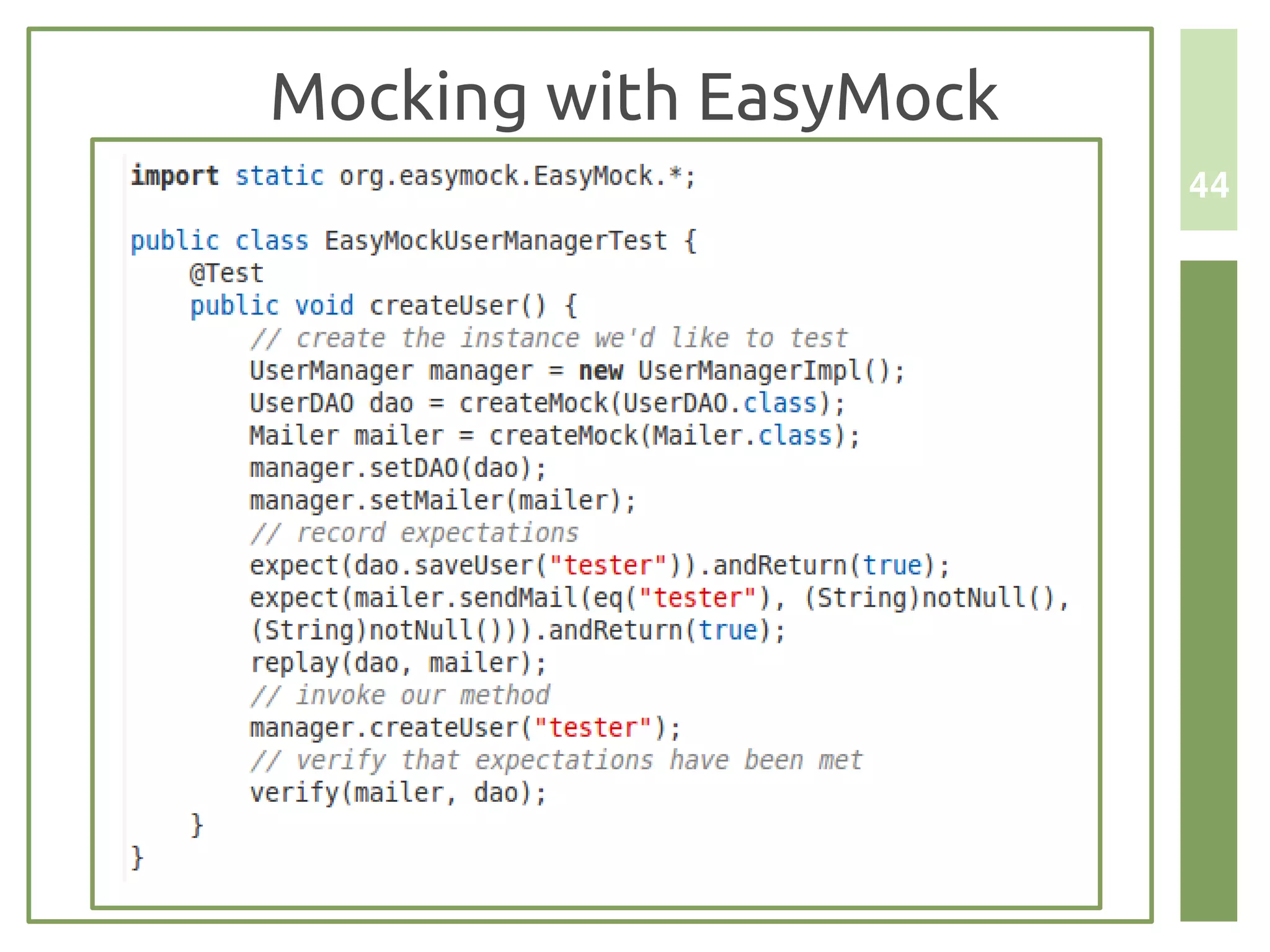
Mocking with EasyMock
                        44
EasyMock Test
                            45

► Create Mock objects
   ○ Java Reflections API

► Record Expectation
   ○ expect methods

► Invoke Primary Test
   ○ replay method

► Verify Expectation
  ○ verify method
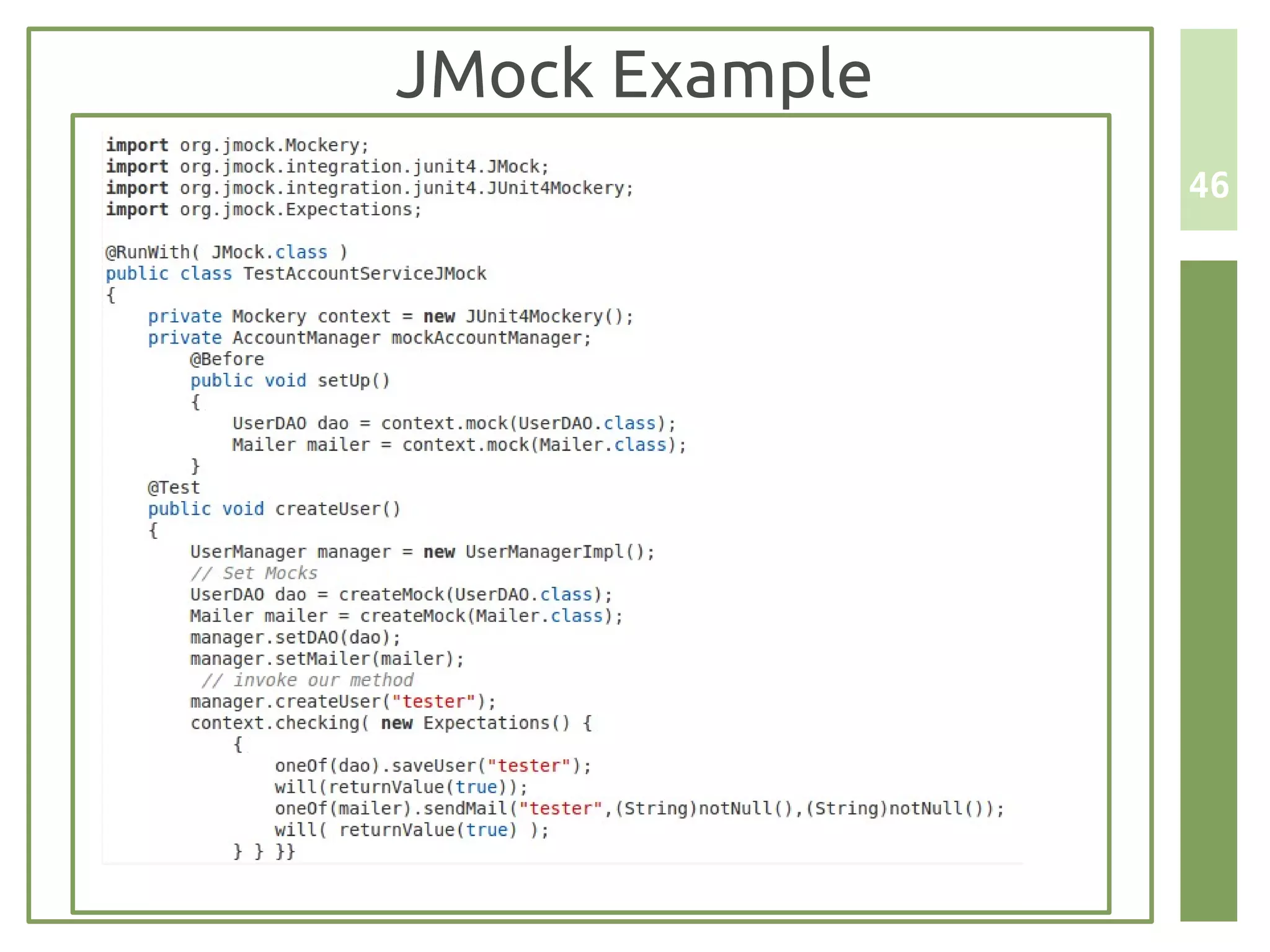
JMock Example
                46
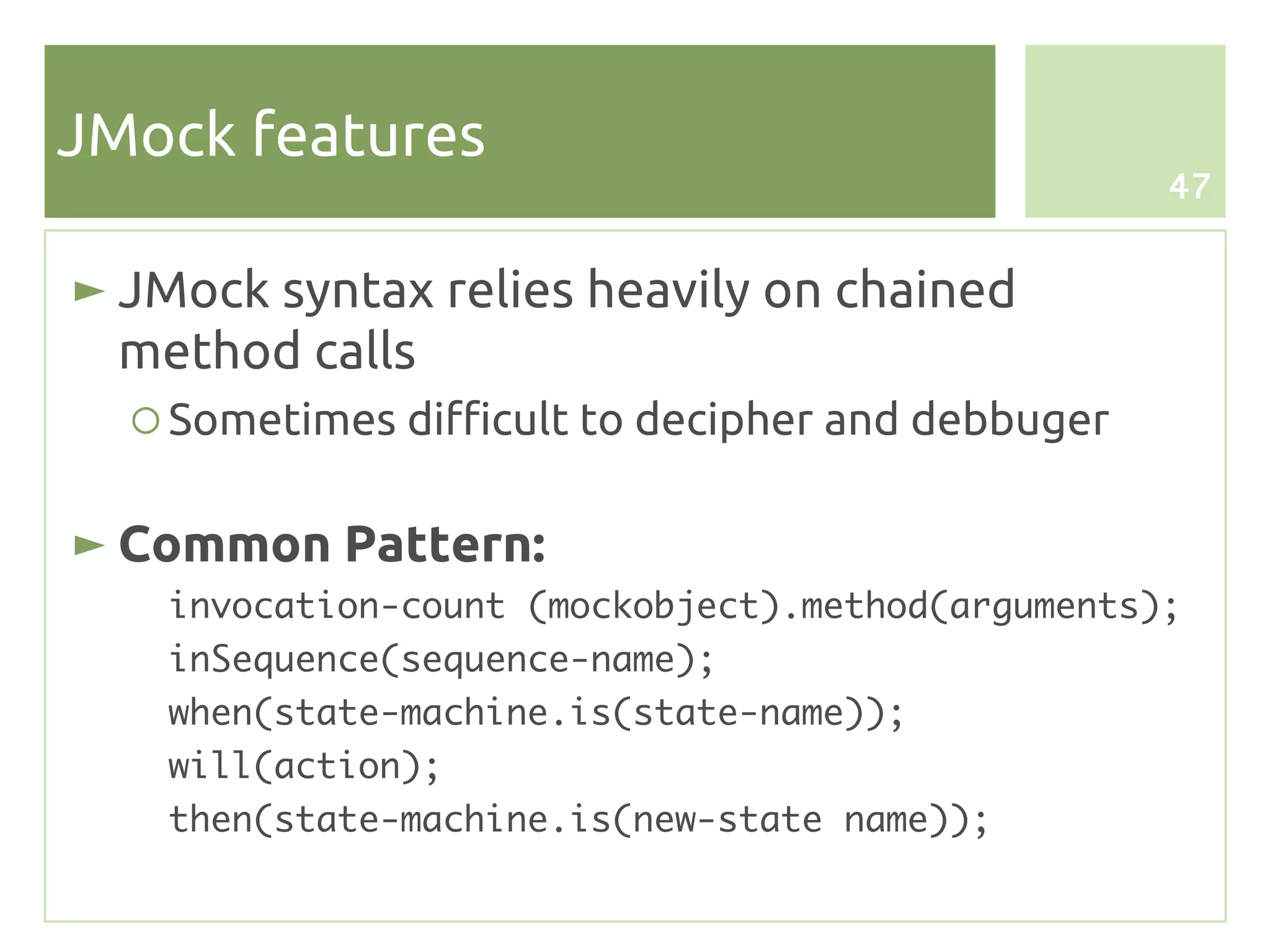
JMock features
                                                   47


► JMock syntax relies heavily on chained
  method calls
  ○ Sometimes difficult to decipher and debbuger

► Common Pattern:
   invocation-count (mockobject).method(arguments);
   inSequence(sequence-name);
   when(state-machine.is(state-name));
   will(action);
   then(state-machine.is(new-state name));
JMock Working Example
JMock features (intro)
                                              49

► JMock previsous versions required subclassing
  ○ Not so smart in testing

  ○ Now directly integrated with Junit4

  ○ JMock tests requires more typing


► JMock API is extensible
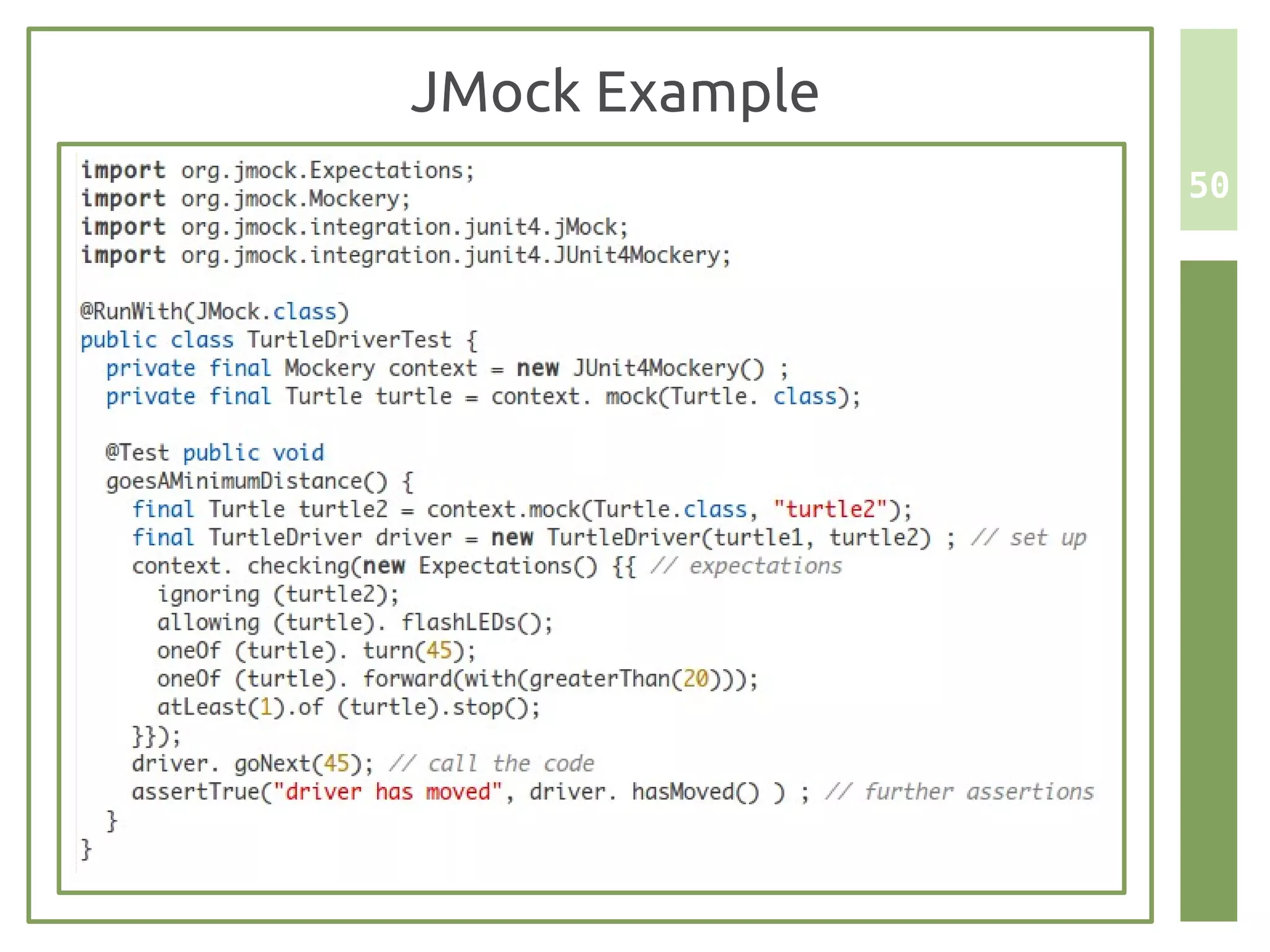
JMock Example
                50
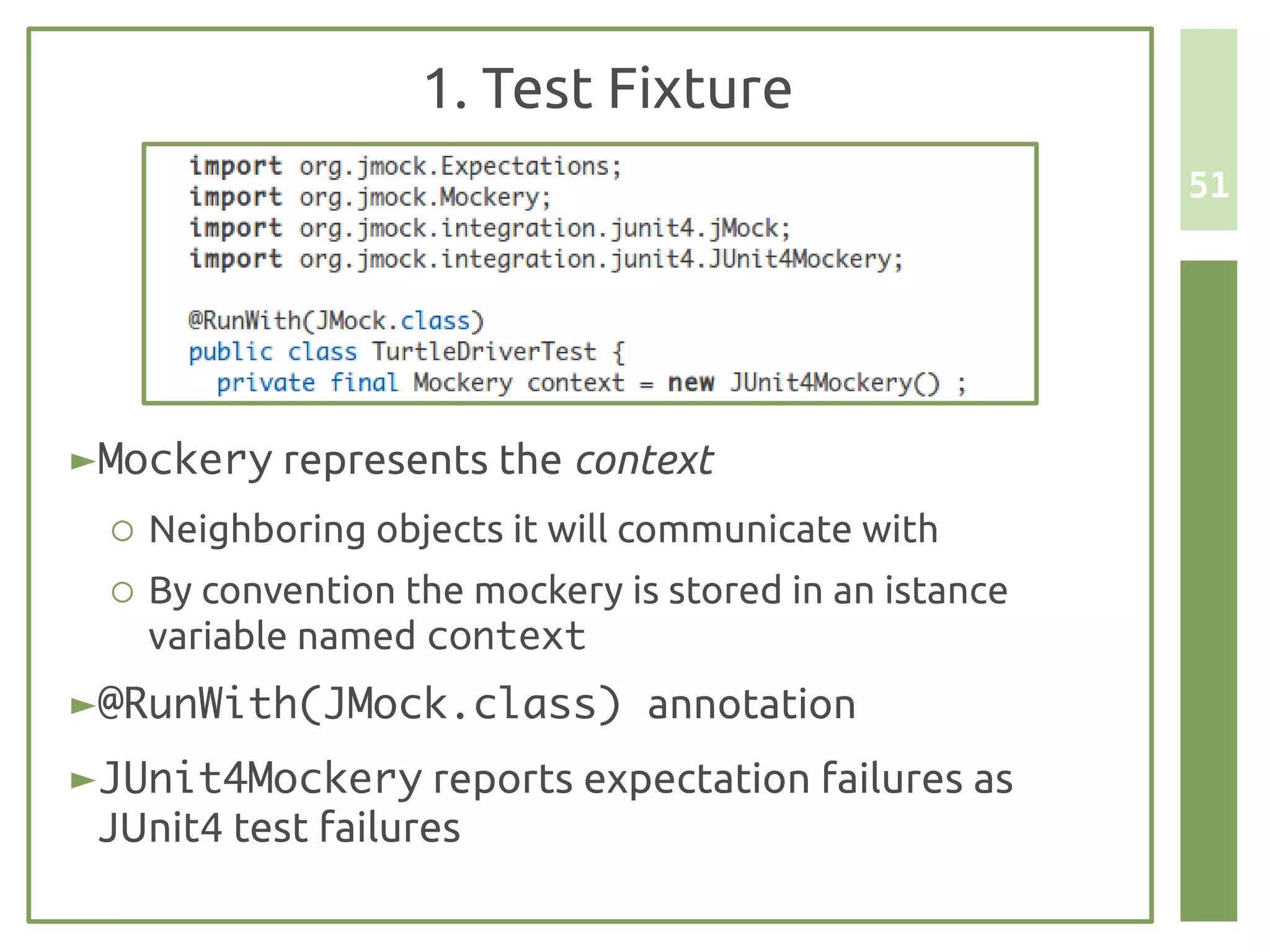
1. Test Fixture
                                                        51


► Mockery represents the context
  ○ Neighboring objects it will communicate with
  ○ By convention the mockery is stored in an istance
    variable named context
► @RunWith(JMock.class) annotation
► JUnit4Mockery reports expectation failures as
  JUnit4 test failures
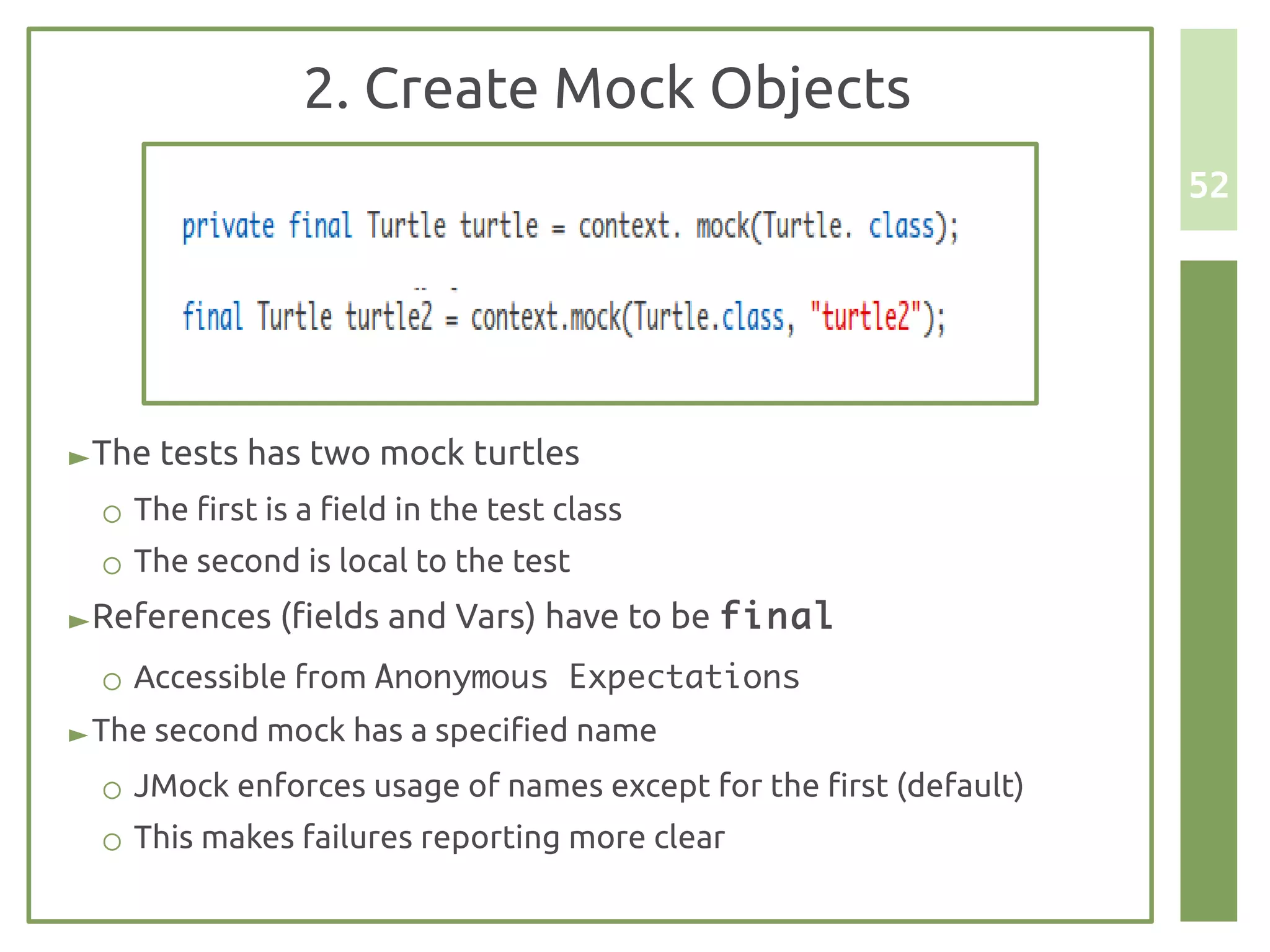
2. Create Mock Objects
                                                                   52


► The tests has two mock turtles
  ○ The first is a field in the test class
  ○ The second is local to the test
► References (fields and Vars) have to be final
  ○ Accessible from Anonymous Expectations
► The second mock has a specified name
  ○ JMock enforces usage of names except for the first (default)
  ○ This makes failures reporting more clear
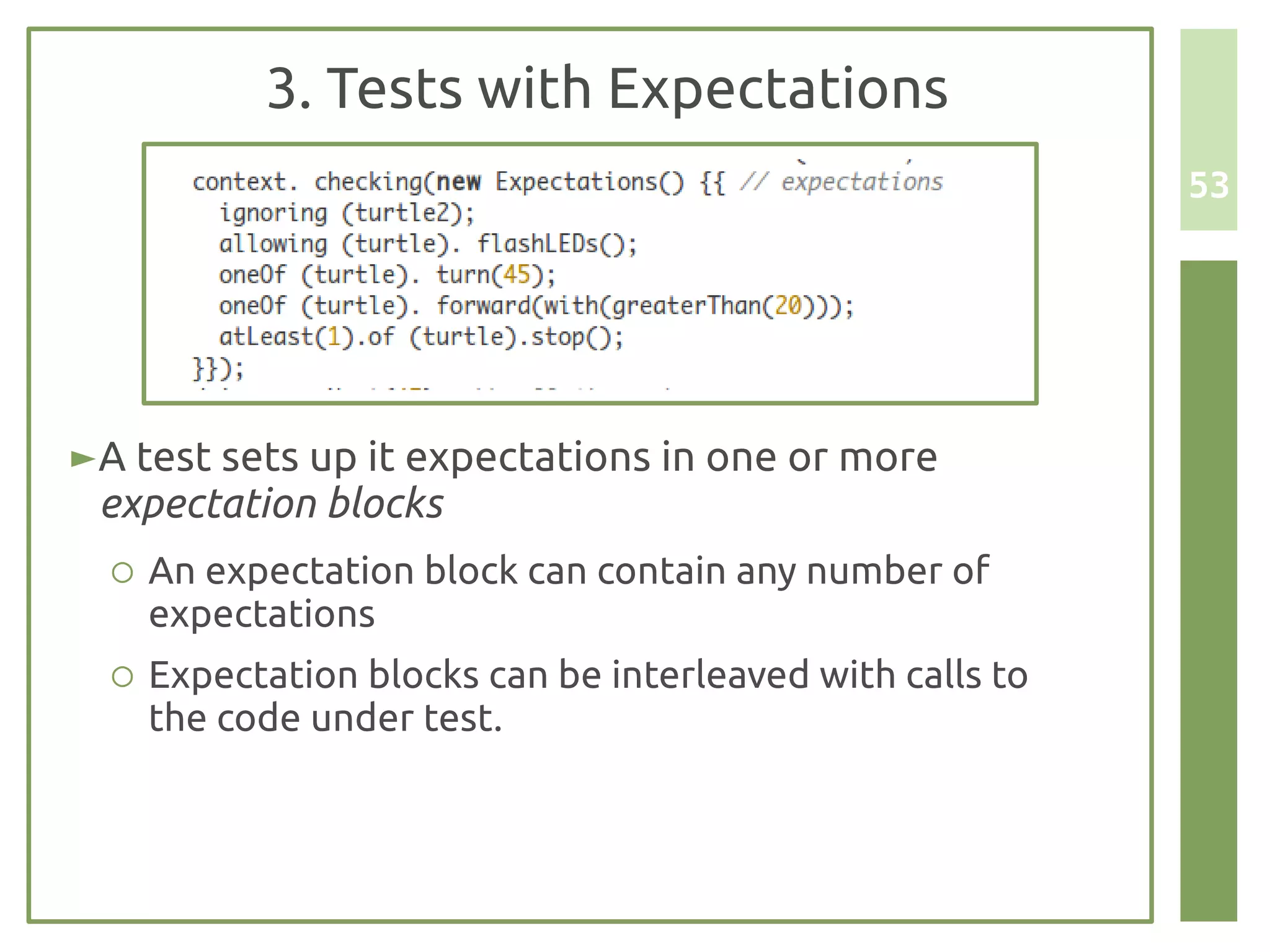
3. Tests with Expectations
                                                          53


► A test sets up it expectations in one or more
  expectation blocks
  ○ An expectation block can contain any number of
    expectations
  ○ Expectation blocks can be interleaved with calls to
    the code under test.
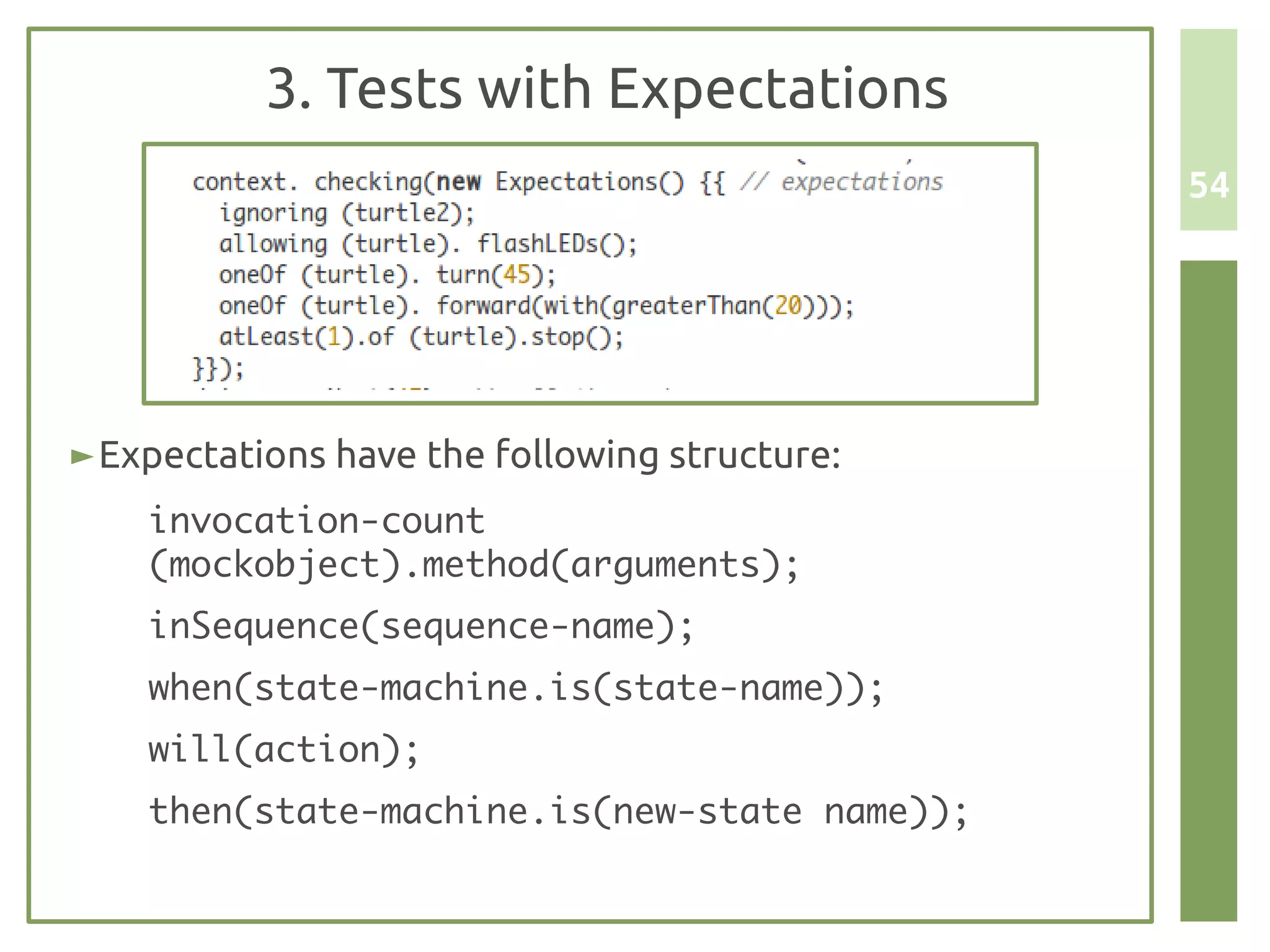
3. Tests with Expectations
                                               54


► Expectations have the following structure:
    invocation-count
    (mockobject).method(arguments);
    inSequence(sequence-name);
    when(state-machine.is(state-name));
    will(action);
    then(state-machine.is(new-state name));
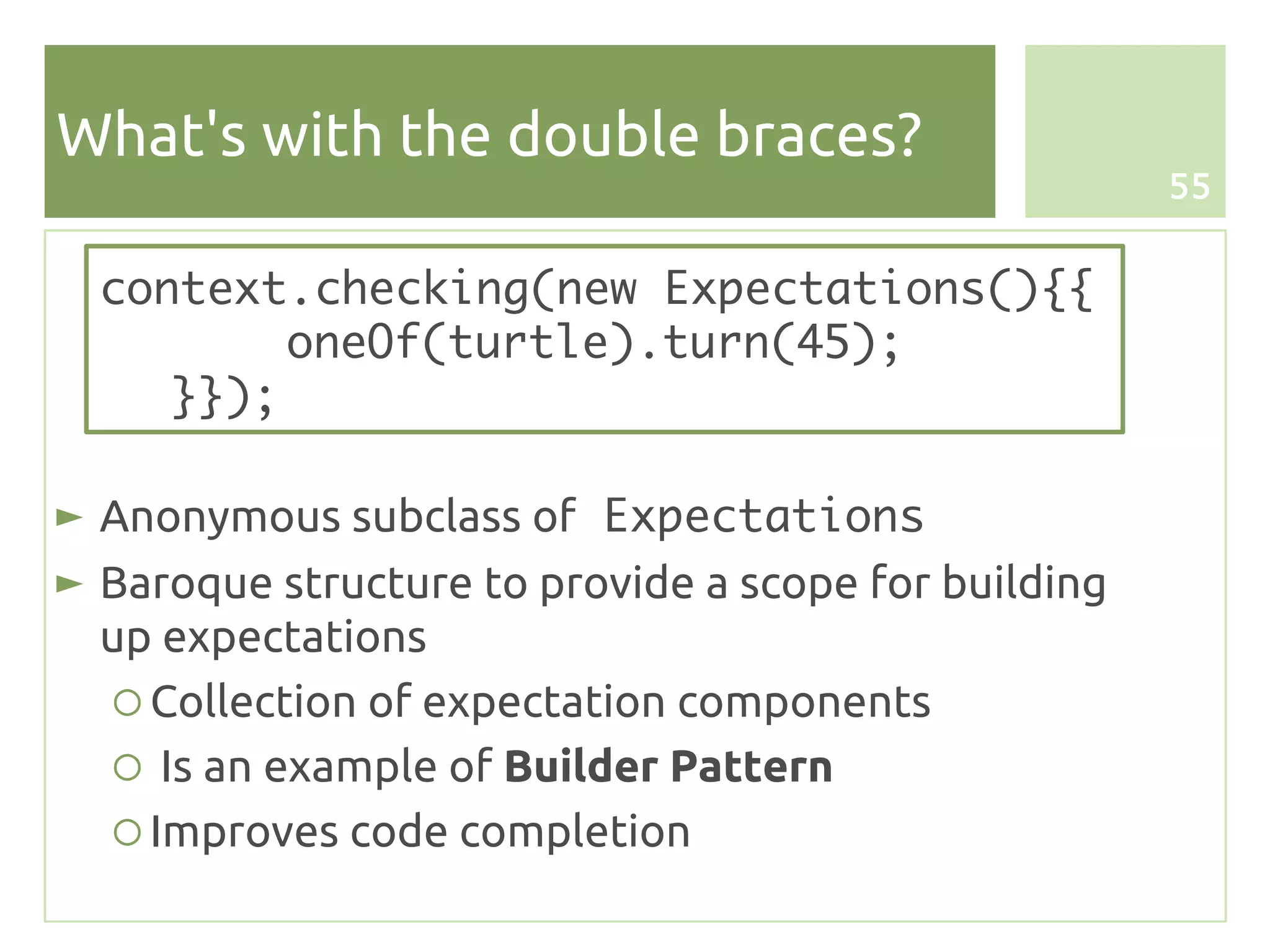
What's with the double braces?
                                                      55


  context.checking(new Expectations(){{
          oneOf(turtle).turn(45);
     }});

► Anonymous subclass of Expectations
► Baroque structure to provide a scope for building
  up expectations
   ○ Collection of expectation components
   ○ Is an example of Builder Pattern
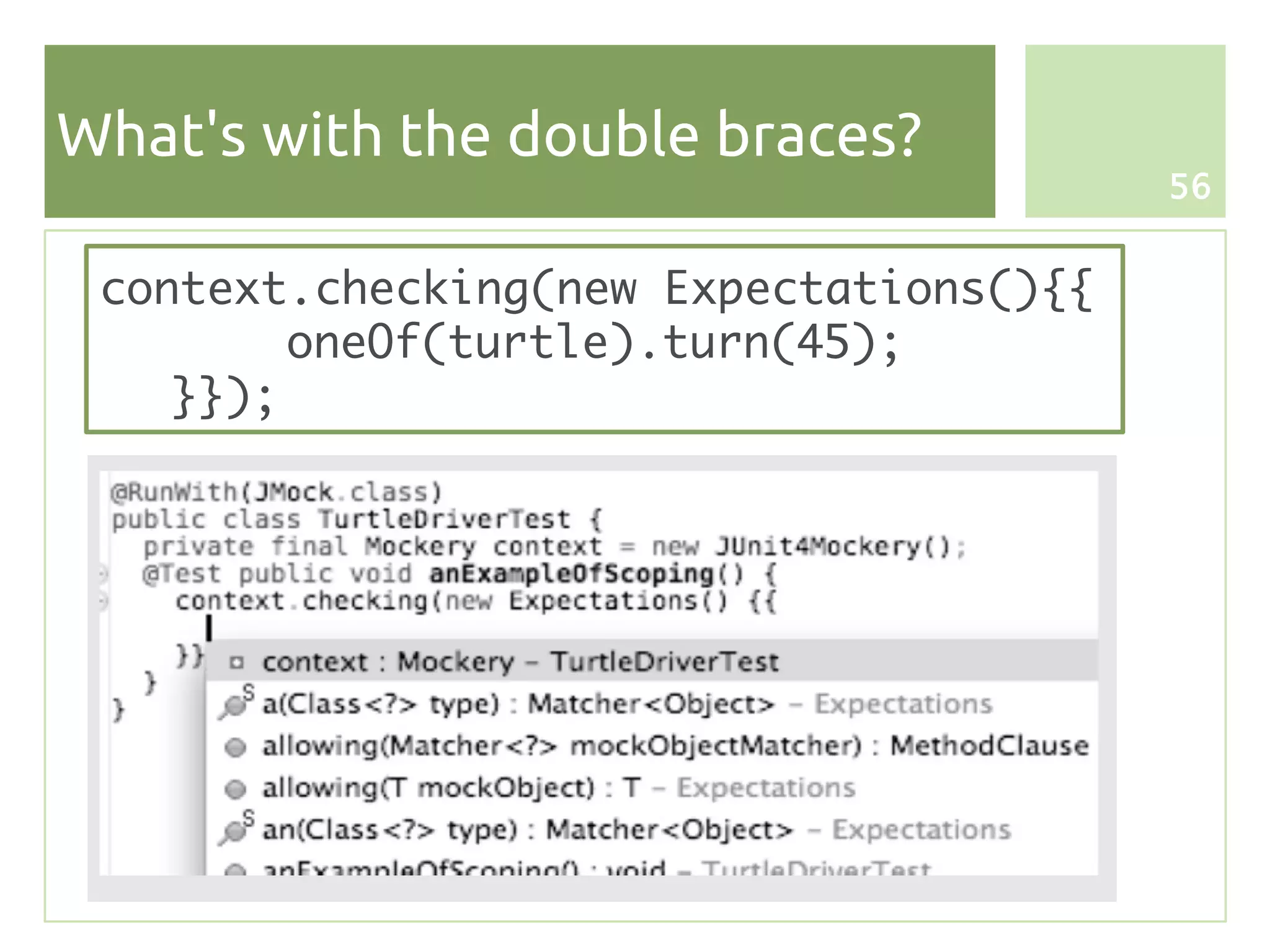
   ○ Improves code completion
What's with the double braces?
                                         56


 context.checking(new Expectations(){{
         oneOf(turtle).turn(45);
    }});
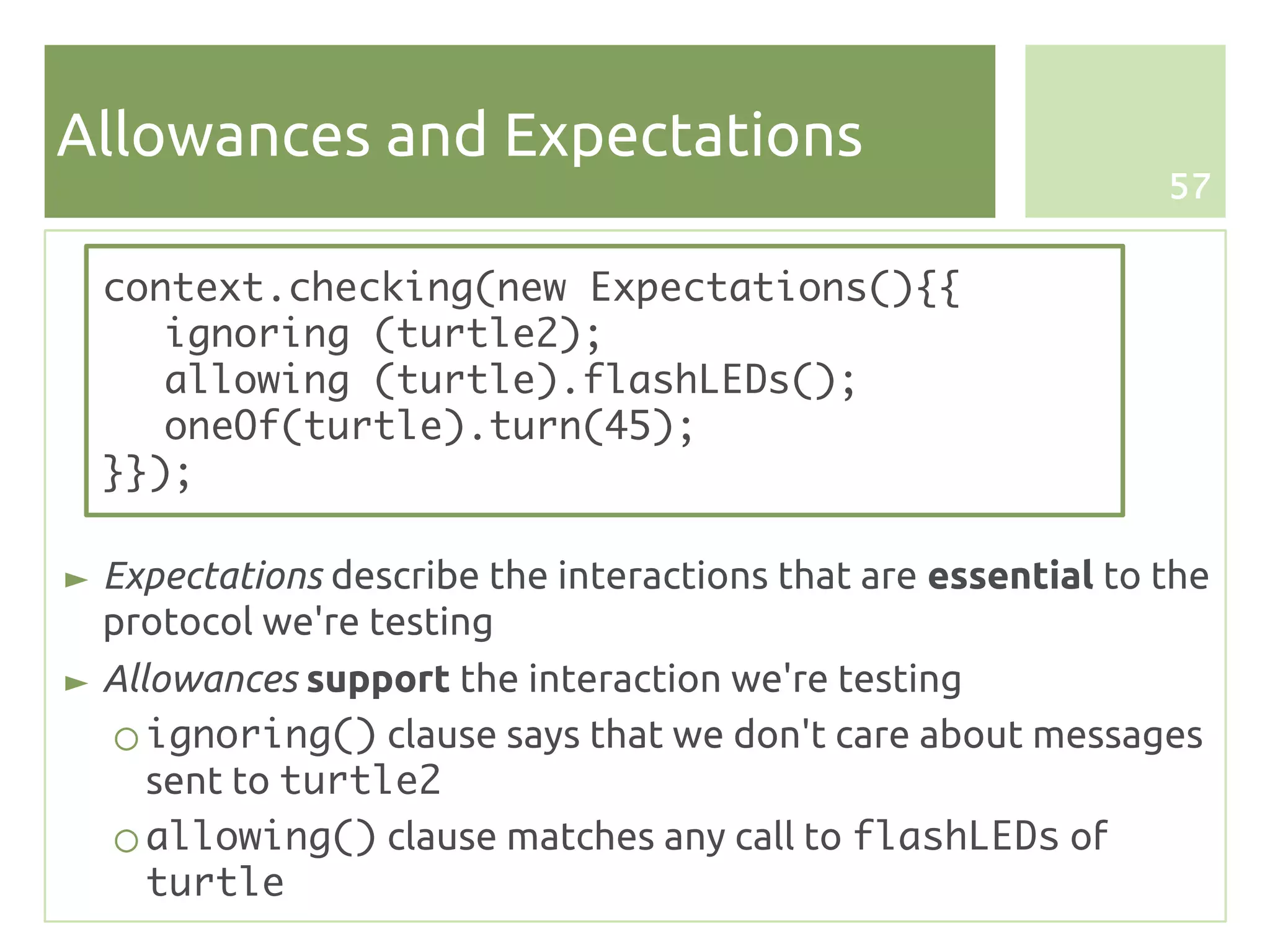
Allowances and Expectations
                                                               57


  context.checking(new Expectations(){{
     ignoring (turtle2);
     allowing (turtle).flashLEDs();
     oneOf(turtle).turn(45);
  }});

► Expectations describe the interactions that are essential to the
  protocol we're testing
► Allowances support the interaction we're testing
   ○ ignoring() clause says that we don't care about messages
     sent to turtle2
   ○ allowing() clause matches any call to flashLEDs of
     turtle
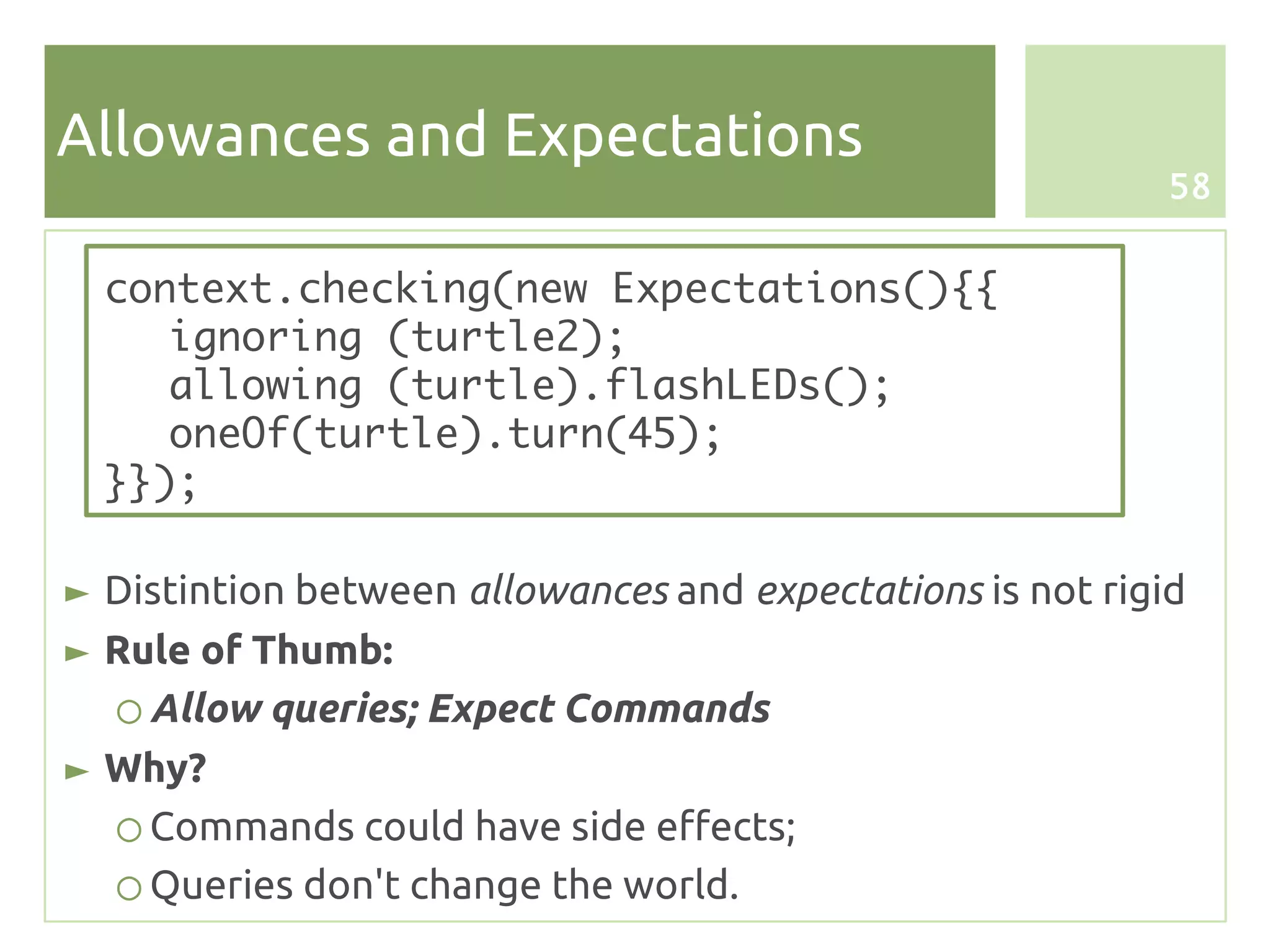
Allowances and Expectations
                                                            58


  context.checking(new Expectations(){{
     ignoring (turtle2);
     allowing (turtle).flashLEDs();
     oneOf(turtle).turn(45);
  }});

► Distintion between allowances and expectations is not rigid
► Rule of Thumb:
  ○ Allow queries; Expect Commands
► Why?
  ○ Commands could have side effects;
  ○ Queries don't change the world.
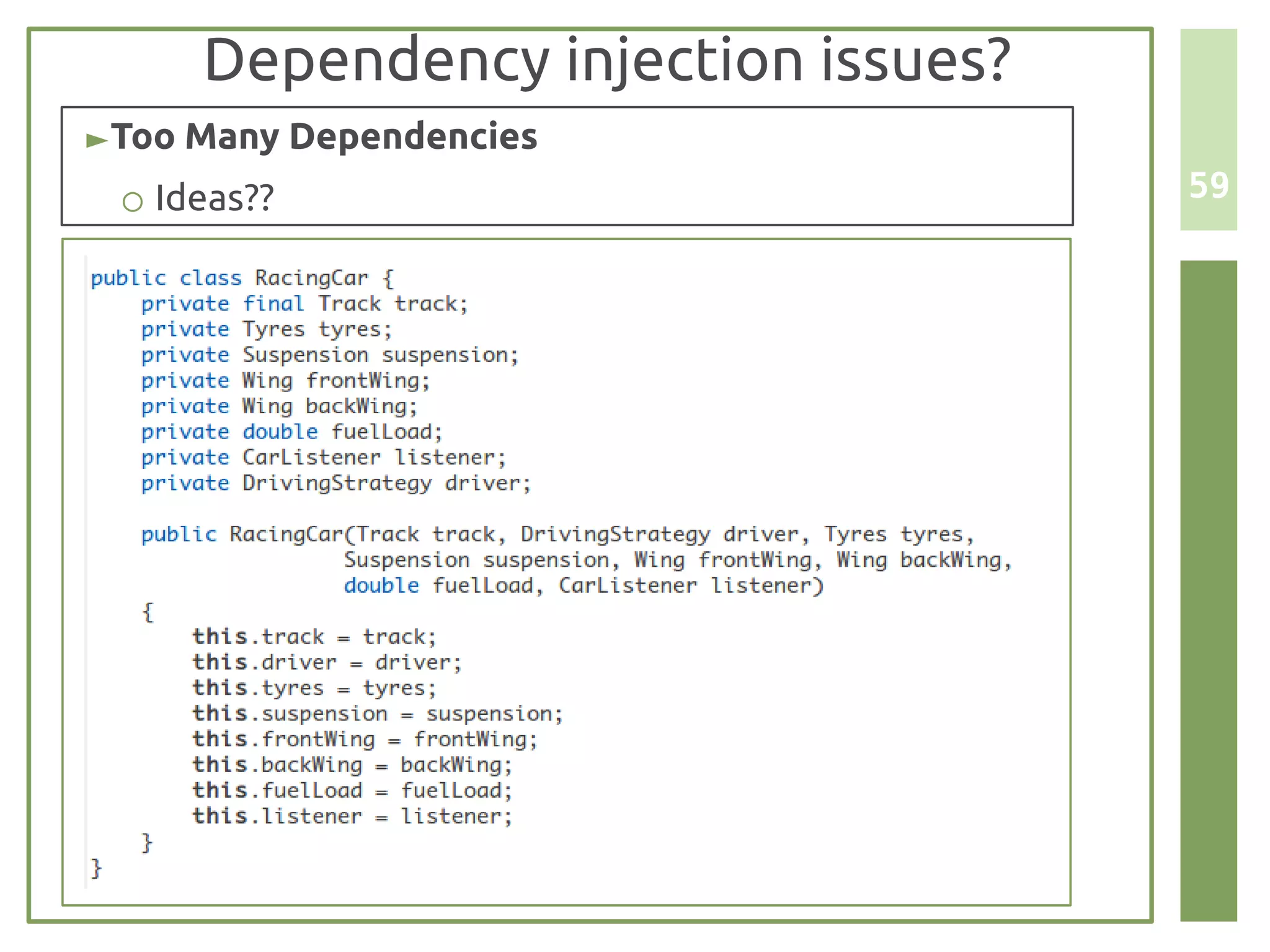
Dependency injection issues?
► Too Many Dependencies
 ○ Ideas??                          59
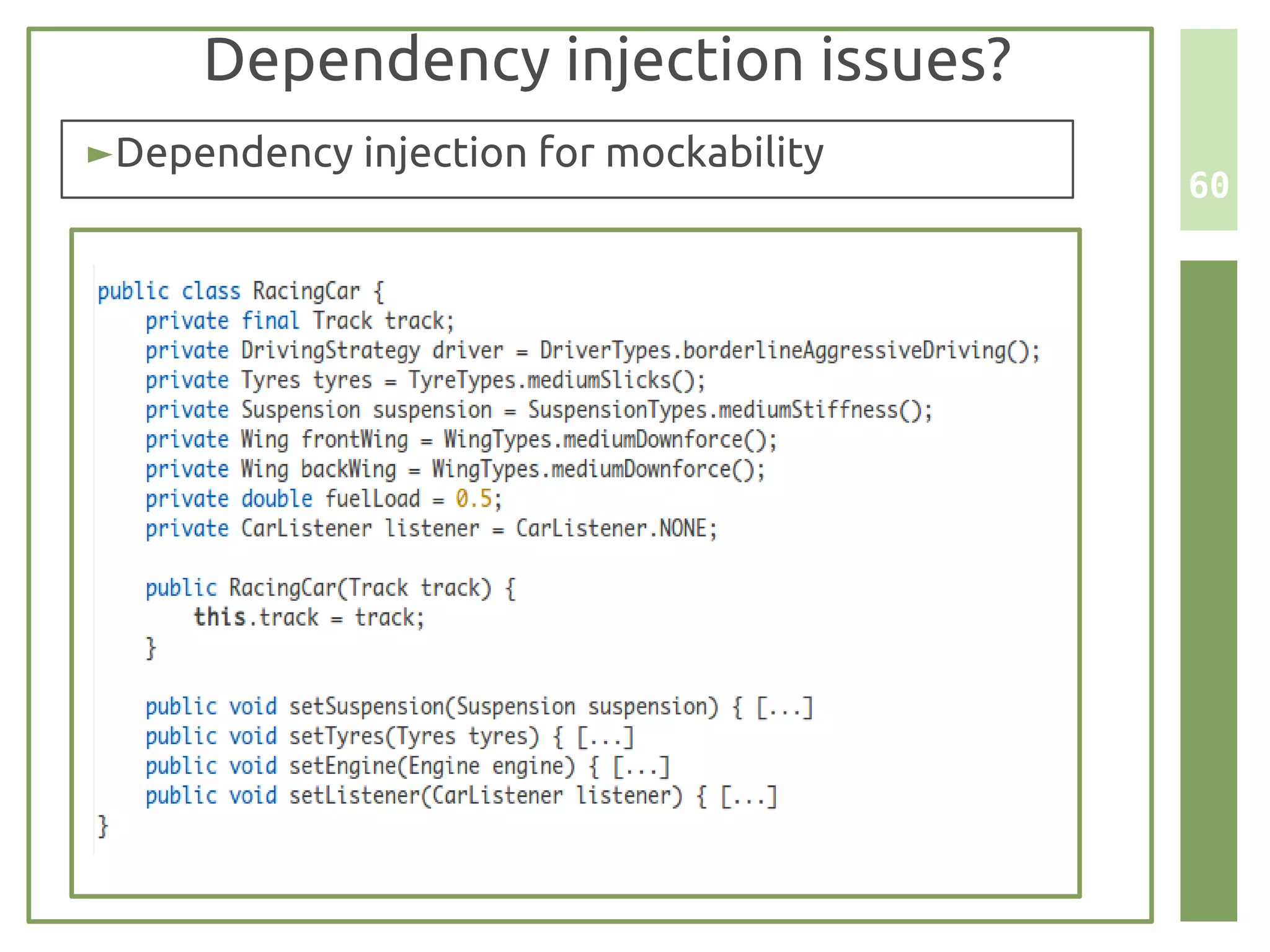
Dependency injection issues?
► Dependency injection for mockability
                                         60
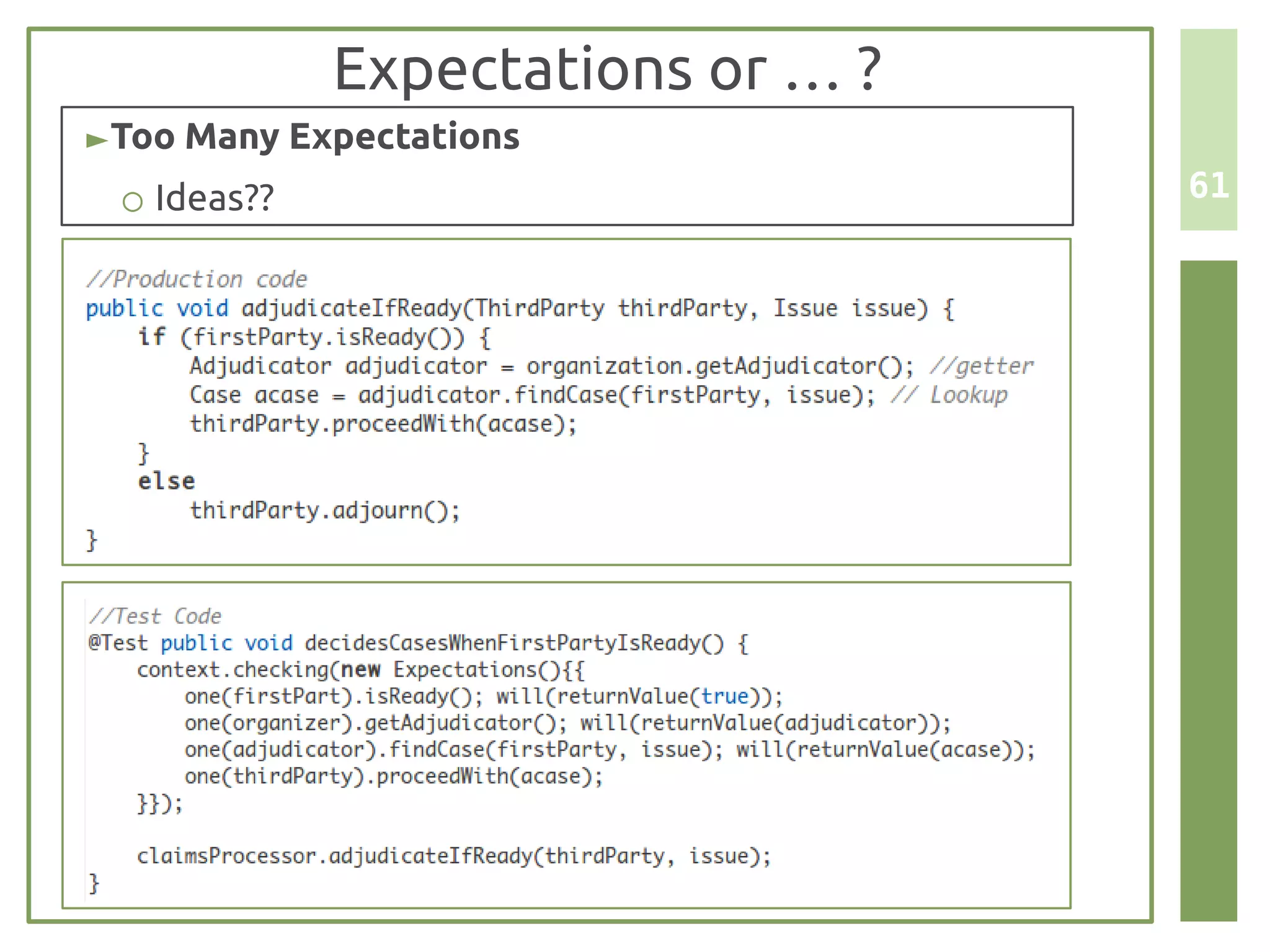
Expectations or … ?
► Too Many Expectations
 ○ Ideas??                         61
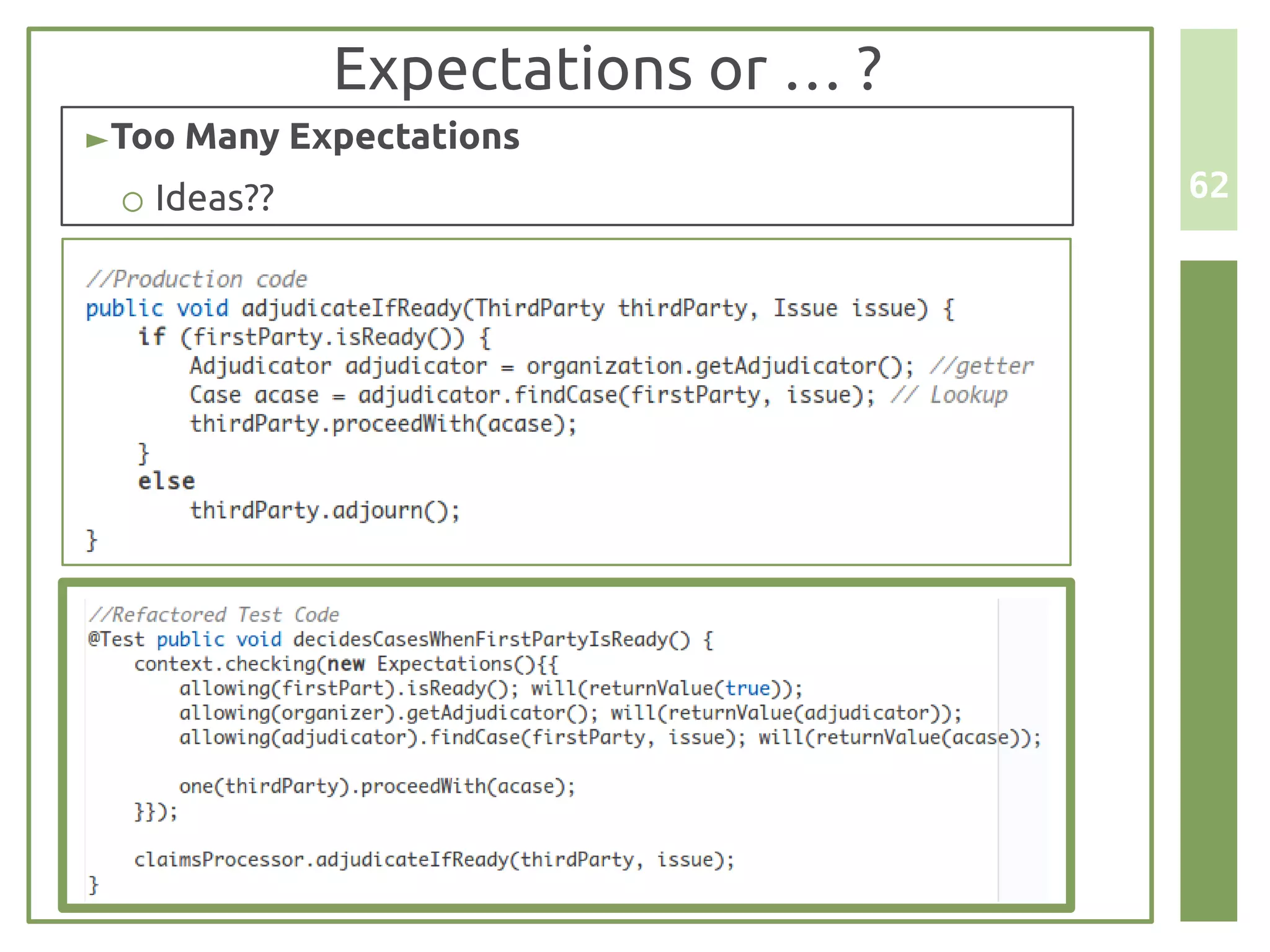
Expectations or … ?
► Too Many Expectations
 ○ Ideas??                         62
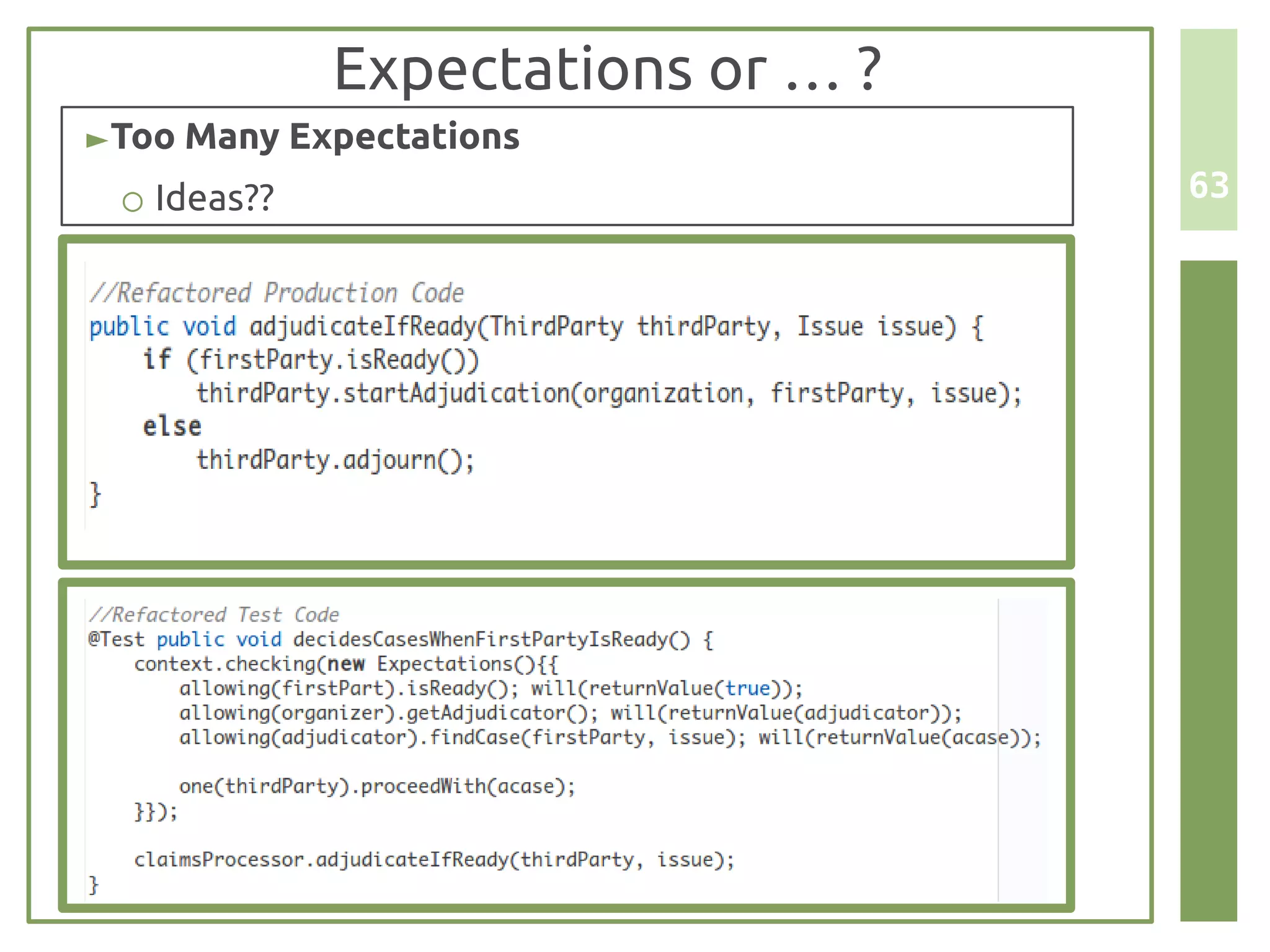
Expectations or … ?
► Too Many Expectations
 ○ Ideas??                         63
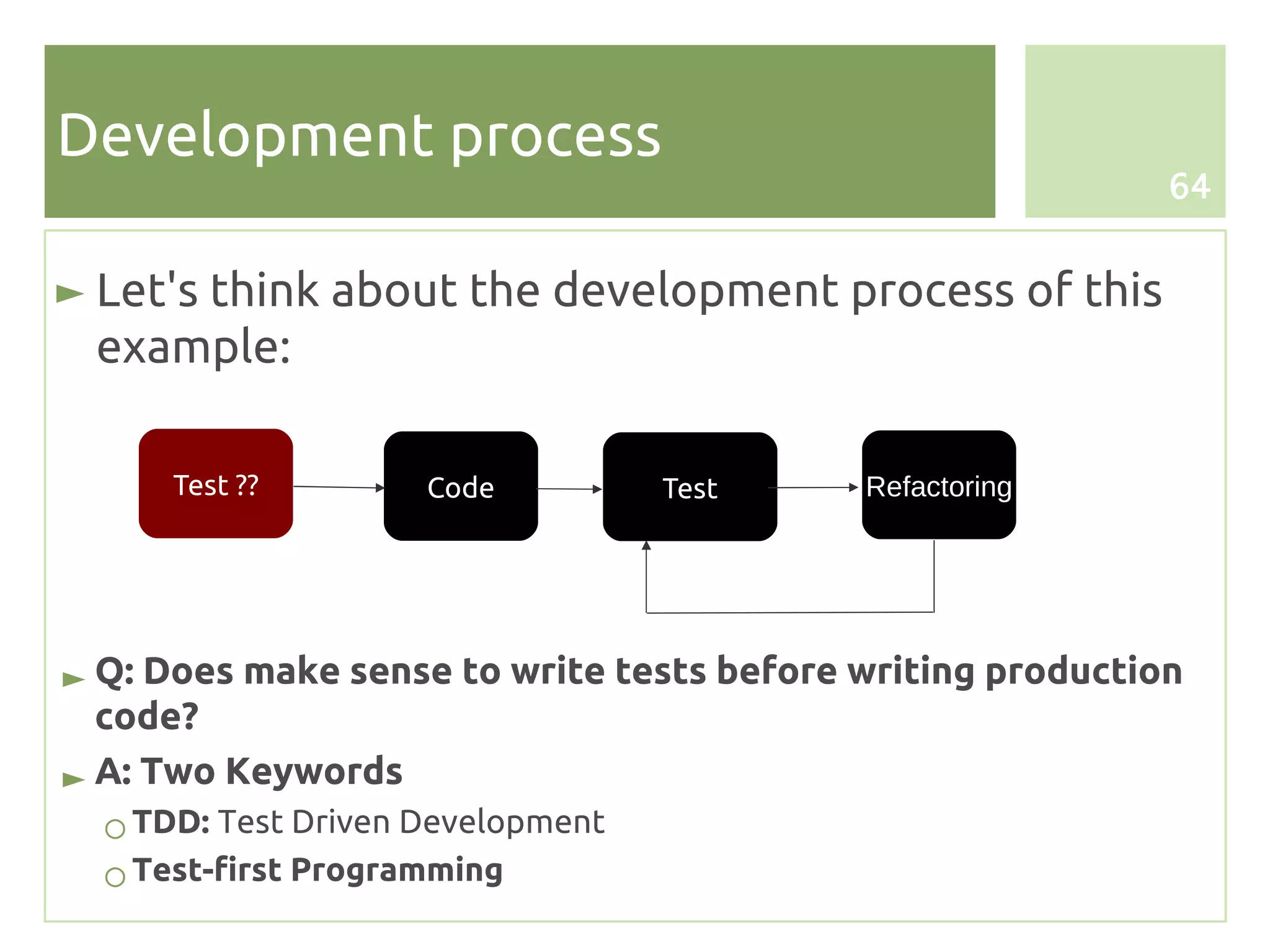
Development process
                                                            64


► Let's think about the development process of this
  example:

      Test ??        Code          Test    Refactoring


► Q: Does make sense to write tests before writing production
  code?
► A: Two Keywords
  ○ TDD: Test Driven Development
  ○ Test-first Programming
Mocks and Stubs Pitfall
                                                   65

► False sense of security

► Maintenance Overhead
  ○ Keep mocks up2date with test and producton code

  ○ Example:
     ● UserManager won't send mail no more

  ○ Maintenance headaches in making test code to run
References
                                                 66


► Professional Java JDK 5 Edition
  ○ Richardson et. al., Wrox Publications 2006
► xUnit Test Patterns
  ○ G. Meszaros, Addison Wesley 2006
► Next Generation Java Testing
  ○ Beust, Suleiman, Addison Wesley 2007
► JUnit in Action, 2nd Ed.
  ○ Massol et al. , Manning Pubs 2009
► Python Testing
  ○ Arbuckle Daniel, Packt Publising 2010

Unit testing and scaffolding

  • 1.
    Unit Testing and Scaffolding Course of Software Engineering II A.A. 2010/2011 Valerio Maggio, PhD Student Prof. Sergio Di Martino
  • 2.
    Testing Preliminaries 2 ► You're a programmer ○ a coder, a developer, or maybe a hacker! ► As such, it's almost impossible that you haven't had to sit down with a program that you were sure was ready for use ○ or worse yet, a program you knew was not ready ► So, you put together a bunch of test to prove the correctness of your code ○ Let's think about what correctness means
  • 3.
    Testing Preliminaries 3 ► Correctness in Testing ? ○ Which is the point of view ? ► Different points of view means different types of tests (testing) ► Automated tools support
  • 4.
    Outline 4 ► Testing Taxonomy ○ Brief Introduction ► Unit testing with JUnit 4.x ○ Main differences with JUnit 3.x ○ Backward compatibilities ○ JUnit Examples in practice ► Test Scaffolding and Mocking
  • 5.
    1. Types oftesting 5
  • 6.
    Example Scenario 6 ► (… not properly related to Computer Science :) ► Please, imagine that you have to test a building ○ Test if it has been constructed properly ○ Test if it is able to resist to earthquake ○ …. ► What types of “testing” will you do? ○ Make an educated guess
  • 7.
    Five Types ofTesting 7
  • 8.
    Unit Testing 8 ► Testing of the smallest pieces of a program ○ Individual functions or methods ► Keyword: Unit ○ (def) Something is a unit if it there's no meaningful way to divide it up further ► Buzz Word: ○ Testing in isolation
  • 9.
    Unit Testing (cont.) 9 ► Unit test are used to test a single unit in isolation ○ Verifying that it works as expected ○ No matter the rest of the program would do ► Possible advantages ? ○ (Possibly) No inheritance of bugs of mistakes from made elsewhere ○ Narrow down on the actual problem
  • 10.
    Unit Testing (cont.) 10 ► Is it enough ? ○ No, by itself, but... ► … it is the foundation upon which everything is based! ► (Back to the example) ○ You can't build a house without solid materials. ○ You can't build a program without units that works as expected.
  • 11.
    Integration Testing 11 ► Aim: Push further back boundaries of isolation ► Tests encompass interactions between related units ► (Important) Every test should still run in isolation ○ To avoid inheriting problems from outside ► Tests check whether the tested unit behave correctly as a group
  • 12.
    Functional Testing 12 ► a.k.a. System Testing ► Extends boundaries of isolation even further ○ To the point they don't even exist. ► Testing application Use Cases ► System tests are very useful, but not so useful without Unit and Integration tests ○ You have to be sure of the pieces before you can be sure of the whole.
  • 13.
    Stress and AcceptanceTesting 13 ► Stress/Load Testing ○ Test of loadings and performances ● (Non functional requirements) ○ Test if the building is able to resist to the earthquake ► Acceptance Testing ○ Last but not least.... ○ … does the customer get what he or she expected?
  • 14.
    Before going on... ►Let'stake a look at this code, please 14
  • 15.
    2. JUnit TestingFramework 15
  • 16.
    Junit 3.x Design 16 ► Design that is compliant with xUnit framework guidelines
  • 17.
    JUnit Assertions 17 ► assertNotNull ○ Test passes if Object is not null. ► assertNull ○ Test passes if Object is null. ► assertEquals ○ Asserts equality of two values ► assertTrue ○ Test passes if condition is True ► assertFalse ○ Test passes if condition is False ► assertSame ○ Test passes if the two Objects are not the same Object
  • 18.
    JUnit 4.x Design 18 ► Main features inspired from other Java Unit Testing Frameworks ○ TestNG ► Test Method Annotations ○ Requires Java5+ instead of Java 1.2+ ► Main Method Annotations ○ @Before, @After ○ @Test, @Ignore ○ @SuiteClasses, @RunWith
  • 19.
    Java5 Annotations atglance 19 ► Meta Data Tagging ○ java.lang.annotation ○ java.lang.annotation.ElementType ● FIELD ● METHOD ● CLASS ●… ► Target ○ Specify to which ElementType is applied ► Retention ○ Specify how long annotation should be available
  • 20.
  • 21.
    Testing exception handling 21 ►Test anything that could possibly fail
  • 22.
    New way ofTesting exception handling 22 ►Test anything that could possibly fail
  • 23.
    JUnit 4.x backwardcompatibility ► JUnit provides a façade class which 23 operates with any of the test runners. ○ org.junit.runner.JUnitCore
  • 24.
    JUnit Matchers: Hamcrest 24 ► Junit 4.4+ introduces matchers ○ Imported from Hamcrest project ○ http://code.google.com/p/hamcrest/ ► Matchers improve testing code refactoring ○ Writing more and more tests assertion became hard to read ○ Remember: ● Documentation purposes ► Let's do an example …
  • 25.
  • 26.
  • 27.
    3. Testing Scaffolding Programming today is a race between software engineers striving to build bigger and better idiot- proof programs, and the Universe trying to produce bigger and better idiots. So far, the Universe is winning. Cit. Rich Cook 27
  • 28.
    Integration Testing Example public class TestDB extends TestCase { 28 private Connection dbConn; protected void setUp() { dbConn = new Connection( "oracle", 1521, "fred", "foobar"); dbConn.connect(); } protected void tearDown() { dbConn.disconnect(); dbConn = null; } public void testAccountAccess() { // Uses dbConn xxx xxx xxxxxx xxx xxxxxxxxx; } }
  • 29.
    Integration testing problem 29 ► Integrate multiple components implies to decide in which order classes and subsystems should be integrated and tested ► CITO Problem ○ Class Integration Testing Order Problem ► Solution: ○ Topological sort of dependency graph
  • 30.
  • 31.
    Testing in isolation 31 ► Testing in isolation offers strong benefits ○ Test code that have not been written ○ Test only a single method (behavior) without side effects from other objects ► Focused Integration Testing (!!) ► Solutions ? ○ Stubs ○ Mocks ○…
  • 32.
  • 33.
  • 34.
  • 35.
    Key Ideas 35 (Ignoring the specifics of codes) ► Mocks do not provide our own implementation of the components we'd like to swap in ► Main Difference: ○ Mocks test behavior and interactions between components ○ Stubs replace heavyweight process that are not relevant to a particular test with simple implementations
  • 36.
    Naming Problems and BuzzWorlds 36 ► Unfortunately, while two components are quite distinct, they're used interchangeably. ○ Example: spring-mock package ► If we want to be stricter in terms of naming, stub objects defined previously are ○ test doubles ► Test Doubles, Stubs, Mocks, Fake Objects… how can we work it out ?
  • 37.
    Test Double Pattern (a.k.a. Imposter) 37 ►Q: How can we verify logic independently when code it depends on is unusable? ○ Q1: How we can avoid slow tests ? ►A: We replace a component on which the SUT depends with a “test-specific equivalent.”
  • 38.
    Test Stub Pattern 38 ►Q: How can we verify logic independently when it depends on indirect inputs from other software components ? ►A: We replace a real objects with a test-specific object that feeds the desired inputs into the SUT
  • 39.
    Mocks Objects 39 ►Q: How can we implement Behavior Verification for indirect outputs of the SUT ? ►A: We replace an object on which the SUT depends on with a test-specific object that verifies it is being used correctly by the SUT.
  • 40.
    Mock Objects Observations 40 ► Powerful way to implement Behavior Verification ○ while avoiding Test Code Duplication between similar tests. ► It works by delegating the job of verifying the indirect outputs of the SUT entirely to a Test Double. ► Important Note: Design for Mockability ○ Dependency Injection Pattern
  • 41.
    Design for Mockability 41 ► Dependency Injection
  • 42.
    Design for Mockability 42 ► Q: How much are the directions in which we could slice functionalities of the system under test? ► A: ○ Vertical Slicing ○ Horizontal Slicing ►
  • 43.
    Mock Libraries 43 ► Two main design philosphy: ○ DSL Libraries ○ Record/Replay Models Libraries ► Record Replay Frameworks ○ First train mocks and then verify expectations ► DSL Frameworks ○ Domain Specific Languages ○ Specifications embedded in “Java” Code
  • 44.
  • 45.
    EasyMock Test 45 ► Create Mock objects ○ Java Reflections API ► Record Expectation ○ expect methods ► Invoke Primary Test ○ replay method ► Verify Expectation ○ verify method
  • 46.
  • 47.
    JMock features 47 ► JMock syntax relies heavily on chained method calls ○ Sometimes difficult to decipher and debbuger ► Common Pattern: invocation-count (mockobject).method(arguments); inSequence(sequence-name); when(state-machine.is(state-name)); will(action); then(state-machine.is(new-state name));
  • 48.
  • 49.
    JMock features (intro) 49 ► JMock previsous versions required subclassing ○ Not so smart in testing ○ Now directly integrated with Junit4 ○ JMock tests requires more typing ► JMock API is extensible
  • 50.
  • 51.
    1. Test Fixture 51 ► Mockery represents the context ○ Neighboring objects it will communicate with ○ By convention the mockery is stored in an istance variable named context ► @RunWith(JMock.class) annotation ► JUnit4Mockery reports expectation failures as JUnit4 test failures
  • 52.
    2. Create MockObjects 52 ► The tests has two mock turtles ○ The first is a field in the test class ○ The second is local to the test ► References (fields and Vars) have to be final ○ Accessible from Anonymous Expectations ► The second mock has a specified name ○ JMock enforces usage of names except for the first (default) ○ This makes failures reporting more clear
  • 53.
    3. Tests withExpectations 53 ► A test sets up it expectations in one or more expectation blocks ○ An expectation block can contain any number of expectations ○ Expectation blocks can be interleaved with calls to the code under test.
  • 54.
    3. Tests withExpectations 54 ► Expectations have the following structure: invocation-count (mockobject).method(arguments); inSequence(sequence-name); when(state-machine.is(state-name)); will(action); then(state-machine.is(new-state name));
  • 55.
    What's with thedouble braces? 55 context.checking(new Expectations(){{ oneOf(turtle).turn(45); }}); ► Anonymous subclass of Expectations ► Baroque structure to provide a scope for building up expectations ○ Collection of expectation components ○ Is an example of Builder Pattern ○ Improves code completion
  • 56.
    What's with thedouble braces? 56 context.checking(new Expectations(){{ oneOf(turtle).turn(45); }});
  • 57.
    Allowances and Expectations 57 context.checking(new Expectations(){{ ignoring (turtle2); allowing (turtle).flashLEDs(); oneOf(turtle).turn(45); }}); ► Expectations describe the interactions that are essential to the protocol we're testing ► Allowances support the interaction we're testing ○ ignoring() clause says that we don't care about messages sent to turtle2 ○ allowing() clause matches any call to flashLEDs of turtle
  • 58.
    Allowances and Expectations 58 context.checking(new Expectations(){{ ignoring (turtle2); allowing (turtle).flashLEDs(); oneOf(turtle).turn(45); }}); ► Distintion between allowances and expectations is not rigid ► Rule of Thumb: ○ Allow queries; Expect Commands ► Why? ○ Commands could have side effects; ○ Queries don't change the world.
  • 59.
    Dependency injection issues? ►Too Many Dependencies ○ Ideas?? 59
  • 60.
    Dependency injection issues? ►Dependency injection for mockability 60
  • 61.
    Expectations or …? ► Too Many Expectations ○ Ideas?? 61
  • 62.
    Expectations or …? ► Too Many Expectations ○ Ideas?? 62
  • 63.
    Expectations or …? ► Too Many Expectations ○ Ideas?? 63
  • 64.
    Development process 64 ► Let's think about the development process of this example: Test ?? Code Test Refactoring ► Q: Does make sense to write tests before writing production code? ► A: Two Keywords ○ TDD: Test Driven Development ○ Test-first Programming
  • 65.
    Mocks and StubsPitfall 65 ► False sense of security ► Maintenance Overhead ○ Keep mocks up2date with test and producton code ○ Example: ● UserManager won't send mail no more ○ Maintenance headaches in making test code to run
  • 66.
    References 66 ► Professional Java JDK 5 Edition ○ Richardson et. al., Wrox Publications 2006 ► xUnit Test Patterns ○ G. Meszaros, Addison Wesley 2006 ► Next Generation Java Testing ○ Beust, Suleiman, Addison Wesley 2007 ► JUnit in Action, 2nd Ed. ○ Massol et al. , Manning Pubs 2009 ► Python Testing ○ Arbuckle Daniel, Packt Publising 2010