Web Frameworks
              web development done right


Course of Web Technologies
A.A. 2010/2011
              Valerio Maggio, PhD Student
                     Prof.ssa Anna Corazza
Outline
                                         2


► Web technologies evolution

► Web frameworks
  ○ Design Principles

► Case Study
  ○ Django and GAE (Google App Engine)

► Working Example
Intruduction
                                               3


► Nowadays frameworks has become a
  buzzword
  ○ Software framework
  ○ Web framework
  ○ Development framework
  ○…


► So, what do you expect a web framework is?
1. Web Technologies
     Evolution


                      4
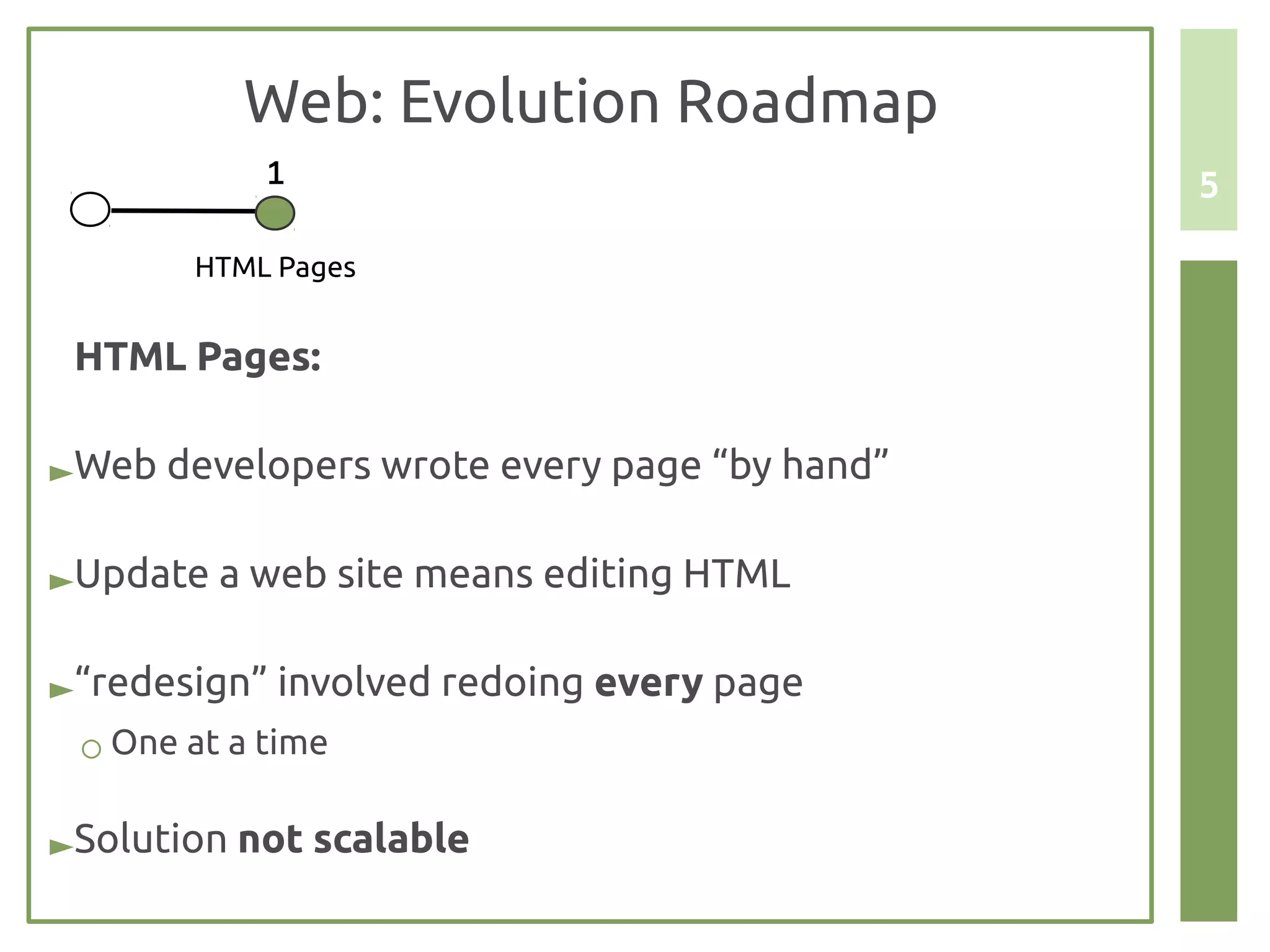
Web: Evolution Roadmap
            1                                5

       HTML Pages


 HTML Pages:

►Web developers wrote every page “by hand”

►Update a web site means editing HTML

►“redesign” involved redoing every page
 ○ One at a time


►Solution not scalable
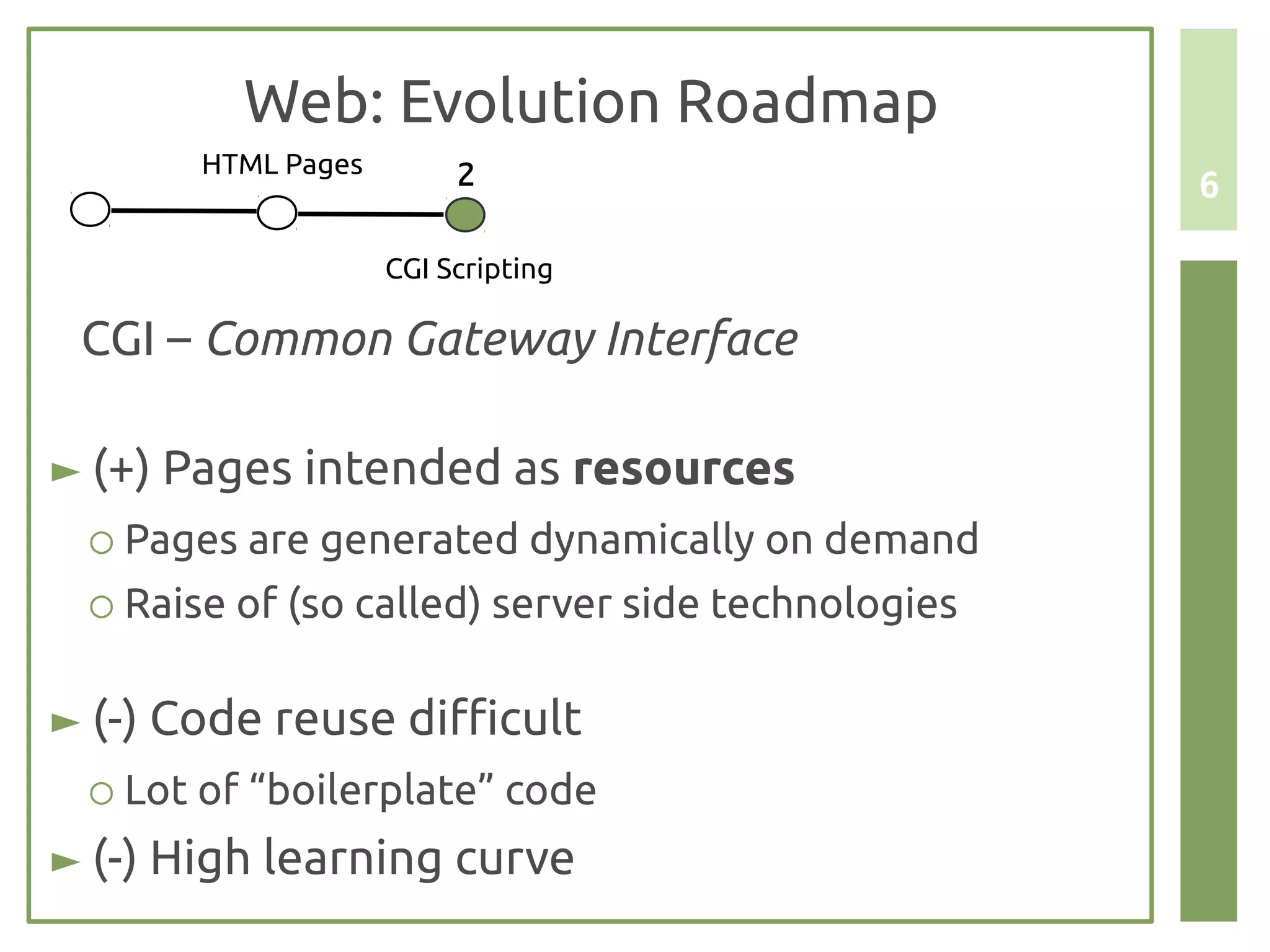
Web: Evolution Roadmap
       HTML Pages        2                         6

                    CGI Scripting

 CGI – Common Gateway Interface

► (+) Pages intended as resources
 ○ Pages are generated dynamically on demand
 ○ Raise of (so called) server side technologies


► (-) Code reuse difficult
 ○ Lot of “boilerplate” code
► (-) High learning curve
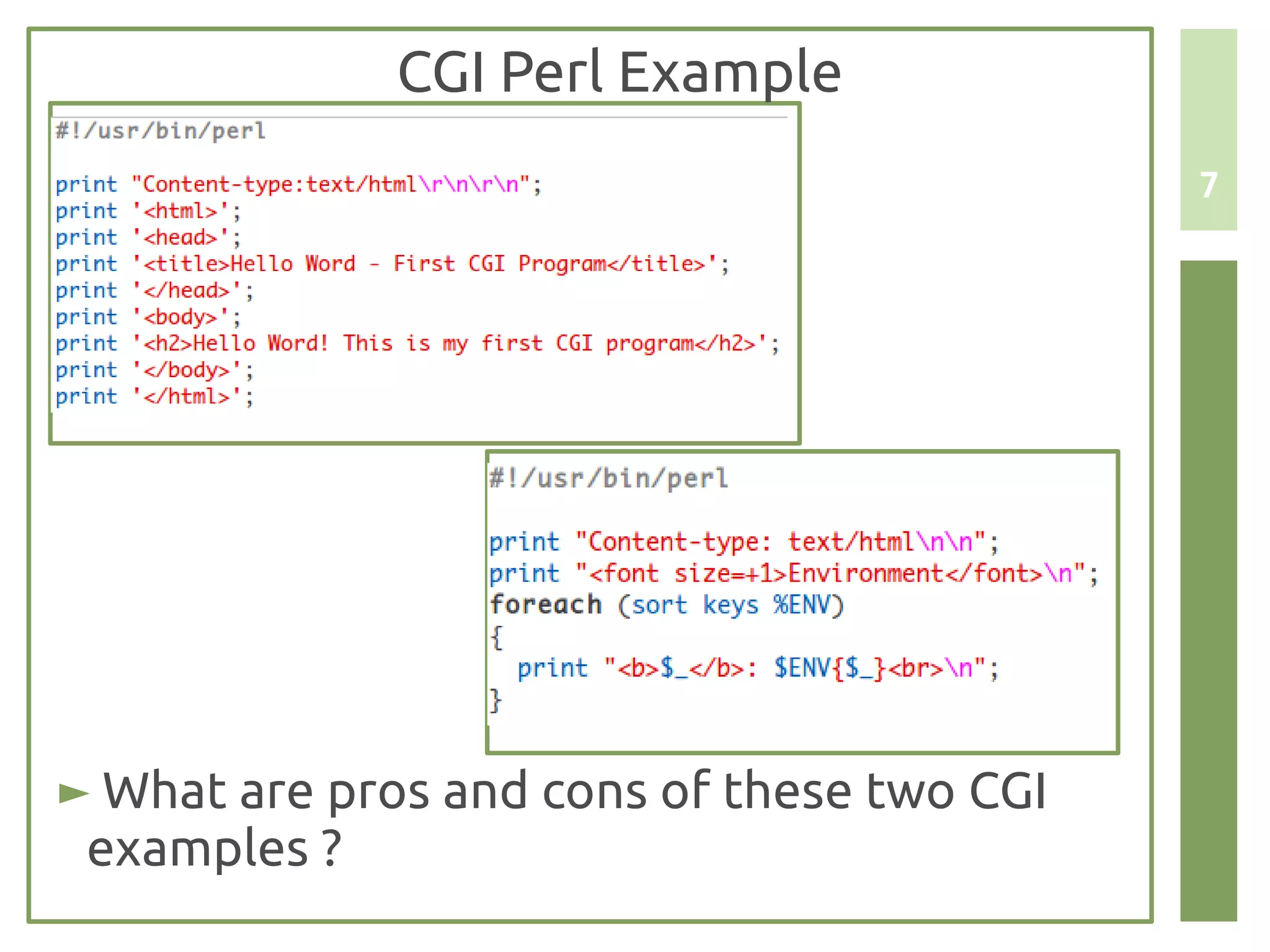
CGI Perl Example
                                            7


► What are pros and cons of these two CGI
 examples ?
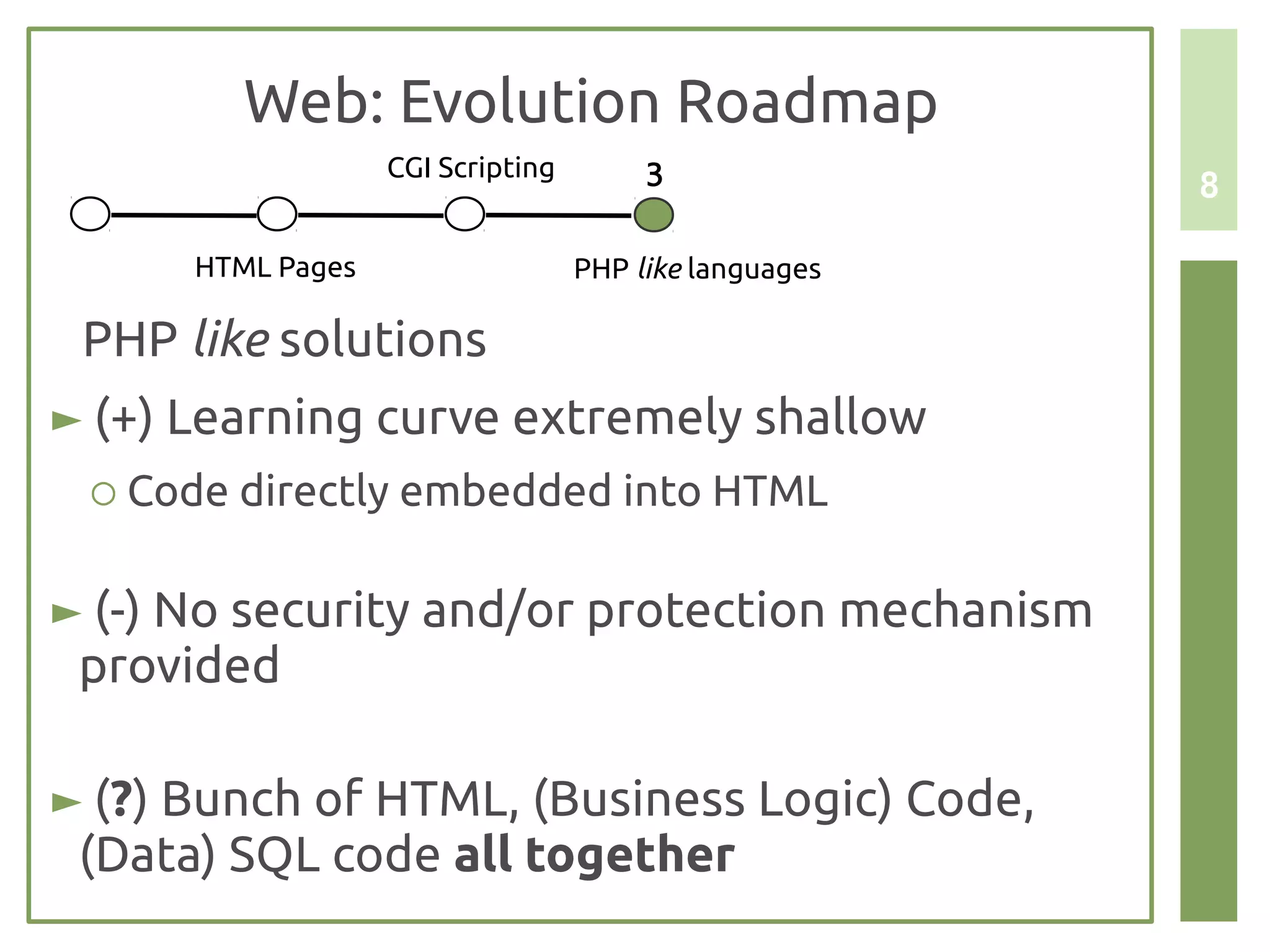
Web: Evolution Roadmap
                   CGI Scripting        3               8

      HTML Pages                   PHP like languages

 PHP like solutions
► (+) Learning curve extremely shallow
 ○ Code directly embedded into HTML


► (-) No security and/or protection mechanism
 provided

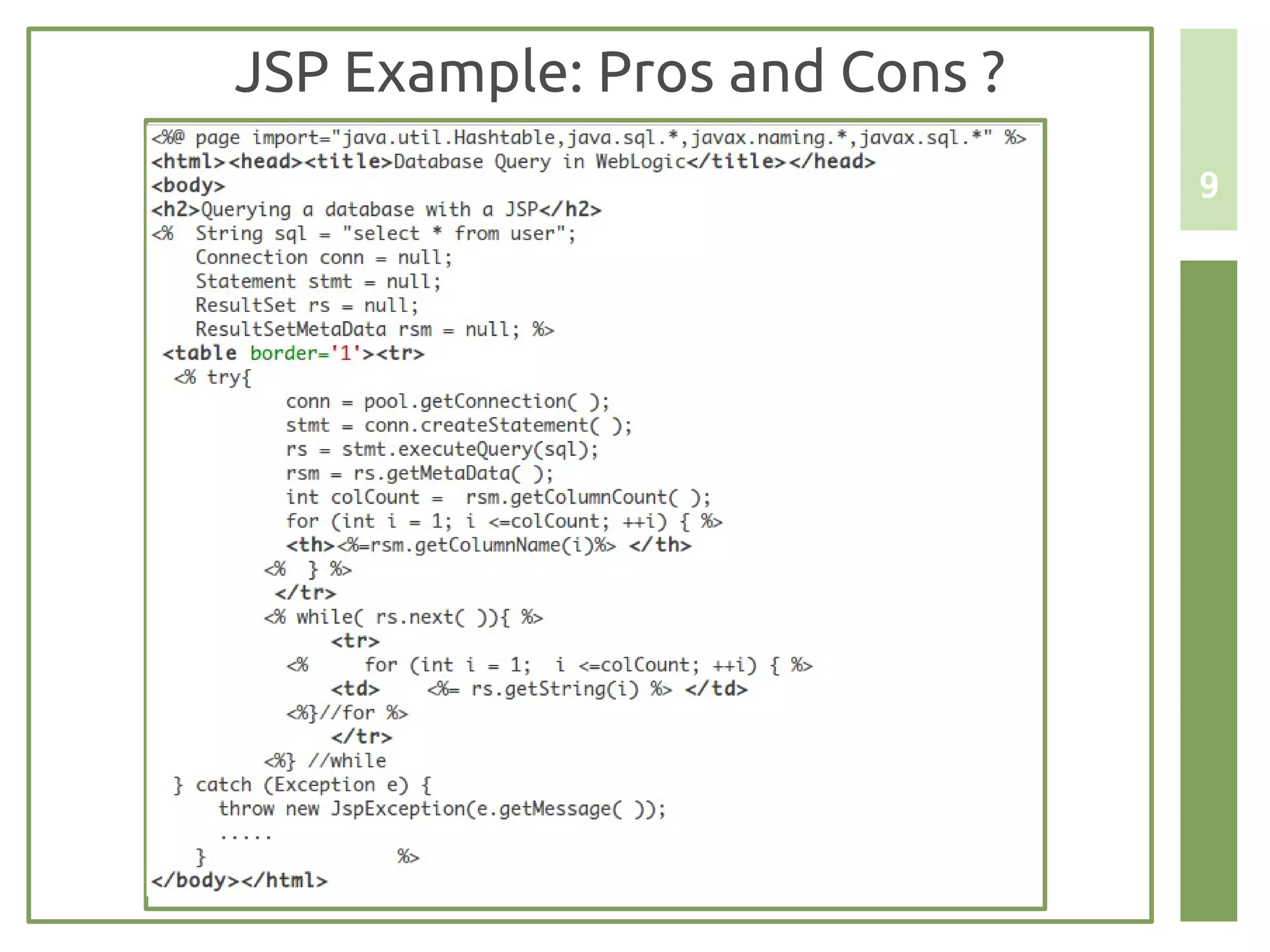
► (?) Bunch of HTML, (Business Logic) Code,
 (Data) SQL code all together
JSP Example: Pros and Cons ?
                               9
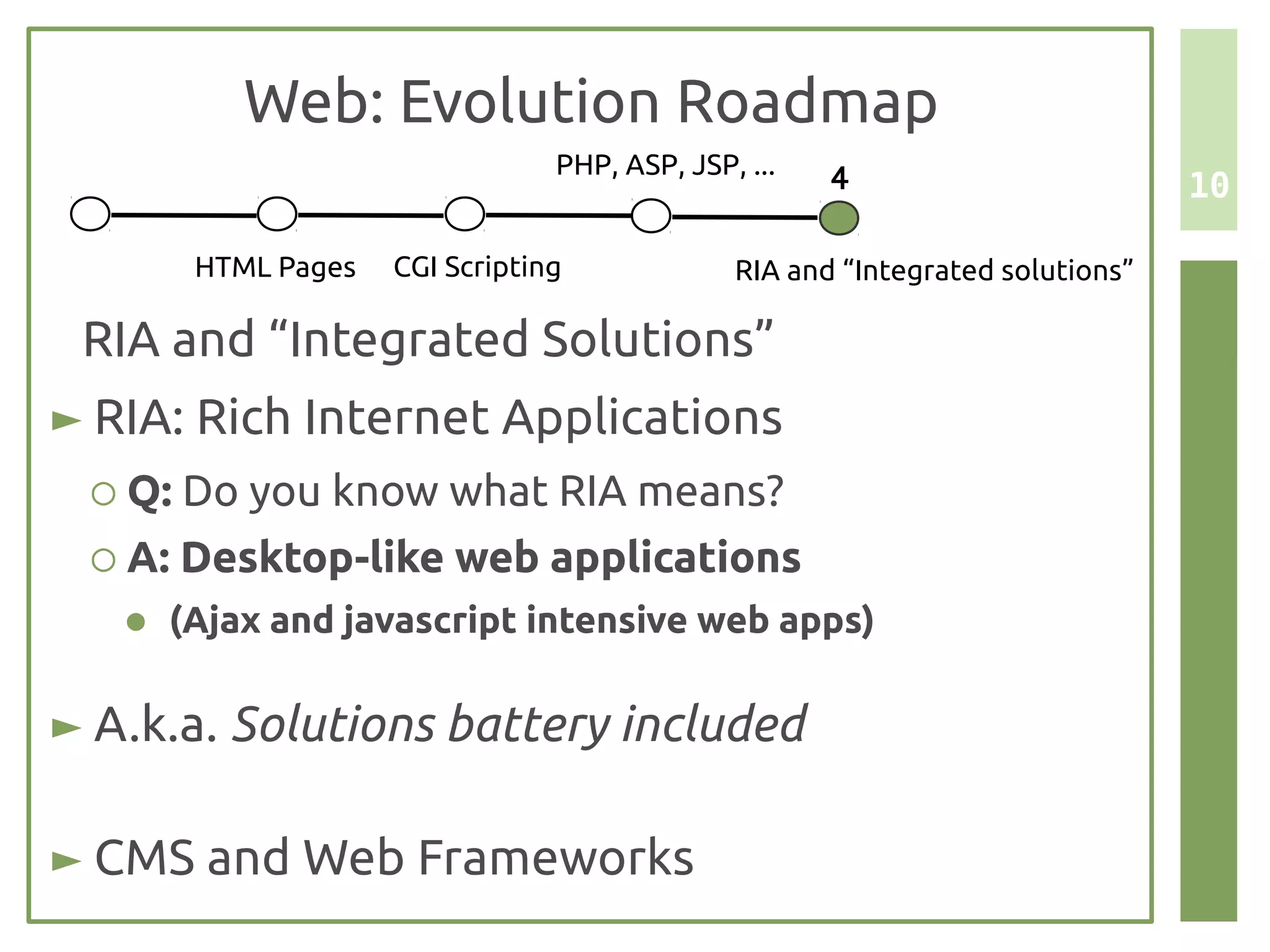
Web: Evolution Roadmap
                                 PHP, ASP, JSP, ...   4                         10

        HTML Pages   CGI Scripting             RIA and “Integrated solutions”

 RIA and “Integrated Solutions”
► RIA: Rich Internet Applications
 ○ Q: Do you know what RIA means?
 ○ A: Desktop-like web applications
   ●   (Ajax and javascript intensive web apps)

► A.k.a. Solutions battery included

► CMS and Web Frameworks
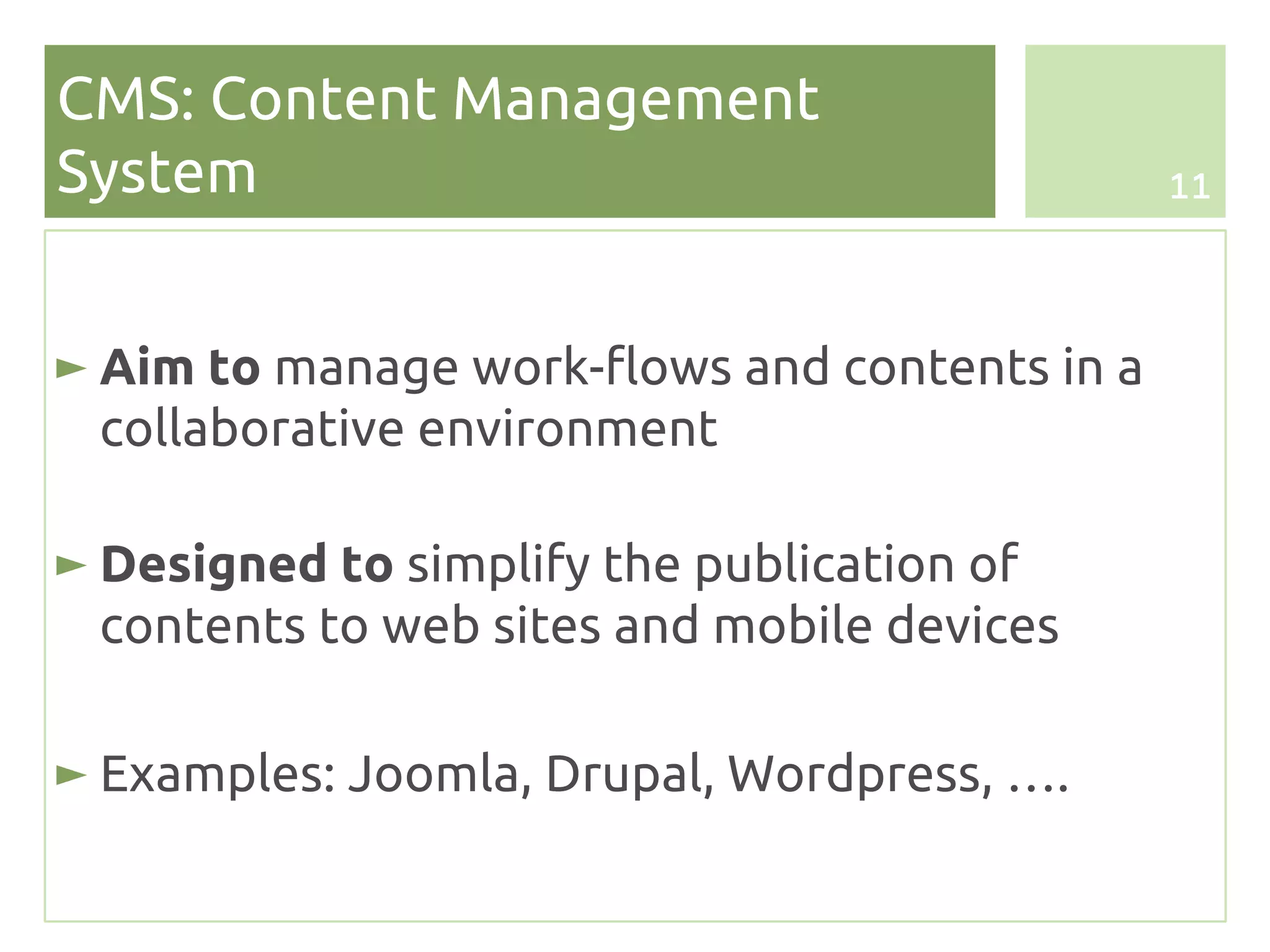
CMS: Content Management
System                                         11


► Aim to manage work-flows and contents in a
  collaborative environment

► Designed to simplify the publication of
  contents to web sites and mobile devices

► Examples: Joomla, Drupal, Wordpress, ….
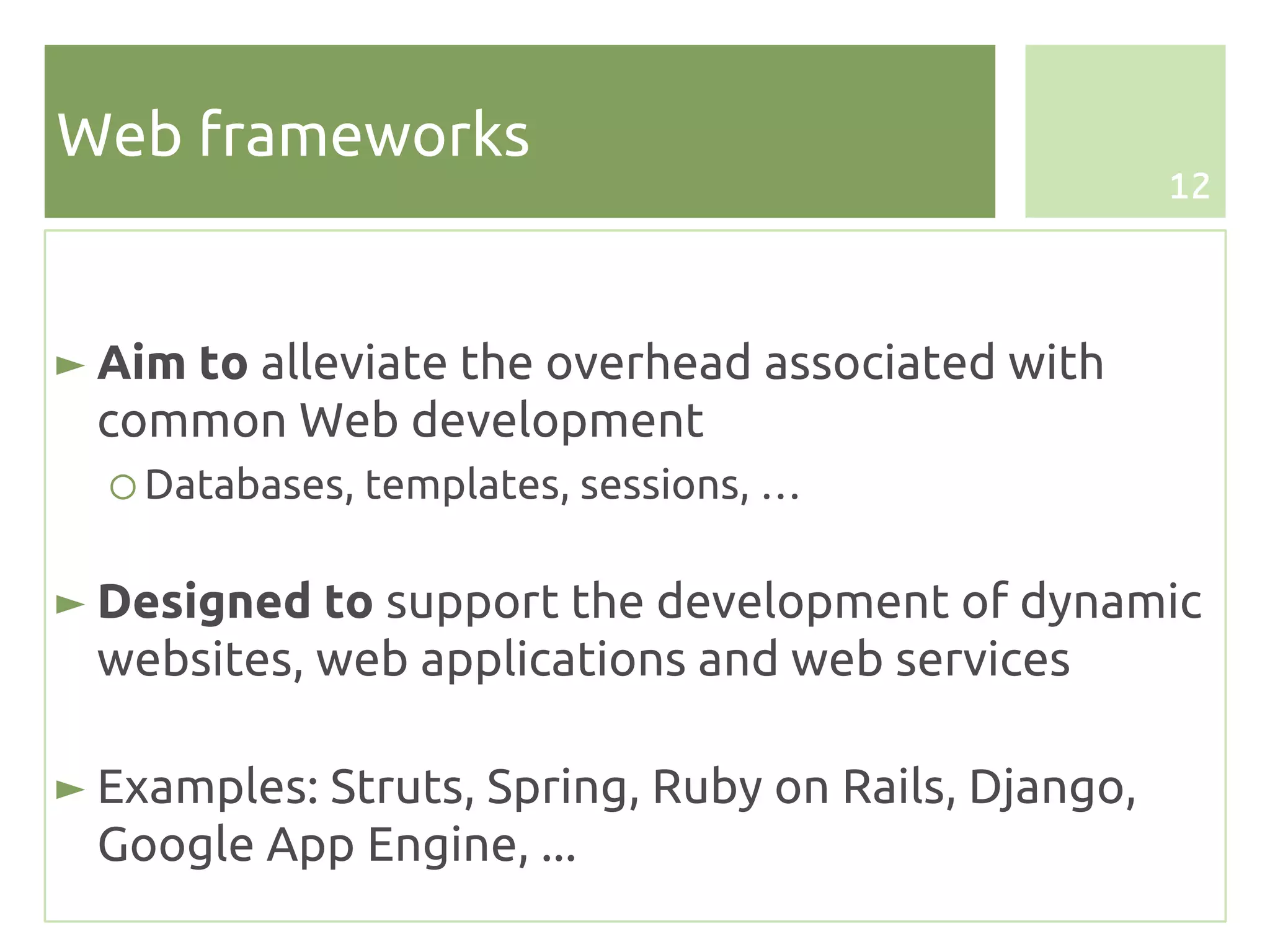
Web frameworks
                                                     12


► Aim to alleviate the overhead associated with
  common Web development
  ○ Databases, templates, sessions, …

► Designed to support the development of dynamic
  websites, web applications and web services

► Examples: Struts, Spring, Ruby on Rails, Django,
  Google App Engine, ...
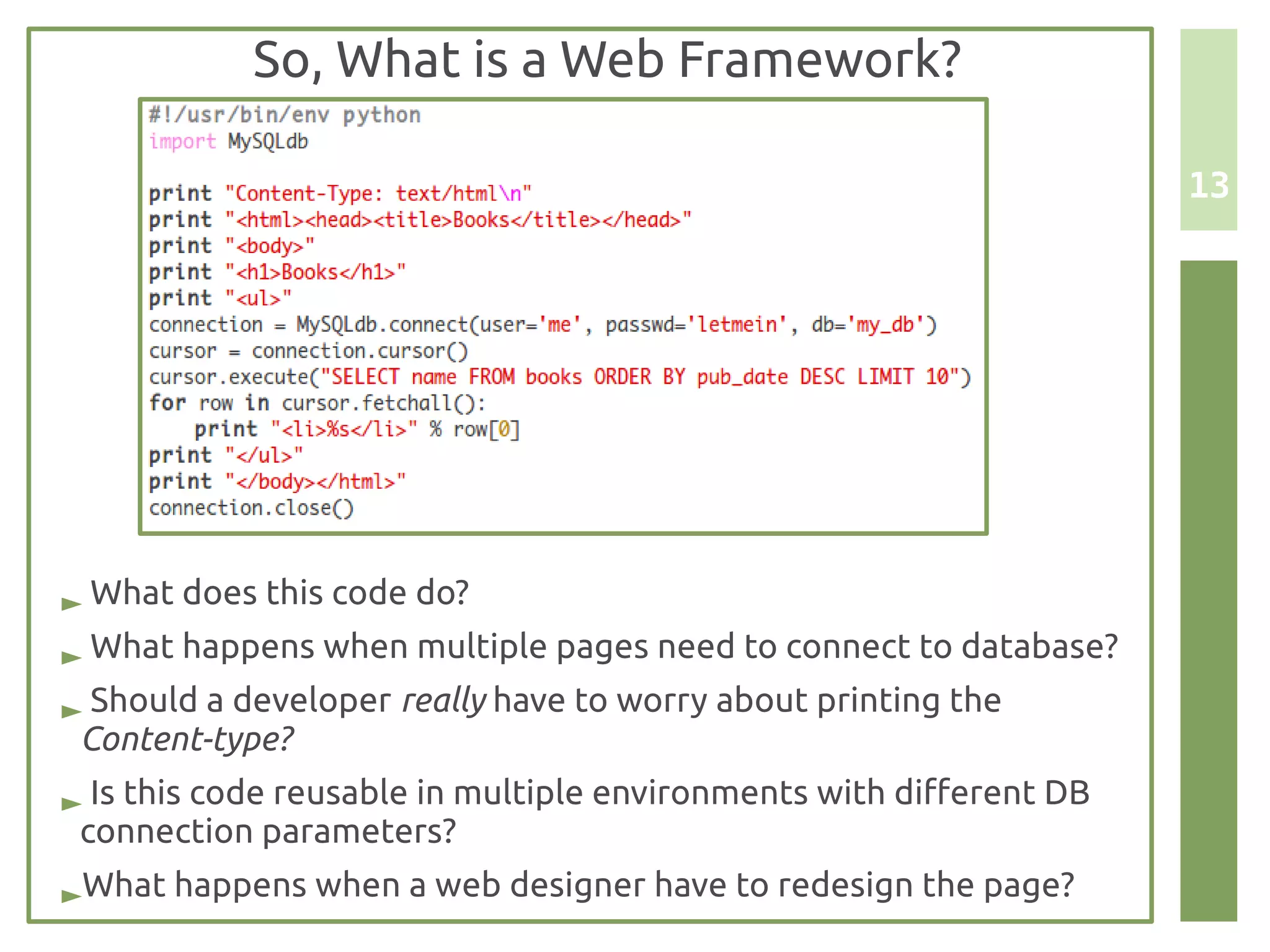
So, What is a Web Framework?

                                                                     13


► What does this code do?
► What happens when multiple pages need to connect to database?
► Should a developer really have to worry about printing the
 Content-type?
► Is this code reusable in multiple environments with different DB
 connection parameters?
►What happens when a web designer have to redesign the page?
Web Frameworks in a nutshell
                                               14


► These problems are exactly what a web
  frameworks tries to solve

► Web frameworks provides a programming
  infrastructure for applications

► Focus on developing code without having to
  reinvent the wheel
2. Web Frameworks Design
        Principles


                           15
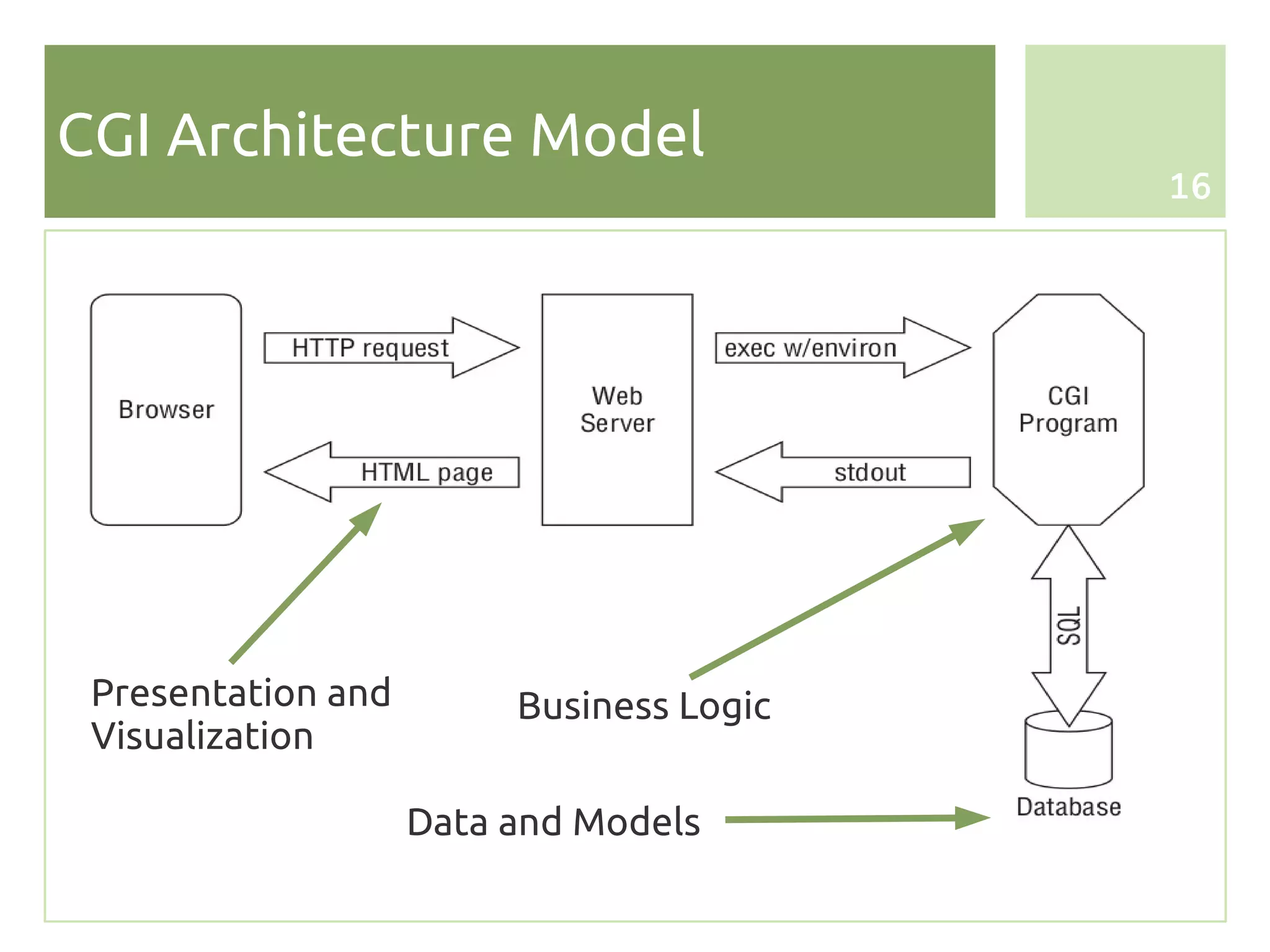
CGI Architecture Model
                                          16


 Presentation and        Business Logic
 Visualization

                    Data and Models
CGI Architecture Model
                                                    17


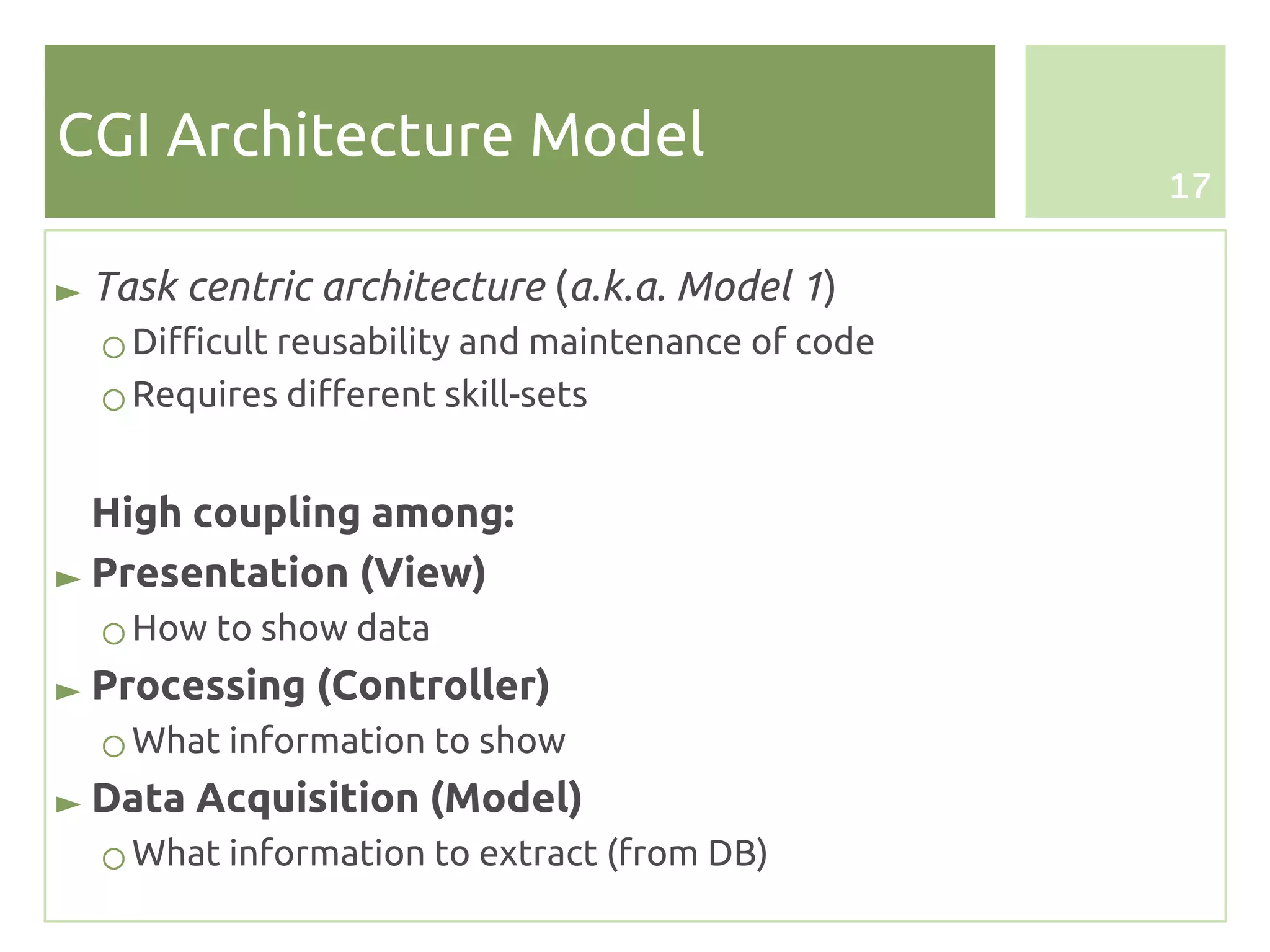
► Task centric architecture (a.k.a. Model 1)
  ○ Difficult reusability and maintenance of code
  ○ Requires different skill-sets


  High coupling among:
► Presentation (View)
  ○ How to show data
► Processing (Controller)
  ○ What information to show
► Data Acquisition (Model)
  ○ What information to extract (from DB)
Model 1 Architecture (Java)
                                              18


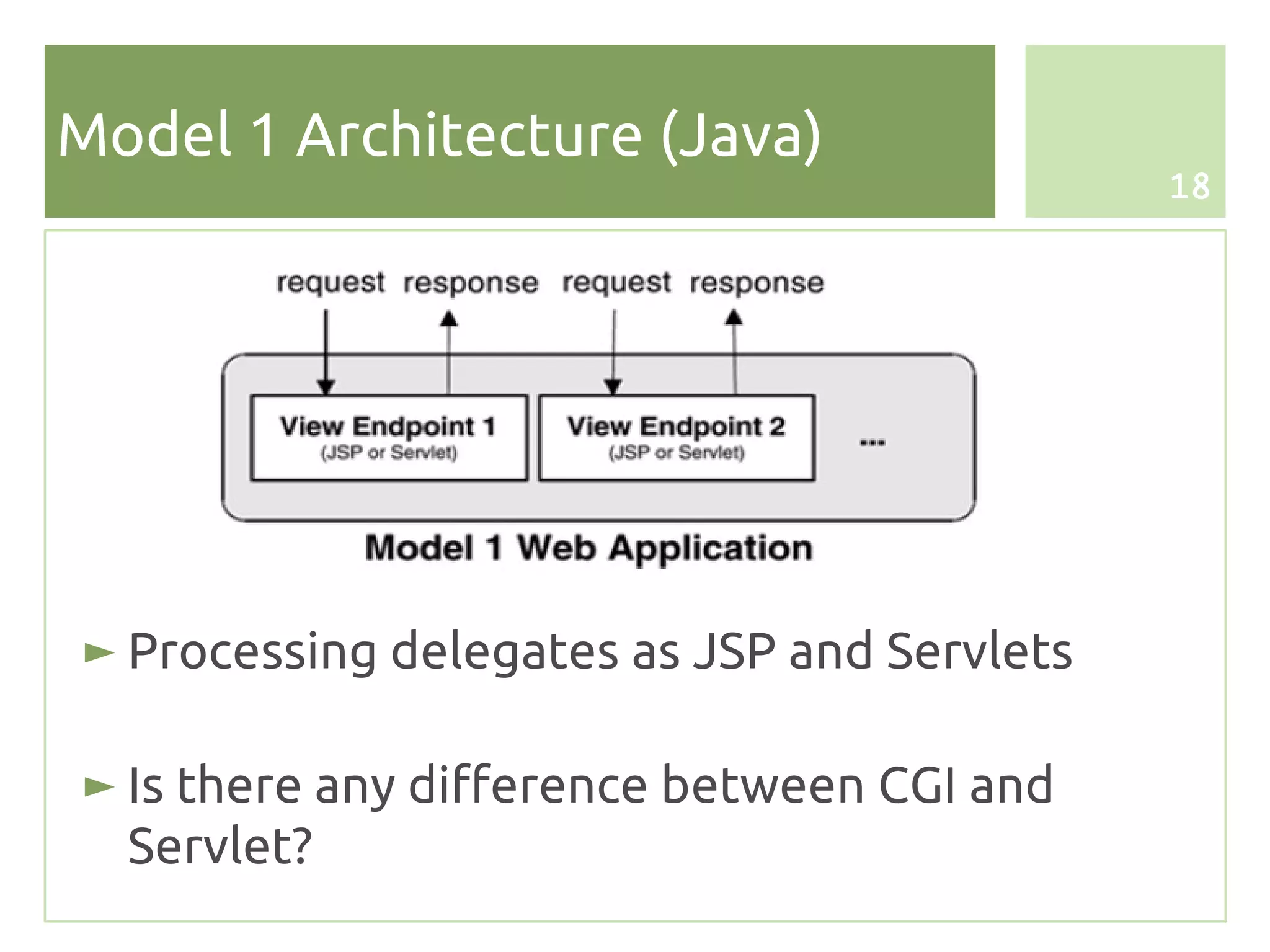
 ► Processing delegates as JSP and Servlets

 ► Is there any difference between CGI and
   Servlet?
MVC Architecture Model
                                                                      19


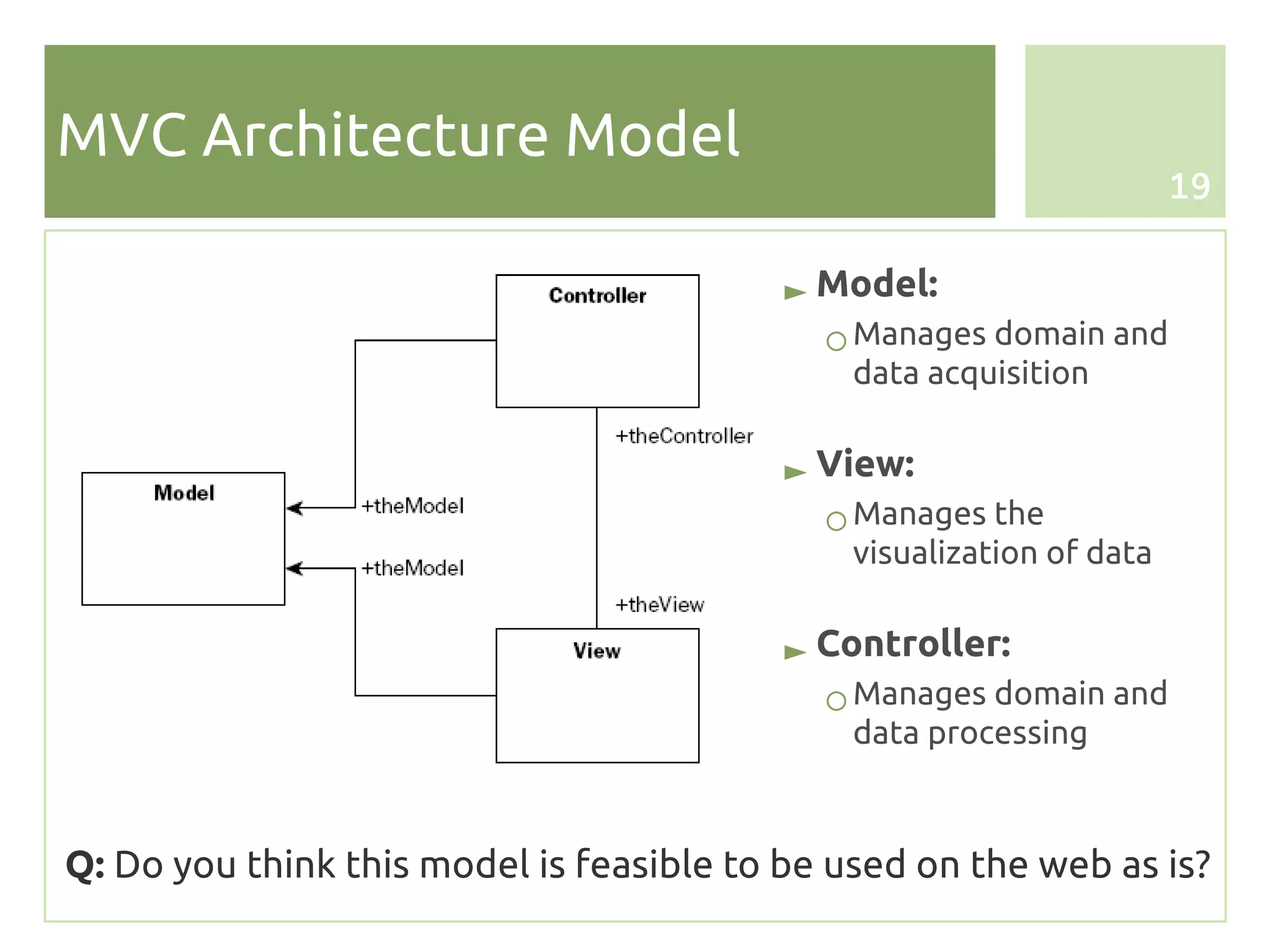
                                          ► Model:
                                            ○ Manages domain and
                                              data acquisition


                                          ► View:
                                            ○ Manages the
                                              visualization of data


                                          ► Controller:
                                            ○ Manages domain and
                                              data processing


Q: Do you think this model is feasible to be used on the web as is?
Web-MVC Architecture Model
                                                                  20


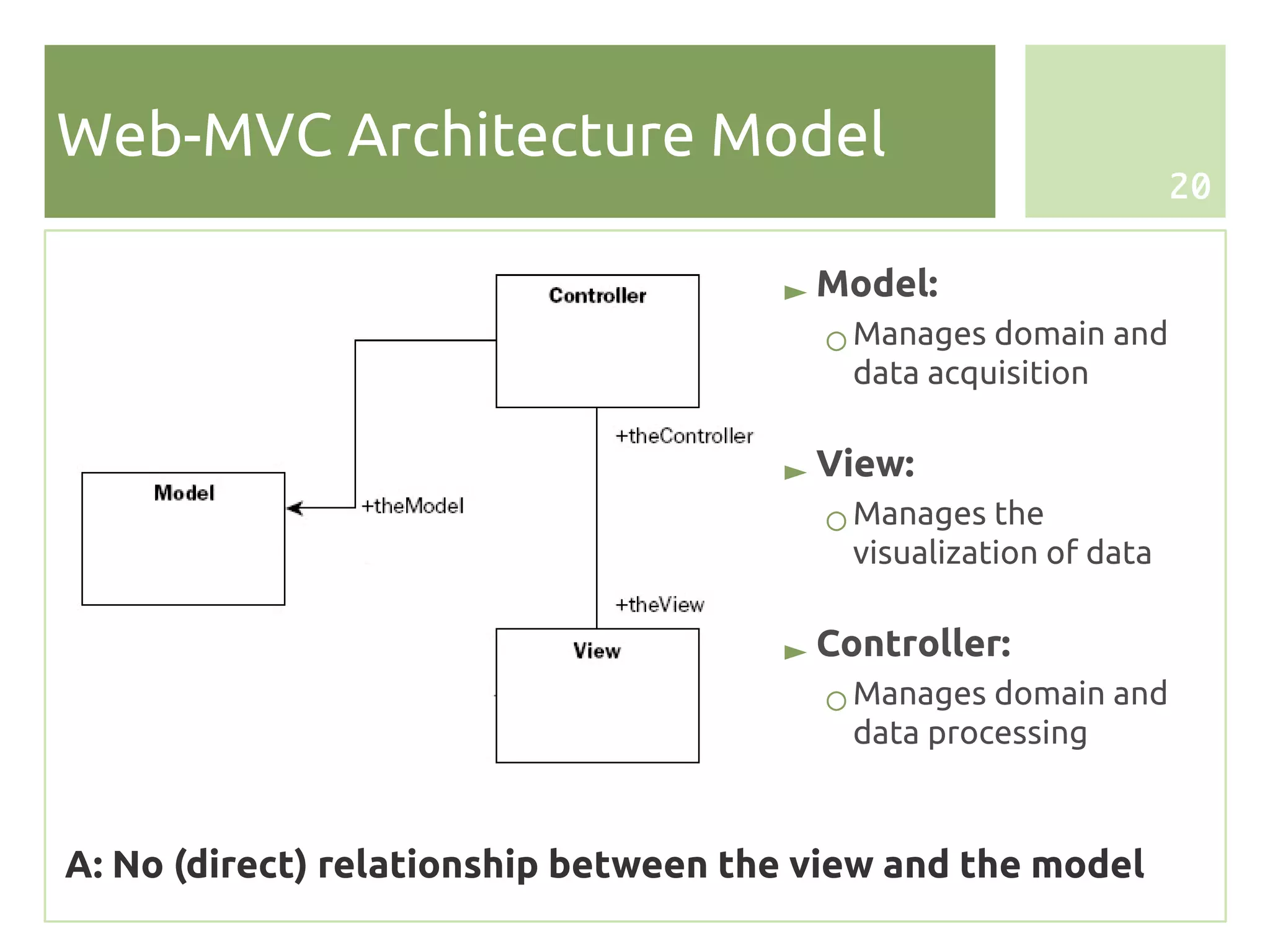
                                      ► Model:
                                        ○ Manages domain and
                                          data acquisition


                                      ► View:
                                        ○ Manages the
                                          visualization of data


                                      ► Controller:
                                        ○ Manages domain and
                                          data processing


A: No (direct) relationship between the view and the model
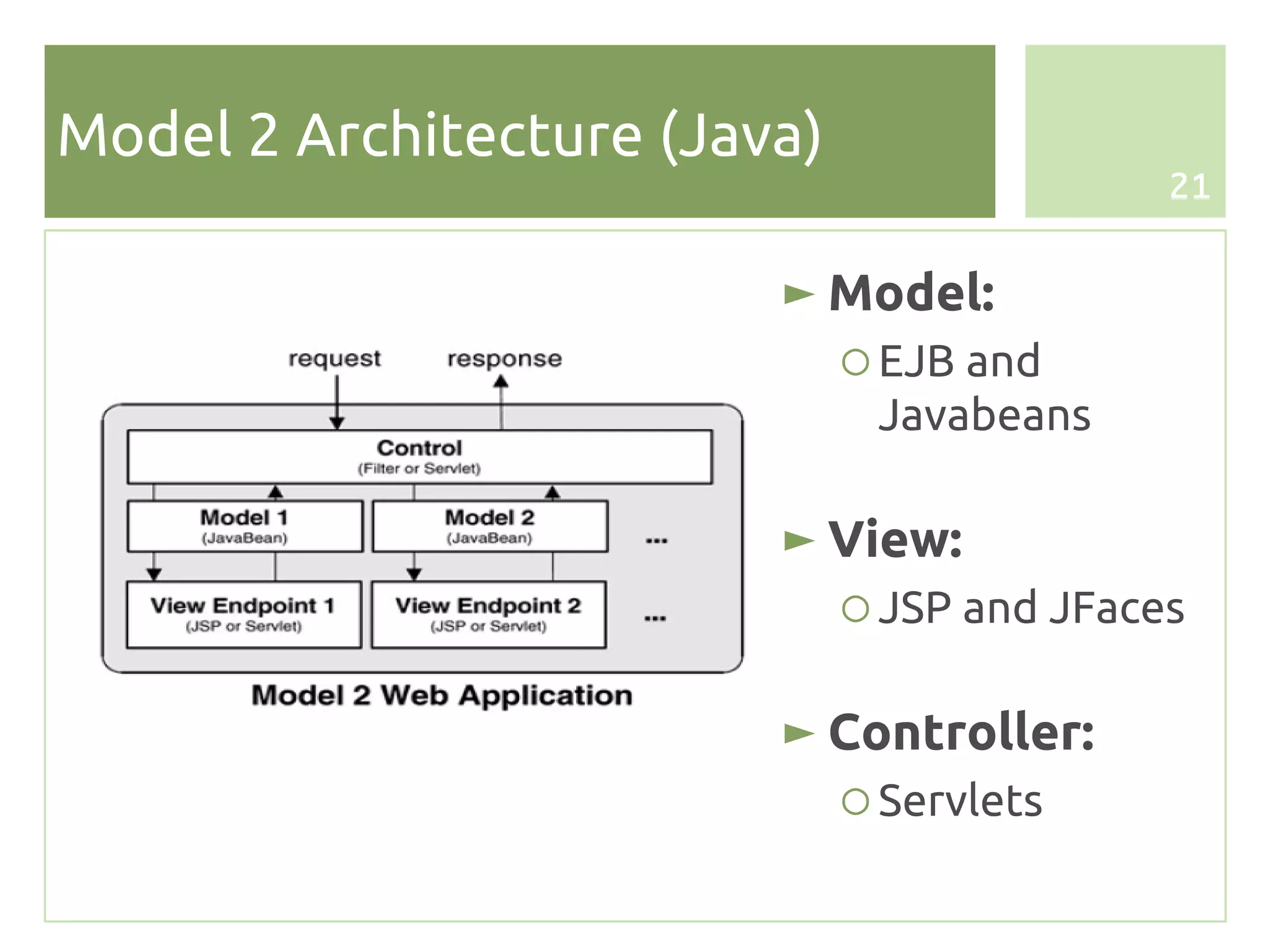
Model 2 Architecture (Java)
                                             21


                         ► Model:
                              ○ EJB and
                                Javabeans

                         ► View:
                              ○ JSP and JFaces

                         ► Controller:
                              ○ Servlets
Fulll-stack web frameworks
                                                       22


► From Python.org wiki:

 [..] frameworks provide support for a number of
 activities such as interpreting requests, producing
 responses, storing data persistently, and so on.
 [..] those frameworks [..] are often known as full-
 stack frameworks in that they attempt to supply
 components for each layer in the stack.

► So, what are such components?
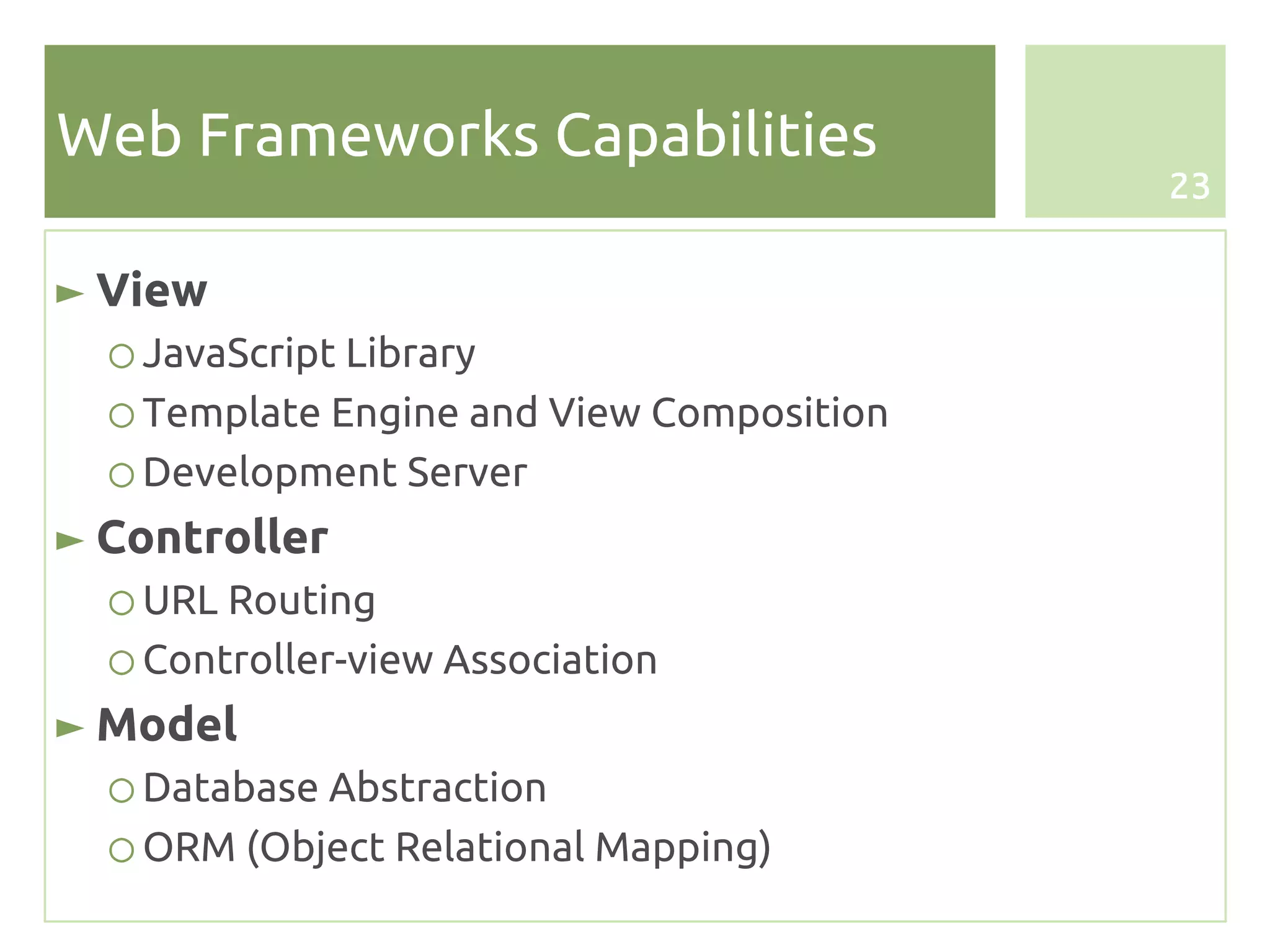
Web Frameworks Capabilities
                                           23


► View
  ○ JavaScript Library
  ○ Template Engine and View Composition
  ○ Development Server
► Controller
  ○ URL Routing
  ○ Controller-view Association
► Model
  ○ Database Abstraction
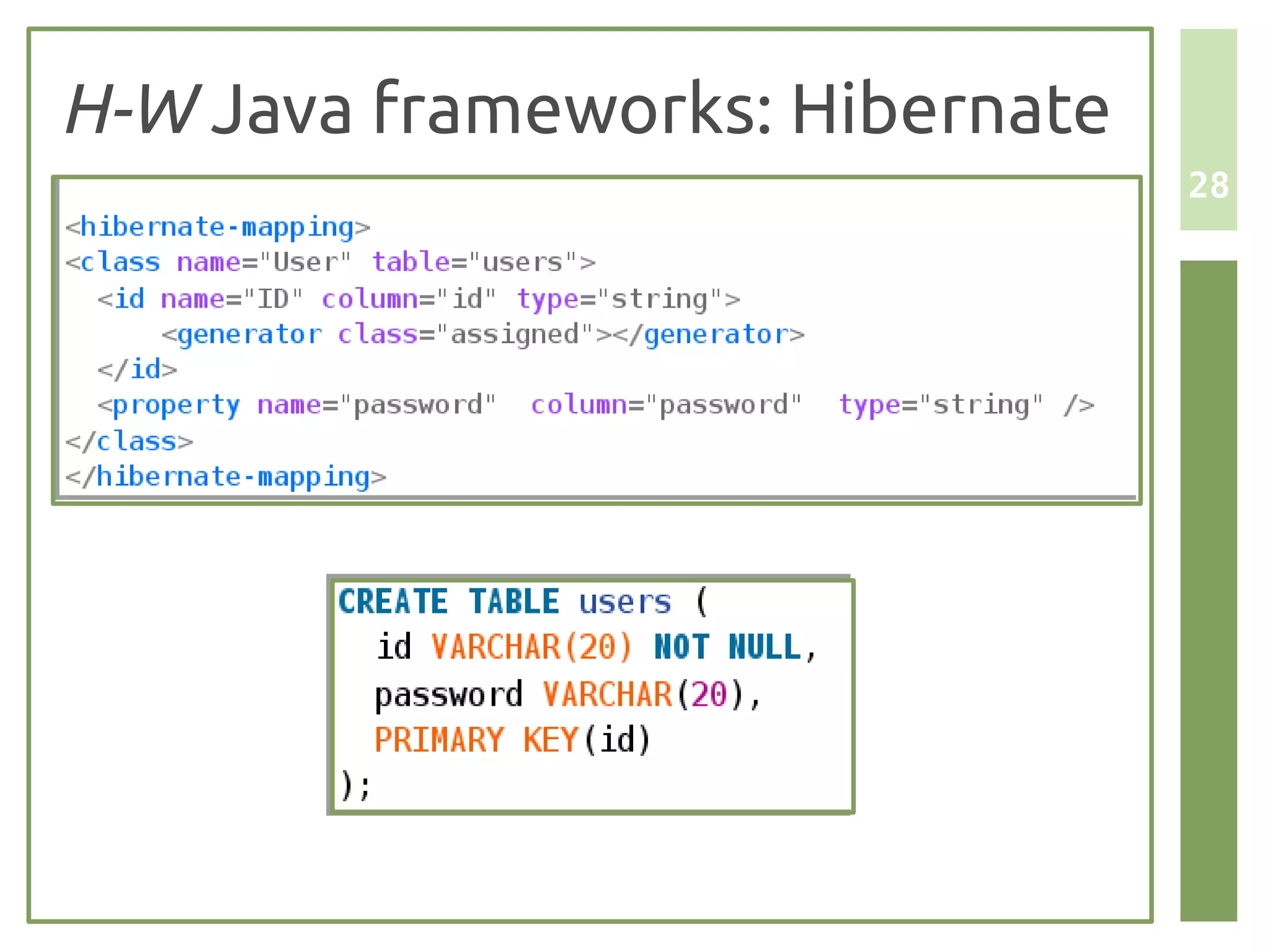
  ○ ORM (Object Relational Mapping)
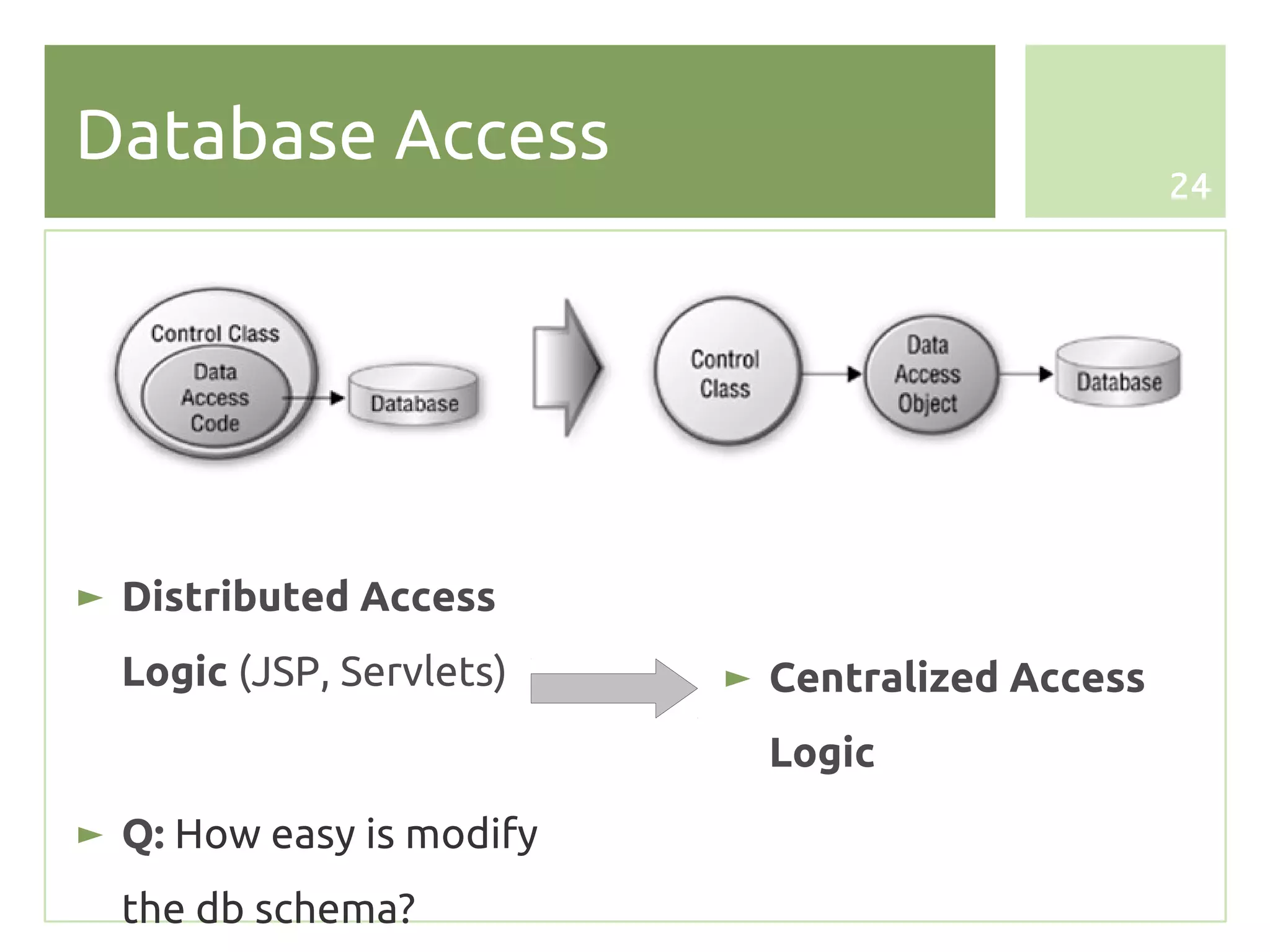
Database Access
                                                 24


► Distributed Access
  Logic (JSP, Servlets)   ► Centralized Access
                            Logic
► Q: How easy is modify
  the db schema?
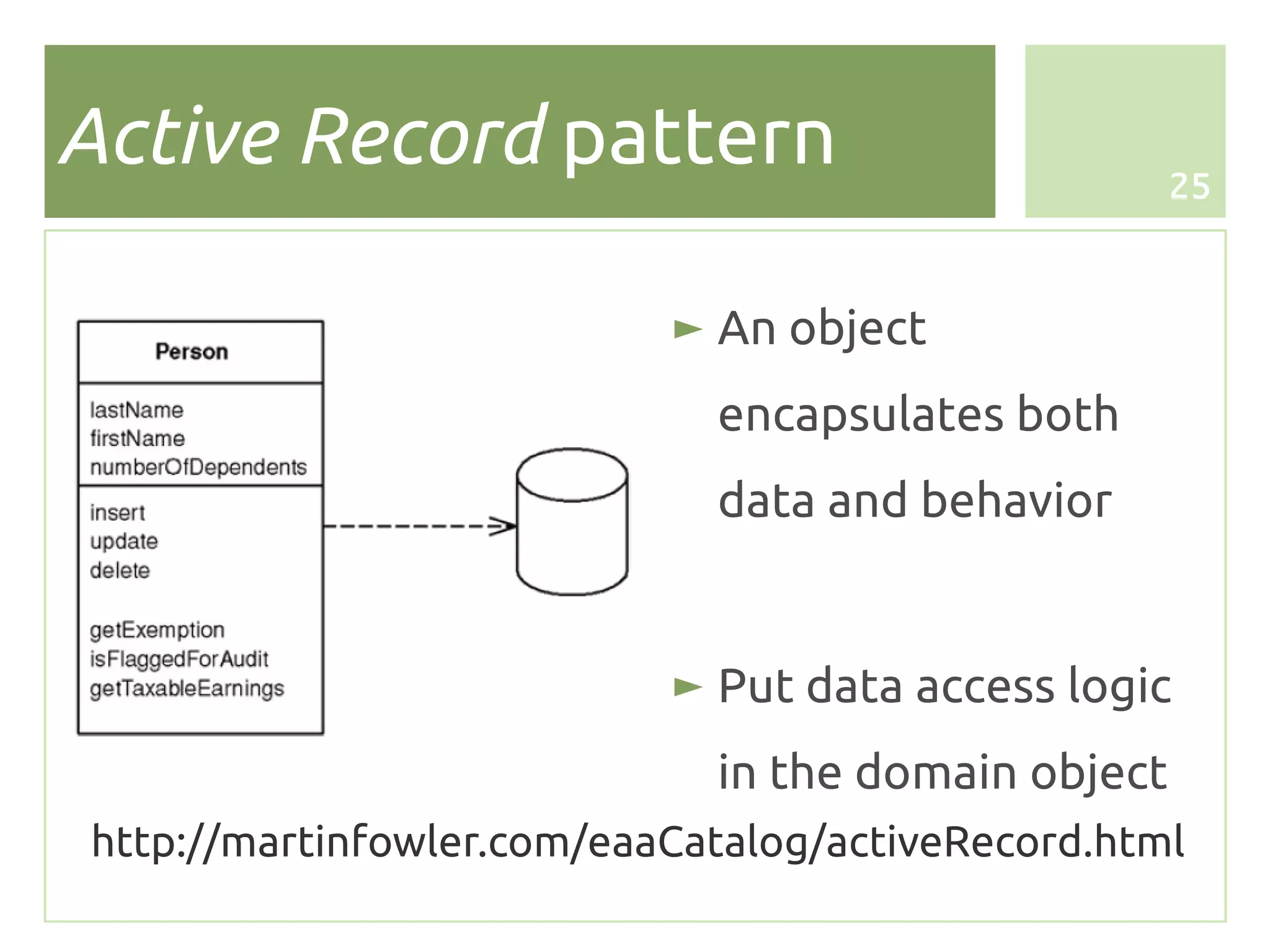
Active Record pattern                               25


                           ► An object
                             encapsulates both
                             data and behavior


                           ► Put data access logic
                             in the domain object
http://martinfowler.com/eaaCatalog/activeRecord.html
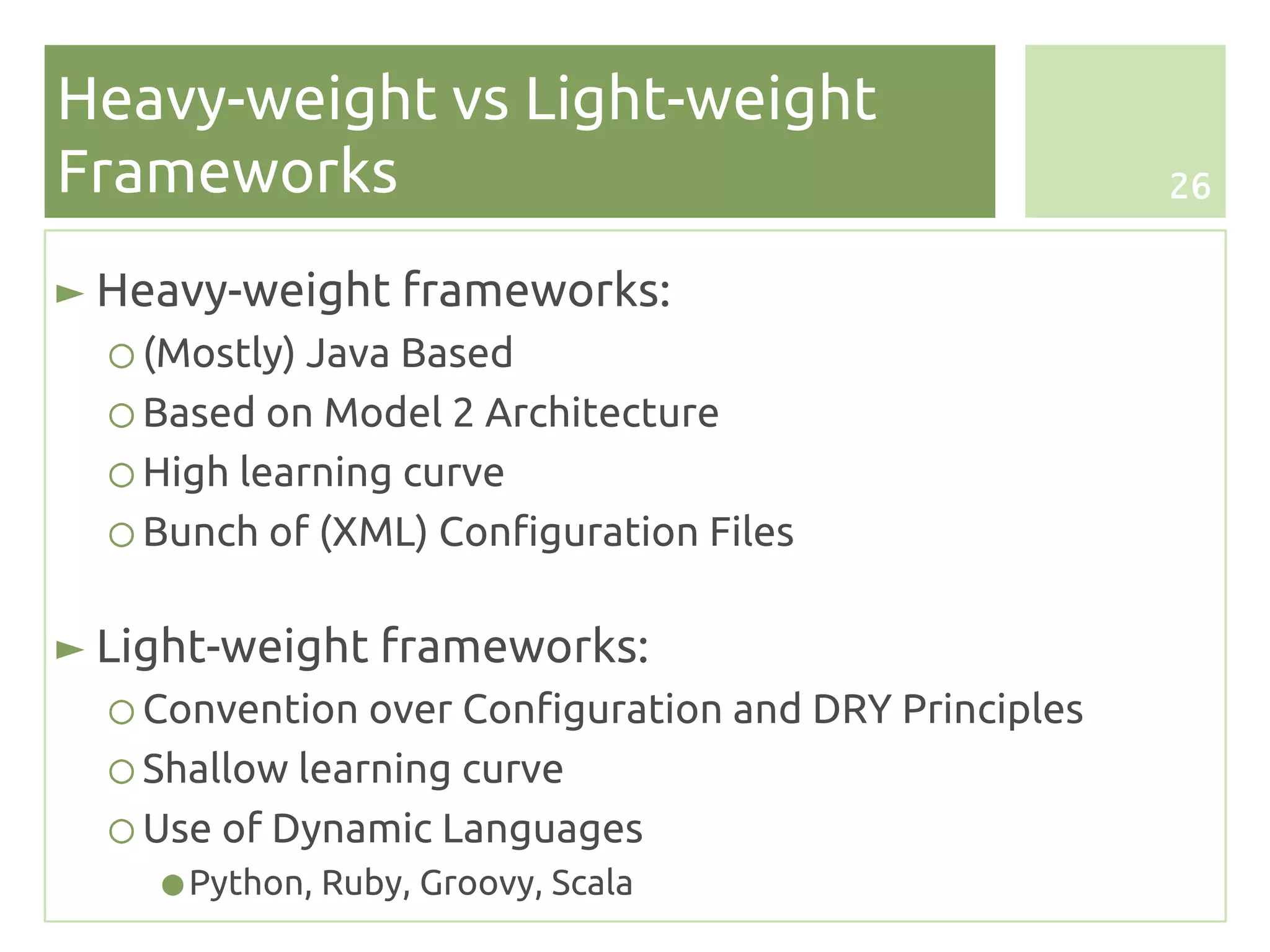
Heavy-weight vs Light-weight
Frameworks                                             26


► Heavy-weight frameworks:
  ○ (Mostly) Java Based
  ○ Based on Model 2 Architecture
  ○ High learning curve
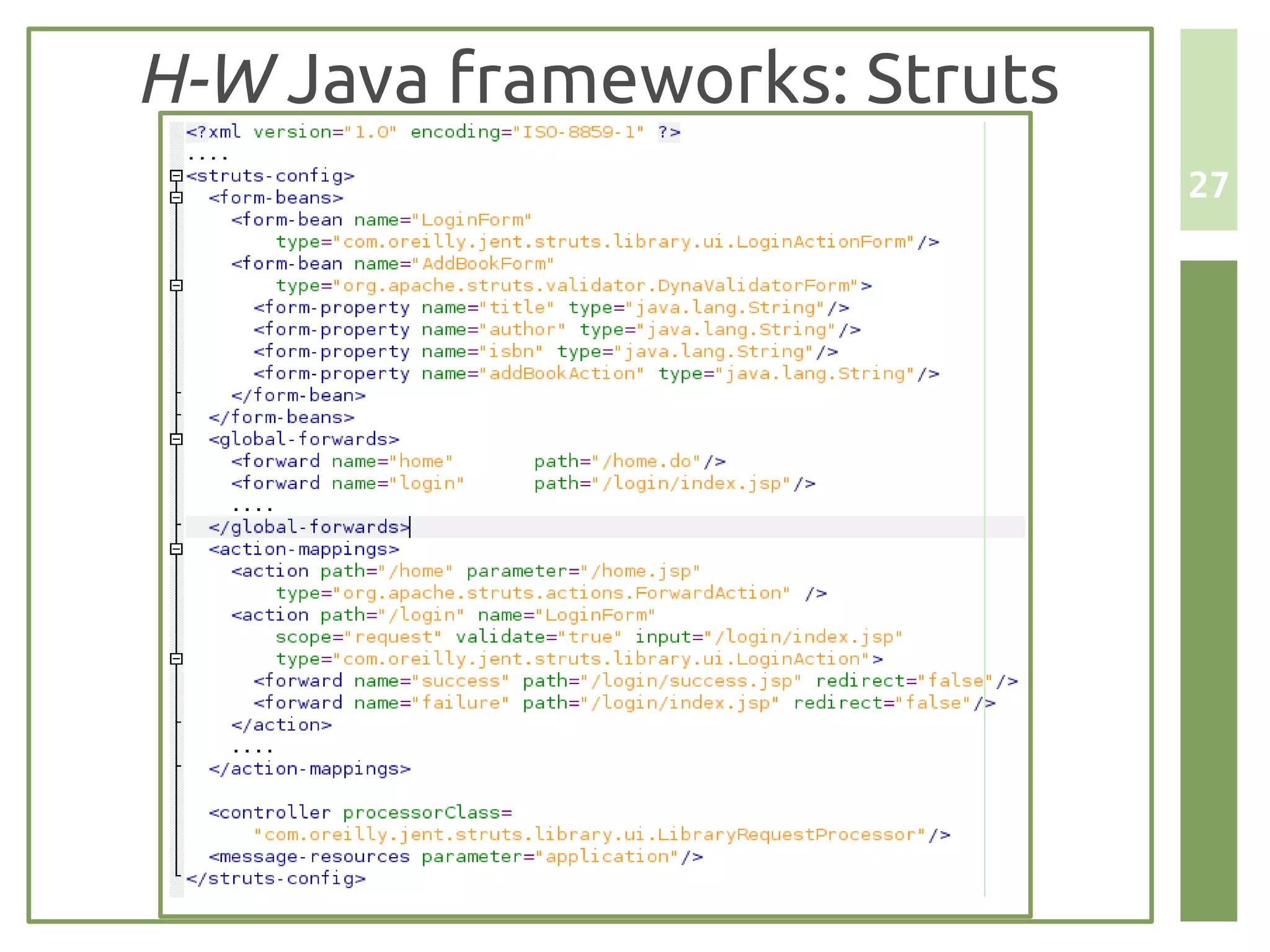
  ○ Bunch of (XML) Configuration Files

► Light-weight frameworks:
  ○ Convention over Configuration and DRY Principles
  ○ Shallow learning curve
  ○ Use of Dynamic Languages
    ● Python, Ruby, Groovy, Scala
H-W Java frameworks: Struts
                              27
H-W Java frameworks: Hibernate
                                 28
Design Principles
                                                                      29


► Convention over configuration
  ○ “Convention over Configuration is a programming design that favors
    following a certain set of programming conventions instead of
    configuring an application framework. [...]”


► DRY (Don't repeat yourself)

  ○ “DRY is a principle that focuses on reducing information duplication
    by keeping any piece of knowledge in a system in only one place.
3. Case Study:
   Django and
Google App Engine


                    30
Frameworks and Languages
                           31
Python Programming Language
                                                          32

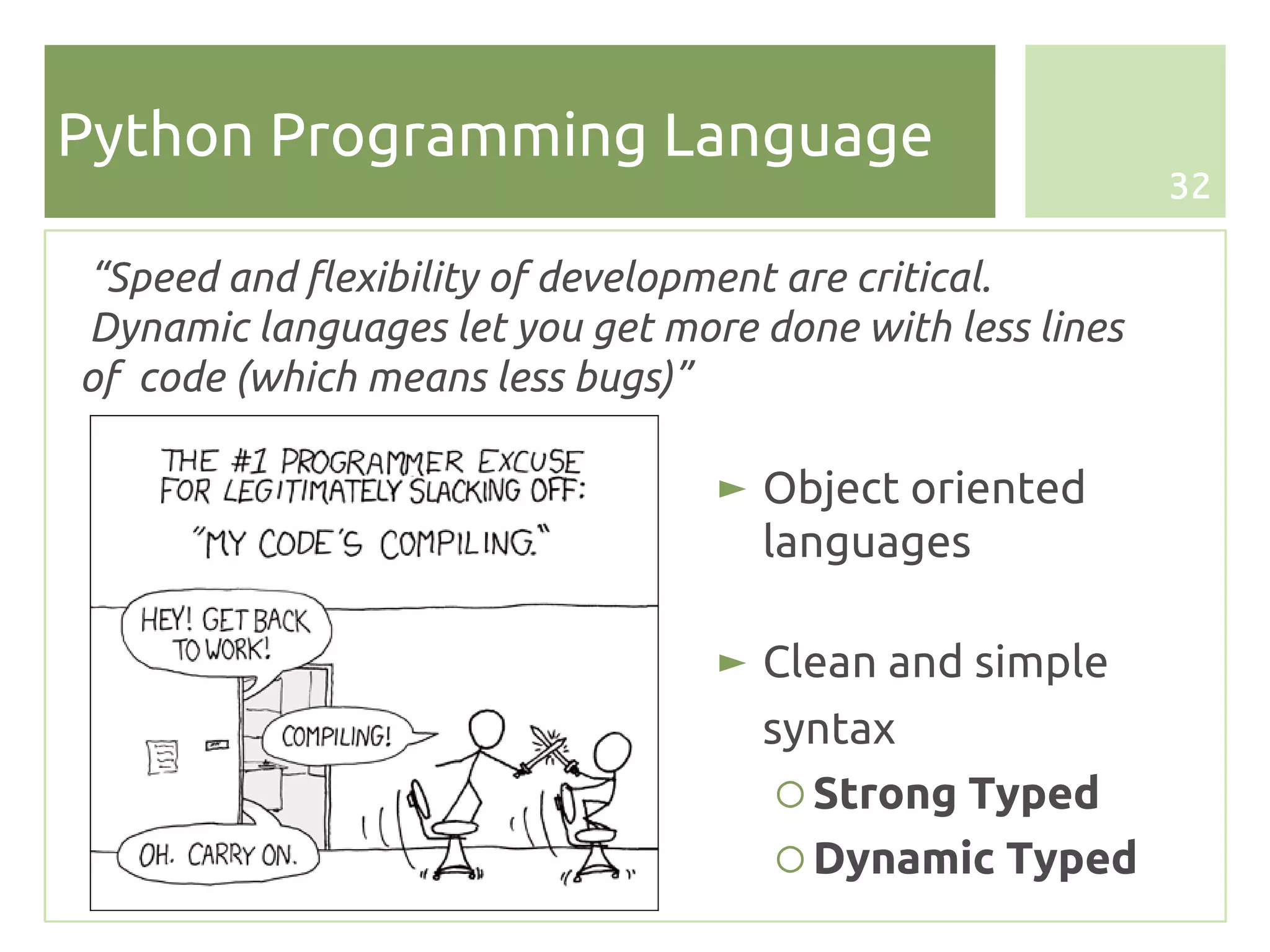
“Speed and flexibility of development are critical.
Dynamic languages let you get more done with less lines
of code (which means less bugs)”

                                 ► Object oriented
                                   languages

                                 ► Clean and simple
                                   syntax
                                    ○ Strong Typed
                                    ○ Dynamic Typed
Python Programming Language
                                         33


► Is there someone that uses
  python in professional
  projects?
  ○ IBM, Google, Sun, HP, Industrial
    Light and Magic, NASA, Microsoft

► Goggle it:
    ● site:microsoft.com python
    ● You'll get more than 9 thousands
      results
Python:
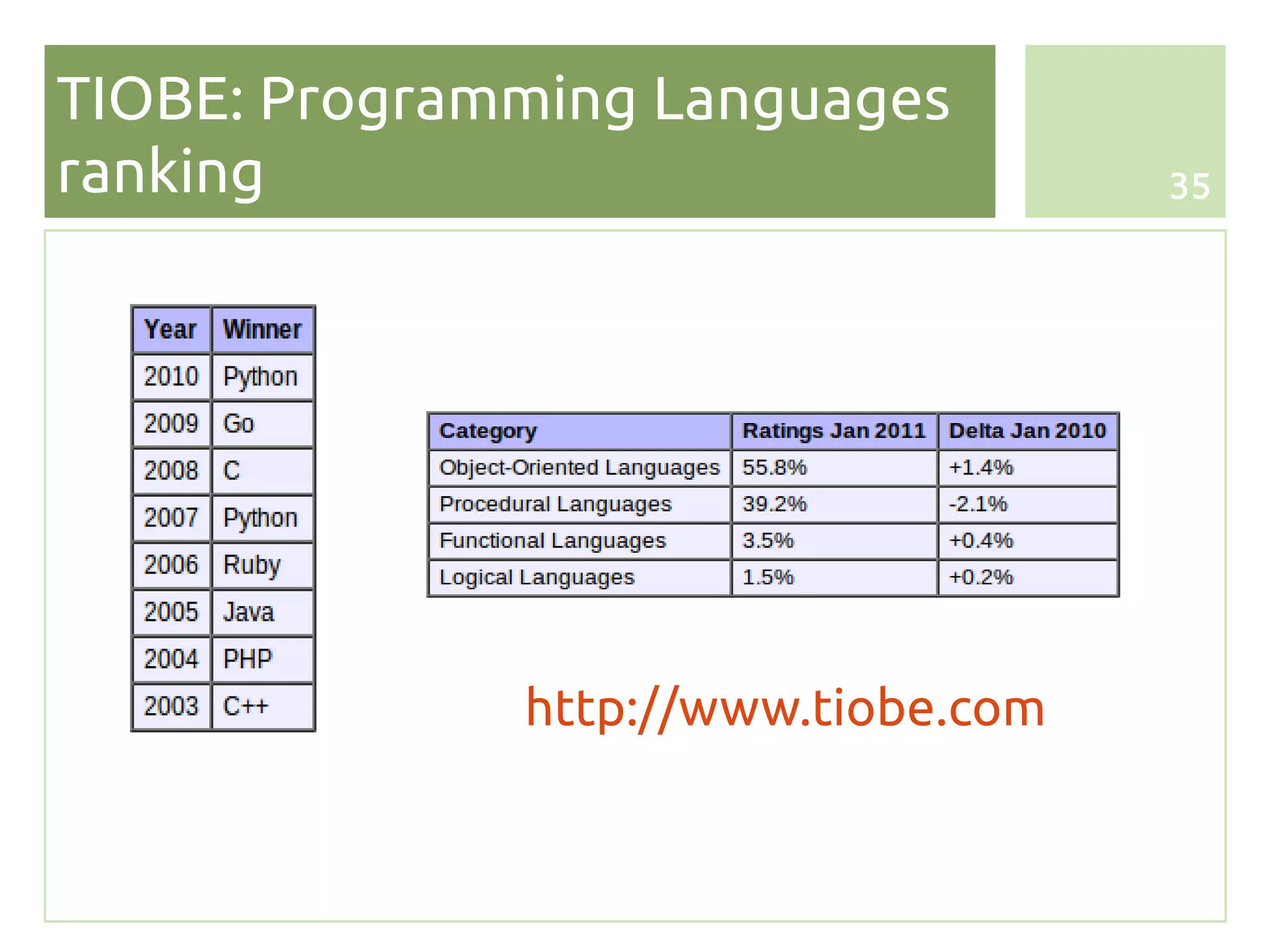
Language of the year 2010                                                          34

Programming language Python has become programming
language of 2010. This award is given to the programming
language that gained most market share in 2010.
Python grew 1.81% since January 2010. This is a bit more
than runner up Objective-C (+1.63%).
Objective-C was favorite for the title for a long time thanks
to the popularity of Apple's iPhone and iPad platforms.
However, it lost too much popularity the last couples of
months.


Python has become the "de facto" standard in system
scripting (being a successor of Perl in this), but it is used for
much more different types of application areas nowadays.            Source: tiobe.com
Python is for instance very popular among web developers,
especially in combination with the Django framework.
Since Python is easy to learn, more and more universities are
using Python to teach programming languages.
TIOBE: Programming Languages
ranking                              35


              http://www.tiobe.com
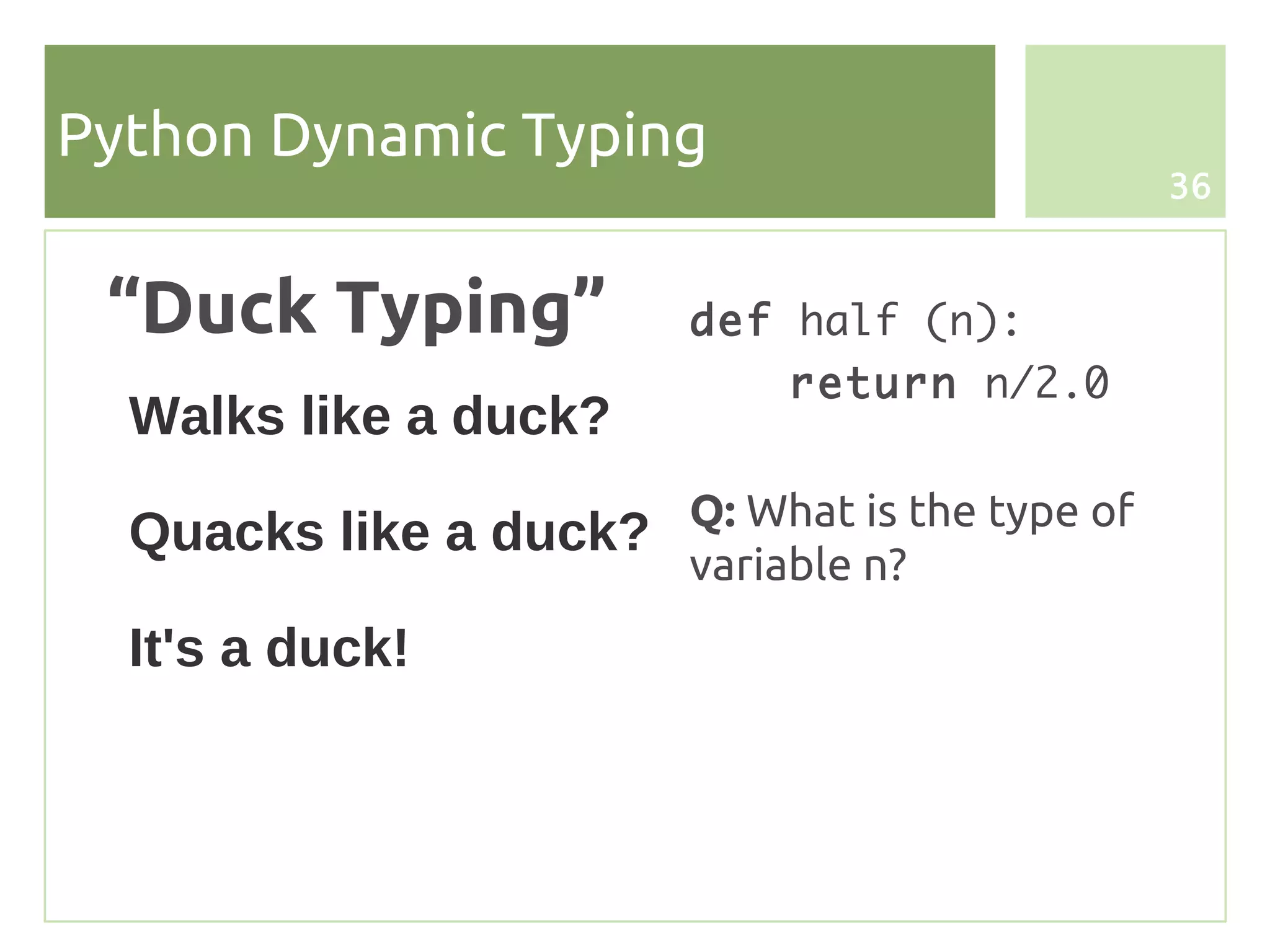
Python Dynamic Typing
                                               36


 “Duck Typing”           def half (n):
                              return n/2.0
  Walks like a duck?

  Quacks like a duck? Q: What is the type of
                         variable n?
  It's a duck!
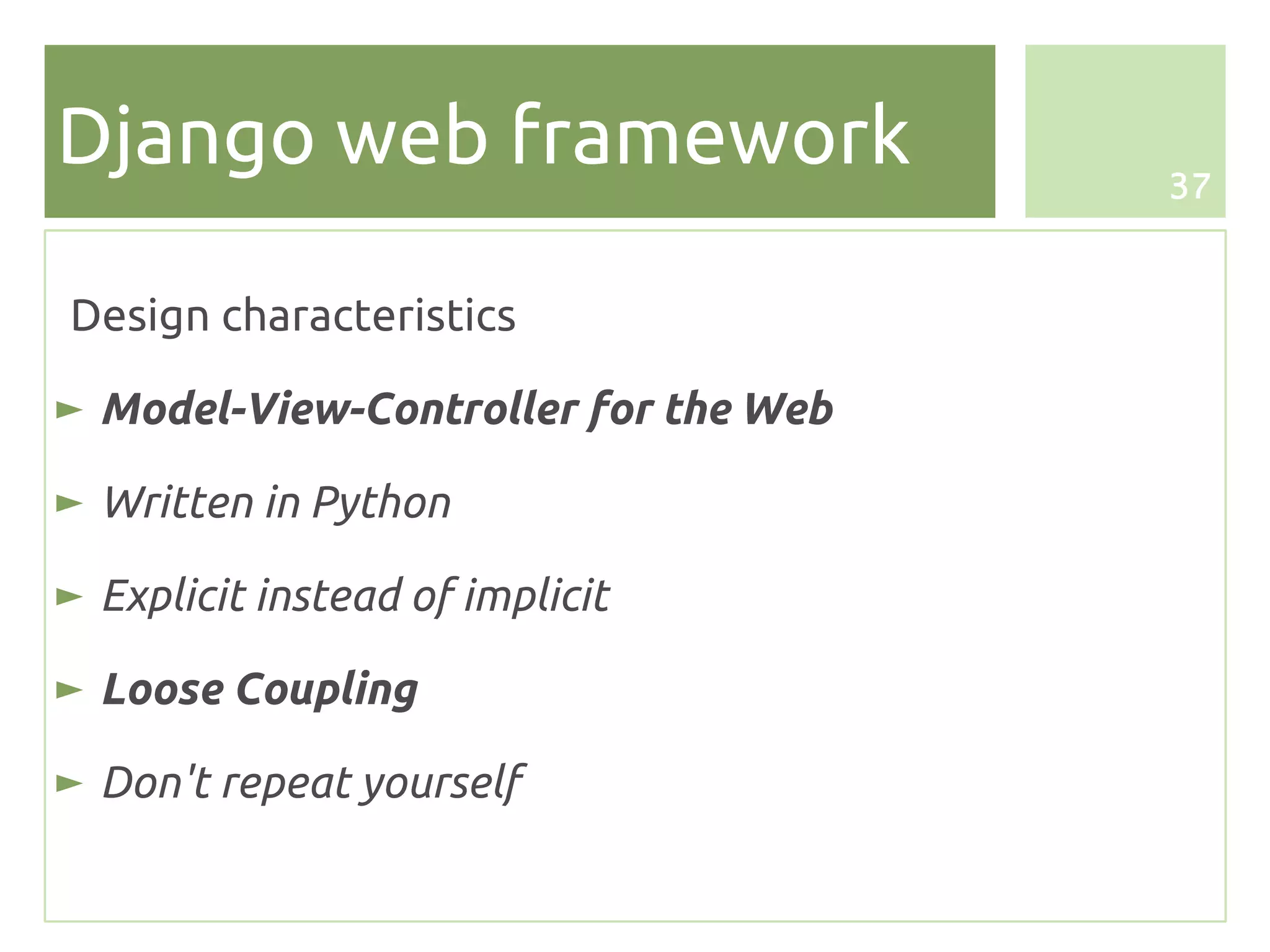
Django web framework                  37


Design characteristics

► Model-View-Controller for the Web

► Written in Python

► Explicit instead of implicit

► Loose Coupling

► Don't repeat yourself
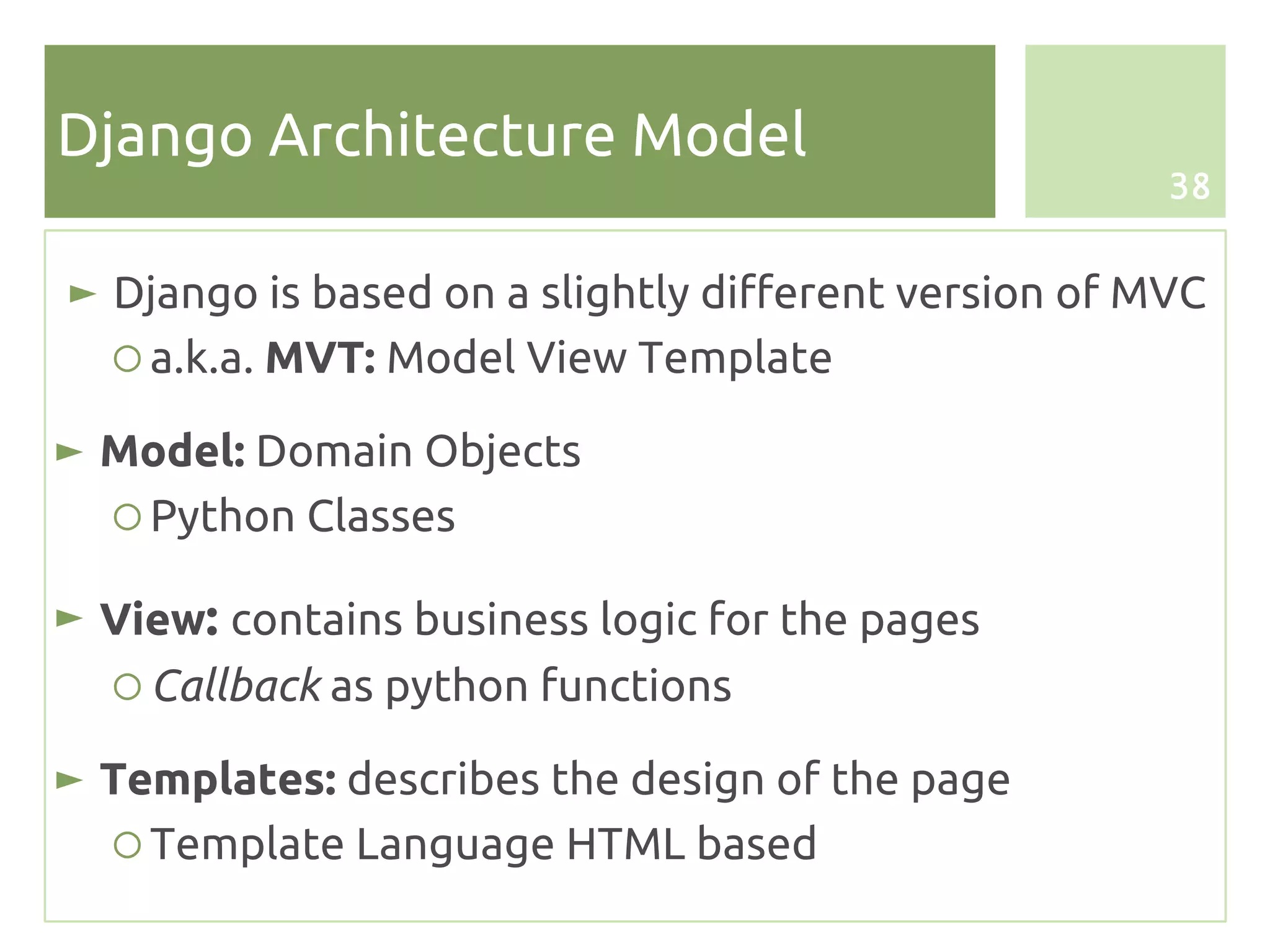
Django Architecture Model
                                                      38


► Django is based on a slightly different version of MVC
  ○ a.k.a. MVT: Model View Template

► Model: Domain Objects
  ○ Python Classes

► View: contains business logic for the pages
  ○ Callback as python functions

► Templates: describes the design of the page
   ○ Template Language HTML based
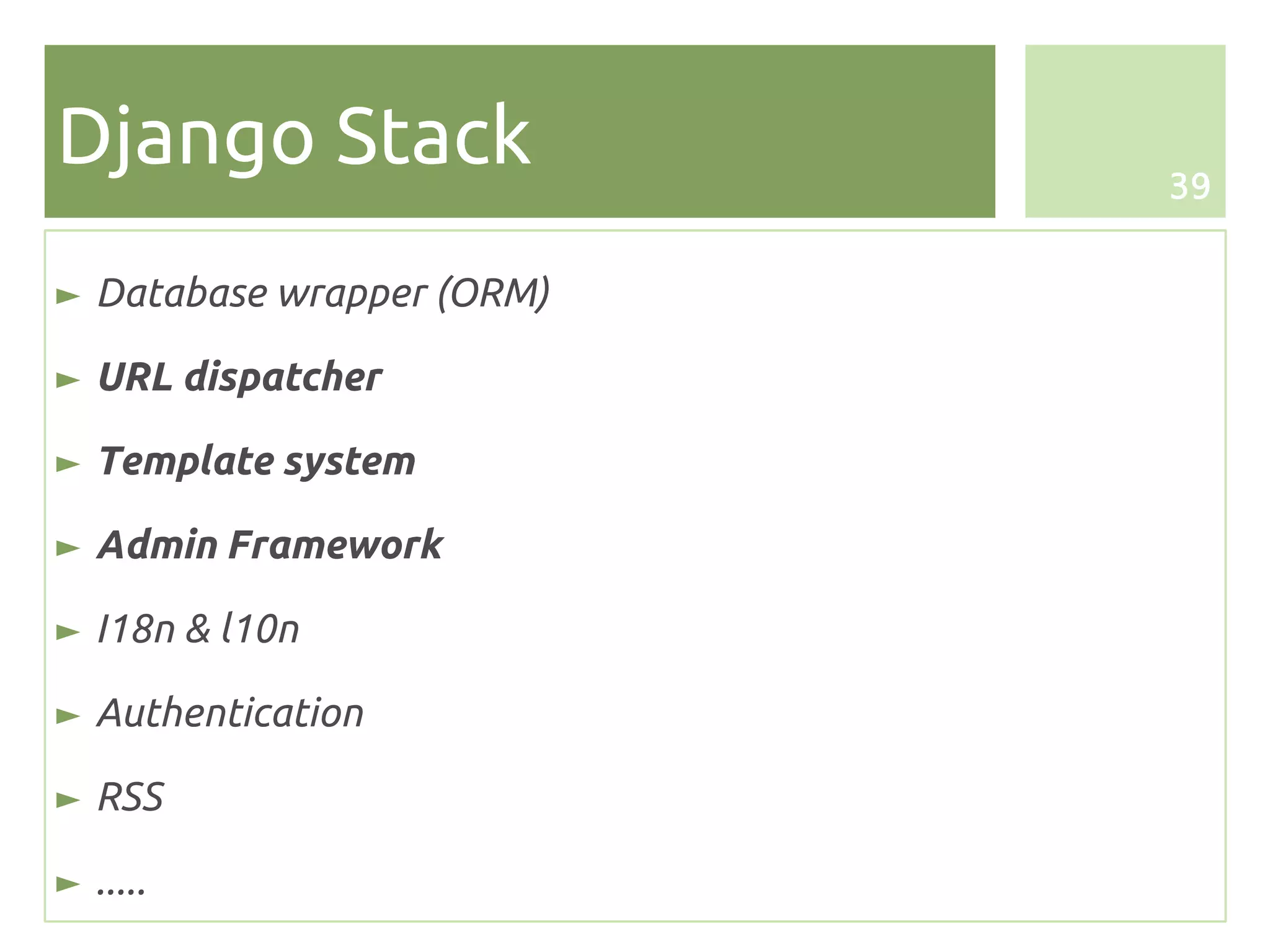
Django Stack               39


► Database wrapper (ORM)

► URL dispatcher

► Template system

► Admin Framework

► I18n & l10n

► Authentication

► RSS

► .....
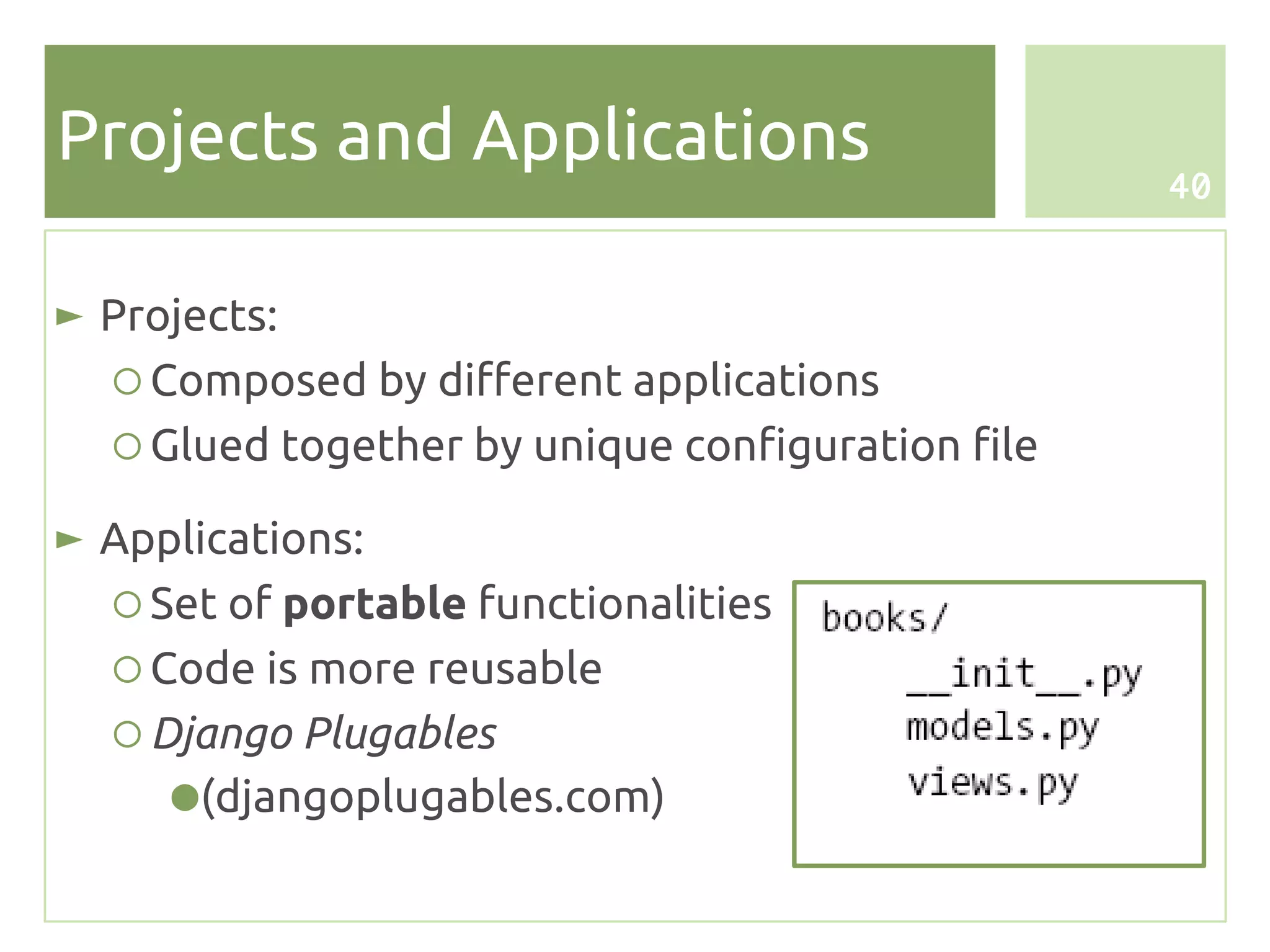
Projects and Applications
                                                   40


► Projects:
   ○ Composed by different applications
   ○ Glued together by unique configuration file

► Applications:
  ○ Set of portable functionalities
  ○ Code is more reusable
  ○ Django Plugables
     ● (djangoplugables.com)
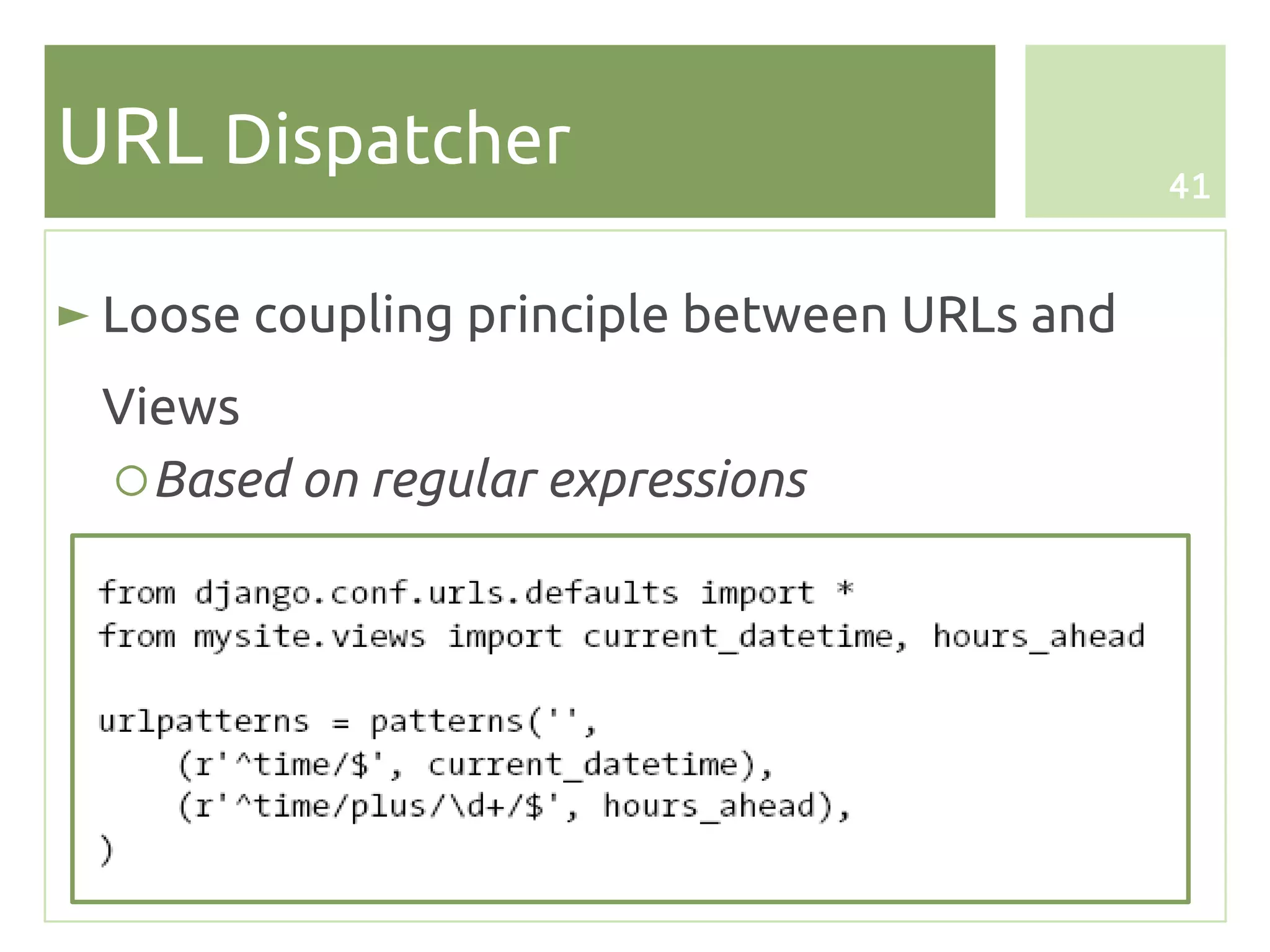
URL Dispatcher                                41


► Loose coupling principle between URLs and
 Views
 ○ Based on regular expressions
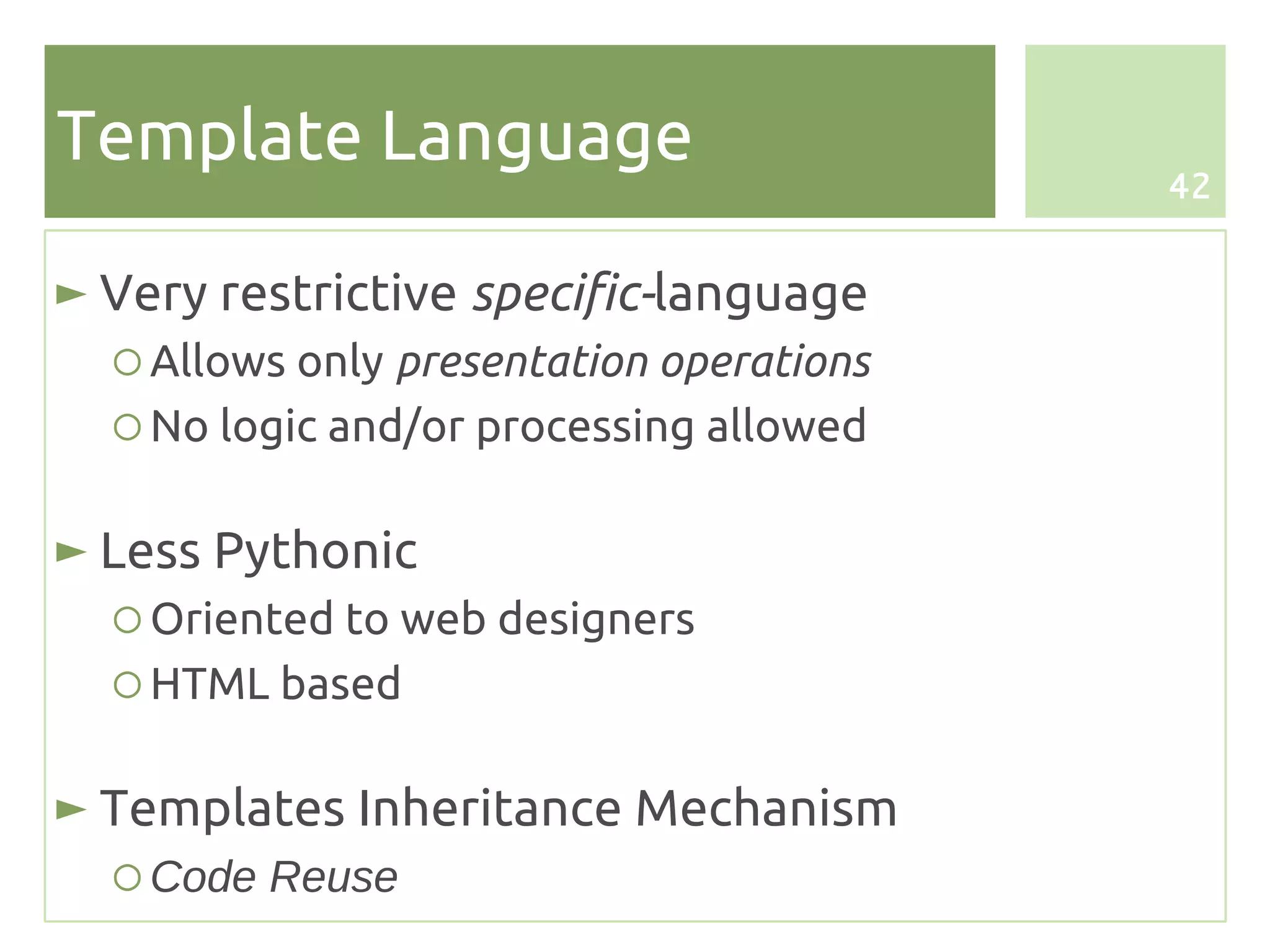
Template Language
                                          42


► Very restrictive specific-language
  ○ Allows only presentation operations
  ○ No logic and/or processing allowed

► Less Pythonic
  ○ Oriented to web designers
  ○ HTML based

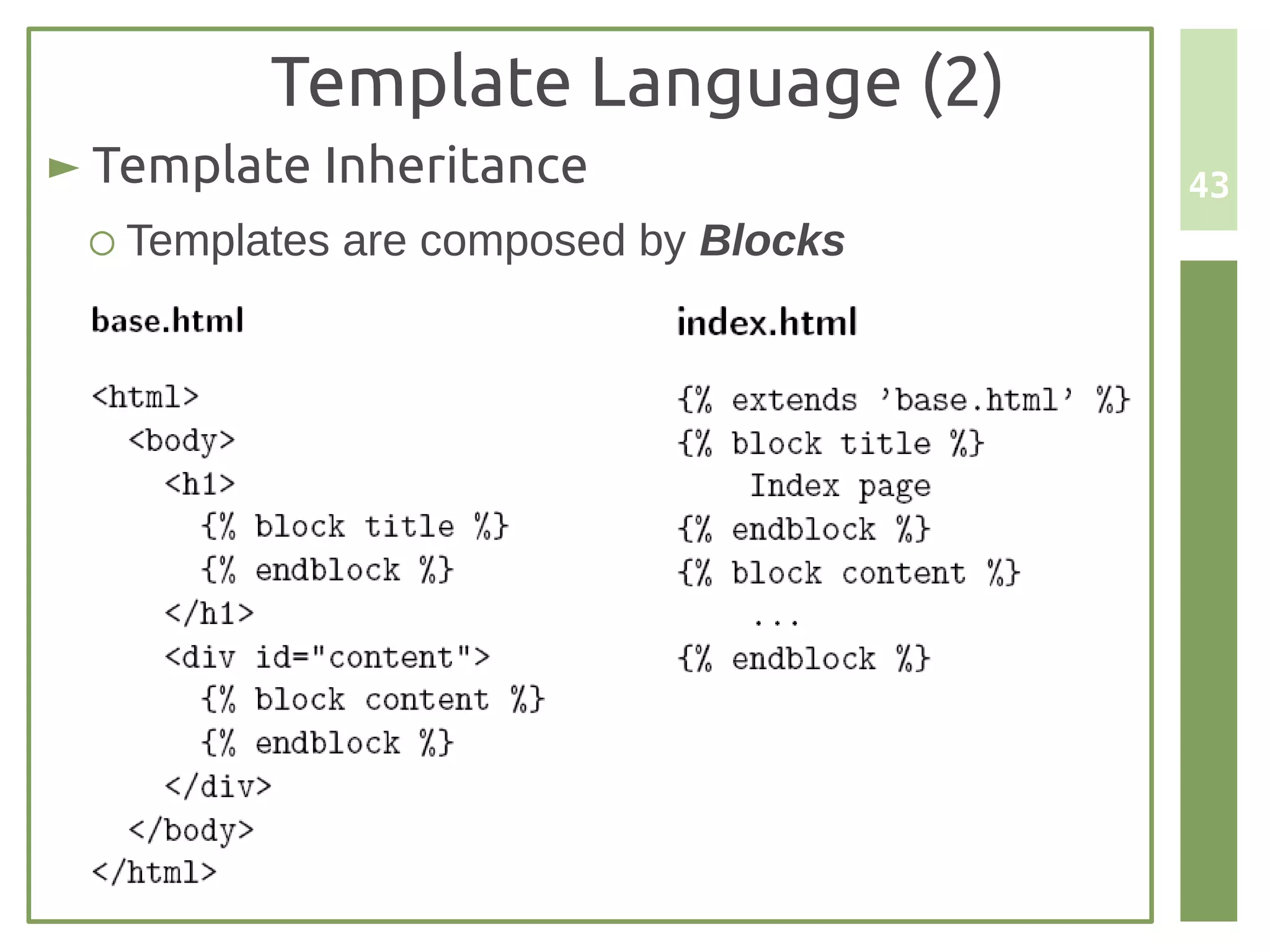
► Templates Inheritance Mechanism
  ○ Code Reuse
Template Language (2)
► Template Inheritance                43
 ○ Templates are composed by Blocks
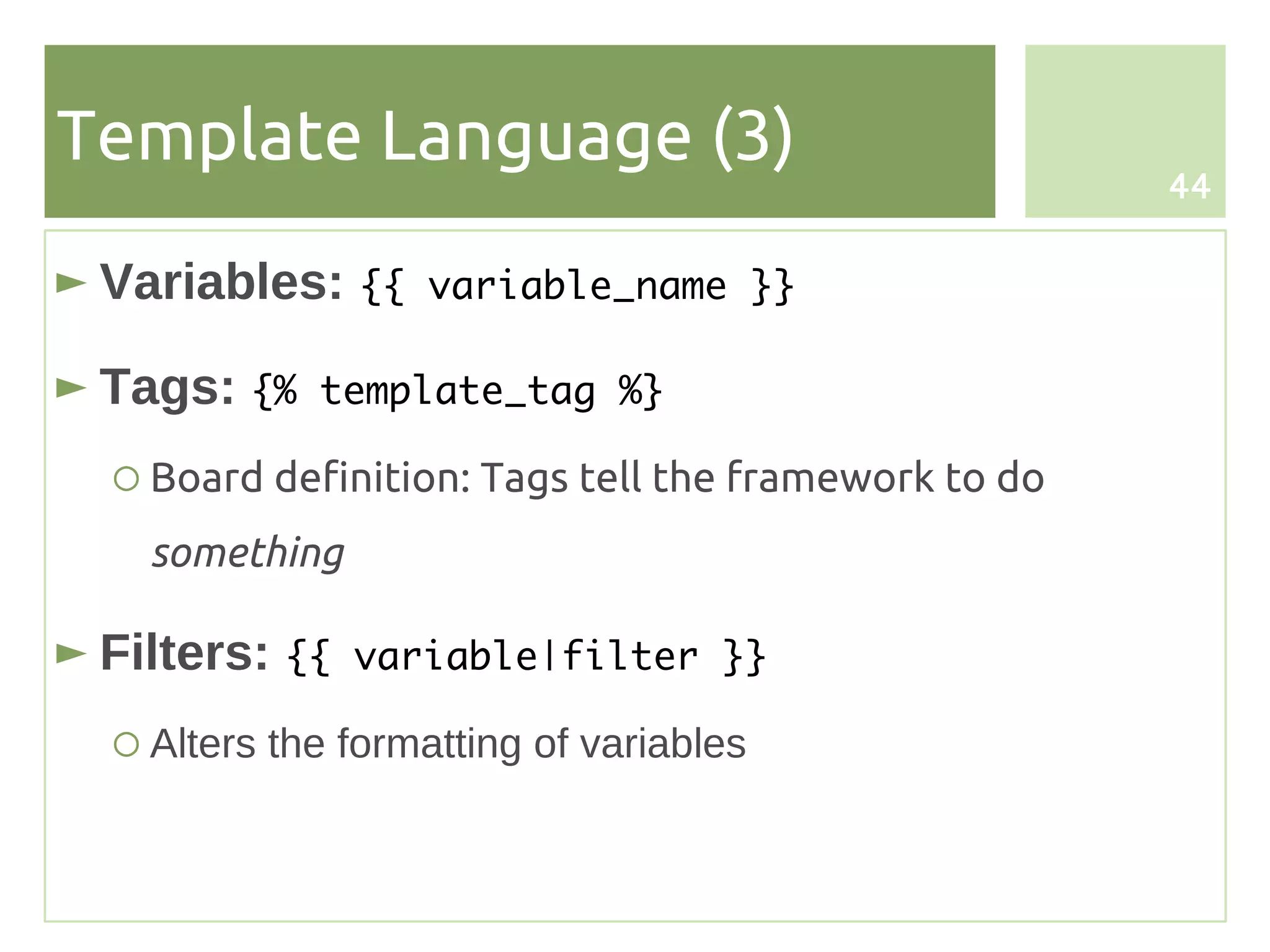
Template Language (3)
                                                      44


► Variables: {{    variable_name }}

► Tags: {%   template_tag %}

  ○ Board definition: Tags tell the framework to do
    something

► Filters: {{   variable|filter }}

  ○ Alters the formatting of variables
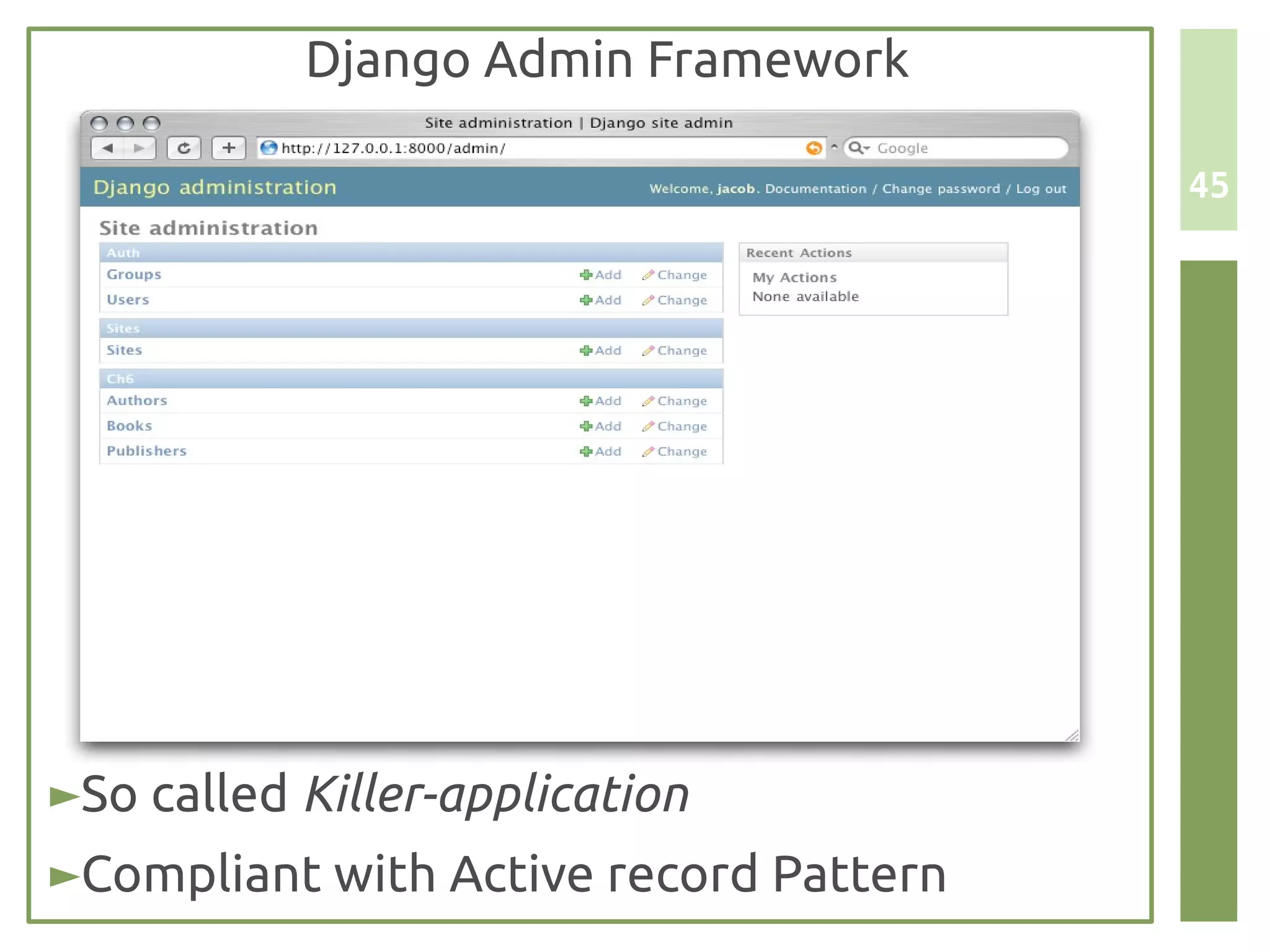
Django Admin Framework

                                        45


►So called Killer-application
►Compliant with Active record Pattern
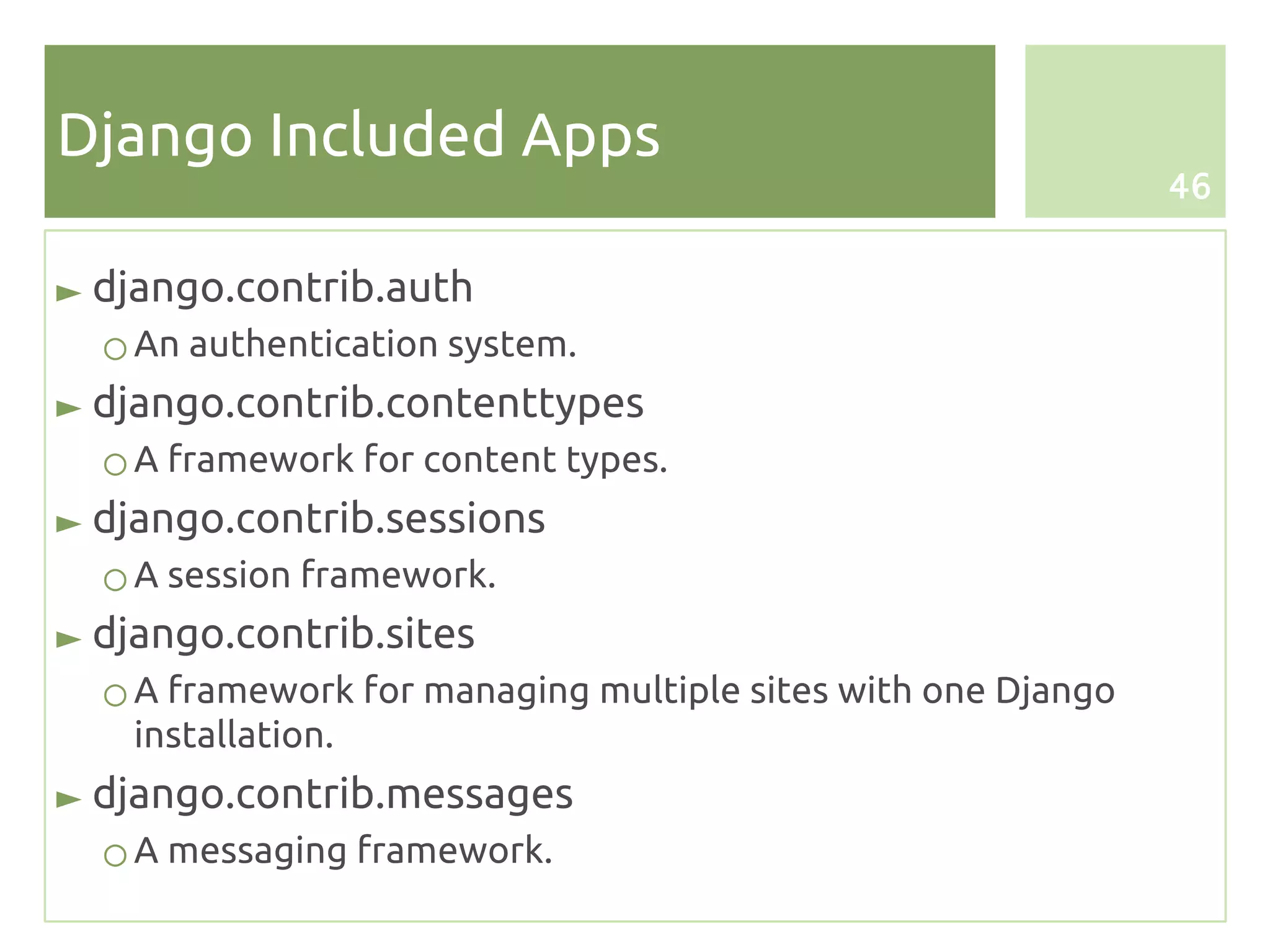
Django Included Apps
                                                              46


► django.contrib.auth
  ○ An authentication system.
► django.contrib.contenttypes
  ○ A framework for content types.
► django.contrib.sessions
  ○ A session framework.
► django.contrib.sites
  ○ A framework for managing multiple sites with one Django
    installation.
► django.contrib.messages
  ○ A messaging framework.
Google App Engine
                                                       47

► dynamic web serving (built on top of Django)
  ○ e.g. supports Django Templating Language
► persistent storage

► automatic scaling and load balancing
► APIs for authenticating
  ○ using Google Accounts

► a fully featured local development environment
► scheduled tasks for triggering events at specified
  times and regular intervals
References: Google App Engine
                                      48


► http://code.google.com/appengine/
References: Django
                                                  49


► http://www.djangoproject.com/
   ○ Sito del Progetto
► https://groups.google.com/forum/#!forum/django-it
   ○ Google group Italiano di Django
References: Python
                                                                50


► http://www.python.org
   ○ Sito ufficiale di Python
► http://www.python.it
   ○ Sito ufficiale Python Italia
► https://groups.google.com/forum/#!forum/it.comp.lang.python
   ○ Google group Italiano di Python
► http://forum.python-it.org
   ○ Forum (~)official Python Italia
► http://www.pycon.it/
   ○ Python Italian Conference
   ○ EuroPython 2011 – Florence, IT – across spring
References: Titles
                                            51


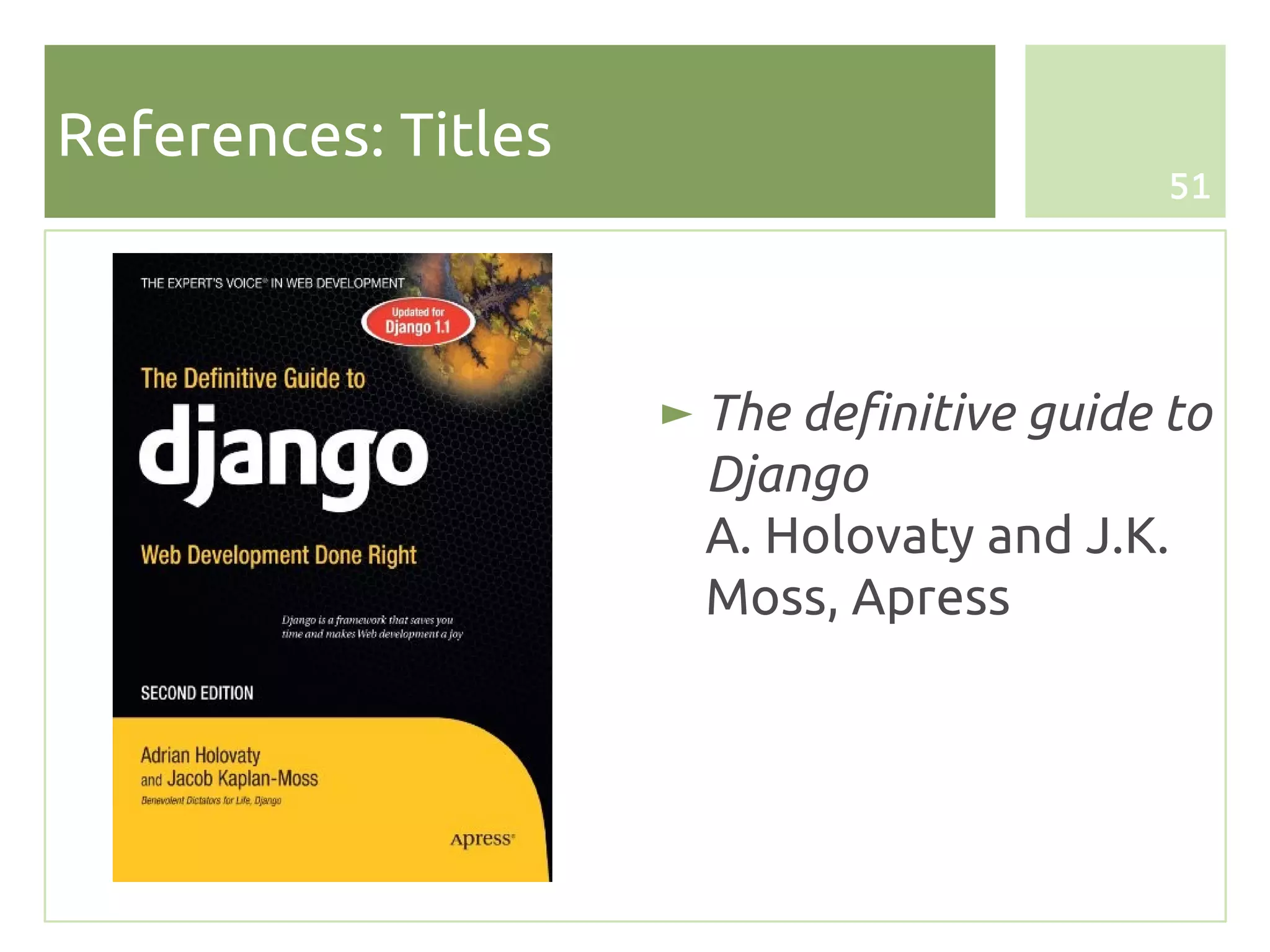
                     ► The definitive guide to
                       Django
                       A. Holovaty and J.K.
                       Moss, Apress
References: Titles
                                          52


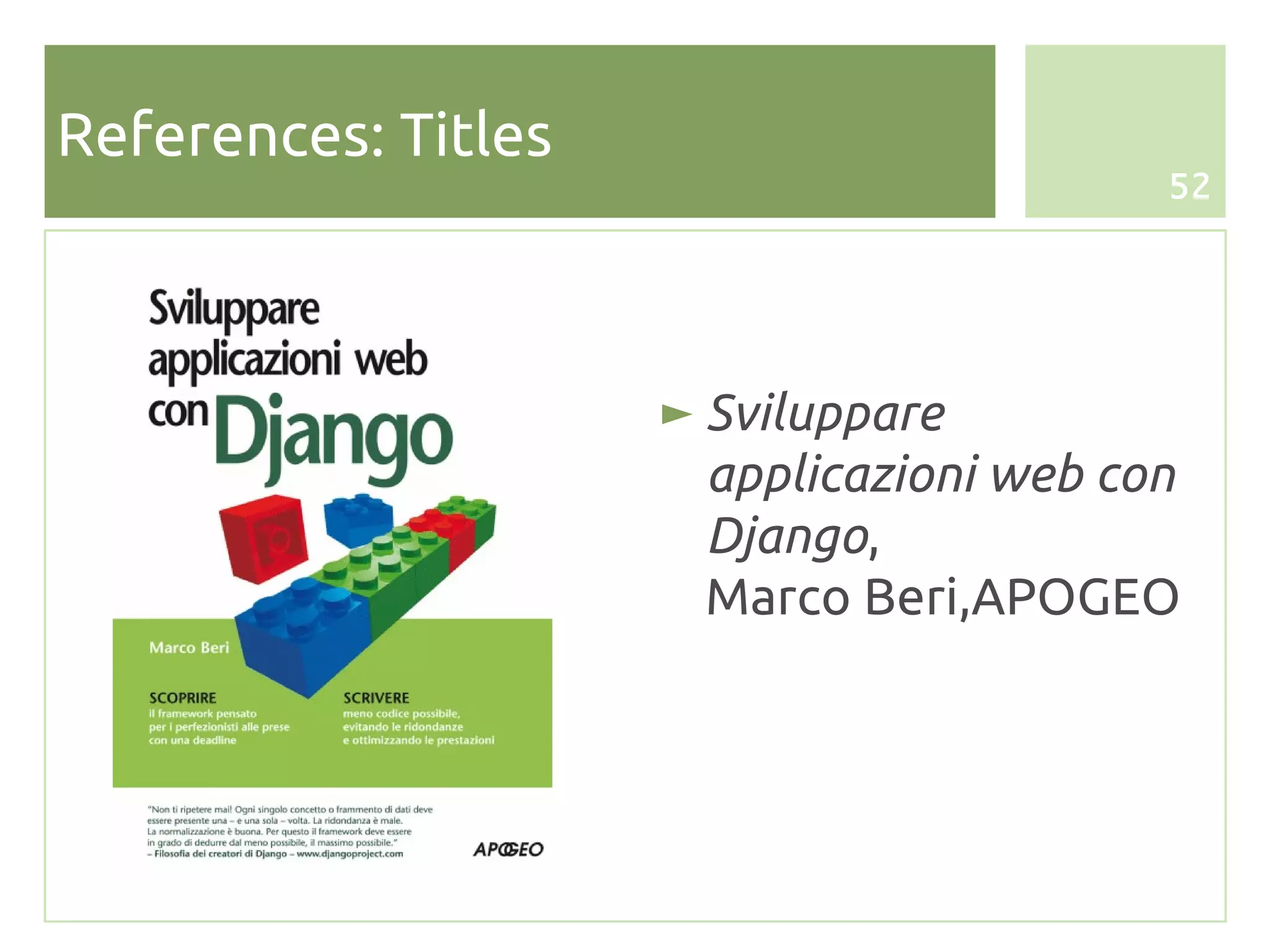
                     ► Sviluppare
                       applicazioni web con
                       Django,
                       Marco Beri,APOGEO
References: Titles
                                        53


                     ► Python,
                       Marco Beri, APOGEO
                       Serie Pocket
References: Titles
                                           54


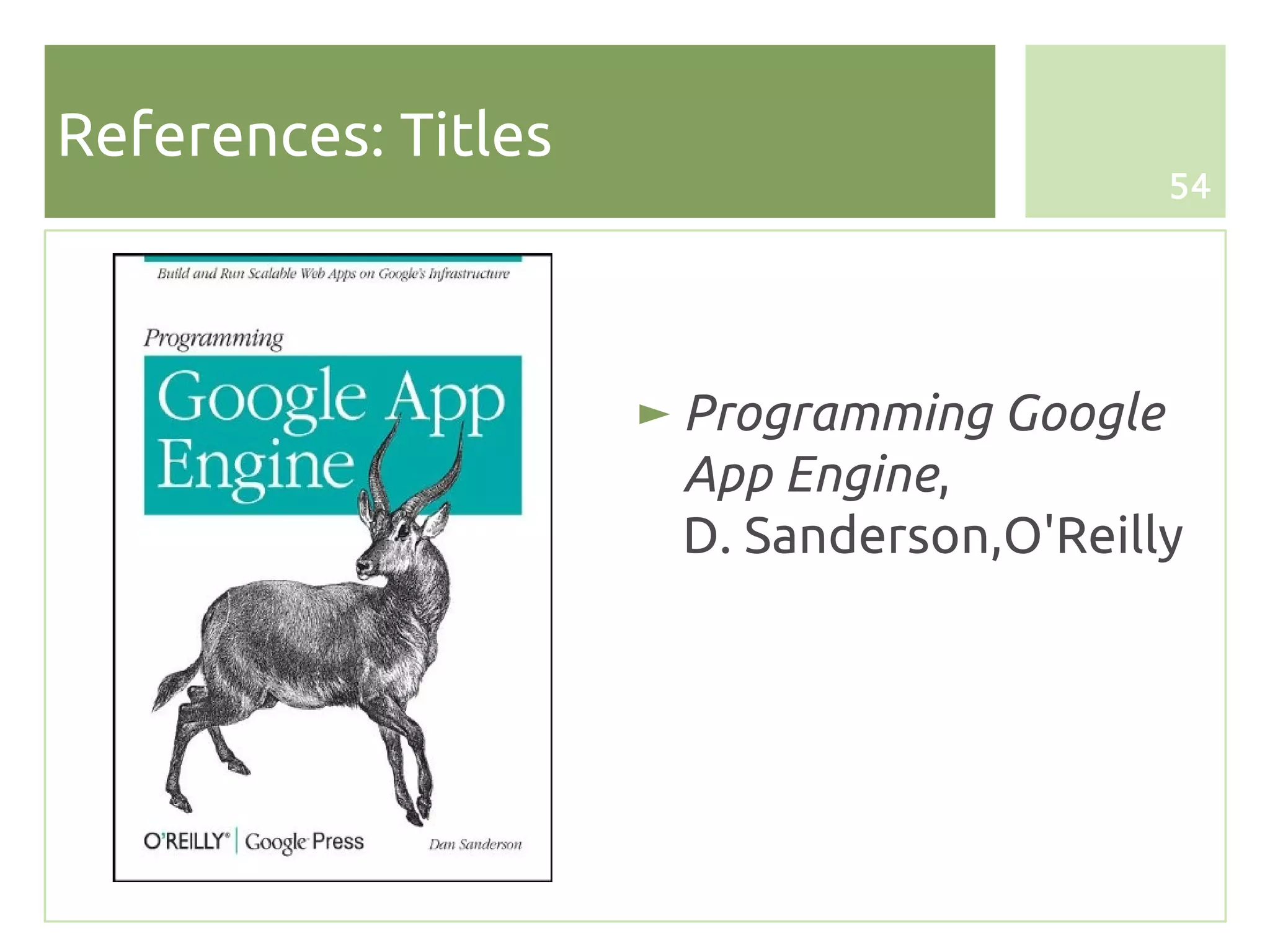
                     ► Programming Google
                       App Engine,
                       D. Sanderson,O'Reilly
And last...             55


►Want to get some actions?

►Let's do together a working
 example

Web frameworks

  • 1.
    Web Frameworks web development done right Course of Web Technologies A.A. 2010/2011 Valerio Maggio, PhD Student Prof.ssa Anna Corazza
  • 2.
    Outline 2 ► Web technologies evolution ► Web frameworks ○ Design Principles ► Case Study ○ Django and GAE (Google App Engine) ► Working Example
  • 3.
    Intruduction 3 ► Nowadays frameworks has become a buzzword ○ Software framework ○ Web framework ○ Development framework ○… ► So, what do you expect a web framework is?
  • 4.
  • 5.
    Web: Evolution Roadmap 1 5 HTML Pages HTML Pages: ►Web developers wrote every page “by hand” ►Update a web site means editing HTML ►“redesign” involved redoing every page ○ One at a time ►Solution not scalable
  • 6.
    Web: Evolution Roadmap HTML Pages 2 6 CGI Scripting CGI – Common Gateway Interface ► (+) Pages intended as resources ○ Pages are generated dynamically on demand ○ Raise of (so called) server side technologies ► (-) Code reuse difficult ○ Lot of “boilerplate” code ► (-) High learning curve
  • 7.
    CGI Perl Example 7 ► What are pros and cons of these two CGI examples ?
  • 8.
    Web: Evolution Roadmap CGI Scripting 3 8 HTML Pages PHP like languages PHP like solutions ► (+) Learning curve extremely shallow ○ Code directly embedded into HTML ► (-) No security and/or protection mechanism provided ► (?) Bunch of HTML, (Business Logic) Code, (Data) SQL code all together
  • 9.
    JSP Example: Prosand Cons ? 9
  • 10.
    Web: Evolution Roadmap PHP, ASP, JSP, ... 4 10 HTML Pages CGI Scripting RIA and “Integrated solutions” RIA and “Integrated Solutions” ► RIA: Rich Internet Applications ○ Q: Do you know what RIA means? ○ A: Desktop-like web applications ● (Ajax and javascript intensive web apps) ► A.k.a. Solutions battery included ► CMS and Web Frameworks
  • 11.
    CMS: Content Management System 11 ► Aim to manage work-flows and contents in a collaborative environment ► Designed to simplify the publication of contents to web sites and mobile devices ► Examples: Joomla, Drupal, Wordpress, ….
  • 12.
    Web frameworks 12 ► Aim to alleviate the overhead associated with common Web development ○ Databases, templates, sessions, … ► Designed to support the development of dynamic websites, web applications and web services ► Examples: Struts, Spring, Ruby on Rails, Django, Google App Engine, ...
  • 13.
    So, What isa Web Framework? 13 ► What does this code do? ► What happens when multiple pages need to connect to database? ► Should a developer really have to worry about printing the Content-type? ► Is this code reusable in multiple environments with different DB connection parameters? ►What happens when a web designer have to redesign the page?
  • 14.
    Web Frameworks ina nutshell 14 ► These problems are exactly what a web frameworks tries to solve ► Web frameworks provides a programming infrastructure for applications ► Focus on developing code without having to reinvent the wheel
  • 15.
    2. Web FrameworksDesign Principles 15
  • 16.
    CGI Architecture Model 16 Presentation and Business Logic Visualization Data and Models
  • 17.
    CGI Architecture Model 17 ► Task centric architecture (a.k.a. Model 1) ○ Difficult reusability and maintenance of code ○ Requires different skill-sets High coupling among: ► Presentation (View) ○ How to show data ► Processing (Controller) ○ What information to show ► Data Acquisition (Model) ○ What information to extract (from DB)
  • 18.
    Model 1 Architecture(Java) 18 ► Processing delegates as JSP and Servlets ► Is there any difference between CGI and Servlet?
  • 19.
    MVC Architecture Model 19 ► Model: ○ Manages domain and data acquisition ► View: ○ Manages the visualization of data ► Controller: ○ Manages domain and data processing Q: Do you think this model is feasible to be used on the web as is?
  • 20.
    Web-MVC Architecture Model 20 ► Model: ○ Manages domain and data acquisition ► View: ○ Manages the visualization of data ► Controller: ○ Manages domain and data processing A: No (direct) relationship between the view and the model
  • 21.
    Model 2 Architecture(Java) 21 ► Model: ○ EJB and Javabeans ► View: ○ JSP and JFaces ► Controller: ○ Servlets
  • 22.
    Fulll-stack web frameworks 22 ► From Python.org wiki: [..] frameworks provide support for a number of activities such as interpreting requests, producing responses, storing data persistently, and so on. [..] those frameworks [..] are often known as full- stack frameworks in that they attempt to supply components for each layer in the stack. ► So, what are such components?
  • 23.
    Web Frameworks Capabilities 23 ► View ○ JavaScript Library ○ Template Engine and View Composition ○ Development Server ► Controller ○ URL Routing ○ Controller-view Association ► Model ○ Database Abstraction ○ ORM (Object Relational Mapping)
  • 24.
    Database Access 24 ► Distributed Access Logic (JSP, Servlets) ► Centralized Access Logic ► Q: How easy is modify the db schema?
  • 25.
    Active Record pattern 25 ► An object encapsulates both data and behavior ► Put data access logic in the domain object http://martinfowler.com/eaaCatalog/activeRecord.html
  • 26.
    Heavy-weight vs Light-weight Frameworks 26 ► Heavy-weight frameworks: ○ (Mostly) Java Based ○ Based on Model 2 Architecture ○ High learning curve ○ Bunch of (XML) Configuration Files ► Light-weight frameworks: ○ Convention over Configuration and DRY Principles ○ Shallow learning curve ○ Use of Dynamic Languages ● Python, Ruby, Groovy, Scala
  • 27.
  • 28.
  • 29.
    Design Principles 29 ► Convention over configuration ○ “Convention over Configuration is a programming design that favors following a certain set of programming conventions instead of configuring an application framework. [...]” ► DRY (Don't repeat yourself) ○ “DRY is a principle that focuses on reducing information duplication by keeping any piece of knowledge in a system in only one place.
  • 30.
    3. Case Study: Django and Google App Engine 30
  • 31.
  • 32.
    Python Programming Language 32 “Speed and flexibility of development are critical. Dynamic languages let you get more done with less lines of code (which means less bugs)” ► Object oriented languages ► Clean and simple syntax ○ Strong Typed ○ Dynamic Typed
  • 33.
    Python Programming Language 33 ► Is there someone that uses python in professional projects? ○ IBM, Google, Sun, HP, Industrial Light and Magic, NASA, Microsoft ► Goggle it: ● site:microsoft.com python ● You'll get more than 9 thousands results
  • 34.
    Python: Language of theyear 2010 34 Programming language Python has become programming language of 2010. This award is given to the programming language that gained most market share in 2010. Python grew 1.81% since January 2010. This is a bit more than runner up Objective-C (+1.63%). Objective-C was favorite for the title for a long time thanks to the popularity of Apple's iPhone and iPad platforms. However, it lost too much popularity the last couples of months. Python has become the "de facto" standard in system scripting (being a successor of Perl in this), but it is used for much more different types of application areas nowadays. Source: tiobe.com Python is for instance very popular among web developers, especially in combination with the Django framework. Since Python is easy to learn, more and more universities are using Python to teach programming languages.
  • 35.
    TIOBE: Programming Languages ranking 35 http://www.tiobe.com
  • 36.
    Python Dynamic Typing 36 “Duck Typing” def half (n): return n/2.0 Walks like a duck? Quacks like a duck? Q: What is the type of variable n? It's a duck!
  • 37.
    Django web framework 37 Design characteristics ► Model-View-Controller for the Web ► Written in Python ► Explicit instead of implicit ► Loose Coupling ► Don't repeat yourself
  • 38.
    Django Architecture Model 38 ► Django is based on a slightly different version of MVC ○ a.k.a. MVT: Model View Template ► Model: Domain Objects ○ Python Classes ► View: contains business logic for the pages ○ Callback as python functions ► Templates: describes the design of the page ○ Template Language HTML based
  • 39.
    Django Stack 39 ► Database wrapper (ORM) ► URL dispatcher ► Template system ► Admin Framework ► I18n & l10n ► Authentication ► RSS ► .....
  • 40.
    Projects and Applications 40 ► Projects: ○ Composed by different applications ○ Glued together by unique configuration file ► Applications: ○ Set of portable functionalities ○ Code is more reusable ○ Django Plugables ● (djangoplugables.com)
  • 41.
    URL Dispatcher 41 ► Loose coupling principle between URLs and Views ○ Based on regular expressions
  • 42.
    Template Language 42 ► Very restrictive specific-language ○ Allows only presentation operations ○ No logic and/or processing allowed ► Less Pythonic ○ Oriented to web designers ○ HTML based ► Templates Inheritance Mechanism ○ Code Reuse
  • 43.
    Template Language (2) ►Template Inheritance 43 ○ Templates are composed by Blocks
  • 44.
    Template Language (3) 44 ► Variables: {{ variable_name }} ► Tags: {% template_tag %} ○ Board definition: Tags tell the framework to do something ► Filters: {{ variable|filter }} ○ Alters the formatting of variables
  • 45.
    Django Admin Framework 45 ►So called Killer-application ►Compliant with Active record Pattern
  • 46.
    Django Included Apps 46 ► django.contrib.auth ○ An authentication system. ► django.contrib.contenttypes ○ A framework for content types. ► django.contrib.sessions ○ A session framework. ► django.contrib.sites ○ A framework for managing multiple sites with one Django installation. ► django.contrib.messages ○ A messaging framework.
  • 47.
    Google App Engine 47 ► dynamic web serving (built on top of Django) ○ e.g. supports Django Templating Language ► persistent storage ► automatic scaling and load balancing ► APIs for authenticating ○ using Google Accounts ► a fully featured local development environment ► scheduled tasks for triggering events at specified times and regular intervals
  • 48.
    References: Google AppEngine 48 ► http://code.google.com/appengine/
  • 49.
    References: Django 49 ► http://www.djangoproject.com/ ○ Sito del Progetto ► https://groups.google.com/forum/#!forum/django-it ○ Google group Italiano di Django
  • 50.
    References: Python 50 ► http://www.python.org ○ Sito ufficiale di Python ► http://www.python.it ○ Sito ufficiale Python Italia ► https://groups.google.com/forum/#!forum/it.comp.lang.python ○ Google group Italiano di Python ► http://forum.python-it.org ○ Forum (~)official Python Italia ► http://www.pycon.it/ ○ Python Italian Conference ○ EuroPython 2011 – Florence, IT – across spring
  • 51.
    References: Titles 51 ► The definitive guide to Django A. Holovaty and J.K. Moss, Apress
  • 52.
    References: Titles 52 ► Sviluppare applicazioni web con Django, Marco Beri,APOGEO
  • 53.
    References: Titles 53 ► Python, Marco Beri, APOGEO Serie Pocket
  • 54.
    References: Titles 54 ► Programming Google App Engine, D. Sanderson,O'Reilly
  • 55.
    And last... 55 ►Want to get some actions? ►Let's do together a working example