UNITTESTING WITH JUNIT
Software Engineering Class
Valerio Maggio, Ph.D. Candidate
valerio.maggio@unina.it
Prof.Adriano Peron
May, 28th 2013
BRIEF INTROTOTHE CLASS
It’s about UnitTesting It’s about JUnit+
It’s about
Unit Testing
with JUnit
You say?!
DISCLAIMER
• At the end of the class you (should)...
1. ..have learnt something more about unit testing;
2. ..have learnt what is JUnit, how to use it and when;
3. ..have realized how much important are testing activities!
This is not a Tutorial Class
( maybe you already noticed
that slides are in English...)
JUNIT PRELIMINARIES
• Q: How many “types” of testing do you know?
• A: SystemTesting, IntegrationTesting, UnitTesting....
• Q: How many “testing techniques” do you know?
• A: Black Box and White BoxTesting
Which is the difference?
• Q:What type and technique do you think JUnit covers?
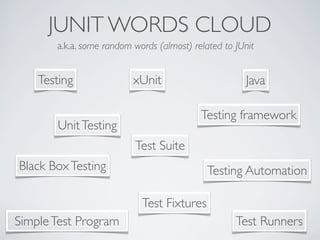
JUNIT WORDS CLOUD
a.k.a. some random words (almost) related to JUnit
UnitTesting
JavaTesting
Black BoxTesting
Testing framework
xUnit
Test Suite
Test Fixtures
Test RunnersSimpleTest Program
Testing Automation
JUNIT JUMPSTART
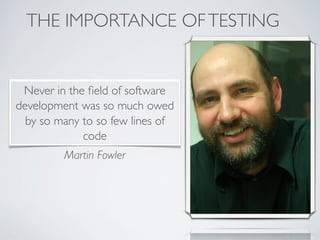
Never in the field of software
development was so much owed
by so many to so few lines of
code
Martin Fowler
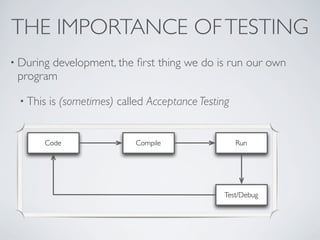
THE IMPORTANCE OFTESTING
• During development, the first thing we do is run our own
program
• This is (sometimes) called Acceptance Testing
Code Compile Run
Test/Debug
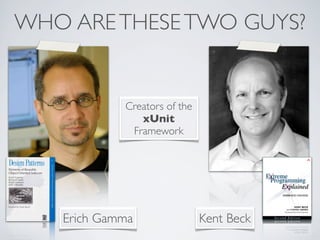
WHO ARETHESETWO GUYS?
Erich Gamma Kent Beck
Creators of the
xUnit
Framework
XUNIT FRAMEWORK
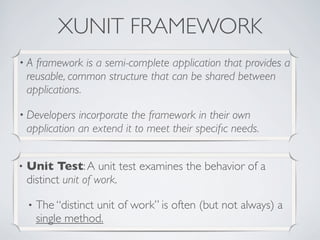
• A framework is a semi-complete application that provides a
reusable, common structure that can be shared between
applications.
• Developers incorporate the framework in their own
application an extend it to meet their specific needs.
• Unit Test:A unit test examines the behavior of a
distinct unit of work.
• The “distinct unit of work” is often (but not always) a
single method.
XUNIT DESIGN
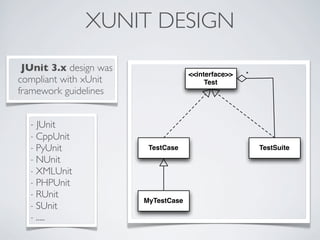
JUnit 3.x design was
compliant with xUnit
framework guidelines
<<interface>>
Test
TestCase TestSuite
MyTestCase
*
- JUnit
- CppUnit
- PyUnit
- NUnit
- XMLUnit
- PHPUnit
- RUnit
- SUnit
- .....
WHY A FRAMEWORK IS NEEDED?
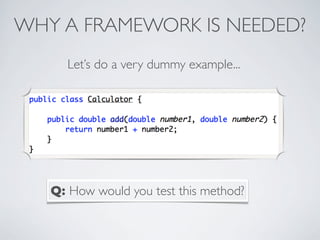
Let’s do a very dummy example...
Q: How would you test this method?
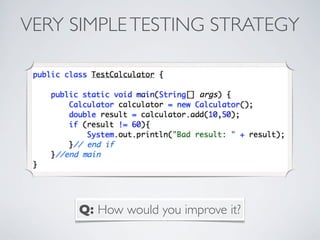
VERY SIMPLETESTING STRATEGY
Q: How would you improve it?
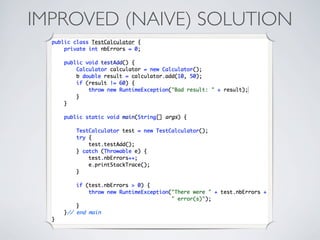
IMPROVED (NAIVE) SOLUTION
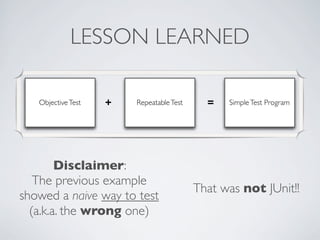
LESSON LEARNED
ObjectiveTest + RepeatableTest = SimpleTest Program
Disclaimer:
The previous example
showed a naive way to test
(a.k.a. the wrong one)
That was not JUnit!!
JAVA UNITTESTING FRAMEWORK
• JUnit is a simple, open source framework to write and run repeatable
tests.
• It is an instance of the xUnit architecture for unit testing frameworks.
• (source: http://junit.org)
• JUnit features include:
• Assertions for testing expected results
• Test fixtures for sharing common test data
• Test runners for running tests
JUNIT 3.X DESIGN RULES
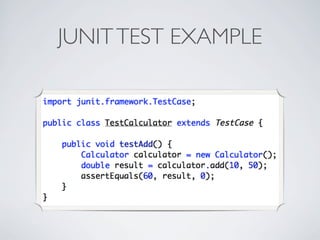
• All theTest classes must extendTestCase
• Functionalities by inheritance
• All the test method's names must start with the “keyword”
test in order to be executed by the framework
• testSomething(...)
• testSomethingElse()
JUNITTEST EXAMPLE
JUNIT 4.X DESIGN
• Main features inspired from other Java UnitTesting Frameworks
• TestNG
• Test Method Annotations
• Requires Java5+ instead of Java 1.2+
• Main Method Annotations
• @Before, @After
• @Test, @Ignore
• @SuiteClasses, @RunWith
JUNITTEST ANNOTATIONS
• @Test public void method()
• Annotation @Test identifies that this method is a test method.
• @Before public void method()
• Will perform the method() before each test.
• This method can prepare the test environment
• E.g. read input data, initialize the class, ...
• @After public void method()
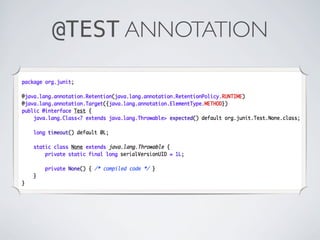
JAVA ANNOTATIONS AT GLANCE
• Meta DataTagging
• java.lang.annotation
• java.lang.annotation.ElementType
• FIELD
• METHOD
• CLASS
• Target
• Specify to which ElementType is applied
• Retention
• Specify how long annotation should be available
@TEST ANNOTATION
JUNIT ANNOTATIONS (2)
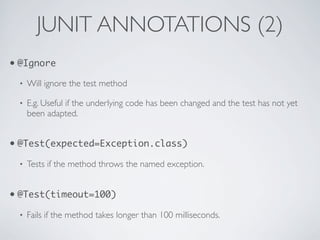
• @Ignore
• Will ignore the test method
• E.g. Useful if the underlying code has been changed and the test has not yet
been adapted.
• @Test(expected=Exception.class)
• Tests if the method throws the named exception.
• @Test(timeout=100)
• Fails if the method takes longer than 100 milliseconds.
JUNIT ASSERT STATEMENTS
• assertNotNull([message], object)
• Test passes if Object is not null.
• assertNull([message], object)
• Test passes if Object is null.
• assertEquals([message],expected, actual)
• Asserts equality of two values
• assertTrue(true|false)
• Test passes if condition isTrue
• assertNotSame([message], expected, actual)
• Test passes if the two Objects are not the same Object
• assertSame([message], expected, actual)
• Test passes if the two Objects are the same Object
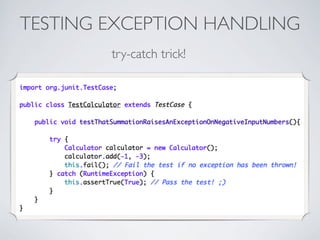
TESTING EXCEPTION HANDLING
try-catch trick!
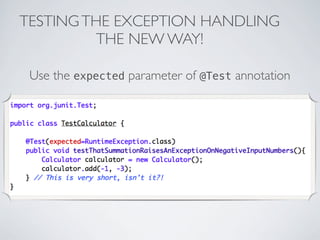
TESTINGTHE EXCEPTION HANDLING
THE NEW WAY!
Use the expected parameter of @Test annotation
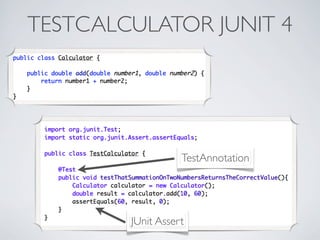
TESTCALCULATOR JUNIT 4
TestAnnotation
JUnit Assert
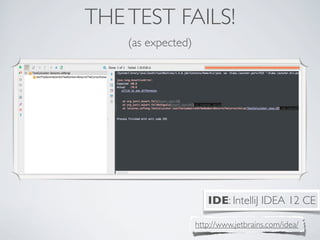
THETEST FAILS!
(as expected)
IDE: IntelliJ IDEA 12 CE
http://www.jetbrains.com/idea/
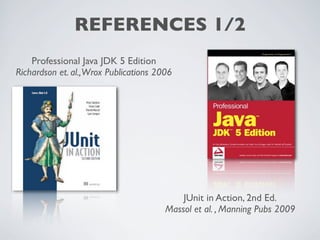
REFERENCES 1/2
Professional Java JDK 5 Edition
Richardson et. al.,Wrox Publications 2006
JUnit in Action, 2nd Ed.
Massol et al. , Manning Pubs 2009
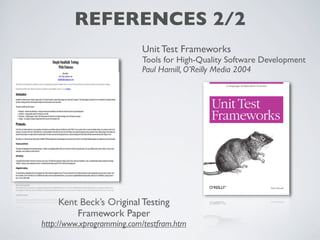
REFERENCES 2/2
Unit Test Frameworks
Tools for High-Quality Software Development
Paul Hamill, O’Reilly Media 2004
Kent Beck’s Original Testing
Framework Paper
http://www.xprogramming.com/testfram.htm

Unit testing with Junit

  • 1.
    UNITTESTING WITH JUNIT SoftwareEngineering Class Valerio Maggio, Ph.D. Candidate valerio.maggio@unina.it Prof.Adriano Peron May, 28th 2013
  • 2.
    BRIEF INTROTOTHE CLASS It’sabout UnitTesting It’s about JUnit+ It’s about Unit Testing with JUnit You say?!
  • 3.
    DISCLAIMER • At theend of the class you (should)... 1. ..have learnt something more about unit testing; 2. ..have learnt what is JUnit, how to use it and when; 3. ..have realized how much important are testing activities! This is not a Tutorial Class ( maybe you already noticed that slides are in English...)
  • 4.
    JUNIT PRELIMINARIES • Q:How many “types” of testing do you know? • A: SystemTesting, IntegrationTesting, UnitTesting.... • Q: How many “testing techniques” do you know? • A: Black Box and White BoxTesting Which is the difference? • Q:What type and technique do you think JUnit covers?
  • 5.
    JUNIT WORDS CLOUD a.k.a.some random words (almost) related to JUnit UnitTesting JavaTesting Black BoxTesting Testing framework xUnit Test Suite Test Fixtures Test RunnersSimpleTest Program Testing Automation
  • 6.
  • 7.
    Never in thefield of software development was so much owed by so many to so few lines of code Martin Fowler THE IMPORTANCE OFTESTING
  • 8.
    THE IMPORTANCE OFTESTING •During development, the first thing we do is run our own program • This is (sometimes) called Acceptance Testing Code Compile Run Test/Debug
  • 9.
    WHO ARETHESETWO GUYS? ErichGamma Kent Beck Creators of the xUnit Framework
  • 10.
    XUNIT FRAMEWORK • Aframework is a semi-complete application that provides a reusable, common structure that can be shared between applications. • Developers incorporate the framework in their own application an extend it to meet their specific needs. • Unit Test:A unit test examines the behavior of a distinct unit of work. • The “distinct unit of work” is often (but not always) a single method.
  • 11.
    XUNIT DESIGN JUnit 3.xdesign was compliant with xUnit framework guidelines <<interface>> Test TestCase TestSuite MyTestCase * - JUnit - CppUnit - PyUnit - NUnit - XMLUnit - PHPUnit - RUnit - SUnit - .....
  • 12.
    WHY A FRAMEWORKIS NEEDED? Let’s do a very dummy example... Q: How would you test this method?
  • 13.
    VERY SIMPLETESTING STRATEGY Q:How would you improve it?
  • 14.
  • 15.
    LESSON LEARNED ObjectiveTest +RepeatableTest = SimpleTest Program Disclaimer: The previous example showed a naive way to test (a.k.a. the wrong one) That was not JUnit!!
  • 16.
    JAVA UNITTESTING FRAMEWORK •JUnit is a simple, open source framework to write and run repeatable tests. • It is an instance of the xUnit architecture for unit testing frameworks. • (source: http://junit.org) • JUnit features include: • Assertions for testing expected results • Test fixtures for sharing common test data • Test runners for running tests
  • 17.
    JUNIT 3.X DESIGNRULES • All theTest classes must extendTestCase • Functionalities by inheritance • All the test method's names must start with the “keyword” test in order to be executed by the framework • testSomething(...) • testSomethingElse()
  • 18.
  • 19.
    JUNIT 4.X DESIGN •Main features inspired from other Java UnitTesting Frameworks • TestNG • Test Method Annotations • Requires Java5+ instead of Java 1.2+ • Main Method Annotations • @Before, @After • @Test, @Ignore • @SuiteClasses, @RunWith
  • 20.
    JUNITTEST ANNOTATIONS • @Testpublic void method() • Annotation @Test identifies that this method is a test method. • @Before public void method() • Will perform the method() before each test. • This method can prepare the test environment • E.g. read input data, initialize the class, ... • @After public void method()
  • 21.
    JAVA ANNOTATIONS ATGLANCE • Meta DataTagging • java.lang.annotation • java.lang.annotation.ElementType • FIELD • METHOD • CLASS • Target • Specify to which ElementType is applied • Retention • Specify how long annotation should be available
  • 22.
  • 23.
    JUNIT ANNOTATIONS (2) •@Ignore • Will ignore the test method • E.g. Useful if the underlying code has been changed and the test has not yet been adapted. • @Test(expected=Exception.class) • Tests if the method throws the named exception. • @Test(timeout=100) • Fails if the method takes longer than 100 milliseconds.
  • 24.
    JUNIT ASSERT STATEMENTS •assertNotNull([message], object) • Test passes if Object is not null. • assertNull([message], object) • Test passes if Object is null. • assertEquals([message],expected, actual) • Asserts equality of two values • assertTrue(true|false) • Test passes if condition isTrue • assertNotSame([message], expected, actual) • Test passes if the two Objects are not the same Object • assertSame([message], expected, actual) • Test passes if the two Objects are the same Object
  • 25.
  • 26.
    TESTINGTHE EXCEPTION HANDLING THENEW WAY! Use the expected parameter of @Test annotation
  • 27.
  • 28.
    THETEST FAILS! (as expected) IDE:IntelliJ IDEA 12 CE http://www.jetbrains.com/idea/
  • 29.
    REFERENCES 1/2 Professional JavaJDK 5 Edition Richardson et. al.,Wrox Publications 2006 JUnit in Action, 2nd Ed. Massol et al. , Manning Pubs 2009
  • 30.
    REFERENCES 2/2 Unit TestFrameworks Tools for High-Quality Software Development Paul Hamill, O’Reilly Media 2004 Kent Beck’s Original Testing Framework Paper http://www.xprogramming.com/testfram.htm