Business Research Methods 12th Edition Cooper Solutions Manual
Business Research Methods 12th Edition Cooper Solutions Manual
Business Research Methods 12th Edition Cooper Solutions Manual
Business Research Methods 12th Edition Cooper Solutions Manual
Business Research Methods 12th Edition Cooper Solutions Manual
1.
Download the fullversion and explore a variety of test banks
or solution manuals at https://testbankfan.com
Business Research Methods 12th Edition Cooper
Solutions Manual
_____ Follow the link below to get your download now _____
https://testbankfan.com/product/business-research-
methods-12th-edition-cooper-solutions-manual/
Access testbankfan.com now to download high-quality
test banks or solution manuals
2.
Here are somerecommended products for you. Click the link to
download, or explore more at testbankfan.com
Business Research Methods 12th Edition Cooper Test Bank
https://testbankfan.com/product/business-research-methods-12th-
edition-cooper-test-bank/
Business Research Methods 11th Edition Cooper Test Bank
https://testbankfan.com/product/business-research-methods-11th-
edition-cooper-test-bank/
Methods in Behavioral Research 12th Edition Cozby
Solutions Manual
https://testbankfan.com/product/methods-in-behavioral-research-12th-
edition-cozby-solutions-manual/
Fundamentals of Investments 8th Edition Jordan Test Bank
https://testbankfan.com/product/fundamentals-of-investments-8th-
edition-jordan-test-bank/
3.
Fundamentals of GeneralOrganic and Biological Chemistry
with MasteringChemistry 7th Edition McMurry Solutions
Manual
https://testbankfan.com/product/fundamentals-of-general-organic-and-
biological-chemistry-with-masteringchemistry-7th-edition-mcmurry-
solutions-manual/
Macroeconomics 10th Edition Boyes Test Bank
https://testbankfan.com/product/macroeconomics-10th-edition-boyes-
test-bank/
Managerial Accounting Creating Value In A Dynamic Business
Environment 9th Edition Hilton Test Bank
https://testbankfan.com/product/managerial-accounting-creating-value-
in-a-dynamic-business-environment-9th-edition-hilton-test-bank/
Core Concepts of Accounting Information Systems 14th
Edition Simkin Solutions Manual
https://testbankfan.com/product/core-concepts-of-accounting-
information-systems-14th-edition-simkin-solutions-manual/
Cosmic Perspective 7th Edition Bennett Test Bank
https://testbankfan.com/product/cosmic-perspective-7th-edition-
bennett-test-bank/
4.
American History Connectingwith the Past UPDATED AP
Edition 2017 1st Edition Brinkley Test Bank
https://testbankfan.com/product/american-history-connecting-with-the-
past-updated-ap-edition-2017-1st-edition-brinkley-test-bank/
northeast of theCherokees, and between the latter and the western
boundary of Missouri. They possess a hundred thousand acres of
choice lands. The Sanduskies number 251 souls; the mixed band,
222. They are represented as farmers and stock-raisers, frugal,
industrious, and less addicted to intemperance than their neighbors.
They cultivated, in 1839, from two hundred and fifty to three
hundred acres of corn. They have a blacksmith's shop, under treaty
stipulations, and possess good stocks of horses, cattle, and hogs.
The Quapaws adjoin the Senecas and Shawnees on the north, and,
as the latter, have their lands fronting on the Neosho. This band
formerly owned and ceded the south banks of the Arkansas from its
mouth as high as the Canadian fork. They are indolent, much
addicted to the use of ardent spirits, and depressed in numbers.
They have a tract of 96,000 acres. They cultivate, generally, about
one hundred acres of corn, in a slovenly manner. Part of their
numbers are seated on the waters of Red River, and the Indian
predilection for rowing is nourished by the frequent habit of passing
to and fro. This erratic habit is an unerring test of the hunter state.
The Piankashaws and Weas are of the Miami stock, and came from
the waters of the Wabash. They are located on 255 sections,
immediately west of the western boundary of Missouri, and about 40
miles south of the Konza. Their population is 384, of which 222 are
Weas. Immediately west of them are the Peorias and Kaskaskias of
the Illinois family. They number 132, and possess 150 sections,
which gives an average of more than a square mile to each soul. Still
west of these, are the Ottowas of Ohio, about 200 in number, and
above them, a small band of 61 of the Chippewas of Swan Creek
and Black River in Michigan. These locations are all on the sources of
the Osage River. The lands are fine, partly woods and partly prairie,
and are easily cultivated. These six fragmentary bands are not
dissimilar in their habits of living and the state of their advance in
agriculture. They subsist themselves by raising corn and cattle and
hogs. They evince an advancing condition, and are surrounded by
circumstances eminently favorable to it.
27.
The Shawnees areplaced at the junction of the Konza with the
Missouri, extending south and west. They number a little short of
1,300, and own a territory of ten thousand square miles, or
6,400,000 acres. They are cultivators and graziers in an advanced
state of improvement. Hunting may be occasionally resorted to as a
sport or amusement, but it has, years since, been abandoned as a
source of subsistence. Indeed, the failure of the game in that region
would have rendered the latter imperative, had not their improved
habits of industry led to it. This tribe have essentially conquered
their aversion to labor. They drive oxen and horses trained to the
plough. They split rails and build fences. They erect substantial
cabins and barns. They have old corn in their cribs from year to year.
They own good saddle-horses and saddles, and other articles of
caparison, and a traveller or visitor will find a good meal, a clean
bed, and kind treatment in their settlements.
Next in position to the Shawnees are the F, the descendants of the
ancient Lenno Lenapees of Pennsylvania. Allies and kindred in their
ancient position, they are still in juxtaposition in their new. Their
tract begins at the junction of the Konza and Missouri on the north,
and after running up the former to the Konza reserve, extends north
and west so as to embrace it on the north. It contains about 2450
square miles, or 2,208,000 acres. They number, at the last dates to
which we have referred, 826 souls, and are on the increase. In point
of habits, industry, and improvement, they are perhaps not inferior
to any of the northern stocks. Shielded from intemperance by their
position, out of the State limits, where they are exclusively under the
influence and protection of Congress laws, this tribe, together with
the entire circle of Indian communities on that frontier, has been for
some years in a favourable position for recovering and developing
their true energies. They have, within a few years, received into
their protection a small band (182) of the Monceys, and a smaller
one, of 74, of the Stockbridges: the latter, we need hardly inform the
intelligent reader, are descendants of the ancient Mohegans, and the
former of the Minsi and Minnisinks, who, at the era of the
colonization of “Nova Belgica” and New York, were respectively
28.
located on theeast and the west banks of the Hudson. The
Stockbridges are civilized; the Munsees less so, but industrious. Both
are poor, and without funds.
Immediately succeeding the Delawares are the Kickapoos, an erratic
race, who, under various names, in connection with the Foxes and
Sacs, have, in good keeping with one of their many names,[50]
skipped over half the continent, to the manifest discomfort of both
German and American philologists and ethnographers, who, in
searching for the so-called “Mascotins,” have followed, so far as their
results are concerned, an ignis fatuus. The Kickapoos have 12,000
square miles, or 768,000 acres. It is a choice, rich tract, and they
are disposed, with the example of the Delawares and Shawnees, to
profit by it. They raise corn and cattle, hogs and horses, and are
prosperous. Their numbers, in 1840, were 470. There is a tract of
200 square miles, on the Great and Little Namaha, assigned to the
metifs, or descendants of mixed blood, of the lowas, Otoes, and
Missouris. These separate the removed and semi-civilized tribes,
south and west of the Missouri, from the wild indigenes—we mean
the Otoes, the Pawnees, the Omahaws, and the Sioux, who extend
over vast tracts, and exist without any sensible improvement in their
condition. The same remark may be applied to the Konzas, who are,
however, hemmed in between the Delawares and the Shawnees,
except on their western borders. It is no part of our purpose to
consider these tribes, as, over and above the influence of contiguous
examples, they constitute no part of the evidence affecting the
general question of the plan of removal.
That this evidence, as now briefly sketched, is favorable, and indeed
highly favorable, to the general condition and prosperity of the
removed tribes, is, we apprehend, clearly manifest. Not only have
they been placed beyond the wasting influence of causes which
oppressed them, within the circle of the State communities; but they
have received in exchange for their eastern lands, a territory which,
as a whole, is highly fertile and salubrious. It is a territory which has
required little comparative labor to cultivate, made up as it is of
29.
mixed forests andprairies. It is also, viewed in extenso, well
watered, having those noble streams, the Red River, the Arkansas,
the Konza, the Platte, and the Missouri, with their tributaries,
running through it. The range which it affords for cattle and stock,
and the abundance of wild hay, of a nutritious quality, has proved
very favorable to an incipient agricultural population, and greatly
mitigated the ordinary labors of farming in northern climates. There
are no latitudes in North America more favorable to the growth of
corn. The cotton plant has been introduced by the Choctaws and
Chickasaws, on the banks of Red river. It is a region abounding in
salt springs and gypsum beds, both which must hereafter be fully
developed, and will prove highly advantageous. It is above the first
or principal rapids of the great streams running down the plateau of
the Rocky Mountains, and consequently affords sites for water-mills,
which are scarce and almost unknown on the lower Arkansas. There
is, indeed, a combination of circumstances, which are calculated to
favor the General Government plan, and foster the Indians in a
general attempt at civilisation and self-government. And we look
with interest, and not without anxiety, at the result of the
experiment.
We are aware that there are trials before them, arising from great
diversity of feelings and opinions, and states of civilisation. Some of
the tribes are powerful, advanced, and wealthy; some feeble and
poor. Education has very unequally affected them. Laws are in their
embryo state. The Gospel has been but partially introduced. In
clothing the native councils with some of the powers of a congress,
and regulating their action by constitutional fixity, there is great care
and deliberation required, not, at once, to grasp too much. There is
perhaps yet greater danger in enlarging the authority of the chiefs
and sagamores into something like presidential dimensions. The
natives have great powers of imitation; and it is to be feared that
they will content themselves by imitating things which they do not
fully understand or appreciate. The national character of the Indians
is eminently suspicious. There is a fear to trust others, even
themselves. Delegated power is narrowly watched, and often
30.
begrudged when given.The acts of their public men are uniformly
impugned. The thought seems hardly to be entertained by the
common Indians, that an officer may be guided by right and honest
motives. The principle of suspicion has, so to say, eaten out the
Indian heart. The jealousy with which he has watched the white
man, in all periods of his history, is but of a piece with that with
which he watches his chiefs, his neighbors, and his very family.
Exaltation of feeling, liberality of sentiment, justness of reasoning, a
spirit of concession, and that noble faith and trust which arise from
purity and virtue, are the characteristics of civilisation; and we
should not be disappointed if they do not, all at once, grow and
flourish in these nascent communities. Still, our hopes predominate
over our fears. Where so much has been accomplished as we see by
the Cherokees, the Choctaws, and Chickasaws, and our most
advanced northern tribes, we expect more. From the tree that bears
blossoms, we expect fruit.
We have no expectation, however, that without some principles of
general political association, the tribes can permanently advance. To
assume the character and receive the respect of a commonwealth,
they must have the political bonds of a commonwealth. Our Indian
tribes have never possessed any of these bonds. They are indeed
the apparent remnants of old races, which have been shivered into
fragments, and never found the capacity to re-unite. The constant
tendency of all things, in a state of nature, has been to divide. The
very immensity of the continent, its varied fertility and resources,
and its grand and wild features, led to this. Hitherto, the removed
tribes in the West have opposed an associated government. They
have stoutly and effectually resisted and rejected this part of the
government scheme. They fear, the agents say, it is some plan to
bring them under the civil yoke. Time, reflection, and education
must tend to correct this. More than all, their civil dissensions must
tend to show the necessity of a more enlarged and general frame of
government, in which some individual rights must be yielded to the
public, to secure the enjoyment of the rest. We think there is some
evidence of the acknowledgment of this want, in their occasional
31.
general councils, atwhich all the tribes have been invited to be
present. During the last year (1843) such a convocation was held at
Tahlequah, the seat of the Cherokee government. At this, there were
delegates present from the Creeks, Chickasaws, Delawares,
Shawnees, Piankashaws, Weas, Osages, Senecas, Stockbridges,
Ottowas, Chippewas, Peorias, Pottowattomies, and Seminoles. The
result of these deliberations, we are informed, was a compact in
which it was agreed:—
1. To maintain peace and friendship among each other.
2. To abstain from the law of retaliation for offences.
3. To provide for improvements in agriculture, the arts, and
manufactures.
4. To provide against any cession of their territory, in any form.
5. To punish crimes, committed by one tribe, in the bounds of
another.
6. To provide for a general citizenship among the contracting parties.
7. To suppress the use or introduction of ardent spirits.
These are very mixed principles, containing no basis of a
government; yet, futile as they are, we apprehend they contain no
effective power for their enforcement. A law without a penalty is like
a rope of sand. Any of these parties might nullify either of these
acts, by neglecting to enforce it. It is, we apprehend, the mere
expression of the popular will, in a council, without any binding
obligation of the whole, or a majority of the tribes, to compel
obedience from the delinquent members. It may, however, lead to
further deliberations; and we cannot but regard the movement as
one which betokens political forethought and purpose.
Our greatest apprehensions, we must confess, before closing this
paper, arise from the peculiar geographical position of the Indian
territory with relation to our own. And this could not, perhaps, have
32.
been anticipated twentyyears ago, when the plan was formed. Our
population is on the broad move west. Nothing, it is evident, will
now repress them this side of the Pacific. The snowy heights of the
Rocky Mountains are already scaled; and we but apply the results of
the past to the future, in saying that the path which has been trod
by a few, will be trod by many. Now, the removed tribes are
precisely in the centre of this path. From the mouth of the Platte, or
the Konza, the great highway to the Oregon must run west. Whether
this new tide of emigration will be successful or unsuccessful, will
those who compose it spare to trample on the red man? Will they
suddenly become kind to him, to whom they have been unkind? Will
they cease to desire the lands which their children want? Will they
consent to see the nation separated by an Indian state? Will they
award honors, nay, justice, to that state? Twenty years will answer
these questions.
Choctaws.—An appropriation of $113,000 has been made by
Congress for the removal and subsistence of the Choctaws now in
Mississippi. There are upwards of six thousand in our state,
comprising about eleven hundred families. These are under Colonels
Johnson and Fisher. The half of the money due the Indians, and to
be paid after their landing in their new homes in the West, is to be
funded. This will effectually prevent all speculation, and enable the
Indians to obtain and hold what is due them. Those now in the state
are guarded against all coercive measures for their removal, and left
free to go West or remain in their homes in Mississippi.—Southern
Reformer.
33.
NURSERY AND CRADLESONGS OF
THE FOREST.
The tickenagun, or Indian cradle, is an object of great pride with an
Indian mother. She gets the finest kind of broad cloth she possibly
can to make an outer swathing band for it, and spares no pains in
ornamenting it with beads and ribbons, worked in various figures. In
the lodges of those who can afford it, there is no article more showy
and pretty than the full bound cradle. The frame of the cradle itself
is a curiosity. It consists of three pieces. The vertebral board, which
supports the back, the hoop or foot-board, which extends tapering
up each side, and the arch or bow, which springs from each side,
and protects the face and head. These are tied together with deer's
sinews or pegged. The whole structure is very light, and is carved
with a knife by the men, out of the linden or maple tree.
Moss constitutes the bed of the infant, and is also put between the
child's feet to keep them apart and adjust the shape of them,
according to custom. A one-point blanket of the trade, is the general
and immediate wrapper of the infant, within the hoop, and the
ornamented swathing band is wound around the whole, and gives it
no little resemblance to the case of a small mummy. As the bow
passes directly above the face and eyes, trinkets are often hung
upon this, to amuse it, and the child gets its first ideas of ornament
from these. The hands are generally bound down with the body, and
only let out occasionally, the head and neck being the only part
which is actually free. So bound and laced, hooped and bowed, the
little fabric, with its inmate, is capable of being swung on its
mother's back, and carried through the thickest forest without injury.
Should it even fall no injury can happen. The bow protects the only
exposed part of the frame. And when she stops to rest, or enters the
lodge, it can be set aside like any other household article, or hung
34.
up by thecradle strap on a peg. Nothing, indeed, could be better
adapted to the exigencies of the forest life. And in such tiny fabrics,
so cramped and bound, and bedecked and trinketed, their famous
Pontiacs and King Philips, and other prime warriors, were once
carried, notwithstanding the skill they afterwards acquired in
wielding the lance and war club.
The Indian child, in truth, takes its first lesson in the art of
endurance, in the cradle. When it cries it need not be unbound to
nurse it. If the mother be young, she must put it to sleep herself. If
she have younger sisters or daughters they share this care with her.
If the lodge be roomy and high, as lodges sometimes are, the cradle
is suspended to the top poles to be swung. If not, or the weather be
fine, it is tied to the limb of a tree, with small cords made from the
inner bark of the linden, and a vibratory motion given to it from
head to foot by the mother or some attendant. The motion thus
communicated, is that of the pendulum or common swing, and may
be supposed to be the easiest and most agreeable possible to the
child. It is from this motion that the leading idea of the cradle song
is taken.
I have often seen the red mother, or perhaps a sister of the child,
leisurely swinging a pretty ornamented cradle to and fro in this way,
in order to put the child to sleep, or simply to amuse it. The
following specimens of these wild-wood chaunts, or wigwam
lullabys, are taken from my notes upon this subject, during many
years of familiar intercourse with the aboriginals. If they are neither
numerous nor attractive, placed side by side with the rich nursery
stores of more refined life, it is yet a pleasant fact to have found
such things even existing at all amongst a people supposed to
possess so few of the amenities of life, and to have so little
versatility of character.
Meagre as these specimens seem, they yet involve no small degree
of philological diligence, as nothing can be more delicate than the
inflexions of these pretty chaunts, and the Indian woman, like her
white sister, gives a delicacy of intonation to the roughest words of
35.
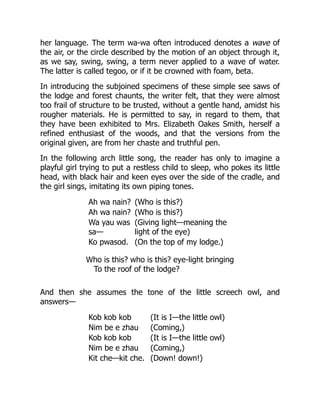
her language. Theterm wa-wa often introduced denotes a wave of
the air, or the circle described by the motion of an object through it,
as we say, swing, swing, a term never applied to a wave of water.
The latter is called tegoo, or if it be crowned with foam, beta.
In introducing the subjoined specimens of these simple see saws of
the lodge and forest chaunts, the writer felt, that they were almost
too frail of structure to be trusted, without a gentle hand, amidst his
rougher materials. He is permitted to say, in regard to them, that
they have been exhibited to Mrs. Elizabeth Oakes Smith, herself a
refined enthusiast of the woods, and that the versions from the
original given, are from her chaste and truthful pen.
In the following arch little song, the reader has only to imagine a
playful girl trying to put a restless child to sleep, who pokes its little
head, with black hair and keen eyes over the side of the cradle, and
the girl sings, imitating its own piping tones.
Ah wa nain? (Who is this?)
Ah wa nain? (Who is this?)
Wa yau was
sa—
(Giving light—meaning the
light of the eye)
Ko pwasod. (On the top of my lodge.)
Who is this? who is this? eye-light bringing
To the roof of the lodge?
And then she assumes the tone of the little screech owl, and
answers—
Kob kob kob (It is I—the little owl)
Nim be e zhau (Coming,)
Kob kob kob (It is I—the little owl)
Nim be e zhau (Coming,)
Kit che—kit che. (Down! down!)
36.
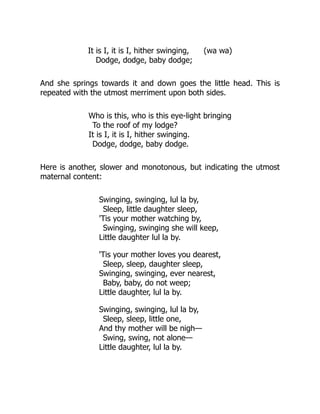
It is I,it is I, hither swinging, (wa wa)
Dodge, dodge, baby dodge;
And she springs towards it and down goes the little head. This is
repeated with the utmost merriment upon both sides.
Who is this, who is this eye-light bringing
To the roof of my lodge?
It is I, it is I, hither swinging.
Dodge, dodge, baby dodge.
Here is another, slower and monotonous, but indicating the utmost
maternal content:
Swinging, swinging, lul la by,
Sleep, little daughter sleep,
'Tis your mother watching by,
Swinging, swinging she will keep,
Little daughter lul la by.
'Tis your mother loves you dearest,
Sleep, sleep, daughter sleep,
Swinging, swinging, ever nearest,
Baby, baby, do not weep;
Little daughter, lul la by.
Swinging, swinging, lul la by,
Sleep, sleep, little one,
And thy mother will be nigh—
Swing, swing, not alone—
Little daughter, lul la by.
37.
This of courseis exceedingly simple, but be it remembered these
chaunts are always so in the most refined life. The ideas are the
same, that of tenderness and protective care only, the ideas being
few, the language is in accordance. To my mind it has been a matter
of extreme interest to observe how almost identical are the
expressions of affection in all states of society, as though these
primitive elements admit of no progress, but are perfect in
themselves. The e-we-yea of the Indian woman is entirely analogous
to the lul la by of our language, and will be seen to be exceedingly
pretty in itself.
2. The original words of this, with their literal import, are also added,
to preserve the identity.
(a.)
Wa wa—wa wa—wa we yea, (Swinging, twice, lullaby.)
Nebaun—nebaun—nebaun, (Sleep thou, thrice.)
Nedaunis-ais, e we yea, (Little daughter, lullaby.)
Wa wa—wa wa—wa wa, (Swinging, thrice.)
Nedaunis-ais, e we yea, (Little daughter lullaby.)
(b.)
Keguh, ke gun ah wain e ma, (Your mother cares for you.)
Nebaun—nebaun—nebaun, e we yea, (Sleep, thrice, lullaby.)
Kago, saigizze-kain, nedaunis-ais, (Do not fear, my little daughter.)
Nebaun—nebaun—nebaun, (Sleep, thrice.)
Kago, saigizze-kain, wa wa, e we yea, (third line repeated.)
(c.)
Wa wa—wa wa—wa we yea, (Swinging, twice, lullaby.)
Kaween neezheka kediausee, (Not alone art thou.)
Ke kan nau wai, ne me go, suhween, (Your mother is caring for you.)
Nebaun—nebaun—nedaunis-ais, (Sleep, sleep, my little daughter.)
Wa wa—wa wa—wa we yea, (Swinging, &c. lullaby.)
Nebaun—nebaun—nebaun, (Sleep! sleep! sleep.[51])
38.
3. THE HAREAND THE LYNX.
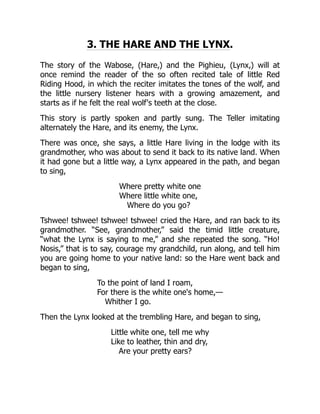
The story of the Wabose, (Hare,) and the Pighieu, (Lynx,) will at
once remind the reader of the so often recited tale of little Red
Riding Hood, in which the reciter imitates the tones of the wolf, and
the little nursery listener hears with a growing amazement, and
starts as if he felt the real wolf's teeth at the close.
This story is partly spoken and partly sung. The Teller imitating
alternately the Hare, and its enemy, the Lynx.
There was once, she says, a little Hare living in the lodge with its
grandmother, who was about to send it back to its native land. When
it had gone but a little way, a Lynx appeared in the path, and began
to sing,
Where pretty white one
Where little white one,
Where do you go?
Tshwee! tshwee! tshwee! tshwee! cried the Hare, and ran back to its
grandmother. “See, grandmother,” said the timid little creature,
“what the Lynx is saying to me,” and she repeated the song. “Ho!
Nosis,” that is to say, courage my grandchild, run along, and tell him
you are going home to your native land: so the Hare went back and
began to sing,
To the point of land I roam,
For there is the white one's home,—
Whither I go.
Then the Lynx looked at the trembling Hare, and began to sing,
Little white one, tell me why
Like to leather, thin and dry,
Are your pretty ears?
39.
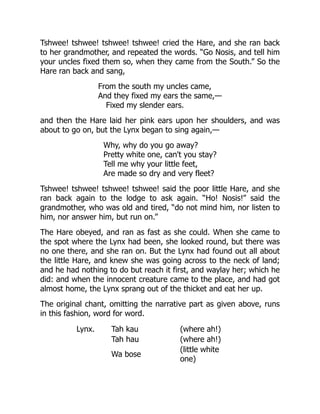
Tshwee! tshwee! tshwee!tshwee! cried the Hare, and she ran back
to her grandmother, and repeated the words. “Go Nosis, and tell him
your uncles fixed them so, when they came from the South.” So the
Hare ran back and sang,
From the south my uncles came,
And they fixed my ears the same,—
Fixed my slender ears.
and then the Hare laid her pink ears upon her shoulders, and was
about to go on, but the Lynx began to sing again,—
Why, why do you go away?
Pretty white one, can't you stay?
Tell me why your little feet,
Are made so dry and very fleet?
Tshwee! tshwee! tshwee! tshwee! said the poor little Hare, and she
ran back again to the lodge to ask again. “Ho! Nosis!” said the
grandmother, who was old and tired, “do not mind him, nor listen to
him, nor answer him, but run on.”
The Hare obeyed, and ran as fast as she could. When she came to
the spot where the Lynx had been, she looked round, but there was
no one there, and she ran on. But the Lynx had found out all about
the little Hare, and knew she was going across to the neck of land;
and he had nothing to do but reach it first, and waylay her; which he
did: and when the innocent creature came to the place, and had got
almost home, the Lynx sprang out of the thicket and eat her up.
The original chant, omitting the narrative part as given above, runs
in this fashion, word for word.
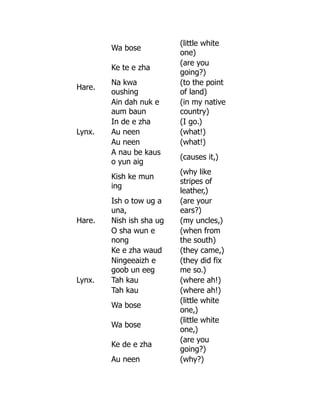
Lynx. Tah kau (where ah!)
Tah hau (where ah!)
Wa bose
(little white
one)
40.
Wa bose
(little white
one)
Kete e zha
(are you
going?)
Hare.
Na kwa
oushing
(to the point
of land)
Ain dah nuk e
aum baun
(in my native
country)
In de e zha (I go.)
Lynx. Au neen (what!)
Au neen (what!)
A nau be kaus
o yun aig
(causes it,)
Kish ke mun
ing
(why like
stripes of
leather,)
Ish o tow ug a
una,
(are your
ears?)
Hare. Nish ish sha ug (my uncles,)
O sha wun e
nong
(when from
the south)
Ke e zha waud (they came,)
Ningeeaizh e
goob un eeg
(they did fix
me so.)
Lynx. Tah kau (where ah!)
Tah kau (where ah!)
Wa bose
(little white
one,)
Wa bose
(little white
one,)
Ke de e zha
(are you
going?)
Au neen (why?)
41.
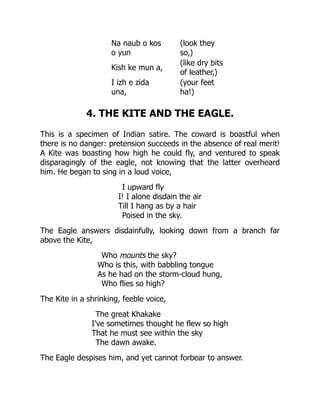
Na naub okos
o yun
(look they
so,)
Kish ke mun a,
(like dry bits
of leather,)
I izh e zida
una,
(your feet
ha!)
4. THE KITE AND THE EAGLE.
This is a specimen of Indian satire. The coward is boastful when
there is no danger: pretension succeeds in the absence of real merit!
A Kite was boasting how high he could fly, and ventured to speak
disparagingly of the eagle, not knowing that the latter overheard
him. He began to sing in a loud voice,
I upward fly
I! I alone disdain the air
Till I hang as by a hair
Poised in the sky.
The Eagle answers disdainfully, looking down from a branch far
above the Kite,
Who mounts the sky?
Who is this, with babbling tongue
As he had on the storm-cloud hung,
Who flies so high?
The Kite in a shrinking, feeble voice,
The great Khakake
I've sometimes thought he flew so high
That he must see within the sky
The dawn awake.
The Eagle despises him, and yet cannot forbear to answer.
42.
I spurn youall, ye prating throng
How often have I passed ye by
When my broad pinions fleet and strong,
Soared up where leapt the thunder cry!
Nor ye with feeble wing might dare,
Those hill-tops high, to mount in air.
and he soared off, up, up into the sky till the boaster could not
behold him. But no sooner was the Kite left alone to himself than he
began to sing again so as to be heard on every side,
I upward fly
I, I alone disdain the air
Till I hang as by a hair
Poised in the sky.
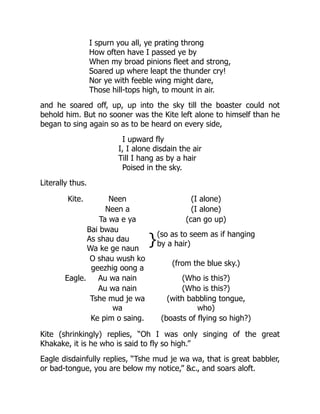
Literally thus.
Kite. Neen (I alone)
Neen a (I alone)
Ta wa e ya (can go up)
Bai bwau
As shau dau
Wa ke ge naun
}(so as to seem as if hanging
by a hair)
O shau wush ko
geezhig oong a
(from the blue sky.)
Eagle. Au wa nain (Who is this?)
Au wa nain (Who is this?)
Tshe mud je wa
wa
(with babbling tongue,
who)
Ke pim o saing. (boasts of flying so high?)
Kite (shrinkingly) replies, “Oh I was only singing of the great
Khakake, it is he who is said to fly so high.”
Eagle disdainfully replies, “Tshe mud je wa wa, that is great babbler,
or bad-tongue, you are below my notice,” &c., and soars aloft.
43.
Kite, resuming itsboasting tone, as soon as the eagle is out of
hearing,
Neen a
(I alone &c., the
whole being a
Neen a
repetition of the first
part.)
Ta we ya
Bai bwau
As shau dau
Wa ke ge naun,
O shau wush ko, geezhig
oong a.
5. THE RAVEN AND WOODPECKER.
A still farther view of Indian manners and opinions is hid under this
simple chant. Opinion among the forest race, makes the whole
animated creation cognizant and intelligent of their customs.
A young married woman is supposed to go out from the lodge, and
busy herself in breaking up dry limbs, and preparing wood, as if to
lay in a store for a future and approaching emergency.
A raven, perched on a neighbouring tree, espies her, at her work,
and begins to sing; assuming the expected infant to be a boy.
In dosh ke zhig o mun
In dosh ke zhig o mun
In dosh ke zhig o mun
My eyes! my eyes! my eyes! Alluding to the boy (and future man)
killing animals as well as men, whose eyes will be left, as the singer
anticipates, to be picked out by ravenous birds. So early are the first
notions of war implanted.
44.
A woodpecker, sittingnear, and hearing this song, replies; assuming
the sex of the infant to be a female.
Ne mos sa mug ga
Ne mos sa mug ga
Ne mos sa mug ga.
My worms! my worms! my worms! Alluding to the custom of the
female's breaking up dry and dozy wood, out of which, it could pick
its favourite food, being the mösa or wood-worm.
Want of space induces the writer to defer, to a future number, the
remainder of his collection of these cradle and nursery chants. They
constitute in his view, rude as they are, and destitute of metrical
attractions, a chapter in the history of the human heart, in the
savage phasis, which deserves to be carefully recorded. It has fallen
to his lot, to observe more perhaps, in this department of Indian life,
than ordinary, and he would not acquit himself of his duty to the
race, were he to omit these small links out of their domestic and
social chain. The tie which binds the mother to the child, in Indian
life, is a very strong one, and it is conceived to admit of illustration
in this manner. It is not alone in the war-path and the council, that
the Red Man is to be studied. To appreciate his whole character, in
its true light, he must be followed into his lodge, and viewed in his
seasons of social leisure and retirement. If there be any thing warm
and abiding in the heart or memory of the man, when thus at ease,
surrounded by his family, it must come out here; and hence, indeed,
the true value of his lodge lore, of every kind.
It is out of the things mental as well as physiological, that pertain to
maternity, that philosophy must, in the end, construct the true
ethnological chain, that binds the human race, in one comprehensive
system of unity.
45.
LANGUAGES OF THEPACIFIC ISLANDS.
The Polynesian languages, like those of the Algonquin group of
North America, have inclusive and exclusive pronouns to express the
words we, ours, and us. They have also causative verbs such as, to
make afraid, to make happy, &c., but while there appears this
analogy in grammatical principles, there are some strong points of
disagreement, and there appears to be no analogy whatever in the
sounds of the language. There are eight well characterized dialects
in the Polynesian family. They are the Tahitian, the Owyhee,
[Hawaiian] Marquesan, or Washingtonian, Austral island, Hervey
island, Samoan, Tongatabu, and New Zealand. In seven of these, the
name for God is Atua, in the eighth, or Tongua dialect, it is Otua.
Great resemblances exist in all the vocabularies. Much of the actual
difference arises from exchanges of the consonants r and l, h and s,
and a few others. They possess the dual number. The scheme of the
pronouns is very complete, and provides for nearly all the recondite
distinctions of person. Where the vocabulary fails in words to
designate objects which were unknown to them before their
acquaintance with Europeans, the missionaries have found it to fall
in better with the genius of the language, to introduce new words
from the Greek, with some modifications. Thus they have introduced
hipo for horse, arenio for lamb, areto for bread, and baptizo for
baptism.
To continue faithful during a course of prosperity, says Xenophon,
hath nothing wonderful in it, but when any set of men continue
steadily attached to friends in adversity, they ought, on that account,
to be eternally remembered.
There are but two sources only, says Polybius, from whence any real
benefit can be derived, our own misfortunes and those that have
happened to other men.
46.
One wise counsel,says Euripides, is better than the strength of
many.
CHAPTER XIX.
OF THEIRWOMEN, THEIR DISPOSITIONS, EMPLOYMENTS,
USAGE BY THEIR HUSBANDS, THEIR APPARELL, AND
MODESTY.
To satisfie the curious eye of women-readers, who otherwise might
thinke their sex forgotten, or not worthy a record, let them peruse
these few lines, wherein they may see their owne happinesse, if
weighed in the womans ballance of these ruder Indians, who scorne
the tuterings of their wives, or to admit them as their equals, though
their qualities and industrious deservings may justly claime the
preheminence, and command better usage and more conjugall
esteeme, their persons and features being every way correspondent,
their qualifications more excellent, being more loving, pittifull, and
modest, milde, provident, and laborious than their lazie husbands.
Their employments be many: First their building of houses, whose
frames are formed like our garden-arbours, something more round,
very strong and handsome, covered with close-wrought mats of their
owne weaving, which deny entrance to any drop of raine, though it
come both fierce and long, neither can the piercing North winde,
finde a crannie, through which he can conveigh his cooling breath,
they be warmer than our English houses; at the top is a square hole
for the smoakes evacuation, which in rainy weather is covered with a
pluver; these bee such smoakie dwellings, that when there is good
fires, they are not able to stand upright, but lie all along under the
smoake, never using any stooles or chaires, it being as rare to see
an Indian sit on a stoole at home, as it is strange to see an English
man sit on his heels abroad. Their houses are smaller in the
Summer, when their families be dispersed, by reason of heate and
occasions. In Winter they make some fiftie or thereescore foote
long, fortie or fiftie men being inmates under one roofe; and as is
their husbands occasion these poore tectonists are often troubled
49.
like snailes, tocarrie their houses on their backs sometimes to
fishing-places, other times to hunting places, after that to a planting-
place, where it abides the longest: an other work is their planting of
corne, wherein they exceede our English husband-men, keeping it so
cleare with their Clamme shell-hooes, as if it were a garden rather
than a corne-field, not suffering a choaking weede to advance his
audacious head above their infant corne, or an undermining worme
to spoile his spurnes. Their corne being ripe, they gather it, and
drying it hard in the Sunne, conveigh it to their barnes, which be
great holes digged in the ground in forme of a brasse pot, seeled
with rinds of trees, wherein they put their corne, covering it from the
inquisitive search of their gurmandizing husbands, who would eate
up both their allowed portion, and reserved seede, if they knew
where to finde it. But our hogges having found a way to unhindge
their barne doores, and robbe their garners, they are glad to implore
their husbands helpe to roule the bodies of trees over their holes, to
prevent those pioners, whose theeverie they as much hate as their
flesh. An other of their employments is their Summer processions to
get Lobsters for their husbands, wherewith they baite their hookes
when they goe a fishing for Basse or Codfish. This is an every dayes
walke, be the weather cold or hot, the waters rough or calme, they
must dive sometimes over head and eares for a Lobster, which often
shakes them by their hands with a churlish nippe, and bids them
adiew. The tide being spent, they trudge home two or three miles,
with a hundred weight of Lobsters at their backs, and if none, a
hundred scoules meete them at home, and a hungry belly for two
days after. Their husbands having caught any fish, they bring it in
their boates as farre as they can by water, and there leave it; as it
was their care to catch it, so it must be their wives paines to fetch it
home, or fast: which done, they must dresse it and cooke it, dish it,
and present it, see it eaten over their shoulders; and their
loggerships having filled their paunches, their sweete lullabies
scramble for their scrappes. In the Summer these Indian women
when Lobsters be in their plenty and prime, they drie them to keepe
for Winter, erecting scaffolds in the hot sun-shine, making fires
likewise underneath them, by whose smoake the flies are expelled,
50.
till the substanceremains hard and drie. In this manner they drie
Basse and other fishes without salt, cutting them very thinne to dry
suddainely, before the flies spoile them, or the raine moist them,
having a speciall care to hang them in their smoakie houses, in the
night and dankish weather.
In Summer they gather flagges, of which they make Matts for
houses, and Hempe and rushes, with dying stuffe of which they
make curious baskets with intermixed colours and portractures of
antique Imagerie, these baskets be of all sizes from a quart to a
quarter, in which they carry their luggage. In winter time they are
their husbunds Caterers, trudging to the Clamm bankes for their
belly timber, and their Porters to lugge home their Venison which
their lazinesse exposes to the Woolves till they impose it upon their
wives shoulders. They likewise sew their husbands shooes, and
weave coates of Turkie feathers, besides all their ordinary household
drudgerie which daily lies upon them. * * * * * [Of the treatment of
babes the writer says]: The young Infant being greased and sooted,
wrapt in a beaver skin, bound to his good behaviour with his feete
upon a board two foote long and one foote broade, his face exposed
to all nipping weather; this little Pappouse travells about with his
bare footed mother to paddle in the ice Clammbanks after three or
foure dayes of age have sealed his passeboard and his mothers
recoverie. For their carriage it is very civill, smiles being the greatest
grace of their mirth; their musick is lullabies to quiet their children,
who generally are as quiet as if they had neither spleene or lungs.
To hear one of these Indians unseene, a good eare might easily
mistake their untaught voyce for the warbling of a well tuned
instrument. Such command have they of their voices.
* * * * * * * * * * * * *
Commendable is their milde carriage and obedience to their
husbands, notwithstanding all this their customarie churlishnesse
and salvage inhumanitie, not seeming to delight in frownes or
offering to word it with their lords, not presuming to proclaime their
female superiority to the usurping of the least title of their husbands
51.
charter, but restthemselves content under their helplesse condition,
counting it the womans portion: since the English, arrivall
comparison hath made them miserable, for seeing the kind usage of
the English to their wives, they doe as much condemne their
husbands for unkindnesse, and commend the English for their love.
As their husbands commending themselves for their wit in keeping
their wives industrious, doe condemne the English for their folly in
spoyling good working creatures. These women resort often to the
English houses, where pares cum paribus congregatæ[52], in Sex I
meane, they do somewhat ease their miserie by complaining and
seldome part without a releefe. If her husband come to seeke for his
Squaw and beginne to bluster, the English woman betakes her to her
armes which are the warlike Ladle, and the scalding liquors,
threatening blistering to the naked runnaway, who is soon expelled
by such liquid comminations. In a word to conclude this womans
historie, their love to the English hath deserved no small esteeme,
ever presenting them some thing that is either rare or desired, as
Strawberries, Hurtleberries, Rasberries, Gooseberries, Cherries,
Plummes, Fish, and other such gifts as their poore treasury yeelds
them. But now it may be, that this relation of the churlish and
inhumane behaviour of these ruder Indians towards their patient
wives, may confirme some in the beliefe of an aspersion, which I
have often heard men cast upon the English there, as if they should
learne of the Indians to use their wives in the like manner, and to
bring them to the same subjection, as to sit on the lower hand, and
to carrie water and the like drudgerie: but if my own experience may
out-ballance an ill-grounded scandalous rumour, I doe assure you,
upon my credit and reputation, that there is no such matter, but the
women finde there as much love, respect, and ease, as here in old
England. I will not deny, but that some poore people may carrie their
owne water, and doe not the poorer sort in England doe the same;
witnesse your London Tankard-bearers, and your countrie-cottagers?
But this may well be knowne to be nothing, but the rancorous
venome of some that beare no good will to the plantation. For what
neede they carrie water, seeing every one hath a Spring at his
52.
Welcome to ourwebsite – the perfect destination for book lovers and
knowledge seekers. We believe that every book holds a new world,
offering opportunities for learning, discovery, and personal growth.
That’s why we are dedicated to bringing you a diverse collection of
books, ranging from classic literature and specialized publications to
self-development guides and children's books.
More than just a book-buying platform, we strive to be a bridge
connecting you with timeless cultural and intellectual values. With an
elegant, user-friendly interface and a smart search system, you can
quickly find the books that best suit your interests. Additionally,
our special promotions and home delivery services help you save time
and fully enjoy the joy of reading.
Join us on a journey of knowledge exploration, passion nurturing, and
personal growth every day!
testbankfan.com






![located on the east and the west banks of the Hudson. The
Stockbridges are civilized; the Munsees less so, but industrious. Both
are poor, and without funds.
Immediately succeeding the Delawares are the Kickapoos, an erratic
race, who, under various names, in connection with the Foxes and
Sacs, have, in good keeping with one of their many names,[50]
skipped over half the continent, to the manifest discomfort of both
German and American philologists and ethnographers, who, in
searching for the so-called “Mascotins,” have followed, so far as their
results are concerned, an ignis fatuus. The Kickapoos have 12,000
square miles, or 768,000 acres. It is a choice, rich tract, and they
are disposed, with the example of the Delawares and Shawnees, to
profit by it. They raise corn and cattle, hogs and horses, and are
prosperous. Their numbers, in 1840, were 470. There is a tract of
200 square miles, on the Great and Little Namaha, assigned to the
metifs, or descendants of mixed blood, of the lowas, Otoes, and
Missouris. These separate the removed and semi-civilized tribes,
south and west of the Missouri, from the wild indigenes—we mean
the Otoes, the Pawnees, the Omahaws, and the Sioux, who extend
over vast tracts, and exist without any sensible improvement in their
condition. The same remark may be applied to the Konzas, who are,
however, hemmed in between the Delawares and the Shawnees,
except on their western borders. It is no part of our purpose to
consider these tribes, as, over and above the influence of contiguous
examples, they constitute no part of the evidence affecting the
general question of the plan of removal.
That this evidence, as now briefly sketched, is favorable, and indeed
highly favorable, to the general condition and prosperity of the
removed tribes, is, we apprehend, clearly manifest. Not only have
they been placed beyond the wasting influence of causes which
oppressed them, within the circle of the State communities; but they
have received in exchange for their eastern lands, a territory which,
as a whole, is highly fertile and salubrious. It is a territory which has
required little comparative labor to cultivate, made up as it is of](https://image.slidesharecdn.com/11537-250313063826-acd33dbe/85/Business-Research-Methods-12th-Edition-Cooper-Solutions-Manual-28-320.jpg)
![This of course is exceedingly simple, but be it remembered these
chaunts are always so in the most refined life. The ideas are the
same, that of tenderness and protective care only, the ideas being
few, the language is in accordance. To my mind it has been a matter
of extreme interest to observe how almost identical are the
expressions of affection in all states of society, as though these
primitive elements admit of no progress, but are perfect in
themselves. The e-we-yea of the Indian woman is entirely analogous
to the lul la by of our language, and will be seen to be exceedingly
pretty in itself.
2. The original words of this, with their literal import, are also added,
to preserve the identity.
(a.)
Wa wa—wa wa—wa we yea, (Swinging, twice, lullaby.)
Nebaun—nebaun—nebaun, (Sleep thou, thrice.)
Nedaunis-ais, e we yea, (Little daughter, lullaby.)
Wa wa—wa wa—wa wa, (Swinging, thrice.)
Nedaunis-ais, e we yea, (Little daughter lullaby.)
(b.)
Keguh, ke gun ah wain e ma, (Your mother cares for you.)
Nebaun—nebaun—nebaun, e we yea, (Sleep, thrice, lullaby.)
Kago, saigizze-kain, nedaunis-ais, (Do not fear, my little daughter.)
Nebaun—nebaun—nebaun, (Sleep, thrice.)
Kago, saigizze-kain, wa wa, e we yea, (third line repeated.)
(c.)
Wa wa—wa wa—wa we yea, (Swinging, twice, lullaby.)
Kaween neezheka kediausee, (Not alone art thou.)
Ke kan nau wai, ne me go, suhween, (Your mother is caring for you.)
Nebaun—nebaun—nedaunis-ais, (Sleep, sleep, my little daughter.)
Wa wa—wa wa—wa we yea, (Swinging, &c. lullaby.)
Nebaun—nebaun—nebaun, (Sleep! sleep! sleep.[51])](https://image.slidesharecdn.com/11537-250313063826-acd33dbe/85/Business-Research-Methods-12th-Edition-Cooper-Solutions-Manual-37-320.jpg)
![LANGUAGES OF THE PACIFIC ISLANDS.
The Polynesian languages, like those of the Algonquin group of
North America, have inclusive and exclusive pronouns to express the
words we, ours, and us. They have also causative verbs such as, to
make afraid, to make happy, &c., but while there appears this
analogy in grammatical principles, there are some strong points of
disagreement, and there appears to be no analogy whatever in the
sounds of the language. There are eight well characterized dialects
in the Polynesian family. They are the Tahitian, the Owyhee,
[Hawaiian] Marquesan, or Washingtonian, Austral island, Hervey
island, Samoan, Tongatabu, and New Zealand. In seven of these, the
name for God is Atua, in the eighth, or Tongua dialect, it is Otua.
Great resemblances exist in all the vocabularies. Much of the actual
difference arises from exchanges of the consonants r and l, h and s,
and a few others. They possess the dual number. The scheme of the
pronouns is very complete, and provides for nearly all the recondite
distinctions of person. Where the vocabulary fails in words to
designate objects which were unknown to them before their
acquaintance with Europeans, the missionaries have found it to fall
in better with the genius of the language, to introduce new words
from the Greek, with some modifications. Thus they have introduced
hipo for horse, arenio for lamb, areto for bread, and baptizo for
baptism.
To continue faithful during a course of prosperity, says Xenophon,
hath nothing wonderful in it, but when any set of men continue
steadily attached to friends in adversity, they ought, on that account,
to be eternally remembered.
There are but two sources only, says Polybius, from whence any real
benefit can be derived, our own misfortunes and those that have
happened to other men.](https://image.slidesharecdn.com/11537-250313063826-acd33dbe/85/Business-Research-Methods-12th-Edition-Cooper-Solutions-Manual-45-320.jpg)

![till the substance remains hard and drie. In this manner they drie
Basse and other fishes without salt, cutting them very thinne to dry
suddainely, before the flies spoile them, or the raine moist them,
having a speciall care to hang them in their smoakie houses, in the
night and dankish weather.
In Summer they gather flagges, of which they make Matts for
houses, and Hempe and rushes, with dying stuffe of which they
make curious baskets with intermixed colours and portractures of
antique Imagerie, these baskets be of all sizes from a quart to a
quarter, in which they carry their luggage. In winter time they are
their husbunds Caterers, trudging to the Clamm bankes for their
belly timber, and their Porters to lugge home their Venison which
their lazinesse exposes to the Woolves till they impose it upon their
wives shoulders. They likewise sew their husbands shooes, and
weave coates of Turkie feathers, besides all their ordinary household
drudgerie which daily lies upon them. * * * * * [Of the treatment of
babes the writer says]: The young Infant being greased and sooted,
wrapt in a beaver skin, bound to his good behaviour with his feete
upon a board two foote long and one foote broade, his face exposed
to all nipping weather; this little Pappouse travells about with his
bare footed mother to paddle in the ice Clammbanks after three or
foure dayes of age have sealed his passeboard and his mothers
recoverie. For their carriage it is very civill, smiles being the greatest
grace of their mirth; their musick is lullabies to quiet their children,
who generally are as quiet as if they had neither spleene or lungs.
To hear one of these Indians unseene, a good eare might easily
mistake their untaught voyce for the warbling of a well tuned
instrument. Such command have they of their voices.
* * * * * * * * * * * * *
Commendable is their milde carriage and obedience to their
husbands, notwithstanding all this their customarie churlishnesse
and salvage inhumanitie, not seeming to delight in frownes or
offering to word it with their lords, not presuming to proclaime their
female superiority to the usurping of the least title of their husbands](https://image.slidesharecdn.com/11537-250313063826-acd33dbe/85/Business-Research-Methods-12th-Edition-Cooper-Solutions-Manual-50-320.jpg)
![charter, but rest themselves content under their helplesse condition,
counting it the womans portion: since the English, arrivall
comparison hath made them miserable, for seeing the kind usage of
the English to their wives, they doe as much condemne their
husbands for unkindnesse, and commend the English for their love.
As their husbands commending themselves for their wit in keeping
their wives industrious, doe condemne the English for their folly in
spoyling good working creatures. These women resort often to the
English houses, where pares cum paribus congregatæ[52], in Sex I
meane, they do somewhat ease their miserie by complaining and
seldome part without a releefe. If her husband come to seeke for his
Squaw and beginne to bluster, the English woman betakes her to her
armes which are the warlike Ladle, and the scalding liquors,
threatening blistering to the naked runnaway, who is soon expelled
by such liquid comminations. In a word to conclude this womans
historie, their love to the English hath deserved no small esteeme,
ever presenting them some thing that is either rare or desired, as
Strawberries, Hurtleberries, Rasberries, Gooseberries, Cherries,
Plummes, Fish, and other such gifts as their poore treasury yeelds
them. But now it may be, that this relation of the churlish and
inhumane behaviour of these ruder Indians towards their patient
wives, may confirme some in the beliefe of an aspersion, which I
have often heard men cast upon the English there, as if they should
learne of the Indians to use their wives in the like manner, and to
bring them to the same subjection, as to sit on the lower hand, and
to carrie water and the like drudgerie: but if my own experience may
out-ballance an ill-grounded scandalous rumour, I doe assure you,
upon my credit and reputation, that there is no such matter, but the
women finde there as much love, respect, and ease, as here in old
England. I will not deny, but that some poore people may carrie their
owne water, and doe not the poorer sort in England doe the same;
witnesse your London Tankard-bearers, and your countrie-cottagers?
But this may well be knowne to be nothing, but the rancorous
venome of some that beare no good will to the plantation. For what
neede they carrie water, seeing every one hath a Spring at his](https://image.slidesharecdn.com/11537-250313063826-acd33dbe/85/Business-Research-Methods-12th-Edition-Cooper-Solutions-Manual-51-320.jpg)