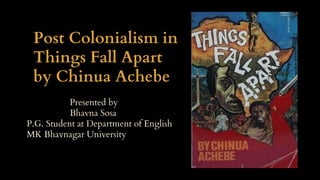
Post Colonialism in
Things Fall Apart
by Chinua Achebe
Presented by
Bhavna Sosa
P.G. Student at Department of English
MK Bhavnagar University
Table content:
1. Introduction
2. What is Post colonialism?
3. Title of the Novel
4. Postcolonial discourse and Things Fall Apart
5. Analysis of the Novel
6. Conclusion
Introduction:
The setting of the novel, Things Fall Apart written by Chinua Achebe, is in the
outskirts of Nigeria in a small fictional village, Umuofia just before the arrival of
white missionaries in to their land.
Achebe's primary purpose of writing the novel is because he wants to educate his
readers about the value of his culture as an African. He educates readers extensively
about Igbo (Ibo) society 's myths and proverbs.
Things Fall Apart provides readers with an insight of Igbo society right before the
white missionaries' invasion on their land . Towards the end of the 19th century
most European states migrated to Africa and other parts of the world where they
established colonies. Nigeria was amongst other African nations that received
visitors who were on a colonising mission.
Things Fall Apart shows how the unexpected arrival of white missionaries in
Umuofia threatens the villagers' culture, i.e. Igbo culture from religion,
traditional gender roles and relations , family structure to trade.
Gikandi (1996) notes that though this novel is not the first African novel , " it
was probably the first work in which the author set out to represent the
African experience in a narrative that sought, self- consciously, to be different
from the colonial novel".
What is Post colonialism?
Post colonialism is the academic study of the cultural legacy of colonialism and
imperialism, focussing on the human consequences of the control and exploitation of
colonised people and their lands. On a deeper level, postcolonialism examines thesocial and
political power relationships that sustained colonialism and neocolonialism, including the
social, political and cultural narratives surrounding thecoloniser and the colonised.
As Ashcroft, Griffiths and Tiffin pertinently assert:
" All post colonial societies are still subject in one way or another to overt or subtle
forms of neo - colonial domination, and independence has not solve this problem. The
development of new elites within independent societies, often buttressed by neo colonial
institutions; the development of internal divisions based on racial, linguistic or religious
discriminations; the continuing unequal treatment of indigenous peoples in settler /
invader societies - all these testify to the fact that post colonialism is a continuing process
of resistance and reconstructions".
Title of the Novel:
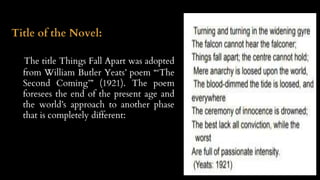
The title Things Fall Apart was adopted
from William Butler Yeats’ poem “‘The
Second Coming’” (1921). The poem
foresees the end of the present age and
the world’s approach to another phase
that is completely different:
Postcolonial discourse and Things Fall Apart :
It is now popular to argue that the post-colonial literatures are primarily
concerned with writing back to the center, by active engagement “in a process of
questioning and travestying” colonial discourses (McLeod 2007: p. 25).
According to O’Reilly (2001), when approaching a postcolonial text the writer has
an awareness of some key issues that include: “the use of indigenous cultural
traditions, the appropriation of English, and the impact of colonialism and its
aftermath” (p. 61).
These three principal issues are scrupulously and efficiently dealt with by Achebe
in Things Fall Apart. This novel illustrates the “cultural traditions” of the
indigenous Igbo. It demonstrates cultural, psychological and political impacts of
colonialism on the Igbo. And for making these two points of demonstration
successful, Achebe resorts to the English language as the medium of expression.
Analysis of Novel:
Chinua Achebe, a native of Africa, examines the root cause of the problems of
his native fellow beings in to the new African world of literariness.
The major themes of this novel are the conflict between past and present,
the changes brought by Europeans imperialism and the erosion traditions,
tribes and religion, conflict between old and new socio-economic values, old
and new order of life , political corruption, opportunism etc.
The central character of Things Fall Apart is Okonkwo, a respected leader
whose inability to resist against the cultural, social and historical changes
enforced by the white man brings about his tragedy. Okonkwo's trouble
starts when he kills a young mother of his tribe by accident.
He gets exile from the clan for seven years as a punishment. After returning
from exile, he discovers that the British missionaries have already started to
change the people.
Okonkwo and a few older members of his tribe try to resist the changes that
the white men enforce and are sent to jail. After this Okonkwo bursts in
anger and kills a messenger from British authorities.
Then Okonkwo commits suicide, a crime in Igbo culture and ends the novel
in a tragedy .
Things Fall Apart depicts a world which is shedding nostalgic tears of the
lost identity, a world which finds itself on the verge of getting sealed in the
dusted files of a forgotten history.
Achebe picks up the situations from a transitional phase of the history.
Conclusion :
in the end, Okonkwo stands as Africa, and his tale becomes Africa's history.
Hence, through Okonkwo 's death , Achebe points out the idea that ' the
suicide is collective suicide of Umuofia ". Achebe documented the social,
political, cultural norms, codes, traditions, customs, conventions with a diligent
detail and their hemiplegic transformation crossing a phase of history in
colonial set and gives it uniqueness and universality. Achebe in this novel
rewrites the lost traditions and cultures of Igbo by differentiating the pre
colonial and post colonial scenario of Igbo society.
Work Cited :
Alam, Md MahbubBhai. “Reading Chinua Achebe’s Things Fall Apart from the
Postcolonial Perspective.” Research on Humanities and Social Sciences, vol. 4,
2014.
Ashcroft, Bill, et al. “Post-Colonial Studies: The Key Concepts.” 2003,
https://doi.org/10.4324/9780203449974.
Barcock, Christopher. “Things Fall Apart Chinua Achebe Activities.”
London:Heinemann, 2005.
Kenalemang, Lame Maatla. “Things Fall Apart: An Analysis of Pre and Post-
Colonial Igbo Society.” 2013.
Mogu, Francis Ibe. “Things Fall Apart Across Cultures: The Universal
Significance of Chinua Achebe’s 1958 Reconstruction of the African
Heritage.” LWATI: A Journal of Contemporary Research, 6 (1), 2009.
Thank You
bhavnasosa211@gmail.com

Post colonialism in Things Fall Apart

  • 1.
    Post Colonialism in ThingsFall Apart by Chinua Achebe Presented by Bhavna Sosa P.G. Student at Department of English MK Bhavnagar University
  • 2.
    Table content: 1. Introduction 2.What is Post colonialism? 3. Title of the Novel 4. Postcolonial discourse and Things Fall Apart 5. Analysis of the Novel 6. Conclusion
  • 3.
    Introduction: The setting ofthe novel, Things Fall Apart written by Chinua Achebe, is in the outskirts of Nigeria in a small fictional village, Umuofia just before the arrival of white missionaries in to their land. Achebe's primary purpose of writing the novel is because he wants to educate his readers about the value of his culture as an African. He educates readers extensively about Igbo (Ibo) society 's myths and proverbs. Things Fall Apart provides readers with an insight of Igbo society right before the white missionaries' invasion on their land . Towards the end of the 19th century most European states migrated to Africa and other parts of the world where they established colonies. Nigeria was amongst other African nations that received visitors who were on a colonising mission.
  • 4.
    Things Fall Apartshows how the unexpected arrival of white missionaries in Umuofia threatens the villagers' culture, i.e. Igbo culture from religion, traditional gender roles and relations , family structure to trade. Gikandi (1996) notes that though this novel is not the first African novel , " it was probably the first work in which the author set out to represent the African experience in a narrative that sought, self- consciously, to be different from the colonial novel".
  • 5.
    What is Postcolonialism? Post colonialism is the academic study of the cultural legacy of colonialism and imperialism, focussing on the human consequences of the control and exploitation of colonised people and their lands. On a deeper level, postcolonialism examines thesocial and political power relationships that sustained colonialism and neocolonialism, including the social, political and cultural narratives surrounding thecoloniser and the colonised. As Ashcroft, Griffiths and Tiffin pertinently assert: " All post colonial societies are still subject in one way or another to overt or subtle forms of neo - colonial domination, and independence has not solve this problem. The development of new elites within independent societies, often buttressed by neo colonial institutions; the development of internal divisions based on racial, linguistic or religious discriminations; the continuing unequal treatment of indigenous peoples in settler / invader societies - all these testify to the fact that post colonialism is a continuing process of resistance and reconstructions".
  • 6.
    Title of theNovel: The title Things Fall Apart was adopted from William Butler Yeats’ poem “‘The Second Coming’” (1921). The poem foresees the end of the present age and the world’s approach to another phase that is completely different:
  • 7.
    Postcolonial discourse andThings Fall Apart : It is now popular to argue that the post-colonial literatures are primarily concerned with writing back to the center, by active engagement “in a process of questioning and travestying” colonial discourses (McLeod 2007: p. 25). According to O’Reilly (2001), when approaching a postcolonial text the writer has an awareness of some key issues that include: “the use of indigenous cultural traditions, the appropriation of English, and the impact of colonialism and its aftermath” (p. 61). These three principal issues are scrupulously and efficiently dealt with by Achebe in Things Fall Apart. This novel illustrates the “cultural traditions” of the indigenous Igbo. It demonstrates cultural, psychological and political impacts of colonialism on the Igbo. And for making these two points of demonstration successful, Achebe resorts to the English language as the medium of expression.
  • 8.
    Analysis of Novel: ChinuaAchebe, a native of Africa, examines the root cause of the problems of his native fellow beings in to the new African world of literariness. The major themes of this novel are the conflict between past and present, the changes brought by Europeans imperialism and the erosion traditions, tribes and religion, conflict between old and new socio-economic values, old and new order of life , political corruption, opportunism etc. The central character of Things Fall Apart is Okonkwo, a respected leader whose inability to resist against the cultural, social and historical changes enforced by the white man brings about his tragedy. Okonkwo's trouble starts when he kills a young mother of his tribe by accident.
  • 9.
    He gets exilefrom the clan for seven years as a punishment. After returning from exile, he discovers that the British missionaries have already started to change the people. Okonkwo and a few older members of his tribe try to resist the changes that the white men enforce and are sent to jail. After this Okonkwo bursts in anger and kills a messenger from British authorities. Then Okonkwo commits suicide, a crime in Igbo culture and ends the novel in a tragedy . Things Fall Apart depicts a world which is shedding nostalgic tears of the lost identity, a world which finds itself on the verge of getting sealed in the dusted files of a forgotten history. Achebe picks up the situations from a transitional phase of the history.
  • 10.
    Conclusion : in theend, Okonkwo stands as Africa, and his tale becomes Africa's history. Hence, through Okonkwo 's death , Achebe points out the idea that ' the suicide is collective suicide of Umuofia ". Achebe documented the social, political, cultural norms, codes, traditions, customs, conventions with a diligent detail and their hemiplegic transformation crossing a phase of history in colonial set and gives it uniqueness and universality. Achebe in this novel rewrites the lost traditions and cultures of Igbo by differentiating the pre colonial and post colonial scenario of Igbo society.
  • 11.
    Work Cited : Alam,Md MahbubBhai. “Reading Chinua Achebe’s Things Fall Apart from the Postcolonial Perspective.” Research on Humanities and Social Sciences, vol. 4, 2014. Ashcroft, Bill, et al. “Post-Colonial Studies: The Key Concepts.” 2003, https://doi.org/10.4324/9780203449974. Barcock, Christopher. “Things Fall Apart Chinua Achebe Activities.” London:Heinemann, 2005. Kenalemang, Lame Maatla. “Things Fall Apart: An Analysis of Pre and Post- Colonial Igbo Society.” 2013.
  • 12.
    Mogu, Francis Ibe.“Things Fall Apart Across Cultures: The Universal Significance of Chinua Achebe’s 1958 Reconstruction of the African Heritage.” LWATI: A Journal of Contemporary Research, 6 (1), 2009.
  • 13.