What is self-monitoring?
   Self-monitoring is defined as “a means
    of increasing the amount of dialogue
    over the text for those whose
    institutional circumstances do not permit
    individual editorial discussions on
    student drafts” (Charles, 1990, p. 288).
What is self-monitoring?
   In writing their annotations, students
    direct the feedback process to their
    needs, establishing a collaborative
    relationship in which they work with
    teacher support either to improve written
    language at the point of use or to
    develop heuristics to solve composing
    problems independently
    (Cresswell, 2000, p. 235)
What is self-monitoring?
   “In permitting students to signal [a]
    language problem together with their
    intention, self-monitoring can remove
    the worry of the block, and free students
    to continue composing, while enabling
    the teacher to offer help with language
    to define the idea appropriately for the
    intended reader” (Cresswell, 2000, p.
    236).
What is self-monitoring?
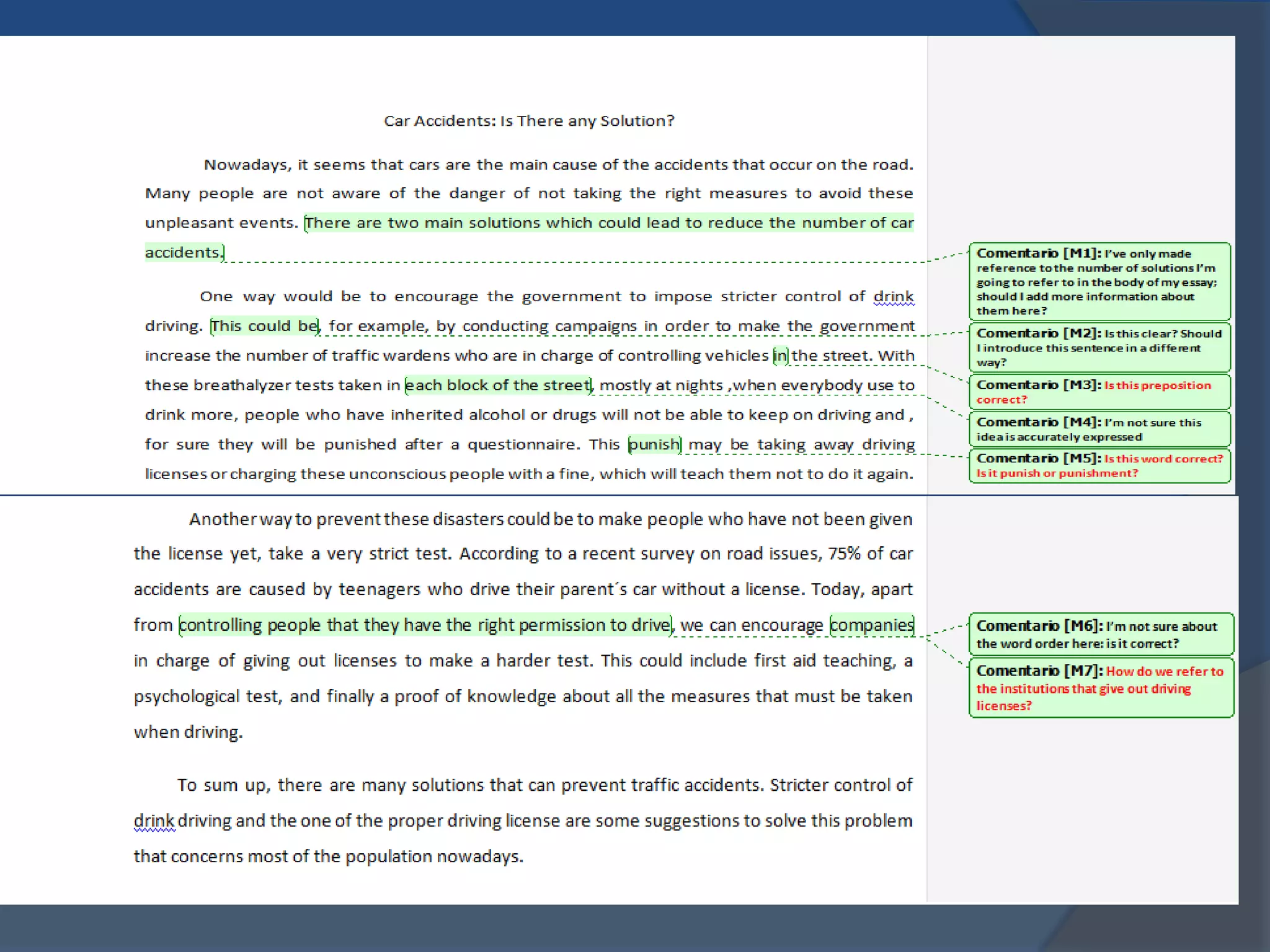
   “The student self-monitoring technique
    increases autonomy in the learning of
    writing by giving learners control over
    the initiation of feedback. In practical
    terms, this means that students write
    marginal annotations about problems in
    their evolving compositions, to which the
    teacher responds (also in writing).”
    (Cresswell, 2000, p. 235)
Self-monitoring

Self-monitoring

  • 2.
    What is self-monitoring?  Self-monitoring is defined as “a means of increasing the amount of dialogue over the text for those whose institutional circumstances do not permit individual editorial discussions on student drafts” (Charles, 1990, p. 288).
  • 3.
    What is self-monitoring?  In writing their annotations, students direct the feedback process to their needs, establishing a collaborative relationship in which they work with teacher support either to improve written language at the point of use or to develop heuristics to solve composing problems independently (Cresswell, 2000, p. 235)
  • 4.
    What is self-monitoring?  “In permitting students to signal [a] language problem together with their intention, self-monitoring can remove the worry of the block, and free students to continue composing, while enabling the teacher to offer help with language to define the idea appropriately for the intended reader” (Cresswell, 2000, p. 236).
  • 5.
    What is self-monitoring?  “The student self-monitoring technique increases autonomy in the learning of writing by giving learners control over the initiation of feedback. In practical terms, this means that students write marginal annotations about problems in their evolving compositions, to which the teacher responds (also in writing).” (Cresswell, 2000, p. 235)