Tragedy and Comedy in
Shakespeare
Romeo and Juliet
Hamlet
Twelfth Night
The Merchant of Venice
WHITE SPACES - Culture, literature and languages
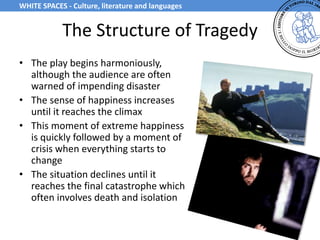
The Structure of Tragedy
• The play begins harmoniously,
although the audience are often
warned of impending disaster
• The sense of happiness increases
until it reaches the climax
• This moment of extreme happiness
is quickly followed by a moment of
crisis when everything starts to
change
• The situation declines until it
reaches the final catastrophe which
often involves death and isolation
WHITE SPACES - Culture, literature and languages
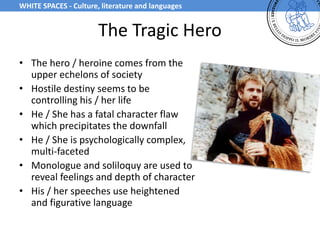
The Tragic Hero
• The hero / heroine comes from the
upper echelons of society
• Hostile destiny seems to be
controlling his / her life
• He / She has a fatal character flaw
which precipitates the downfall
• He / She is psychologically complex,
multi-faceted
• Monologue and soliloquy are used to
reveal feelings and depth of character
• His / her speeches use heightened
and figurative language
WHITE SPACES - Culture, literature and languages
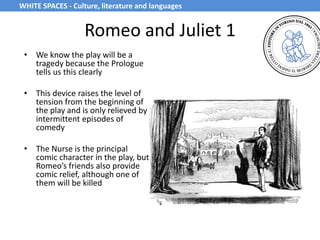
Romeo and Juliet 1
• We know the play will be a
tragedy because the Prologue
tells us this clearly
• This device raises the level of
tension from the beginning of
the play and is only relieved by
intermittent episodes of
comedy
• The Nurse is the principal
comic character in the play, but
Romeo’s friends also provide
comic relief, although one of
them will be killed
WHITE SPACES - Culture, literature and languages
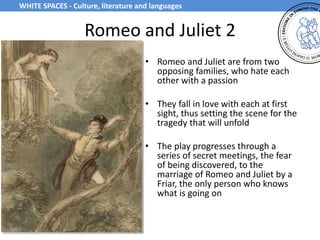
Romeo and Juliet 2
• Romeo and Juliet are from two
opposing families, who hate each
other with a passion
• They fall in love with each at first
sight, thus setting the scene for the
tragedy that will unfold
• The play progresses through a
series of secret meetings, the fear
of being discovered, to the
marriage of Romeo and Juliet by a
Friar, the only person who knows
what is going on
WHITE SPACES - Culture, literature and languages
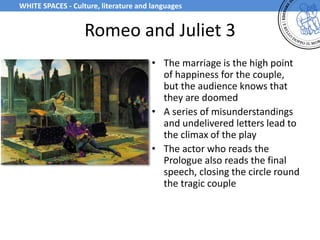
Romeo and Juliet 3
• The marriage is the high point
of happiness for the couple,
but the audience knows that
they are doomed
• A series of misunderstandings
and undelivered letters lead to
the climax of the play
• The actor who reads the
Prologue also reads the final
speech, closing the circle round
the tragic couple
WHITE SPACES - Culture, literature and languages
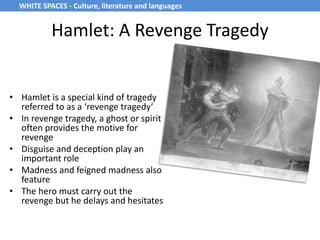
Hamlet: A Revenge Tragedy
• Hamlet is a special kind of tragedy
referred to as a ‘revenge tragedy’
• In revenge tragedy, a ghost or spirit
often provides the motive for
revenge
• Disguise and deception play an
important role
• Madness and feigned madness also
feature
• The hero must carry out the
revenge but he delays and hesitates
WHITE SPACES - Culture, literature and languages
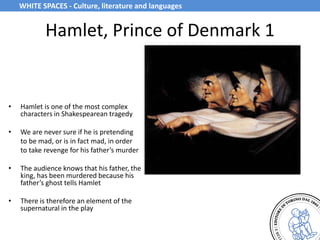
Hamlet, Prince of Denmark 1
• Hamlet is one of the most complex
characters in Shakespearean tragedy
• We are never sure if he is pretending
to be mad, or is in fact mad, in order
to take revenge for his father’s murder
• The audience knows that his father, the
king, has been murdered because his
father’s ghost tells Hamlet
• There is therefore an element of the
supernatural in the play
WHITE SPACES - Culture, literature and languages
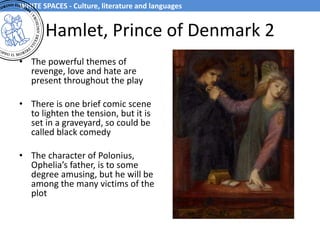
Hamlet, Prince of Denmark 2
• The powerful themes of
revenge, love and hate are
present throughout the play
• There is one brief comic scene
to lighten the tension, but it is
set in a graveyard, so could be
called black comedy
• The character of Polonius,
Ophelia’s father, is to some
degree amusing, but he will be
among the many victims of the
plot
WHITE SPACES - Culture, literature and languages
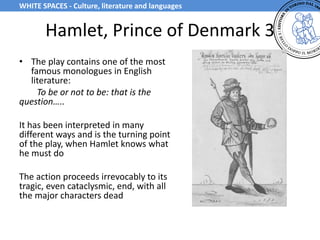
Hamlet, Prince of Denmark 3
• The play contains one of the most
famous monologues in English
literature:
To be or not to be: that is the
question…..
It has been interpreted in many
different ways and is the turning point
of the play, when Hamlet knows what
he must do
The action proceeds irrevocably to its
tragic, even cataclysmic, end, with all
the major characters dead
WHITE SPACES - Culture, literature and languages
Hamlet – The Final Scene
• King Claudius plots with Laertes, brother
of Ophelia, who has gone mad after
Hamlet kills her father Polonius and
drowned herself
• Laertes challenges Hamlet to a duel:
Laertes’ rapier has poison on it, but in
case it goes wrong, Claudius has
prepared a cup of poisoned wine for
Hamlet
• It ends with Claudius, Queen Gertrude,
Laertes and Hamlet dead: Hamlet is
revenged on Claudius but at a terrible
cost
WHITE SPACES - Culture, literature and languages
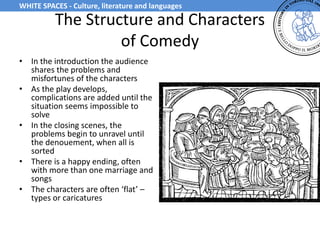
The Structure and Characters
of Comedy
• In the introduction the audience
shares the problems and
misfortunes of the characters
• As the play develops,
complications are added until the
situation seems impossible to
solve
• In the closing scenes, the
problems begin to unravel until
the denouement, when all is
sorted
• There is a happy ending, often
with more than one marriage and
songs
• The characters are often ‘flat’ –
types or caricatures
WHITE SPACES - Culture, literature and languages
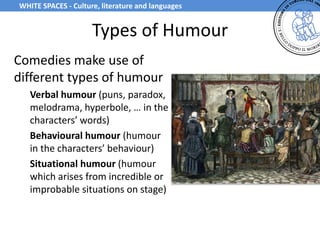
Types of Humour
Comedies make use of
different types of humour
Verbal humour (puns, paradox,
melodrama, hyperbole, … in the
characters’ words)
Behavioural humour (humour
in the characters’ behaviour)
Situational humour (humour
which arises from incredible or
improbable situations on stage)
WHITE SPACES - Culture, literature and languages
Twelfth Night 1
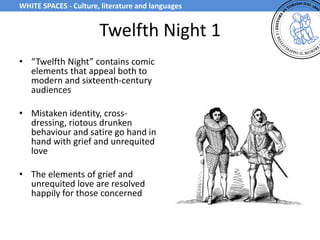
• “Twelfth Night” contains comic
elements that appeal both to
modern and sixteenth-century
audiences
• Mistaken identity, cross-
dressing, riotous drunken
behaviour and satire go hand in
hand with grief and unrequited
love
• The elements of grief and
unrequited love are resolved
happily for those concerned
WHITE SPACES - Culture, literature and languages
Twelfth Night 2
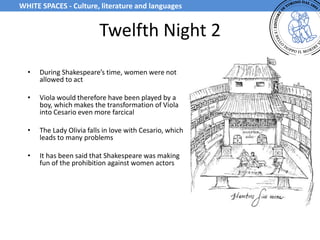
• During Shakespeare’s time, women were not
allowed to act
• Viola would therefore have been played by a
boy, which makes the transformation of Viola
into Cesario even more farcical
• The Lady Olivia falls in love with Cesario, which
leads to many problems
• It has been said that Shakespeare was making
fun of the prohibition against women actors
WHITE SPACES - Culture, literature and languages
Twelfth Night 3
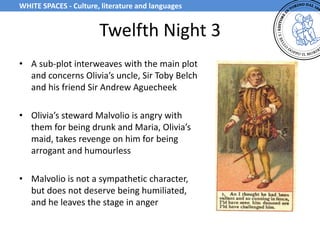
• A sub-plot interweaves with the main plot
and concerns Olivia’s uncle, Sir Toby Belch
and his friend Sir Andrew Aguecheek
• Olivia’s steward Malvolio is angry with
them for being drunk and Maria, Olivia’s
maid, takes revenge on him for being
arrogant and humourless
• Malvolio is not a sympathetic character,
but does not deserve being humiliated,
and he leaves the stage in anger
WHITE SPACES - Culture, literature and languages
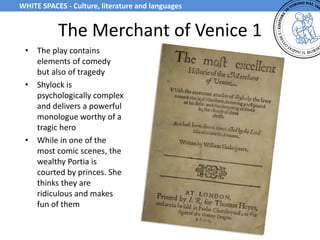
The Merchant of Venice 1
• The play contains
elements of comedy
but also of tragedy
• Shylock is
psychologically complex
and delivers a powerful
monologue worthy of a
tragic hero
• While in one of the
most comic scenes, the
wealthy Portia is
courted by princes. She
thinks they are
ridiculous and makes
fun of them
WHITE SPACES - Culture, literature and languages
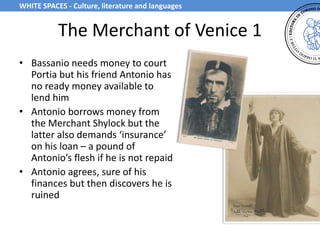
The Merchant of Venice 1
• Bassanio needs money to court
Portia but his friend Antonio has
no ready money available to
lend him
• Antonio borrows money from
the Merchant Shylock but the
latter also demands ‘insurance’
on his loan – a pound of
Antonio’s flesh if he is not repaid
• Antonio agrees, sure of his
finances but then discovers he is
ruined
WHITE SPACES - Culture, literature and languages
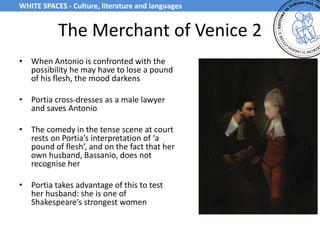
The Merchant of Venice 2
• When Antonio is confronted with the
possibility he may have to lose a pound
of his flesh, the mood darkens
• Portia cross-dresses as a male lawyer
and saves Antonio
• The comedy in the tense scene at court
rests on Portia’s interpretation of ‘a
pound of flesh’, and on the fact that her
own husband, Bassanio, does not
recognise her
• Portia takes advantage of this to test
her husband: she is one of
Shakespeare’s strongest women
WHITE SPACES - Culture, literature and languages
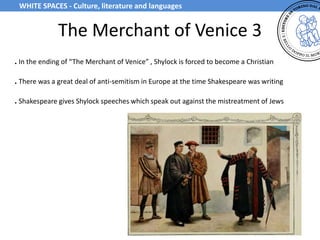
The Merchant of Venice 3
. In the ending of “The Merchant of Venice” , Shylock is forced to become a Christian
. There was a great deal of anti-semitism in Europe at the time Shakespeare was writing
. Shakespeare gives Shylock speeches which speak out against the mistreatment of Jews
WHITE SPACES - Culture, literature and languages

Shakespeare, Tragedy and Comedy.pptx

  • 1.
    Tragedy and Comedyin Shakespeare Romeo and Juliet Hamlet Twelfth Night The Merchant of Venice WHITE SPACES - Culture, literature and languages
  • 2.
    The Structure ofTragedy • The play begins harmoniously, although the audience are often warned of impending disaster • The sense of happiness increases until it reaches the climax • This moment of extreme happiness is quickly followed by a moment of crisis when everything starts to change • The situation declines until it reaches the final catastrophe which often involves death and isolation WHITE SPACES - Culture, literature and languages
  • 3.
    The Tragic Hero •The hero / heroine comes from the upper echelons of society • Hostile destiny seems to be controlling his / her life • He / She has a fatal character flaw which precipitates the downfall • He / She is psychologically complex, multi-faceted • Monologue and soliloquy are used to reveal feelings and depth of character • His / her speeches use heightened and figurative language WHITE SPACES - Culture, literature and languages
  • 4.
    Romeo and Juliet1 • We know the play will be a tragedy because the Prologue tells us this clearly • This device raises the level of tension from the beginning of the play and is only relieved by intermittent episodes of comedy • The Nurse is the principal comic character in the play, but Romeo’s friends also provide comic relief, although one of them will be killed WHITE SPACES - Culture, literature and languages
  • 5.
    Romeo and Juliet2 • Romeo and Juliet are from two opposing families, who hate each other with a passion • They fall in love with each at first sight, thus setting the scene for the tragedy that will unfold • The play progresses through a series of secret meetings, the fear of being discovered, to the marriage of Romeo and Juliet by a Friar, the only person who knows what is going on WHITE SPACES - Culture, literature and languages
  • 6.
    Romeo and Juliet3 • The marriage is the high point of happiness for the couple, but the audience knows that they are doomed • A series of misunderstandings and undelivered letters lead to the climax of the play • The actor who reads the Prologue also reads the final speech, closing the circle round the tragic couple WHITE SPACES - Culture, literature and languages
  • 7.
    Hamlet: A RevengeTragedy • Hamlet is a special kind of tragedy referred to as a ‘revenge tragedy’ • In revenge tragedy, a ghost or spirit often provides the motive for revenge • Disguise and deception play an important role • Madness and feigned madness also feature • The hero must carry out the revenge but he delays and hesitates WHITE SPACES - Culture, literature and languages
  • 8.
    Hamlet, Prince ofDenmark 1 • Hamlet is one of the most complex characters in Shakespearean tragedy • We are never sure if he is pretending to be mad, or is in fact mad, in order to take revenge for his father’s murder • The audience knows that his father, the king, has been murdered because his father’s ghost tells Hamlet • There is therefore an element of the supernatural in the play WHITE SPACES - Culture, literature and languages
  • 9.
    Hamlet, Prince ofDenmark 2 • The powerful themes of revenge, love and hate are present throughout the play • There is one brief comic scene to lighten the tension, but it is set in a graveyard, so could be called black comedy • The character of Polonius, Ophelia’s father, is to some degree amusing, but he will be among the many victims of the plot WHITE SPACES - Culture, literature and languages
  • 10.
    Hamlet, Prince ofDenmark 3 • The play contains one of the most famous monologues in English literature: To be or not to be: that is the question….. It has been interpreted in many different ways and is the turning point of the play, when Hamlet knows what he must do The action proceeds irrevocably to its tragic, even cataclysmic, end, with all the major characters dead WHITE SPACES - Culture, literature and languages
  • 11.
    Hamlet – TheFinal Scene • King Claudius plots with Laertes, brother of Ophelia, who has gone mad after Hamlet kills her father Polonius and drowned herself • Laertes challenges Hamlet to a duel: Laertes’ rapier has poison on it, but in case it goes wrong, Claudius has prepared a cup of poisoned wine for Hamlet • It ends with Claudius, Queen Gertrude, Laertes and Hamlet dead: Hamlet is revenged on Claudius but at a terrible cost WHITE SPACES - Culture, literature and languages
  • 12.
    The Structure andCharacters of Comedy • In the introduction the audience shares the problems and misfortunes of the characters • As the play develops, complications are added until the situation seems impossible to solve • In the closing scenes, the problems begin to unravel until the denouement, when all is sorted • There is a happy ending, often with more than one marriage and songs • The characters are often ‘flat’ – types or caricatures WHITE SPACES - Culture, literature and languages
  • 13.
    Types of Humour Comediesmake use of different types of humour Verbal humour (puns, paradox, melodrama, hyperbole, … in the characters’ words) Behavioural humour (humour in the characters’ behaviour) Situational humour (humour which arises from incredible or improbable situations on stage) WHITE SPACES - Culture, literature and languages
  • 14.
    Twelfth Night 1 •“Twelfth Night” contains comic elements that appeal both to modern and sixteenth-century audiences • Mistaken identity, cross- dressing, riotous drunken behaviour and satire go hand in hand with grief and unrequited love • The elements of grief and unrequited love are resolved happily for those concerned WHITE SPACES - Culture, literature and languages
  • 15.
    Twelfth Night 2 •During Shakespeare’s time, women were not allowed to act • Viola would therefore have been played by a boy, which makes the transformation of Viola into Cesario even more farcical • The Lady Olivia falls in love with Cesario, which leads to many problems • It has been said that Shakespeare was making fun of the prohibition against women actors WHITE SPACES - Culture, literature and languages
  • 16.
    Twelfth Night 3 •A sub-plot interweaves with the main plot and concerns Olivia’s uncle, Sir Toby Belch and his friend Sir Andrew Aguecheek • Olivia’s steward Malvolio is angry with them for being drunk and Maria, Olivia’s maid, takes revenge on him for being arrogant and humourless • Malvolio is not a sympathetic character, but does not deserve being humiliated, and he leaves the stage in anger WHITE SPACES - Culture, literature and languages
  • 17.
    The Merchant ofVenice 1 • The play contains elements of comedy but also of tragedy • Shylock is psychologically complex and delivers a powerful monologue worthy of a tragic hero • While in one of the most comic scenes, the wealthy Portia is courted by princes. She thinks they are ridiculous and makes fun of them WHITE SPACES - Culture, literature and languages
  • 18.
    The Merchant ofVenice 1 • Bassanio needs money to court Portia but his friend Antonio has no ready money available to lend him • Antonio borrows money from the Merchant Shylock but the latter also demands ‘insurance’ on his loan – a pound of Antonio’s flesh if he is not repaid • Antonio agrees, sure of his finances but then discovers he is ruined WHITE SPACES - Culture, literature and languages
  • 19.
    The Merchant ofVenice 2 • When Antonio is confronted with the possibility he may have to lose a pound of his flesh, the mood darkens • Portia cross-dresses as a male lawyer and saves Antonio • The comedy in the tense scene at court rests on Portia’s interpretation of ‘a pound of flesh’, and on the fact that her own husband, Bassanio, does not recognise her • Portia takes advantage of this to test her husband: she is one of Shakespeare’s strongest women WHITE SPACES - Culture, literature and languages
  • 20.
    The Merchant ofVenice 3 . In the ending of “The Merchant of Venice” , Shylock is forced to become a Christian . There was a great deal of anti-semitism in Europe at the time Shakespeare was writing . Shakespeare gives Shylock speeches which speak out against the mistreatment of Jews WHITE SPACES - Culture, literature and languages