The First World War (WWI)
TB Connection
Pgs. 450-457
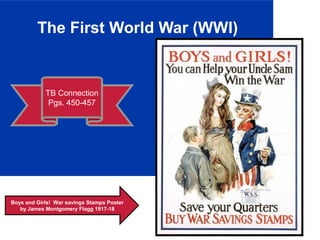
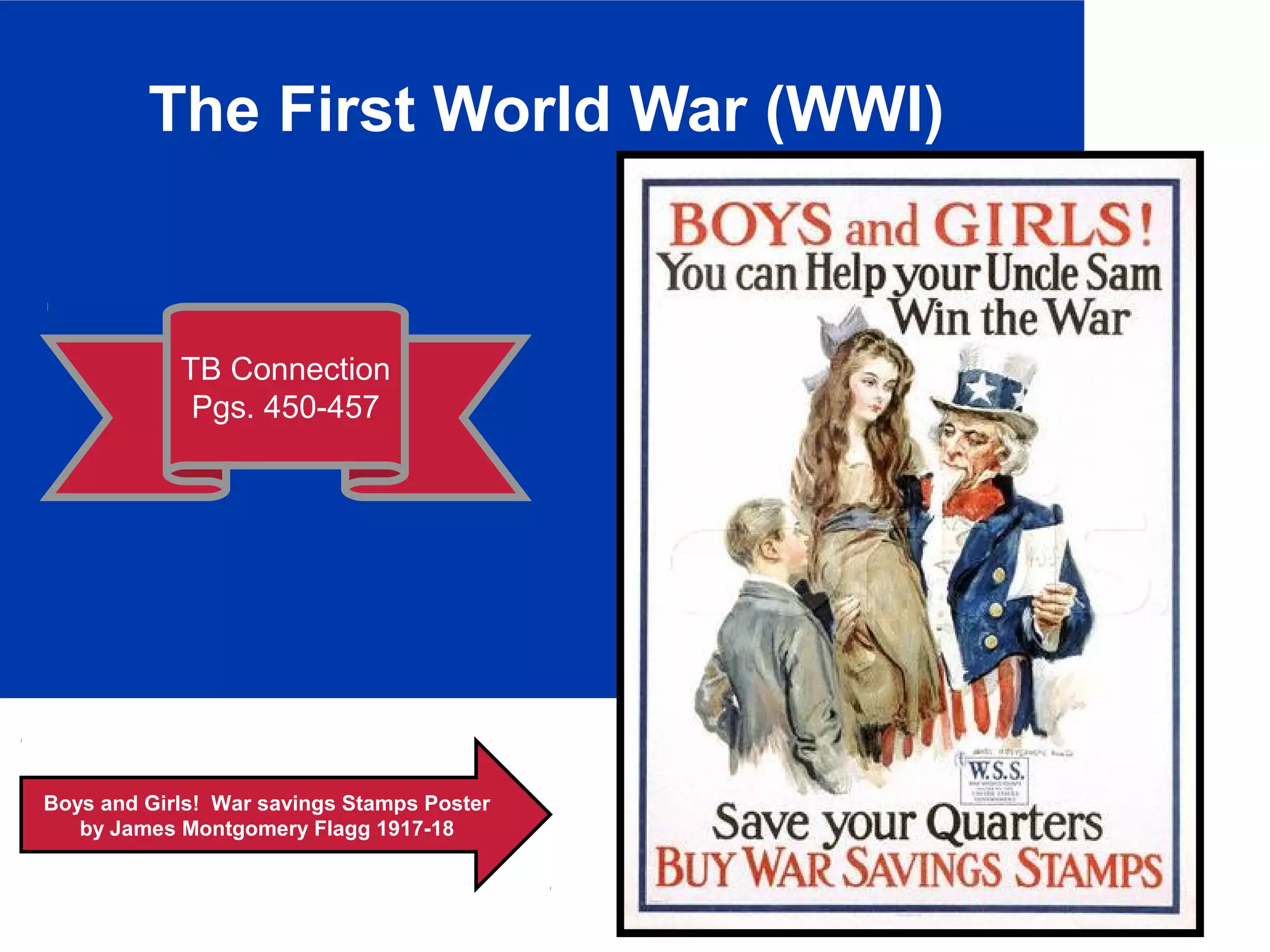
Boys and Girls! War savings Stamps Poster
by James Montgomery Flagg 1917-18
2
The First World War:
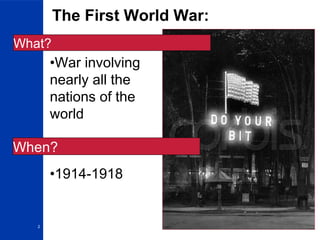
•War involving
nearly all the
nations of the
world
•1914-1918
What?
When?
3
The First World War:
Why did the war begin?
Long term -
1. Alliance system
2. Imperialist competition
3. Stockpiling of weapons
by countries
Short term –
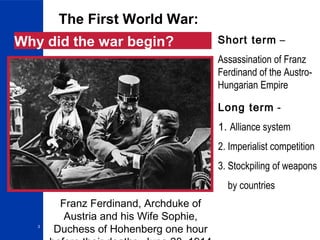
Assassination of Franz
Ferdinand of the Austro-
Hungarian Empire
Franz Ferdinand, Archduke of
Austria and his Wife Sophie,
Duchess of Hohenberg one hour
4
The First World War:
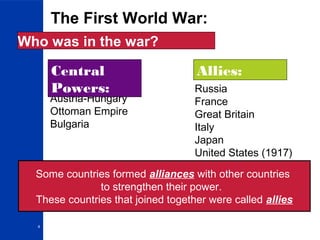
Who was in the war?
Germany
Austria-Hungary
Ottoman Empire
Bulgaria
Russia
France
Great Britain
Italy
Japan
United States (1917)
Central
Powers:
Allies:
Some countries formed alliances with other countries
to strengthen their power.
These countries that joined together were called allies
5
The First World War:
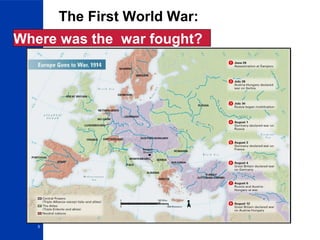
Where was the war fought?
6
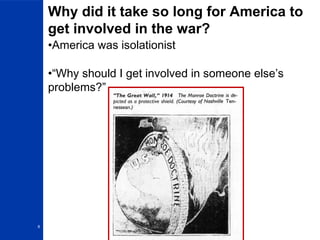
Why did it take so long for America to
get involved in the war?
•America was isolationist
•“Why should I get involved in someone else’s
problems?”
7
Why did it take so long for America to
get involved in the war?
•America was isolationist
•“Why should I get involved in someone else’s
problems?”Isolationism is the desire to remain neutral
and let other countries handle their own
affairs. With the Atlantic Ocean between
the US and Europe,
it was easy to stay isolated.
8
Thinking Slide
Is isolationism really an
option for a country as
powerful as the United
States?
9
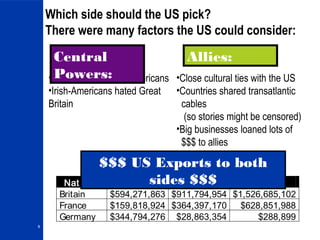
Which side should the US pick?
There were many factors the US could consider:
•11 million German- Americans
•Irish-Americans hated Great
Britain
•Close cultural ties with the US
•Countries shared transatlantic
cables
(so stories might be censored)
•Big businesses loaned lots of
$$$ to allies
Central
Powers:
Allies:
Nations 1914 1915 1916
Britain $594,271,863 $911,794,954 $1,526,685,102
France $159,818,924 $364,397,170 $628,851,988
Germany $344,794,276 $28,863,354 $288,899
$$$ US Exports to both
sides $$$
10
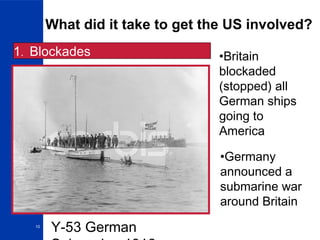
What did it take to get the US involved?
1. Blockades •Britain
blockaded
(stopped) all
German ships
going to
America
•Germany
announced a
submarine war
around Britain
Y-53 German
11
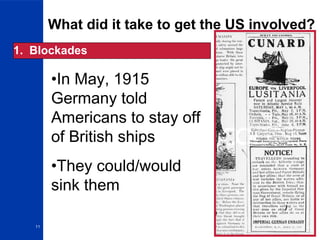
What did it take to get the US involved?
1. Blockades
•In May, 1915
Germany told
Americans to stay off
of British ships
•They could/would
sink them
12
What did it take to get the US
involved?
1. Blockades
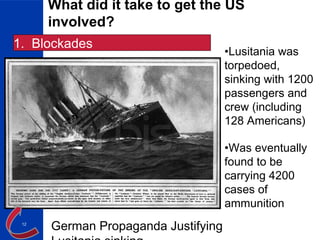
•Lusitania was
torpedoed,
sinking with 1200
passengers and
crew (including
128 Americans)
•Was eventually
found to be
carrying 4200
cases of
ammunition
German Propaganda Justifying
13
What did it take to get the US involved?
1. Blockades
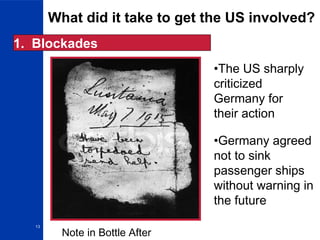
•The US sharply
criticized
Germany for
their action
•Germany agreed
not to sink
passenger ships
without warning in
the future
Note in Bottle After
14
What did it take to get the US involved?
2. Unlimited Submarine Warfare
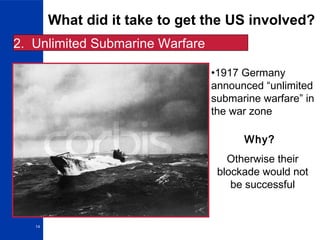
•1917 Germany
announced “unlimited
submarine warfare” in
the war zone
Why?
Otherwise their
blockade would not
be successful
15
What did it take to get the US involved?
3. Zimmerman Note
•US intercepted a note from Germany to
Mexico,
•It promised Texas, New Mexico, and
Arizona back in return for an alliance
16
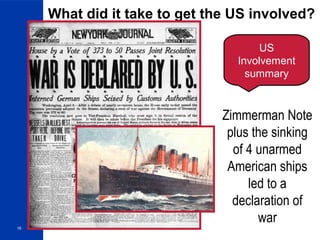
What did it take to get the US involved?
Zimmerman Note
plus the sinking
of 4 unarmed
American ships
led to a
declaration of
war
US
Involvement
summary
17
How was the war looking for the allies?
•Russia left the war after its communist
revolution in 1917
•This made it a one front war for Germany-
all its troops could concentrate on France
Not Good...
18
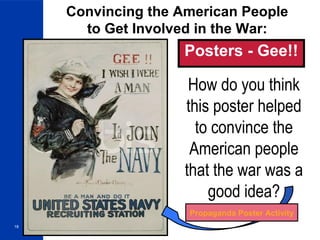
Convincing the American People
to Get Involved in the War:
Posters - Gee!!
How do you think
this poster helped
to convince the
American people
that the war was a
good idea?
Propaganda Poster Activity
19
Convincing the American People to
Get Involved in the War
1. War to End All Wars
Idealism: 2 Goals For War:
2. Making the World Safe for Democracy
Idealism is the practice of
forming ideals and/or living
under their influence
20
Convincing the American People
to Get Involved in the War
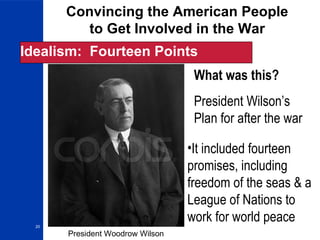
Idealism: Fourteen Points
What was this?
President Wilson’s
Plan for after the war
•It included fourteen
promises, including
freedom of the seas & a
League of Nations to
work for world peace
President Woodrow Wilson
21
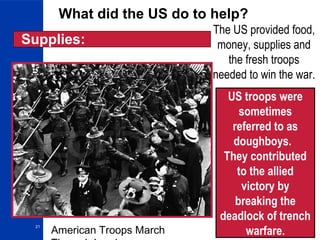
What did the US do to help?
The US provided food,
money, supplies and
the fresh troops
needed to win the war.
American Troops March
Supplies:
US troops were
sometimes
referred to as
doughboys.
They contributed
to the allied
victory by
breaking the
deadlock of trench
warfare.
22
How did the War Affect the US?
Women
•Women filled factory jobs
•This may have led to the 19th Amendment
after the war ( the 19th
Amendment gave
women the right to vote)
•Black soldiers still served in Segregated
Units
African Americans
•A “Great Migration” occurred when thousands
of African Americans moved North to work in
factories
23
How did the War Affect the US?
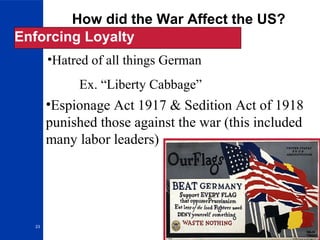
Enforcing Loyalty
•Hatred of all things German
Ex. “Liberty Cabbage”
•Espionage Act 1917 & Sedition Act of 1918
punished those against the war (this included
many labor leaders)
24
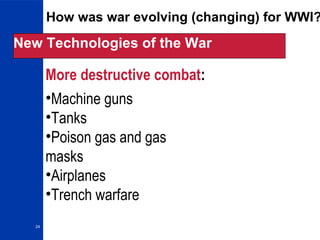
How was war evolving (changing) for WWI?
New Technologies of the War
More destructive combat:
•Machine guns
•Tanks
•Poison gas and gas
masks
•Airplanes
•Trench warfare
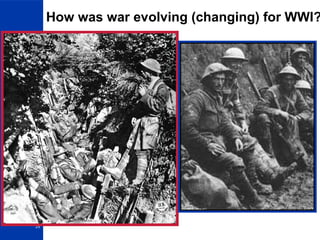
25
How was war evolving (changing) for WWI?
More destructive combat:
•Machine guns
•Tanks
•Poison gas and gas
masks
•Airplanes
•Trench warfare
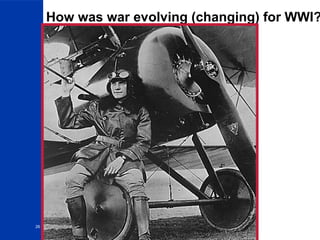
26
How was war evolving (changing) for WWI?
More destructive combat:
•Machine guns
•Tanks
•Poison gas and gas
masks
•Airplanes
•Trench warfare
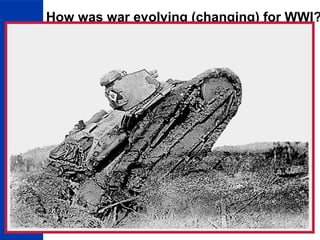
27
How was war evolving (changing) for WWI?
New Technologies of the War
More destructive combat:
•Machine guns
•Tanks
•Poison gas and gas
masks
•Airplanes
•Trench warfare
 After four long years, on November 11, 1918
the Central Powers surrendered
 The US troops contributed to the Allied victory
by breaking the deadlock of trench warfare
 The US troops also helped in the peacemaking
process by helping redraw state borders in
Europe
 In January 1919 the Treaty of Versailles
officially ended WWI
28
TheEndoftheWar
29
The Treaty of Versailles:
Took away Germany’s colonies
Redrew its national borders
Demanded it not to rebuild its army
Demanded it pay heavy fines to the Allied
Powers
TheEndoftheWar

Becoming a World Power - World War I

  • 1.
    The First WorldWar (WWI) TB Connection Pgs. 450-457 Boys and Girls! War savings Stamps Poster by James Montgomery Flagg 1917-18
  • 2.
    2 The First WorldWar: •War involving nearly all the nations of the world •1914-1918 What? When?
  • 3.
    3 The First WorldWar: Why did the war begin? Long term - 1. Alliance system 2. Imperialist competition 3. Stockpiling of weapons by countries Short term – Assassination of Franz Ferdinand of the Austro- Hungarian Empire Franz Ferdinand, Archduke of Austria and his Wife Sophie, Duchess of Hohenberg one hour
  • 4.
    4 The First WorldWar: Who was in the war? Germany Austria-Hungary Ottoman Empire Bulgaria Russia France Great Britain Italy Japan United States (1917) Central Powers: Allies: Some countries formed alliances with other countries to strengthen their power. These countries that joined together were called allies
  • 5.
    5 The First WorldWar: Where was the war fought?
  • 6.
    6 Why did ittake so long for America to get involved in the war? •America was isolationist •“Why should I get involved in someone else’s problems?”
  • 7.
    7 Why did ittake so long for America to get involved in the war? •America was isolationist •“Why should I get involved in someone else’s problems?”Isolationism is the desire to remain neutral and let other countries handle their own affairs. With the Atlantic Ocean between the US and Europe, it was easy to stay isolated.
  • 8.
    8 Thinking Slide Is isolationismreally an option for a country as powerful as the United States?
  • 9.
    9 Which side shouldthe US pick? There were many factors the US could consider: •11 million German- Americans •Irish-Americans hated Great Britain •Close cultural ties with the US •Countries shared transatlantic cables (so stories might be censored) •Big businesses loaned lots of $$$ to allies Central Powers: Allies: Nations 1914 1915 1916 Britain $594,271,863 $911,794,954 $1,526,685,102 France $159,818,924 $364,397,170 $628,851,988 Germany $344,794,276 $28,863,354 $288,899 $$$ US Exports to both sides $$$
  • 10.
    10 What did ittake to get the US involved? 1. Blockades •Britain blockaded (stopped) all German ships going to America •Germany announced a submarine war around Britain Y-53 German
  • 11.
    11 What did ittake to get the US involved? 1. Blockades •In May, 1915 Germany told Americans to stay off of British ships •They could/would sink them
  • 12.
    12 What did ittake to get the US involved? 1. Blockades •Lusitania was torpedoed, sinking with 1200 passengers and crew (including 128 Americans) •Was eventually found to be carrying 4200 cases of ammunition German Propaganda Justifying
  • 13.
    13 What did ittake to get the US involved? 1. Blockades •The US sharply criticized Germany for their action •Germany agreed not to sink passenger ships without warning in the future Note in Bottle After
  • 14.
    14 What did ittake to get the US involved? 2. Unlimited Submarine Warfare •1917 Germany announced “unlimited submarine warfare” in the war zone Why? Otherwise their blockade would not be successful
  • 15.
    15 What did ittake to get the US involved? 3. Zimmerman Note •US intercepted a note from Germany to Mexico, •It promised Texas, New Mexico, and Arizona back in return for an alliance
  • 16.
    16 What did ittake to get the US involved? Zimmerman Note plus the sinking of 4 unarmed American ships led to a declaration of war US Involvement summary
  • 17.
    17 How was thewar looking for the allies? •Russia left the war after its communist revolution in 1917 •This made it a one front war for Germany- all its troops could concentrate on France Not Good...
  • 18.
    18 Convincing the AmericanPeople to Get Involved in the War: Posters - Gee!! How do you think this poster helped to convince the American people that the war was a good idea? Propaganda Poster Activity
  • 19.
    19 Convincing the AmericanPeople to Get Involved in the War 1. War to End All Wars Idealism: 2 Goals For War: 2. Making the World Safe for Democracy Idealism is the practice of forming ideals and/or living under their influence
  • 20.
    20 Convincing the AmericanPeople to Get Involved in the War Idealism: Fourteen Points What was this? President Wilson’s Plan for after the war •It included fourteen promises, including freedom of the seas & a League of Nations to work for world peace President Woodrow Wilson
  • 21.
    21 What did theUS do to help? The US provided food, money, supplies and the fresh troops needed to win the war. American Troops March Supplies: US troops were sometimes referred to as doughboys. They contributed to the allied victory by breaking the deadlock of trench warfare.
  • 22.
    22 How did theWar Affect the US? Women •Women filled factory jobs •This may have led to the 19th Amendment after the war ( the 19th Amendment gave women the right to vote) •Black soldiers still served in Segregated Units African Americans •A “Great Migration” occurred when thousands of African Americans moved North to work in factories
  • 23.
    23 How did theWar Affect the US? Enforcing Loyalty •Hatred of all things German Ex. “Liberty Cabbage” •Espionage Act 1917 & Sedition Act of 1918 punished those against the war (this included many labor leaders)
  • 24.
    24 How was warevolving (changing) for WWI? New Technologies of the War More destructive combat: •Machine guns •Tanks •Poison gas and gas masks •Airplanes •Trench warfare
  • 25.
    25 How was warevolving (changing) for WWI? More destructive combat: •Machine guns •Tanks •Poison gas and gas masks •Airplanes •Trench warfare
  • 26.
    26 How was warevolving (changing) for WWI? More destructive combat: •Machine guns •Tanks •Poison gas and gas masks •Airplanes •Trench warfare
  • 27.
    27 How was warevolving (changing) for WWI? New Technologies of the War More destructive combat: •Machine guns •Tanks •Poison gas and gas masks •Airplanes •Trench warfare
  • 28.
     After fourlong years, on November 11, 1918 the Central Powers surrendered  The US troops contributed to the Allied victory by breaking the deadlock of trench warfare  The US troops also helped in the peacemaking process by helping redraw state borders in Europe  In January 1919 the Treaty of Versailles officially ended WWI 28 TheEndoftheWar
  • 29.
    29 The Treaty ofVersailles: Took away Germany’s colonies Redrew its national borders Demanded it not to rebuild its army Demanded it pay heavy fines to the Allied Powers TheEndoftheWar