Unit 7
   Emerging Environmental
        Challenges
7-Mar-13             Prof. Prabha Panth
                                    1
Market Failure
• The Perfect Competition market is assumed to
  be the Best Market.
• But it fails to maximise Benefits in the allocation
  of Environmental Goods and Services.
• Market failure occurs when private decisions
  based on market prices, do not generate an
  efficient allocation of resources to society.
• Leads to social and environmental problems –
  cannot be tackled by market forces


7-Mar-13         Prof. Prabha Panth                     2
Characteristics of Environmental
         Goods and Services
1. Free Goods:
      All environmental goods and services provided
      freely by nature.
      No ownership, so there is no price for use or
      misuse. Common property resources.
2. Pure Public Goods:
     * Non-excludable: One person cannot stop
       another from using it. E.g. oxygen, oceans
     * Non-rival: One person‟s use of the
       environment does not reduce the amount
       available for others. E.g. oxygen, oceans    3
7-Mar-13
                 Prof. Prabha Panth
3. Externality:
Externality or External Costs and Benefits: when one
    unit‟s action affects another outside the market price.
Marginal Environmental Cost or Benefit  Private Cost or
    Benefit.
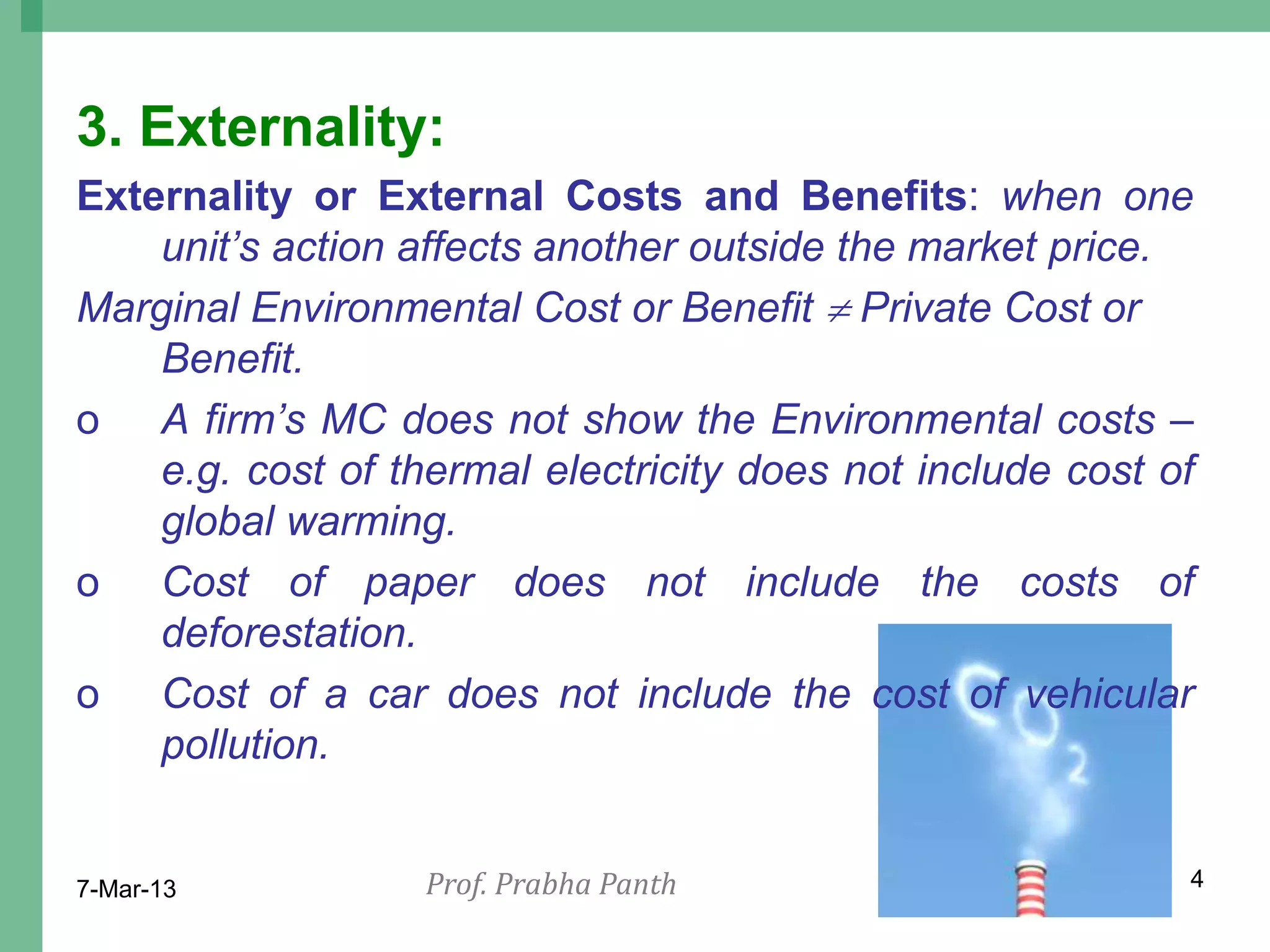
o A firm‟s MC does not show the Environmental costs –
    e.g. cost of thermal electricity does not include cost of
    global warming.
o Cost of paper does not include the costs of
    deforestation.
o Cost of a car does not include the cost of vehicular
    pollution.


7-Mar-13           Prof. Prabha Panth                       4
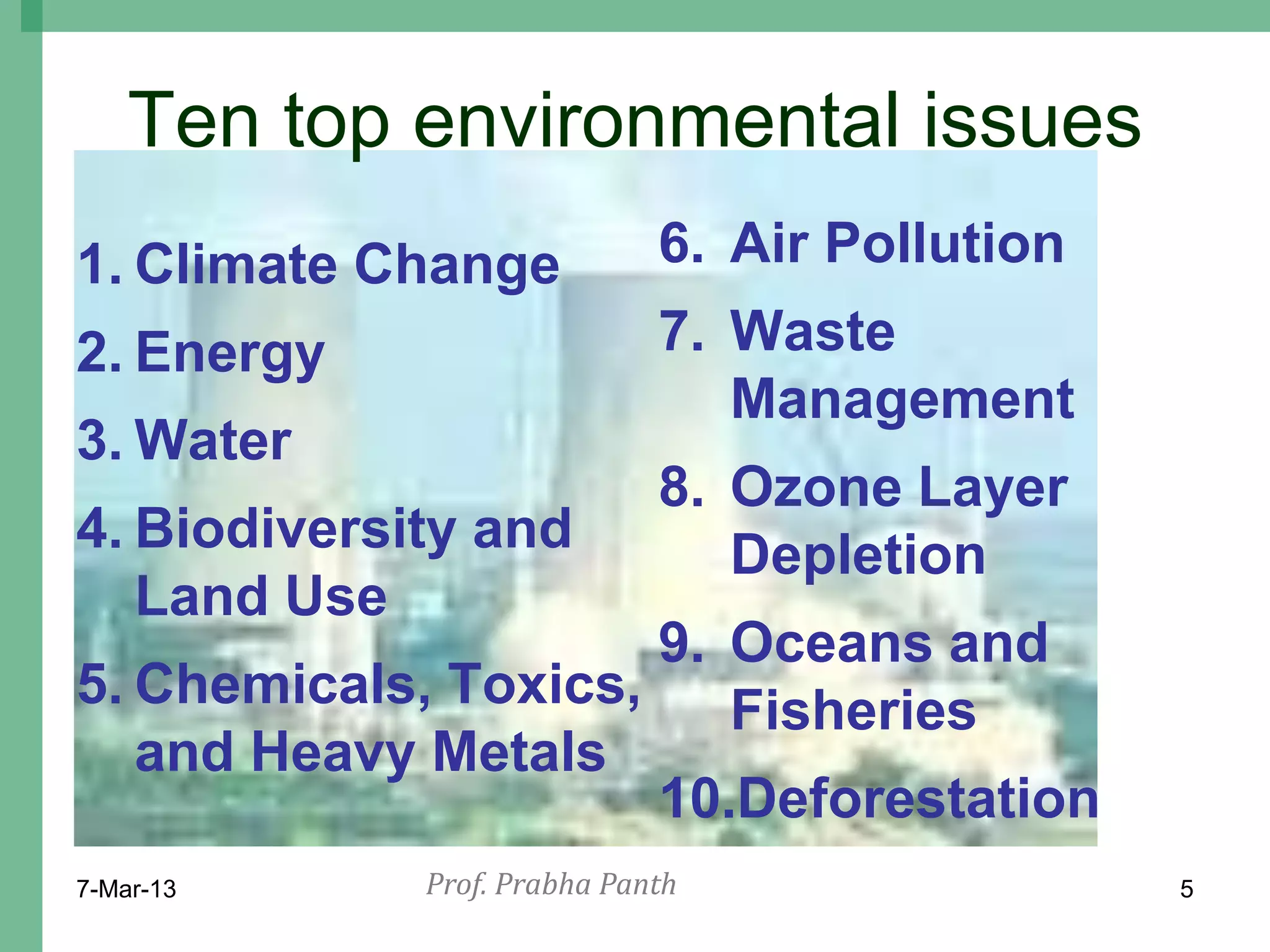
Ten top environmental issues
1. Climate Change            6. Air Pollution
2. Energy                    7. Waste
                                Management
3. Water
                             8. Ozone Layer
4. Biodiversity and             Depletion
   Land Use
                      9. Oceans and
5. Chemicals, Toxics,    Fisheries
   and Heavy Metals
                      10.Deforestation
7-Mar-13     Prof. Prabha Panth                 5
Environmental Impacts of
                    Industries
• Industrial development requires huge amounts of
  natural resources inputs.
• Creates huge amounts of pollution,
• Result:
     –     Loss of forests, coastal areas, erosion,
     –     Mining which affects soil, water and air,
     –     Industrial emissions affect air quality,
     –     Effluents affect water resources, agriculture
     –                     Medical and solid wastes,
     –     Products themselves – environmentally harmful
7-Mar-13               Prof. Prabha Panth                  6
Environment Impacts and Business
• Business cannot ignore environmentalism
    – Consumer awareness, Green consumerism, Good will
      through „greening‟ business.
    – Reaction by public affected by pollution and resource
      degradation,
    – Regulations and penalties
    – Ecological conservation programmes,
    – International controls – Environmental summits, Kyoto
      Protocol, Montreal Protocol, etc.
    – Cost effectiveness in “prevention” rather than “cure”
    – Greater efficiency though saving energy, and recycling

7-Mar-13           Prof. Prabha Panth                      7
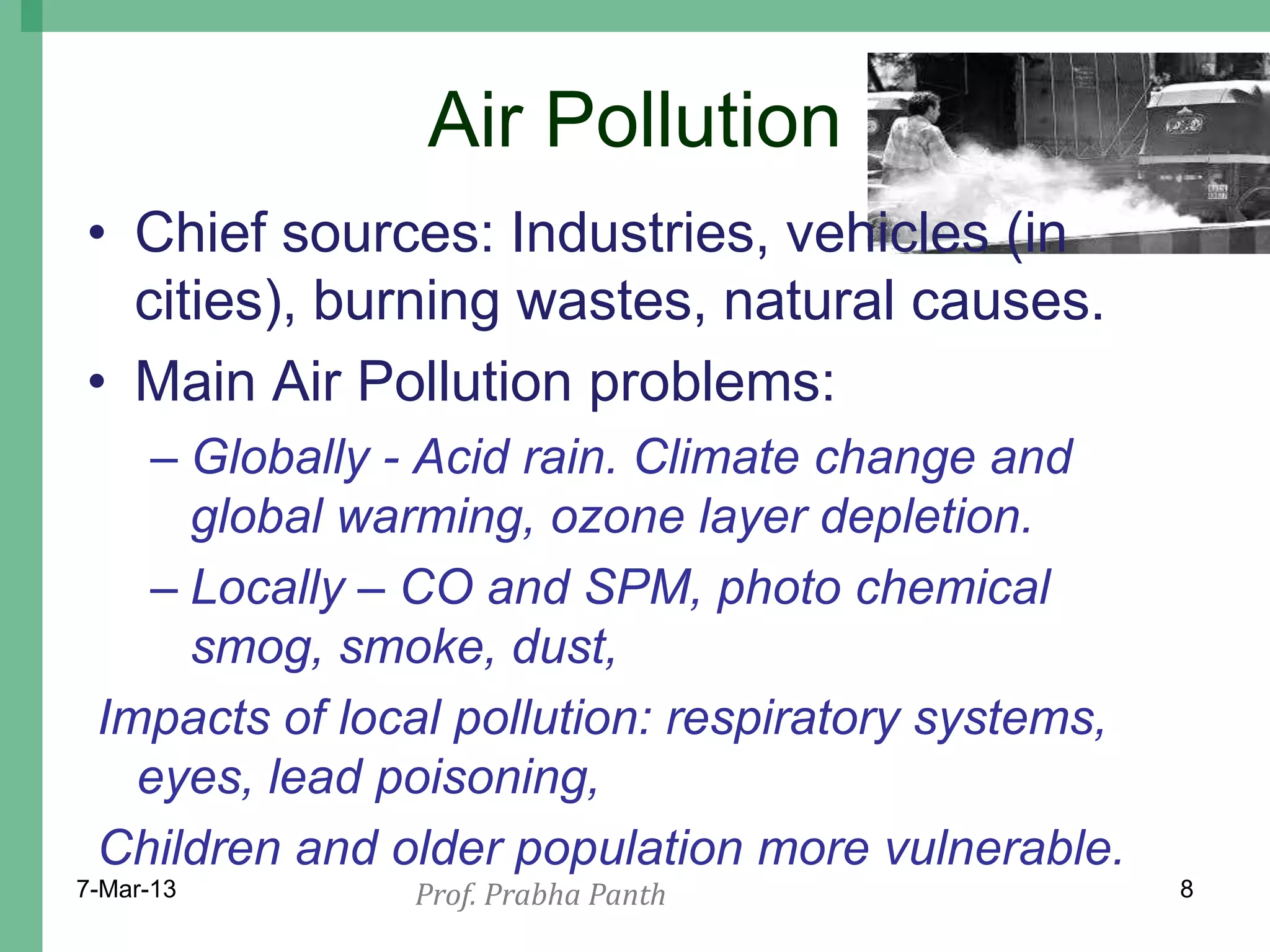
Air Pollution
• Chief sources: Industries, vehicles (in
  cities), burning wastes, natural causes.
• Main Air Pollution problems:
    – Globally - Acid rain. Climate change and
      global warming, ozone layer depletion.
    – Locally – CO and SPM, photo chemical
      smog, smoke, dust,
 Impacts of local pollution: respiratory systems,
   eyes, lead poisoning,
 Children and older population more vulnerable.
7-Mar-13       Prof. Prabha Panth                   8
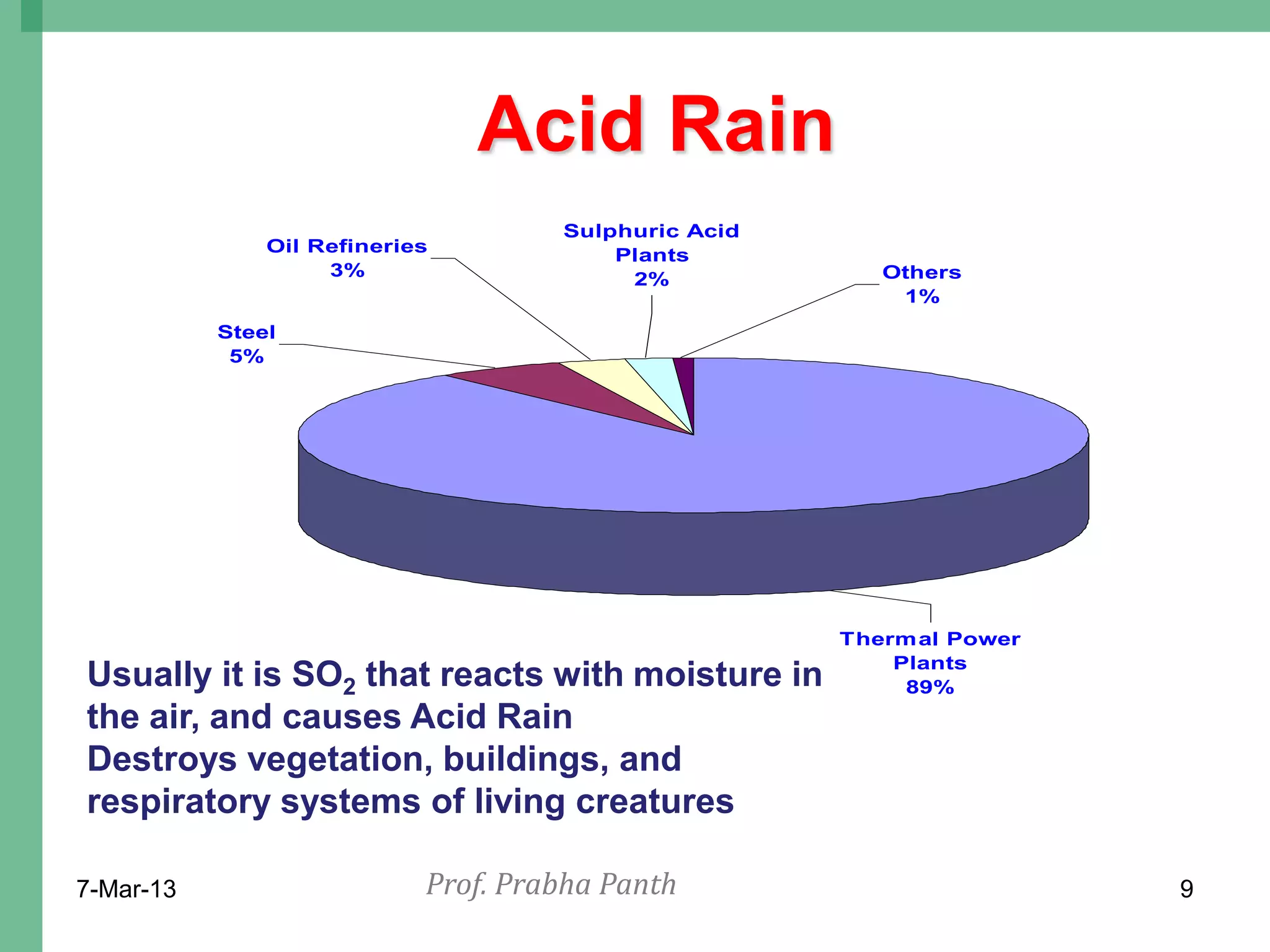
Acid Rain
                                     Sulphuric Acid
               Oil Refineries            Plants
                    3%                    2%             Others
                                                          1%
           Steel
            5%


                                                      Thermal Power
                                                          Plants
Usually it is SO2 that reacts with moisture in             89%
the air, and causes Acid Rain
Destroys vegetation, buildings, and
respiratory systems of living creatures

7-Mar-13                    Prof. Prabha Panth                        9
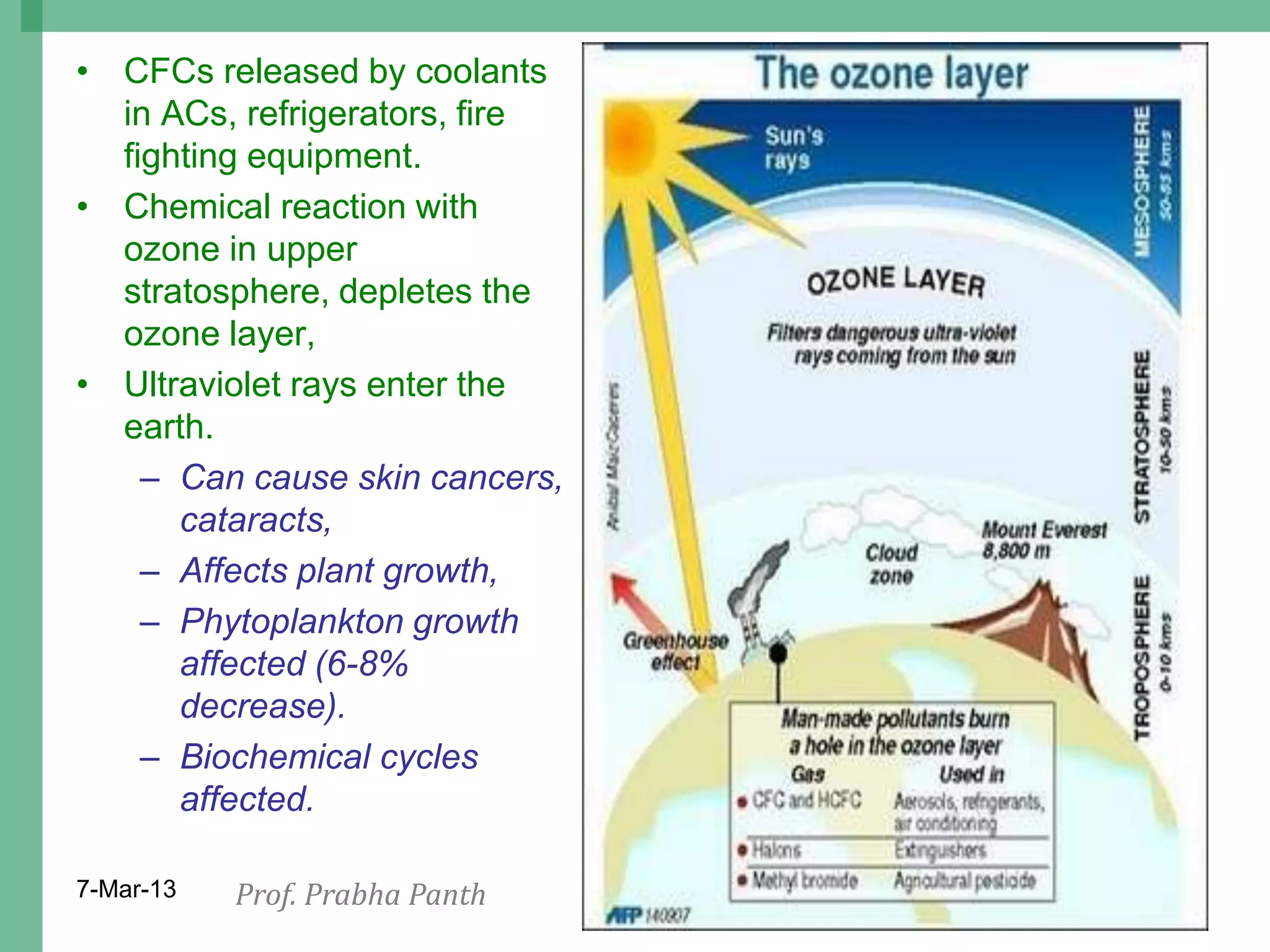
• CFCs released by coolants
  in ACs, refrigerators, fire
  fighting equipment.
• Chemical reaction with
  ozone in upper
  stratosphere, depletes the
  ozone layer,
• Ultraviolet rays enter the
  earth.
    – Can cause skin cancers,
      cataracts,
    – Affects plant growth,
    – Phytoplankton growth
      affected (6-8%
      decrease).
    – Biochemical cycles
      affected.

7-Mar-13   Prof. Prabha Panth   10
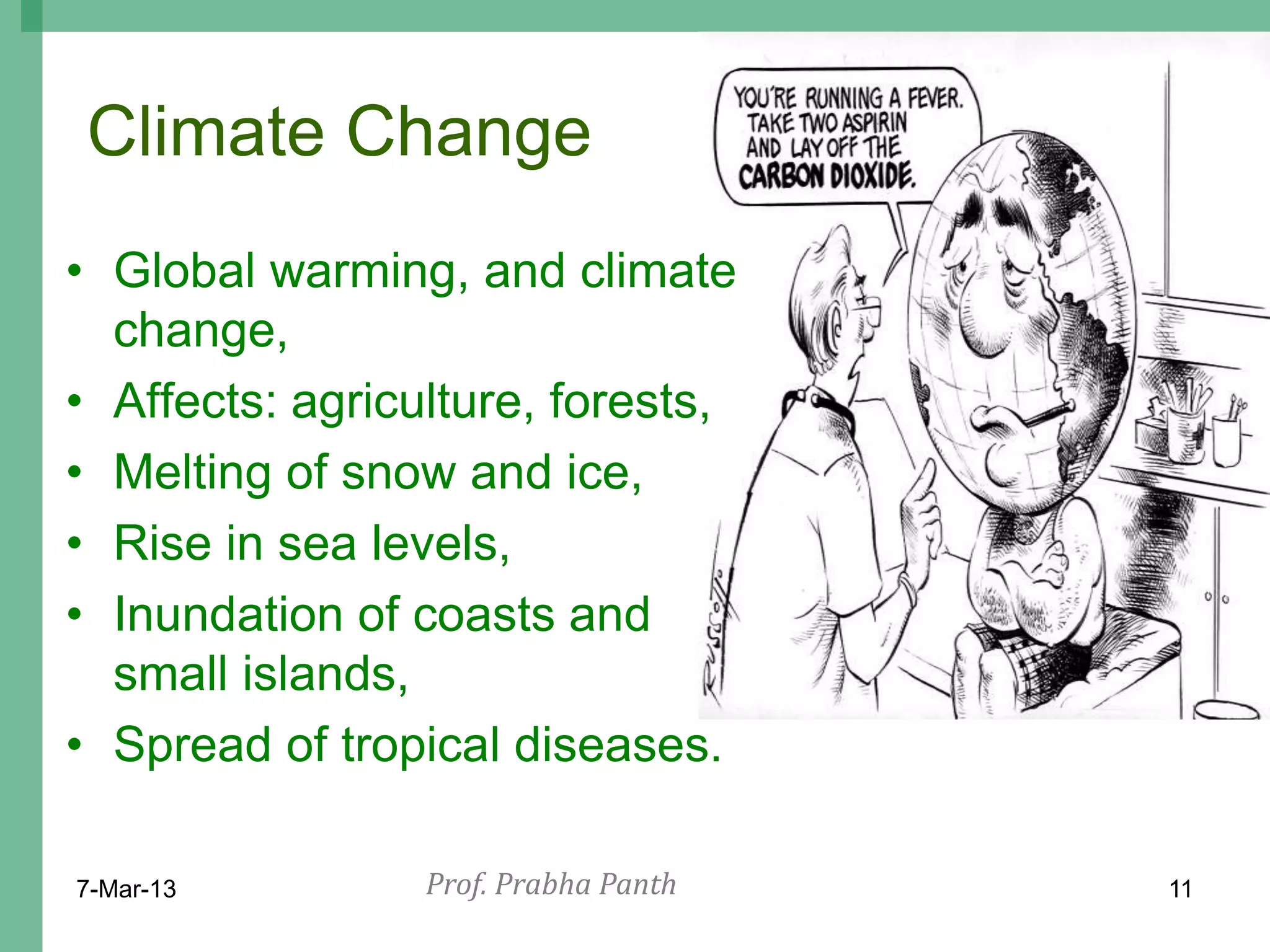
Climate Change
• Global warming, and climate
  change,
• Affects: agriculture, forests,
• Melting of snow and ice,
• Rise in sea levels,
• Inundation of coasts and
  small islands,
• Spread of tropical diseases.

7-Mar-13         Prof. Prabha Panth   11
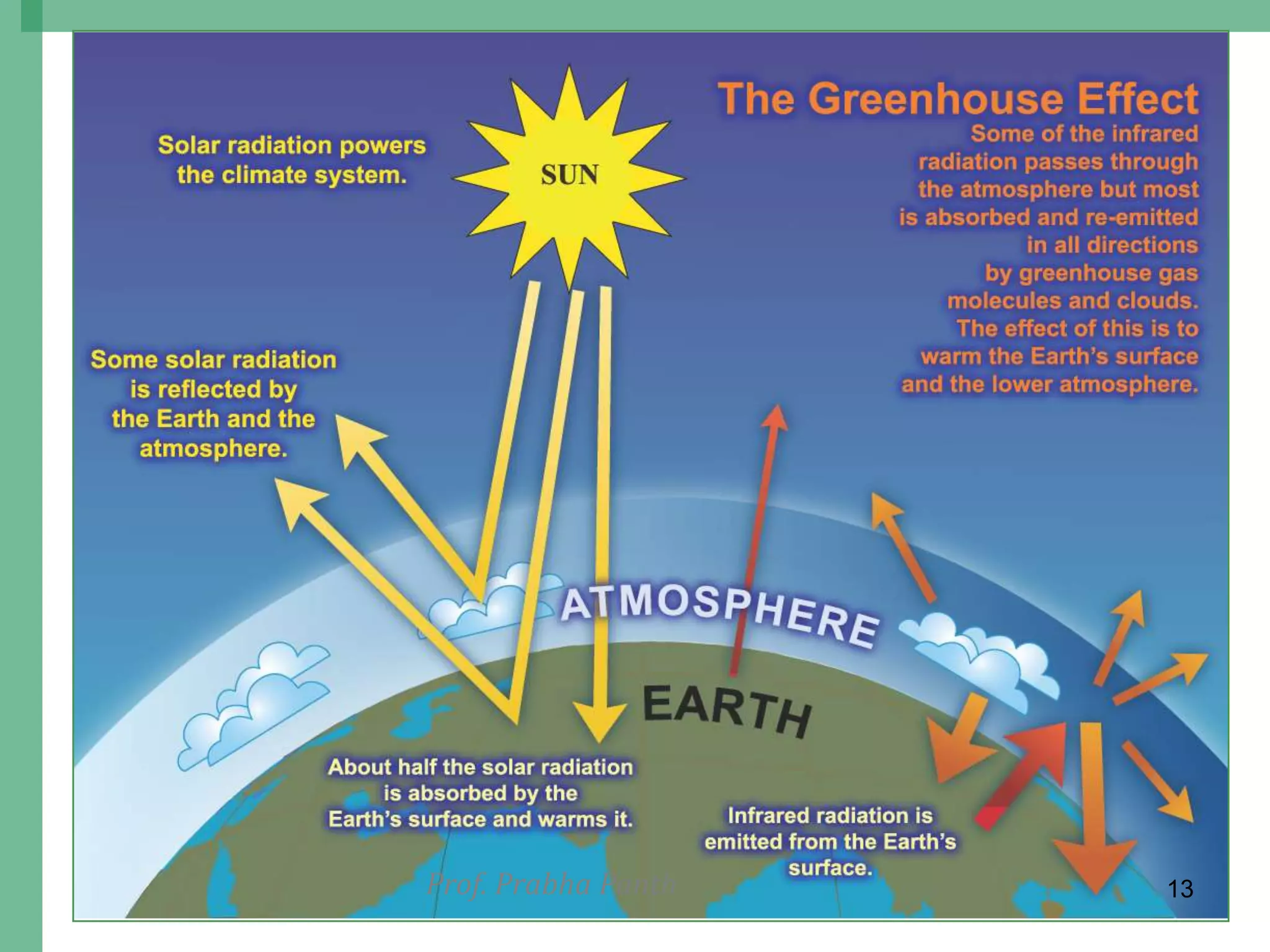
Greenhouse Gases
Greenhouse gases include:
• Carbon dioxide: through burning fossil fuels.
• Methane: agriculture, dairying,
• CFCs: cooling agents in fire fighting equipment,
  air conditioners, refrigerators,
• Nitrous oxides: industrial smoke and vehicular
  pollution.
• Deforestation and Land use change: CO2 not
  converted to oxygen
7-Mar-13       Prof. Prabha Panth                12
7-Mar-13   Prof. Prabha Panth   13
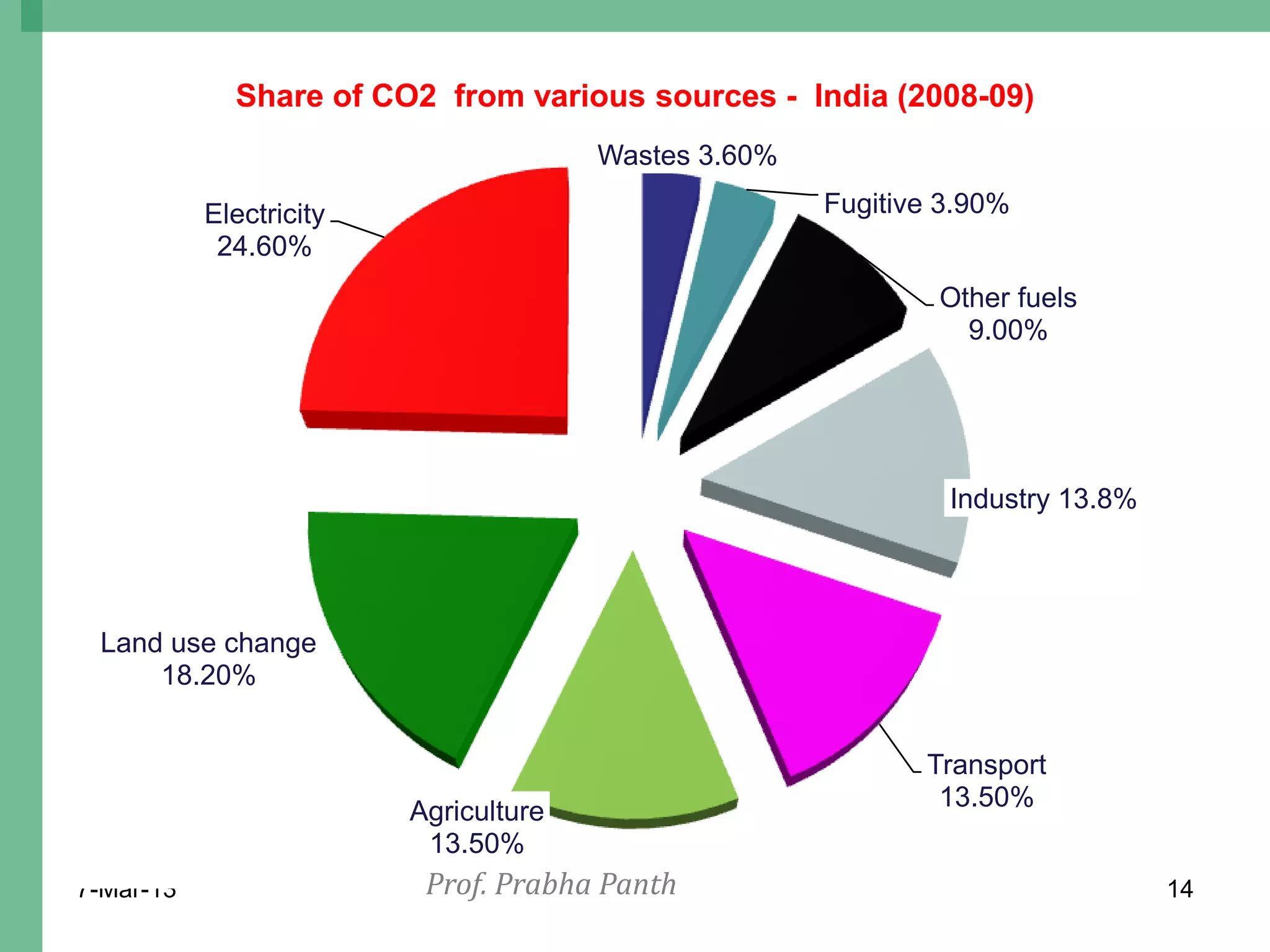
Share of CO2 from various sources - India (2008-09)
                                       Wastes 3.60%

           Electricity                                Fugitive 3.90%
            24.60%
                                                              Other fuels
                                                                9.00%


                                                               Industry 13.8%


 Land use change
     18.20%


                                                             Transport
                                                              13.50%
                         Agriculture
                          13.50%
7-Mar-13                  Prof. Prabha Panth                                    14
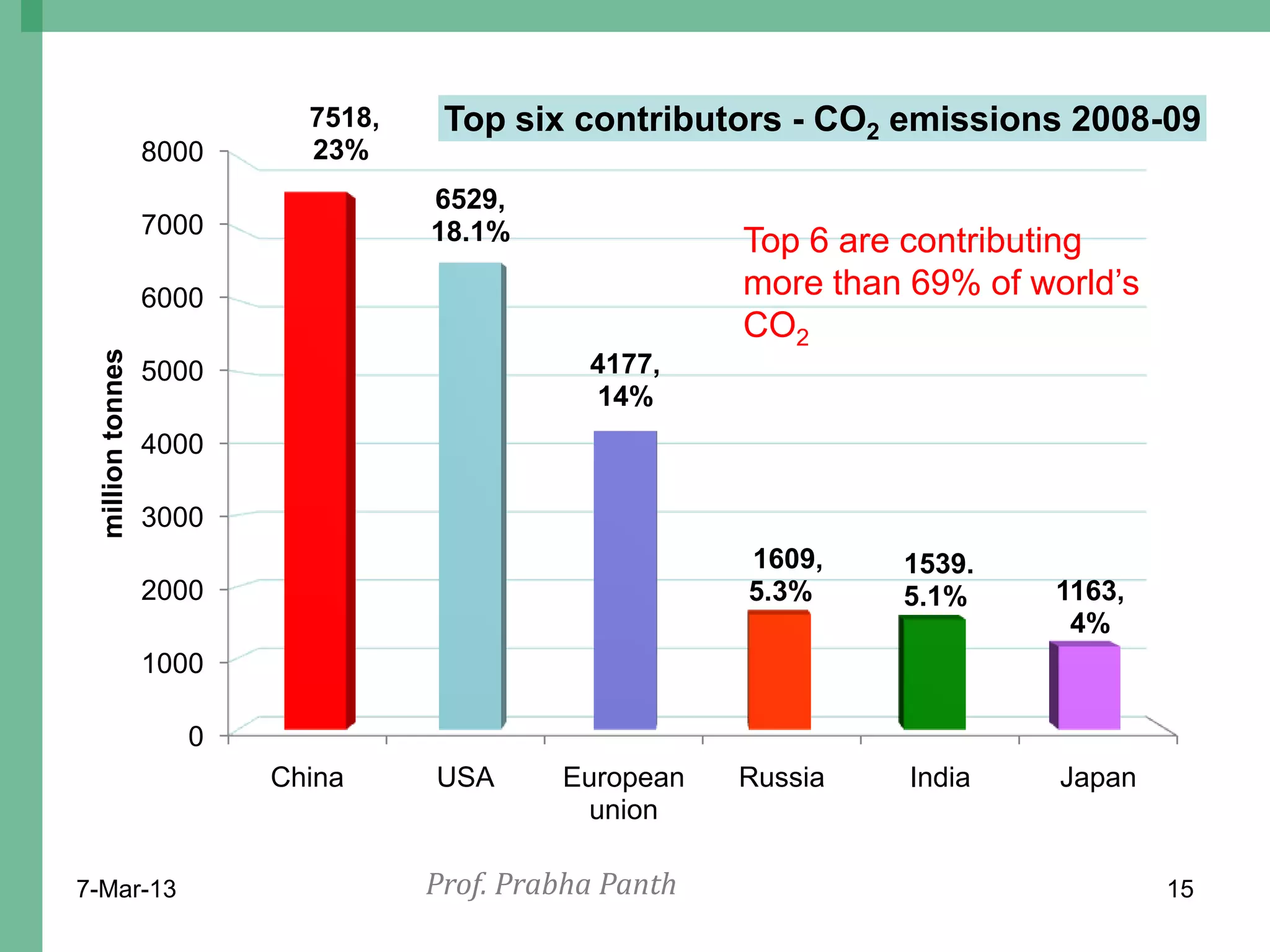
7518,    Top six contributors - CO2 emissions 2008-09
                   8000     23%
                                    6529,
                   7000             18.1%                Top 6 are contributing
                   6000                                  more than 69% of world’s
                                                         CO2
  million tonnes


                   5000                        4177,
                                               14%
                   4000

                   3000
                                                         1609,    1539.
                   2000                                  5.3%     5.1%     1163,
                                                                            4%
                   1000

                      0
                          China     USA      European    Russia    India    Japan
                                              union

7-Mar-13                            Prof. Prabha Panth                              15
Water Pollution
  • Point source: from a specific point – such as
    sewage, oil spills, industrial effluents from
    stationary sources such as factories, etc.
  • Non-point sources: carried over to different
    points from the main source:
       – Effluents from industries
       – agricultural chemicals from farmland,
       – nutrients and toxic materials from urban and
         suburban areas,
       – Oil spills
    This runoff finds its way into water bodies, and
    pollutes them
7-Mar-13            Prof. Prabha Panth                  16
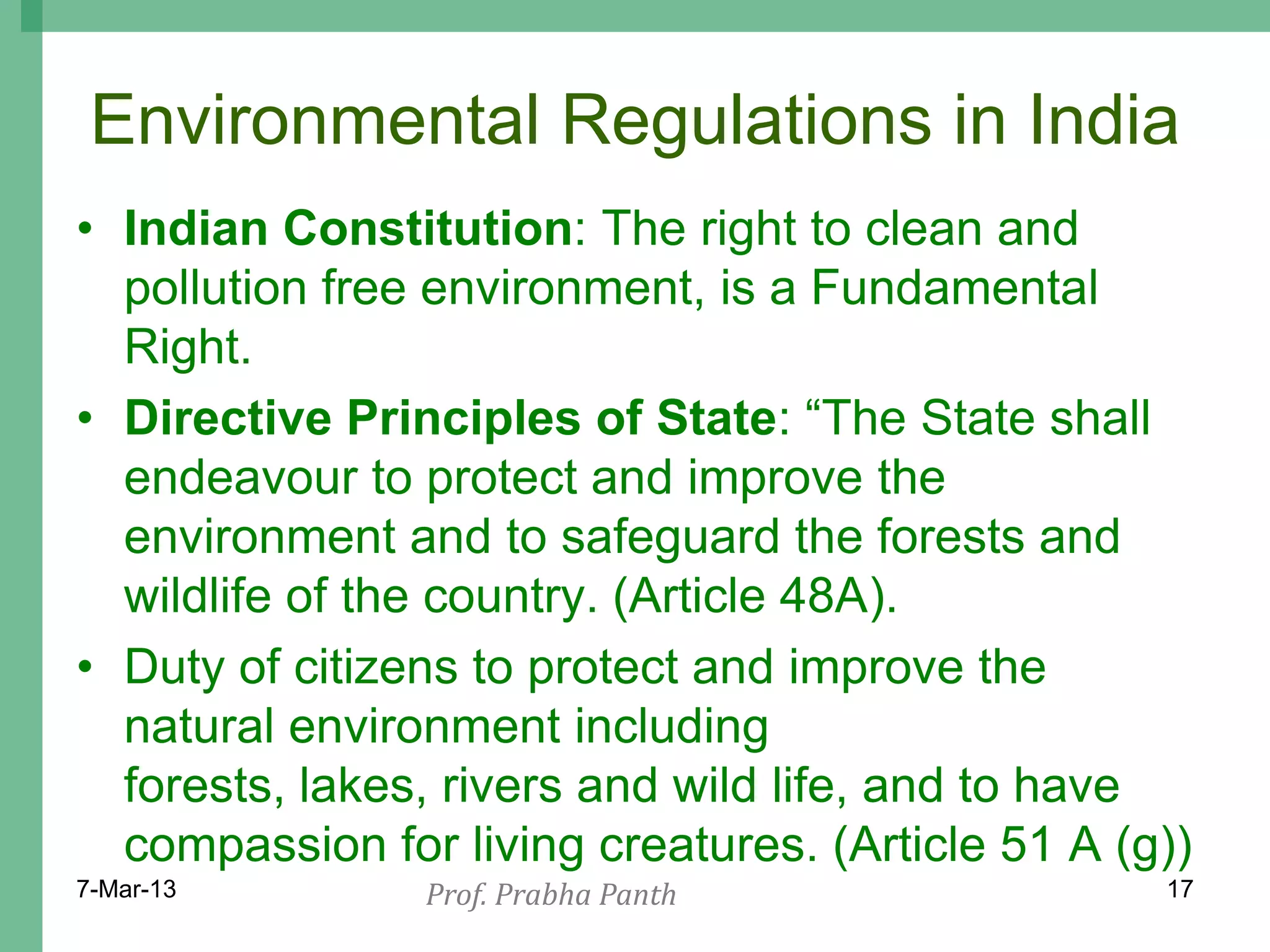
Environmental Regulations in India
• Indian Constitution: The right to clean and
  pollution free environment, is a Fundamental
  Right.
• Directive Principles of State: “The State shall
  endeavour to protect and improve the
  environment and to safeguard the forests and
  wildlife of the country. (Article 48A).
• Duty of citizens to protect and improve the
  natural environment including
  forests, lakes, rivers and wild life, and to have
  compassion for living creatures. (Article 51 A (g))
7-Mar-13        Prof. Prabha Panth                 17
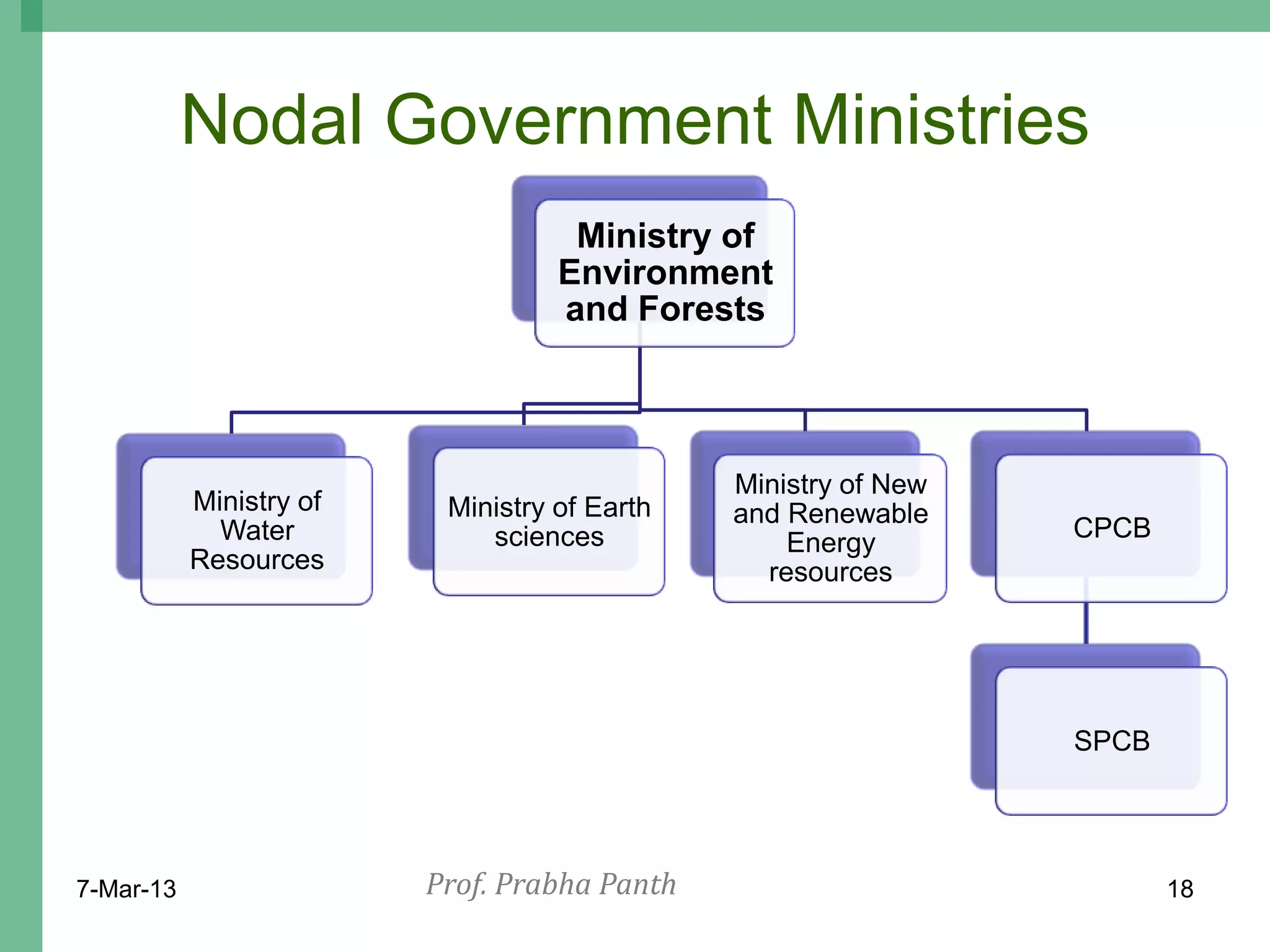
Nodal Government Ministries
                                    Ministry of
                                   Environment
                                   and Forests


                                              Ministry of New
           Ministry of    Ministry of Earth   and Renewable
             Water           sciences                           CPCB
                                                  Energy
           Resources                            resources


                                                                SPCB


7-Mar-13                 Prof. Prabha Panth                            18
Environmental Laws in India
     • The Water (Prevention and Control of
       Pollution) Act, 1974.
           – Prevention and control of water pollution,
           – Mandatory Green Clearance,
           – CPCB and SPCBs were set up –
           – Provision to inspect and penalise polluting
             industries.
           – Take samples of effluent for analysis,
           – Can close down non-compliant factories, and cut
             off water and power supply.
           – Provides for criminal liabilities


7-Mar-13              Prof. Prabha Panth                       19
• The Water (Prevention and Control of
  Pollution) CESS Act, 1977.
– Industries to pay for water use. Water cess.
– Quantity specified per industry, over use penalised.
– 25% rebate if ETPs installed
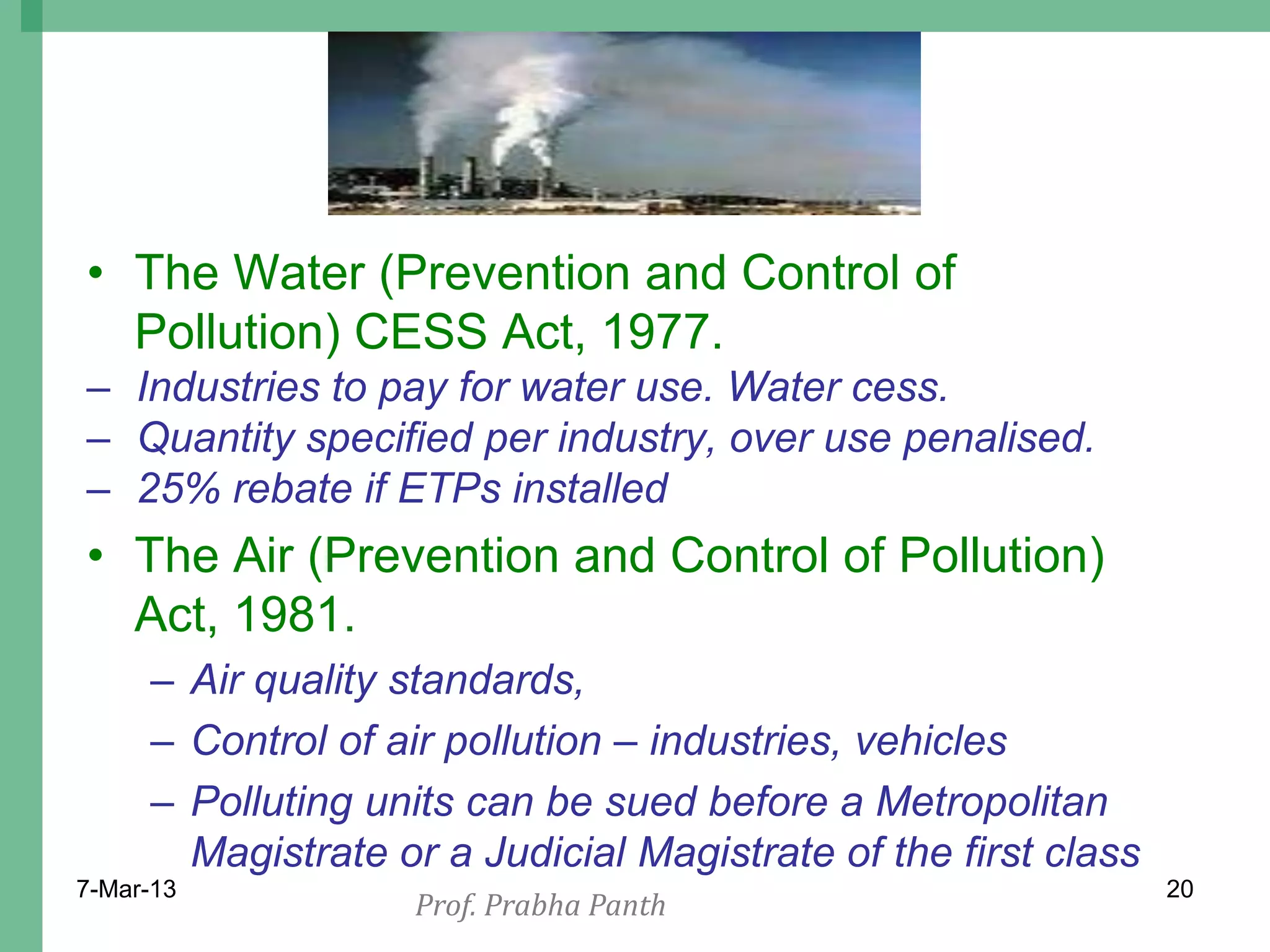
• The Air (Prevention and Control of Pollution)
  Act, 1981.
     – Air quality standards,
     – Control of air pollution – industries, vehicles
     – Polluting units can be sued before a Metropolitan
       Magistrate or a Judicial Magistrate of the first class
7-Mar-13                                                        20
                   Prof. Prabha Panth
• The Environment (Protection) Act, 1986
     – Umbrella legislation,
     – Industrial location, handling of hazardous material.
     – 5 years imprisonment, and 5 lakh Rs fine, and if not
       compliant, Rs.5000 for each day on non-compliance
• National Environmental Policy 2006:
    Conservation of critical natural resources,
    Livelihood Security for the Poor.
    Integration of Environmental Concerns in Economic
     and Social Development,
    Efficiency in Environmental Resource Use,
    Environmental Governance.

7-Mar-13            Prof. Prabha Panth                        21
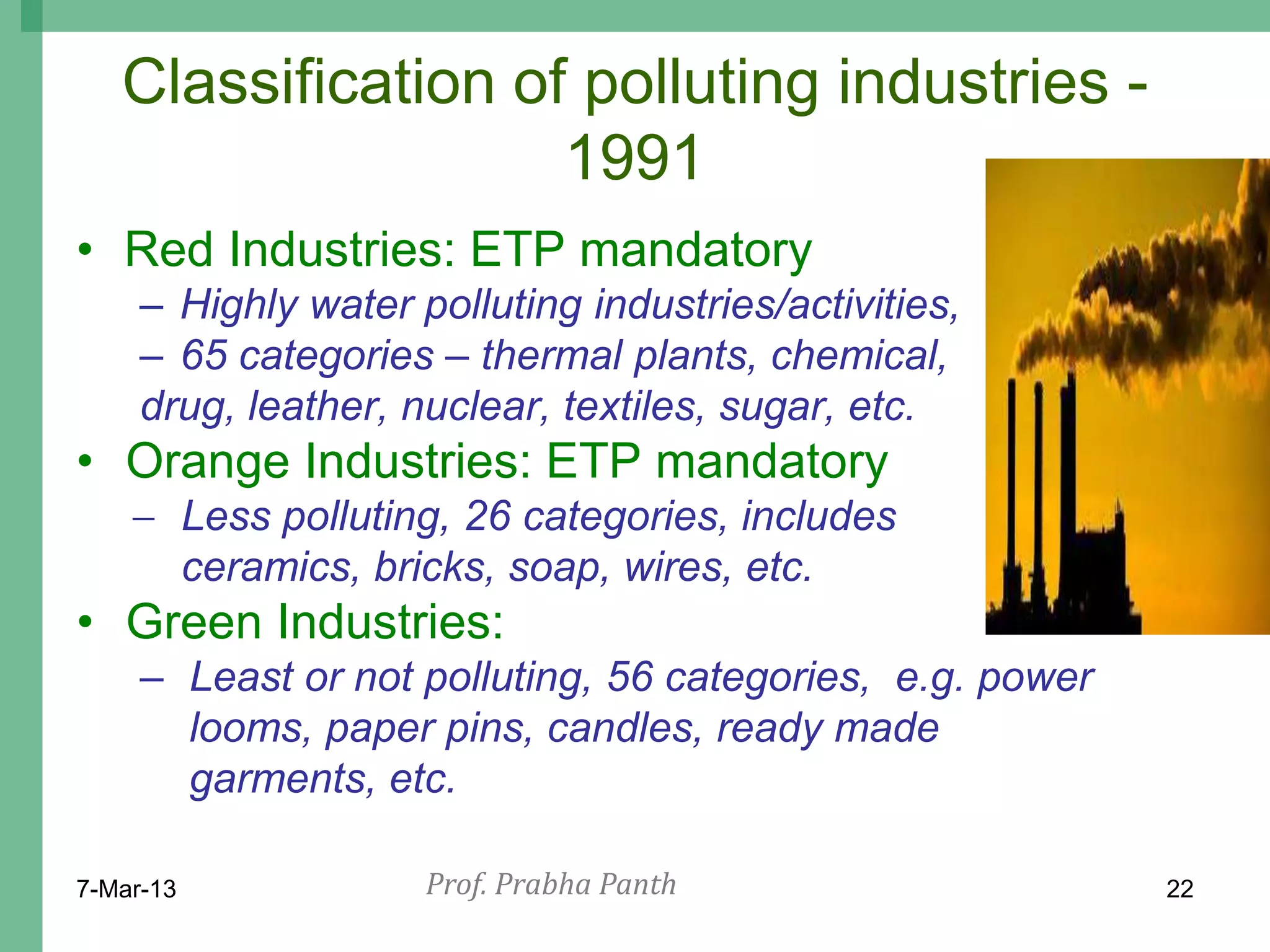
Classification of polluting industries -
                    1991
• Red Industries: ETP mandatory
     – Highly water polluting industries/activities,
     – 65 categories – thermal plants, chemical,
     drug, leather, nuclear, textiles, sugar, etc.
• Orange Industries: ETP mandatory
     Less polluting, 26 categories, includes
      ceramics, bricks, soap, wires, etc.
• Green Industries:
     – Least or not polluting, 56 categories, e.g. power
       looms, paper pins, candles, ready made
       garments, etc.

7-Mar-13             Prof. Prabha Panth                    22
Environmental regulation in India
1. Consent for operation and establishment
   (green licence)
o Annual data to be submitted to State
      PCB, which will inspect and check if information
      is correct.
o If non-compliance is detected, can close down
      the unit, or cut off power and water,
o Or ask company to pay compensation to
      victims, until it is compliant.
o If not satisfied, consent may not be given.
o
7-Mar-13             Prof. Prabha Panth              23
2. Environmental Impact Assessment
   – Statutory for 29 different activities:
   – Industry, mining, irrigation, power plants, ports
     and harbours, atomic power plants, railways
     and road highways, bridges, airport and
     communications.
   – EIS to be submitted to Central Government.
   – Includes 1) Alternatives, 2) Scope, 3)
     Screening, 4) Public hearing, 5) Reporting
     6) follow up.
• Projects may be denied if they cause large
  environmental and social damages.
7-Mar-13        Prof. Prabha Panth                  24
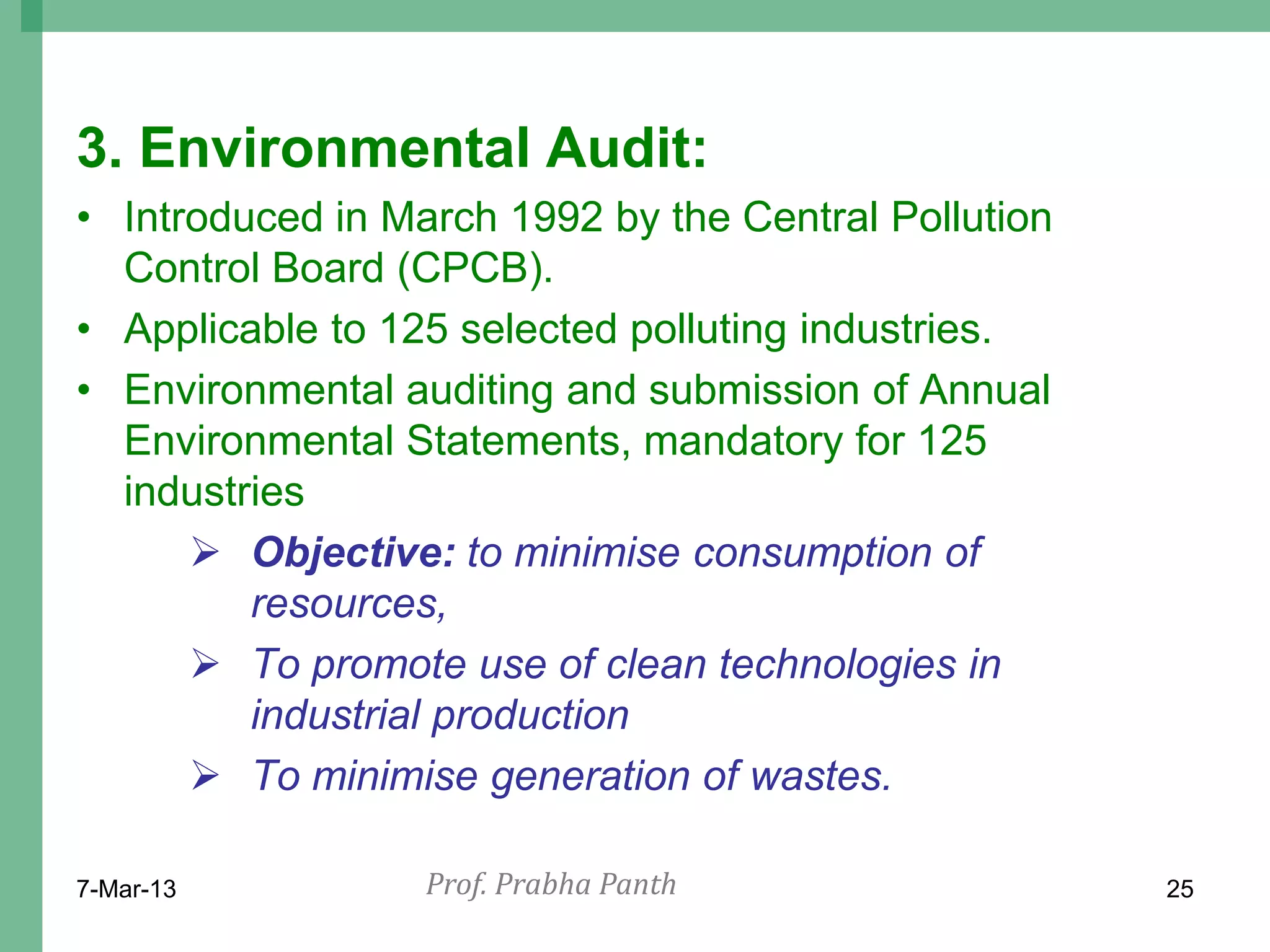
3. Environmental Audit:
• Introduced in March 1992 by the Central Pollution
  Control Board (CPCB).
• Applicable to 125 selected polluting industries.
• Environmental auditing and submission of Annual
  Environmental Statements, mandatory for 125
  industries
       Objective: to minimise consumption of
         resources,
       To promote use of clean technologies in
         industrial production
       To minimise generation of wastes.

7-Mar-13          Prof. Prabha Panth                  25
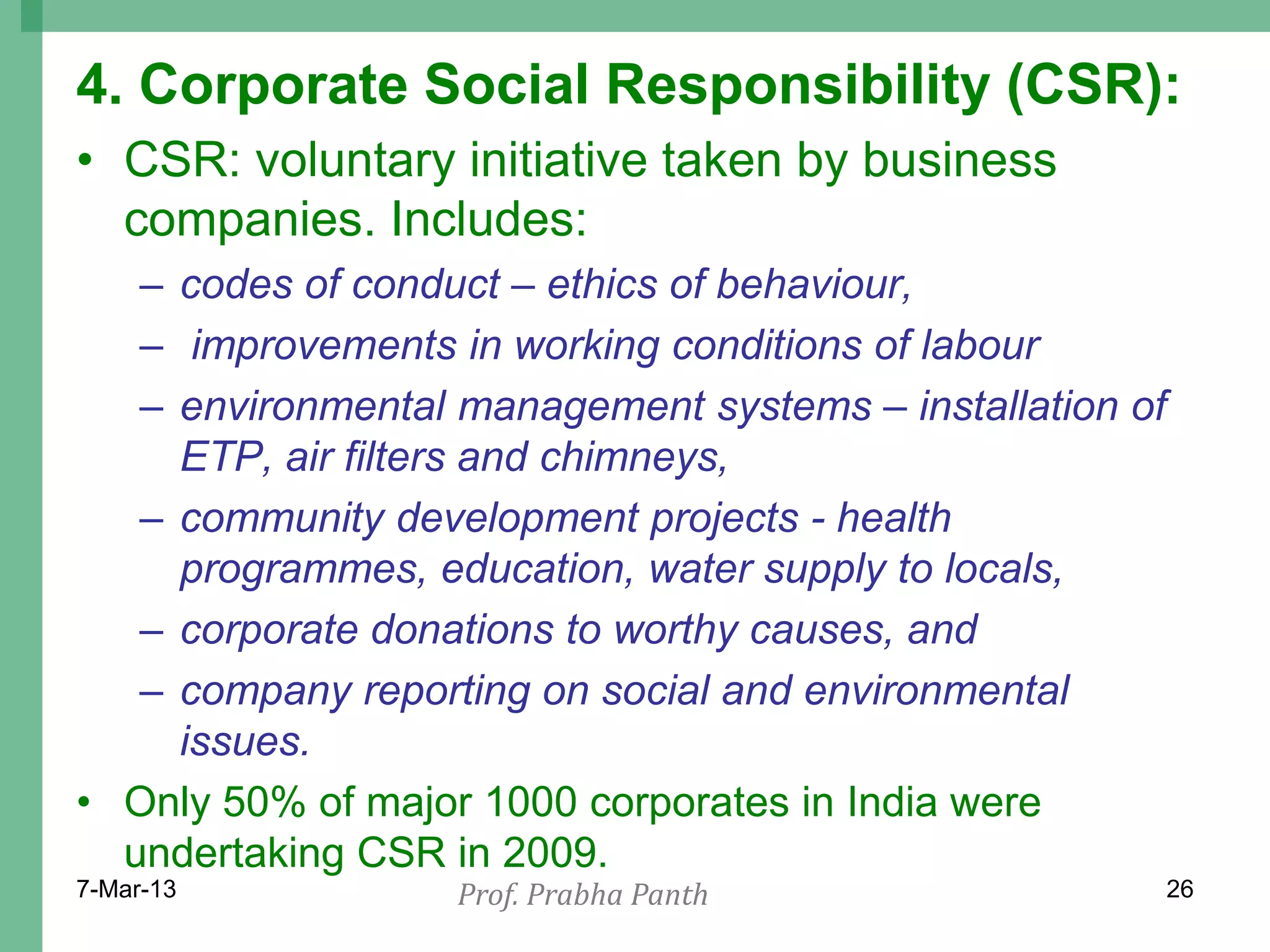
4. Corporate Social Responsibility (CSR):
• CSR: voluntary initiative taken by business
  companies. Includes:
   – codes of conduct – ethics of behaviour,
   – improvements in working conditions of labour
   – environmental management systems – installation of
     ETP, air filters and chimneys,
   – community development projects - health
     programmes, education, water supply to locals,
   – corporate donations to worthy causes, and
   – company reporting on social and environmental
     issues.
• Only 50% of major 1000 corporates in India were
  undertaking CSR in 2009.
7-Mar-13           Prof. Prabha Panth                     26
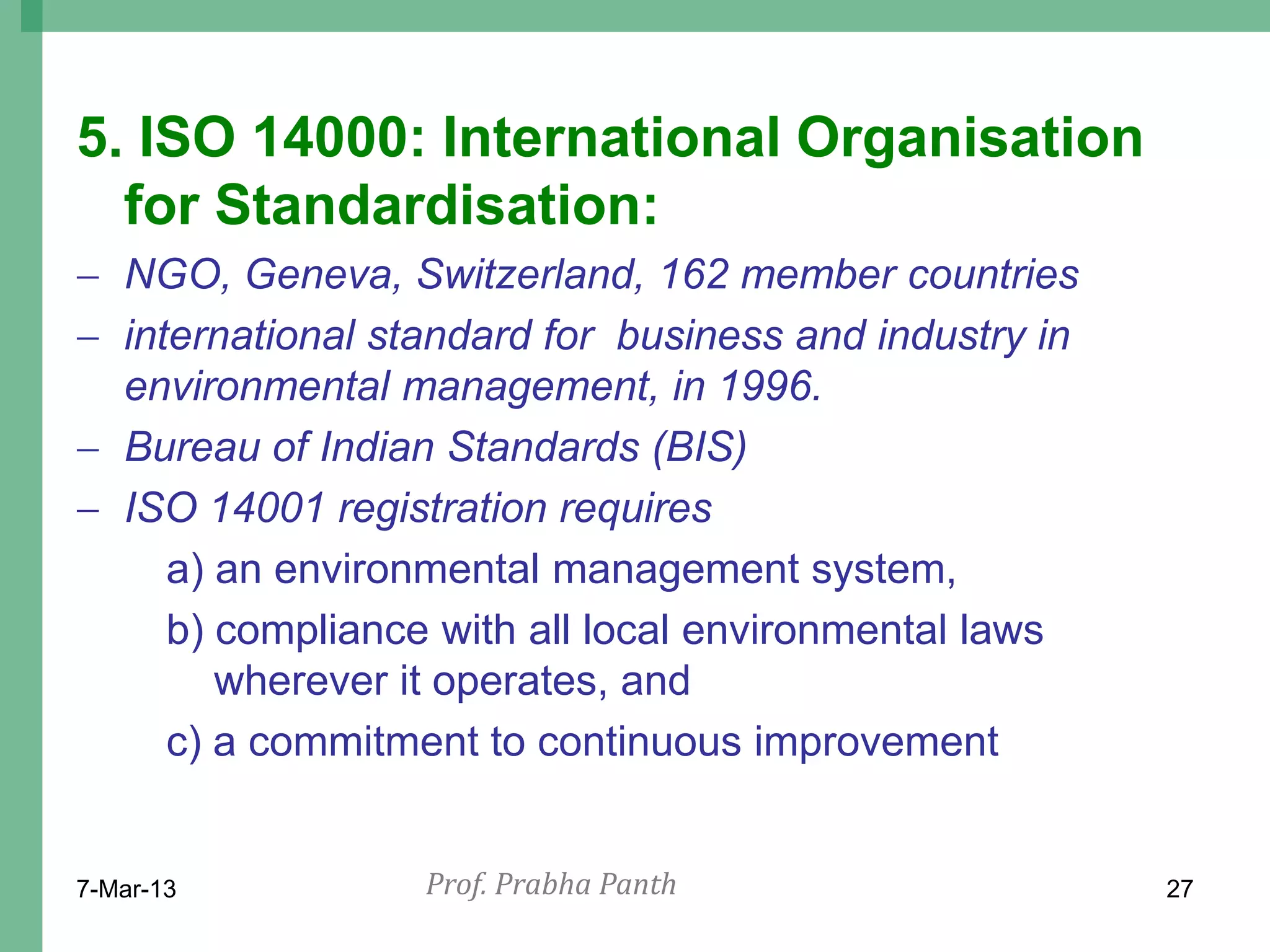
5. ISO 14000: International Organisation
  for Standardisation:
 NGO, Geneva, Switzerland, 162 member countries
 international standard for business and industry in
  environmental management, in 1996.
 Bureau of Indian Standards (BIS)
 ISO 14001 registration requires
     a) an environmental management system,
     b) compliance with all local environmental laws
        wherever it operates, and
     c) a commitment to continuous improvement


7-Mar-13          Prof. Prabha Panth                    27
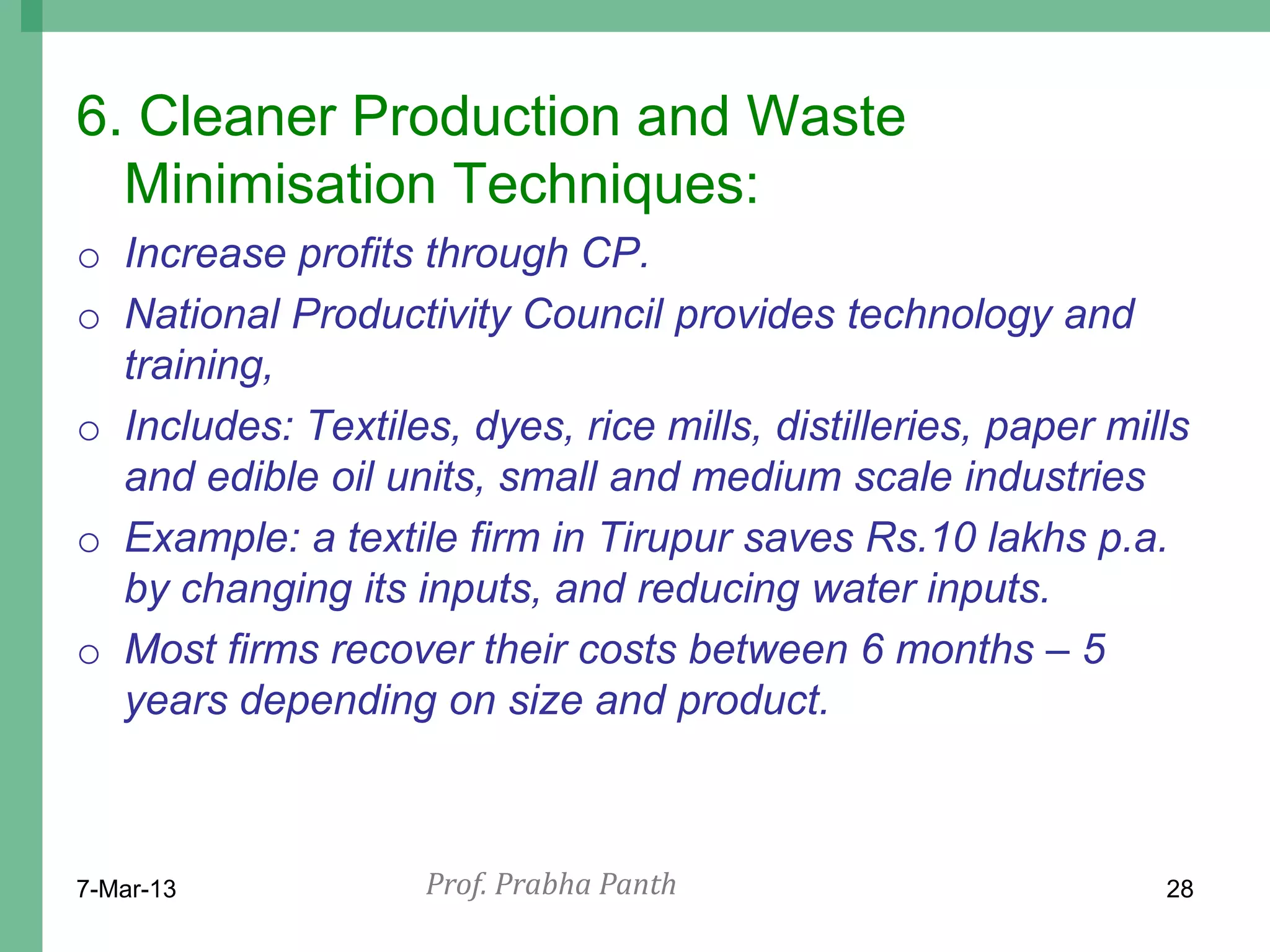
6. Cleaner Production and Waste
  Minimisation Techniques:
o Increase profits through CP.
o National Productivity Council provides technology and
  training,
o Includes: Textiles, dyes, rice mills, distilleries, paper mills
  and edible oil units, small and medium scale industries
o Example: a textile firm in Tirupur saves Rs.10 lakhs p.a.
  by changing its inputs, and reducing water inputs.
o Most firms recover their costs between 6 months – 5
  years depending on size and product.


7-Mar-13            Prof. Prabha Panth                         28
Economics of environmental
           protection by Industrial firms
• For most firms, cost of compliance < cost of
  penalties of non-compliance.
• Closure – loss of profits.
• Power and water cuts: fall in production, and
  loss of profits.
• Compensation to victims, adds to cost.
• International pressure on environmental safety
  and pollution control. Affects exports.
• Prevention is better than cure.
7-Mar-13          Prof. Prabha Panth               29
7-Mar-13   Prof. Prabha Panth   30

Unit 7 environmental management 1

  • 1.
    Unit 7 Emerging Environmental Challenges 7-Mar-13 Prof. Prabha Panth 1
  • 2.
    Market Failure • ThePerfect Competition market is assumed to be the Best Market. • But it fails to maximise Benefits in the allocation of Environmental Goods and Services. • Market failure occurs when private decisions based on market prices, do not generate an efficient allocation of resources to society. • Leads to social and environmental problems – cannot be tackled by market forces 7-Mar-13 Prof. Prabha Panth 2
  • 3.
    Characteristics of Environmental Goods and Services 1. Free Goods: All environmental goods and services provided freely by nature. No ownership, so there is no price for use or misuse. Common property resources. 2. Pure Public Goods: * Non-excludable: One person cannot stop another from using it. E.g. oxygen, oceans * Non-rival: One person‟s use of the environment does not reduce the amount available for others. E.g. oxygen, oceans 3 7-Mar-13 Prof. Prabha Panth
  • 4.
    3. Externality: Externality orExternal Costs and Benefits: when one unit‟s action affects another outside the market price. Marginal Environmental Cost or Benefit  Private Cost or Benefit. o A firm‟s MC does not show the Environmental costs – e.g. cost of thermal electricity does not include cost of global warming. o Cost of paper does not include the costs of deforestation. o Cost of a car does not include the cost of vehicular pollution. 7-Mar-13 Prof. Prabha Panth 4
  • 5.
    Ten top environmentalissues 1. Climate Change 6. Air Pollution 2. Energy 7. Waste Management 3. Water 8. Ozone Layer 4. Biodiversity and Depletion Land Use 9. Oceans and 5. Chemicals, Toxics, Fisheries and Heavy Metals 10.Deforestation 7-Mar-13 Prof. Prabha Panth 5
  • 6.
    Environmental Impacts of Industries • Industrial development requires huge amounts of natural resources inputs. • Creates huge amounts of pollution, • Result: – Loss of forests, coastal areas, erosion, – Mining which affects soil, water and air, – Industrial emissions affect air quality, – Effluents affect water resources, agriculture – Medical and solid wastes, – Products themselves – environmentally harmful 7-Mar-13 Prof. Prabha Panth 6
  • 7.
    Environment Impacts andBusiness • Business cannot ignore environmentalism – Consumer awareness, Green consumerism, Good will through „greening‟ business. – Reaction by public affected by pollution and resource degradation, – Regulations and penalties – Ecological conservation programmes, – International controls – Environmental summits, Kyoto Protocol, Montreal Protocol, etc. – Cost effectiveness in “prevention” rather than “cure” – Greater efficiency though saving energy, and recycling 7-Mar-13 Prof. Prabha Panth 7
  • 8.
    Air Pollution • Chiefsources: Industries, vehicles (in cities), burning wastes, natural causes. • Main Air Pollution problems: – Globally - Acid rain. Climate change and global warming, ozone layer depletion. – Locally – CO and SPM, photo chemical smog, smoke, dust, Impacts of local pollution: respiratory systems, eyes, lead poisoning, Children and older population more vulnerable. 7-Mar-13 Prof. Prabha Panth 8
  • 9.
    Acid Rain Sulphuric Acid Oil Refineries Plants 3% 2% Others 1% Steel 5% Thermal Power Plants Usually it is SO2 that reacts with moisture in 89% the air, and causes Acid Rain Destroys vegetation, buildings, and respiratory systems of living creatures 7-Mar-13 Prof. Prabha Panth 9
  • 10.
    • CFCs releasedby coolants in ACs, refrigerators, fire fighting equipment. • Chemical reaction with ozone in upper stratosphere, depletes the ozone layer, • Ultraviolet rays enter the earth. – Can cause skin cancers, cataracts, – Affects plant growth, – Phytoplankton growth affected (6-8% decrease). – Biochemical cycles affected. 7-Mar-13 Prof. Prabha Panth 10
  • 11.
    Climate Change • Globalwarming, and climate change, • Affects: agriculture, forests, • Melting of snow and ice, • Rise in sea levels, • Inundation of coasts and small islands, • Spread of tropical diseases. 7-Mar-13 Prof. Prabha Panth 11
  • 12.
    Greenhouse Gases Greenhouse gasesinclude: • Carbon dioxide: through burning fossil fuels. • Methane: agriculture, dairying, • CFCs: cooling agents in fire fighting equipment, air conditioners, refrigerators, • Nitrous oxides: industrial smoke and vehicular pollution. • Deforestation and Land use change: CO2 not converted to oxygen 7-Mar-13 Prof. Prabha Panth 12
  • 13.
    7-Mar-13 Prof. Prabha Panth 13
  • 14.
    Share of CO2from various sources - India (2008-09) Wastes 3.60% Electricity Fugitive 3.90% 24.60% Other fuels 9.00% Industry 13.8% Land use change 18.20% Transport 13.50% Agriculture 13.50% 7-Mar-13 Prof. Prabha Panth 14
  • 15.
    7518, Top six contributors - CO2 emissions 2008-09 8000 23% 6529, 7000 18.1% Top 6 are contributing 6000 more than 69% of world’s CO2 million tonnes 5000 4177, 14% 4000 3000 1609, 1539. 2000 5.3% 5.1% 1163, 4% 1000 0 China USA European Russia India Japan union 7-Mar-13 Prof. Prabha Panth 15
  • 16.
    Water Pollution • Point source: from a specific point – such as sewage, oil spills, industrial effluents from stationary sources such as factories, etc. • Non-point sources: carried over to different points from the main source: – Effluents from industries – agricultural chemicals from farmland, – nutrients and toxic materials from urban and suburban areas, – Oil spills This runoff finds its way into water bodies, and pollutes them 7-Mar-13 Prof. Prabha Panth 16
  • 17.
    Environmental Regulations inIndia • Indian Constitution: The right to clean and pollution free environment, is a Fundamental Right. • Directive Principles of State: “The State shall endeavour to protect and improve the environment and to safeguard the forests and wildlife of the country. (Article 48A). • Duty of citizens to protect and improve the natural environment including forests, lakes, rivers and wild life, and to have compassion for living creatures. (Article 51 A (g)) 7-Mar-13 Prof. Prabha Panth 17
  • 18.
    Nodal Government Ministries Ministry of Environment and Forests Ministry of New Ministry of Ministry of Earth and Renewable Water sciences CPCB Energy Resources resources SPCB 7-Mar-13 Prof. Prabha Panth 18
  • 19.
    Environmental Laws inIndia • The Water (Prevention and Control of Pollution) Act, 1974. – Prevention and control of water pollution, – Mandatory Green Clearance, – CPCB and SPCBs were set up – – Provision to inspect and penalise polluting industries. – Take samples of effluent for analysis, – Can close down non-compliant factories, and cut off water and power supply. – Provides for criminal liabilities 7-Mar-13 Prof. Prabha Panth 19
  • 20.
    • The Water(Prevention and Control of Pollution) CESS Act, 1977. – Industries to pay for water use. Water cess. – Quantity specified per industry, over use penalised. – 25% rebate if ETPs installed • The Air (Prevention and Control of Pollution) Act, 1981. – Air quality standards, – Control of air pollution – industries, vehicles – Polluting units can be sued before a Metropolitan Magistrate or a Judicial Magistrate of the first class 7-Mar-13 20 Prof. Prabha Panth
  • 21.
    • The Environment(Protection) Act, 1986 – Umbrella legislation, – Industrial location, handling of hazardous material. – 5 years imprisonment, and 5 lakh Rs fine, and if not compliant, Rs.5000 for each day on non-compliance • National Environmental Policy 2006:  Conservation of critical natural resources,  Livelihood Security for the Poor.  Integration of Environmental Concerns in Economic and Social Development,  Efficiency in Environmental Resource Use,  Environmental Governance. 7-Mar-13 Prof. Prabha Panth 21
  • 22.
    Classification of pollutingindustries - 1991 • Red Industries: ETP mandatory – Highly water polluting industries/activities, – 65 categories – thermal plants, chemical, drug, leather, nuclear, textiles, sugar, etc. • Orange Industries: ETP mandatory  Less polluting, 26 categories, includes ceramics, bricks, soap, wires, etc. • Green Industries: – Least or not polluting, 56 categories, e.g. power looms, paper pins, candles, ready made garments, etc. 7-Mar-13 Prof. Prabha Panth 22
  • 23.
    Environmental regulation inIndia 1. Consent for operation and establishment (green licence) o Annual data to be submitted to State PCB, which will inspect and check if information is correct. o If non-compliance is detected, can close down the unit, or cut off power and water, o Or ask company to pay compensation to victims, until it is compliant. o If not satisfied, consent may not be given. o 7-Mar-13 Prof. Prabha Panth 23
  • 24.
    2. Environmental ImpactAssessment – Statutory for 29 different activities: – Industry, mining, irrigation, power plants, ports and harbours, atomic power plants, railways and road highways, bridges, airport and communications. – EIS to be submitted to Central Government. – Includes 1) Alternatives, 2) Scope, 3) Screening, 4) Public hearing, 5) Reporting 6) follow up. • Projects may be denied if they cause large environmental and social damages. 7-Mar-13 Prof. Prabha Panth 24
  • 25.
    3. Environmental Audit: •Introduced in March 1992 by the Central Pollution Control Board (CPCB). • Applicable to 125 selected polluting industries. • Environmental auditing and submission of Annual Environmental Statements, mandatory for 125 industries  Objective: to minimise consumption of resources,  To promote use of clean technologies in industrial production  To minimise generation of wastes. 7-Mar-13 Prof. Prabha Panth 25
  • 26.
    4. Corporate SocialResponsibility (CSR): • CSR: voluntary initiative taken by business companies. Includes: – codes of conduct – ethics of behaviour, – improvements in working conditions of labour – environmental management systems – installation of ETP, air filters and chimneys, – community development projects - health programmes, education, water supply to locals, – corporate donations to worthy causes, and – company reporting on social and environmental issues. • Only 50% of major 1000 corporates in India were undertaking CSR in 2009. 7-Mar-13 Prof. Prabha Panth 26
  • 27.
    5. ISO 14000:International Organisation for Standardisation:  NGO, Geneva, Switzerland, 162 member countries  international standard for business and industry in environmental management, in 1996.  Bureau of Indian Standards (BIS)  ISO 14001 registration requires a) an environmental management system, b) compliance with all local environmental laws wherever it operates, and c) a commitment to continuous improvement 7-Mar-13 Prof. Prabha Panth 27
  • 28.
    6. Cleaner Productionand Waste Minimisation Techniques: o Increase profits through CP. o National Productivity Council provides technology and training, o Includes: Textiles, dyes, rice mills, distilleries, paper mills and edible oil units, small and medium scale industries o Example: a textile firm in Tirupur saves Rs.10 lakhs p.a. by changing its inputs, and reducing water inputs. o Most firms recover their costs between 6 months – 5 years depending on size and product. 7-Mar-13 Prof. Prabha Panth 28
  • 29.
    Economics of environmental protection by Industrial firms • For most firms, cost of compliance < cost of penalties of non-compliance. • Closure – loss of profits. • Power and water cuts: fall in production, and loss of profits. • Compensation to victims, adds to cost. • International pressure on environmental safety and pollution control. Affects exports. • Prevention is better than cure. 7-Mar-13 Prof. Prabha Panth 29
  • 30.
    7-Mar-13 Prof. Prabha Panth 30