DYNAMIC PRICING
Tom Bacon
Airline Strategist
April, 2015
Lessons from Airline Revenue Management
DYNAMIC PRICING
 “Dynamic pricing” is practiced across the globe in a
variety of industries
 Personalized pricing strategies based on sophisticated analytics and Big Data
 Reduced “consumer surplus” as every individual customer pays close to his
personal value
 Facilitated by the internet and e-tailing
 Pioneered by airlines in the ‘80’s in the form of
Revenue Management
 A multitude of rapidly changing fares exploiting elasticities of different segments
 Airlines continue to perfect the craft. Key features are:
 Creative Market Segmentation
 Big Data Analytics
 Competitive Positioning
 Unbundling and Rebundling
 Merchandising Sell-up
Y S O
CREATIVE MARKET SEGMENTATION
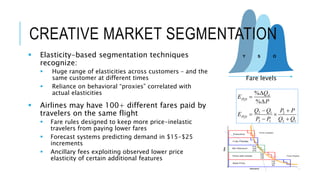
 Elasticity-based segmentation techniques
recognize:
 Huge range of elasticities across customers – and the
same customer at different times
 Reliance on behavioral “proxies” correlated with
actual elasticities
 Airlines may have 100+ different fares paid by
travelers on the same flight
 Fare rules designed to keep more price-inelastic
travelers from paying lower fares
 Forecast systems predicting demand in $15-$25
increments
 Ancillary fees exploiting observed lower price
elasticity of certain additional features
2 1 2
2 1 2 1
%
%
d
P D
P D
Q
E
P
Q Q P P
E
P P Q Q



 
 
 
Price
Demand
159
129
99
189
159
129
419
349
279
Executive
Fully Flexible
Biz Discount
Price with extras
Best Price
Price Inelastic
Price Elastic
Fare levels
BIG DATA ANALYTICS
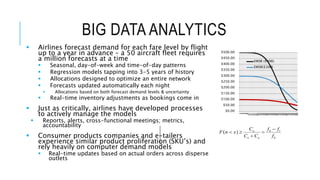
 Airlines forecast demand for each fare level by flight
up to a year in advance – a 50 aircraft fleet requires
a million forecasts at a time
 Seasonal, day-of-week and time-of-day patterns
 Regression models tapping into 3-5 years of history
 Allocations designed to optimize an entire network
 Forecasts updated automatically each night
 Allocations based on both forecast demand levels & uncertainty
 Real-time inventory adjustments as bookings come in
 Just as critically, airlines have developed processes
to actively manage the models
 Reports, alerts, cross-functional meetings; metrics,
accountability
 Consumer products companies and e-tailers
experience similar product proliferation (SKU’s) and
rely heavily on computer demand models
 Real-time updates based on actual orders across disperse
outlets
$0.00
$50.00
$100.00
$150.00
$200.00
$250.00
$300.00
$350.00
$400.00
$450.00
$500.00
123456789101112131415161718192021222324252627282930313233343536373839404142434445464748495051525354555657585960
EMSR ($400)
EMSR($300)
( ) u h l
o u h
C f f
F n x
C C f

  

COMPETITIVE POSITIONING
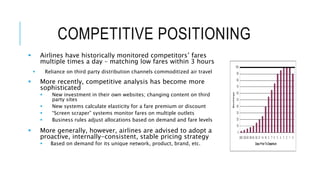
 Airlines have historically monitored competitors’ fares
multiple times a day – matching low fares within 3 hours
 Reliance on third party distribution channels commoditized air travel
 More recently, competitive analysis has become more
sophisticated
 New investment in their own websites; changing content on third
party sites
 New systems calculate elasticity for a fare premium or discount
 “Screen scraper” systems monitor fares on multiple outlets
 Business rules adjust allocations based on demand and fare levels
 More generally, however, airlines are advised to adopt a
proactive, internally-consistent, stable pricing strategy
 Based on demand for its unique network, product, brand, etc.
UNBUNDLING AND
REBUNDLING
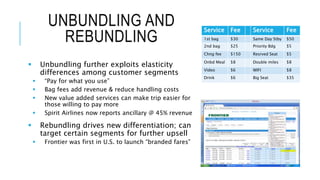
 Unbundling further exploits elasticity
differences among customer segments
 “Pay for what you use”
 Bag fees add revenue & reduce handling costs
 New value added services can make trip easier for
those willing to pay more
 Spirit Airlines now reports ancillary @ 45% revenue
 Rebundling drives new differentiation; can
target certain segments for further upsell
 Frontier was first in U.S. to launch “branded fares”
Service Fee Service Fee
1st bag $30 Same Day Stby $50
2nd bag $25 Priority Bdg $5
Chng fee $150 Resrved Seat $5
Onbd Meal $8 Double miles $8
Video $6 WIFI $8
Drink $6 Big Seat $35
MERCHANDISING SELL-UP
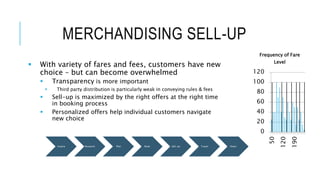
 With variety of fares and fees, customers have new
choice – but can become overwhelmed
 Transparency is more important
 Third party distribution is particularly weak in conveying rules & fees
 Sell-up is maximized by the right offers at the right time
in booking process
 Personalized offers help individual customers navigate
new choice
0
20
40
60
80
100
120
50
120
190
Frequency of Fare
Level
Inspire Research Plan Book Sell-up Travel Share
CULTURE
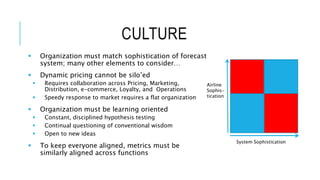
 Organization must match sophistication of forecast
system; many other elements to consider…
 Dynamic pricing cannot be silo’ed
 Requires collaboration across Pricing, Marketing,
Distribution, e-commerce, Loyalty, and Operations
 Speedy response to market requires a flat organization
 Organization must be learning oriented
 Constant, disciplined hypothesis testing
 Continual questioning of conventional wisdom
 Open to new ideas
 To keep everyone aligned, metrics must be
similarly aligned across functions
System Sophistication
Airline
Sophis-
tication
DO YOU PRICE DYNAMICALLY?
 How granularly do you segment demand?
 Do you understand the elasticity of different segments?
 Do you adjust prices based on forecast demand by market segment?
 Do you update the forecast algorithms frequently based on the latest data?
 Do you factor in forecast accuracy in decision making? What is the relative cost of over- vs.
under-forecasting?
 Do you distinguish between “actual” underlying demand and “observed” demand based on
supply, merchandising, and pricing decisions?
 Do you regularly test for higher fare demand?
 Do you know your competitors’ pricing?
 Can you predict their response to your pricing actions?
 Can you charge separately for different features/services?
 Can you personalize offers?
 Do you integrate Pricing with the rest of the organization? How linked are
pricing and merchandising?
 Do you have a culture that supports Big Data Analytics?
DO YOU PRICE DYNAMICALLY?
 Tom Bacon has applied Big Data Analytics and Merchandising to
support dynamic pricing at numerous airlines
 He has led RM and commercial initiatives as an executive at 5 carriers
 Restructured carriers in changing markets or facing new competition
 All sectors: global legacy carriers, LCC’s, regionals, and niche carriers
 Global: North America, Asia, Middle East, Europe
 Assessed RM systems & modules; and airline’s success in RM management
 Implemented new RM organizational structure and competitive fare tracking at Gulf airline
 Evaluated competing RM systems in context of an airline merger
 Recommended process changes at European carrier
 Persistent advocate for cross-functional collaboration between RM and other departments
 Quadrupled ancillary revenue at Frontier Airlines
 Launched first branded fares in U.S.
 To implement dynamic pricing in your organization please contact
Tom at tom.bacon@yahoo.com

Dynamic pricing: Lessons from Airline Revenue Management

  • 1.
    DYNAMIC PRICING Tom Bacon AirlineStrategist April, 2015 Lessons from Airline Revenue Management
  • 2.
    DYNAMIC PRICING  “Dynamicpricing” is practiced across the globe in a variety of industries  Personalized pricing strategies based on sophisticated analytics and Big Data  Reduced “consumer surplus” as every individual customer pays close to his personal value  Facilitated by the internet and e-tailing  Pioneered by airlines in the ‘80’s in the form of Revenue Management  A multitude of rapidly changing fares exploiting elasticities of different segments  Airlines continue to perfect the craft. Key features are:  Creative Market Segmentation  Big Data Analytics  Competitive Positioning  Unbundling and Rebundling  Merchandising Sell-up
  • 3.
    Y S O CREATIVEMARKET SEGMENTATION  Elasticity-based segmentation techniques recognize:  Huge range of elasticities across customers – and the same customer at different times  Reliance on behavioral “proxies” correlated with actual elasticities  Airlines may have 100+ different fares paid by travelers on the same flight  Fare rules designed to keep more price-inelastic travelers from paying lower fares  Forecast systems predicting demand in $15-$25 increments  Ancillary fees exploiting observed lower price elasticity of certain additional features 2 1 2 2 1 2 1 % % d P D P D Q E P Q Q P P E P P Q Q          Price Demand 159 129 99 189 159 129 419 349 279 Executive Fully Flexible Biz Discount Price with extras Best Price Price Inelastic Price Elastic Fare levels
  • 4.
    BIG DATA ANALYTICS Airlines forecast demand for each fare level by flight up to a year in advance – a 50 aircraft fleet requires a million forecasts at a time  Seasonal, day-of-week and time-of-day patterns  Regression models tapping into 3-5 years of history  Allocations designed to optimize an entire network  Forecasts updated automatically each night  Allocations based on both forecast demand levels & uncertainty  Real-time inventory adjustments as bookings come in  Just as critically, airlines have developed processes to actively manage the models  Reports, alerts, cross-functional meetings; metrics, accountability  Consumer products companies and e-tailers experience similar product proliferation (SKU’s) and rely heavily on computer demand models  Real-time updates based on actual orders across disperse outlets $0.00 $50.00 $100.00 $150.00 $200.00 $250.00 $300.00 $350.00 $400.00 $450.00 $500.00 123456789101112131415161718192021222324252627282930313233343536373839404142434445464748495051525354555657585960 EMSR ($400) EMSR($300) ( ) u h l o u h C f f F n x C C f     
  • 5.
    COMPETITIVE POSITIONING  Airlineshave historically monitored competitors’ fares multiple times a day – matching low fares within 3 hours  Reliance on third party distribution channels commoditized air travel  More recently, competitive analysis has become more sophisticated  New investment in their own websites; changing content on third party sites  New systems calculate elasticity for a fare premium or discount  “Screen scraper” systems monitor fares on multiple outlets  Business rules adjust allocations based on demand and fare levels  More generally, however, airlines are advised to adopt a proactive, internally-consistent, stable pricing strategy  Based on demand for its unique network, product, brand, etc.
  • 6.
    UNBUNDLING AND REBUNDLING  Unbundlingfurther exploits elasticity differences among customer segments  “Pay for what you use”  Bag fees add revenue & reduce handling costs  New value added services can make trip easier for those willing to pay more  Spirit Airlines now reports ancillary @ 45% revenue  Rebundling drives new differentiation; can target certain segments for further upsell  Frontier was first in U.S. to launch “branded fares” Service Fee Service Fee 1st bag $30 Same Day Stby $50 2nd bag $25 Priority Bdg $5 Chng fee $150 Resrved Seat $5 Onbd Meal $8 Double miles $8 Video $6 WIFI $8 Drink $6 Big Seat $35
  • 7.
    MERCHANDISING SELL-UP  Withvariety of fares and fees, customers have new choice – but can become overwhelmed  Transparency is more important  Third party distribution is particularly weak in conveying rules & fees  Sell-up is maximized by the right offers at the right time in booking process  Personalized offers help individual customers navigate new choice 0 20 40 60 80 100 120 50 120 190 Frequency of Fare Level Inspire Research Plan Book Sell-up Travel Share
  • 8.
    CULTURE  Organization mustmatch sophistication of forecast system; many other elements to consider…  Dynamic pricing cannot be silo’ed  Requires collaboration across Pricing, Marketing, Distribution, e-commerce, Loyalty, and Operations  Speedy response to market requires a flat organization  Organization must be learning oriented  Constant, disciplined hypothesis testing  Continual questioning of conventional wisdom  Open to new ideas  To keep everyone aligned, metrics must be similarly aligned across functions System Sophistication Airline Sophis- tication
  • 9.
    DO YOU PRICEDYNAMICALLY?  How granularly do you segment demand?  Do you understand the elasticity of different segments?  Do you adjust prices based on forecast demand by market segment?  Do you update the forecast algorithms frequently based on the latest data?  Do you factor in forecast accuracy in decision making? What is the relative cost of over- vs. under-forecasting?  Do you distinguish between “actual” underlying demand and “observed” demand based on supply, merchandising, and pricing decisions?  Do you regularly test for higher fare demand?  Do you know your competitors’ pricing?  Can you predict their response to your pricing actions?  Can you charge separately for different features/services?  Can you personalize offers?  Do you integrate Pricing with the rest of the organization? How linked are pricing and merchandising?  Do you have a culture that supports Big Data Analytics?
  • 10.
    DO YOU PRICEDYNAMICALLY?  Tom Bacon has applied Big Data Analytics and Merchandising to support dynamic pricing at numerous airlines  He has led RM and commercial initiatives as an executive at 5 carriers  Restructured carriers in changing markets or facing new competition  All sectors: global legacy carriers, LCC’s, regionals, and niche carriers  Global: North America, Asia, Middle East, Europe  Assessed RM systems & modules; and airline’s success in RM management  Implemented new RM organizational structure and competitive fare tracking at Gulf airline  Evaluated competing RM systems in context of an airline merger  Recommended process changes at European carrier  Persistent advocate for cross-functional collaboration between RM and other departments  Quadrupled ancillary revenue at Frontier Airlines  Launched first branded fares in U.S.  To implement dynamic pricing in your organization please contact Tom at tom.bacon@yahoo.com