RECENT TRENDS IN
MARKETING
Part 2 UNIT – 8
PART 2 UNIT 8
Importance of data analytics in marketing
Customer relationship marketing
Digital marketing
Sustainable marketing
Rural marketing
Introduction to global marketing
Incoterms and its types
Importance of Data
Analytics in Marketing
Strategies
Data Analytics in Marketing
• Data analytics is an applied branch of statistics
which is concerned with study of data in order
to derive meaningful information for business
decision making
• Data analytics is being widely being used in
studying marketing phenomena
• Companies make marketing decisions based
on data analytics tools
What kind of data is used by data
analytics?
• Data can be related with:
Production [manufacturing] data
Sales data
Advertisement expenditure data
Customers data
Market data regarding demand etc
Why data analytics is important for
marketing?
• Data analytics is important for marketing because:
It is useful for making better marketing decisions
In today’s competitive business world, data
analytics can be used as a tool to make better
marketing strategies
Better marketing strategies can increase the
profitability of the company
In the longer run, data analytics can save cost for
the company
Data analytics can help the company stay ahead
of its competitors
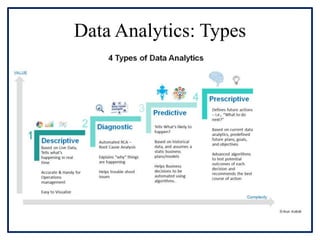
Data Analytics: Types
Data Analytics tools
• Below are some of the popular Data Analytics
tools:
Microsoft Excel
R programming
Python
Customer Relationship
Marketing
[CRM]
Customer Relationship Marketing
• Customer Relationship Marketing a business
functions which focuses on developing a
lasting relationship with customers using
customer’s data and regular feedback
• It is focused on improving the customer
loyalty
Customer Relationship Marketing:
Significance
• Customer Relationship marketing focuses on
the customer’s needs & requirements
• It helps in improving customer loyalty
• It helps in improving profitability
• Satisfied and delighted loyal customers
improve the reputation of the company through
word of mouth publicity
• It emphasizes on long term relations with
customers
Customer Relationship Marketing:
Key Strategies
• Good customer service team that is responsive
to the customers
• Focusing on customer’s needs and interest
• Continuous Communication with customers
• Using social media as a tool for CRM
• Creating an innovative reward program for the
customers
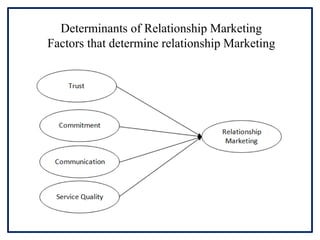
Determinants of Relationship Marketing
Factors that determine relationship Marketing
Digital Marketing
What is Digital Marketing?
• Digital marketing can be simply defined as
Digital Marketing = Internet + Marketing
• Digital marketing can be defined as the use of
information technology in performing
functions of marketing like – advertising,
customer relationship management, sales etc
• Digital marketing has become very popular in
last once decade
Reasons for popularity of Digital
Marketing
• The following reasons can be noted:
Increasing Internet penetration
Improvement in mobile phone technology
[smart phones]
Reduction in internet usage prices
Increase in internet data speed
Development in area of E-Commerce
Types of Digital Marketing
• The following types can be noted:
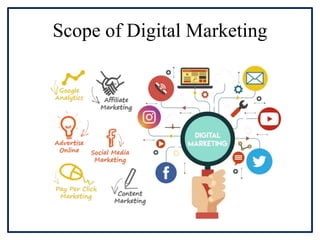
Website marketing [SEO]
Search Engine Marketing [Google Ads]
Mobile Marketing through ‘Apps’
Social Media Marketing through various
platforms [Facebook, Instagram etc]
Video Marketing [YouTube]
Advantages of Digital Marketing
• The following advantages can be noted:
Wider customer reach than traditional
marketing
Relatively low cost
Can be managed easily
Fetches high returns on investment [ROI]
Becoming highly popular among the
consumers
Scope of Digital Marketing
Sustainable Marketing
Sustainable Marketing: Meaning
• Sustainable marketing is also called ‘Green
Marketing’
• Sustainable marketing is the promotion of
environmental and socially responsible
products and marketing practices
• E.g. organic food products are examples of
sustainable marketing
Sustainable Marketing: objectives
To offer products which are better for the
environment
To offer ‘natural’ or ‘green’ products to the
customers for harm-free consumption
Sustainable marketing can be considered as a
branding strategy e.g. OLA’s shared rides
Sustainable marketing has long term
perspective
Sustainable Marketing: Advantages
Safeguards the environment
Reduces wastage
Improves brand image and reputation
Increases the ability of business to comply
with regulations
Long terms benefits in terms of attractive
investors
Sustainable Marketing Practices
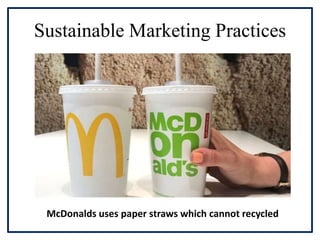
McDonalds uses paper straws which cannot recycled
Sustainable Marketing Practices
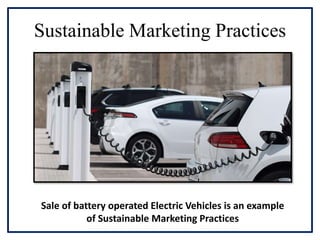
Sale of battery operated Electric Vehicles is an example
of Sustainable Marketing Practices
Rural Marketing
Rural Marketing: Meaning
Rural marketing is a process of
Developing
Pricing
Promoting
Distributing rural specific goods and services
leading to desired exchange
with rural customers to satisfy their needs and
wants, and also to achieve organizational
objectives.
Rural Consumer: Characteristics
Characteristics of rural customers [in
comparison to urban consumers]
Low education level
Low income level
Less brand awareness
Limited product choices
Rigidity in traditions and customs
Rural Marketing: Opportunities
Wide scope of marketing
Large proportion of population lives in rural
areas
Improvement in rural infrastructure
Initiatives by corporate houses such as ITC,
Tata, Reliance etc
Increase in demand due to improvement in
rural income
Rural Marketing: Challenges
Low profitability for companies
Lack of communication facilities
Many products are not demanded in rural areas
Increasing brand awareness for rural
population
Dispersed markets
Rural Marketing: Rural Marts
Setting up of Rural marts by NABARD
[left] and Reliance Foundation [above]
Introduction to
Global Marketing
Global Marketing: Meaning
Global marketing is “marketing on a
worldwide scale”
Global marketing is also a field of study in
general business management that markets
products, solutions and services to customers
internationally and globally
Global Marketing: Meaning
• It includes the whole process of planning,
producing, placing, and promoting a
company’s products in a worldwide market
• Global marketing is particularly important for
products that have universal demand, such as
food and automobiles.
• E.g. I-phone, coca cola etc
Global Marketing: Approaches
• There are three popular strategies:
Ethnocentric – Local values are ignored e.g.
standard products such as Apple Iphone
Polycentric – Local values are considered e.g.
McDonald burger in India is called Aloo Tikki
Burger
Geocentric – Fusion of Ethnocentric and
polycentric e.g. Coca Cola can taste same in
US and UK but different in India
Global Marketing: Entry Strategies
• The popular methods of entry into Global
markets are:
Exporting
Licensing
Franchising
Joint Venture
Foreign Direct Investment [FDI]
Global Marketing: Entry Strategies
Exporting – in this method the product is made
in the home country and exported to foreign
countries e.g. manufactured goods like shoes
Licensing – in this method, license [or permit]
is given to foreign companies to manufacture
products e.g. in case of medicines
Franchising – it is an agreement between the
franchisor and a franchisee for operating
business as per the terms of the franchisor e.g.
McDonalds operates restaurants on this model.
Global Marketing: Entry Strategies
Joint Venture: In this method a company
collaborates with a foreign company to enter
into a joint venture to manufacture goods and
services. E.g. Honda of Japan and Hero motors
of India had a joint venture ‘Hero Honda’
Foreign Direct Investment [FDI] – in this
method, a company starts its business in a
foreign country from the scratch – setting up
factory, hiring people, manufacturing and
selling product etc. It is a costly method.
Incoterms [2020]
[International Commercial Terms]
Incoterms: Meaning
• Incoterms are a set of rules defining the terms
of sale. They are used while transporting goods
from the seller to the buyer.
• Incoterms refer primarily to the UN
Convention on Contracts for the International
Sale of Goods.
• The rules change every 10 years. The list of
Incoterms was last revised in 2020
Incoterms
• Incoterms 2020 are divided into four groups
(C, D, E, F).
• The rules are classified according to the fees,
risk, responsibility for formalities, as well as
issues related to import and export.
• According to the updated list of 2020, there are
11 Incoterms
Incoterms: Objectives
To provide a set of international rules for
foreign trade
To avoid misinterpretation in trade practices
To avoid dispute between the buyer and the
seller in international trade
To make the process of foreign trade smooth
To establish stronger security related standards
List of Incoterms 2020
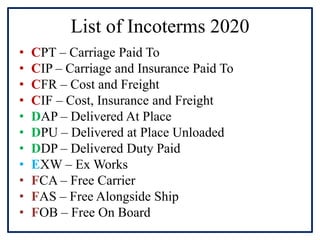
• CPT – Carriage Paid To
• CIP – Carriage and Insurance Paid To
• CFR – Cost and Freight
• CIF – Cost, Insurance and Freight
• DAP – Delivered At Place
• DPU – Delivered at Place Unloaded
• DDP – Delivered Duty Paid
• EXW – Ex Works
• FCA – Free Carrier
• FAS – Free Alongside Ship
• FOB – Free On Board

Unit 8 part_2_recent_trends_in_marketing

  • 1.
  • 2.
    PART 2 UNIT8 Importance of data analytics in marketing Customer relationship marketing Digital marketing Sustainable marketing Rural marketing Introduction to global marketing Incoterms and its types
  • 3.
    Importance of Data Analyticsin Marketing Strategies
  • 4.
    Data Analytics inMarketing • Data analytics is an applied branch of statistics which is concerned with study of data in order to derive meaningful information for business decision making • Data analytics is being widely being used in studying marketing phenomena • Companies make marketing decisions based on data analytics tools
  • 5.
    What kind ofdata is used by data analytics? • Data can be related with: Production [manufacturing] data Sales data Advertisement expenditure data Customers data Market data regarding demand etc
  • 6.
    Why data analyticsis important for marketing? • Data analytics is important for marketing because: It is useful for making better marketing decisions In today’s competitive business world, data analytics can be used as a tool to make better marketing strategies Better marketing strategies can increase the profitability of the company In the longer run, data analytics can save cost for the company Data analytics can help the company stay ahead of its competitors
  • 7.
  • 8.
    Data Analytics tools •Below are some of the popular Data Analytics tools: Microsoft Excel R programming Python
  • 9.
  • 10.
    Customer Relationship Marketing •Customer Relationship Marketing a business functions which focuses on developing a lasting relationship with customers using customer’s data and regular feedback • It is focused on improving the customer loyalty
  • 11.
    Customer Relationship Marketing: Significance •Customer Relationship marketing focuses on the customer’s needs & requirements • It helps in improving customer loyalty • It helps in improving profitability • Satisfied and delighted loyal customers improve the reputation of the company through word of mouth publicity • It emphasizes on long term relations with customers
  • 12.
    Customer Relationship Marketing: KeyStrategies • Good customer service team that is responsive to the customers • Focusing on customer’s needs and interest • Continuous Communication with customers • Using social media as a tool for CRM • Creating an innovative reward program for the customers
  • 13.
    Determinants of RelationshipMarketing Factors that determine relationship Marketing
  • 14.
  • 15.
    What is DigitalMarketing? • Digital marketing can be simply defined as Digital Marketing = Internet + Marketing • Digital marketing can be defined as the use of information technology in performing functions of marketing like – advertising, customer relationship management, sales etc • Digital marketing has become very popular in last once decade
  • 16.
    Reasons for popularityof Digital Marketing • The following reasons can be noted: Increasing Internet penetration Improvement in mobile phone technology [smart phones] Reduction in internet usage prices Increase in internet data speed Development in area of E-Commerce
  • 17.
    Types of DigitalMarketing • The following types can be noted: Website marketing [SEO] Search Engine Marketing [Google Ads] Mobile Marketing through ‘Apps’ Social Media Marketing through various platforms [Facebook, Instagram etc] Video Marketing [YouTube]
  • 18.
    Advantages of DigitalMarketing • The following advantages can be noted: Wider customer reach than traditional marketing Relatively low cost Can be managed easily Fetches high returns on investment [ROI] Becoming highly popular among the consumers
  • 19.
  • 20.
  • 21.
    Sustainable Marketing: Meaning •Sustainable marketing is also called ‘Green Marketing’ • Sustainable marketing is the promotion of environmental and socially responsible products and marketing practices • E.g. organic food products are examples of sustainable marketing
  • 22.
    Sustainable Marketing: objectives Tooffer products which are better for the environment To offer ‘natural’ or ‘green’ products to the customers for harm-free consumption Sustainable marketing can be considered as a branding strategy e.g. OLA’s shared rides Sustainable marketing has long term perspective
  • 23.
    Sustainable Marketing: Advantages Safeguardsthe environment Reduces wastage Improves brand image and reputation Increases the ability of business to comply with regulations Long terms benefits in terms of attractive investors
  • 24.
    Sustainable Marketing Practices McDonaldsuses paper straws which cannot recycled
  • 25.
    Sustainable Marketing Practices Saleof battery operated Electric Vehicles is an example of Sustainable Marketing Practices
  • 26.
  • 27.
    Rural Marketing: Meaning Ruralmarketing is a process of Developing Pricing Promoting Distributing rural specific goods and services leading to desired exchange with rural customers to satisfy their needs and wants, and also to achieve organizational objectives.
  • 28.
    Rural Consumer: Characteristics Characteristicsof rural customers [in comparison to urban consumers] Low education level Low income level Less brand awareness Limited product choices Rigidity in traditions and customs
  • 29.
    Rural Marketing: Opportunities Widescope of marketing Large proportion of population lives in rural areas Improvement in rural infrastructure Initiatives by corporate houses such as ITC, Tata, Reliance etc Increase in demand due to improvement in rural income
  • 30.
    Rural Marketing: Challenges Lowprofitability for companies Lack of communication facilities Many products are not demanded in rural areas Increasing brand awareness for rural population Dispersed markets
  • 31.
    Rural Marketing: RuralMarts Setting up of Rural marts by NABARD [left] and Reliance Foundation [above]
  • 32.
  • 33.
    Global Marketing: Meaning Globalmarketing is “marketing on a worldwide scale” Global marketing is also a field of study in general business management that markets products, solutions and services to customers internationally and globally
  • 34.
    Global Marketing: Meaning •It includes the whole process of planning, producing, placing, and promoting a company’s products in a worldwide market • Global marketing is particularly important for products that have universal demand, such as food and automobiles. • E.g. I-phone, coca cola etc
  • 35.
    Global Marketing: Approaches •There are three popular strategies: Ethnocentric – Local values are ignored e.g. standard products such as Apple Iphone Polycentric – Local values are considered e.g. McDonald burger in India is called Aloo Tikki Burger Geocentric – Fusion of Ethnocentric and polycentric e.g. Coca Cola can taste same in US and UK but different in India
  • 36.
    Global Marketing: EntryStrategies • The popular methods of entry into Global markets are: Exporting Licensing Franchising Joint Venture Foreign Direct Investment [FDI]
  • 37.
    Global Marketing: EntryStrategies Exporting – in this method the product is made in the home country and exported to foreign countries e.g. manufactured goods like shoes Licensing – in this method, license [or permit] is given to foreign companies to manufacture products e.g. in case of medicines Franchising – it is an agreement between the franchisor and a franchisee for operating business as per the terms of the franchisor e.g. McDonalds operates restaurants on this model.
  • 38.
    Global Marketing: EntryStrategies Joint Venture: In this method a company collaborates with a foreign company to enter into a joint venture to manufacture goods and services. E.g. Honda of Japan and Hero motors of India had a joint venture ‘Hero Honda’ Foreign Direct Investment [FDI] – in this method, a company starts its business in a foreign country from the scratch – setting up factory, hiring people, manufacturing and selling product etc. It is a costly method.
  • 39.
  • 40.
    Incoterms: Meaning • Incotermsare a set of rules defining the terms of sale. They are used while transporting goods from the seller to the buyer. • Incoterms refer primarily to the UN Convention on Contracts for the International Sale of Goods. • The rules change every 10 years. The list of Incoterms was last revised in 2020
  • 41.
    Incoterms • Incoterms 2020are divided into four groups (C, D, E, F). • The rules are classified according to the fees, risk, responsibility for formalities, as well as issues related to import and export. • According to the updated list of 2020, there are 11 Incoterms
  • 42.
    Incoterms: Objectives To providea set of international rules for foreign trade To avoid misinterpretation in trade practices To avoid dispute between the buyer and the seller in international trade To make the process of foreign trade smooth To establish stronger security related standards
  • 43.
    List of Incoterms2020 • CPT – Carriage Paid To • CIP – Carriage and Insurance Paid To • CFR – Cost and Freight • CIF – Cost, Insurance and Freight • DAP – Delivered At Place • DPU – Delivered at Place Unloaded • DDP – Delivered Duty Paid • EXW – Ex Works • FCA – Free Carrier • FAS – Free Alongside Ship • FOB – Free On Board