BACKGROUND
Simultaneous-source
Ocean Bottom Nodes acquisition
Common receiver gather
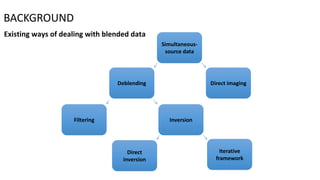
BACKGROUND
Existing ways of dealing with blended data
Simultaneous-
source data
Direct imagingDeblending
Filtering Inversion
Direct
inversion
Iterative
framework
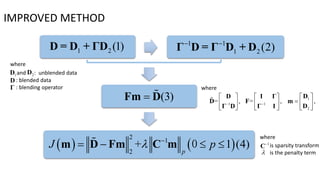
IMPROVED METHOD
1 2 (1)D = D + ΓD 1 1
1 2 (2) 
Γ D = Γ D + D
(3)Fm D 1
1 1
2
= , = , , 
    
     
     
DD I Γ
D F m
DΓ D Γ I
and : unblended data
: blended data
: blending operator
where
where
2D1D
D
Γ
   
2
1
2
+ 1 (4)
p
J p 
   m D Fm C m 0 is sparsity transform
is the penalty term
where
1
C

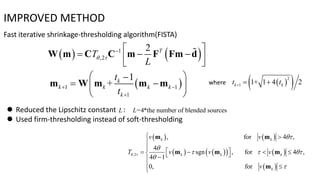
IMPROVED METHOD
   1
,2
2 T
T
L
 
  
    
W m C C m F Fm d
 1 1
1
1
+ k
k k k k
k
t
t
 

 
  
 
m W m m m
Fast iterative shrinkage-thresholding algorithm(FISTA)
   
      
 
,2
, for 4 ,
4
sgn , for 4 ,
4 1
0, for
k k
k k k
k
v v
T v v v
v
 


  


 


      
 

m m
m m m
m
  2
1 1+ 1 4 2k kt t  where
 Reduced the Lipschitz constant :
 Used firm-thresholding instead of soft-thresholding
L =4*the number of blended sourcesL
Simple Numerical Blended Data
EXAMPLES
Fig 1a. Unblended profile Fig 1b. Blended profile
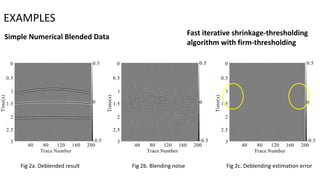
Simple Numerical Blended Data
EXAMPLES
Fast iterative shrinkage-thresholding
algorithm with firm-thresholding
Fig 2a. Deblended result Fig 2b. Blending noise Fig 2c. Deblending estimation error
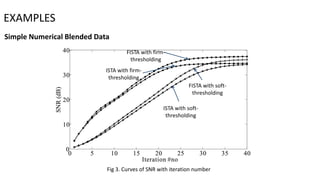
Simple Numerical Blended Data
EXAMPLES
Fig 3. Curves of SNR with iteration number
ISTA with firm-
thresholding
ISTA with soft-
thresholding
FISTA with soft-
thresholding
FISTA with firm-
thresholding
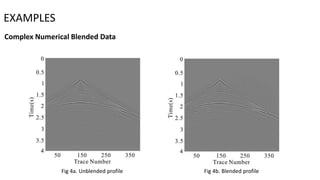
EXAMPLES
Complex Numerical Blended Data
Fig 4a. Unblended profile Fig 4b. Blended profile
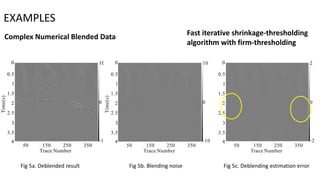
EXAMPLES
Fast iterative shrinkage-thresholding
algorithm with firm-thresholding
Complex Numerical Blended Data
Fig 5a. Deblended result Fig 5b. Blending noise Fig 5c. Deblending estimation error
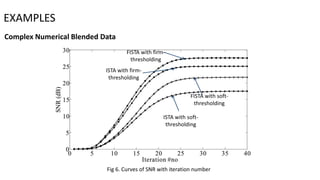
EXAMPLES
ISTA with firm-
thresholding
ISTA with soft-
thresholding
FISTA with soft-
thresholding
FISTA with firm-
thresholding
Complex Numerical Blended Data
Fig 6. Curves of SNR with iteration number
EXAMPLES
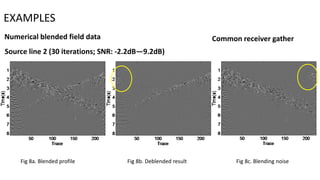
Numerical blended field data Common receiver gather
Fig 7a. Blended profile Fig 7b. Deblended result Fig 7c. Blending noise
Source line 1 (30 iterations; SNR: 2.2dB—11.6dB)
Common receiver gather
EXAMPLES
Numerical blended field data
Fig 8a. Blended profile Fig 8b. Deblended result Fig 8c. Blending noise
Source line 2 (30 iterations; SNR: -2.2dB—9.2dB)
EXAMPLES
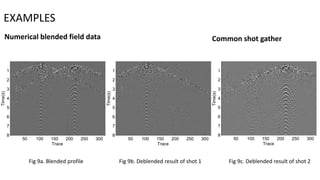
Numerical blended field data
Trace
Time(s)
50 100 150 200 250 300
1
2
3
4
5
6
7
8
Trace
Time(s)
50 100 150 200 250 300
1
2
3
4
5
6
7
8
Trace
Time(s)
50 100 150 200 250 300
1
2
3
4
5
6
7
8
Common shot gather
Fig 9a. Blended profile Fig 9b. Deblended result of shot 1 Fig 9c. Deblended result of shot 2
EXAMPLES
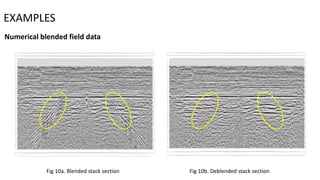
Numerical blended field data
Fig 10a. Blended stack section Fig 10b. Deblended stack section
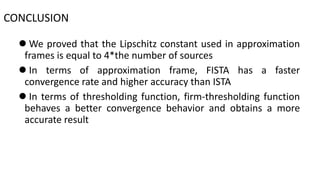
 We proved that the Lipschitz constant used in approximation
frames is equal to 4*the number of sources
 In terms of approximation frame, FISTA has a faster
convergence rate and higher accuracy than ISTA
 In terms of thresholding function, firm-thresholding function
behaves a better convergence behavior and obtains a more
accurate result
CONCLUSION

Deblending

  • 1.
    BACKGROUND Simultaneous-source Ocean Bottom Nodesacquisition Common receiver gather
  • 2.
    BACKGROUND Existing ways ofdealing with blended data Simultaneous- source data Direct imagingDeblending Filtering Inversion Direct inversion Iterative framework
  • 3.
    IMPROVED METHOD 1 2(1)D = D + ΓD 1 1 1 2 (2)  Γ D = Γ D + D (3)Fm D 1 1 1 2 = , = , ,                   DD I Γ D F m DΓ D Γ I and : unblended data : blended data : blending operator where where 2D1D D Γ     2 1 2 + 1 (4) p J p     m D Fm C m 0 is sparsity transform is the penalty term where 1 C 
  • 4.
    IMPROVED METHOD   1 ,2 2 T T L           W m C C m F Fm d  1 1 1 1 + k k k k k k t t           m W m m m Fast iterative shrinkage-thresholding algorithm(FISTA)              ,2 , for 4 , 4 sgn , for 4 , 4 1 0, for k k k k k k v v T v v v v                        m m m m m m   2 1 1+ 1 4 2k kt t  where  Reduced the Lipschitz constant :  Used firm-thresholding instead of soft-thresholding L =4*the number of blended sourcesL
  • 5.
    Simple Numerical BlendedData EXAMPLES Fig 1a. Unblended profile Fig 1b. Blended profile
  • 6.
    Simple Numerical BlendedData EXAMPLES Fast iterative shrinkage-thresholding algorithm with firm-thresholding Fig 2a. Deblended result Fig 2b. Blending noise Fig 2c. Deblending estimation error
  • 7.
    Simple Numerical BlendedData EXAMPLES Fig 3. Curves of SNR with iteration number ISTA with firm- thresholding ISTA with soft- thresholding FISTA with soft- thresholding FISTA with firm- thresholding
  • 8.
    EXAMPLES Complex Numerical BlendedData Fig 4a. Unblended profile Fig 4b. Blended profile
  • 9.
    EXAMPLES Fast iterative shrinkage-thresholding algorithmwith firm-thresholding Complex Numerical Blended Data Fig 5a. Deblended result Fig 5b. Blending noise Fig 5c. Deblending estimation error
  • 10.
    EXAMPLES ISTA with firm- thresholding ISTAwith soft- thresholding FISTA with soft- thresholding FISTA with firm- thresholding Complex Numerical Blended Data Fig 6. Curves of SNR with iteration number
  • 11.
    EXAMPLES Numerical blended fielddata Common receiver gather Fig 7a. Blended profile Fig 7b. Deblended result Fig 7c. Blending noise Source line 1 (30 iterations; SNR: 2.2dB—11.6dB)
  • 12.
    Common receiver gather EXAMPLES Numericalblended field data Fig 8a. Blended profile Fig 8b. Deblended result Fig 8c. Blending noise Source line 2 (30 iterations; SNR: -2.2dB—9.2dB)
  • 13.
    EXAMPLES Numerical blended fielddata Trace Time(s) 50 100 150 200 250 300 1 2 3 4 5 6 7 8 Trace Time(s) 50 100 150 200 250 300 1 2 3 4 5 6 7 8 Trace Time(s) 50 100 150 200 250 300 1 2 3 4 5 6 7 8 Common shot gather Fig 9a. Blended profile Fig 9b. Deblended result of shot 1 Fig 9c. Deblended result of shot 2
  • 14.
    EXAMPLES Numerical blended fielddata Fig 10a. Blended stack section Fig 10b. Deblended stack section
  • 15.
     We provedthat the Lipschitz constant used in approximation frames is equal to 4*the number of sources  In terms of approximation frame, FISTA has a faster convergence rate and higher accuracy than ISTA  In terms of thresholding function, firm-thresholding function behaves a better convergence behavior and obtains a more accurate result CONCLUSION